Tag: Wages & Entitlements

  • Alison Pennington: Budget billions wasted as real wages go backwards

    The federal government’s budget would have us believe that the cost of living is a sudden problem because of higher oil prices.

    But the real reason people are feeling the pinch is because their real wages are going backwards.

    The budget forecasts wage growth of 2.75 per cent in 2021-22, below inflation which is forecast to grow by 4.25 per cent. That’s a real wage cut of 1.5 per cent.

    The budget will increase the low-and-middle-income tax offset, but then scrap it at the end of this financial year. The fuel excise will be reduced for six months.

    Complex tax-bracket-shifting schemes are a good way to distract from powerful wage suppression policies. While we’re calculating “how much do I get”, these policies entrench insecure work, cap public sector pay, and stop collective bargaining. These measures hit workers every pay packet, not just at tax time.

    The amount workers get from the tax cuts is nothing compared to normal wage increases. For the 15 years to 2012, private-sector wages grew about 3.5 per cent per year. For someone on $70,000, that’s about $2500 more in one year.

    Distracting the income-strapped

    This budget is about trying to distract the income-strapped with temporary solutions that do nothing to help in the long-run. Alongside time-bound tax cuts are $250 one-off payments to income support recipients – thousands of people who permanently languish below the poverty line.

    The government is also hoping people believe in magical free-market fairies – that lower unemployment will finally unlock wages growth. As though holding a job automatically equips workers with bargaining power.

    The “record funding” fairies were out in full force, too. The Treasurer says “record funding” has been allocated in schools, hospitals, mental health, aged care, women’s safety and disability health. But if you reduce spending to rock-bottom, every marginal increase in spending with population growth can be called “record funding”.

    If it’s not enough funding to meet demand, then it can still be “record funding” for some. Shockingly, public school funding will be cut by $560 million over the next three years. Meanwhile, JobKeeper-subsidy-dripping private schools will get $2.6 billion more over the forward estimates. It’s not a budget without blows.

    Cuts to workers’ pay

    Worse, this budget signals more cuts to workers’ pay. The budget has earmarked reducing legislated minimum redundancy payments for part-time workers. This will disproportionately affect women.

    Women’s chronically low wages and poor job quality receive no attention. Hundreds of thousands of women in underfunded healthcare and social services need government to front up and fund their pay increases. This budget is proof the biggest barrier to Australian women’s progress isn’t glass ceilings, but their own government.

    This government will balls up any opportunity to address structural gender inequality. A new paid parental leave (PPL) scheme will combine the paltry two-week Dad and Partner Pay with the existing 18-week program for a combined 20 weeks. Packaged as empowering “family choice”, it will remove any incentive for fathers to take leave.

    PPL payment at minimum wage will continue to push women into primary caring roles. This is because men earn almost one-third more than women on average. That’s not women’s “choice”.

    Governments have wage-booting tools to deal with the higher cost of living. Across the ditch, New Zealand just increased the minimum wage by 6 per cent, recognising its frontline lowest-paid workers have offered the most in the pandemic, and been hit the hardest.

    Genuine cost-of-living help overlooked

    Along with boosting minimum wages, there are other options for helping workers deal with high inflation. The government could lower the cost of living by ending fee-for-service practices in all the areas they fund – child care, aged care, and disability care. Under the current government, out-of-pocket healthcare costs have increased almost three times more than CPI.

    And there’s not much hope for youth in this budget. Presented with a future of declining living standards, political dysfunction and ecological catastrophe, young people are given just $206 million in mental health funding. They can talk to someone on the phone while the world burns.

    The bottom rungs on the economic-opportunity ladder have been eliminated and youth can’t get up. Tens of thousands of educated capable youth languish in dead-end jobs. Sacrificed by a government that would rather turn unemployment into a misery industry than to create secure, career-building jobs.

    Billions of waste

    The government is wasting billions of dollars paying off their friends in business without conditions to invest in higher wages. Before this Budget, $291 billion in public spending was ploughed into a “business-led recovery” from COVID. On businesses responsibility to reinvest post-war record-high profits, there’s an eery silence.

    And in this budget, we have zero assurances new business subsidies will be invested in the real economy – people, capital, research – rather than more profit-padding.

    On budget eve, Morrison attempted to hat-tip a bygone conservative era. He said “families” will be key to winning the upcoming election. But he never invested in them, instead putting them in a pressure cooker of record-low wage growth and high living costs.

    The government was struck by enormous luck this budget. Extra revenue to play with and they’ve thrown it all away. Hundreds of billions in government spending and no era-defining economic reforms.

    Cos-of-living pressures wouldn’t be as acute if people had almost a decade of normal wages growth. But the truth is, the government has pursued wage suppression over the entire nine years it has been in power.

    The post Alison Pennington: Budget billions wasted as real wages go backwards appeared first on The Australia Institute's Centre for Future Work.
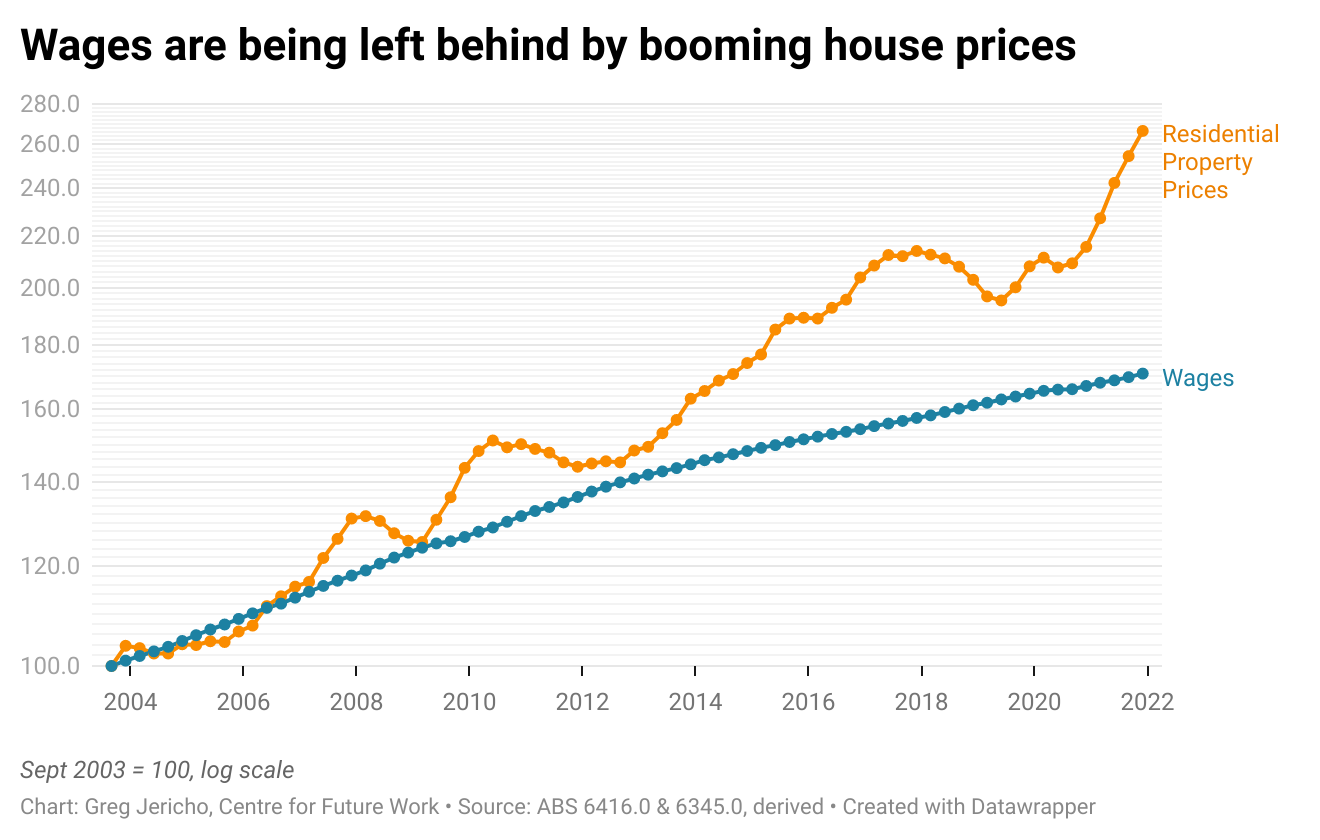
  • Flat wages and booming house prices cause housing affordability to plunge

    A decade ago the medium-priced house in Sydney was equivalent to 5.8 times the annual income of a median household; now it is 10.8 times that income. 

    Greg Jericho examines the issue in his column in Guardian Australia and drills down to look at the affordability of housing across the nation and finds a shocking, yet unsurprising tale – and one that deserves a much greater focus in the coming election campaign than is currently the case 

    https://www.datawrapper.de/_/GmaeJ/

    The post Flat wages and booming house prices cause housing affordability to plunge appeared first on The Australia Institute's Centre for Future Work.

  • Loss of Bargaining Power Explains Wage Stagnation

    Our Policy Director Greg Jericho writes in Guardian Australia that claims of a “wages breakout” remain purely a scare campaign from employer groups determined to keep wages low. He finds that once again real wages are failing to keep pace with productivity and that as a result no pressure on inflation is coming from wage claims, but instead workers are missing out. With levels of unemployment now associated with much lower wage growth than in the past, it is clear the power imbalance in wage negotiations has shifted drastically away from workers.

    The post Loss of Bargaining Power Explains Wage Stagnation appeared first on The Australia Institute's Centre for Future Work.

  • Power, Not Just Supply and Demand, Vital to Future Wage Growth

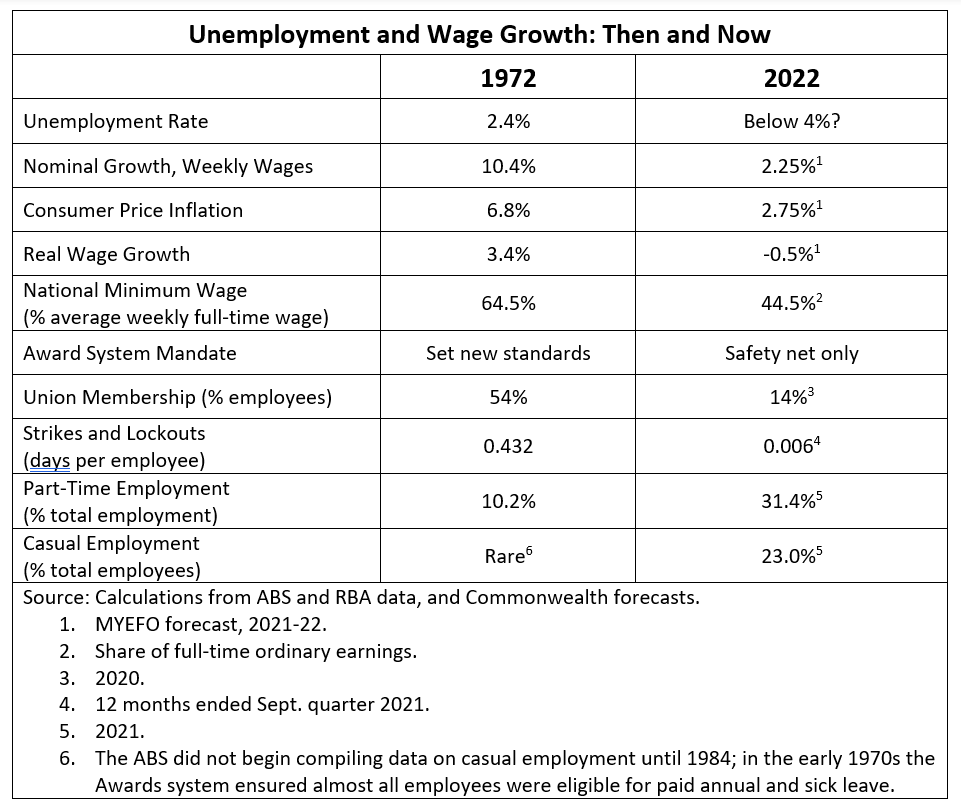
    Will a low unemployment rate be sufficient to solve the crisis in Australian wages? In this article published in The Conversation, Centre for Future Work Director Jim Stanford argues that the historic restructuring of Australia’s labour market institutions over the last half-century (since the last time unemployment was below 4%) will continue to undermine wages, despite apparently tight labour markets.

    This table compares regulatory and institutional parameters today, compared to fifty years ago. Across multiple dimensions (including the minimum wage, the Awards system, unions and collective bargaining, and job security), workers have lost the bargaining power they need to win higher wages. Hence labour costs remain suppressed, and business profits hit records, even as unemployment declines.

    Labour Institutions Then and NowPlease see Jim’s full article, “Why there’s no magic jobless rate to increase Australians’ wages,” at The Conversation.

    The post Power, Not Just Supply and Demand, Vital to Future Wage Growth appeared first on The Australia Institute's Centre for Future Work.

  • Of 3’s, and Other Important Labour Market Numbers

    Prime Minister Scott Morrison set tongues wagging this week with a confident pledge that Australia’s unemployment rate could have “a 3 in front of it” this year. It’s a theme that will loom large in his campaign for reelection later this year.

    In this commentary, Centre for Future Work Director Jim Stanford considers whether a low unemployment rate is an accurate indicator of the state of the labour market — and whether, even if achieved, it would reignite wage growth and solve other problems holding back Australia’s labour market.

    The unemployment rate was 4.2% in December, so Mr Morrison’s prediction may not be as brave as might seem: it would only take a .3-point drop to achieve that magical ‘3’. The official unemployment rate often bounces by more than that (in either direction) in any given month, purely due to measurement errors or shifts in recorded labour force participation. So his prediction will likely come true. But is it the economic triumph that he and his political allies will claim?

    A lower unemployment rate is obviously better than a higher unemployment rate. But the unemployment rate itself has lost much of its value as an indicator of the state of the labour market. There are large pools of unutilised and underutilised labour in our economy that are not captured by the official unemployment measure.

    Equally important, assumptions that a historically low unemployment rate will automatically correct many of the labour market problems that Australia has experienced in recent years are misplaced. Problems like wage stagnation, falling real wages, income inequality and poverty (even among employed people), and the economic exclusion of sectors of society (such as indigenous and immigrant communities, and people with disability) all require more concerted and targeted actions to fix.

    Please see Jim’s full commentary: Of 3’s, and Other Important Labour Market Numbers.

    The post Of 3’s, and Other Important Labour Market Numbers appeared first on The Australia Institute's Centre for Future Work.

  • As collective bargaining erodes in Australia, solutions from other countries could strengthen bargaining and lift wages

    On the heels of new data showing further erosion of Australia’s collective bargaining system, researchers and practitioners from five countries have identified best practices from other countries that could strengthen collective bargaining and lift wages.

    Key findings of the research include:

    • The Ardern government in New Zealand has implemented a new sector-wide bargaining system (called ‘Fair Pay Agreements’) that could be a model for similar changes in Australia. It would enhance workers’ ability to win more stable jobs and higher wages in highly fragmented industries (like security, cleaning or childcare).
    • New Zealand-style reforms could also improve the effectiveness of Australia’s pay equity legislation. Recent changes in New Zealand’s pay equity system prove that wider scope for bargaining can address persistent gendered pay discrimination. One recent enterprise agreement in Australia (covering public sector workers in Victoria) has already applies that model here.
    • Nordic and continental European countries have used coordinated sectoral bargaining systems to enhance vocational training and technology adoption. Australia could learn from that experience to better integrate skills programs with secure job pathways.
    • In Germany, a combination of sector-wide bargaining over wages and other core compensation, combined with workplace-level consultations (under that country’s ‘works council’ system), produces employment outcomes that are both flexible and fair.

    “The erosion of collective bargaining has been a major factor in Australia’s record-weak wage growth over the past decade,” said Alison Pennington, Senior Economist at the Centre for Future Work and co-editor (with Dr. Jim Stanford) of the special issue.

    “This research confirms that other countries are implementing innovative and powerful measures to strengthen collective bargaining and support a healthier post-COVID recovery. Australia should learn from those countries and take urgent measures to stop the decline of collective bargaining here.”

    “A wealth of experience from other countries proves collective bargaining can be strengthened and modernised, to provide workers with a decent shot at fair compensation and better jobs. Unfortunately, Australian governments seem more obsessed with vilifying and policing unions, instead of engaging them as full and constructive partners. The resulting erosion of collective bargaining will only lead to even weaker wages in the future,” said Pennington.

    New data released this week from the Commonwealth government confirm that collective bargaining coverage has declined further during the pandemic, with 600,000 workers losing enterprise agreement coverage since end-2019. That erosion of collective bargaining has been a key reason for Australia’s record-weak wage growth.

    The newly released special issue of Labour and Industry contains 13 contributions from academics, union leaders, and practitioners around the world.

    “Australian workers need an effective system of collective bargaining that goes beyond the legal entity that directly employs them,” said Tim Kennedy, Secretary of the United Workers Union, and co-author one of the articles in the special issue. “This is a vital mechanism to ensure workers have greater control over the safety of their work, across sectors, industries, franchises, labour hire arrangements, supply chains – or however work is configured.”

    “Australia is currently deprived of the skill formation benefits that arise from strong sectoral collective bargaining between social partners in Nordic nations,” said Andrew Scott, Professor of Politics and Policy at Deakin University, and author of another article in the special issue.

    “It’s exacerbating deficiencies in our training arrangements, evident in high rates of misalignment between jobs and skills. Australia can learn much from the Nordic countries’ superior economic and social policy outcomes that arise from well-integrated skills and collective bargaining systems,” said Professor Scott.

    The research is the culmination of a two-year project coordinated by the Centre for Future Work at the Australia Institute.

    The post As collective bargaining erodes in Australia, solutions from other countries could strengthen bargaining and lift wages appeared first on The Australia Institute's Centre for Future Work.

  • New International Research: Australia’s Missed Wage-boosting Opportunities

    International comparison of wage-boosting policies Australia has not adopted.

    Authors: Stanford et al.

    Download the full report.

  • Fair Pay Agreements: How Workers in NZ Are Getting Their Share

    The Centre for Future Work hosted a special webinar with Craig Renney, Economist & Director of Policy for the New Zealand Council of Trade Unions. In the recorded webinar, Craig explains key FPA policy details including design & coverage of the system, and how FPAs can lift wages and labour standards, stop the ‘race to the bottom’, and rebuild worker bargaining power in NZ. The webinar is the first in the Centre’s exciting new webinar series exploring key labour market topics related to work, wages, and fairness. Hosted by our Senior Economist Alison Pennington.

    Craig Renney’s presentation slides presented for the webinar are available below.

    The Centre for Future Work has published research on several ambitious progressive labour reforms pursued in New Zealand. For more, please read Workplace Policy Reform in New Zealand: What are the Lessons for Australia?, by Alison Pennington.

    The post Fair Pay Agreements: How Workers in NZ Are Getting Their Share appeared first on The Australia Institute's Centre for Future Work.

  • The Broken Bargain: Australia’s Growing Wages Crisis with Sally McManus

    Even prior to the COVID-19 pandemic, wage growth in Australia was anemic.

    Historically, a working class with power to organise and bargain, and a broad commitment to the social wage ensured Australia’s wealth was shared. But the last 30 years have seen a dramatic shift of the share of Australia’s prosperity going to profit and away from working people.The shift in the distribution of GDP from the mid-1970s to today has transferred 10% of GDP directly from workers to corporate profits. That’s more than $200 billion – or almost $20,000 per waged worker – per year.

    Australians are facing a wages crisis, and Government actions and inactions are making this problem worse.

    In conversation with Australia Institute Deputy Director Ebony Bennett, and Centre for Future Work Director Jim Stanford, Sally McManus outlines the reasons why wage growth is so poor, and the way back for working people to once again be at the heart of a strong economy.

    Recorded live on 14 July 2021, as part of the Australia Institute’s 2021 webinar series. A transcript of Sally McManus’s speech is available below.

    The post The Broken Bargain: Australia’s Growing Wages Crisis with Sally McManus appeared first on The Australia Institute's Centre for Future Work.

  • Women’s Casual Job Surge Widens Gender Pay Gap

    IWD 2021 research on how the pandemic recovery widened the gender pay gap.

    Authors: Alison Pennington

    Download the full report.