Tag: Wages & Entitlements

  • Restoring Collective Bargaining Coverage Would Boost Wage Growth: Research Report

    Proposed reforms to Australia’s industrial relations laws are likely to support higher coverage for collective bargaining in the national labour market, and provide a boost to stagnant wage growth according to new research from the Centre for Future Work.

    The report reviews historical data on the erosion of collective bargaining in Australia, and its close correlation to the slowdown in wage growth visible after 2013. The authors find that the decline of collective bargaining coverage (which fell by almost half in the private sector since 2013) explains over 50% of the change in wage growth during that same time.

    “Restoring collective bargaining is vital to any strategy to get wages growing again in Australia,” said Dr. Jim Stanford, co-author of the report and Director of the Centre for Future Work.

    “International evidence indicates that requires the ability to undertake bargaining at a multi-employer level.”

    Key Points from Report:

    • Each one percentage point loss of bargaining coverage has been associated with a reduction in annual wage growth of 0.15 percentage points.
    • There is a clear and predictable relationship between countries which support broader multi-employer bargaining, and the level of bargaining coverage which they achieve.
    • The reforms contemplated in the Secure Jobs, Better Wages legislation would incrementally restore collective bargaining coverage in Australia: by relaxing current restrictions on multi-employer bargaining, and supporting bargaining through other measures (such as limitations on employer termination of enterprise agreements, stronger dispute settlement provisions, and streamlined processes for approving new agreements).
    • These reforms would elevate bargaining coverage in Australia toward a level typical of other countries where most bargaining still occurs at the enterprise level (as would be true under these reforms), but supplemented by some multi-employer bargaining and broader coordination. The OECD has identified a group of these countries, with an average bargaining coverage rate of 33%.
    • That would reverse most (but not all) of the loss in coverage experienced over the past decade.
    • Considering the observed correlation between bargaining coverage and wage growth, this would lead to an improvement in nominal wage growth of 1.6 percentage points per year.
    • Just one year of wage growth at this faster pace would boost annual earnings for a worker with average full-time wages by $1473. That increment would expand to $8300 by the fifth year of (compounded) faster wage growth. On a cumulative basis over the first five years alone, the average worker would receive additional income of almost $24,000.
    • The 1.6-percentage-point increment in annual wage growth would boost aggregate wage incomes by $15 billion in the first year, and $75 billion in the fifth year.

    The post Restoring Collective Bargaining Coverage Would Boost Wage Growth: Research Report appeared first on The Australia Institute's Centre for Future Work.
  • Multi-Employer Bargaining Necessary for Fixing Wages Crisis

    But as our Policy Director Fiona Macdonald argues in this new commentary for The Conversation, multi-employer bargaining is already allowed under various existing provisions of the Fair Work Act. The problem is that those provisions do not work. For example, the low-paid bargaining stream in the Fair Work Act has yet to result in a single multi-employer agreement, due to its stringent conditions and inconsistent application by the Fair Work Commission.

    Dr Macdonald argues that reforming these multi-employer bargaining streams so they can actually work will be an important part of any strategy to revitalise stagnant wages in Australia.

    For more details on the failure of existing multi-employer bargaining streams, and core principles for a stronger bargaining system, please also see the Centre for Future Work’s submission to the Senate inquiry on the Secure Jobs, Better Wages reform package (co-authord by Dr Macdonald, Jim Stanford, and Lily Raynes).

    The post Multi-Employer Bargaining Necessary for Fixing Wages Crisis appeared first on The Australia Institute's Centre for Future Work.
  • IR Reforms To Close Off The Nuclear Option Will Protect Wages and Entitlements

    The paper reviews one dramatic example of this termination threat – dubbed the ‘nuclear option’ by labour law experts (because it ‘blows up’ years of collective bargaining embodied in existing enterprise agreements). Earlier this year, Qantas threatened termination of the EA covering its international cabin crew unless they accepted significant contract concessions.

    The new report confirms that losses from termination, if it had gone ahead, would have been enormous for the affected workers:

    • Hourly wage cuts between 25% and 70%
    • Annual income losses up to $67,000 for the most senior staff
    • Loss of superannuation contributions and investment income, totalling as much as $130,000 and dramatically reducing retirement incomes
    • Painful retrenchment of many working conditions issues (including rest periods and accommodation)

    From the company’s perspective, termination of the EA for just this group of its staff would save $63 million per year, and up to $1 billion over 15 years.

    This threat, backed up by an application for termination lodged with the Fair Work Commission, was sufficient to convince cabin crew staff to accept a new EA containing a two-year wage freeze, real wage cuts, and other compensation and conditions reductions. Staff had earlier voted 97% to reject that agreement. This reversal confirms the termination threat is a very powerful bargaining lever for employers.

    “The scale of the losses experienced by Qantas staff as a result of termination would have been catastrophic,” said Lily Raynes of the Centre for Future Work, co-author of the report.

    “It would undermine their quality of life for the rest of their careers, and indeed right through their retirement,” Ms Raynes said.

    “The ability to credibly threaten termination, even as workers are trying to negotiate a replacement EA, provides a powerful advantage to employers,” said Jim Stanford, Director of the Centre for Future Work and the other co-author.

    “It shifts the playing field decisively in employers’ favour and has been a major factor in the rapid erosion of collective agreement coverage over the past decade,” Dr Stanford said.

    “Qantas ruthlessly took advantage of this loophole in labour law to threaten cabin crew staff and impose terms and conditions that are blatantly unfair, given this company’s power and profits,” said Teri O’Toole, Federal Secretary of the Flight Attendants’ Association of Australia (one of the unions representing cabin crew at the airline).

    “Qantas, and other greedy companies, will keep doing this unless the legislation is changed,” Ms O’Toole said.

    The report recommends reforms to the Fair Work Act to limit employers’ ability to apply for unilateral termination during renegotiations. Current legislation in Parliament (the Secure Jobs, Better Pay Bill) would put new restrictions on employers’ ability to terminate EAs during renegotiation.

    The post IR Reforms To Close Off The ‘Nuclear Option’ Will Protect Wages and Entitlements appeared first on The Australia Institute's Centre for Future Work.
  • Collective Bargaining and Wage Growth in Australia

    The measures provided here will not suddenly transform Australia in the image of leading OECD countries, where centralised and coordinated collective bargaining covers most workers, and wage outcomes are much more equal as a result. But they would support a gradual restoration of collective bargaining coverage, consistent with practices in other countries where bargaining still occurs mostly at the enterprise level – but where some broader bargaining and coordination is possible. On that basis, and over several years, this should result in a partial restoration of bargaining coverage lost over the past decade, and a corresponding (but still incomplete) recovery in wage growth.

    The post Collective Bargaining and Wage Growth in Australia appeared first on The Australia Institute's Centre for Future Work.

  • The Cumulative Costs of Wage Caps for NSW Essential Service Workers

    In this new report, Centre for Future Work Economist and Director Jim Stanford adds up the enormous and growing cost of this decade-long wage suppression for nurses, midwives, and other public sector workers in NSW.

    In any given year, the state’s wage cap reduces compensation below what would have been determined under normal free collective bargaining processes. When sustained over many years, however, the wage caps have an exponential effect in suppressing compensation levels. That’s because each year’s continued wage cap is applied against a lower starting wage base. Over time, the gap between capped and negotiated pay widens dramatically.

    The report estimates that compared to long-run pre-cap compensation trends, experienced nurses and midwives made $335 less per week in 2021-22 (or $17,500 less for the year) compared to pre-cap trends. On a cumulative basis, they have already lost $80,000 in compensation since the caps were introduced.

    But that pay suppression will continue to get worse if the caps are maintained. By 2023-24, on the basis of the government’s stated plan to suppress compensation growth to 3% and 3.5% (and restrain wages even lower, after adjusting for superannuation), the loss in wages will grow to $390 per week (or over $20,000 for the year), and the cumulative loss for someone who has worked throughout the wage cap period will reach $120,000.

    Worse yet, for three consecutive years, the NSW pay caps have reduced wage growth well below inflation, resulting in a significant erosion of real wages for nurses, midwives and other public sector workers. Public sector workers will see real purchasing power decline by 7.5% by end 2023-24 (on the basis of RBA inflation forecasts and the NSW government’s stated cap). That is equivalent to a loss of $6750 for a full-time experienced nurse or midwife.

    The economic pain experienced by public sector workers will not even stop when they retire. Because superannuation contributions are tied automatically to wages, nurses, midwives, and other public sector workers have lost thousands of dollars in superannuation contributions from their employers — and thousands more in foregone investment income on those contributions. That will translate into reduced superannuation balances and pension income after retirement. Already, an experienced nurse or midwife has had their pension income reduced by $1000 per year, and those losses will get larger the longer the pay caps are maintained. And because of the sustained suppression of their wages (and hence their superannuation savings), the goal of a decent stable retirement is increasingly out of reach for many NSW workers — especially for women, and especially for those who do not own their home. The report indicates that under existing capped wages, a nurse or midwife who is single, female, and rents their accommodation will accumulate less than half of the superannuation savings required for them to meet the ASFA comfortable retirement income threshold.

    In summary, the NSW’s ongoing suppression of pay for public sector workers, whose commitment has been essential to helping NSW residents through the pandemic, is arbitrary, anti-democratic, and economically damaging. The report recommends that the government abandon this policy, and instead engage in normal pay negotiations with public sector workers and their unions, on the basis of normal wage determinants.

    The post The Cumulative Costs of Wage Caps for Essential Service Workers in NSW appeared first on The Australia Institute's Centre for Future Work.

  • Inflation is soaring and real wages are plummeting

    The biggest concerns about the figures are that inflation is rising fastest for items that are non-discretionary, which means people are unable to avoid paying them – things like food, energy bills, transport costs, and health costs. As Labour market and fiscal policy Director, Greg Jericho, notes in his Guardian Australia column low-middle income earners have to spend a greater share of their income on these items than the average, which means they are hurt hardest.

    The inflation figures also show that while house prices are still rising strongly, the rising interest rates are now starting to truly have an impact on rents. Rental prices across every capital city rose by more than 1% in the September quarter – the first time that has happened since 2007.

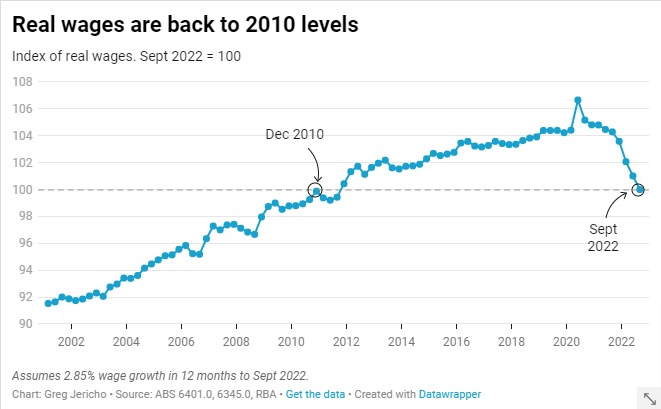
    But the real damage of inflation is seen in relation to wage growth. The Reserve Bank estimates that wages in the 12 months to September will have grown just 2.85%. This means people’s ability to buy things with their wages has fallen over 4% in the past year. This is a massive drop in real wages and unfortunately, it is expected to continue at least until the middle to end of next year.

    Right now real wages are back where they were 12 years ago. It is a damning indictment of the Industrial Relations system that has been designed to keep wages down. The Government today has introduced the Fair Work Legislation Amendment (Secure Jobs, Better Pay) Bill 2022 which seeks to provide workers with greater power to bargain for better wages. Given the latest figures, it is clear how urgently the changes are needed.

    The post Inflation is soaring and real wages are plummeting appeared first on The Australia Institute's Centre for Future Work.

  • Webinar on Wages, Prices, and Power

    Jim Stanford (Economist and Director) and Greg Jericho (Policy Director, Labour Market and Fiscal) from the Centre for Future Work are providing keynote presentations as part of this series. Below is a recording of the first of these presentations, presented by Jim.

    For other resources on inflation, how it is undermining real living standards for workers, and how to fix it (without throwing the whole economy into recession – an even bigger risk!), please see:

    The Wages Crisis: Revisited (Centre for Future Work overview of falling real wages, by Andrew Stewart, Jim Stanford, and Tess Hardy)

    An Economy That Works for People (ACTU Macroeconomics Discussion Paper)

    The Cure of Inflation Looks Worse than the Disease (latest Guardian Australia column by Greg Jericho)

    The post Webinar on Wages, Prices, and Power appeared first on The Australia Institute's Centre for Future Work.

  • International Seafarers Suffer $65 Million in Wage Theft Annually in Australian Waters

    Seafarers working on foreign-registered freight ships in Australian waters face regular theft of wages and other entitlements due to legal loopholes and lax enforcement of labour standards, according to a new research report published today by the Australia Institute’s Centre for Future Work.

    The report, titled Robbed At Sea, examines records of wage inspections conducted over the last decade by the International Transport Federation (ITF), a global federation of maritime and other transportation unions. The ITF sponsors a small team of 4 inspectors in Australia, to conduct spot checks of international vessels visiting our ports.

    Key points:

    • Over the last decade, in close to 5000 inspections in Australian ports the ITF found 70% of ships failing to meet minimum international standards for wage payment and other core labour standards – with resulting recovery orders totaling $38 million over that time.
    • But the ITF team can only inspect a tiny fraction of all foreign vessels visiting Australian ports: about 450 per year, or just 2.5% of visits by foreign-registered ships in that time. On the basis of reasonable assumptions regarding the prevalence of wage theft in the other, uninspected ships, the report estimates total wage theft from international seafarers across the Australian shipping industry of some $65 million per year.
    • Seafarers on foreign-registered vessels (often flying ‘flags of convenience’ to evade labour and tax rules) usually come from low-wage developing countries, and have little power to resist exploitation by unethical ship owners, contractors, and sub-contractors.
    • Stronger rules in port countries (like Australia) are necessary to offer greater protection while they are in Australian waters. But the report identified several loopholes and enforcement failures that explain why these seafarers are routinely exploited, even when delivering cargo from one Australian port to another.

    “Australia prides itself on being a country that respects the rule of law, and a fair go for workers. Yet we are allowing some of the most vulnerable workers in the entire global economy to be ruthlessly and knowingly exploited, right here in our own waters,” said Rod Pickette, co-author of the report.

    “Repeated inspections have confirmed routine wage theft and other exploitation in our ports,” said Lily Raynes, co-author of the report.

    “But those inspections are just the tip of the iceberg. Clearly this exploitation is a normal feature of international shipping, and Australia has both a moral and an economic responsibility to stop it within our jurisdiction,” Ms Raynes said.

    The report makes ten specific recommendations for reducing the incidence of wage theft from international seafarers in Australian waters.

    Report Recommendations Include:

    • Closing a current legal loophole which allows foreign-registered ships to conduct two trips between Australian ports without needing to respect the Fair Work Act or the Seagoing Industry Award
    • Strengthening inspection resources for the Australian Maritime Safety Authority and the Fair Work Ombudsman to ensure that existing rules are better respected

    The report was prepared in cooperation with the International Transport Federation’s Australian Shipping Inspectorate.

    It is being released to commemorate World Maritime Day (Thursday, 29 September) – an annual opportunity to raise awareness about the risks and exploitation faced in international seafarers.

    The post International Seafarers Suffer $65 Million in Wage Theft Annually in Australian Waters appeared first on The Australia Institute's Centre for Future Work.

  • They didn’t cause the inflation, but workers are expected to cure it

    In his Guardian column, Policy Director Greg Jericho notes that given real wages have already fallen for 2 straight years any further falls will take workers’ purchasing power backwards to where it was more than a decade ago. This however is viewed as being “worse than the alternative” of inflation growth above 3%.

    He notes that over the past 2 years the profit margins of many industries, and most especially the mining industry, have risen and have themselves fuelled inflation. But company profits are never expected to suffer, wages however are always viewed as either the culprit of inflation or the means to reduce it. The vast increase in mining profits, largely due to the Russian invasion of Ukraine, also highlights the urgent need for a windfall profits tax.

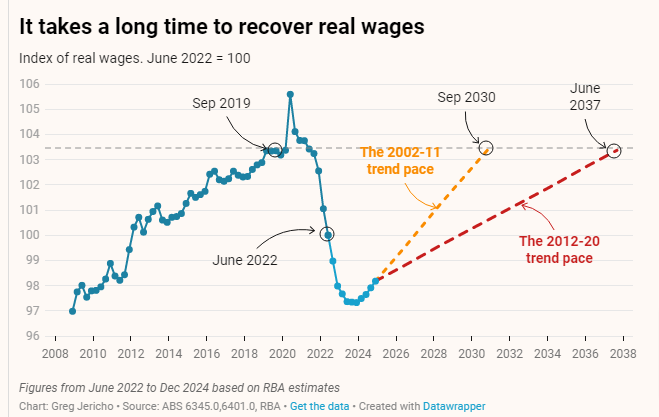
    Using the RBA’s own estimates Jericho calcuates that by the end of next year real wages will be back at 2008 levels and even with the most optimistic outlook they will not return to 2019 levels until 2030.

    The Reserve Bank’s strategy of sharply increasing interest rates risk slowing the economy into a recession even though real wages are already falling faster and for longer than they have in modern times.

    The post They didn’t cause the inflation, but workers are expected to cure it appeared first on The Australia Institute's Centre for Future Work.

  • The biggest real wages fall on record

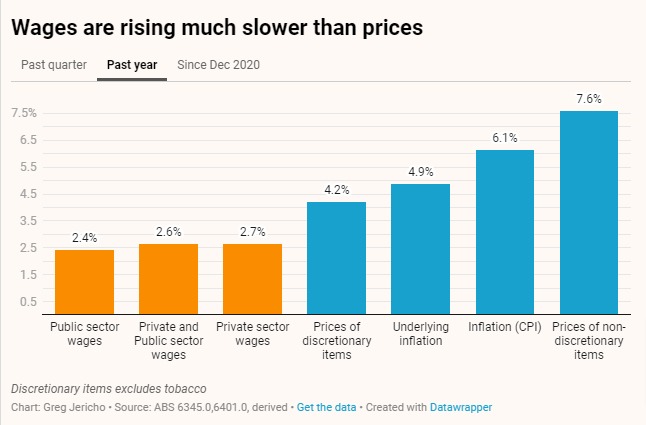
    In his column in Guardian Australia, Labour Market and Fiscal Policy Director, Greg Jericho, notes that while nominal wage grew 2.6% in the past year, real wages fell 3.3%. That fall has taken workers’ purchasing power back to 2012 levels.

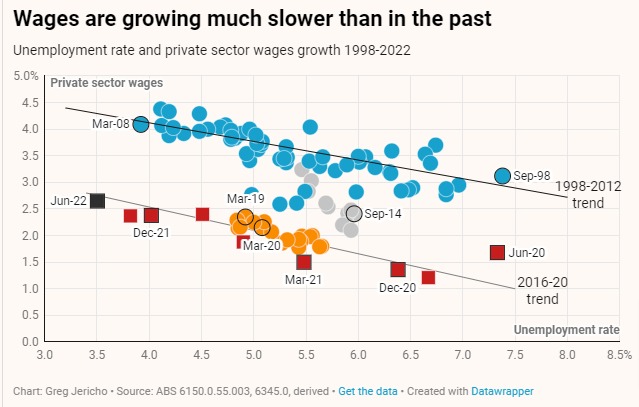
    This lack of strong wages growth despite unemployment being at nearly 50 year lows highlights just how skewed the bargaining system is against employees. In the past, unemployment this low would have been delivering wages well above 4%.

    The weak public-sector wages growth also reveals the impact of public-sector wage caps. For 6 consecutive quarters the annual growth of public-sector wages has been below that of the private sector. No longer does the public sector guide and support private-sector wages. This is the result of instituting arrangements which prevent a natural bargaining process to occur and in a time of rising inflation produce a massive fall in real wages for public-sector workers.

    In the past year wages in the education system, for example, rose just 2.3% on average, meaning teachers real wages fell 3.7% in the past year.

    While the real wages fall is terrible, it is likely worse for many families.

    The Bureau of Statistics estimates that households on average spend around 60% of their weekly expenses on essential/non-dictionary items. But because the prices of those items rose by 7.6% over the past year compared to average inflation of 6.1%, any households that need to spend a greater share of their income on essential items would have seen their real wages fall even further. For a family that spends 80% of their weekly budget on essential items, real wages fell by 4% – a truly horrific experience.

    The wages data confirm that there is no wages breakout that is driving inflation, instead workers are being left behind while companies produce record profits.

    The Jobs and Skills Summit in September must address this imbalance.

    The post The biggest real wages fall on record appeared first on The Australia Institute's Centre for Future Work.