Tag: Wages & Entitlements

  • Fair Work: 5.75% Award Wage Boost will not cause Wage-Price Spiral

    Today’s 5.75% award wage increase is a necessary boost for the lowest paid workers but does not keep pace with inflation.

    The Fair Work Commission (FWC) has today explicitly said this increase “will consequently not cause or contribute to any ‘wage price spiral’”.

    Key Points:

    • Award wage increase of 5.75% is less than inflation, which is running at 7%. (This covers approx. 20% of workers)
    • FWC Commission have said explicitly this will not cause or contribute to a so-called ‘wage-price spiral’
    • FWC acknowledges the increase “will not maintain the real value of modern award minimum wages nor reverse the reduction in real value which has occurred”
    • Australia Institute research shows excess corporate profits, not wages, are the major driver of inflation
    • Fair Work Commission also increased the national minimum wage by 8.65% (this covers approx 0.7% of workers)

    “This is a necessary boost, but insufficient to keep the lowest paid workers ahead of inflation,” said Dr. Greg Jericho, Policy Director at the Australia Institute’s Centre for Future Work.

    “It’s significant that the Fair Work Commission has explicitly said this will “not cause or contribute to any wage-price spiral”. At a time when companies are making record profits, our research shows profits, not wages, are the major driver of inflation.

    “The FWC notes it “will make only a modest contribution to total wages growth in 2023-24 and will consequently not cause or contribute to any wage-price spiral.

    “The FWC has made it clear the Reserve Bank can not blame low paid workers wages for driving inflation in the event they raise interest rates next week.”

    Excerpt from Fair Work Commission Decision:

    As the total wages of modern award-reliant workers constitute a limited proportion of the national wage bill, we are confident that the increase we have determined will make only a modest contribution to total wages growth in 2023-24 and will consequently not cause or contribute to any wage-price spiral.

    We acknowledge that this increase will not maintain the real value of modern award minimum wages nor reverse the reduction in real value which has occurred over recent years.

    The post Fair Work: 5.75% Award Wage Boost will not cause “Wage-Price Spiral” appeared first on The Australia Institute's Centre for Future Work.
  • Real wages falls and interest rates rises signal tough times for households

    The Australian economy – like all economies – is about people. And yet too often company profits are used as a judge of economic health. Throughout the pandemic and in the years since, company profits have soared while the real wages of workers has fallen. This situation is inherently unsustainable with an economy dependent upon household consumption. As policy director Greg Jericho writes in his Guardian Australia column, we are beginning to see households struggle to keep going.

    The Budget delivered this month by Treasurer Jim Chalmers revealed that the next financial year starting in little over a month is set to be one of the worst in the past 40 years. Household consumption is expected to rise just 1.5% – the 5th worst since 1985-86. Even worse if we account for an expected 1.7% rise in population this means in a per capita sense, real household spending is about to fall.

    And when household spending slows, so too does the entire economy.

    We have already see the beginnings of this with sharp slowing in the volume of retail spending being done, all while the amount of money we are spending rises. In effect we are paying more for less. This means the “nominal” figures in the retail trade data hides the weakness in the economy and the pain households are going through.

    With mortgage repayments rising nearly 80% in the past year, households are switching from spending in shops and on services that employ people, to paying off their loans – driving up the profits of banks ever more, but in doing so actually slowing the economy.

    The Reserve Bank is getting what it wanted – a slowing economy, less money being spent and rising unemployment. But with conditions only seen in recessions expected in the next year, the risk that this slowing will lead to the economy stopping completely is rising, and the Reserve Bank must not raise rates any further and be extremely mindful of the pain they have already caused to households struggling from the fastest increase in loan repayments in over 30 years at the same time as real wage fall faster than they have on record.

    The post Real wages falls and interest rates rises signal tough times for households and the economy appeared first on The Australia Institute's Centre for Future Work.

  • Wages are growing solidly but real wages continue to plummet

    The good news of the strongest wages growth since 2012, writes policy director Greg Jericho, in his Guardian Australia column, is tempered by the fact that real wages have fallen back to levels last seen in early 2009.

    The 3.7% growth in the wage price index demonstrates that workers are finally seeing some return for the tighter labour market in which unemployment is at around 50-year lows. It also reflects that public servants are also becoming free of the wage caps over the past decade that had purposefully kept wages down.

    In the March quarter for the first time in more than a decade, public-sector wages grew by 0.9%. Private-sector wages have also grown above 0.75% for 4 straight quarters – the first time since September 2012.

    But even with this very good wage growth, workers are seeing their living standards fall. In real terms, wages fell 3.1% in the past year and are now 5.4% below where they were before the pandemic. This destruction of purchasing power will take many years to recover. And it highlights that wages should rise faster than inflation and with workers being the ones who have suffered the most from inflation, they should not be expected to suffer once inflation is back within normal ranges.

    The post Wages are growing solidly but real wages continue to plummet appeared first on The Australia Institute's Centre for Future Work.

  • The Reserve Bank’s decision to raise rates shows a total lack of coherency

    Yesterday the Reserve Bank shocked markets and most economists by raising the cash rate to 3.85%. But it didn’t just contradict outside observers, it contradicted the views of the RBA board just one month ago when it decided to keep rates steady.

    Policy director Greg Jericho, writes in his Guardian Australia column that in the month since the April RBA meeting data on inflation has suggested faster than anticipated slowing, the economy overall is now expected to slow more quickly, and there is no sign of long-term wages growth rising beyond what would be consistent with 3% inflation.

    And yet despite this, the board decided to raise rates.

    The decision smacks of a board reacting less to economic conditions and more to the recent Review of the RBA which recommended taking the decisions to change rates away from the current board.

    The Reserve Bank suggested a month ago it needed time to pause and review. Nothing in the intervening time has suggested they made a mistake in not continuing to raise rate, and yet the bank seems determined to slow the economy and raise unemployment to 4.5%.

    The bank is so beholden to neo-liberal views of the non-accelerating inflation rate of unemployment that it is determined to keep raising rates until unemployment rises to a level it believes is “full employment”.

    We know the current level of inflation is largely driven by corporate profits and some overhang of supply-side issues and savings from the pandemic/lockdown period. At no point is there any sign that wages are rising in a manner that is fueling inflation and yet the RBA continues to attack inflation like we are experiencing the mining boom of the 2000s which saw wages and jobs grow strongly, rather than the current boom which is seeing profits grow exponentially and real wages plunge .

    The post The Reserve Bank’s decision to raise rates shows a total lack of coherency appeared first on The Australia Institute's Centre for Future Work.

  • 7% Minimum Wage Rise Would Tackle Inflation, not Feed it: Research

    A 7% minimum wage rise would have a virtually undetectable impact on economy-wide prices.

  • Minimum wages and inflation (2023)

    New research from the Centre for Future Work at the Australia Institute has revealed how rises in the minimum wage have almost no impact on inflation and given the collapse in the value of the minimum wage in real terms over the past 2 years, a 7% increase is a necessary recompense for Australia’s lowest paid workers.

    Each year the Fair Work Commission conducts the Annual Wage Review (AWR) which determines the national minimum and award wages. And each year it is met with a chorus of cries from business groups, conservative politicians and commentators that Australia’s economy will surely break should the minimum wage be raised too much.

    Over the past two years however, the minimum wage has risen by less than inflation, causing a significant decline in the real purchasing power of millions of workers covered by the Modern Award system. This marks the first time in a quarter-century that the minimum wage has had a deflationary impact on the economy (that is, increased by less than the inflation rate) over successive years.

    Despite this fall, once again, submissions from business groups to this year’s AWR have called for rises below inflation, and have cited concerns about a wage-price spiral as justification for advocating a further erosion of low-paid worker’s living standards.

    But research by Greg Jericho and Jim Stanford shows that minimum wage increases over the past 25 years have had little to no impact on inflation at all. It also demonstrates that a 1% increase in the minimum wage and all Modern Award wages – even if completely passed through into higher prices – would result in a virtually undetectable 0.06% increase in economy-wide prices. So small is this that a mere 0.2% fall in profits would be enough to cancel any impact on prices at all.

    The research reveals that the call from the Australian Council of Trade Unions for a 7% increase in the national minimum wage would make up a portion (but not all) of the real wage losses, workers have experienced in the past two years. Even if fully passed on in higher prices, with no reduction in current record-high business profits, a 7% minimum wage hike would at most translate into an increase of just 0.4% in economy-wide prices.

    Alternatively, that 0.4% rise could be offset by just a 1.4% reduction in total corporate profits.

    With inflation passing its peak, there is no cause for concern that a minimum wage rise of 7% (equal to the annual rate to the March quarter) would add fuel to the inflation fire.

    This reinforces recent research by the Centre for Future Work that profit margins are presently at record highs in Australia, because companies have increased prices since the pandemic far more than their own input costs. This gives companies ample cushion to absorb the cost of higher minimum wages, with no impact on prices at all.

    In sum, the impact of minimum wage increases on average prices is thus little more than a rounding error. But for the 20% of employees who earn either the national minimum wage or wages set under Modern Awards, a strong minimum wage increase will be vital. It will ensure that the lowest paid, who have already been most hurt by inflation, are not forced to suffer more due to an inflationary upsurge that was ultimately spurred by higher profits, not wages.

    The post Minimum wages and inflation appeared first on The Australia Institute's Centre for Future Work.

  • Stop the fear, give workers a fair pay rise

    It took roughly one day after the New South Wales election for conservative media groups to begin spreading fear about union power and public sector wage blowouts. But as labour market policy director, Greg Jericho writes in his Guardian Australia column these fears are massively overblown and also ignore the reality of how much workers have lost out over the past few years.

    In NSW public-sector wages grew just 2.5% in 2022, well below private-sector wage growth in that state and massively below inflation which rose 7.6% in that state last year.

    Public-sector wage caps were notionally introduced to get the budget back into surplus, but that was just a fib – once the budget returned to surplus the caps remained. The purpose of the wage caps has always been to drive down private-sector wage growth, a point made abundantly clear by former Treasurer Matt Kean when he told an audience at a Business NSW function that removing the public-sector wage cap would see their companies “competing for labour against the public service who were paying huge wage increases.”

    But the reality is the wage cap not only keeps private-sector wages down it has smashed the living standard of public sector workers whose real wages are now more than 5% lower than they were 2 years ago.

    The fear of wage rises must stop.

    The post Stop the fear, give workers a fair pay rise appeared first on The Australia Institute's Centre for Future Work.

  • Profit-Price Spiral: Excess Profits Fuelling Inflation & Interest Rates, not Wages

    The dramatic expansion of business profits has gone mostly ignored by the RBA and other macroeconomic policy-makers, who have focused instead on a supposed ‘wage-price’ spiral which does not exist. This suggests the focus of the RBA on wage restraint is misplaced and unfair, and that interest rates would be far lower today if companies had not gouged customers at the checkout.

    The report Profit-Price Spiral: The Truth Behind Australia’s Inflation (attached) comes in the same week supermarket giants Woolworths and Coles posted soaring profits, with banks, gas and petrol companies posting similarly soaring returns.

    Key Findings:

    • A Profit-Price spiral is the main driver of inflation in Australia, rather than a supposed “Wage-Price” spiral, which does not exist
    • As of the September quarter of 2022 (most recent data available), Australian businesses increased prices by a total of $160 billion per year over and above their higher expenses for labour, taxes, and other inputs, and over and above profits generated by growth in real economic output
    • Without the inclusion of those excess profits in final prices for Australian-made goods and services, inflation since the pandemic would have been much slower: an annual average of 2.7% per year, barely half of the 5.2% annual average actually recorded since end-2019.
    • That pace of inflation would have fallen within the RBA’s target inflation band (equal to its 2.5% target, plus-or-minus 0.5%)
    • Excess corporate profits account for 69% of additional inflation beyond the RBA’s target. Rising unit labour costs account for just 18% of that inflation
    • The RBAs 9 back-to-back interest rate rises would have been unlikely without excess profits and prices based on the RBA’s own policy framework
    • Real wages in Australia fell 4.5% in 2022, the largest fall on record

    “This empirical evidence shows excess corporate profits are the main culprit driving inflation, not workers’ wages,” said Dr. Jim Stanford from the Australia Institute’s Centre for Future Work.

    “For Australians doing it tough this data would be aggravating.

    “We’ve been told a story that workers need to restrict wage growth and accept a permanent reduction in living standards in order to fix inflation. This evidence shows that’s an economic fairytale.

    “ABS data shows that without excess price hikes through the pandemic, inflation would likely be within the RBA target band, and hence there would be no need for the nine extreme, back-to-back interest rate rises that are crushing households and mortgage holders, fuelling the cost-of-living crisis.

    “The pain experienced by workers through current inflation contrasts sharply with unprecedented increases in business profitability at the same time.

    “Through this episode of post-COVID inflation, real wages have declined rapidly, labour’s share of GDP has declined, and corporate profits have set records. That is completely opposite from the experience of the 1970s, when real wages rose, labour’s share of GDP increased, and corporate profit margins fell.

    “History confirms that fears of a 1970s-style ‘wage price spiral’ are simply not justified or grounded in reality. Instead, inflation in Australia since the pandemic clearly reflects a profit-price dynamic.”

    The new report ‘Profit-Price Spiral: The Truth Behind Australia’s Inflation’ is attached and comes from the Australia Institute’s Centre for Future Work, by Dr. Jim Stanford.

    Supermarkets, banks and petrol companies have recently posted huge profits:

    The post Profit-Price Spiral: Excess Profits Fuelling Inflation & Interest Rates, not Wages appeared first on The Australia Institute's Centre for Future Work.

  • Deal on IR Reforms Sets Stage for Faster Wage Growth

    A legislative consensus reached over the weekend to approve reforms to industrial relations laws sets the stage for rebuilding collective bargaining and a significant acceleration of wage growth, according to research from the Australia Institute’s Centre for Future Work.

    “These reforms will lift wage growth and improve fairness in workplaces across Australia, big and small, in all sectors of the economy,” said Dr Jim Stanford, Economist and Director of the Centre for Future Work.

    “These measures will rebuild collective bargaining, enhance gender equity, ensure greater transparency, and equip workers with critical tools to pursue fair treatment,” Dr Stanford said.

    Research published by the Centre for Future Work suggests collective bargaining coverage will rebound under the new laws, which will allow for multi-employer collective bargaining in certain circumstances. Bargaining coverage in Australia has declined dramatically since 2013, with just 11% of private sector workers now covered by a current enterprise agreement. That fall in coverage has been the largest single cause of record-slow wage growth over the last decade.

    Based on the historical relationship between bargaining coverage and wage growth, rebuilding coverage toward pre-2013 levels will lift nominal wage growth by 1.6 percentage points per year. Additional wage growth of that magnitude would lift annual incomes for a typical worker by almost $1500 in just one year, and a cumulative total of almost $24,000 over five years.

    Another provision in the reform package is a new limit on the ability of employers to unilaterally terminate expired enterprise agreements during their renegotiation. Many employers have used this loophole to wipe out years of collective bargaining gains. A recent example was Qantas’s threat earlier this year to terminate its agreement for cabin crew. Centre for Future Work modeling shows that could have cost senior staff as much as $67,000 per year. This so-called ‘nuclear option’ in employers’ arsenal will be prohibited under the new laws.

    “With the post-pandemic acceleration of inflation, many years of wage stagnation have now tipped over into the fastest decline in real wages in Australian history,” said Dr Stanford.

    “This bill is a needed and timely response to an unprecedented crisis in workers’ living standards.

    “I congratulate the legislators, including Minister Tony Burke, Greens Leader Adam Bandt, and Senator David Pocock, for negotiating this package and working to approve it in Parliament,” Dr Stanford said.

    The post Deal on IR Reforms Sets Stage for Faster Wage Growth appeared first on The Australia Institute's Centre for Future Work.

  • Wages growth improves but real wages fall at a record rate

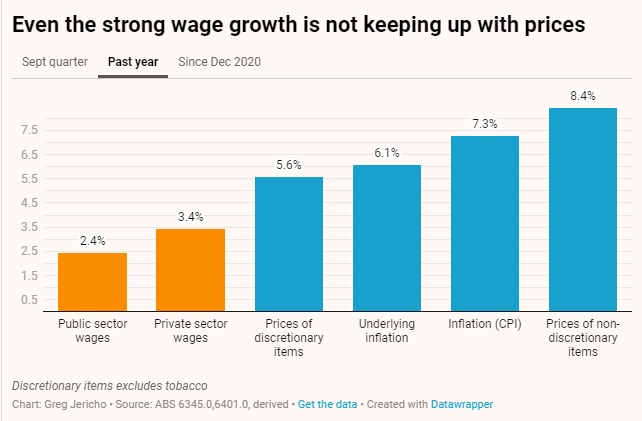
    This growth is very welcome. It highlights that far from wages driving inflation, wage growth is only now beginning to grow at a pace that would be expected given the low level of unemployment. But as Labour Market and Fiscal Policy Director, Greg Jericho notes in his Guardian Australia column, while the level of wage growth we are seeing remains well below what would have been expected in the past with a 3.5% unemployment rate.

    The strong growth came mostly from the private sector through a combination of new financial year individual contracts and the 5.2% minimum wage increase.

    But even this is not enough to prevent real wages from falling for the 9th straight quarter. For more than 2 years now prices have been rising faster the wages. It has seen real wages fall back to 2011 levels after a 4.6% fall since September 2020.

    The figures show that greater bargaining power is required for workers as they continue to lose out. The fastest wage growth for a decade should not see the biggest fall in real wages on record.

    We know that greater enterprise bargaining producers better wages growth. That business groups are so against the provision in the Fair Work Amendment Bill demonstrates how worried they are about the ability of workers to have increased ability to bargain.

    Profits have been growing faster than inflation, but wages are not.

    The latest wage growth figures are pleasing to see, but they also demonstrate the challenges ahead, and just how greatly workers’ living standards have been hit by price rises that they did nothing to cause.

    The post Wages growth improves but real wages fall at a record rate appeared first on The Australia Institute's Centre for Future Work.