Tag: Wages & Entitlements

  • Go Home On Time Day 2018: Australians Owed $106 Billion in Unpaid Overtime

    A national survey undertaken as part of the report has shown that the average Australian worker now puts in six hours of unpaid overtime per week, which equates to working an extra two months for free every year. That’s an increase from 5.1 hours on average in last year’s survey.

    “Australians are working more unpaid overtime than ever before, and they’re paying a high price for it,” said Troy Henderson, Economist at the Centre for Future Work.

    “Time theft takes many forms, including employees staying late, coming in early, working through their lunch or other breaks, taking work home on evenings and weekends or being contacted to perform work out of hours.

    “Most Australians wouldn’t dream of working for two months without pay. But it’s spread out over the whole year, and has become part of the implicit expectations of too many jobs. ‘Time theft’ has thus become endemic across the whole labour market.

    “Today we ask that all Australians go home on time and try to limit the unpaid overtime they work. And stopping time theft is ultimately the responsibility of employers and government, too, not just individual workers: employers must value and respect the leisure time of workers, and recognise that work cannot take over our entire lives.”

    The survey indicated that even part-time and casual workers – most of whom want more paid hours of work each week – are being asked to work unpaid overtime (averaging over 4 hours per week for part-timers and almost 3 hours per week for casuals). “Given the problem of underemployment and precarious work in today’s labour market, it is especially unfair that part-time and casual workers are being pressured to work for free,” Mr. Henderson added.

    This year’s Go Home on Time Day survey also included a special questionnaire on the use of digital surveillance and monitoring in Australian workplaces. 70% of respondents said their employers use at least one form of digital surveillance or monitoring, including cameras, GPS tracking, monitoring internet or social media activity or counting keystrokes, to monitor employees – and sometimes to discipline or even dismiss them.

    “Technology can have a strong positive effect in the workplace, but our research shows it is also being used in ways that increase pressure on employees and reduce the level of trust in workplaces,” Mr. Henderson said.

    “It’s clear from our research that millions of Australians are losing out to time theft. Both underemployed workers, and those who work too much, are giving up their precious time for free. All Australian workers have the right to go home on time.”

    The post ‘Go Home On Time Day’ 2018: Australians Owed $106 Billion in Unpaid Overtime, Report Reveals appeared first on The Australia Institute's Centre for Future Work.

  • Infographic: The Shrinking Labour Share of GDP and Average Wages

    This infographic summarises the bottom-line impact on average wage incomes for Australian workers.

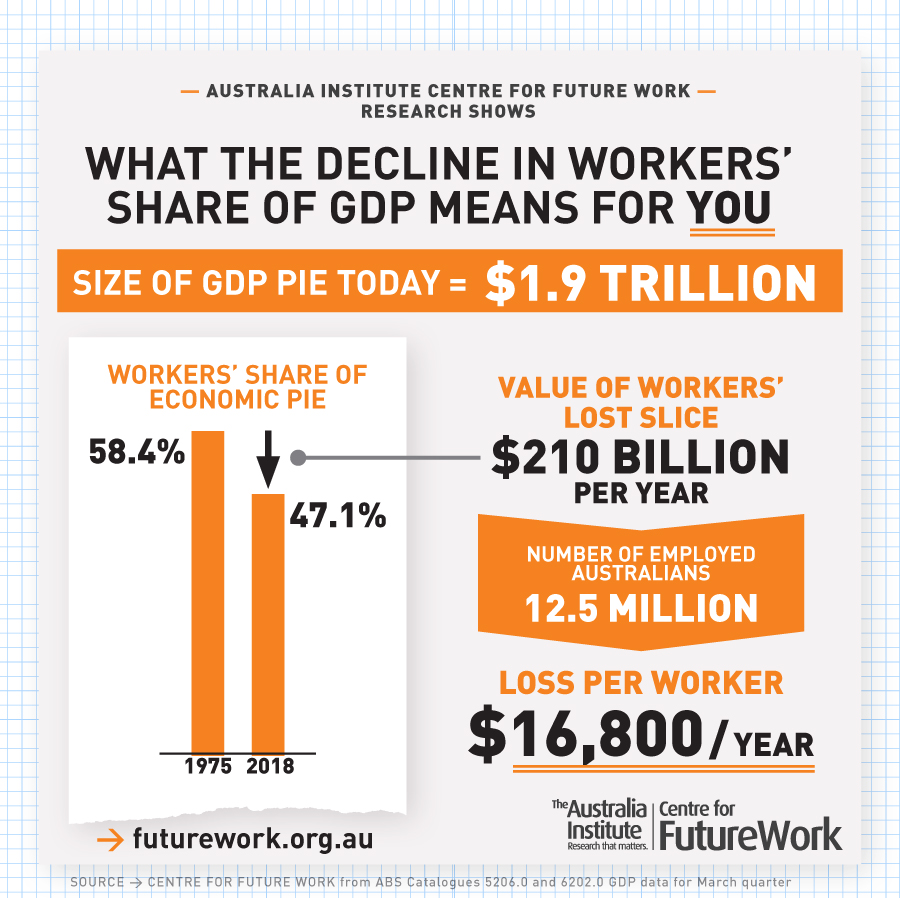
    Labour Share Infographic

    In the March quarter of 2018, labour income (in wages, salaries, and superannuation contributions) accounted for 47.1% of total GDP. That is down over 11 percentage points from the peak labour share (over 58%) recorded in the same quarter of 1975. The loss of that share of GDP, given total output today, is equivalent to a redirection of some $210 billion in annual income – and the research symposium showed that almost all of that income was captured in the form of higher company profits (especially in the financial sector). If it were divided equally amongst all employed Australians, that lost income share translates into foregone income of close to $17,000 per worker.

    Many thanks to Anna Chang for her creative work on the infographic!

    The research symposium highlighted several factors that have caused the long-run shift in income distribution from workers to the business sector, and resulting growth in personal income inequality in Australia. Key factors included the erosion of union representation and collective bargaining, inadequate minimum wages, and the growing power of the financial sector.  For more details, see the articles by Jim Stanford, David Peetz, Margaret Mackenzie, Shaun Wilson, and Frances Flanagan.

    The post Infographic: The Shrinking Labour Share of GDP and Average Wages appeared first on The Australia Institute's Centre for Future Work.

  • Government Spending Power Could Support Stronger Wage Growth

    New research from the Centre for Future Work at The Australia Institute demonstrates a strong connection between government spending and working conditions across the economy.

    “Weak labour market conditions, including record-weak wage growth, could be improved by linking public spending in all forms to improved job quality and compensation,” said Dr. Jim Stanford, Director of the Centre for Future Work.

    The Centre for Future Work report finds three main avenues through which government spending could lift wages and working conditions:

    1. Direct work and production undertaken within government and its departments and agencies (the public sector).
    2. Arms-length service-producing organisations which depend on government funding (the non-profit sector).
    3. Private-sector firms which supply government and public agencies with goods and services (the private sector).

    “It is ironic that Treasurers are always praying for stronger wage growth with every year’s budget in order to generate stronger growth and stronger revenues. Yet governments don’t pursue obvious opportunities to actually achieve that wage growth by linking labour standards to their own expenditure policies,” said Dr Stanford.

    “This is clearly a lost opportunity. Australia’s government sector is by far the single largest part of Australia’s economy.

    “This economic footprint, if wielded consistently to achieve higher wages and better jobs, could have a powerful impact on labour market outcomes.”

    Australian government economic footprint at a glance:

    • Total expenditures of over $660 billion per year, equal to 36 percent of Australia’s GDP.
    • Expenditures on current production of public goods and services of over $330 billion per year (18.5 percent of GDP), and further spending on capital investments of over $85 billion (another 5 percent of GDP).
    • Direct public sector employment of close to 2 million workers, with millions more jobs indirectly dependent on government injections of spending power.
    • Fiscal support for public and community services by arms-length non-profit agencies, worth at least another 4 percent of GDP.
    • Goods and services procured from private-sector suppliers equivalent to around 10 percent of GDP (or about $175 billion per year).

    The post Government Spending Power Could Support Stronger Wage Growth appeared first on The Australia Institute's Centre for Future Work.

  • Wages Crisis Has Obvious Solutions

    This recent commentary, by Centre for Future Work Director Jim Stanford, appears in the March 2018 issue of Australian Options magazine, and is reprinted with permission.

    Wage Crisis Has Obvious Solutions

    By Jim Stanford

    When the head of the central bank declares wages are too low, and urges workers to demand more money, you know you have a problem.

    After all, central bankers are traditionally the “party poopers” of the economy: they are the ones who march in and take away the punch bowl, as soon as the party gets rolling. Yet here was Governor Philip Lowe, Governor of the Reserve Bank of Australia, urging party-goers to turn up the volume. It’s like he was pouring bottles of straight tequila into the punchbowl, instead of taking it away – desperately trying to turn a boring flop into a wild shindig.

    Mr. Lowe made his surprising call at a conference last year on Australia’s economic outlook at Australian National University. He said weak wage growth was holding back national purchasing power and economic growth, and contributing to too-low inflation (which has languished below his bank’s official 2.5 percent target for several years running).

    But while his acknowledgement of the consequences of wage stagnation was refreshing, his diagnosis of the causes was incomplete and unconvincing. In fact, Governor Lowe almost seemed to blame the victims of wage stagnation – namely, Australia’s workers – for the problem. They were unduly worried about losing their jobs to robots or imports, he suggested; they should feel more “confident” in asking for higher wages. He has clearly not experienced the reality of Australia’s dog-eat-dog labour market in recent years, or felt the desperation that drives workers, especially young workers, to accept any job on offer.

    (Incidentally, the RBA’s own enterprise agreement signed last year will raise base wages by just 2 percent per year over the next 3 years … below the bank’s own inflation target!)

    While mainstream economists and policy-makers belatedly recognise the economic and social damage resulting from weak wages (even Treasurer Scott Morrison frets about the negative effect of slow wage growth on his budget balance), they’ve been distinctly reticent to connect the dots about the causes of the problem – and its obvious solutions. Lowe, Morrison, and their colleagues pretend wages will pick up automatically as the economy grows and the labour market tightens. But with official unemployment only a tick above 5 percent (still the RBA /Treasury estimate of “full employment,” according to their discredited but still operational NAIRU model), yet wages still decelerating, this faith in a market solution is increasingly far-fetched.

    Measuring the Slowdown

    The stagnation of Australian wages is visible by many indicators. The most common “headline” source is the ABS’s quarterly Wage Price Index, which reports an index of wages calculated from a representative sample of jobs (the methodology is similar to the Consumer Price Index). The WPI therefore measures changes in average hourly compensation holding constant the bundle of jobs which make up the overall labour market.

    However, one important factor in weak wages has been the changing composition of work. In particular, the growth of part-time, casual, and irregular jobs has undermined the overall level (and stability) of labour incomes. These changes are not captured in the WPI. Similarly, changes in average hours worked per week (due to growing part-time work) are also excluded from the WPI. So the WPI data understates the true extent of the wage slowdown.

    Other ways of measuring the wage slowdown show an even bigger drop-off in wage growth. These include average weekly earnings, the pay increases specified in enterprise agreements, and estimates of average labour compensation generated through GDP statistics. Trends in all these indicators are summarised in the accompanying table. Whatever measure is chosen, it is clear that there has been a dramatic slowdown in wage growth – especially visible since 2013.
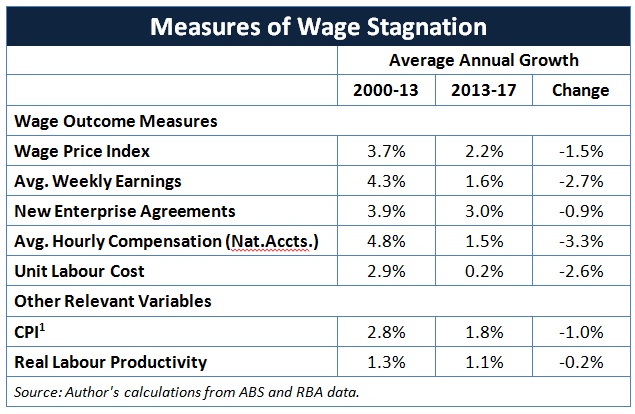
    Annual wage growth fluctuated around 4 to 5 percent during the first decade of the century. Wage growth fell sharply but temporarily during the GFC – but then quickly regained pre-crisis norms from 2011 through 2013. After 2013, however, wage growth has decelerated dramatically: to 2 percent or even lower. In fact, by the broadest measure of labour compensation (wages, salaries, and superannuation contributions paid per hour of work), there has been virtually no nominal wage growth in the past year. Consumer prices, meanwhile, continue to grow at around 2 percent per year (and even faster, if escalating housing prices are taken into account). Real earnings, therefore, are flat or falling.

    What is “Normal” Wage Growth?

    Any shortfall in wage growth below the pace of consumer price increases (corresponding to a decline in the real purchasing power of workers’ incomes) is a clear sign of labour market dysfunction. But even flat real wages (ie. nominal wages that just keep pace with inflation) are problematic. After all, wages are supposed to reflect ongoing growth in real labour productivity (or at least that’s what the economics textbooks tell us). So wages should actually consistently grow faster than consumer price inflation, to fairly reflect the enhanced real output of each hour of labour.

    Therefore, a “normal” benchmark for wage growth might be the sum of long-run consumer price inflation (the RBA’s 2.5 percent target) plus average productivity growth (running around 1.5 percent per year over the past three decades). That suggests a “normal” benchmark for annual nominal wage growth should be 4 percent per year. Australian wage growth in the pre-GFC period generally fit that definition of “normal.” But since 2013 wages shifted to a significantly lower trajectory.

    Joining the Dots

    Contrary to the assumptions of free-market economics, there is no guarantee that wages will automatically grow in line with labour productivity, as a result of automatic market mechanisms. Power is always a key factor in income distribution. And labour markets never “clear,” so that labour supply (the number of workers) equals labour demand (the number of jobs). In fact, inflation-targeting policy deliberately aims to maintain a certain level of unemployment (5 percent is the target in Australia) to suppress wage demands and protect profits.

    The systematic and structural disempowerment of workers and their unions over the neoliberal era is therefore the most relevant factor in the deceleration of wage growth, and the erosion of labour’s share of total GDP. Some obvious indicators of that dramatic shift in economic and political power include:

    • A steady erosion in the real “bite” of minimum wages, which have fallen from 60 percent of median wages in 1990 to around 45 percent today.
    • The collapse of trade union membership in the face of legal restrictions, harassment, and full-protection for “free riders.” Today just 9 percent of private sector workers, and less than 5 percent of young workers, are union members.
    • A corresponding collapse in collective industrial action. Adjusted for the size of the workforce, the frequency of strikes and other industrial disputes has declined by 97 percent from the 1970s to the present decade.
    • The relegation of industry awards to a baseline “safety net,” instead of a system for supporting ongoing progress in wages and working conditions.
    • The generally pro-business shifts in economic policy, including tax cuts, deregulation, privatisation, and globalisation, which have also shifted economic power in favour of employers and hence indirectly suppressed wage growth.

    To begin to rebuild wage growth, restore labour’s share of GDP, and achieve greater equality in labour incomes will require a comprehensive, multidimensional effort to restore the power of all these wage-supporting institutions. The ACTU is tackling this challenge with gusto, with its ambitious “Change the Rules” campaign. The goal is to propose a consistent, holistic vision for repairing the institutions that support workers and their wages – and then building a strong grass roots campaign to push politicians of all stripes to adopt that vision.

    On the other hand, if we follow the advice of Scott Morrison and Philip Lowe, and simply wait for supply and demand forces to rescue wages from their current doldrums, we are going to be waiting a very long time.

    The post Wages Crisis Has Obvious Solutions appeared first on The Australia Institute's Centre for Future Work.
  • Subsidising Billionaires: Net Incomes of UberX Drivers in Australia

    The report considers gross revenues generated by a typical urban fare (traveling 10 km, and taking 22 minutes to complete), according to UberX’s published rate schedule. After deducting Uber’s various fees, net taxes, and the costs of providing and maintaining the vehicle, the driver is left with an average of just $8.29 from that fare (barely one-third of the gross revenue they collect). Accounting for unpaid time spent waiting for the next fare and collecting the passenger from their pick-up point, this translates into a net hourly wage (before personal income tax) of $14.62 per hour. This is well below the national statutory minimum wage, and less than half the level of the weighted-average minimum wage (including casual loading and penalty rates for evening and weekend work) that would apply to waged employees under Australia’s Passenger Vehicle Transportation Award. The underpayment of UberX drivers in Australia constitutes a subsidy paid by them to the company amounting to hundreds of millions of dollars per year; and this underpayment of drivers (in Australia and elsewhere) has been essential to the dramatic expansion of Uber’s market value (most recently estimated at almost $50 billion U.S.).

    These findings confirm that the use of digital platforms to organise and compensate irregular work, and the ability of businesses (including large global firms like Uber) to classify their workers as independent businesses in their own right, are undermining the effectiveness of traditional labour market protections (such as the minimum wage, superannuation entitlements, paid leave, and others). The report calls on Australian lawmakers and regulators to urgently address the gaps in existing labour laws, to ensure that traditional labour protections are available to workers in the “gig economy.”

    The post Subsidising Billionaires: Simulating the Net Incomes of UberX Drivers in Australia appeared first on The Australia Institute's Centre for Future Work.

  • Job Growth No Guarantee of Wage Growth

    Job Growth No Guarantee of Wage Growth

    by Dr. Anis Chowdhury

    ‘Remarkable’ jobs growth raises hopes for wages” was the headline for a recent Sydney Morning Herald opinion piece by Clancy Yeates. He bases this claim on “some brighter news on the labour market to balance the bad: there is something of a jobs boom under way”. Apparently “more jobs have been created in 2017 in net terms than any year since 2005, with 371,000 new net jobs so far this year”. Clancy Yeates also points to “the lowest number of unemployed people per unfilled position since 2012”.

    This optimism is also shared by the Treasury Secretary John Fraser. In his opening statement at the recent Senate budget estimates hearing on 25 October, he said, “We expect that a period of stronger growth and falling unemployment will lift wages in the next few years.” He further noted, “We do expect that as the cyclical constraints that have weighed on the economy recede wages growth will accelerate.”

    The RBA also holds a similar optimistic view. Philip Lowe, the RBA Governor, in his September statement observed, “Employment growth has been stronger over recent months and has increased in all states. The various forward-looking indicators point to solid growth in employment over the period ahead. … stronger conditions in the labour market should see some lift in wages growth over time.” He had the same positive view in his October statement.

    But can we really be so confident that job growth will eventually lead to wage growth? And even if it does, would it be strong enough to catch up and compensate for the losses incurred from such a long period of wage stagnation?

    Unfortunately, the answer to these questions is a resounding ‘NO’. This so-called remarkable jobs growth will not result in an eventual wage growth sufficient to close the wages gap. This has been confirmed by the latest data showing wages rose by less than expected last quarter; even a significant mandated jump in the minimum wage failed to lift the rate of growth of workers’ pay across the economy. The most broad measure of average earnings growth (derived from GDP statistics) has actually turned negative – the weakest since the mid-1960s.

    The reason for this contradiction is very simple – it is rooted in the different nature of new and old jobs. Jobs, whether part-time or full-time, are now more insecure. Just consider some recent news. The NAB has announced 6,000 job cuts by 2020 even when it announced $6.6 billion profit! Earlier Telstraconfirmed 1,400 job cuts.

    Job insecurity is not just a phenomena in the private sector. Governments – State and Commonwealth – have also joined the new trend. For example, the NSW department of Finance Services and Innovation has notified the union representing the cleaners that employment guarantees in place since 1994 “will not be extended in the new contracts from 2018”.

    The optimists seemed to have decided to ignore what Alan Greenspan, the former chairman of the US Federal Reserve, said in his Congressional hearing two decades ago (on 26 February, 1997). Explaining why “the rate of pay increase still was markedly less than historical relationships with labor market conditions would have predicted”, he said: “Atypical restraint on compensation increases … appears to be mainly the consequence of greater worker insecurity.”

    He clearly elevated job insecurity to major status in the Fed’s policy analysis. Workers have been too worried about keeping their jobs to push for higher wages. And this has been sufficient to hold down inflation without the added restraint of higher interest rates.

    But Greenspan also implied that workers’ fear of losing their jobs was not in itself a sufficient explanation for their failure to push for significant wage increases. The sense of job insecurity has to be rising over time; that is, continually getting worse. Because once the level of insecurity leveled off, and workers become accustomed to their new level of uncertainty, their confidence may revive and the upward pressure on wages would resume. That is particularly true when the unemployment rate is low, as it is today (at least officially).

    However, looking at the length of contracts, Jeff Borland, a leading Australian labour economist, finds no evidence of increased job insecurity in Australia. Others have reported similar findings, while others cite different data to indicate a growth in insecurity. A new ABS survey also showed that while there had been an increase in the number of people with more than one job since 2010-11, those doing multiple jobs as a proportion of the workforce had remained almost completely unchanged at 6%.

    Job insecurity is notoriously difficult to measure. It is not the length of contracts or whether a job is full-time or part-time, that matters. It is the constant threat of losing jobs or pay conditions despite tenure due to constant restructuring that the workers fear. It is the news like that from the ice cream manufacturer Street wanting to terminate its enterprise agreement, or announcements like the one from the NSW department of Finance Services and Innovation, which generate the sense of job insecurity.

    It is this sense of job insecurity and fear of not finding a decent job after losing one (as experienced, for example, when Holden and Toyota recently closed down) which Alan Greenspan had in mind when he calibrated Fed’s monetary policy levers. Thus, there has to be continuous restructuring in the guise of addressing falling or stagnant productivity to keep lid on wages, while the real intent is creating fears among the working class.

    When nearly half the Australian families (41%) feel job security is chief among their concerns, this supposedly remarkable jobs growth won’t generate pressure for wage growth as hoped by the optimists. “Insecure, stressed, and underemployed: The daily reality for millions of Australians”, is how David Taylor summarised the labour market in Australia. This is experienced even as profits are growing at their highest rate in two decades.

    Governments – State and Federal – should worry about rising job insecurity, instead of adding fuel to the fire with their own employment restructuring initiatives. The high level of job insecurity doesn’t just have an effect on wage growth and inflation. Recent research has found that it “cuts to the core of identity and social stability – and can push people towards extremism”. We all have a stake in creating more secure jobs, and fairly rewarding those who perform them.

    The post Job Growth No Guarantee of Wage Growth appeared first on The Australia Institute's Centre for Future Work.

  • Cutting penalty rates will reinforce wage stagnation

    The Fair Work Commission’s decision to reduce penalty rates for Sundays and holidays in retail and hospitality jobs will reinforce wage stagnation and further widen income inequality, which is bad news for the economy as a whole, according to Dr. Jim Stanford, Director of the Centre for Future Work at the Australia Institute.

    “It’s painfully ironic that the Fair Work Commission’s decision was released just a day after the ABS confirmed the pace of Australian wages had already slowed to the worst in the history of their data,” Dr. Stanford said.

    “With household incomes going nowhere, and the economy slowing accordingly, now is the time to support the wages of low-income workers, not suppress them further.”

    “The economic argument that business will open longer, creating jobs has no basis. It will simply spread limited demand, and therefore jobs, over a longer period without increased employment.”

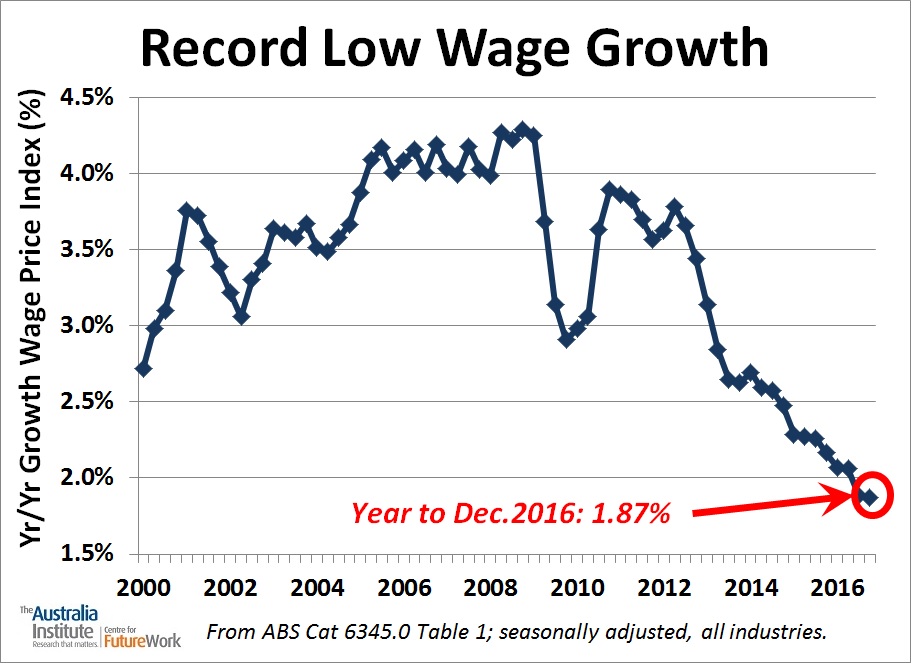
    ABS data released on Wednesday showed annual wage increases in the year to December 2016 fell to just 1.87 percent. Wages in retail and hospitality already lag far behind economy-wide averages, and part-time and casual jobs are the norm.

    Record low wage growth

    “Worse yet, workers in these sectors also face widespread wage fraud and violation of minimum wage laws, as documented at employers like 7-11 stores and Domino’s Pizza.”

    “By cutting Sunday and holiday penalty rates to as low as 125 percent, the Commission’s decision will significantly damage incomes for workers who already face precarious schedules and incomes.”

    Dr. Stanford was especially critical of claims that lower weekend wages will spur new job-creation in retail and hospitality.

    “It is elementary economics that employment in service sectors like retail and restaurants is constrained by the level of consumer demand, not by the level of wages.”

    “Lower wages will not lead to lower prices, they cannot boost consumer spending, and they will not create new jobs. In fact, by further suppressing labour incomes, this decision will undermine economic growth and job-creation even further.”

    “The idea that more businesses will open up on a Sunday and this will lead to more employment is also flawed logic. Since total demand will remain unchanged, a business will simply sell the same amount over 7 days instead of 6 days,” Stanford said.

    Read our previous polling of public attitudes to cutting penalty rates.

    The post Cutting penalty rates will reinforce wage stagnation appeared first on The Australia Institute's Centre for Future Work.