Research on the ‘nuclear option’ of enterprise agreement termination.
Authors: Raynes, Stanford
Research on the ‘nuclear option’ of enterprise agreement termination.
Authors: Raynes, Stanford
The measures provided here will not suddenly transform Australia in the image of leading OECD countries, where centralised and coordinated collective bargaining covers most workers, and wage outcomes are much more equal as a result. But they would support a gradual restoration of collective bargaining coverage, consistent with practices in other countries where bargaining still occurs mostly at the enterprise level – but where some broader bargaining and coordination is possible. On that basis, and over several years, this should result in a partial restoration of bargaining coverage lost over the past decade, and a corresponding (but still incomplete) recovery in wage growth.
The post Collective Bargaining and Wage Growth in Australia appeared first on The Australia Institute's Centre for Future Work.
Jim Stanford (Economist and Director) and Greg Jericho (Policy Director, Labour Market and Fiscal) from the Centre for Future Work are providing keynote presentations as part of this series. Below is a recording of the first of these presentations, presented by Jim.
For other resources on inflation, how it is undermining real living standards for workers, and how to fix it (without throwing the whole economy into recession – an even bigger risk!), please see:
The Wages Crisis: Revisited (Centre for Future Work overview of falling real wages, by Andrew Stewart, Jim Stanford, and Tess Hardy)
An Economy That Works for People (ACTU Macroeconomics Discussion Paper)
“The Cure of Inflation Looks Worse than the Disease“ (latest Guardian Australia column by Greg Jericho)
The post Webinar on Wages, Prices, and Power appeared first on The Australia Institute's Centre for Future Work.
Even with this new increase, however, real wages for the lowest-paid Australian workers are likely to go backwards this year, with inflation pegged to accelerate to as much as 7%. Nevertheless, Australia’s business lobby are repeating tired old complaints about minimum wages being too high, stoking further inflation, and undermining profits.
In his latest commentary, published in The Guardian, Policy Director Greg Jericho reviews and debunks these predictable complaints. The evidence is clear that wages are not causing inflation. Profit margins have grown along with prices. Workers deserve to have their real incomes protected, as the true sources of the problem (arising mostly from after-effects of the pandemic and the global energy price shock) are addressed.
Please see Greg’s full column, “Workers and their wages are the collateral damage of the war on inflation.”
The post Employer Arguments Against Minimum Wage Boost Don’t Hold Water appeared first on The Australia Institute's Centre for Future Work.
The new Commonwealth government has pledged to find ways to strengthen collective bargaining. In this feature interview with the ABC’s national economics program The Business, Senior Economist Alison Pennington discusses the reasons why the current system is not working, and some of the reforms that will be required to support bargaining and lift wages.
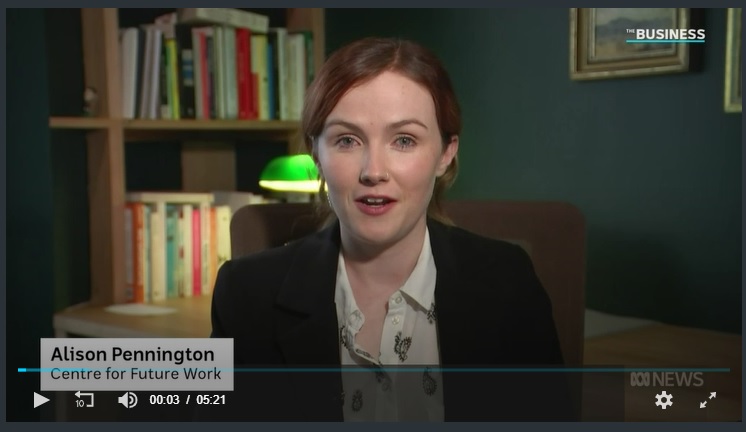
The post Enterprise Bargaining System no Longer Fit for Purpose appeared first on The Australia Institute's Centre for Future Work.
We recently hosted a special webinar to discuss the Commission’s changes, their significance, and what comes next in the struggle to improve and properly value work in human services.
The webinar featured two representatives from the Australian Services Union, which was centrally involved in the campaign for these changes: Emeline Gaske, Assistant National Secretary for the ASU, and Michael Robson, National Industrial Coordinator. They reviewed the economic and policy context for the review, the specific changes that have been announced, how they will be implemented, and the next steps in lifting the quality of work in these vital sectors. The conversation was chaired by our Policy Director for Industrial and Social issues, Dr. Fiona Macdonald.
The post Webinar: Changes to the SCHADS Award and Next Steps to Improve Job Quality in Human Services appeared first on The Australia Institute's Centre for Future Work.
On 10 February, Centre for Future Work hosted an exciting timely panel discussion between international collective bargaining experts titled “Beyond the Enterprise: Building Sectoral Collective Bargaining Systems in the Anglophone World”. The panel, delivered for the Association of Industrial Relations Academics of Australia and New Zealand (AIRAANZ) 2022 Conference, explored proposals across Australia, New Zealand, Britain and the US for widening bargaining scope to the multi-employer, industry-wide, or occupational level. Panelists and their presentation links are below:
Jim Stanford, Economist and Director at Centre for Future Work chaired the panel.
The AIRAANZ panel follows release of the 13-article Special Issue Global Lessons for Stronger Collective Bargaining Systems prepared by academic researchers and trade unionists from five countries for the peer-reviewed journal Labour and Industry. The Issue co-edited by Alison Pennington and Jim Stanford adopts a multi-dimensional approach to collective bargaining revitalisation, investigating the role of bargaining in skills and education, unemployment insurance and other social insurance policies, and industry policy – in addition to specific industrial relations matters.
The final published versions of all articles in the Special Issue are available through Labour and Industry, or through your local library. All commentaries in the Issue freely accessible until end-March 2022.
The post International Collective Bargaining Experts Explore Future System Reform appeared first on The Australia Institute's Centre for Future Work.
Our Policy Director Greg Jericho writes in Guardian Australia that claims of a “wages breakout” remain purely a scare campaign from employer groups determined to keep wages low. He finds that once again real wages are failing to keep pace with productivity and that as a result no pressure on inflation is coming from wage claims, but instead workers are missing out. With levels of unemployment now associated with much lower wage growth than in the past, it is clear the power imbalance in wage negotiations has shifted drastically away from workers.
The post Loss of Bargaining Power Explains Wage Stagnation appeared first on The Australia Institute's Centre for Future Work.
On the heels of new data showing further erosion of Australia’s collective bargaining system, researchers and practitioners from five countries have identified best practices from other countries that could strengthen collective bargaining and lift wages.
Key findings of the research include:
“The erosion of collective bargaining has been a major factor in Australia’s record-weak wage growth over the past decade,” said Alison Pennington, Senior Economist at the Centre for Future Work and co-editor (with Dr. Jim Stanford) of the special issue.
“This research confirms that other countries are implementing innovative and powerful measures to strengthen collective bargaining and support a healthier post-COVID recovery. Australia should learn from those countries and take urgent measures to stop the decline of collective bargaining here.”
“A wealth of experience from other countries proves collective bargaining can be strengthened and modernised, to provide workers with a decent shot at fair compensation and better jobs. Unfortunately, Australian governments seem more obsessed with vilifying and policing unions, instead of engaging them as full and constructive partners. The resulting erosion of collective bargaining will only lead to even weaker wages in the future,” said Pennington.
New data released this week from the Commonwealth government confirm that collective bargaining coverage has declined further during the pandemic, with 600,000 workers losing enterprise agreement coverage since end-2019. That erosion of collective bargaining has been a key reason for Australia’s record-weak wage growth.
The newly released special issue of Labour and Industry contains 13 contributions from academics, union leaders, and practitioners around the world.
“Australian workers need an effective system of collective bargaining that goes beyond the legal entity that directly employs them,” said Tim Kennedy, Secretary of the United Workers Union, and co-author one of the articles in the special issue. “This is a vital mechanism to ensure workers have greater control over the safety of their work, across sectors, industries, franchises, labour hire arrangements, supply chains – or however work is configured.”
“Australia is currently deprived of the skill formation benefits that arise from strong sectoral collective bargaining between social partners in Nordic nations,” said Andrew Scott, Professor of Politics and Policy at Deakin University, and author of another article in the special issue.
“It’s exacerbating deficiencies in our training arrangements, evident in high rates of misalignment between jobs and skills. Australia can learn much from the Nordic countries’ superior economic and social policy outcomes that arise from well-integrated skills and collective bargaining systems,” said Professor Scott.
The research is the culmination of a two-year project coordinated by the Centre for Future Work at the Australia Institute.
The post As collective bargaining erodes in Australia, solutions from other countries could strengthen bargaining and lift wages appeared first on The Australia Institute's Centre for Future Work.
The Centre for Future Work hosted a special webinar with Craig Renney, Economist & Director of Policy for the New Zealand Council of Trade Unions. In the recorded webinar, Craig explains key FPA policy details including design & coverage of the system, and how FPAs can lift wages and labour standards, stop the ‘race to the bottom’, and rebuild worker bargaining power in NZ. The webinar is the first in the Centre’s exciting new webinar series exploring key labour market topics related to work, wages, and fairness. Hosted by our Senior Economist Alison Pennington.
Craig Renney’s presentation slides presented for the webinar are available below.
The Centre for Future Work has published research on several ambitious progressive labour reforms pursued in New Zealand. For more, please read Workplace Policy Reform in New Zealand: What are the Lessons for Australia?, by Alison Pennington.
The post Fair Pay Agreements: How Workers in NZ Are Getting Their Share appeared first on The Australia Institute's Centre for Future Work.