Tag: Tax, Spending & the Budget

  • The Stage 3 tax cuts are bad economics combined with terrible politics. They should be dumped.

    During the 2022 election campaign the ALP in a desperate and misguided move to avoid being wedged, agreed to implement the horrendously inequitable Stage 3 tax cuts. But, as Policy Director Greg Jericho writes in his Guardian Australia column agreeing to bad policy in opposition means you own the bad policy in government – except you get no credit for it and all of the blame.

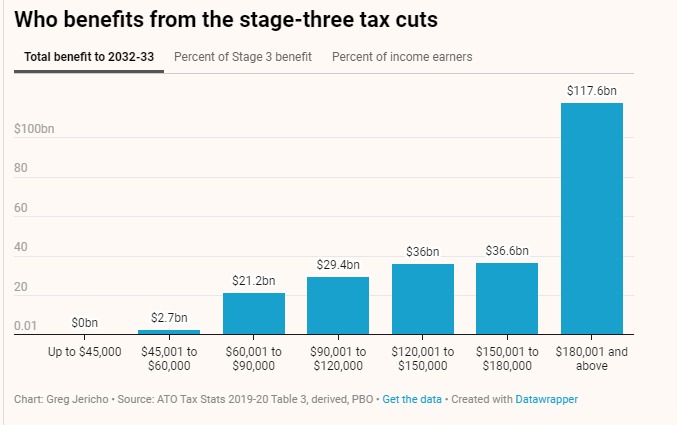
    While the Stage 3 tax cuts have always been wildly expensive and unfair, with around half of the benefit going to the richest 3%, but the removal of the low-middle income tax offset (LMITO) has made them even more unfair and politically foolish for the ALP.

    Because the LMITO was targeted most at those earning between $50,000 and $90,000 and the Stage 3 tax cuts are least targeted towards those people, it means the removal of the $1,500 LMITO for someone on the median income of $65,000 will only be replaced by a $500 tax cut under Stage 3.

    This means the ALP if it continues to implement Scott Morrison’s tax policy will go to the next election in a position where middle-income earners will be paying more tax than they did in 2022 while people on $200,000 will be $9,075 better off.

    That is a weird strategy for a progressive political party to pursue.

    In reality, the Albanese government will get no credit for implementing the Stage 3 cuts and will get all the blame for leaving around 75% of taxpayers worse compared to the last year of the Morrison government.

    It is time to dump the tax cuts and for the Albanese government to deliver policies that it would be proud to defend. Fairer tax cuts, increase Jobseeker, invest in renewables and other vital infrastructure and improve services.

    The post The Stage 3 tax cuts are bad economics combined with terrible politics. They should be dumped. appeared first on The Australia Institute's Centre for Future Work.

  • The Fiscal, Economic, and Public Health Dangers of Water Privatisation (NSW)

    But beyond the obvious importance of good water systems to life, health, and well-being, the water system also constitutes a valuable economic asset in the overall portfolio of public enterprise (see box). Investments in high-quality water and sewage systems represent enormous sums of fixed capital. The financial and operational dimensions of water systems are significant to the fiscal and macroeconomic functioning of the whole state economy.

    In this context, suggestions that the Sydney Water system might be sold to private investors raise a wide range of significant concerns: regarding the efficiency and safety of their continued operation, access to healthy and affordable water services for state residents, and the economic implications for customers, workers, and state government itself. A new research report from the Centre for Future Work reviews some of those concerns, and considers the likely consequences of Sydney Water’s potential privatisation.

    Main findings of the report include:

    • Sydney Water represents an essential public asset, important for both economic as well as public health reasons
    • Sydney Water boasts total assets of almost $24 billion, public equity of $8 billion, annual revenues of $2.8 billion, and dividend and tax payments to the people of NSW that averaged $870 million per year since 2018
    • The state earns far more from dividend payments arising from its equity in Sydney Water, than it would pay in interest on an equivalent amount of public debt
    • Selling the utility would impose a significant fiscal cost on the state through lost dividend and tax revenues
    • Experience with privately-owned water systems in other countries suggests water charges would rise significantly under private ownership, largely because of higher interest costs, higher debt, and higher dividend payouts
    • Based on UK and US studies, Sydney Water customers could see their annual water bills grow under private ownership by 39% to 59% (or by an average of between $174 and $264 per customer per year).

    The report was commissioned by the NSW & ACT Branch of the Australian Services Union.

    The post The Fiscal, Economic, and Public Health Dangers of Water Privatisation appeared first on The Australia Institute's Centre for Future Work.
  • Superannuation needs an objective and needs to be reviewed

    This week the government announced a review to legislate the objective of superannuation. Surprisingly, there is no official objective of superannuation and this has allowed it to be used for purposes that are decidedly not about ensuring a comfortable retirement.

    The review has sparked criticism from the opposition who are using it to suggest the government is coming after your money. But as policy director, Greg Jericho, writes in his Guardian Australia column, for the very rich, superannuation has become less about retirement and more about dodging tax.

    Because super contributions are taxed at 15% the biggest benefit goes to those who are on the highest marginal income tax rate. As a result, those with the highest incomes contribute much more of their own money to superannuation than do those on lower incomes. Those earning over $150,000 make up 7% of individuals, 27% of total income, but 32% of total personal superannuation contributions. Also because there is no limit on the size of superannuation balances that can access this tax concession it means those with the very largest superannuation balances continue to get the advantage of a tax concession that has long past any sense of assisting a comfortable retirement.

    These tax concessions are now extremely costly – costing the government almost as much as the aged pension – and moreover so slanted are the benefits to the wealthy that the richest 20 per cent cost the government more tax concessions than it would pay them the full aged pension.

    Clearly, the system is not working as it should. It is not about self-funding retirement but funding retirement by avoiding tax.

    The Treasurer has suggested putting a cap on the size of superannuation balances – somewhere around $3m. Such a size would only affect less than 1.5% of all individuals aged 55-69. But clearly needs to be done because those 1.5% hold 14% of all superannuation balances of people in that age.

    Superannuation is important and vital for the retirement of many Australians. But it should not be used just to avoid paying tax – the cost of that lost revenue is denying assistance to those who actually need help once they stop work.

    The post Superannuation needs an objective and needs to be reviewed appeared first on The Australia Institute's Centre for Future Work.

  • As interest rate rises bite, the Reserve Bank should not raise rates next week

    Since May last year, the Reserve Bank has increased the cash rate from 0.1% to 3.1%. The latest cost of living data released this week reveals that this has incurred a 61% rise in mortgage repayments for the typical employee household.

    As policy director, Greg Jericho notes in his Guardian Australia column, this increase has had a dramatic effect on people’s ability to spend money elsewhere. The latest retail trade data released on Tuesday showed a dramatic fall in retail spending in December. The 3.9% fall in the nominal amount spent is increased once you consider the inflation. Even if you account for the tendency for monthly figures to be erratic, the last three months of 2022 saw a stalling of retail spending and a decline in real terms.

    Clearly, the rate rises are forcing people to spend less on retail items and other discretionary purchases. This of course is the intended impact. Raising interest rates increases the cost of borrowing and reduces the level of demand in the economy. But the danger is that the Reserve Bank increases interest rates so fast and so greatly that it slows demand by more than is needed.

    Given the impact of the 300 basis points rises has yet to fully flow through as current mortgage holders typically see their interest rates rise only a month or two after each increase by the Reserve Bank we can expect the cost of mortgage repayment to keep rising in the first quarter of this year.

    With the data already showing the pain of rate rises is causing changes in household spending. The Reserve Bank shod not raise the cash rate when it meets next week, but wait to see the full impact flow through to the economy. After a 300 basis points rise in 8 months no one can suggest the Reserve Bank has been too timid. The fast increase now gives them room to wait and observe rather than keep slamming on the brakes.

    The post As interest rate rises bite, the Reserve Bank should not raise rates next week appeared first on The Australia Institute's Centre for Future Work.

  • A new tool reveals how badly the Stage 3 cuts mismanage the budget

    Just before Christmas last month the Parliamentary Budget Office released a “Build Your Own Budget” tool that reveals the interactions of taxes, spending and economic conditions that go into determining the budget balance.

    While the tool is an invaluable device for economists, its real value as noted by Labour Market and Fiscal Policy Director Greg Jericho, is how it highlights the massive cost of the Stage 3 tax cuts.

    In his Guardian Australian column, Jericho notes that the Stage 3 tax debate has become about all-or-nothing rather than realising the $300bn cost of the tax cuts over 9 years provides an opportunity for the Albanese government to amend the tax cuts and also increase support for benefits and government services.

    The Stage 3 tax cuts are so expensive that the PBO’s budget tool reveals you could raise Jobseeker from its current rate of $668 a fortnight to $1,925 and the budget deficit in 2032-33 would still be lower than it is currently predicted to be with the Stage 3 tax cuts.

    The Stage 3 tax cuts could be amended to reduce the 32.5% tax rate for earnings between $45,000 to $120,000 to 30% and still raise the top tax threshold from $180,000 to $200,000. These still very large tax cuts would cost $120bn less over the first 9 years than would the Stage 3 cuts. That would enable the government to, for example, increase Jobseeker to $1,025 and still have a better budget position than current predicted with the Stage 3 cuts.

    This highlights just how many options are available to the government.

    Budget are about choices, government is about choices. The Albanese government has a massive choice to make – either continue with the Stage 3 tax cuts that massive hit the budget for little reason other than to hand wealthy people a huge tax cut, or it can take this opportunity to create a fairer economy and society.

    The post A new tool reveals how badly the Stage 3 cuts mismanage the budget appeared first on The Australia Institute's Centre for Future Work.

  • Inequality and poverty is a policy choice – and the Stage 3 tax cuts will make both worse

    Much has been made in the debate around the Stage 3 Tax Cut that the cuts themselves massively favour the wealthy and make our income tax system less progressive. But as Policy Director, Greg Jericho, notes in his Guardian Australia column the latest survey of Household Income Distribution reveals that is only the beginning of the problem.

    Taxation works to redistribute the national income, but taxes alone play only a small part. The real work in lowering inequality and raising people out of poverty comes from government benefits and crucially the provision of government services like public health and education.

    The poorest 20% of households have just 4.1% of all private household income in Australia. After taxes, this rises to 4.7%. Once you include government benefits it rises even more to 8.1%. But when you also include the dollar value of public education, health and other government services it rises to 12.1%.

    Without properly funded broad government services, Australia’s society would be much less equal as low t middle income households would be forced to battle the private sector for access to vital services.

    Given the massive cost of the Stage 3 tax cuts, which in their initial year cost $17.7bn – roughly the same as the cost of the PBS, and $6.2bn more than the federal government will spend that year on public schools – the policy threatens to not just make the tax system less fair, it will also significantly affect the ability of the government to provide the necessary services that create a better and fairer society.

    The post Inequality and poverty is a policy choice – and the Stage 3 tax cuts will make both worse appeared first on The Australia Institute's Centre for Future Work.

  • Gas companies are profiting off of human misery – we need a windfall profits tax

    But none of these profits have come from either management decisions or productive investments. The price rise has not come from any economic improvements. No, they have come only from an illegal invasion that is causing great human misery.

    Labour market and fiscal policy director Greg Jericho notes research suggests that the gas sector has accrued around $26bn in profits due to price rises affected by the Russian invasion. He argues that all of these profits should be garnered in taxation – a view that echoes that of former Treasurer Secretary Ken Henry.

    This revenue would be enough to cover the cost of rewiring the nation and greatly assist the tradition to renewables.

    But the problem of revenue are much deeper than the need for a windfall profits tax.

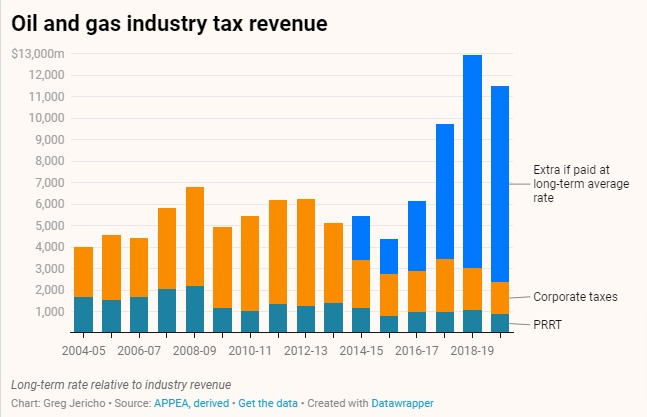
    Jericho’s analysis of industry data reveals that the industry pays much less company tax relative to production than it did in the past.

    Had the industry paid the same level of company tax relative to revenue that is had in the decade prior to the opening of the Gladstone port, in 2019-20 alone, an extra $9.1bn in tax revenue would have been raised.

    Oil and gas are Australia’s resources. Not only are their emissions causing climate change but the profits are largely headed overseas, and more than in the past not flowing through into taxation.

    As Australians demand better and wider government services, and the costs of dealing with climate change grow ever higher, we need to ensure the fossil fuel companies pay their rightful share.

    The post Gas companies are profiting off of human misery – we need a windfall profits tax appeared first on The Australia Institute's Centre for Future Work.

  • The October 2022-23 Commonwealth Budget

    In this review of the budget, our team of Centre for Future Work researchers evaluates the budget’s assumptions and policy measures, from the perspective of workers and labour markets. The budget marks a clear change of emphasis from budgets over the previous decade: including explicit recognition of the need to strengthen wage growth, new funding for vital care sectors, and important investments in diversifying Australia’s industrial base.

    However, the budget also acknowledges the downside risk of a slowing world economy, which could engulf Australia in another recession — just three years after entering the COVID pandemic. Stronger fiscal measures and income supports will be required if the economy does enter a downturn. And deep problems such as falling real wages, entrenched poverty, and gender inequality will require stronger measures than are included in this first budget. Meanwhile, crucial fiscal decisions (including the regressive Stage 3 tax cuts for high-income Australians) have been deferred for a later date.

    In sum, the budget marks a good start on addressing many of Australia’s key economic, social, and environmental challenges. But much more will be needed – and the risking of looming recession will complicate this progress considerably.

    The post The October 2022-23 Commonwealth Budget: A Good Start… But Rocky Times Ahead appeared first on The Australia Institute's Centre for Future Work.

  • The UK shows how bad the Stage 3 tax cuts will be

    Fiscal Policy Director, Greg Jericho, notes in his Guardian Australia column that there are big lessons for Australia.

    The Stage 3 tax cuts are a case of terrible economics masquerading as a growth strategy. Trickledown economics does not work, never has, and this week we have discovered that even the markets agree.

    Rather than destroy your tax base, governments need to care about sustaining a broad revenue base that works to reduce inequality and fund services and investments that drives productivity and helps those who most need it.

    Trickledown economics has never worked and was always just fraudulent spin designed to hide its real aim of giving rich and powerful people tax cuts at the expense of others.

    This week has shown that no one even believes the lie anymore.

    The post The UK shows how bad the Stage 3 tax cuts will be appeared first on The Australia Institute's Centre for Future Work.

  • The PBO reveals just how much the Stage 3 tax cuts favour the wealthy

    As labour market and fiscal policy director, Greg Jericho notes in his Guardian Australia column, the PBO estimates that of the $243.5bn that the tax cuts will cost in their first 9 years, 48% will go to people earning over $180,000, and 77% will go to the richest 25%.

    In the first year of operation, the richest 1% of income earners will get the same benefit from the tax cuts as will the poorest 65%.

    Greg Jericho notes that in 2024-25, $12.7bn of the $17.7bn annual cost of the tax cuts that year will go to those earning above $120,000. That is almost the same amount expected to be spent on Jobseeker payments that year.

    The Stage 3 cuts are designed to favour the wealthy and reduce the level of revenue which in turn will force cuts to spending and programs that assist the most vulnerable.

    The post The PBO reveals just how much the Stage 3 tax cuts favour the wealthy appeared first on The Australia Institute's Centre for Future Work.