Tag: Superannuation & Retirement

  • Life Savers Without Life Savings (firefighters & paramedics)

    Firefighters and paramedics save lives, protect us from the ravages of fire, and ensure the sick and injured receive the medical treatment they need. However, after a working life protecting others, these emergency workers face substantial risk of having inadequate retirement incomes.

    Firefighters and paramedics are regularly compelled to retire early due to particular barriers to working beyond the age of 60. Workers in these intense and challenging roles should have access to early retirement options. However, early retirement means fewer years for superannuation to grow and more years in retirement drawing on superannuation.

    The possibility of superannuation running out is significant even under relatively optimistic assumptions.

    This paper provides simulations of retirement income trajectories for firefighters and paramedics under a range of assumptions. For firefighters, these show, under relatively optimistic assumptions, an early-retiring single firefighter can expect their superannuation to run out six years before male life expectancy, nine years before female life expectancy, and 15 years earlier than for a regular retiree (retiring at 67). Under alternative scenarios, incorporating plausible risks, an early-retiring firefighter can expect their superannuation to run out 15 or more years before life expectancy.

    For paramedics, the challenges are similar and severe. Our simulations indicate that, even under optimistic assumptions, an early-retiring single paramedic can expect their superannuation to run out seven years before male life expectancy, ten years before female life expectancy, and 14 years earlier than for a regular retiree. Considering plausible risks, an early-retiring paramedic’s superannuation could run out 15 or more years before life expectancy.

    To extend superannuation longevity through to the age of their expected lifespan an early-retiring firefighter or paramedic would need to reduce their annual living expenses by 18.5%.

    Given the challenges of continuing their work in these intense roles past age 60, it is unacceptable that retired firefighters and paramedics should have either significantly reduced living standards or risk running out of superannuation in retirement.

    Among the range of potential policy responses considered in this paper, one response with promise is to increase employer superannuation contributions for emergency responders and supplement this with a one-time special superannuation contribution for workers already approaching retirement.

    The post Life Savers Without Life Savings appeared first on The Australia Institute's Centre for Future Work.
  • Australia is an energy super power, we need to use that power for good

    As the Australian Government continues to pursue policies notionally designed to reduce our greenhouse gas emissions, a great store has been placed in Australia becoming a “renewable energy superpower”. However as Labour Market and Fiscal Policy Director, Greg Jericho, notes in his Guardian Australia column, Australia already is an energy superpower. But we fail to use that power for good.

    Australia is either the world’s largest or second-largest exporter of metallurgical coal, thermal coal and LNG. And yet we have not sought to use this power to pursue policies that would reduce demand for fossil fuels and transition the world towards renewable energy. Instead, we placate mining companies and give no timeline to end coal and gas use. We continue to approve new coal mines and fail to insert a climate-change trigger into environment protection legislation that determines whether new mines can be approved.

    Given September this year was the hottest September on record, after August this year being the hottest August on record, July this year being the hottest July on record and June this year being the hottest June on record, the time for action that reduces Australia’s and the world’s emissions is urgent and critical.

    Climate change is one area where Australia can legitimately take a leading role in global affairs, our power as an energy producer and supplier of fossil fuels which continue to exacerbate climate change demands we show this leadership.

    For too long Australian governments have cowered before mining companies, now it’s the time to realise we have the minerals they want now and in the future when renewable energy becomes the dominant power and thus we can dictate terms.

    Leadership requires the grasping of power and using it for good.

    The post Australia is an energy super power, we need to use that power for good appeared first on The Australia Institute's Centre for Future Work.
  • Women Earn $1m less than men & $136,000 Less in Super over Working Life

    New research released on International Women’s Day reveals Australian women earn $1.01m less over their working lives than men, based on median income data.

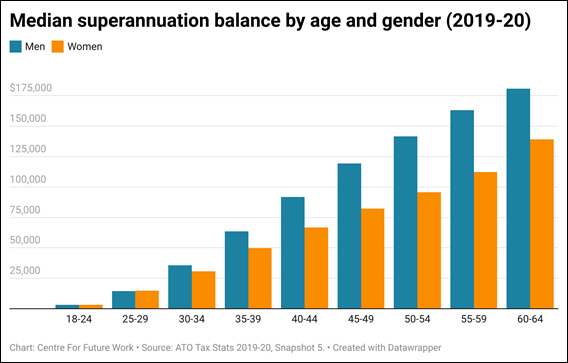
    Women earn $136,000 less in superannuation over their working lives than men, based on median income data. Women earning the median wage will accumulate approximately $393,676 in super, $151,000 below what is considered a ‘comfortable retirement’. The average super balance in Australia in 2023 is $150k.

    Experts say if the gender pay gap was eliminated women would be $3 billion per week better off.

    Despite the gender pay gap narrowing slowly, based on data from the past decade it will only be eradicated by the year 2053 when more than 60% of the current workforce will be retired.

    Key Points:

    • Australian women on a median income will earn $1.01m less over their working lives on average than their male counterparts.
    • Australian women on a median income will earn $136,000 less in superannuation over their working lives than their male counterparts.
      • Women earning the median wage will accumulate approximately $393,676 in super, $151,000 below what is considered a ‘comfortable retirement.
      • The average super balance in Australia in 2023 is $150k.
    • Experts say if the gender pay gap was eliminated women would be $3 billion per week better off.
    • The gender pay gap is narrowing so slowly that it will not fully close for another 30 years until 2053. At that stage 60% of people currently working will have retired.
    • The Gender wage gap in Australia (15.3%) is more than double what it is in New Zealand (6.7%)
    • The gender gap occurs across all occupations and industries:
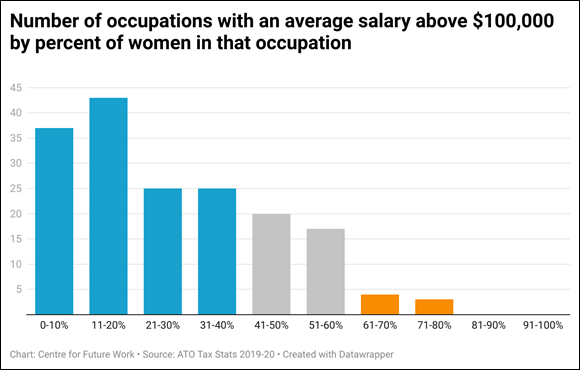
      • Men have higher average salaries than women in 95% of all occupations, including those where women dominate the workforce. For example, women account for 99% of all midwives, and yet are paid on average 19% less.
        • 80 occupations in which men make up 80% or more of the workforce have an average salary above $100,000.
        • By contrast zero occupations in which women make up 80% or more of the workforce have an average salary above $100,000.

    “For the average woman in Australia, the gender pay gap will be more than $1.01m over her working life, based on conservative estimates,” said Senior Economist Eliza Littleton from the Australia Institute’s Centre for Future Work.

    “There’s been a noisy political debate about super in Australia for the past week, but this data shows that based on median income data Australian women will earn $136,000 less than their male counter parts over their working life. When you consider that the average super balance in Australia right now is approximately $150,000, that’s a huge disparity.

    “Australian women continue to be paid less than men on average across all industries and occupations, costing us more than $3b across the economy each week.

    “We know that older women are one of the most vulnerable groups when it comes to poverty and homelessness in Australia.

    “Australian women shouldn’t have to wait until the year 2053 for substantive equality. We deserve equity today and our research makes several sensible policy recommendations for the Labor Government to action.”

    Policy recommendations:

    • Greater access to free or more affordable earlier childhood education & care: Australia Institute research shows if Australia had the same labour force participation rates as Nordic countries do, then the economy would be $60 billion, or 3.2% of GDP, larger (Grudnoff and Denniss, 2020).
    • More paid parental leave for both parents: Australia’s PPL scheme is well behind international standards. The OECD average PPL scheme is 60 weeks in total, with 24.6 weeks reserved for mothers, 10.4 weeks for fathers and 25.4 weeks that can be flexibly distributed (OECD, 2022). With a 20-week scheme, Australia unsurprisingly ranks low – 30th out of 38 countries for the duration of paid leave entitlements. Extending leave entitlements and encouraging a more even distribution of childcare would help reduce the career and financial penalty of having children both for all parents, but especially women. Additionally, making it mandatory for superannuation to be paid while a person is taking paid parental leave would help to reduce the gendered super gap.
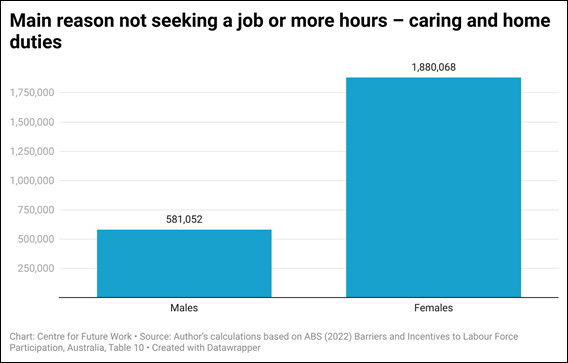
    • Greater family-friendly work practices: Some workplaces and workers have managed to maintain flexible working arrangements, but this should be standardised, expanded and embedded in employment relations frameworks to make balancing work and care more achievable across the workforce. Breaking down rigid job design in male-dominated jobs could also help with reducing entrenched gendered segregation by industry and occupation.
    • Deliberate policy to lift the wages for industries dominated by women — most urgently in the care sector: Women dominated sectors, especially in the care industry are among the lowest paid work. The 2021 Royal Commission into Aged Care Quality and Safety recommended that gig work, independent contracting and other ‘indirect’ employment arrangements be restricted in the publicly-funded aged care sector. This needs to be agreed to.
    • Address insecure work: Further reforms should include rights to family-friendly working time arrangements and stable work as minimum standards for all employees in the National Employment Standards.
    • Full recommendations in attached report

    The post Women Earn $1m less than men & $136,000 Less in Super over Working Life appeared first on The Australia Institute's Centre for Future Work.
  • Superannuation needs an objective and needs to be reviewed

    This week the government announced a review to legislate the objective of superannuation. Surprisingly, there is no official objective of superannuation and this has allowed it to be used for purposes that are decidedly not about ensuring a comfortable retirement.

    The review has sparked criticism from the opposition who are using it to suggest the government is coming after your money. But as policy director, Greg Jericho, writes in his Guardian Australia column, for the very rich, superannuation has become less about retirement and more about dodging tax.

    Because super contributions are taxed at 15% the biggest benefit goes to those who are on the highest marginal income tax rate. As a result, those with the highest incomes contribute much more of their own money to superannuation than do those on lower incomes. Those earning over $150,000 make up 7% of individuals, 27% of total income, but 32% of total personal superannuation contributions. Also because there is no limit on the size of superannuation balances that can access this tax concession it means those with the very largest superannuation balances continue to get the advantage of a tax concession that has long past any sense of assisting a comfortable retirement.

    These tax concessions are now extremely costly – costing the government almost as much as the aged pension – and moreover so slanted are the benefits to the wealthy that the richest 20 per cent cost the government more tax concessions than it would pay them the full aged pension.

    Clearly, the system is not working as it should. It is not about self-funding retirement but funding retirement by avoiding tax.

    The Treasurer has suggested putting a cap on the size of superannuation balances – somewhere around $3m. Such a size would only affect less than 1.5% of all individuals aged 55-69. But clearly needs to be done because those 1.5% hold 14% of all superannuation balances of people in that age.

    Superannuation is important and vital for the retirement of many Australians. But it should not be used just to avoid paying tax – the cost of that lost revenue is denying assistance to those who actually need help once they stop work.

    The post Superannuation needs an objective and needs to be reviewed appeared first on The Australia Institute's Centre for Future Work.

  • Wrecking superannuation, not protecting women, is the government’s priority

    Women deserve so much more than what Jane Hume is proposing, writes Alison Pennington. Photo: AAP

    It doesn’t matter what the crisis, when it comes to the Morrison government the message is clear: you’re on your own.

    As women across Australia lead historic mobilisations demanding government action on gendered violence week, the federal government encouraged women facing domestic abuse to raid their own superannuation accounts.

    Calling superannuation withdrawal measures of up to $10,000 “an important last resort lifeline” for women experiencing domestic violence, Minister for Superannuation, Financial Services and the Digital Economy Jane Hume later announced the policy would be reviewed following concerns from frontline workers about victim coercion.

    Minister Hume now proposes to strengthen the “integrity” of the scheme with safeguards protecting the free withdrawal of funds. But additional steps for accessing women’s retirement funds do not change the policy’s message: survivors of abuse must fund their own crisis supports. All the while abusers roam free – an addition of intolerable insult to injury.

    Safeguards may stop abusive partners forcing women to raid their retirement savings, but it’s not stopping the federal government. The early-release scheme is entirely consistent with the government’s clear established priorities: dismantling the superannuation system – rain, hail or shine.

    Women marching for economic security and safety are not just ignored by the government. The Coalition’s anti-superannuation crusade to transform the system into an emergency personal bank account actively exploits women’s heightened COVID-era economic vulnerability.

    Women worse off since COVID

    In the initial COVID shutdowns, women experienced greater losses of jobs and hours. Against this backdrop of women’s desperation, the federal government introduced the superannuation early release scheme. Significantly, this was introduced two weeks before the introduction of the Coronavirus Supplement and the JobKeeper wage subsidy.

    Between April and December 2020, 1.5 million women drew down their super, one-quarter of the entire female workforce. $14.9 billion was stripped from women’s already meagre retirement savings. Some 345,000 women completely emptied their accounts. Many more women aged under 20, and also those aged 36-55 (prime working years pre-retirement), withdrew from their superannuation compared to men.

    In 2018, the Coalition announced domestic violence would be added to the list of early release “compassionate grounds”. Frontline domestic violence services voiced concern back then too. Now, pressured by intensifying calls for a proactive government addressing gendered violence, the Coalition suggests “safeguards”.

    The federal government acknowledged heightened gendered violence risks during COVID. But it has still failed to give sufficient funding to the domestic violence sector, lift critical income supports for vulnerable women fleeing abuse, or introduce paid domestic violence leave into minimum labour laws. In fact, $1 million was cut from anti-domestic violence education programs in schools in the 2020 October Budget.

    Early release scheme exacerbates disadvantage

    Women already face systematic disadvantage in the superannuation system and have much lower retirement incomes: they retire with barely half the retirement savings of men. There urgently needs to be targeted reforms to prevent labour market inequalities that reduce women’s career earnings from being baked into the superannuation system as well.

    Abolishing the $450 per month minimum threshold, closing the ‘motherhood gap’ by making super payable for all paid and unpaid care-related absences, and proceeding with the legislated increase in the superannuation guarantee (to 12 per cent) are all important to boosting women’s economic security and safety.

    In the absence of real action on gendered workplace and domestic violence, the government’s superannuation early release scheme for domestic violence victims only exacerbates women’s economic insecurity.

    Women desperate for incomes to survive are more reliant on abusive partners and low-wage casual jobs, more helpless to the threat of ‘handsy’ bosses and colleagues, and below-poverty welfare payments in the future. This latest policy only increases the risks of gendered violence over women’s lifetimes.

    For women experiencing job loss, financial hardship or domestic violence, the message from the federal government is one we are getting sick of hearing: in a crisis, you’re on your own.

    Australian women deserve so much more.

    The post Wrecking superannuation, not protecting women, is the government’s priority appeared first on The Australia Institute's Centre for Future Work.

  • The Relationship Between Superannuation Contributions and Wages

    The research refutes claims made by some commentators and lobbyists that higher superannuation contributions would automatically lead to lower wages, and hence would be self-defeating. The new research finds no statistical evidence for that claim in Australian empirical data.

    The paper reviews economic statistics from the introduction of superannuation to the present. On average, wages were more likely to accelerate and grow at a faster rate when the superannuation guarantee (SG) rate was increased, than to decelerate or grow more slowly. This indicates a slight positive correlation between wages growth and changes in employers’ minimum SG rate.

    The paper also reviews theoretical predictions and empirical findings from previously published economic research. Even under very restrictive and unrealistic assumptions about competitive market-clearing behaviour in labour markets, the expectation of a fully offsetting one-for-one trade off between wages and SG contributions only occurs in the special cases of perfectly inelastic labour supply, or perfect substitutability between voluntary and policy-induced personal savings. Neither of those conditions prevail in practice. More realistic economic models (that allow for responsiveness in labour supply, minimum wages, and other real-world features) do not anticipate a full trade-off – and many expect no trade-off at all.

    The paper concludes that current record-low wage growth in Australia cannot be “fixed” by abandoning scheduled increases in the SG rate (which is currently legislated to grow from 9.5% of wages to 12% over a five-year period, beginning 1 July 2021). Abandoning those increases would only further suppress the total compensation received by workers, which has been falling steadily as a share of GDP for decades. Instead, weak wage growth should be tackled with direct wage-boosting policies; the determination of wages and superannuation contributions are largely independent policy decisions.

    The post The Relationship Between Superannuation Contributions and Wages in Australia appeared first on The Australia Institute's Centre for Future Work.