Tag: Macroeconomics

  • House prices means interest rates do not need to rise much to inflict great costs

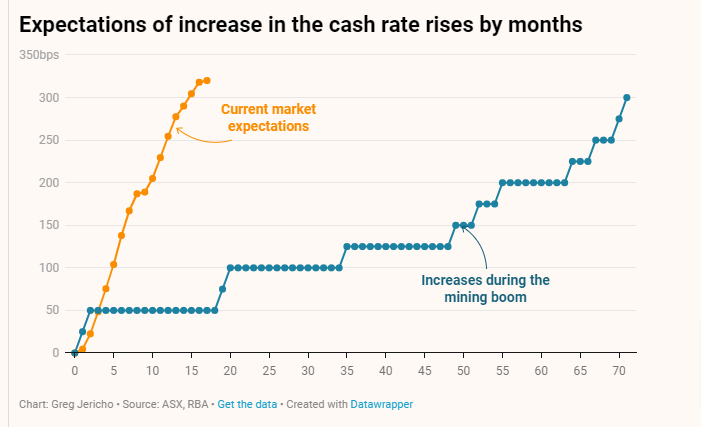
    But while that may have been a neutral rate in the past, the Centre’s Fiscal and Labour Market Policy Director Greg Jericho, notes in his column in Guardian Australia, recent surges in house prices means such a rise would place an extreme burdon on mortgage payers – one not conducive to an economy still in recovery. 

    It took nearly 6 years during the mining boom for the RBA to raise the cash rate by 300 basis points; currently the market anticipates the same rise occurring in 17 months.

    That would massively limit economic growth for little purpose at a time when wage rises remains below inflation, and rather unlikely to occur given the Reserve Bank’s recent hesitancy to slow the economy until real wage again start rising.

    The post House prices means interest rates do not need to rise much to inflict great costs appeared first on The Australia Institute's Centre for Future Work.

  • Alison Pennington: Budget billions wasted as real wages go backwards

    The federal government’s budget would have us believe that the cost of living is a sudden problem because of higher oil prices.

    But the real reason people are feeling the pinch is because their real wages are going backwards.

    The budget forecasts wage growth of 2.75 per cent in 2021-22, below inflation which is forecast to grow by 4.25 per cent. That’s a real wage cut of 1.5 per cent.

    The budget will increase the low-and-middle-income tax offset, but then scrap it at the end of this financial year. The fuel excise will be reduced for six months.

    Complex tax-bracket-shifting schemes are a good way to distract from powerful wage suppression policies. While we’re calculating “how much do I get”, these policies entrench insecure work, cap public sector pay, and stop collective bargaining. These measures hit workers every pay packet, not just at tax time.

    The amount workers get from the tax cuts is nothing compared to normal wage increases. For the 15 years to 2012, private-sector wages grew about 3.5 per cent per year. For someone on $70,000, that’s about $2500 more in one year.

    Distracting the income-strapped

    This budget is about trying to distract the income-strapped with temporary solutions that do nothing to help in the long-run. Alongside time-bound tax cuts are $250 one-off payments to income support recipients – thousands of people who permanently languish below the poverty line.

    The government is also hoping people believe in magical free-market fairies – that lower unemployment will finally unlock wages growth. As though holding a job automatically equips workers with bargaining power.

    The “record funding” fairies were out in full force, too. The Treasurer says “record funding” has been allocated in schools, hospitals, mental health, aged care, women’s safety and disability health. But if you reduce spending to rock-bottom, every marginal increase in spending with population growth can be called “record funding”.

    If it’s not enough funding to meet demand, then it can still be “record funding” for some. Shockingly, public school funding will be cut by $560 million over the next three years. Meanwhile, JobKeeper-subsidy-dripping private schools will get $2.6 billion more over the forward estimates. It’s not a budget without blows.

    Cuts to workers’ pay

    Worse, this budget signals more cuts to workers’ pay. The budget has earmarked reducing legislated minimum redundancy payments for part-time workers. This will disproportionately affect women.

    Women’s chronically low wages and poor job quality receive no attention. Hundreds of thousands of women in underfunded healthcare and social services need government to front up and fund their pay increases. This budget is proof the biggest barrier to Australian women’s progress isn’t glass ceilings, but their own government.

    This government will balls up any opportunity to address structural gender inequality. A new paid parental leave (PPL) scheme will combine the paltry two-week Dad and Partner Pay with the existing 18-week program for a combined 20 weeks. Packaged as empowering “family choice”, it will remove any incentive for fathers to take leave.

    PPL payment at minimum wage will continue to push women into primary caring roles. This is because men earn almost one-third more than women on average. That’s not women’s “choice”.

    Governments have wage-booting tools to deal with the higher cost of living. Across the ditch, New Zealand just increased the minimum wage by 6 per cent, recognising its frontline lowest-paid workers have offered the most in the pandemic, and been hit the hardest.

    Genuine cost-of-living help overlooked

    Along with boosting minimum wages, there are other options for helping workers deal with high inflation. The government could lower the cost of living by ending fee-for-service practices in all the areas they fund – child care, aged care, and disability care. Under the current government, out-of-pocket healthcare costs have increased almost three times more than CPI.

    And there’s not much hope for youth in this budget. Presented with a future of declining living standards, political dysfunction and ecological catastrophe, young people are given just $206 million in mental health funding. They can talk to someone on the phone while the world burns.

    The bottom rungs on the economic-opportunity ladder have been eliminated and youth can’t get up. Tens of thousands of educated capable youth languish in dead-end jobs. Sacrificed by a government that would rather turn unemployment into a misery industry than to create secure, career-building jobs.

    Billions of waste

    The government is wasting billions of dollars paying off their friends in business without conditions to invest in higher wages. Before this Budget, $291 billion in public spending was ploughed into a “business-led recovery” from COVID. On businesses responsibility to reinvest post-war record-high profits, there’s an eery silence.

    And in this budget, we have zero assurances new business subsidies will be invested in the real economy – people, capital, research – rather than more profit-padding.

    On budget eve, Morrison attempted to hat-tip a bygone conservative era. He said “families” will be key to winning the upcoming election. But he never invested in them, instead putting them in a pressure cooker of record-low wage growth and high living costs.

    The government was struck by enormous luck this budget. Extra revenue to play with and they’ve thrown it all away. Hundreds of billions in government spending and no era-defining economic reforms.

    Cos-of-living pressures wouldn’t be as acute if people had almost a decade of normal wages growth. But the truth is, the government has pursued wage suppression over the entire nine years it has been in power.

    The post Alison Pennington: Budget billions wasted as real wages go backwards appeared first on The Australia Institute's Centre for Future Work.
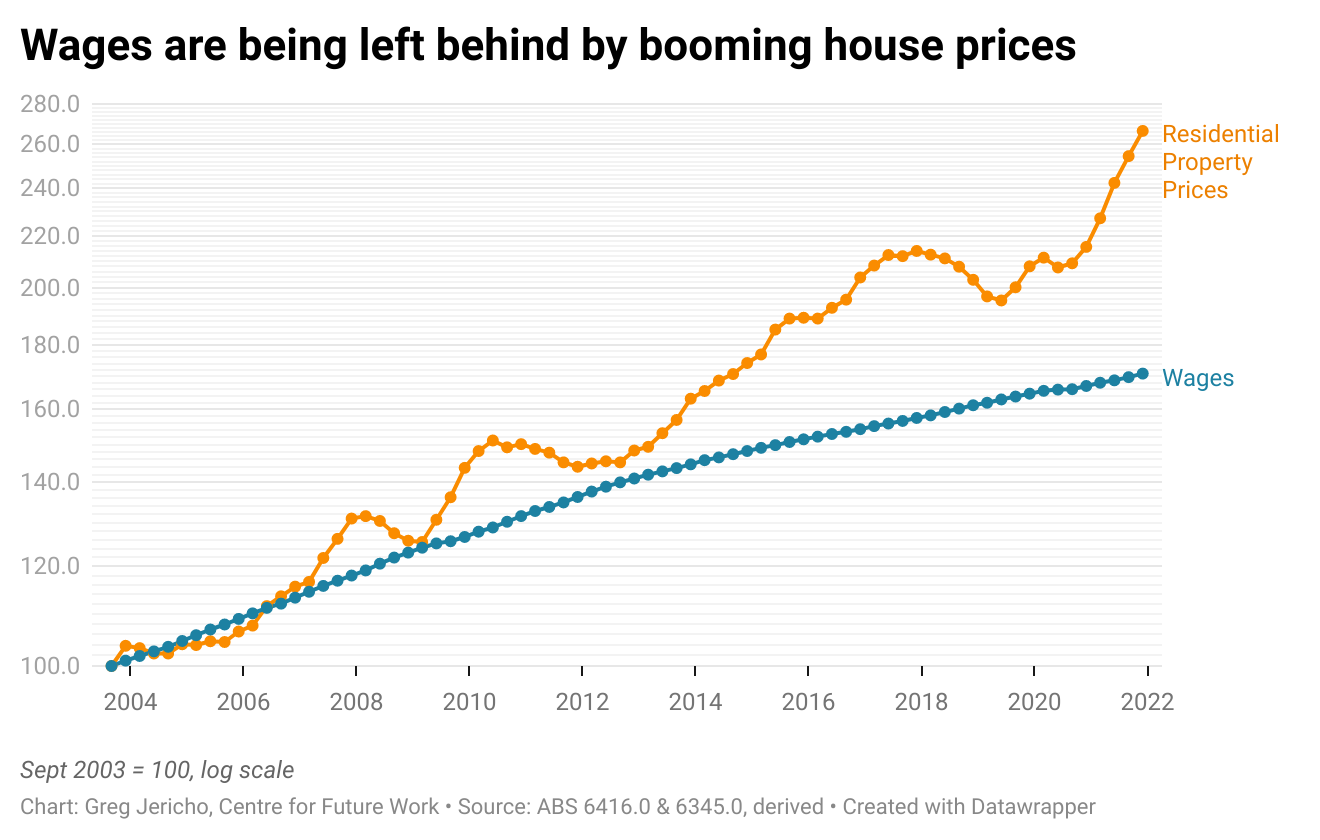
  • Flat wages and booming house prices cause housing affordability to plunge

    A decade ago the medium-priced house in Sydney was equivalent to 5.8 times the annual income of a median household; now it is 10.8 times that income. 

    Greg Jericho examines the issue in his column in Guardian Australia and drills down to look at the affordability of housing across the nation and finds a shocking, yet unsurprising tale – and one that deserves a much greater focus in the coming election campaign than is currently the case 

    https://www.datawrapper.de/_/GmaeJ/

    The post Flat wages and booming house prices cause housing affordability to plunge appeared first on The Australia Institute's Centre for Future Work.

  • Loss of Bargaining Power Explains Wage Stagnation

    Our Policy Director Greg Jericho writes in Guardian Australia that claims of a “wages breakout” remain purely a scare campaign from employer groups determined to keep wages low. He finds that once again real wages are failing to keep pace with productivity and that as a result no pressure on inflation is coming from wage claims, but instead workers are missing out. With levels of unemployment now associated with much lower wage growth than in the past, it is clear the power imbalance in wage negotiations has shifted drastically away from workers.

    The post Loss of Bargaining Power Explains Wage Stagnation appeared first on The Australia Institute's Centre for Future Work.

  • Interest Rates and the Federal Election

    Inflation is occurring off the back of the largest government intervention and the lowest interest rates in post-WWII history. But while the economy is performing better than might have been expected when the pandemic first occurred it would be a mistake now to quickly reduce economic support from the public sector.

    After the global financial crisis, worries about debt and deficit took precedence over the strength of the economy. At a time when government borrowing rates still remain historically low, the need to improve productivity through infrastructure and support in areas such as education and health, as well as equality improvements through high a higher Jobseeker rate, should take precedence in the upcoming federal budget.

    The post Interest Rates and the Federal Election appeared first on The Australia Institute's Centre for Future Work.

  • CPI Numbers Don’t Tell the Whole Story

    Jericho shows that inflation measurements can very widely for different types of household. Those with limited incomes (including government benefit recipients), who spend more of their income on ‘non-discretionary’ items, face an especially large threat to their real living standards as inflation picks up.

    See Greg’s full column, “With inflation on the rise, Australia’s cost of living will dominate the election debate,” in the Guardian Australia.

    The post CPI Numbers Don’t Tell the Whole Story appeared first on The Australia Institute's Centre for Future Work.

  • Pandemic Exacerbated Inequality, Insecurity in Australia’s Labour Market

    A year-end review of the dramatic changes in Australia’s labour market in 2020 has confirmed that the worst economic impacts of the Covid-19 pandemic were felt by Australians in relatively low-paid, insecure jobs.

    Key Findings:

    • Workers in casual jobs lost employment at a rate 8 times faster than those in permanent positions
    • Part-time workers suffered job losses 3 times worse than full-time workers
    • Young workers, women, and workers who do not work in offices also suffered disproportionate job losses during the initial shutdowns – and continue to experience much worse employment conditions
    • Worse yet, the report shows the rebound in employment that began in May has seen a historic surge in insecure jobs – which account for the vast majority of new jobs created since the economy began re-opening

    “It is painfully ironic that the worst impacts of the pandemic were felt by those who could least afford to lose their work and income,” said Dr Jim Stanford, Director of the Centre for Future Work, and co-author of the report.

    “Both on the way down, and on the way back up, this recession has reinforced the dominance of insecure work in Australia’s labour market.

    “Precarious work strategies explain why the effects of the pandemic were so painfully unequal, and this new surge in insecure work makes Australians even more vulnerable to such shocks in the future.

    “Covid-19 had a terrible impact on both the quantity and quality of work in 2020. Because Australia has been relatively successful in controlling the virus, the labour market could improve significantly in 2021, however, the rapid expansion of insecure work poses a major challenge to the stability and prosperity of Australian households,” Dr Stanford said.

    Other findings of the report include:

    • Since May, over 400,000 casual jobs have been created (2200 per day, on average), accounting for over 60% of all new waged positions since the recovery started. That is the largest surge in casual employment in Australia’s history – contradicting business and government claims that uncertainty about casual employment rules are holding back hiring.
    • Workers over 35 years of age have regained all of the jobs lost in the pandemic, and then some. All remaining job losses are concentrated among workers under 35.
    • Office-based occupations (professionals, clerical workers, and most managers) have also regained pre-pandemic employment levels. But other occupations (especially community and personal services, sales workers, and labourers) continue to suffer major employment losses.
    • New labour laws proposed by the Commonwealth government would accelerate the surge in insecure work: liberalising the use of casual labour by employers, and allowing them to treat permanent part-time workers more like casuals.

    The post Pandemic Exacerbated Inequality, Insecurity in Australia’s Labour Market appeared first on The Australia Institute's Centre for Future Work.

  • ABCC will do nothing for housing prices: Report

    Prime Minister Turnbull blamed construction workers and their union for the high cost of housing, when he re-introduced the ABCC bill in Parliament last month, claiming the bill would help “young Australian couples that can’t afford to buy a house because their costs are being pushed up by union thuggery.”

    But new research from the Centre for Future Work shows there is no statistical correlation between construction unionization or construction wages, and the soaring cost of housing.

    “The government’s claim that construction labour costs explain the rising price of housing has no basis in evidence,” Director of the Centre for Future Work, Jim Stanford said.

    “The suggestion that restricting union activity in construction can somehow deflate the great Australian property bubble reveals a critical misunderstanding of the Australian housing market.”

    The study provides detailed statistics regarding housing prices, union membership, wage growth, total construction costs, and replacement building costs. The report finds that:

    • Construction wages have grown more slowly than the Australian average over the last five years.
    • Real wage gains in construction have been slower than real productivity growth, and hence real unit labour costs in construction have declined.
    • Construction labour accounts for only 17-22 percent of the total costs of new building.
    • Construction costs, in turn, account for less than half the market value of residential property.
    • Construction labour costs correspond to less than 10 percent of housing prices (and even less than that in Australia’s biggest cities).
    • Construction labour accounts for about the same proportion of a house purchase as real estate commissions and stamp duty.

    “Homes in Australia are fast becoming unaffordable, even for the workers who build them. On average, a construction worker now needs 9.2 years of pre-tax earnings to purchase a median home – up 25 percent from just four years ago.

    “If the government is genuine in its desire to make housing more affordable in Australia, it should turn its attention to the real causes of the problem. Better policy responses would include measures to cool off property speculation, more carefully regulate the banking sector, and reform property-related taxes,” Dr Stanford said.

    The post ABCC will do nothing for housing prices: Report appeared first on The Australia Institute's Centre for Future Work.