Tag: Macroeconomics

  • The Continuing Irrelevance of Minimum Wages to Future Inflation

    Updated analysis by the Centre for Future Work at The Australia Institute reveals that a fair and appropriate increase to the minimum wage, and accompanying increases to award rates, would not have a significant effect on inflation.

    The analysis examines the correlation between minimum wage increases and inflation going back to 1990, and finds no consistent link between minimum wage increases and inflation.

    It also reveals that such an increase to award wages could be met with only a small reduction in profit margins.

    The report, authored by Greg Jericho, based on previous work by both he and Jim Stanford, finds that an increase to the National Minimum Wage and award wages of between 5.8% and 9.2% in the Fair Work Commissions’ Annual Wage Review, due in June, is required to restore the real buying power of low-paid workers to pre-pandemic trends.

    The report also finds that this would not significantly affect headline inflation.

    Key findings of the report include:

    • Last year’s decision, which lifted the minimum wage and award wages by 3.75 per cent, offset the inflation of the previous year but still left those on Modern Awards with real earnings below what they were in 2020.
    • By June this year, the real value of Modern Award wages will be almost 4 per cent below what they were in September 2020.
    • Despite increases in the minimum wage over the past 2 years above inflation, inflation fell by a combined 4.5 percentage points.
    • There has been no significant correlation between rises in the minimum wage and inflation since 1990.
    • Raising wages by 5.8 to 9.2 percent this year would offset recent inflation and restore real wages for award-covered workers to the pre-pandemic trend.
    • Even if fully passed on by employers, higher award wages would have no significant impact on economy-wide prices.
    • A 9.2 per cent increase in award wages could be fully offset, with no impact on prices at all, by a 1.8 per cent reduction in corporate profits – still leaving profits far above historical levels.

    “Australia’s lowest paid workers have been hardest hit by inflation over the past 3 years,” said Greg Jericho, Chief Economist at The Australia Institute’s Center for Future Work.

    “The price rises of necessities always hurt those on low incomes harder than those on average and high incomes.

    “This analysis shows there is no credible economic reason to deny them a decent pay raise above inflation.

    “It’s vital the Fair Work Commission ensure that the minimum wage not only keeps up with inflation but also returns the value to the real trend of before the pandemic.”

    The post The continuing irrelevance of minimum wages to future inflation appeared first on The Australia Institute's Centre for Future Work.

  • Climate crisis escalates cost-of-living pressures

    The report identifies three key areas where the climate crisis is directly driving up costs for Australians: insurance, food, and energy.

    These sectors combined have accounted for over a fifth of the consumer price inflation experienced in Australia since 2022.

    Key findings:

    • Insurance premiums have soared due to an increase in natural disasters, with some households now spending over seven weeks of gross income just to cover home insurance
    • Food prices have risen by 20% since 2020, with climate-related disruptions wiping out harvests and making it harder for some regions to grow food
    • Energy costs remain high due to a reliance on fossil fuels, underinvestment in renewables, and fossil fuel exports forcing Australians to compete with the global market for Australia’s resources
    • The impacts of the climate crisis are disproportionately affecting lower-income and regional households, who are already feeling the financial strain more severely

    The report underscores the need for urgent climate action to protect Australian households from these escalating costs. Addressing the root causes of climate change is essential to lowering future risks and alleviating the economic strain that millions of Australians are facing.

    “Insurance costs keep on rising and, while competition across big business sectors is needed, the thing that is driving insurance costs is climate change,” said Richard Dennis, Executive Director at The Australia Institute.

    “The only way to keep insurance costs down is to keep fossil fuel emissions down. The more we heat the climate, the more expensive storms, floods and fires will be and, in turn, the more insurance will cost. It’s time we started to tax the fossil fuel companies to fund the damage that their previous emissions are already causing.”

    As the world’s second-largest fossil fuel exporter and fifth largest producer, Australia’s actions are making a significant contribution to the problem.

    “The increasing frequency and severity of natural disasters driven by climate change have resulted in higher payouts for insurance companies and rising premiums for homeowners,” said Mark Ogge, Principal Advisor at The Australia Institute.

    “One in 20 Australian households now spend more than seven weeks’ worth of gross income just to pay for home insurance and in many regional areas, where household incomes are lower, the burden is even heavier.

    “As climate change continues to fuel more frequent disasters, entire suburbs or towns could become uninsurable.

    “Food prices have also surged and in some regions growing certain crops is becoming harder and harder, making food insecurity worse, and even without price-gouging by retailers like Coles and Woolworths, prices are expected to keep rising due to the ongoing climate crisis.”

    “Meanwhile, Australia’s energy sector keeps using expensive fossil fuels and there is serious underinvestment in renewable energy solutions which provide far cheaper electricity

    “Exposure to global prices for fossil fuels due to coal and gas exports has driven up local electricity costs and even if Australia moves away from international pricing, the continued risk of climate disasters damaging critical infrastructure will ensure that energy prices remain high for the foreseeable future.”

    The post Climate crisis escalates cost-of-living pressures appeared first on The Australia Institute's Centre for Future Work.

  • Doing it Tough: Cost of Living Crisis

    The current cost of living crisis in Australia has two components – the incomes that people receive, and the prices they pay for goods and services. This is what Alan Fels has recently referred to as the “two faces” of the crisis . Action to protect the living standards of Australians must address both faces of the crisis.

    As part of a broader research initiative investigating the human costs of the crisis and the impact of austerity on Australian workers, the Australia Institute’s Centre for Future Work surveyed a nationally representative sample of 1014 adults living in Australia about their household income and the costs of living. The results show that:

    • Almost three-quarters (72%) of respondents felt their wages had grown slower than prices over the previous year.
    • Over half of respondents (53%) said their household’s financial situation was worse that it was two years ago.
    • The cost of living crisis has had differential impacts. Because it has affected lower-income Australians most severely, the cost of living crisis has exacerbated inequality.
    • Respondents identified higher grocery prices as the most visible source of the increased cost of living. Six out of 10 (60%) of respondents identified groceries as the purchase where they have most noticed higher prices followed by utilities (21%) and transport (7%).
    • There was strong support for measures across a broad range of policy areas to address the costs of living. 64% of respondents said it was very important to lower utility costs to reduce cost of living pressures. 64% said it was very important to increase supermarket competition, 60% to lower medical costs, and 58% to increase the pace of wages growth.

    The respondents to this survey supported a suite of policy initiatives designed to both reduce the cost of living, and to increase wages and income supports. In their view, addressing the cost of living crisis requires a multi-dimensional approach, rather than a singular reliance on high interest rates to slow inflation.

    The report is published by the Centre for Future Work in conjunction with a one-day symposium it is hosting in Melbourne on 17 October on the crisis in living standards in Australia, and how to address it through greater investments in wages, public services, and affordable housing and energy.

    The post Doing it Tough appeared first on The Australia Institute's Centre for Future Work.

  • Chalmers is right, the RBA has smashed the economy

    Last year the government announced it was considering removing its statutory power to overrule the Reserve Bank. Thankfully it has now reconsidered that move, and the actions of the RBA over the past year serve to remind everyone that it is far from infallible.

    In its May Statement on Monetary Policy the RBA looked ahead one month and estimated that in June the annual growth of household consumption would be 1.1%. When the national accounts were released last week, the actual growth was revealed to be just 0.5%.

    Now obviously economic forecasting is a bit of a mugs game, but household consumption makes up half of Australia’s economy and accounted for around 45% of all the growth in the economy over the past decade so it is pretty important. It is also the area of the economy most directly affected by interest rate rises. This error of forecasting suggests that the Reserve Bank has rather poorly misread just how greatly households had been impacted by the 13 rate rises that had taken the cash rate from 0.1% in April 2022 to 4.35% in November 2023.

    This error is crucial because the main reason the RBA raises rates is to reduce the ability of households to spend. Because you can’t tell your bank that you don’t really feel like paying your mortgage this month, interest rate rises force households to divert money that would have been spent on goods and services to paying your mortgage.

    The problem is when you are trying to slow down half of the economy so directly, if you overdo it the entire economy begins to fall. This is what happened in the early 1980s and 1990s when interest rates were raised sharply in order to slow inflation.

    And the private sector has already slowed so greatly that the only reason GDP rose in the past year was because of increased government spending.
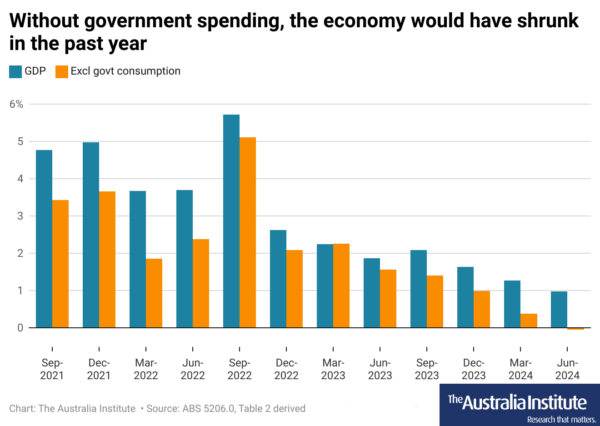
    That is not a sign of a strong economy, nor a sign of one, according to the assistant governor of the RBA, Dr Sarah Hunter, that “is running a little bit hotter than we thought previously”.

    Economies that are running a bit hot are ones in which households are spending a lot more than they were the year before because unemployment is falling and wages are rising well ahead of inflation. Instead we currently have a situation where unemployment has risen from 3.5% in June last year to the current level of 4.2%, household spending grew just 0.5% – well below the long-term average of 3% – and real wages in the past year rose just 0.1%.

    When asked about this discrepancy between reality and the RBA’s belief, the Governor of the Reserve Bank, Michele Bullock told reporters last week that

    …it’s the difference between growth rates and levels.

    She noted that “it’s true that the growth rate of GDP has slowed” but that “part of monetary policy’s job has been to try and slow the growth of the economy because the level of demand for goods and services in the economy is higher than the ability of the economy to supply those goods and services. So there’s still a gap there. So even though it’s slowing, we still have this gap.”

    In effect Bullock was telling people to stop worrying about the fact that household consumption was barely growing or that GDP only grew because of government spending or that GDP per capita has fallen for a record 6 consecutive quarters because the amount of consumption and GDP was too high.

    This could make sense – think of it like a car travelling on a 60km/h road. If it was travelling at 80km/h and slowed to 70km/h even though it was slowing it would still be going too fast.

    In essence this is what Bullock is arguing is happening to demand in the economy – it is slowing but overall there’s still too much of it.

    The only problem is that this is completely wrong.

    Consider the suggestion that the demand for goods and services is higher than the ability of the economy to supply those goods and services. One simple way to look at this is to see if the amount of goods and services bought per person is currently at a level consistent with the growth observed in the decade before the pandemic.

    This is actually not a major test – household consumption, along with most of the economy was rather weak in the 7 or 8 years before 2020. The RBA at the time actually was hoping Australians would spend more than they did, so you would expect in an economy with too much demand that the amount of things we are buying is well above the levels of that particularly weak period.

    But it is not.

    As we can see from the below graph, while household spending did quickly recover after the lockdowns in 2020 and 2021, by the time the RBA began raising interest rates our level of demand for goods and services was only back to the level consistent with the pre-pandemic growth.
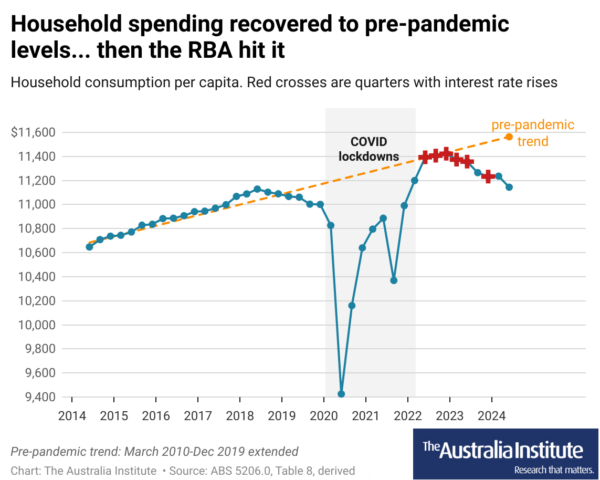
    Now yes you can argue the RBA was right to increase rates at that time – to ensure our spending didn’t keep zooming up in recovery. But by the time of the 10th rate increase in March 2023, household spending per person was already falling and 0.7% below the pre-pandemic trend. When the RBA raised rates for there 12th time in June 2023, the level of demand for goods and services was 1% below the pre-pandemic trend.

    At this point you might think the RBA had done enough. But after pausing for 4 months, the bank inexplicably raised rates for a 13th time in November 2023. At this stage household level of spending was 2.5% below the pre-pandemic trend.

    And because interest rate rises take months to worth through the economy we now find ourselves at a point where the level of household consumption per person is 3.8% lower than would have been expected had households merely kept increasing our consumption in line with the decade before the pandemic.

    In effect Australians are currently consuming almost the same amount of goods and services as they did in June 2018 and yet the head of the RBA would have us believe that is a case of excess demand.

    If we look at the overall economy, the picture is much the same (see the graph at the top of the page). Australia’s level of GDP per capita did recover quickly after the lockdowns and by June 2022 was 1.4% above the pre-pandemic trend level. But the interest rates rises had an immediate impact – reducing GDP per capita in 7 of the next 8 quarters. By June 2023 the level of activity in the economy was already below pre-pandemic expectations, and when the RBA hit Australians with the 13th rate rise in November 2023, the level of GDP per capita was 1.2% below the long-term trend.

    It is now 2.5% below – back at the level it was in June 2021.

    The RBA has got it wrong. They were initially worried that inflation was driven by concerns of strong wage growth rather than supply side issues and corporate profits. They then tried to argue household spending was still growing too strongly. The GDP figures showed that to be woefully mistaken. They then tried to argue that while growth in the economy was slow, there was still too much demand. But again the figures show this to be mistaken.

    The Treasurer Jim Chalmers stated nothing but the facts when he said earlier this month that rate rises were “smashing the economy”. The data supports his assertion, and it is time the RBA admits that their actions have not only slowed the economy but slowed it at a pace that is now harming Australians for no benefit other than the RBA saving face from its previous over-reactions.

    The post Chalmers is right, the RBA has smashed the economy appeared first on The Australia Institute's Centre for Future Work.

  • Cost of living crisis hits lowest earners hardest

    Research showing the cost of living crisis disproportionately affects low-income workers.

  • Minimum wage increase won’t cause inflation

    Research showing minimum wage rises do not drive inflation.

  • Budget 2024-25: Resists Austerity, Reduces Inflation

    Targeted cost of living measures will directly reduce inflation in some areas (like energy and rents), while helping working Australians deal with higher prices in others (including reworked State 3 tax cuts, and support for higher wages for ECEC and aged care workers). Unlike previous years, the budget is projecting real wage gains in coming years that are actually likely to materialise — however, the damage from recent real wage cuts will take several years to repair, and further support for strong wage growth will be required, from both fiscal policy and industrial laws. The budget also spelled out initial steps in the government’s Future Made in Australia strategy to build renewable energy and related manufacturing industries; these steps are welcome but need to be expanded, and accompanied by strong and consistent measures to accelerate the phase-out of fossil fuels.

    Our team of researchers at the Centre for Future Work has parsed the budget, focusing on its impacts on work, wages, and labour markets. Please read our full briefing report.

    The post Budget 2024-25: Resists Austerity, Reduces Inflation, Targets Wage Gains appeared first on The Australia Institute's Centre for Future Work.

  • Increasing minimum wage would not drive inflation up: new report

    The analysis, The Irrelevance of Minimum Wages to Future Inflation, examines the correlation between minimum wage increases and inflation going back to 1997.

    It finds that, contrary to employer concerns, there is no consistent link between minimum wage increases and inflation in the modern Australian context.

    The report finds that a minimum wage rise of between five and 10 per cent in the Fair Work’s Annual Wage Review, due in June, is needed to restore the real buying power of low-paid workers to pre-pandemic trends, but would not significantly affect headline inflation.

    Key points:

    • Last year’s decision, which lifted the minimum wage by 8.65 per cent and other award wages by 5.75 per cent, offset some but not all of the effects of recent inflation on real earnings for low-wage workers.
    • At the same time, inflation fell by 3 full percentage points.
    • There has been no significant correlation between rises in the minimum wage and inflation since 1997.
    • Raising wages by 5 to 10 per cent this year would offset recent inflation and restore the pre-pandemic trend in real wages for award-covered workers.
    • Even if fully passed on by employers, higher award wages would have no significant impact on economy-wide prices.
    • A 10 per cent increase in award wages could be fully offset, with no impact on prices at all, by just a 2 per cent reduction in corporate profits – still leaving profits far above historical levels.

    “Australia’s lowest paid workers have been hardest hit by inflation since Covid. There is a moral imperative to restore quality of life for these Australians and this analysis shows that there is no credible economic reason to deny them,” Australia Institute and Centre for Future Work Chief Economist Greg Jericho said.

    “It’s vital the Fair Work Commission ensure that the minimum wage not only keeps up with inflation, but also grows gradually in real terms – as was the trend before the pandemic.

    “Whenever wages go up, the business lobby cries wolf, claiming it will cost people their jobs, shutter businesses and stifle competition.

    “The business lobby always has some reason that wages should be suppressed. But the historical data prove that concerns about inflation are not a credible excuse to deny low-paid workers a much-needed pay rise.

    “Even if businesses respond to minimum wage rises by charging consumers more, it would have a minuscule effect on inflation because it would be subsumed by much larger factors including chain disruptions, energy shocks, and corporate profits.”

    The post Increasing minimum wage would not drive inflation up: new report appeared first on The Australia Institute's Centre for Future Work.

  • The Irrelevance of Minimum Wages to Future Inflation (2024)

    The report, co-authored by Greg Jericho (Policy Director) and Jim Stanford (Director), finds that a minimum wage rise of between five and 10 per cent in the Fair Work’s Annual Wage Review, due in June, is needed to restore the real buying power of low-paid workers to pre-pandemic trends, but would not significantly affect headline inflation.

    Key findings of the report include:

    • Last year’s decision, which lifted the minimum wage by 8.65 per cent and other award wages by 5.75 per cent, offset some but not all of the effects of recent inflation on real earnings for low-wage workers.
    • At the same time, inflation fell by 3 full percentage points.
    • There has been no significant correlation between rises in the minimum wage and inflation since 1997.
    • Raising wages by 5 to 10 per cent this year would offset recent inflation and restore the pre-pandemic trend in real wages for award-covered workers.
    • Even if fully passed on by employers, higher award wages would have no significant impact on economy-wide prices.
    • A 10 per cent increase in award wages could be fully offset, with no impact on prices at all, by just a 2 per cent reduction in corporate profits – still leaving profits far above historical levels.

    “Australia’s lowest paid workers have been hardest hit by inflation since Covid. There is a moral imperative to restore quality of life for these Australians and this analysis shows that there is no credible economic reason to deny them,” Jericho said.

    “It’s vital the Fair Work Commission ensure that the minimum wage not only keeps up with inflation, but also grows gradually in real terms – as was the trend before the pandemic.

    The post The Irrelevance of Minimum Wages to Future Inflation appeared first on The Australia Institute's Centre for Future Work.

  • RBA rate rises are hurting workers most

    How RBA interest rate rises are falling hardest on working Australians.