Tag: Insecure & Precarious Work

  • Turning Gigs Into Decent Jobs (Victorian On-Demand Workforce)

    The government of Victoria is holding an important inquiry into the conditions and challenges of working in the ‘on-demand’ economy: a polite euphemism for gigs. The Centre for Future Work has made a submission.

    Our submission notes that digitally-mediated on-demand production typically incorporates five broad characteristics:

    • Work is performed on an on-demand or as-needed basis. Producers only work when their services are immediately required, and there is no guarantee of ongoing engagement.
    • Work is compensated on a piece-work basis. Producers are paid for each discrete task or unit of output, not for their time.
    • Producers are required to supply their own capital equipment. This typically includes providing the place where work occurs (their home, their car, etc.), as well as any tools, equipment and materials utilised directly in production. Because individual workers’ financial capacity to provide these up-front investments is limited, the capital requirements of platform work (at least that used directly by workers) are small.
    • The entity organising the work is distinct from the end-user or final consumer of the output, implying a triangular relationship between the producer, the end-user, and the intermediary.
    • Finally, some form of digital intermediation is utilised to commission the work, engage the producer, supervise it, deliver it to the final customer, and facilitate payment. In the modern economy, this last criteria is hardly exrtaordinary: virtually any job imaginable today relies on some form of digital task allocation or management.

    Despite the media hype which on-demand platforms have generated, the scale of employment engaged in on-demand work so far is rather modest. The number of people engaged in actual productive work organised through a digital platform is small (less than 1% of the labour force), and a large (likely majority) proportion of those rely on on-demand work for only a minority of their total income. Many people have signed up to perform work through one or more of these platforms, but do not stay with the platform long, and/or do not work many hours in the role.

    Another stereotype that needs to be challenged in considering on-demand work is the common claim that these employment practices are novel and innovative. Here it is crucial to distinguish between the technical innovations which these businesses utilise, and the changes in work organisation which those models also introduce. In fact, the major organisational features of digital platform work are not new at all. These practices have been used regularly in labour markets for hundreds of years; what is novel is the use of digital technologies for organising, supervising, and compensating work in that manner. And the growth of insecure or precarious work practices is not an essentially technology-driven phenomenon. Rather, the growing precarity of work, including in digitally-mediated on-demand jobs, reflects the evolution of social relationships and power balances, more than technological innovation in its own right. Appreciating the social and regulatory dimensions of technology and work organisation contributes to a more holistic and balanced understanding of the rise of on-demand work, its consequences, and its potential remedies.

    All the core features associated with on-demand work are long-standing. The practice of on-call or contingent labour – whereby workers are employed only when directly needed – has been common for hundreds of years. In an Australian context, a famous example is the former practice of dockworkers lining up each morning (for example, along Sydney’s ‘Hungry Mile’) in hopes of attaining employment that day; other examples are common in other sectors (including minerals, forestry, manufacturing, and agriculture).

    Home-based work, and other systems in which workers supply their own capital equipment, have also been common in many applications and contexts – from the ‘putting out’ system for manufacturing textile products and housewares in the early years of the industrial revolution, to the important role played by owner-operators in many modern industries (including transportation, resources, fisheries, and personal services).

    Piece-work compensation systems also have a long if uneven history. Employers have long aimed to tie compensation directly to output (as a way of shifting responsibility for managing work effort and productivity onto workers). Yet at the same time, the use of piece-work is constrained by numerous well-known problems, including difficulties in applying them in situations which require an emphasis on quality, not just quantity of output (like most service sector activities), and where work is performed jointly by teams or larger groups of workers.

    Finally, the triangular relationship that is evident in the on-demand economy between the worker/producer, the ultimate end-user of their labour (whether a business or a consumer), and an intermediary/‘middleman’ business is also very familiar from economic history. Past examples include labour hire services, “gang-masters,” and other forms of labour supply intermediation. Under this triangulated model of employment, it can be unclear who is the actual ‘employer’; this ambiguity opens the possibility for various negative practices and outcomes, which have been recognised for years in legislation, regulation, and jurisprudence. An example is Australia’s long-standing rules regarding ‘sham contracting’, and more recent initiatives to regulate labour hire businesses in Queensland and Victoria.

    In short, the core features of on-demand work are not novel; and claims that this way of organising work is ‘new’ are not valid. Rather, on-demand businesses reflect a resurgence of very old business practices, that date back hundreds of years. So ‘gig’ employers cannot be allowed to invoke claims of technological advancement, to justify work practices that are hundreds of years old – and in many cases violate community standards and traditional labour laws.

    The post Turning ‘Gigs’ Into Decent Jobs appeared first on The Australia Institute's Centre for Future Work.
  • The REAL Diary of an Uber Driver

    A version of this commentary originally appeared on the 10 Daily website.

    The REAL Diary of an Uber Driver

    by Jim Stanford

    ABC recently announced plans for a new 6-part television drama called “Diary of an Uber Driver.” It’s hard to imagine that an Uber driver’s actual life would make for riveting TV viewing. Here’s an illustrative account I have constructed, based on observations and real conversations with ride-share drivers:

    5:25 am. Shower and quick breakfast. Uber says I can “work when I want.” So why am I up at 5? Because that’s when there’s customers.

    6:10 am. Got one ride to the City, now deadheading back to suburb where the app says they need cars. 20 minutes of my time, plus petrol, down the tube.

    7:38 am. Been waiting 7 minutes for fare to come out of her house; I can charge her extra – but she’ll likely give me 2 stars out of 5 on the customer rating.

    8:12 am. Asshole office guy demands to get out at a traffic island. Totally illegal. If I refuse, I’ll lose stars.

    8:35 am. Driving obnoxious kid and dad to school. Kid waving a stuffed animal out the window, dangerous and illegal. If I tell the dad to stop it, I’ll lose more stars.

    9:20 am. Buy petrol. Price up another 3 cents. Apparently I operate an “independent” business, but I can’t raise my price when costs rise. In fact, I never even touch the money – it all goes through the app.

    9:28 am. Next door at Aldi’s buying bottled water, candies, and gum. $16. Customers expect the perks – and I gotta buy them, or lose my stars.

    10:35 am. Been waiting 15 minutes without a fare. Waits that long cut my effective hourly wage by a third. Think I’ll go home and go back to sleep.

    3:20 pm. Back on the app. Deadhead back to the City for rush hour.

    5:17 pm. Waiting 3 minutes in no-stopping zone for guy who said he’d be right there. Risking big ticket. Could move, would lose stars.

    6:20 pm. Cop eyes me at traffic light as I accept next fare on the app. I know it’s illegal, but it’s the only way to work it. If he fines me ($484 and 4 demerits), that’s 3 days’ net pay. I’m lucky.

    7:18 pm. Arrogant stockbroker gives me 2 stars, even though nothing went wrong. Why? Maybe it was my skin colour, not my service.

    8:25 pm. Drunken kids demand I go through McDonald’s. If I refuse, 2 stars for sure. Car now smells like French fries. And they spilled Coke on my carpet; another cleaning. They give me 2 stars anyway. I could give them 2 stars (as their rating), but it doesn’t matter. The customer is always right, and they’ll always get a driver. I might not find another job.

    9:38 pm. Another 15 minute wait for next fare. I suspect I’m being punished by the algorithm: it sends more jobs to preferred drivers.

    10:33 pm. More drunks, demanding to play Spotify through my sound system. Cranking it to the max. Stars at risk if I complain.

    1:18 am. Slow night, too many drivers out there. Getting very tired. Uber limits me to 18 hours work in any 24 (gosh); gotta sign off soon. I could always switch to Lyft and drive a few more hours. App sends rah-rah message that I could get to $250 for the day with a couple more fares.

    1:52 am. Deadhead home. App tells me I made $276, 15 hours on-line. That’s before petrol ($60 today), vehicle costs, data costs, and the damn gum. I’ll be lucky to keep half that. Didn’t make the minimum wage today… what else is new?

    This doesn’t make for feel-good viewing, by any definition. So what is ABC thinking?

    The mini-series is a spin-off from a blog and subsequent book by Ben Phillips, who began driving for Uber in Sydney after his own small business went belly-up. His writing describes many strange encounters with weird customers and other characters. The series will also draw in his own personal angst – including fears about becoming a father.

    In short, it’s like Taxi Driver for the gig-economy: a chronicle of mini-dramas compiled by a neurotic driver, ferrying colourful passengers around the big, lonely city. There will surely be entertainment value in some scenarios. But it’s hardly an accurate portrayal of the mind-numbing, exploitive reality of ride-share driving. And the whole concept raises questions that the broadcaster and its viewers should ponder carefully.

    For starters, why is the ABC naming a TV series after a corporation? Uber is the best-known ride-share company, sure, but there are many competitors. Moreover, conventional taxis are still a mainstay of urban transportation – and taxi drivers surely have as many interesting stories as Phillips. Taxis, however, are old-fashioned, while Uber is “cool.” ABC is riding the coattails of Uber’s brand by naming the whole show after it. Unfortunately, this also provides profile and endorsement to a troubled and controversial American corporation – one gearing up for a potential $120 billion (U.S.) stock offering.

    Let’s set that ethical issue aside. An even bigger concern is that the series will whitewash, even glamorise, a highly exploitative employment practice whose legitimacy and even legality is under siege in courtrooms and parliaments around the world. Uber has recently lost precedent-setting legal cases in France, Italy, the U.K., the U.S., and Canada. More challenges are underway, including in Australia.

    Uber has been avoiding the risks, costs, and responsibilities that come with directly employing drivers – inconveniences like minimum wages, workers’ compensation, paid holidays, and more. Drivers pay all vehicle costs (including depreciation, maintenance, tires, petrol, phone and insurance). Uber controls all payments (through the app), deducting booking fees and a fat 27.5% commission; the driver is stuck with all other costs (including GST), hoping there’s enough left at the end to buy groceries. They can be fired for inadequate consumer ratings (logged through the app’s 5-star system). Uber claims its drivers are “entrepreneurs,” not employees – but that fiction is crumbling in the face of myriad legal challenges.

    In practice, many Uber drivers make well under the minimum wage: my 2018 research indicated average pay (after vehicle expenses) of $14.62 per hour across 6 Australian cities; other surveys suggest even less. Other issues faced by drivers include dismissal without severance or recourse; traffic fines (including for operating the Uber app while driving); unlimited competition (there’s no cap on how many drivers can sign on); and deadening, dangerous hours. Little wonder 90% or more of Uber drivers quit within a year.

    It’s hard to believe this series will portray the ugly side of ride-share driving. Instead, working for Uber will come off as a humble but meaningful vocation: one where human interaction (rather than earning the minimum wage) is the main remuneration. At a moment when the exploitive practices of Uber and other gig employers are finally receiving critical attention around the world, this smells like corporate propaganda, not high-quality drama.

    The post The REAL Diary of an Uber Driver appeared first on The Australia Institute's Centre for Future Work.

  • Permanent Casuals, and Other Oxymorons

    Here is a commentary from Jim Stanford, Director of the Centre for Future Work, discussing the implications of these decisions for the mis-use of casual work. The commentary was originally published on the Ten Daily website.

    Time to rethink reliance on casual work

    Casual work has become a pervasive feature of Australia’s labour market. Until the 1990s, almost all workers, even part-timers, had permanent jobs with reasonably predictable schedules and access to normal work-related entitlements (like paid holidays and sick time). But then employers became obsessed with achieving “flexibility” in hiring. Flexibility sounds like a good thing, but in practice it meant granting employers more freedom to disemploy their workers, with no notice and no severance costs. The downside for workers is lack of certainty in rostering, poor job security, and no access to paid leave. That makes it impossible to make major purchases, plan child care, or take family holidays.

    At last count, around 25 percent of paid employees in Australia (or over 2.5 million workers) were employed on a casual basis. The incidence of casual work has grown noticeably since 2012, when the mining investment boom ended and the overall labour market weakened. Casual work has grown fastest in full-time positions, and among male workers. For young workers (under 25), casual work is especially ubiquitous: 55 percent work casual. OECD data indicates that Australia now has the highest incidence of temporary work of any industrial country.

    Because it is so common, casual work has become “normalised” in the eyes of employers and policy-makers. For example, Craig Laundy, former Commonwealth Minister for the Workplace, endorsed casual work enthusiastically this year, saying it is “a completely appropriate way for many businesses and many employees to conduct their relationship.” Even business lobbyists admit that most casual staff actually work regular and predictable schedules.

    With this normalisation, many industries in Australia now rely on casual work as a permanent, core feature. Instead of using casual workers to meet temporary or seasonal fluctuations in demand, thousands of employers tap a permanent pool of casual workers to meet ongoing staffing requirements. Workers can be stuck on casual status even if they work regular shifts, for years at a time.

    In theory, employers pay a price for this super-flexibility: Australia’s casual loading rules require a 25 percent wage penalty to be paid to casual workers: compensation for lack of access to paid sick leave and holidays, and for the insecurity and instability attached to casual work. In practice, many employers do not pay this wage premium – effectively “hiding it” in lower base wages, or else evading it entirely (especially for young and foreign workers who do not understand the rules). But even if they do pay casual loading, employers should be prevented from abusing casual work as is now commonplace. After all, the inherent insecurity of casual work imposes a cost on workers and their families – a cost that grows if that insecurity is permanent.

    A series of recent legal decisions, however, is now challenging the assumption that casual work can be normal, legitimate and universal. Three particularly important cases could force employers to rethink their reliance on casual staffing:

    • A Federal Court judgment has ordered a labour hire company to pay retroactive annual leave to a mine driver who worked casual for several years, even though he was assigned to regular shifts. Employers complain this ruling somehow amounts to “double-dipping:” they claim that paying the 25 percent casual loading somehow entitles employers to deny paid holidays and other normal rights, even to long-term staff. That assumption has now been refuted.
    • The Fair Work Commission has decided to harmonise evening and Saturday penalty rates between casual and permanent workers in the retail sector. Until now, casuals were denied penalties of up to 25 percent of base wages for those shifts, compared to permanent workers. Now the penalties for casual workers will be raised to the same level as for permanent staff (although, perversely, the Commission is also in the process of cutting penalty rates for all workers on Sundays and holidays).
    • Another Fair Work Commission ruling affecting 85 different modern awards affirmed the right of casual staff to request conversion to permanent status after working regular shifts for a year. Employers can turn down those requests, but only if they would result in major changes in the applicant’s hours of work, or are otherwise “unreasonable.”

    Employers are pushing back hard against these precedents – and they seem to have the ear of the federal government. Business lobbyists predict billions in back payments arising from the annual leave decision, and are demanding legislative changes to avoid those costs. Kelly O’Dwyer, Minister for Jobs and Industrial Relations, has promised to investigate the idea. Some business groups are even proposing a brand new category of “perma-flexi” workers, who would receive a (smaller) wage loading for accepting casual status for years at a time. Anxious to preserve this highly profitable staffing practice, business leaders seem oblivious to the oxymoron inherent in their proposal for permanent casual work.

    Business complaints about the costs of treating casual workers fairly ring hollow. The 25 percent casual loading system was never intended as a carte blanche: that is, a kind of “permit” that granted employers permission to keep workers in perpetual insecurity, denied access to basic security and regular entitlements. Employers who used casual workers only where originally intended – that is, in temporary or irregular shifts – can continue to do so without significant extra costs.

    However, while promising, these recent decisions do not fully address the misuse of casual work. Casual workers should have broader options to convert to permanent status after shorter periods (say, six months) in a regular position. And the application of casual employment rules (which deny termination pay and notice of dismissal to workers, as well as access to paid leave) should be restricted to carefully-defined and genuine situations of temporary or volatile demand.

    Nevertheless, these recent decisions are an important recognition that employers have been abusing this form of employment. And they are a wake-up call to employers, who should now think hard about reducing their reliance on casual staffing – and get back to creating steady jobs that workers (and their families) can count on.

    The post “Permanent Casuals,” and Other Oxymorons appeared first on The Australia Institute's Centre for Future Work.

  • The Dimensions of Insecure Work in Australia

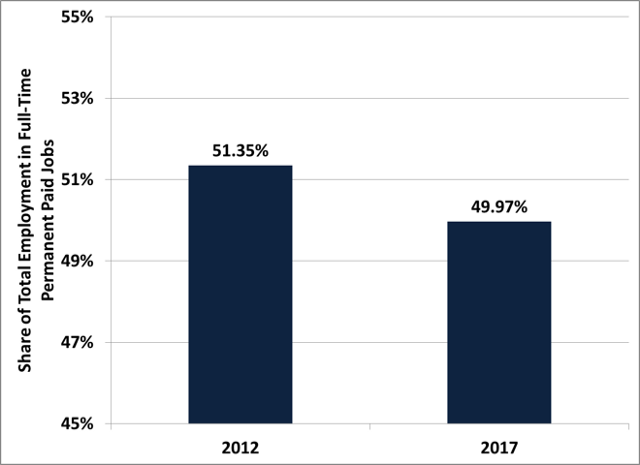
    Share of Workers in Full-Time Paid Employment with Leave Entitlements. Source: Centre for Future Work calculations from ABS Catalogues 6291.0.55.003, EQ04 (2017), and 6333.0 Tables 2.3 and 9.1 (2012).

    The report, The Dimensions of Insecure Work: A Factbook, reviews eleven statistical indicators of the growth in employment insecurity over the last five years: including part-time work, short hours, underemployment, casual jobs, marginal self-employment, and jobs paid minimum wages under modern awards.

    All these indicators of job stability have declined since 2012, thanks to a combination of weak labour market conditions, aggressive profit strategies by employers, and passivity by labour regulators. Together, these trends have produced a situation where over 50 per cent of Australian workers now experience one or more of these dimensions of insecurity in their jobs - and less than half have access to “standard,” more secure employment.

    “Australians are rightly worried about the growing insecurity of work, especially for young people,” said Dr. Jim Stanford, one of the co-authors of the report. “Many young people are giving up hope of finding a permanent full-time job, and if these trends continue, many of them never will.”

    The report also documents the low and falling earnings received by workers in insecure jobs. While real wages for those in permanent full-time positions (the best-paid category) have grown, wages for casual workers have declined. And part-time workers in marginal self-employed positions (including so-called “gig” workers) have fared the worst: with real wages falling 26 percent in the last five years.

    “Given current labour market conditions and lax labour standards, employers are able to hire workers on a ‘just-in-time’ basis,” Dr. Stanford said. “They employ workers only when and where they are most needed, and then toss them aside. This precariousness imposes enormous risks and costs on workers, their families, and the whole economy.”

    Dr. Stanford called on policy-makers to address growing precarity with stronger rules to protect workers in insecure jobs (such as provisions for more stable schedules, and options to transition to permanent from casual work). He also stressed the need for economic policies that target the creation of permanent full-time jobs.

    The post The Dimensions of Insecure Work in Australia appeared first on The Australia Institute's Centre for Future Work.

  • Insecure work: The New Normal

    In this commentary article published originally by Ten Daily, Our Director Dr. Jim Stanford summarises the findings of the Centre’s recent report on “The Dimensions of Insecure Work.”

    If You Have A Stable Full-Time Job You’re An Endangered Species

    Ask any young job-seeker about their prospects of finding a permanent full-time job, and they won’t know whether to laugh or cry. Sure, they might get a few hours of work here, a few hours there: piecing together disparate “gigs” in hopes of paying the rent.

    But landing a permanent full-time job with a regular salary and basic benefits (like paid holidays and superannuation)? Dream on.

    It’s no surprise that young workers experience the insecurity of modern work most brutally: they don’t have experience, seniority, or connections to help them in their hunt. But precarious work now affects Australians of any age, in all sectors of the economy, not just those trying to break in. What was once considered a “standard” job – the kind where you know where and when you will work, and how much you will earn – now feels like the exception, not the rule. And in fact, the hard numbers now confirm it: insecure work has indeed become the new normal.

    With co-author Dr. Tanya Carney, I recently assembled data on eleven different dimensions of job insecurity, based on official statistics from the Australian Bureau of Statistics and other government sources. We considered many aspects of the problem: including the rise of part-time work, casual jobs, people working very short hours, temporary foreign workers, and workers in nominally “self-employed” positions.

    In every case, there has been a marked increase in insecurity in recent years. A turning point was reached in 2012, as the mining investment boom (that underpinned several years of strong job conditions) turned down. That boom, and associated macroeconomic expansion, had masked longer-run structural shifts in the nature of employment – but only for a while. But now, since 2012, the sea-change in employment relationships is starkly visible.

    It was when we put all of these different indicators of insecurity together, that a startling conclusion became clear. The standard “job” has been whittled away on all sides – by part-time work, by casual and temporary jobs, by shifting more tasks to supposedly independent contractors and self-employed gig workers. And in 2017, for the first time since these statistics have been collected, the proportion of employed Australians filling a standard job fell below 50 percent. Less than half of employed Australians now work in a permanent full-time paid position with basic entitlements (like sick pay and paid holidays).

    In other words, most employed Australians experience one or more dimensions of insecurity in their jobs. Insecure work, once on the margins of the labour market, is now the norm. In fact, many workers experience multiple aspects of this insecurity.

    For example, part-time marginally self-employed workers are among the most insecure of all. They have no employees of their own; most aren’t even incorporated. They get a tax number, and then scrabble from gig to gig – accepting outsourced work from large firms who once hired actual employees to perform these tasks. Their incomes, low to start with, have declined a shocking 26 percent in real terms since 2012. They now make, on average, barely one-third as much as a typical paid full-time permanent employee.

    Surprisingly, some defenders of the status quo in Australia’s labour market deny any problem with job security. For example, Craig Laundy, Australia’s Minister for Small Business, claims insecure work is not actually more common, and defends casual work as “a completely appropriate way for many businesses and many employees to conduct their relationship.” Business lobbyists also deny work has become any less secure.

    But this flies in the face of both the official statistics, and the lived experience of millions of Australians struggling to find stable employment. And the increasing precarity of modern work in turn produces a spate of economic, social and political consequences. Households can’t predict their future income; they also can’t make long-run financial commitments (like buying a home, supporting children through higher education, or saving for retirement). Consumer spending and financial stability suffer, as does growth and job-creation.

    Politically, the frustration of millions of Australians about this chronic insecurity will inevitably bubble up at the polling booths. Job insecurity has reached a tipping point, now that less than half of all employed workers fill standard permanent full-time jobs. Sooner or later, a political tipping point will also be reached: as Australians react against the erosion of the ideal of a “fair go.”

    For this reason, hopeful politicians should be ready to present convincing ideas for restoring job stability and shared prosperity, in the lead-up to the next Commonwealth election. Denying that there is even a problem, will not likely do the trick.

    Jim Stanford is Economist and Director of the Centre for Future Work at the Australia Institute. With Tanya Carney he is co-author of The Dimensions of Insecure Work: A Factbook.

    The post Insecure work: The New Normal appeared first on The Australia Institute's Centre for Future Work.

  • The Dimensions of Insecure Work: A Factbook

    Share of Workers in Full-Time Paid Employment with Leave Entitlements. Source: Centre for Future Work calculations from ABS Catalogues 6291.0.55.003, EQ04 (2017), and 6333.0 Tables 2.3 and 9.1 (2012).

    The report, The Dimensions of Insecure Work: A Factbook, reviews eleven statistical indicators of the growth in employment insecurity over the last five years: including part-time work, short hours, underemployment, casual jobs, marginal self-employment, and jobs paid minimum wages under modern awards.

    All these indicators of job stability have declined since 2012, thanks to a combination of weak labour market conditions, aggressive profit strategies by employers, and passivity by labour regulators. Together, these trends have produced a situation where over 50 per cent of Australian workers now experience one or more of these dimensions of insecurity in their jobs - and less than half have access to “standard,” more secure employment.

    “Australians are rightly worried about the growing insecurity of work, especially for young people,” said Dr. Jim Stanford, one of the co-authors of the report. “Many young people are giving up hope of finding a permanent full-time job, and if these trends continue, many of them never will.”

    The report also documents the low and falling earnings received by workers in insecure jobs. While real wages for those in permanent full-time positions (the best-paid category) have grown, wages for casual workers have declined. And part-time workers in marginal self-employed positions (including so-called “gig” workers) have fared the worst: with real wages falling 26 percent in the last five years.

    “Given current labour market conditions and lax labour standards, employers are able to hire workers on a ‘just-in-time’ basis,” Dr. Stanford said. “They employ workers only when and where they are most needed, and then toss them aside. This precariousness imposes enormous risks and costs on workers, their families, and the whole economy.”

    Dr. Stanford called on policy-makers to address growing precarity with stronger rules to protect workers in insecure jobs (such as provisions for more stable schedules, and options to transition to permanent from casual work). He also stressed the need for economic policies that target the creation of permanent full-time jobs.

    The post The Dimensions of Insecure Work in Australia appeared first on The Australia Institute's Centre for Future Work.

  • Subsidising Billionaires: Net Incomes of UberX Drivers in Australia

    The report considers gross revenues generated by a typical urban fare (traveling 10 km, and taking 22 minutes to complete), according to UberX’s published rate schedule. After deducting Uber’s various fees, net taxes, and the costs of providing and maintaining the vehicle, the driver is left with an average of just $8.29 from that fare (barely one-third of the gross revenue they collect). Accounting for unpaid time spent waiting for the next fare and collecting the passenger from their pick-up point, this translates into a net hourly wage (before personal income tax) of $14.62 per hour. This is well below the national statutory minimum wage, and less than half the level of the weighted-average minimum wage (including casual loading and penalty rates for evening and weekend work) that would apply to waged employees under Australia’s Passenger Vehicle Transportation Award. The underpayment of UberX drivers in Australia constitutes a subsidy paid by them to the company amounting to hundreds of millions of dollars per year; and this underpayment of drivers (in Australia and elsewhere) has been essential to the dramatic expansion of Uber’s market value (most recently estimated at almost $50 billion U.S.).

    These findings confirm that the use of digital platforms to organise and compensate irregular work, and the ability of businesses (including large global firms like Uber) to classify their workers as independent businesses in their own right, are undermining the effectiveness of traditional labour market protections (such as the minimum wage, superannuation entitlements, paid leave, and others). The report calls on Australian lawmakers and regulators to urgently address the gaps in existing labour laws, to ensure that traditional labour protections are available to workers in the “gig economy.”

    The post Subsidising Billionaires: Simulating the Net Incomes of UberX Drivers in Australia appeared first on The Australia Institute's Centre for Future Work.