Tag: Insecure & Precarious Work

  • Rough times ahead for Australia’s economy as oil, gas and coal companies celebrate

    As Labour market and Fiscal Policy Director, Greg Jericho, notes in in his Guardian Australia column, the OECD predicts in both 2023 and 2024 Australia’s economy will grow by less than 2%. In the past such weak growth has been associated with recessions. And while a recession is not predicted, unlike for the UK and Germany, the OECD also notes the risks that lie ahead.

    One major problem is that most nations around the world are lifting interest rates to attempt to slow their economies and thus reduce inflation. The OECD notes however that when nations act in concert the impact of higher interest rates on slowing the economy is greater, while the impact on slowing inflation is weaker.

    Given Australia has a higher proportion of mortgage holders with variable rates this increases the risk that higher interest rates will slow our economy more than in other nations, and still have less impact on inflation.

    But one sector of the economy are rejoicing at the current conditions that are causing the rising inflation – energy companies.

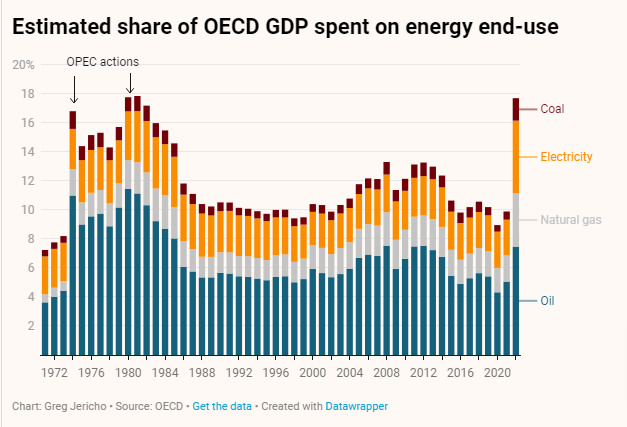
    The OECD notes that the share of GDP being spent on energy by OECD nations is higher now than it was during the OPEC crisis in 1974 and 1980. The evidence again is clear that a windfall profits tax should be levied on coal, oil and gas companies who a reaping massive profits while the cost of living rises sharply for households.

    The post Rough times ahead for Australia’s economy as oil, gas and coal companies celebrate appeared first on The Australia Institute's Centre for Future Work.

  • Working With COVID: Insecure Jobs, Sick Pay, and Public Health

    Almost one in five Australians (and a higher proportion of young workers) acknowledge working with potential COVID symptoms over the course of the pandemic, according to new opinion research published by the Centre for Future Work.

    The research confirms the public health dangers of Australia’s existing patchwork system of sick leave and related entitlements.

    The main findings of the report, based on a poll of 1000 Australians, include:

    • More than one in three (37%) employed Australians have no access to statutory paid sick leave entitlements (including workers hired under casual employment arrangements, and self-employed workers). Another 12% had access only to pro-rated part-time entitlements.
    • When the pandemic hit Australia, barely half (51%) of employed workers could count on regular full-time income if they had to stay home from work.
    • Almost one in five respondents (19%), and a higher proportion of young workers (29%), acknowledged working with potential COVID symptoms at some point during the pandemic. This confirms the public health dangers of Australia’s patchwork system of sick leave and related entitlements.
    • Polling results also confirm that a significant proportion of workers (17%) also attended work after exposure to someone possibly infected with COVID.
    • Given inadequate sick pay entitlements and the surprising share of workers attending work in violation of public health advice, it is not surprising that 18% of workers did not feel safe attending their normal workplaces during the pandemic.

    This research indicates that Australia’s sick pay entitlements are clearly inadequate to protect workers’ health and safety at work and allow them to stay home from work when health advice requires it. The expansion of non-standard and insecure forms of work (including part-time work, casual jobs, contractor positions, and ‘gigs’) has heightened concern that many workers do not have the effective ability to stay home from work for health reasons.

    Government should expand sick pay entitlements to cover all workers, and also implement strategies to limit and reduce the incidence of insecure work: including by constraining employers’ use of ‘permanent casual’ arrangements, sham contracting, and on-demand gigs, none of which provide normal and healthy paid leave entitlements.

    Unfortunately, the current federal Government has done the opposite by reinforcing this shift toward insecure working arrangements – including through its 2021 amendments to the Fair Work Act, which cemented and expanded employers’ rights to hire workers on a casual basis (with no sick pay) in virtually any job they wish.

    The post Working With COVID: Insecure Jobs, Sick Pay, and Public Health appeared first on The Australia Institute's Centre for Future Work.

  • We (still) need to talk about insecure work

    Taking this perspective to task in a piece for The New Daily, Jim Stanford and Mark Dean discuss how a much broader range of forms of insecure work face many workers in Australia today, with the issue not getting any better. This is not even a trend created by unavoidable conditions created by the pandemic; it has rather been a deliberate outcome of the federal government’s labour market policies. Simply pretending it isn’t an issue won’t make it go away; nor will it provide us with sustainable solutions to the precarious situation that will keep facing more and more workers until the problem of insecure work is adequately addressed

    The post We (still) need to talk about insecure work appeared first on The Australia Institute's Centre for Future Work.

  • What Next for Casual Work? Professor Andrew Stewart webinar recording

    What do these new developments mean for the further spread of casual and precarious work? What are the other implications of the High Court ruling for future employer strategies? And what options remain for limiting the spread of casual and insecure work? To examine these matters and their implications, we were recently joined by renowned labour law expert Professor Andrew Stewart from the University of Adelaide.

    Andrew’s highly informative presentation can be viewed below:

    The post What Next for Casual Work? Professor Andrew Stewart webinar recording appeared first on The Australia Institute's Centre for Future Work.

  • Insecure Workers Have Been the Shock Troops of the COVID-19 Pandemic: New Report

    New research from the Australia Institute’s Centre for Future Work confirms that workers in casual and insecure jobs have borne the lion’s share of job losses during the COVID-19 pandemic – both the first lockdowns in 2020, and the more recent Delta-wave of closures.

    Key Findings:

    • Since May, workers in casual and part-time jobs have suffered over 70% of job losses from renewed lockdowns and workplace closures.
    • Casual workers have been 8 times more likely to lose work than permanent staff. Meanwhile, part-time workers have been 4.5 times more likely to lose work than full-timers.
    • The report documents the disproportionate concentration of insecure work among women, young workers, and in the retail and hospitality sectors. Women hold over 53% of all casual jobs, but only 48% of permanent roles.
    • Average wages are much lower in insecure jobs. Casual workers, on average, earn 26% less per hour and 52% less per week than permanent workers – contrary to the common assumption that casual workers receive higher wages to offset their lack of entitlements and job protections.
    • The research estimates that if casual workers received the same hourly wages as permanent staff, overall wage incomes in Australia would grow by $30 billion per year, or 3.5%. That would mark a welcome change from the past eight consecutive years of record-low wage growth.
    • The report also shows that less than half of working Australians now hold a permanent, full-time waged job with entitlements. The traditional norm of a ‘standard’ job has been eroded on all sides by part-time jobs, casual work, temporary and contractor jobs, precarious forms of self-employment, and (more recently) on-demand gig work.

    “Workers in insecure jobs have been the shock troops of the pandemic,” said Dr Jim Stanford, director of the Australia Institute’s Centre for Future Work, and report author.

    “They suffered by far the deepest casualties during the first round of layoffs. Then they were sent back into battle, as the economy temporarily recovered. But now their livelihoods are being shot down again, in mass numbers.

    “It is bad enough that workers in these jobs do not receive basic entitlements like paid sick leave or severance protections. But even when they are working, they are paid far less than other workers.

    “The long-term and multi-faceted expansion of insecure work, in all its forms, is ripping apart economic and social stability in Australia.”

    “Recent changes in labour law, which confirm the right of employers to use casual labour in any position — even stable long-term roles — will lead to further expansion of insecure work once the pandemic is over. New pathways for workers to convert to permanent status have numerous limitations and exemptions, and will not significantly affect growing job insecurity.”

    The post Insecure Workers Have Been the ‘Shock Troops’ of the COVID-19 Pandemic: New Report appeared first on The Australia Institute's Centre for Future Work.

  • Shock Troops of the Pandemic: Casual and Insecure Work in COVID

    New research confirms that workers in casual and insecure jobs have borne the lion’s share of job losses during the COVID-19 pandemic – both the first lockdowns in 2020, and the more recent second wave of closures.

    Since May, workers in casual and part-time jobs have suffered over 70% of job losses from renewed lockdowns and workplace closures. Casual workers have been 8 times more likely to lose work than permanent staff. And part-timers have been 4.5 times more likely to lose work than full-timers.

    “Workers in insecure jobs have been the shock troops of the pandemic,” said Jim Stanford, Economist with the Centre for Future Work and author of the report. “They suffered by far the deepest casualties during the first round of layoffs. Then they were sent back into battle, as the economy temporarily recovered. But now their livelihoods are being shot down again, in mass numbers.”

    The post Shock Troops of the Pandemic appeared first on The Australia Institute's Centre for Future Work.

  • If You Thought Employers Were Exploiting Workers With Too Many Insecure Jobs Before The Pandemic…

    COVID-19 has been reintroduced into multiple aged care homes in Victoria, in part via staff who worked in multiple locations. We have been here before, but this time, the Commonwealth government should have prevented this channel of contagion.

    The poorly-managed vaccine rollout, including inexplicable delays in vaccinating aged care residents and staff, has played a key role in the current outbreak. But there is another policy factor at play as well: multi-site, insecure, and precarious work in Australia’s aged care sector.

    There has been a dramatic expansion of insecure work in this sector: including more than doubling the share of part-time jobs in the last generation, a huge shift toward lower-qualified, frequently precarious personal care positions (rather than qualified and registered health workers), and the widespread use of labour hire and agencies to provide short-term labour (rather than creating permanent, stable jobs).

    The recent report of the Royal Commission into Aged Care Quality and Safety identified these precarious staffing practices as a major risk to the quality and safety of care. The Commissioners criticised the over-use of temporary or agency work, and emphasised the inextricable linkage between ‘the quality of care and the quality of jobs.’ They recommended that permanent, more stable jobs are most compatible with ‘developing a skilled, career-based, stable and engaged workforce providing high quality aged care’.

    It’s not just in aged care facilities that insecure work has accelerated the spread, and magnified the consequences, of COVID-19. In fact, insecure work has generally weakened Australia’s resistance to the virus, and undermined both our health and economic responses. In aged care and beyond, precarious work enhances risks that the virus is transmitted.

    Precarious jobs do not provide the training and stability to ensure that rigorous infection control measures are implemented and followed. Workers in those jobs have low and unstable incomes, and generally lack paid sick leave: the resulting economic desperation compels many of them to work, when they should be isolating. Another tragic example of the overlap between insecure work and COVID-19 contagion was the tragic failures in hotel quarantine – where a perfect storm of poor training, low wages, and insecure work clearly contributed to the virus’s escape into the community.

    Precarious work is more than just casual work – it includes part-time (especially with unpredictable hours), casual, labour hire, sham contracting, and gig work. Around half of all Australian jobs embody one or more of those dimensions of insecurity.

    Sick pay is unavailable in most of these roles: casual and self-employed workers have none, while even permanent part-timers accumulate only partial credits. When the pandemic hit, 37% of all employed Australians (including self-employed) had no paid sick leave entitlement. Unwell workers thus faced the economic compulsion to work when they should have stayed home.

    Workers in insecure jobs experienced the lion’s share of initial job loss in the early days of the pandemic, cruelly concentrating the costs of the downturn on those who could least afford it. Casual workers lost employment eight times faster than those in permanent jobs. Part-time workers lost work three times faster than full-time workers, and insecure self-employed workers (those without incorporation or without any employees) lost work four times faster than those in more stable small businesses.

    Now, however, the rebound of employment since the initial lockdowns is being dominated by a surge in insecure jobs. Casual jobs account for almost 60% of all waged jobs created since the trough of the recession. Part-time work accounts for almost two-thirds of all new jobs. And very insecure positions (including own-account contractors and ‘gigs’) account for most of the rebound in self-employment.

    So without measures to improve job stability, the post-COVID labour market will clearly be dominated by insecure work – setting us up for future economic, social, and public health risks in the future.

    Multiple job-holding provides further evidence that the labour market, for many people, provides only fractured, incomplete, precarious opportunity. In the December quarter of 2020, there were over a million ‘secondary jobs’ in Australia (where a person is working that job in addition to another role) – the highest in history. Secondary jobs surged by 27% from June through December 2020 (alongside other types of insecure work).

    These jobs now account for 7.2% of all employment in Australia – also the highest in history. As we have tragically been reminded, multiple job holding poses enormous risks: not just on workers forced to juggle multiple positions to make ends meet, but for quality of care and public health.

    Finally, the broader social and familial stresses unleashed by the pandemic have also been exacerbated by insecure work. This problem has a particularly gendered slant: women do most of the unpaid work in our society, and carrying this burden of unpaid work is made even more difficult when paid work is precarious and unreliable. Family demands do not suddenly disappear when there is an opportunity to pick up a casual shift. And for the worker, the consequences of turning down that shift can be damaging and long-term – likely leading to fewer hours subsequently offered by that employer.

    Avoidable outbreaks of COVID-19 provide further proof that Australia needs to roll back precarious work, and ensure all workers have basic security, stability and entitlements.

    Australia has among the highest reliance on insecure work arrangements of any industrial country. That precarity is not natural or inevitable, it is the result of deliberate policy choices. And in the wake of COVID-19, Australia should be making different ones.

    The post If You Thought Employers Were Exploiting Workers With Too Many Insecure Jobs Before The Pandemic, Wait Till You See The Figures Now appeared first on The Australia Institute's Centre for Future Work.

  • Submission: Senate Select Committee on Job Security

    Submission to the Senate inquiry on insecure and precarious work.

    Authors: Dan Nahum

    Download the full report.

  • Expansion of Employer Power to Use Casual Work Hurts Women Most

    In this commentary, Senior Economist Alison Pennington explains how new casuals measures and the government’s wider economic policies – including in industrial relations, childcare, welfare, and fiscal spending – significantly undermine the economic security of women, entrench pay inequality, and ultimately, increase their vulnerability to gendered violence.

    This commentary was originally published in Michael West Media.

    Crocodile tears no mask for Coalition’s economic war on women

    Well may Scott Morrison tear up as he relates how his daughters, wife and widowed mother drive his every decision. The facts are that every move of the Coalition government ensures women are poorer, more insecure at work and more vulnerable to violence on the job. The Industrial Relations bill pushed through last week is a final nail in the coffin for women. Alison Pennington reports.

    After a month of anger from women around the country about sexual harassment and the treatment of women in the workplace, federal parliament passed legislation last week that will strike a massive, lasting blow to women’s job quality and pay, entrenching pay inequality and exacerbating women’s economic insecurity.

    The mainstream media has mainly focused on the fact that most of the Industrial Relations bill didn’t pass. But the cornerstone of the legislation – and the primary reason for its inception, pre-pandemic, by business lobbyists – did.

    A new legal definition of casual work will allow employers to call any job a casual one. Jobs can now look and smell like permanent jobs, except that employers can legally engage you as a casual, stripping away your legal entitlements at will.

    So-called “permanency conversion” rights in the legislation are so weak that employers will easily craft employment arrangements to lock in casual jobs long-term.

    Employers will simply vary rosters

    Employers will vary rosters sufficiently to ensure that employees will never reach the benchmarks of six and 12 months of regular schedules that should lead to permanency. In any case, employers will be allowed to refuse offers on “reasonable grounds”. And small businesses, which employ a huge 44% of all private sector employees, are exempted entirely.

    The federal government’s new casual laws will expand the incidence of casual work. Women will disproportionately suffer in a labour market with diminishing opportunities to obtain secure, decent jobs because women are more likely to be in casual roles (filling 54% of all casual positions). And women’s vulnerability to casualisation is growing. Women accounted for 62% of all new casual jobs created in the period from May to November 2020.

    Casual workers are not compensated

    Despite claims from employers that casual workers are compensated for the loss of entitlements and lack of predictability in rosters and tenure, nothing could be further from the truth.

    Casual workers are, on average, paid far less than employees in permanent roles. Median weekly earnings of full-time casuals were 23% lower ($1080 per week) than those in permanent roles ($1400 per week), and 45% lower for casual part-time workers ($390 per week) compared with permanent part-time workers on $720 per week.

    The expansion of the power of employers to use casual work in a jobs market awash with many hungry mouths desperate for paid work means more women in lower-paying, insecure jobs.

    The government’s decision to subject the unemployed to a below-poverty JobSeeker rate means more women reliant on employers to survive. At every move the Liberal National party government is making Australian women poorer, more insecure and more vulnerable to violence on the job.

    Women return to lower quality jobs

    Treasurer Josh Frydenberg celebrates the recent fall in the unemployment rate to 5.8 per cent, claiming the recovery is well under way. But the detailed job quality data tell a very different story for women.

    Women workers are “snapping back” to a world of paid work on inferior terms compared with men – fewer hours, less pay and less security.

    Casual jobs accounted for 64.3% of the total growth in women’s employment from May to November last year.

    Alarmingly, more than half of all the growth in women’s employment over the six-month period was in both low-hours and insecure work, with 52.4% of total growth in employees in part-time casual jobs.

    Traditional full-time permanent jobs with normal entitlements (such as paid sick leave, holidays and superannuation) represented a dismal 10.4% of female employment growth from May through November.

    It’s a crude fact that as women’s casual jobs were booming, business lobbyists were pushing for passage of the IR Bill on the basis that employers “lacked confidence” to hire casuals due to legal “uncertainty”. Australia was simultaneously experiencing the largest and fastest increase in casual employment in its history.

    More fuel for gender pay gap fire

    The consequences of an employment recovery overwhelmingly concentrated in part-time and casual jobs for women is more fuel for the gender pay gap fire.

    The gender pay gap is most often measured by comparing the earnings of men and women in full-time jobs. But women face persistent barriers to workforce participation – including unaffordable childcare, lack of family-friendly work arrangements, and workplace discrimination. Consequently, almost half (45.1%) of all employed women are in part-time work.

    Measuring the gender pay gap using total average earnings data (including both full-time and part-time workers, and bonuses and overtime as well as ordinary time wages) indicates that the gender pay gap is 31% across all jobs – a more dire, but more accurate, measure of the pay gap.

    Ironically, the gender pay gap narrowed in the early stages of pandemic and recession. From late-2019 to May 2020, the gap between male and female total wage incomes declined from 31.4% to 29.6% – down by 1.8 percentage points.

    But this did not represent “progress” in pay equality. The gap only closed because more than 300,000 women in low-paid casual roles lost their jobs, which increased the average earnings of those women who were able to stay connected to the workforce.

    How good’s “snap back”?

    As the economy recovered from May last year, an influx of women’s lower-paying jobs widened the gender pay gap again, just as quickly. How good’s “snap back”?

    Instead of improving the quantity and quality of jobs for women, governments have actively pursued policies that will exacerbate pay inequality this year and into the future.

    In addition to casual work changes pushed through in the IR bill, two other policies create higher barriers to women’s participation in paid work, and suppress their pay once they get on the job.

    The federal government and all states and territories (bar Tasmania and Victoria) have imposed punitive and counterproductive public sector wage freezes and caps on their workforces. This suppression of public sector pay hurts women most because they account for 61.7% of all public sector jobs.

    The failure of government to provide affordable, quality childcare presents another major barrier to women’s paid work opportunities. After dangling free childcare in front of families early in the pandemic, the federal government cut supports and reintroduced fees after just three months.

    The return of full-fee, high-cost childcare prices women out of paid work. More than half of women with young children outside the workforce list childcare costs as a key factor in their decision not to work. A childcare system that lets a small number of profit-driven providers determine access denies families and their children access to critical developmental education and much-needed community bonds as people emerge from pandemic-era isolation.

    Rebuilding women’s economic security requires a very different approach from the bankrupt austerity agenda of government. Women need more and better quality jobs, free childcare, a superannuation system that provides genuine income security and an employment relations system that works to lift the quality, pay and safety of their jobs, not undermine it.

    The post Expansion of Employer Power to Use Casual Work Hurts Women Most appeared first on The Australia Institute's Centre for Future Work.
  • Casual Job Surge Widens Gender Pay Gap

    New research, released for International Women’s Day (8 March 2021), shows Australia’s recovery from the pandemic recession has widened the gender pay gap, as women’s jobs returned on a more part-time and casualised basis than for men.

    The report, by the Centre for Future Work, warns that Australia’s gender pay gap could deteriorate even further in the wake of policies proposed by the Government for 2021: including the further expansion of casual work and reduced pay for part-time workers, tabled in the omnibus industrial relations bill; public sector pay caps for both federal and state employees; and a high-cost, inaccessible childcare system.

    Key findings:

    • Women suffered disproportionate job losses when the COVID pandemic hit, and as the economy recovers are returning to jobs that are relatively more insecure.
      • Employment for women declined almost 8% between February and May 2020—over 2 percentage points worse than for men.
      • Women’s employment is still 0.9% lower than in January last year (around 53,000 less jobs), while male employment went up over that same period (by an additional 7,000 jobs).
      • Job-creation since May (the worst month of the COVID recession) has been heavily concentrated in casual and part-time jobs. From May through November, casual jobs made up over 60% of new jobs –and women filled 62% of those casual roles.
      • The disproportionate concentration of women in newly-created casual and part-time jobs is largely responsible for a significant widening of the gender pay gap after May.
    • Measuring the gender pay gap using total average earnings data (including both full-time and part-time workers, and bonuses and overtime as well as ordinary time wages) indicates that the gender pay gap is 31% across all jobs. That is a more dire, but more accurate, measure of the pay gap than other measures which include only full-time jobs.
    • Three major existing and proposed government policies could further widen pay inequality in 2021:
      • The further expansion of casual work and reduced pay for part-time workers, tabled in the omnibus industrial relations bill.
      • Public sector pay caps for both federal and state employees.
      • A high-cost, inaccessible childcare system.

    “The gendered nature of the pandemic recession on Australia’s labour market has markedly worsened pay inequality,” said Alison Pennington, senior economist at the Centre for Future Work.

    “Women lost jobs at a greater rate than men when the pandemic hit, and as the economy has recovered, are returning to fewer jobs offered on a more casualised basis. The gendered employment recovery is disproportionately leaving women with less hours, security and pay than men—a clear example of why a simple post-COVID “snap back” was never adequate for women.

    “Women have been bearing the brunt of the COVID recession while governments have targeted stimulus spending in bloke-heavy industries, neglecting investment in industries that support women’s employment, including healthcare, education and social services. To stop further deterioration in pay inequality, targeted efforts to lift women’s work and earning opportunities is critical.

    “Focused investment in women’s job creation, free childcare, and wage-boosting industrial relations policies are all within reach of governments at both federal and state levels.”

    The post Casual Job Surge Widens Gender Pay Gap appeared first on The Australia Institute's Centre for Future Work.