Tag: Insecure & Precarious Work

  • Fixing the work and care crisis means tackling insecure and unpredictable work

    The Fair Work Commission is examining how to reduce insecurity and unpredictability in part-time and casual work to help employees better balance work and care.

    The Commission is reviewing modern awards that set out terms and conditions of employment for many working Australians to consider how workplace relations settings in awards impact on work and care. This follows a 2023 finding by the Senate Select Committee Inquiry into Work and Care last year that there is a “work and care crisis”.

    The Select Committee’s final report noted “too many Australians are working in conditions that lack predictable hours and thus pay”, making it difficult to manage their care responsibilities with paid work.

    Insufficient income to meet family needs, inability to plan, inability to access suitable care, high stress levels and lack of time for life are some of the negative impacts of insecure and unpredictable part-time and casual work for workers with caring responsibilities.

    Women are overrepresented in part-time and casual jobs, as they continue to provide most unpaid care for children, elderly parents, and sick or disabled family members. Among women, casual employment is most common among 15 to 34 year-olds, while for men it is highest among those aged 65 years and older. Women’s casual employment is linked to child-rearing.

    Pay rates in casual jobs are often lower than for employees in equivalent permanent part-time and full-time jobs, despite casual loadings. Underemployment is also high and unpredictable working hours are common among casual and part-time employees, including in services sectors such as retail and care. In both sectors, insecure casual jobs provide workers with very little control over their work hours. Lack of control over hours is often a feature of permanent part-time jobs as well as casual jobs

    In a job with unpredictable hours it can be extremely difficult to organise and manage the costs of care. For example, for parents, uncertainty of working hours and income can make access to reliable and affordable childcare impossible. Unpredictable short-hours rosters can make it barely worth working at all as income may not cover the costs of formal childcare.

    Good quality, secure part-time jobs have long been regarded as essential for greater gender equality in employment, including as part-time jobs can support better sharing of care among men and women. However, the expansion of part-time work in the Australian economy since the 1980s has been an expansion of casual and part-time jobs that are highly insecure, often low-paid and with poorer conditions, protections and entitlements than most full-time jobs.

    It is possible to make casual and part-time jobs more secure and predictable. The Fair Work Commission’s analysis of industrial awards shows that there are many provisions in awards applying to part-time and casual employment that contribute to insecurity and lack of predictability. Award provisions include, for example, short minimum payments periods, broken shifts, poor guarantees around minimum and regular hours of work, little or no payment for travel time between different work locations, little or no notice of roster changes and poor compensation for being on-call.

    Secure work and a living wage are fundamental to good work and care arrangements. Secure work doesn’t just mean ongoing work or protection from unfair dismissal. Secure work entails adequate and predictable work hours, reasonable flexibility of working time, compensation for unsocial hours, safety at work and access to union representation.

    Worker-carers should also have rights to carer’s leave and personal leave, regardless of their employment arrangements. Systems of portable leave entitlements could help all workers manage care and work at all stages of their working lives. These and other leave entitlements would have the benefit of supporting a better sharing of care.

    The Fair Work Commission’s will complete its review in the middle of 2024. It is to be hoped that this leads to improved working conditions for worker carers, enabling men and women to care and work without paying the price through job insecurity.

    The post Fixing the work and care crisis means tackling insecure and unpredictable work appeared first on The Australia Institute's Centre for Future Work.
  • More loopholes to close on insecure work and a new right to disconnect from work

    This means Australia’s employment laws will be further amended to tackle the problems of insecurity and low pay, with the changes targeting casual employment and gig platform work arrangements. The package also includes a new right for employees to disconnect from work outside their paid work time.

    A new definition of casual employment will be included in the Fair Work Act, making it harder for employers to classify their employees as casual when, in reality, the employees are required to work regular hours for a continuing and indefinite period. The legislation also establishes a new pathway for casual employees to seek permanent status.

    The casual employment changes should go some way to stopping and reversing the growth of so-called ‘permanent casual’ arrangements, which have become widespread. Workers in these arrangements are actually in permanent jobs while they are given casual employment status.

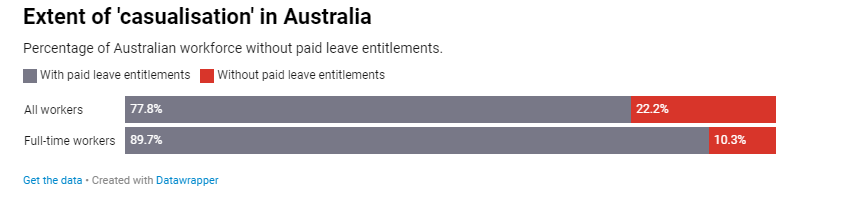
    Casual employment means lower pay, little or no job security and no right to paid leave. Lack of employment security in casual employment creates all sorts of other insecurities for workers, such as limiting access to finance, secure housing and childcare. According to government estimates, there are over 850,000 casual employees who could be eligible to seek permanency under the legislation.

    Gig worker or ‘employee-like’ reforms in the Closing Loopholes package aim to address low pay and poor working conditions experienced by workers on digital platforms who are engaged as independent contractors, are low-paid and/or have very limited bargaining power, such as delivery riders and rideshare drivers. The Fair Work Commission will now be able to make orders for minimum standards for these digital platform workers.

    This ‘employee-like’ reforms extend the scope of Australia’s Fair Work Act to provide protections and rights to vulnerable workers, who are not employees. This should prove to be an effective response to the challenges facing vulnerable ‘gig workers as argued by the Centre for Future Work’s David Peetz has argued in a recent Centre for Future Work report on self-employment.

    Closing Loopholes also includes a ‘right to disconnect’ from work, an initiative of the Greens, included to get the minor party’s support for the bill. In future, employees will have a right to refuse to respond to contact from their employers outside their scheduled hours if the contact is unreasonable.

    Go Home on Time Day research conducted in 2022 by the Centre for Future Work found that 8 out of every 10 workers supported a right to disconnect. This level of support is not surprising, given the amount of unpaid overtime workers are doing. In 2023, the Centre for Future Work reported employees are, on average, working 5.8 hours a week — total of 280 hours, or 7 weeks, a year of unpaid overtime per employee.

    The new right to disconnect is a practical solution for many employees that should also assist to shift cultures in workplaces where reliance on unpaid overtime has become the norm.

    Some employer groups are arguing the Closing Loopholes legislation ‘goes too far’. To the contrary, if there is a weakness in the legislation, it is that it does not always account for power imbalances in the relationship between employees and employers. And this may limit the effectiveness of the some of the new provisions.

    As a result of amendments put forward by independent David Pocock and the two Jacqui Lambie Network senators in response to employers’ concerns, a number of the bill’s provisions will be weaker in the final legislation than they were in the government’s original bill.

    The amended bill passed by the Senate yesterday provides greater scope for employers to refuse casual employees’ requests for permanent status. The proposed prohibition on employers unreasonably contacting employees out of work hours has been removed. In the amended bill the prohibition is now on employers punishing employees who refuse to monitor and respond to unreasonable contact.

    The Closing Loopholes part 2 reforms are welcome changes that will limit some of the damage and disadvantage caused by insecure work and the encroachment of (unpaid) work into life outside work.

    The post More loopholes to close on insecure work … and a new right to disconnect from work appeared first on The Australia Institute's Centre for Future Work.
  • We Cannot Truly Value Care Until Workers Using Digital Labour Platforms Get Fair Pay and Conditions

    Australia risks returning to the days when the value of a female care worker’s effort and their working conditions were largely determined in private, informal relationships out of sight and out of the scope of regulation that protects most other workers.

    For most of the 20th Century, women workers providing care and assistance to people in private residences were explicitly excluded from the industrial relations system that ensured rights and standards, including minimum wages and employment conditions, for 90 per cent of Australian workers.

    Homecare and other social and community services workers were only recognised as workers at the end of the century, after long and enormously difficult struggles by women and their unions.

    Finally, in the 1990s, for the first time, care and support workers gained regulated minimum standards of pay and conditions. Previously, as unregulated workers, they had extremely low pay rates and some of the worst working conditions in Australia.

    Fast forward thirty years to 2024. The care and support workforce is still highly feminised. It is large and it is growing 3 times faster than other sectors in the Australian economy. Most care and support jobs are still relatively low-paid and insecure.

    Today, however, the need for fair pay, better quality jobs, and career paths for care and support workers has the attention of government and other policy makers. In the wake of the pandemic there is greater appreciation of how the quality of these jobs impacts on the quality of care and support for the aged and people with disability.

    And it is very clear that, if we are to successfully tackle Australia’s gender pay gap and women’s economic inequality, we must ensure better pay and career pathways for care and support workers.

    But now, digital or ‘gig’ labour platforms are undermining the slow progress that has been made towards proper recognition and valuing of care work. This is because most platforms, through which aged care and disability support workers connect with people requiring care and support, insist that workers are independent contractors.

    Platforms compete in the NDIS and aged care markets by using independent contractors to provide cheaper services, while other service providers directly employ workers. Platforms profit from avoiding the costs of employment, including superannuation, training and supervision. Platform workers have no minimum employment standards.

    Digital platform care and support workers have a lot in common with previous care and domestic workers who, for most of the 20th Century, were invisible and isolated, and struggled to have their labour recognised as work.

    Platform workers are without any rights to minimum rates of pay, working time standards, superannuation or other benefits and protections they would have as employees. They mostly perform their labour without peer support, organisational supervision and training, and they are cut off from opportunities for development and promotion.

    Opponents of employment standards for platform care and support workers don’t see it like this. They argue standards are not needed as workers are “entrepreneurs” who set their own rates, earn more than employees, enjoy the flexibility of working when and where they want, and are doing this work as a “side hustle” on top of more substantial jobs.

    None of this is true of the majority of care and support workers on platforms. Most (70 per cent) believe they are employees of the platform, even though they’re not. Even the platforms’ own data shows that workers from groups likely to be vulnerable to exploitation – migrants and younger workers – are over-represented on platforms. Many workers are paid below the relevant award minimum pay rate.

    It makes little sense to refer to jobs as side hustles when 4 out of 5 home and community-based care and support jobs (on and off platforms) are part-time, often short-hours jobs.

    Just because jobs are part-time, or a worker holds multiple jobs, doesn’t mean fair pay and working conditions don’t matter.

    For decades, women had to put up with undervalued work while employers, economists and public policy makers argued women worked in care jobs for love rather than money, and their earnings were not essential income. Present-day arguments opposing minimum standards are a little different, however, they would achieve the same end, perpetuating undervaluation and gender inequality.

    The post We Cannot Truly Value ‘Care’ Until Workers Using Digital Labour Platforms Get Fair Pay and Conditions appeared first on The Australia Institute's Centre for Future Work.

  • New Report Reveals Changing Face and Future of Self-Employment

    The Centre for Future Work’s Carmichael Centre study shows that self-employment is both shrinking and becoming more precarious.

    Over the past decade, there were 112,000 fewer employers, 35,000 more part-time solo self-employed, and 91,000 fewer full-time solo self-employed than there would have been if their shares of total employment had remained unchanged.

    “Contrary to some predictions, self-employment has not taken over the world – but the nature of what self-employment means has changed,” said David Peetz, research fellow and author of Self Employment Myths & Realities.

    “Self-employment is in decline, not just in Australia but overseas.

    “The only thing that’s growing in the self-employment area is part-time, solo self-employment. A lot of that is ‘gig’ work. It’s insecure, the pay is poor, it’s sometimes even dangerous.

    “The nature of what self-employment means has changed. For someone wanting to be their own boss, it’s a lot harder these days to get a small business into markets. Big firms aren’t keen to let them in. They’re a lot happier to just hire a contractor to do short gigs for them.

    “There’s a lot of barriers to start-ups, but there’s no barriers to how many delivery drivers rely on three different apps to make ends meet.

    “This has left many self-employed workers exposed to poorly regulated or non-existent workplace standards.”

    The report shows standards and protections can be set for gig workers. This can be done in ways that these workers actually want, without getting in the way of the genuine innovators among the self-employed.

    “The second tranche of the government’s Closing Loopholes Bill puts a floor on gig work standards and is vital to protect livelihoods and the economy,” Professor Peetz said.

    “Workers want the flexibility that comes with self-employment, but they also want and deserve to be protected.

    “The protections in the government’s Closing Loopholes Bill, returning to parliament next year, strike the right balance between protecting the right to choose self-employment and stamping out exploitation of vulnerable workers.”

    The post New Report Reveals Changing Face and Future of Self-Employment appeared first on The Australia Institute's Centre for Future Work.

  • A Better Future for Self-Employment (gig work)

    The first is that self-employment is inexorably growing. The second is that self-employment cannot, or should not, be regulated in order to protect self-employed workers and improve the conditions of their work.

    This new report from the Carmichael Centre at the Centre for Future Work shows that, in reality, self-employment is not growing inexorably — in fact, in most countries (including Australia) it is declining.

    The much-trumpeted surge in self-employment and ‘freelancing’ is a myth. However, the nature of self-employment is changing: fewer self-employed people are running successful independent businesses, and more are engaged in precarious ‘solo’ activities like short-term contracting and part-time ‘gig’ work.

    The report also shows that some forms of self-employment can be regulated to protect affected workers, provided two simple and important criteria are satisfied: the workers are vulnerable and hence need protection, and a viable mechanism exists that enables their work to be efficiently regulated.

    The report reviews the proposed provisions of the second part of the federal government’s new Closing Loopholes legislation, which would allow for minimum labour standards to be applied to digital platform workers and owner-operators in the transportation sector. The new legislation (to be considered in Parliament in 2024) is an appropriate and effective response to the challenges facing these two groups of ‘gig’ workers.

    Please see the full report, “A Better Future for Self-Employment: How is it changing, and how can ‘gig’ work be regulated?,” by David Peetz, Laurie Carmichael Distinguished Research Fellow at the Centre for Future Work.

    The post A Better Future for Self-Employment appeared first on The Australia Institute's Centre for Future Work.

  • Insecure work is a feature of our labour market. New laws can change that.

    Chris Wright is Associate Professor in the Discipline of Work and Organisational Studies at the University of Sydney, and a member of the Centre for Future Work’s Advisory Committee. This commentary is based on his submission to the Senate Education and Employment Legislation Committee’s inquiry into the Fair Work Legislation Amendment (Closing Loopholes) Bill 2023, and originally appeared in the Sydney Morning Herald.

    * * * * *

    The Senate has started reviewing the Australian Government’s Closing Loopholes Bill. If passed, this legislation will allow minimum standards to be set for contract workers, provide stronger penalties against employers who commit wage theft and deter employers from outsourcing to circumvent enterprise bargaining.

    These measures will strengthen protections for workers who often face barriers to job security and career development.

    Australia’s current system of workplace laws was adopted at a time when enterprise bargaining and awards covered a larger share of the workforce than today. Enterprise bargaining and awards encourage employers to invest in their workers through “standard” employment arrangements underpinned by permanent contracts, decent wages and training.

    These arrangements promoting workforce investment benefit both workers and employers. Workers gain job and economic security and career progression opportunities. Employers gain loyal and satisfied workers who contribute to productivity and innovation. As the architects of the current system of workplace laws envisaged, workforce investment thus provides the basis for high-productivity business strategies, which help to make the Australian economy more internationally competitive.

    Recently, however, more businesses have opted for a different course. These businesses have tried to compete not through high-productivity strategies but instead by undercutting or evading workplace laws and by engaging workers via “non-standard” arrangements such as casual contracts or via gig economy platforms.

    The rising incidence of wage theft in which employers pay workers below their legal entitlements is evidence of this undercutting. The growing numbers of workers hired through labour hire arrangements, which some businesses have used to avoid their enterprise bargaining obligations, is evidence of evasion. So too is the emergence of gig platforms exempt from workplace laws.

    Wage theft, gig platforms and use of labour hire as an evasion tactic have become features of Australia’s modern labour market. None of these features existed when the foundations of the current system of workplace laws were first laid in the 1990s.

    As the nature of work and the labour market evolves, workplace laws must adapt in response. The Closing Loopholes Bill recognises this by allowing workers on casual contracts to convert more easily to permanent contracts, increasing protections for gig and labour hire workers and introducing new measures against employers who undercut wage laws.

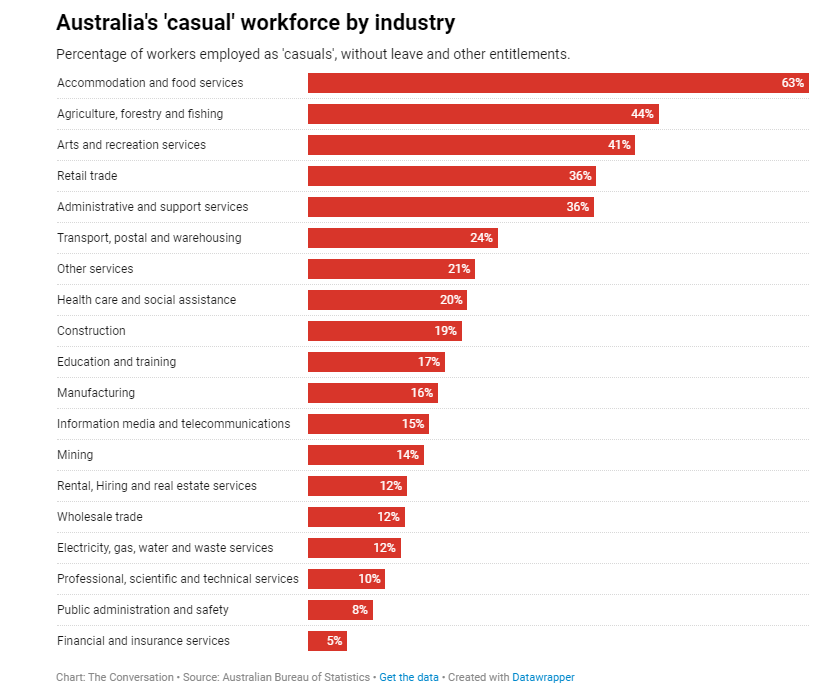
    While non-standard workers have flexibility, they have little job and economic security under current laws. For instance, casual workers receive a higher hourly pay rate as compensation for this insecurity but are concentrated in the lowest-paid industries. Like their counterparts in the gig economy, casual workers are less likely to receive training than permanent workers.

    The proposed change to give casuals who work regular hours the right to convert to permanent employment will probably improve their access to good quality jobs and career development opportunities.

    Business groups have criticised the Closing Loopholes Bill for its supposedly negative impacts on productivity and innovation. They have not offered evidence supporting these claims. To the contrary, research evidence suggests that measures promoting standard employment are more likely to encourage businesses to compete through high-productivity and innovation-enhancing strategies rather than by undercutting or evading.

    Winston Churchill once said that without effective workplace laws, “the good employer is undercut by the bad and the bad by the worst… Where those conditions prevail you have not a condition of progress, but a condition of progressive degeneration”.

    Workers in Australia are increasingly missing out on legal protections under current laws. The research evidence suggests the Closing Loopholes Bill’s provisions are necessary to avoid a situation like the one Churchill described.

    The post Insecure work is a feature of our labour market. New laws can change that. appeared first on The Australia Institute's Centre for Future Work.

  • New laws for employee-like gig workers are good but far from perfect

    The Workplace Relations Minister Tony Burke has described proposed new laws to regulate digital platform work as building a ramp with employees at the top, independent contractors at the bottom, and gig platform workers halfway up.

    The new laws will allow the Fair Work Commission to set minimum standards for ‘employee-like workers’ on digital platforms. They are a key part of reforms in the government’s Closing the Loopholes workplace relations bill introduced into parliament this week, and are part of a commitment made before the 2022 election.

    So, what will being halfway up the ramp mean for ‘employee-like’ platform workers? Under the changes, minimum standards can now be set for platform workers, including rideshare drivers, food delivery workers and care workers. Up until now, as independent contractors, digital platform workers have had very few rights, including no rights to minimum pay rates.

    With the changes, the Fair Work Commission will be able to set minimum standards for workers concerning payment terms, deductions, working time, record-keeping, insurance, consultation, representation, delegates’ rights and cost recovery and other matters.

    Other provisions in the legislation are designed to protect workers from being unfairly deactivated from platforms, which is equivalent to being unfairly dismissed, and allow collective agreements for platform workers where platform operators agree.

    The laws will apply only to ‘employee-like’ platform workers, meaning workers who are low-paid (compared to what they would be paid under an award), have low bargaining power and/or have low control over their work.

    There are some restrictions on the standards the Fair Work Commission can set for platform workers. Minimum standards cannot be set concerning overtime rates or rostering arrangements. Nor can the Commission use its standard-setting powers to turn a platform worker into an employee.

    So, ‘employee-like’ platform workers will not have all the minimum standards and rights that employees have. However, halfway up the ramp, they will be much better placed than they were with the minimal rights of independent contractors.

    Overall, these changes are very positive for platform workers and should prevent exploitation of vulnerable workers. However, the reforms stop short of responding to longstanding calls for platform workers, including rideshare, food delivery and care workers, to be treated as employees, and for platform operators to be treated as employers, an approach that has recently been agreed by the 32 member countries of the European Union.

    The proposed reforms in the Closing Loopholes bill don’t go as far as aiming to ensure that how a person is employed can’t leave them without the rights and standards most comparable workers enjoy at work. It leaves platform workers halfway up the ramp in a new worker category with lesser rights than employees.

    The creation of this new category of ‘employee-like’ worker does open up the possibility that some employers may seek to reform their workforces and business models to engage workers who are in the new cheaper worker category, in place of employees. Internationally, where a third category of worker has been created by governments in order to provide protections for low-paid independent contractors, there has been some substitution of employees for workers with less favourable conditions.

    The Closing the Loopholes approach to platform workers also suggests we need to think harder about how to support better flexibility at work.

    The platform work reforms appear to be built on an assumption it is ok for workers who need or want flexibility to have lesser standards and fewer rights at work because of this. Most platform workers value the flexibility they have in their jobs. But that does not mean they should have to trade off rights and standards. Flexibility is not a benefit that accrues only to workers. Consumers and platform operators want flexible services too.

    Originally published in The New Daily 8 September 2023

    The post New laws for ‘employee-like’ gig workers are good but far from perfect appeared first on The Australia Institute's Centre for Future Work.

  • We need more than a definition change to fix Australia’s culture of permanent casual work

    It’s that employer advocates are getting so excited about them, despite the small number of people they will affect and the small impact they will have.

    That’s not to say the changes aren’t needed. Rather, true reform of the “casual” employment system, of which this is just a first but important step, has a lot further to go to resolve the “casual problem”.

    What is the ‘casual problem’?

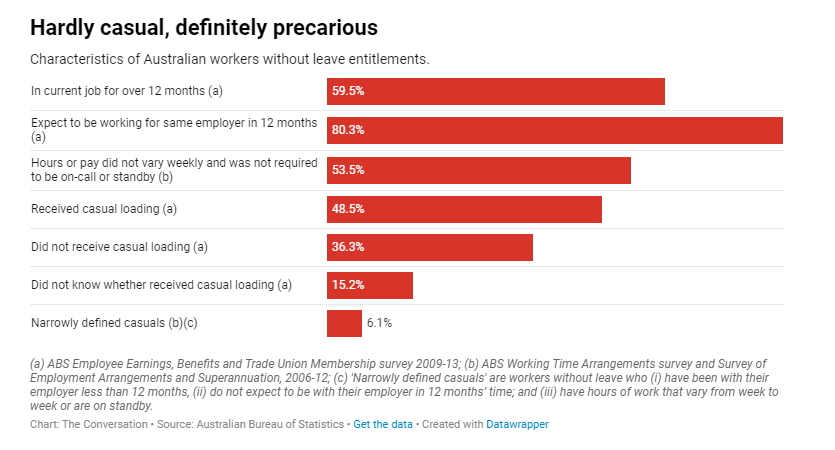
    This problem is that most “casual” workers aren’t really casual at all — as shown by analysis that I and colleague Robyn May did, using unpublished data from the Australian Bureau of Statistics (ABS).

    The premise for hiring them is that the work is intermittent, short-term and unpredictable. But, as you can see from the chart, the last time the ABS collected these data, a majority of “casuals” worked regular hours.

    Almost 60% of “casuals” had been in the job for more than a year. About 80% expected to still be there in a year’s time.

    Only 6% of “casuals” (1.5% of employees) worked varying hours (or were on standby), had been with their employer for a short time, and expected to be there for a short time.

    Even now, some “casuals” have been doing the same “casual” work for over 20 years.

    Permanent ‘casuals’

    All this has led to a class of “permanent casuals” – a nonsense term. They should more accurately be called “permanently insecure”.

    The one thing “casuals” have in common is they’re not entitled to sick leave or annual leave, and they are in a precarious employment situation. Their contract of employment only lasts till the end of their work day.

    That means they have much less power than other workers. So little power, in fact, that barely half of them even get the casual loading they are meant to be paid in compensation for not receiving other entitlements.

    On average, low-paid “casuals” get less pay than equivalent permanent workers, despite the loading.

    Changing legal definitions

    Not many “casuals” have been brave enough to challenge this exploitative relationship. But when they did a few years ago, Australia’s courts agreed permanent casual work was nonsensical.

    To be a “casual worker”, there had to be no promise of ongoing employment. A court would judge this not just by what was in the formal contract of employment but also by what the employer actually did. If they kept hiring you, week after week, on a predictable roster, you weren’t casual.

    In 2018, mine worker Paul Skene challenged his classification as a casual worker, arguing he had done pretty much the same work, with a few changes along the way, for five years.

    The Federal Court agreed he wasn’t a casual employee and should be back-paid annual leave. Another mine worker, Robert Rossato, had a similar victory in 2020.

    Employer organisations were “outraged” by the “billions” in back pay they could be forced to pay for having misclassified ongoing workers as casuals. They lobbied the Morrison government to amend the law, and challenged the rulings in the High Court.

    The Morrison government changed the law in early 2021, to give primacy to the written contract, ignore employer behaviour, and protect employers from back-pay claims.

    Later that year the High Court overturned the Federal Court decisions, ruling it was the written employment contract that mattered. If that was worded a certain way, you couldn’t test whether a worker was “casual” by whether the employer treated them that way afterwards.

    Labor promised to overturn these interpretations, and that’s what this proposal does.

    What will the legislation change?

    The details of the government’s plan is still not clear, but it is likely it will seek to amend the Fair Work Act to revert to something close to the pre-2020 definition of casual work, with a procedural twist.

    It will again be possible to judge whether an employee is “casual” based on employer behaviour. And an employee who repeatedly works a similar roster can, after six months, demand “permanency” – meaning rights to sick leave, annual leave, and better protection against arbitrary sacking.

    The twist: until they demanded “permanency” they won’t be entitled to any leave. So employers will be protected against claims for back pay.

    Theoretically this could affect hundreds of thousands of “casual” workers. In reality, it will likely help far fewer.

    Suppose you’re a “casual” labour hire worker in mining. You can tell what time you’ll start work on the first Friday next June. You go to your employer — the labour hire company — and say: “Make me permanent.” The labour hire company says: “We can’t. You might not have a job tomorrow.”

    And indeed, now that you’ve asked, maybe you won’t have a job. So would you really ask?

    It will depend critically on the protections offered to workers who ask to convert, and how credible they are to workers.

    Most people only expect a few people to make the demand. Workplace relations minister Tony Burke says he believes only a “very small proportion” of “casuals” working regular shifts will do so.

    Part of that reluctance will be fear of the consequences, and part of it will be that many casuals rely on their casual loading. About half of “casuals” are on the award minimum rate, compared with 15% of “permanent” full-time workers. Most cannot afford to “choose” to trade the money for holidays and other entitlements.

    If you’re not getting the casual loading, you’ve got nothing to lose — except your job. If the power imbalance means you don’t get the loading, you won’t fancy your chances.

    So, it will just work for a small number or workers – though it’s likely to be very important to them.

    More needs to be done

    In short, this is a good step but more needs to be done.

    In most other wealthy countries all workers – including temporary workers – are entitled to annual leave. That’s not the case in Australia, because of the “casual” ruse. These laws will not change that.

    There should be universal leave entitlements. Sure, there needs to be a loading where work is unpredictable, and hence so short-term that leave entitlements would not be practical.

    But everyone else should get annual and sick leave, and minimum award wages should be high enough that low-wage workers don’t have to rely on the casual loading to get by.

    The challenge should be about how we transition to that situation.

    The post We need more than a definition change to fix Australia’s culture of permanent ‘casual’ work appeared first on The Australia Institute's Centre for Future Work.

  • Workplace Law Reform Must Limit Cancer of Gig Work in Care Economy: Research

    Researchers have recommended limits are placed on the growth of gig work in the NDIS as part of the third tranche of the Commonwealth Government’s industrial relations reforms later for later this year. Researchers say the promised reforms to ‘Employee-like’ forms of work should be used to protect minimum employment standards and quality service delivery for care workers and consumers.

    Key findings

    • The gig work model is growing in the care economy and NDIS, undermining wages, conditions and gender pay equality
    • Care workers on platforms are younger, less experienced and more likely to be migrant workers than workers in the broader care and support workforce.
    • Platform care work is insecure on-demand work, working time is fragmented, pay can be unpredictable. Many workers’ earnings are equivalent to below award-level pay.
    • Worker-friendly flexibility is limited and is mainly only possible in short hours jobs. Flexibility comes at the expense of a living wage.
    • Care and support platform workers are isolated and largely invisible, working in private homes without organisational supervision, support, guidance or training.
    • In platform and other independent contracting arrangements, risks and responsibilities for care quality and client safety are devolved to individual workers.
    • Platforms compete by avoiding the costs and risks of business fluctuations, of employing workers and of accountability for care and support quality and safety. Costs and risks are devolved to low-paid and insecure frontline workers.
    • Platforms profit from retaining funds that are allocated for employong workers and providing training and supervision.

    “Unregulated gig work is a cancer for workers rights in Australia,” said Dr Fiona Macdonald, Policy Director, at the Australia Institute’s Centre for Future Work.

    “The growth of gig work on digital platforms in the care economy eats away at minimum employment conditions and shifts risk on to care consumers and staff.

    “Care is a public good. Stopping the gigification of disability and aged care workforces is necessary to prevent public funding allocations for essential workers’ wages, superannuation, training and supervision from being diverted to profits.

    “Sector-specific reforms are currently being considered for the road transport industry. Yet, in the public care and support sectors, the same concerns—safety, sustainability and viability—are being approached through disconnected policy processes, rather than being addressed head on.

    “The Women’s Budget Statement reiterated the Government’s commitment to ‘a sustainable and productive care and support economy that delivers quality care and decent jobs’. Gig care work should be addressed with a view to gender equality.

    “We are seeing the Gigification of care work and, without protections, we will risk seeing this spread to other sectors of the labour market.”

    Recommended policy responses:

    • The Government has committed to reforms to ‘Employee-like’ forms of work in 2023
    • These reforms must be designed to restore full employment rights and benefits to all care and support workers, including minimum wages, super & WHS
    • Comprehensive employment minimum standards should apply for all care and support workers, regardless of employment status
      Digital platforms in the care sector should be bound by mandatory codes of conduct

    The post Workplace Law Reform Must Limit Cancer of ‘Gig Work’ in Care Economy: Research appeared first on The Australia Institute's Centre for Future Work.

  • Unacceptable Risks: Gig Models of Care and Support Work

    New research reveals the unacceptable risks of digital labour platforms and the expansion of gig work in low-paid feminised care and support workforces. Risks are to frontline care and support workers, people receiving care and support and to workforce sustainability.

    The report calls for comprehensive industrial reforms to address gig work as part of broader workforce strategies for the NDIS and aged care sectors.

    The research finds that care and support ‘gig’ workers, treated as independent contractors, are in highly insecure work without minimum standards and effective rights to collective bargaining.

    • Many essential frontline care and support workers earn below award-level pay.
    • Work and incomes are insecure: work is on-demand, working time is fragmented, pay can be unpredictable.
    • Workers must cover their own superannuation, leave and workers’ compensation.
    • Gig work in the feminised workforces poses a serious threat to better recognition and equal pay.
    • Better jobs and careers for frontline workers are vital to closing the gender pay gap.

    Four in every 5 of the 240,000 aged care and disability support workers are women.

    • Care and support workers on platforms are younger, less experienced and more likely to be migrant workers.
    • Platform workers lack access to support, training and progression opportunities.
    • Gig workers lack employment benefits and entitlements, including leave and superannuation.

    Flexibility of work is only possible with short hours work and comes at the expense of decent pay and working conditions. Workers cannot earn a living wage.

    • Risks to workers are also risks to vulnerable people with disability and the elderly.
    • Care and support platform workers are isolated and largely invisible, working in private homes without organisational supervision, support, guidance or training.
    • Workers bear risks and responsibilities for care and support quality and client safety, including for highly vulnerable people.
    • Care labour platforms compete unfairly with other NDIS and aged care providers.
    • Unfair competition poses a significant threat to the sustainability of Australia’s long-term care systems.

    Platforms compete by avoiding the costs and risks of business fluctuations, of employing workers and of accountability for care and support quality and safety. Costs and risks are devolved to low-paid and insecure frontline workers. Platforms profit from retaining public funding that is intended to employ and pay essential workers fairly and to provide them with supervision and support.

    The post Unacceptable Risks appeared first on The Australia Institute's Centre for Future Work.