Tag: Inflation & Cost of Living

  • Are Wages or Profits Driving Australia’s Inflation?

    Labour costs have played an insignificant role in the recent increase in inflation, accounting for just 15 percent of economy wide price increases while profits have played an overwhelming role, accounting for about 60 percent of recent inflation.

    The post Are Wages or Profits Driving Australia’s Inflation? appeared first on The Australia Institute's Centre for Future Work.

  • Will curing inflation cause a recession?

    Labour market and fiscal policy director, Greg Jericho writes in Guardian Australia that the rising level of inflation, which combined with low wages growth has led to massive falls in real wages, has many Australians wondering if increasing interest rates is going bring the economy to a halt.

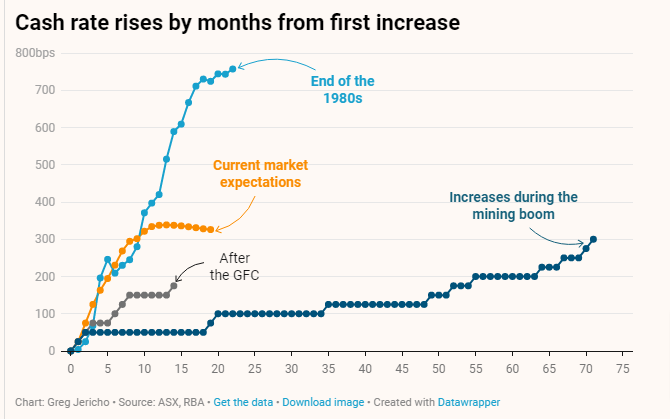
    He writes that for now a recession is unlikely, but the risks remain. Previous periods of sharply increasing rates have been followed by rising unemployment, and the current market expectations for the cash rate rising above 3.5% within a year would certainly create a massive brake on the economy.

    The story from overseas is also worrying, with the United States battling even higher inflation than Australia and suggestions that the market is already pricing in a recession.

    It all highlights that while today’s labour force figures are on the surface very promising, they also show just how affected the economy continues to be by the pandemic. Nearly 300,000 employed in June worked zero hours because of sickness or injury – well over double the usual amount.

    The nearly 50-year low unemployment rates are also failing to lead to wages growth anywhere near what would have been expected in previous years, let alone at a level that is keeping up with inflation.

    While inflationary pressure do remain, the risk that the Reserve Bank will raise rates too high and too fast remains very much in place – especially given the lack of wages growth.

    The post Will “curing” inflation cause a recession? appeared first on The Australia Institute's Centre for Future Work.

  • Profits push up prices too, so why is the RBA governor only talking about wages?

    Reserve Bank of Australia governor Phillip Lowe has invoked memories of the 1970s, warning wage growth must be restrained to contain Australia’s surging inflation.

    In the 1970s, Lowe said last week, “we got into trouble because wages growth responded mechanically to the higher inflation rate”. Now, with inflation above 5%, and tipped to reach 7% by the end of the year, he wants want people to keep in mind an “anchoring point” for wage growth of 3.5%.

    That 3.5% represents the central bank’s long-standing judgement that wage growth equal to the RBA’s ideal inflation target (2.5%) plus productivity growth (typically more than 1% a year, currently above 2%) is economically sustainable.

    Lowe says “if wage increases become common in the 4% and 5% range” that will make it harder to get inflation back to his target. But that prospect seems so remote it’s a wonder why he focused on it. Particularly when he said nothing about about the role of ever higher profits on increasing prices.

    Wages increases aren’t the problem.

    Nominal wage growth has languished well below that 3.5% benchmark since 2012. The last time wages grew at more than 4% was 2009.

    Over the past decade, wages have fallen further and further behind the level implied by the RBA’s magic formula. During this time Lowe (governor since 2016) repeatedly cited weak wages as a key factor keeping inflation below the bank’s 2-3% target – but nothing happened.

    So why is he now ringing alarm bells about wages growing too fast? It’s not at all clear when broad wage growth will even regain 3.5%, let alone surge faster.

    The Fair Work Commission’s decision this month to raise the minimum wage by 5.2% and wages for other award-covered workers by 4.6% will boost the pay for about a quarter of workers. But even that can’t be considered “inflationary” by any stretch of imagination. In real terms, the minimum wage will fall again this year, as it did last year.

    Most other workers have little chance of doing as well.

    Wage gains from enterprise bargaining agreements (covering about 35% of workers) remain subdued. In the latest 12-month period they delivered an average increase of just 2.6%.

    For the 38% of workers on individual contracts – now the most common pay-setting method in Australia’s individualised labour market – there is even less reason to expect wage growth to suddenly accelerate.

    Profits have played a bigger role

    Labour is not the only component in production costs: a considerable profit margin is also built into final prices. In fact, after decades of capital’s share of GDP increasing while labour’s declines, those profits have become more important in price-setting.

    That’s a big change from the 1970s, when the narrative about wage-driven inflation became so firmly locked into the national policy discourse.

    Indeed, by the end of 2021, corporations made 62 cents in gross profit for every dollar they paid in labour compensation. That’s the highest in history – and more than twice the rate in the 1970s.

    Yet while the RBA warns darkly about rising labour costs, the growing importance of profits in driving higher prices is not mentioned. This reflects an ideological bias that wages are a “cost” item that must be tightly controlled, while profit is assumed to be a legitimate “reward” to businesses that efficiently supply the market with something valuable.

    Calculating profit costs
    The Australian Bureau of Statistics calculates several measures of unit labour costs – the cost of employing labour per “unit” of production. It does not publish a measure of “unit profit cost” – what gets paid in profit per unit of production. But perhaps it should. That might motivate greater attention to the role of profit margins in current inflation.

    In lieu of ABS data, however, we can create a broad measure of unit profit cost by comparing the growth of nominal corporate profits to the growth of real output (similar to the methodology for measuring unit labour costs).

    As shown in the following graph, since the start of the COVID-19 pandemic unit profit cost has surged 24%, compared with a 4% increase in the nominal unit labour cost (which, being over two years, is still below the RBA’s inflation target.

    Blaming the victims
    Warnings about wages misdiagnose the source of current inflation. They blame the victims of falling real wages for a problem they did not cause.

    The RBA acknowledges the upsurge in inflation was initially fuelled by COVID-19 disruptions – including supply chain problems, global energy prices and major (but temporary) shifts in the composition of consumer demand.

    But corporations with pricing power (particularly potent in sectors like energy, housing and groceries) took advantage of those disruptions to fatten their profit margins. They have profited from inflation, while workers lost out.

    Now workers are being told they must swallow further real wage cuts to fix the inflation that enriched their employers.

    Once the RBA confronts the issue of inflated profits as both a cause and a consequence of current inflation, we then might discuss labour’s role. Until then, workers are justified in fighting to protect their real incomes.

    The post Profits push up prices too, so why is the RBA governor only talking about wages? appeared first on The Australia Institute's Centre for Future Work.
  • Exit Poll: Overwhelming Majority of Australians Want Wage Growth in Line with Cost of Living

    As the Fair Work Commission prepares to announce this year’s increase in the national minimum wage, new polling data shows that the vast majority of Australians support lifting wages to keep up with rising inflation.

    The Australia Institute conducted a special exit poll, surveying a nationally representative sample of 1,424 Australians on the evening of Saturday May 21, following the federal election. Among other questions, the survey asked about voters’ attitudes towards cost of living and low wage growth.

    Key Findings:

    • An overwhelming majority of Australians (83%) support wage increases that keep up with cost of living, only 10% disagree.
      • Strong support for boosting wages to keep up with inflation was expressed across all voting intentions (Coalition 79% agree, 13% disagree; Labor 88% agree, 8% disagree; Greens 83% agree, 11% disagree; PHON 70% agree, 14% disagree; IND/other 84% agree, 7% disagree.)
    • In this context, criticism directed at Mr. Albanese during the election campaign for agreeing that wage increases should keep pace with inflation more likely hurt the Coalition campaign, not the Labor leader.
      • 39% of respondents felt Labor was best placed to address the issues of wages and the cost of living, compared to 26% who felt the Coalition had the stronger position.
    • Almost two in three Australians (65%) believe their nominal incomes have lagged behind inflation in the past year.
      • Regarding what can be done to ameliorate this problem, Australians were evenly divided: about half of respondents believe government policies can significantly alter the course of wage growth, while the other half do not.

    “Our research shows that while conservative commentators might be alarmed at the idea that wages should increase as fast as prices, among the voting public the idea seems reasonable and fair,” said Dr Jim Stanford, Economist and Director of the Centre for Future Work.

    “There is no economic basis for the view that wages keeping up with inflation will only cause further inflation. The current cost of living crisis is clearly due to factors (like supply chain disruptions and global energy prices) that have nothing to do with Australian wages.

    “Unit labour costs in Australia are falling, not increasing. Workers should not be punished further with falling real wages for a problem they did not create.

    “Wages can and should keep pace with rising prices to protect the real living standards of Australian workers, while the true causes of inflation are addressed.”

    The post Exit Poll: Overwhelming Majority of Australians Want Wage Growth in Line with Cost of Living appeared first on The Australia Institute's Centre for Future Work.
  • Wages, Prices and the Federal Election

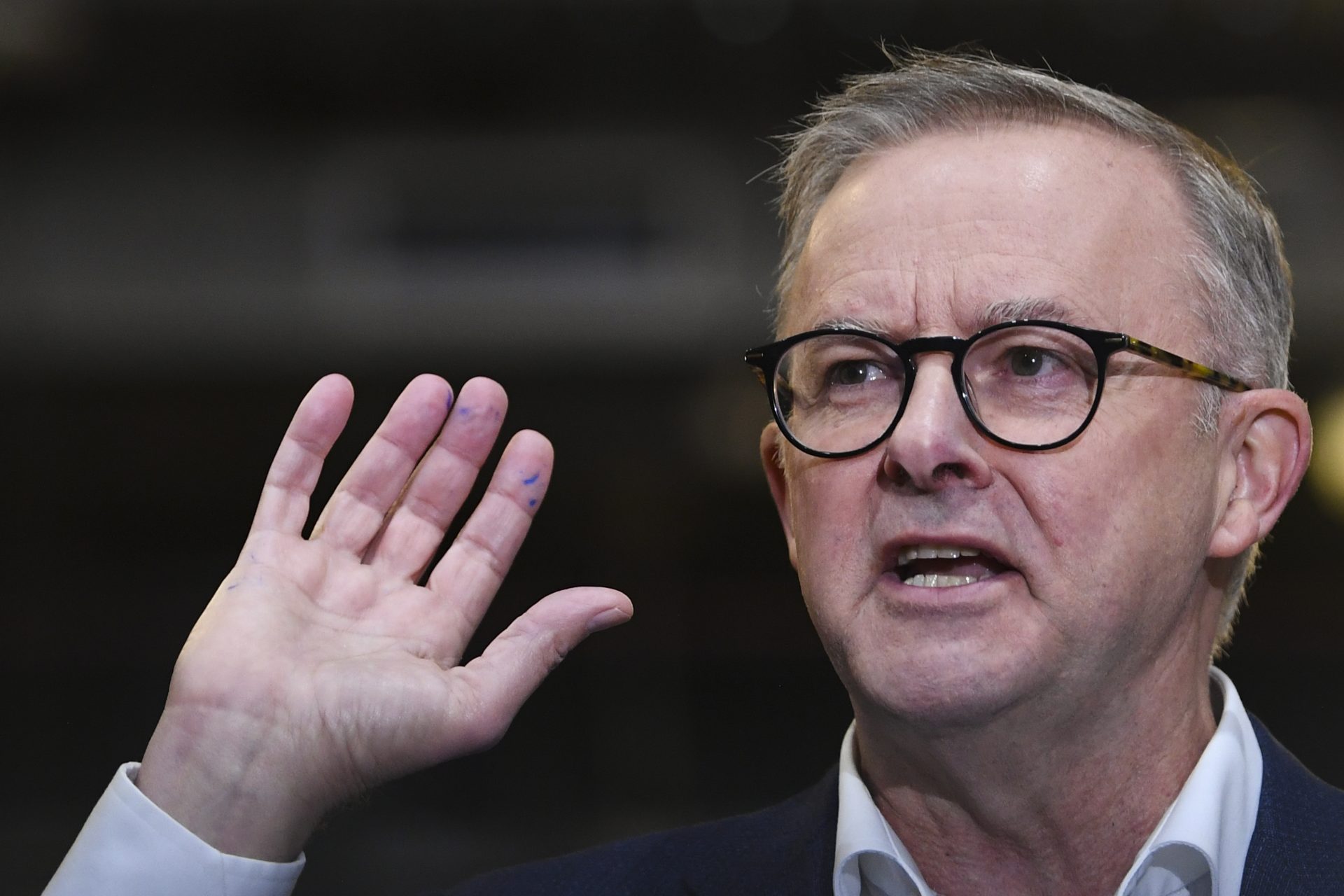
    The recent federal election featured important debate regarding the rising cost of living in Australia, and whether and how wages should be boosted to keep up with higher prices. One exchange, late in the campaign, occurred when ALP leader Anthony Albanese stated his belief that wages should keep up with prices — but then was strongly criticised for that view by Coalition leaders and some business commentators.

    New exit poll results from the Australia Institute indicate that a very strong majority of voters (83%) in fact support the idea that wages should at least keep up with prices. This opinion was shared broadly across the political spectrum. Even 79% of Coalition voters supported lifting wages to at least keep up with inflation.

    It seems likely, therefore, that this debate over wages and prices worked to the advantage of Mr Albanese. The exit poll indicated that voters identified the ALP, by a large margin, as having enunciated the best position on the problems of wages and the rising cost of living. 39% of voters (including 11% of Coalition voters) indicated the ALP had the strongest position on this issue, compared to 26% who thought the Coalition had the best policy.

    The post Wages, Prices and the Federal Election appeared first on The Australia Institute's Centre for Future Work.
  • To really address housing affordability we need to think differently

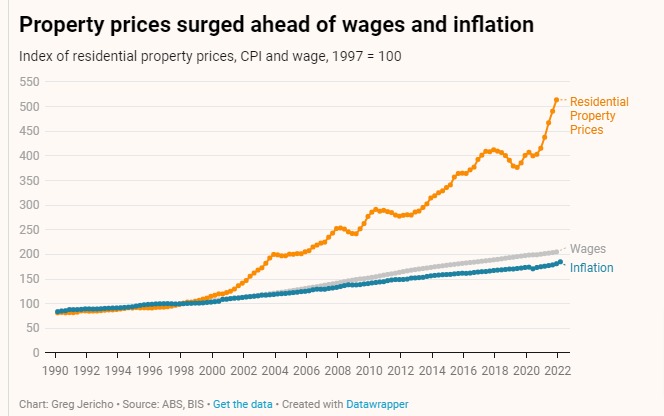
    The problem is that for many decades, housing policies have overwhelmingly been geared toward increasing demand within the private-sector housing market. This has only served to pump prices and make it harder for first-home buyers to enter the market, and also increasing the age that people are buying their first home.

    Policy Director, Greg Jericho, writes in a column for Guardian Australia, that we need to instead focus on the supply side – increasing the stock of housing – and we also need to be bold enough to look outside the typical private-sector model.

    The Australia Institute’s Nordic Policy Centre has proposed a number of measures that have been pursued in Norway, Sweden and Finland that show the solution to housing affordability is not about creating tax distortions that benefit homeowners or which serve only to transfer money from low-income people to the wealthy, but instead treats housing as a need rather than just a wealth-building asset.

    After decades of failure, the solution to housing affordability needs to be something other than more policies designed to lift housing prices.

    The post To really address housing affordability we need to think differently appeared first on The Australia Institute's Centre for Future Work.
  • Why commentary that wages growing in line with inflation will drive up inflation is completely misguided

    Today the opposition leader, Anthony Albanese was asked about wages in the following exchange:

    Journalist: “You said that you don’t want people to go backwards. Does that mean that you would support a wage hike of 5.1% just to keep up with inflation?

    Anthony Albanese: “Absolutely”.

    Any other response would be to suggest that real wages – and thus people’s ability to purchase goods and services with the money they earn – should decline.

    The suggestion that wages rising in line with inflation or even marginally above inflation will increase inflation in a “return to the 1970s” wage spiral ignores basic economics and the advice of the Treasury department.

    Real wages should rise – and unless they are outpacing productivity there is no case to be made that they are driving inflation.

    This very point was made in February by the Secretary of the Treasury, Steven Kennedy when he noted

    “if we can achieve productivity growth of 1.5 per cent, then nominal wages [assuming inflation of 2.5 per cent] can grow at four per cent and put no pressure on inflation”[i].

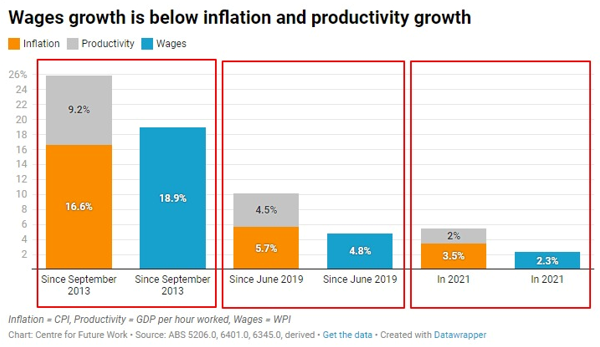
    The problem is not that wages are growing too fast, but that over the past 3 years they have not kept pace with inflation and productivity growth.

    From June 2019 to the end of 2021 inflation has increased 5.7% and productivity has grown by 4.5%. And yet rather than wages growth being equal to the sum of those two measures, nominal wages in that period increased just 4.8%, and real wages have fallen 0.8%. Real wages have thus declined, while real labour productivity increased.

    The evidence is clear that wages did not cause the current surge in inflation. There is no reason to believe that suppressing wages will cause inflation to moderate. Asking workers to accept a permanent reduction in their real living standards to fight inflation that they did not cause is neither fair nor economically sensible.

    The Reserve Bank has rightly suggested that it will keep an eye on labour costs, however it should be noted that in the 12 months to March while the Consumer Price Index grew 5.1%, the Producer Price Index, which measures the inflation of input costs, rose 4.9%, and nominal unit labour costs grew just 4.0%. This confirms that inflation is not being driven by labour costs.

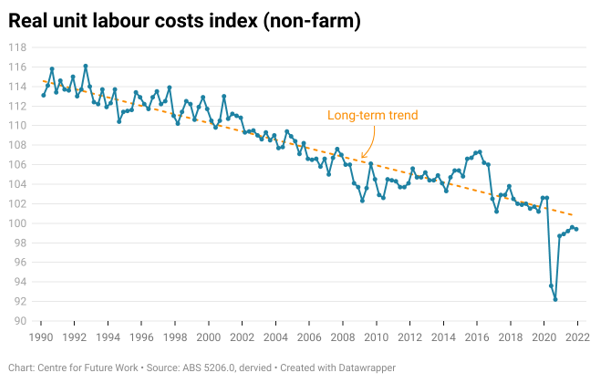
    Moreover, Non-farm, Real Unit Labour Costs are now 3.1% below their pre-pandemic level of December 2019.

    That decline is even faster than the long-term trend.

    Real unit labour costs index (non-farm)

    A fall in real wages will only continue the transfer of national income from workers to corporate profits – something which also occurred when inflation was falling. Workers were told then to accept lower wages growth (and also public-sector wage caps) because inflation was low. Now they are being told to accept lower wages because inflation is high – and for no fault of their own.

    [i] Economics Legislation Committee, 16 February 2022.

    The post Why commentary that wages growing in line with inflation will drive up inflation is completely misguided appeared first on The Australia Institute's Centre for Future Work.
  • Rate rises are going to cause a housing affordability crunch

    But that is about to change.

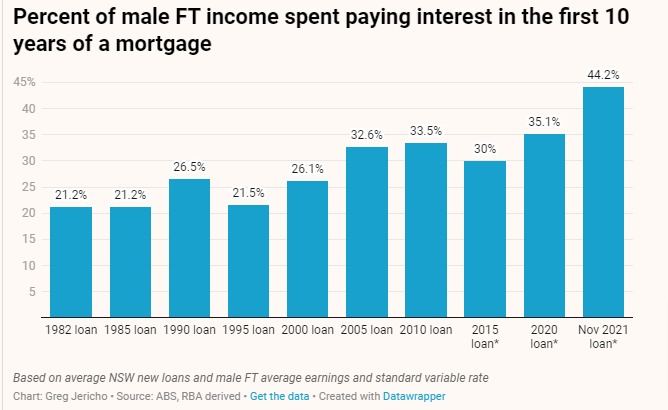
    The signal that interest rates are going to rise by possibly 2.5% points over the next 18 months means that for new mortgage holders the cost of repaying a mortgage is going to be harder than ever before – harder even than when interest rates hit 17% in 1990.

    It is a hit that will only exacerbate standard of living problems as wages will struggle to keep up with the rising cost of of holding a mortgage – especially given the belief that wage rises need to be contained below inflation rises continues in economic debate.

    The post Rate rises are going to cause a housing affordability crunch appeared first on The Australia Institute's Centre for Future Work.
  • High inflation means real wages have plummeted

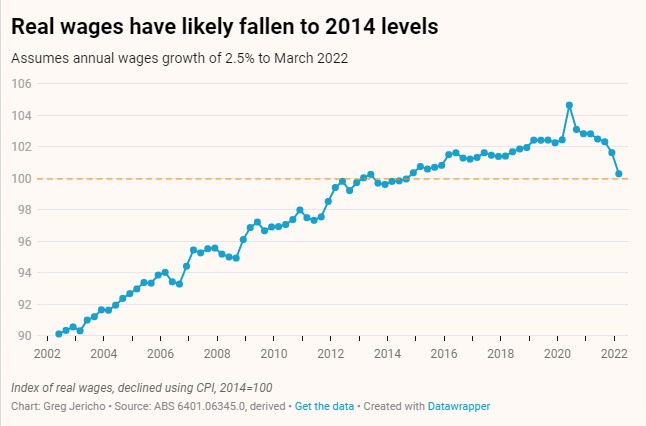
    Labour market policy director, Greg Jericho, notes in his column in Guardian Australia that even if wages have increased by 2.5% in the next release (up from 2.3% in the 12 months to December) real wages will have fallen 2.5% in the past 12 months.

    That would mean real wages would be back at 2014 levels and barely above where they were when the LNP took office in September 2013.

    Worse still for low-income earners, in the past 12 months the prices of non-discretionary items rose 6.6%. For those whose income goes more towards paying essential bills than does the average household, the pain of these price rises has been much higher. Their real wages have likely fallen by more than 3% in the past 12 months.

    This is why any gloating about a recovery from the pandemic must be tempered to consider the reality of workers’ lives. It is not enough to point to lower unemployment if real wages are falling faster than they ever have outside of the introduction of the GST – especially for lower income earners.

    That is not a recovery; that is a failure.

    With interest rate rises now very much on the way, without wage rises that account for inflation and properly reward for increases in productivity, workers standard of living is set to fall and see them back where they were nearly a decade ago.

    The post High inflation means real wages have plummeted appeared first on The Australia Institute's Centre for Future Work.