International Women’s Day analysis of persistent gender pay gaps.
Tag: Gender at Work
-
Going Backwards: NDIS Workforce and Gender Equality
Hundreds of thousands of NDIS participants rely on this workforce to provide personal support and care on a daily basis.
The NDIS workforce is large and growing, currently employing about a quarter of a million workers, mostly women. Pay, working conditions and career opportunities in the disability support workforce are critical to the future of women’s economic equality in Australia.
It is a decade since the NDIS was first piloted, yet the promise for workers, that the scheme would translate into ‘greater pay, … better working conditions … (and) enough resources to do the job properly’ has not been fulfilled.
Rather, conditions of work in the NDIS are poor and deteriorating.
The design of the NDIS, with its market basis and poor and uneven regulatory oversight, has undermined fair pay and working conditions for disability support workers and is threatening workforce stability.
This briefing paper reviews this evidence and argues for significant reforms to address urgent problems arising from these design flaws and regulatory failures.
The post Going Backwards appeared first on The Australia Institute's Centre for Future Work.
-
Workplace Law Reform Must Limit Cancer of Gig Work in Care Economy: Research
Researchers have recommended limits are placed on the growth of gig work in the NDIS as part of the third tranche of the Commonwealth Government’s industrial relations reforms later for later this year. Researchers say the promised reforms to ‘Employee-like’ forms of work should be used to protect minimum employment standards and quality service delivery for care workers and consumers.
Key findings
- The gig work model is growing in the care economy and NDIS, undermining wages, conditions and gender pay equality
- Care workers on platforms are younger, less experienced and more likely to be migrant workers than workers in the broader care and support workforce.
- Platform care work is insecure on-demand work, working time is fragmented, pay can be unpredictable. Many workers’ earnings are equivalent to below award-level pay.
- Worker-friendly flexibility is limited and is mainly only possible in short hours jobs. Flexibility comes at the expense of a living wage.
- Care and support platform workers are isolated and largely invisible, working in private homes without organisational supervision, support, guidance or training.
- In platform and other independent contracting arrangements, risks and responsibilities for care quality and client safety are devolved to individual workers.
- Platforms compete by avoiding the costs and risks of business fluctuations, of employing workers and of accountability for care and support quality and safety. Costs and risks are devolved to low-paid and insecure frontline workers.
- Platforms profit from retaining funds that are allocated for employong workers and providing training and supervision.
“Unregulated gig work is a cancer for workers rights in Australia,” said Dr Fiona Macdonald, Policy Director, at the Australia Institute’s Centre for Future Work.
“The growth of gig work on digital platforms in the care economy eats away at minimum employment conditions and shifts risk on to care consumers and staff.
“Care is a public good. Stopping the gigification of disability and aged care workforces is necessary to prevent public funding allocations for essential workers’ wages, superannuation, training and supervision from being diverted to profits.
“Sector-specific reforms are currently being considered for the road transport industry. Yet, in the public care and support sectors, the same concerns—safety, sustainability and viability—are being approached through disconnected policy processes, rather than being addressed head on.
“The Women’s Budget Statement reiterated the Government’s commitment to ‘a sustainable and productive care and support economy that delivers quality care and decent jobs’. Gig care work should be addressed with a view to gender equality.
“We are seeing the Gigification of care work and, without protections, we will risk seeing this spread to other sectors of the labour market.”
Recommended policy responses:
- The Government has committed to reforms to ‘Employee-like’ forms of work in 2023
- These reforms must be designed to restore full employment rights and benefits to all care and support workers, including minimum wages, super & WHS
- Comprehensive employment minimum standards should apply for all care and support workers, regardless of employment status
Digital platforms in the care sector should be bound by mandatory codes of conduct
The post Workplace Law Reform Must Limit Cancer of ‘Gig Work’ in Care Economy: Research appeared first on The Australia Institute's Centre for Future Work.
-
The Times They Aren’t A-Changin (enough) — gender & work
This report examines the barriers to closing the gender gap by reviewing Australia’s position within the industrial countries of the OECD. The report also uses data from the ABS and the ATO to highlight gender disparities across all levels of income, ranges of occupation and ages, as well as disparities regarding who undertakes the greater share of unpaid work.
One clear concern is gender segregation, where either men or women dominate an occupation or industry. Men have higher average salaries than women in 95% of all occupations, including those where women dominate the workforce. For example, women account for 99% of all midwives, and yet are paid on average 19% less.
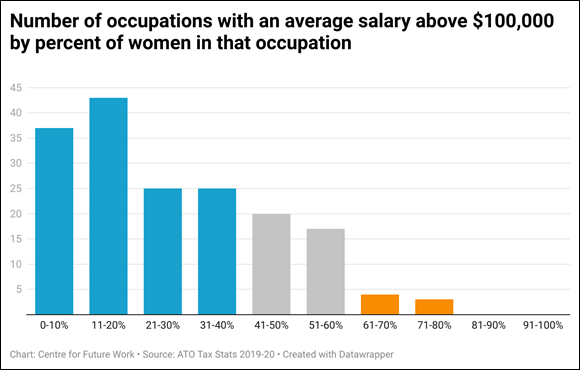
We identify 80 occupations in which men make up 80% or more of the workforce; these occupations have an average salary above $100,000. In contrast, no occupation where women make up that share of the workforce has such a high average salary. This highlights how segregation has reinforced massive differences in pay.
The report recommends policies to promote greater access to childcare and parental leave for both parents, family-friendly work practices, and the lifting of wages for industries dominated by women – most urgently in the care sector.
The post The Times They Aren’t A-Changin (enough) appeared first on The Australia Institute's Centre for Future Work.
-
Women Earn $1m less than men & $136,000 Less in Super over Working Life
New research released on International Women’s Day reveals Australian women earn $1.01m less over their working lives than men, based on median income data.
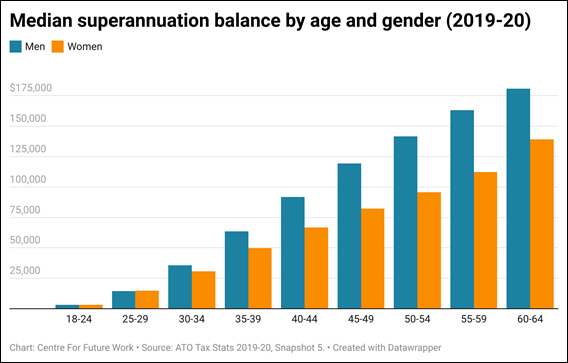
Women earn $136,000 less in superannuation over their working lives than men, based on median income data. Women earning the median wage will accumulate approximately $393,676 in super, $151,000 below what is considered a ‘comfortable retirement’. The average super balance in Australia in 2023 is $150k.
Experts say if the gender pay gap was eliminated women would be $3 billion per week better off.
Despite the gender pay gap narrowing slowly, based on data from the past decade it will only be eradicated by the year 2053 when more than 60% of the current workforce will be retired.
Key Points:
- Australian women on a median income will earn $1.01m less over their working lives on average than their male counterparts.
- Australian women on a median income will earn $136,000 less in superannuation over their working lives than their male counterparts.
- Women earning the median wage will accumulate approximately $393,676 in super, $151,000 below what is considered a ‘comfortable retirement.
- The average super balance in Australia in 2023 is $150k.
- Experts say if the gender pay gap was eliminated women would be $3 billion per week better off.
- The gender pay gap is narrowing so slowly that it will not fully close for another 30 years until 2053. At that stage 60% of people currently working will have retired.
- The Gender wage gap in Australia (15.3%) is more than double what it is in New Zealand (6.7%)
- The gender gap occurs across all occupations and industries:
- Men have higher average salaries than women in 95% of all occupations, including those where women dominate the workforce. For example, women account for 99% of all midwives, and yet are paid on average 19% less.
- 80 occupations in which men make up 80% or more of the workforce have an average salary above $100,000.
- By contrast zero occupations in which women make up 80% or more of the workforce have an average salary above $100,000.
- Men have higher average salaries than women in 95% of all occupations, including those where women dominate the workforce. For example, women account for 99% of all midwives, and yet are paid on average 19% less.
“For the average woman in Australia, the gender pay gap will be more than $1.01m over her working life, based on conservative estimates,” said Senior Economist Eliza Littleton from the Australia Institute’s Centre for Future Work.
“There’s been a noisy political debate about super in Australia for the past week, but this data shows that based on median income data Australian women will earn $136,000 less than their male counter parts over their working life. When you consider that the average super balance in Australia right now is approximately $150,000, that’s a huge disparity.
“Australian women continue to be paid less than men on average across all industries and occupations, costing us more than $3b across the economy each week.
“We know that older women are one of the most vulnerable groups when it comes to poverty and homelessness in Australia.
“Australian women shouldn’t have to wait until the year 2053 for substantive equality. We deserve equity today and our research makes several sensible policy recommendations for the Labor Government to action.”
Policy recommendations:
- Greater access to free or more affordable earlier childhood education & care: Australia Institute research shows if Australia had the same labour force participation rates as Nordic countries do, then the economy would be $60 billion, or 3.2% of GDP, larger (Grudnoff and Denniss, 2020).
- More paid parental leave for both parents: Australia’s PPL scheme is well behind international standards. The OECD average PPL scheme is 60 weeks in total, with 24.6 weeks reserved for mothers, 10.4 weeks for fathers and 25.4 weeks that can be flexibly distributed (OECD, 2022). With a 20-week scheme, Australia unsurprisingly ranks low – 30th out of 38 countries for the duration of paid leave entitlements. Extending leave entitlements and encouraging a more even distribution of childcare would help reduce the career and financial penalty of having children both for all parents, but especially women. Additionally, making it mandatory for superannuation to be paid while a person is taking paid parental leave would help to reduce the gendered super gap.
- Greater family-friendly work practices: Some workplaces and workers have managed to maintain flexible working arrangements, but this should be standardised, expanded and embedded in employment relations frameworks to make balancing work and care more achievable across the workforce. Breaking down rigid job design in male-dominated jobs could also help with reducing entrenched gendered segregation by industry and occupation.
- Deliberate policy to lift the wages for industries dominated by women — most urgently in the care sector: Women dominated sectors, especially in the care industry are among the lowest paid work. The 2021 Royal Commission into Aged Care Quality and Safety recommended that gig work, independent contracting and other ‘indirect’ employment arrangements be restricted in the publicly-funded aged care sector. This needs to be agreed to.
- Address insecure work: Further reforms should include rights to family-friendly working time arrangements and stable work as minimum standards for all employees in the National Employment Standards.
- Full recommendations in attached report
The post Women Earn $1m less than men & $136,000 Less in Super over Working Life appeared first on The Australia Institute's Centre for Future Work.
-
Families change but the same problems remain
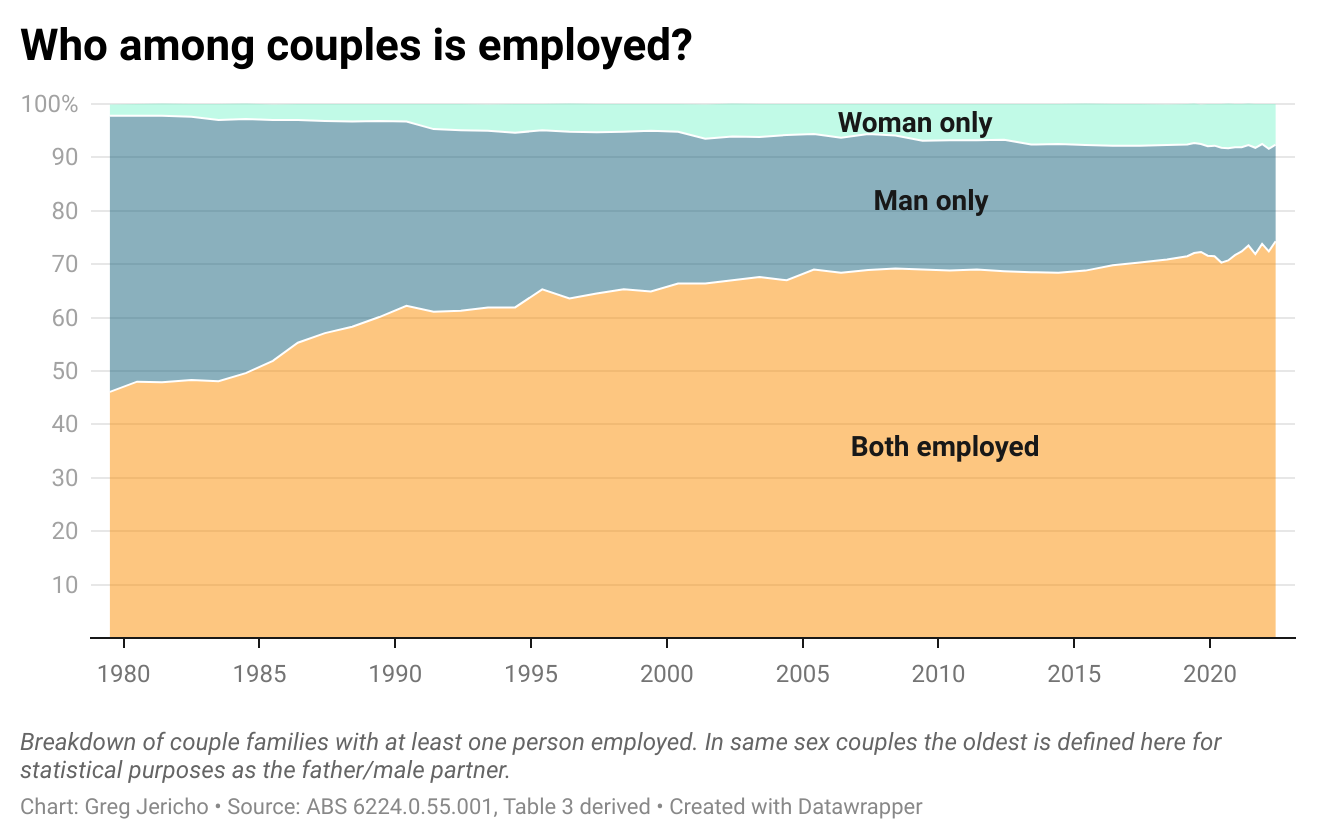
Labour market policy director, Greg Jericho, notes in his Guardian Australia column that over the past 40 years the make-up of families has shifted dramatically from ones with just one parent working to now more than 70% having both partners in employment.
While this has mostly come from the great gains made by women since the 1970s that have seen changes to discrimination laws, child care and also societal norms to allow women to participate in paid work even once they have had children, it also highlights the rising cost of living pressures faced by most families.
The times when a family on one income could be expected to buy a house are long gone. But the decade of weak wage growth and recent falls in real wages make living on one wage even more difficult.
But the data reveals that men are still more likely to be the sole breadwinner and it confirms the labour force data that shows women remain much less likely than men to work full-time. This is a major reason why women in over 90% of occupations earn on average less than do men. It means that women remain at a heightened risk of income loss in the event of relationship breakdowns that can severely affect their standard of living, especially in retirement.
The data also reveals that women remain very much the most likely parent in sole-parent families. Given the laws that now see such parents move from the parenting allowance to the lower-paying Jobseeker once their youngest child turns 8, this highlights the precarious nature over 800,000 women face as they attempt to survive as the sole parent.
The post Families change but the same problems remain appeared first on The Australia Institute's Centre for Future Work.
-
Work in the Care Economy Vital for Future Well-Being
Our Policy Director for Industrial and Social issues, Dr Fiona Macdonald, recently discussed these issues in a feature conversation with Richard Aedy on the ABC RN program, The Money. They discussed the size of the care workforce, the challenges faced by care providers and participants alike, and the need for government reform.
The post Work in the Care Economy Vital for Future Well-Being appeared first on The Australia Institute's Centre for Future Work.
-
The latest taxation statistics reveal the massive gender pay gap across the whole economy
The 2019-20 taxation statistics released this week by the ATO provide a plethora of data that reveals with precision the salaries of people by location, occupation age and importantly, gender.
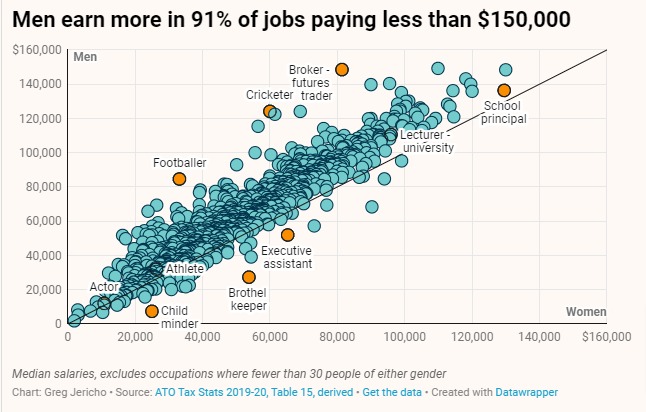
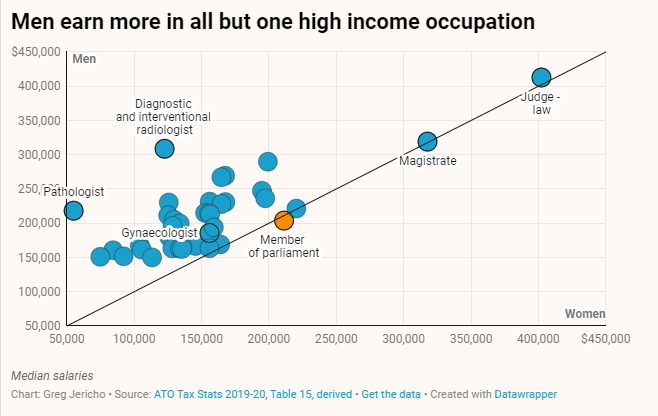
Labour market and fiscal policy director, Greg Jericho, undertook a deep dive into the data. He notes in his column in Guardian Australia that in 91% of over 1,000 separate occupation groups from Nightclub DJ through to Magistrates and Judges, men have a higher median income than do women.
The data reveals that women are less likely to work in higher paying occupations, and perhaps more damning those occupations with high levels of female participation are more likely to be low paid than are jobs which are mostly done by men.
It is clear that work traditionally done by women is much lower paid than stereotypically traditional male jobs.
But it is not just those occupations where the imbalance occurs. Even in jobs where women are the majority of workers, men will likely have a higher median salary and be more likely to be paid over $90,000 a year and be within the top two tax brackets.
Women for example make up 57% of a journalists, and yet account for just 46% of all journalists earnings between $90,000 and $180,000 and a mere 36% of those earning above $180,000.
The data highlights that the gender pay gap is not just about being paid the same hourly rate for the same work, but who gets the opportunity to work more hours, and who is more likely to be given roles that pay higher wages.
It reveals a deep structural issue within our economy in which even in jobs largely done by women, the men in those occupations will most likely be paid more.
The post The latest taxation statistics reveal the massive gender pay gap across the whole economy appeared first on The Australia Institute's Centre for Future Work.
-
The great (gendered) resignation is not what you think. It’s worse
Have you heard? The so-called great resignation is afoot. A world where an empowered workforce say “no” to bad bosses and a life dictated by work. In the US, increased job departures have been coined a “revolution in workers’ expectations”.
Australian workers were squeezed for an average 6.1 hours unpaid overtime per week in 2021 – a substantial increase on 2020. If only expectations matched reality.
In Australia, employers crow about shortages in low-paid, “churn and burn” jobs of which they refuse to improve the quality. Meanwhile, 700,000 people are unemployed, and 1.3 million are in jobs, but need more work. Around 1 million more aren’t looking for work, but want to work and are available. The ABS calls them “marginally attached” and “discouraged” workers.
Women know a thing or two about being discouraged. Far from quitting as an act of righteous agency, they’ve lost their jobs during lockdowns against their will. It’s material. Less “life’s too short to work 24/7”. More “my kids need care immediately”.
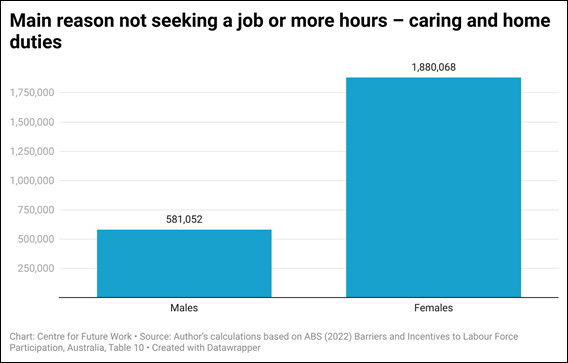
The explosion in caring demands associated with lockdowns fell disproportionately to women – as in 2020, when women’s average hours caring for children and performing household tasks rose faster than for men, reaching 5.1 hours per day (versus 3.1 for men).
In February 2021, 175,000 women didn’t look for work even though they were available and ready to start within four weeks because they had pressing caring responsibilities.
Even if women loaded with caring demands wanted to retain their jobs, the odds were stacked against them. They hold the majority of low-hours insecure jobs without protections against sacking. When bosses want to shed jobs to save bottom lines, women cop it worst.
68% of all jobs lost between May and October were held by women (205,000 jobs). Women’s participation in the job market fell 1.7 percentage points. Nearly all (90%) of women’s jobs lost were part-time.
Little acknowledged, the latest job vacancies data mirror women’s exodus from paid work. In August, vacancies were highest in healthcare, administration and retail. These are all industries employing 50% or more women. All are in the bottom-half of industries by average weekly earnings.
The question is, as wallets open, beers flow and economic activity resumes, what’s bringing women back to work? A couple shifts at minimum wage, and higher COVID-19 contagion risks to boot. All to pay for one day of high-cost childcare? Hardly appealing.
An empowered workforce can walk away from bad jobs. But structural barriers stop women from participating in the first place.
High-cost childcare is a clear barrier for women workers. Before the pandemic, over half of non-employed women with young children said high-cost childcare was the biggest influence on their decision not to work.
Australia’s outdated paid parental scheme bakes “primary” and “secondary” carers into family structures – reinforcing the exodus of women from work, and blocking the equal participation of fathers in raising their children.
The so-called great resignation is gendered. But women shouldn’t have to resign themselves to the revolving door of crap jobs and important caring responsibilities.
We’ve come a long way since the 1950s when conservative norms dictated women’s labour should be unpaid and confined to the home. Women have better access to the world of paid work now. But their relegation to insecure, low-paid, and junior roles shows we have much further to go.
And it’s government policies that holds us back.
Australian women need genuine measures to support them in all aspects of their lives; from free early childhood care and education, better work-family balance policies, pay equity, and more opportunities for decent jobs.
Only then, can women imagine a world where they are empowered through work.
The post The great (gendered) resignation is not what you think. It’s worse appeared first on The Australia Institute's Centre for Future Work.