Tag: Employment & Unemployment

  • Workplace Law Reform Must Limit Cancer of Gig Work in Care Economy: Research

    Researchers have recommended limits are placed on the growth of gig work in the NDIS as part of the third tranche of the Commonwealth Government’s industrial relations reforms later for later this year. Researchers say the promised reforms to ‘Employee-like’ forms of work should be used to protect minimum employment standards and quality service delivery for care workers and consumers.

    Key findings

    • The gig work model is growing in the care economy and NDIS, undermining wages, conditions and gender pay equality
    • Care workers on platforms are younger, less experienced and more likely to be migrant workers than workers in the broader care and support workforce.
    • Platform care work is insecure on-demand work, working time is fragmented, pay can be unpredictable. Many workers’ earnings are equivalent to below award-level pay.
    • Worker-friendly flexibility is limited and is mainly only possible in short hours jobs. Flexibility comes at the expense of a living wage.
    • Care and support platform workers are isolated and largely invisible, working in private homes without organisational supervision, support, guidance or training.
    • In platform and other independent contracting arrangements, risks and responsibilities for care quality and client safety are devolved to individual workers.
    • Platforms compete by avoiding the costs and risks of business fluctuations, of employing workers and of accountability for care and support quality and safety. Costs and risks are devolved to low-paid and insecure frontline workers.
    • Platforms profit from retaining funds that are allocated for employong workers and providing training and supervision.

    “Unregulated gig work is a cancer for workers rights in Australia,” said Dr Fiona Macdonald, Policy Director, at the Australia Institute’s Centre for Future Work.

    “The growth of gig work on digital platforms in the care economy eats away at minimum employment conditions and shifts risk on to care consumers and staff.

    “Care is a public good. Stopping the gigification of disability and aged care workforces is necessary to prevent public funding allocations for essential workers’ wages, superannuation, training and supervision from being diverted to profits.

    “Sector-specific reforms are currently being considered for the road transport industry. Yet, in the public care and support sectors, the same concerns—safety, sustainability and viability—are being approached through disconnected policy processes, rather than being addressed head on.

    “The Women’s Budget Statement reiterated the Government’s commitment to ‘a sustainable and productive care and support economy that delivers quality care and decent jobs’. Gig care work should be addressed with a view to gender equality.

    “We are seeing the Gigification of care work and, without protections, we will risk seeing this spread to other sectors of the labour market.”

    Recommended policy responses:

    • The Government has committed to reforms to ‘Employee-like’ forms of work in 2023
    • These reforms must be designed to restore full employment rights and benefits to all care and support workers, including minimum wages, super & WHS
    • Comprehensive employment minimum standards should apply for all care and support workers, regardless of employment status
      Digital platforms in the care sector should be bound by mandatory codes of conduct

    The post Workplace Law Reform Must Limit Cancer of ‘Gig Work’ in Care Economy: Research appeared first on The Australia Institute's Centre for Future Work.

  • Unacceptable Risks: Gig Models of Care and Support Work

    New research reveals the unacceptable risks of digital labour platforms and the expansion of gig work in low-paid feminised care and support workforces. Risks are to frontline care and support workers, people receiving care and support and to workforce sustainability.

    The report calls for comprehensive industrial reforms to address gig work as part of broader workforce strategies for the NDIS and aged care sectors.

    The research finds that care and support ‘gig’ workers, treated as independent contractors, are in highly insecure work without minimum standards and effective rights to collective bargaining.

    • Many essential frontline care and support workers earn below award-level pay.
    • Work and incomes are insecure: work is on-demand, working time is fragmented, pay can be unpredictable.
    • Workers must cover their own superannuation, leave and workers’ compensation.
    • Gig work in the feminised workforces poses a serious threat to better recognition and equal pay.
    • Better jobs and careers for frontline workers are vital to closing the gender pay gap.

    Four in every 5 of the 240,000 aged care and disability support workers are women.

    • Care and support workers on platforms are younger, less experienced and more likely to be migrant workers.
    • Platform workers lack access to support, training and progression opportunities.
    • Gig workers lack employment benefits and entitlements, including leave and superannuation.

    Flexibility of work is only possible with short hours work and comes at the expense of decent pay and working conditions. Workers cannot earn a living wage.

    • Risks to workers are also risks to vulnerable people with disability and the elderly.
    • Care and support platform workers are isolated and largely invisible, working in private homes without organisational supervision, support, guidance or training.
    • Workers bear risks and responsibilities for care and support quality and client safety, including for highly vulnerable people.
    • Care labour platforms compete unfairly with other NDIS and aged care providers.
    • Unfair competition poses a significant threat to the sustainability of Australia’s long-term care systems.

    Platforms compete by avoiding the costs and risks of business fluctuations, of employing workers and of accountability for care and support quality and safety. Costs and risks are devolved to low-paid and insecure frontline workers. Platforms profit from retaining public funding that is intended to employ and pay essential workers fairly and to provide them with supervision and support.

    The post Unacceptable Risks appeared first on The Australia Institute's Centre for Future Work.
  • Affordability of a Liveable Jobseeker Payment is a Non-Issue

    Commonwealth on Track for Diminutive Deficit or Surplus in 2022-2023

    In the lead-up to its 2023-24 budget, the Labor Government finds itself in an awkward position, accepting that the Jobseeker payment is “seriously inadequate” and an impediment to regaining work, yet professing that it lacks the financial capacity to afford a meaningful increase anytime soon.

    The Economic Inclusion Advisory Committee’s (EIAC) April 2023 Interim Report recommended raising Jobseeker from 70% of the Pension up to 90%. The current Jobseeker base rate for a single person with no children is $693.10 per fortnight. Lifting it up to 90% of the current Pension payment of $971.50 per fortnight would provide the unemployed with an extra $181.25 per fortnight (or $12.25 per day).

    Labor has baulked at the cost of the EIAC’s Jobseeker proposal. There is speculation that the upcoming budget will include a $50 per fortnight increase in the Jobseeker payment for those over 55 years of age. It is unclear if that increase will apply to everyone over 55 years of age, or just to the 55 to 59 year old cohort who are currently ineligible for the additional $52 per fortnight already available to those over 60 and who have been unemployed for longer than nine months.

    A $3.57 per day rise in the Jobseeker payment for those over 55 years of age (or between 55 and 59) seems rather stingy. One might expect that the plight of the unemployed—among the least well-off and most financially-constrained members of society—would be a high priority in the middle of a cost-of-living crisis.

    Before last year’s election, the Labor party abandoned a previous pledge to raise Jobseeker payments, on concerns about growing Commonwealth government debt. The EIAC then only came about as a concession to gain Senator David Pocock’s support for the Secure Jobs Better Pay Act 2022.

    Labor’s meme of “inheriting a trillion dollar debt that will take generations to pay off” has echoed the Coalition’s 2013 so-called “budget emergency”, also used to blame the preceding government. The nation’s allegedly dire fiscal position was cited by Bill Shorten as justification for not adopting the EIAC’s key recommendations: ‘We can only do what is responsible and sustainable and unfortunately the budget we inherited from the previous government is heaving with a trillion dollars of Liberal debt, so [we] can’t do everything.’

    The strategy of deflecting accountability for policy choices on grounds of fiscal constraint has become less credible, given the robust post-pandemic economic recovery and the boom in commodity prices – all of which has generated large improvements in the Commonwealth government’s fiscal position. As illustrated in Figure 1, the government’s underlying cash deficit for the current financial year (2022-23), once expected to be $100 billion, has shrunk dramatically.

    Sources: Australian Government, Budget Papers, Monthly Financial Statements. Author’s calculations.

    Indeed, the Commonwealth Government’s latest Monthly Financial Statements show that it is on track to post a very small deficit, or even a surplus, for the 2022-23 financial year. As of March 2023 the underlying cash balance (UCB) had improved by $23.3 billion over the estimates in the October 2022-23 Budget. If the year-to-date deficit changes little in the last quarter, and with higher GDP than previously estimated, then the UCB in 2022-23 would come in at a diminutive -0.5% of GDP. That’s insignificant by any meaningful economic standard.

    Further upside is possible. If the average monthly improvement from November 2022 to March 2023 continues in the last quarter of the financial year, the UCB in 2022-23 would be a surplus of $2.8 billion.

    Australia’s public debt load – also measured appropriately as a proportion of GDP (rather than in big scary ‘trillion dollar’ terms) is also modest when compared to the nation’s peers and to its own historical record. Our general government debt (including state governments) is lower than any G7 economy, and half the size of the average for advanced economies. The same cannot be said, however, for Australian households: their debt is higher than any G7 economy, and ranks second (behind only Switzerland) among all industrial countries (see Figure 2).

    Figure 2: Government and Household Debt

    Sources: International Monetary Fund, World Economic Database. Bank for International Settlements, Credit to the Non-Financial Sector.

    Having switched from “opposition mode” into “governance mode,” it makes sense for Labor to start to talk up the nation’s public finances. Such a narrative would be plausible given that Australia’s fiscal position is robust and sustainable: now and into the foreseeable future. That is the current assessment of the International Monetary Fund in its latest Article IV Consultation, amongst others.

    The prospect for further substantial improvement in the UCB over the forecasts – and perhaps even a surplus – should raise expectations about what the government can do to ease cost-of-living pressures. Arguably, however, a liveable unemployment benefit should be prioritised regardless of the economic and fiscal outlook.

    The EIAC’s Jobseeker proposal is estimated to cost $24 billion over four years. Implementing all of the EIAC’s other recommendations brings the cost to $36 billion. The annual cost of the full package would amount, respectively, to just 0.3% of GDP in the next financial year. Such expenditures, while having a diminutive impact on the Commonwealth Government’s fiscal position, would literally transform the lives of the unemployed.

    When all is said and done whether a nation should have a liveable unemployment benefit is a question of principles. There is an obvious option for Labor to allay its worries about the budgetary or inflationary pressures of a liveable Jobseeker payment: namely, jettison the 2024-25 Stage 3 tax cuts, that are estimated to cost $300 billion over the first nine years. Tax cuts that mainly benefit high-income earners make no sense in an economic landscape where over 90% of the pre-tax income gains from growth in national income have in recent experience gone to the highest-income 10% of households.

    The reluctance of the government to discard or redesign the Stage 3 tax cuts is attributed by some to the Labor Party’s pre-election commitments. It remains that the tick boxes for good governance do not include steadfast adherence to suboptimal policy positions. Overseeing regressive tax cuts, while being unwilling to meaningfully improve the lot of the least well-off, has those principles back-to-front.

    Dr Brett Fiebiger is a post-Keynesian economist. His research focuses on macroeconomic policy, growth theory and income distribution.

    The post Affordability of a Liveable Jobseeker Payment is a Non-Issue appeared first on The Australia Institute's Centre for Future Work.
  • Inclusive and Sustainable Employment for Disadvantaged Jobseekers (VIC)

    Employment policy and employment assistance for jobseekers focus on individuals’ skills and job readiness, and on job placement. Less attention is given to ensuring placements are into sustainable employment in inclusive workplaces. That is, placement into jobs that people can keep, that support wellbeing and provide opportunity for long-term employment pathways, and in workplaces where people feel safe and are able to participate. Recruiting and placing people experiencing labour market disadvantage into jobs may not lead to positive outcomes if people are not able to retain jobs and benefit from their employment.

    Employment can provide people with benefits that improve wellbeing in various ways, including through increasing income, providing routine and increasing social contact. However, where job quality, pay or working conditions are poor, employment can also have cumulative negative effects. Placing people experiencing disadvantage in jobs in which they are insecure, underemployed, or cannot establish daily routines; or placing them in workplaces in which they experience poor or discriminatory treatment and disempowerment, are not likely to produce sustainable employment outcomes or create social value.

    This report calls for a greater focus on workplace and job-related factors, including employer knowledge, employment practices, work organisation, job quality and employment arrangements, to addressing barriers to employment for disadvantaged jobseekers. Emphasis on employment placement alone is not likely to produce sustainable employment outcomes. Action is required to tackle barriers present in workplaces and in employment arrangements.

    This report was commissioned by Jobsbank, a Victorian-based not-for-profit organisation that works with business and other partners to support sustainable, inclusive employment and make social procurement work. In Victoria, the Government’s Social Procurement Framework aims to improve employment outcomes for people from groups experiencing labour market disadvantage through requiring suppliers and contractors tendering for high value government contracts to employ people from these groups. The Victorian Government’s Fair Jobs Code promotes fair labour standards, secure employment and job security, equity and diversity, and cooperative workplace relationships and workers’ representation. This report recommends that employers be encouraged to develop strategies to meet these standards through collaboration with unions and community groups as one obvious way to address workplace and employment factors that create barriers to sustainable and inclusive employment for disadvantaged jobseekers.

    The post Inclusive and Sustainable Employment for Jobseekers Experiencing Disadvantage appeared first on The Australia Institute's Centre for Future Work.

  • Multi-Employer Bargaining Necessary for Fixing Wages Crisis

    But as our Policy Director Fiona Macdonald argues in this new commentary for The Conversation, multi-employer bargaining is already allowed under various existing provisions of the Fair Work Act. The problem is that those provisions do not work. For example, the low-paid bargaining stream in the Fair Work Act has yet to result in a single multi-employer agreement, due to its stringent conditions and inconsistent application by the Fair Work Commission.

    Dr Macdonald argues that reforming these multi-employer bargaining streams so they can actually work will be an important part of any strategy to revitalise stagnant wages in Australia.

    For more details on the failure of existing multi-employer bargaining streams, and core principles for a stronger bargaining system, please also see the Centre for Future Work’s submission to the Senate inquiry on the Secure Jobs, Better Wages reform package (co-authord by Dr Macdonald, Jim Stanford, and Lily Raynes).

    The post Multi-Employer Bargaining Necessary for Fixing Wages Crisis appeared first on The Australia Institute's Centre for Future Work.

  • IR Reforms To Close Off The Nuclear Option Will Protect Wages and Entitlements

    The paper reviews one dramatic example of this termination threat – dubbed the ‘nuclear option’ by labour law experts (because it ‘blows up’ years of collective bargaining embodied in existing enterprise agreements). Earlier this year, Qantas threatened termination of the EA covering its international cabin crew unless they accepted significant contract concessions.

    The new report confirms that losses from termination, if it had gone ahead, would have been enormous for the affected workers:

    • Hourly wage cuts between 25% and 70%
    • Annual income losses up to $67,000 for the most senior staff
    • Loss of superannuation contributions and investment income, totalling as much as $130,000 and dramatically reducing retirement incomes
    • Painful retrenchment of many working conditions issues (including rest periods and accommodation)

    From the company’s perspective, termination of the EA for just this group of its staff would save $63 million per year, and up to $1 billion over 15 years.

    This threat, backed up by an application for termination lodged with the Fair Work Commission, was sufficient to convince cabin crew staff to accept a new EA containing a two-year wage freeze, real wage cuts, and other compensation and conditions reductions. Staff had earlier voted 97% to reject that agreement. This reversal confirms the termination threat is a very powerful bargaining lever for employers.

    “The scale of the losses experienced by Qantas staff as a result of termination would have been catastrophic,” said Lily Raynes of the Centre for Future Work, co-author of the report.

    “It would undermine their quality of life for the rest of their careers, and indeed right through their retirement,” Ms Raynes said.

    “The ability to credibly threaten termination, even as workers are trying to negotiate a replacement EA, provides a powerful advantage to employers,” said Jim Stanford, Director of the Centre for Future Work and the other co-author.

    “It shifts the playing field decisively in employers’ favour and has been a major factor in the rapid erosion of collective agreement coverage over the past decade,” Dr Stanford said.

    “Qantas ruthlessly took advantage of this loophole in labour law to threaten cabin crew staff and impose terms and conditions that are blatantly unfair, given this company’s power and profits,” said Teri O’Toole, Federal Secretary of the Flight Attendants’ Association of Australia (one of the unions representing cabin crew at the airline).

    “Qantas, and other greedy companies, will keep doing this unless the legislation is changed,” Ms O’Toole said.

    The report recommends reforms to the Fair Work Act to limit employers’ ability to apply for unilateral termination during renegotiations. Current legislation in Parliament (the Secure Jobs, Better Pay Bill) would put new restrictions on employers’ ability to terminate EAs during renegotiation.

    The post IR Reforms To Close Off The ‘Nuclear Option’ Will Protect Wages and Entitlements appeared first on The Australia Institute's Centre for Future Work.

  • Job Opening: Carmichael Distinguished Research Fellow

    Applications are due at 11:59 pm 21 November 2022. The Melbourne-based position will start in January. Please see job description and application details below. Come and join our team!

    *   *   *   *   *

    The Carmichael Centre is a project housed within the Centre for Future Work at the Australia Institute, to acknowledge the legacy of former union leader Laurie Carmichael. Laurie passed away in 2018 after a lifetime of outstanding service and innovative leadership to the trade union and social justice movements in Australia. His legacy touches on numerous themes that remain relevant and pressing today, including:

    • The importance of active industrial policy to develop Australia’s value-added industries.
    • The importance of skills and vocational education to a strong economy and labour market.
    • The importance of strong union education programs to the development of an effective and vibrant cadre of union leaders and activists.
    • The importance of shorter working hours and superannuation to the quality of life of working people.
    • The importance of actively integrating economic, labour market and social policies, in a multi-dimensional plan for achieving full economic and social equality.
    • The importance of peace and resistance to war.

    The Carmichael Centre is established to:

    • Increase public awareness of Laurie Carmichael’s life, achievements, and ideas.
    • Undertake and publish new research into themes relevant to Laurie’s legacy (including trade unionism, vocational education, and labour and social policy).
    • Contribute to modern efforts to educate trade unionists in political-economy and related subjects.
    • Celebrate the achievements of the union movement and inspire emerging leaders.

    To that end, the Carmichael Centre hosts a 3-year research and public education position, the Laurie Carmichael Distinguished Research Fellow, awarded to a mid-career or senior researcher in labour and industrial relations, political-economy, or a related field.

    The Fellow will undertake and publish new research, and undertake other educational and commentary activities, consistent with the themes and progressive vision expressed by Laurie Carmichael, and the goals of the Centre.

    The Fellow will be employed by the Australia Institute, and would work from our office in Melbourne.

    Compensation for the position will be consistent with experience of the successful candidate (and will include superannuation contributions and related employment expenses).

    Prospective candidates for the Fellow must demonstrate the following attributes:

    • Proven record of high-quality research and publication in fields relevant to the Carmichael Centre’s goals.
    • Demonstrated history of commitment to and engagement in the trade union movement.
    • Capacity and willingness to engage in the range of activities (including research, education, public commentary, and public events) that will be required of the role.

    Applicants are invited for the Carmichael Fellow. Applications must include a cover letter describing the applicant’s interest and experience in trade unionism and the themes relevant to the Carmichael Centre; a full resume (listing relevant experience and publications); and 2 letters of reference.

    Applications should be submitted electronically by 11:59 pm AEDT on Monday 21 November, 2022, to:

    recruitment@australiainstitute.org.au

    Only applicants selected for an interview will be contacted. Online interviews will be held in early December. The successful candidate will commence work in January, 2023.

    Thank you for your interest in the Carmichael Centre!

    The post Job Opening: Carmichael Distinguished Research Fellow appeared first on The Australia Institute's Centre for Future Work.

  • Work in the Care Economy Vital for Future Well-Being

    Our Policy Director for Industrial and Social issues, Dr Fiona Macdonald, recently discussed these issues in a feature conversation with Richard Aedy on the ABC RN program, The Money. They discussed the size of the care workforce, the challenges faced by care providers and participants alike, and the need for government reform.

    The post Work in the Care Economy Vital for Future Well-Being appeared first on The Australia Institute's Centre for Future Work.

  • The GDP figures show the ongoing shift of the national income to profits

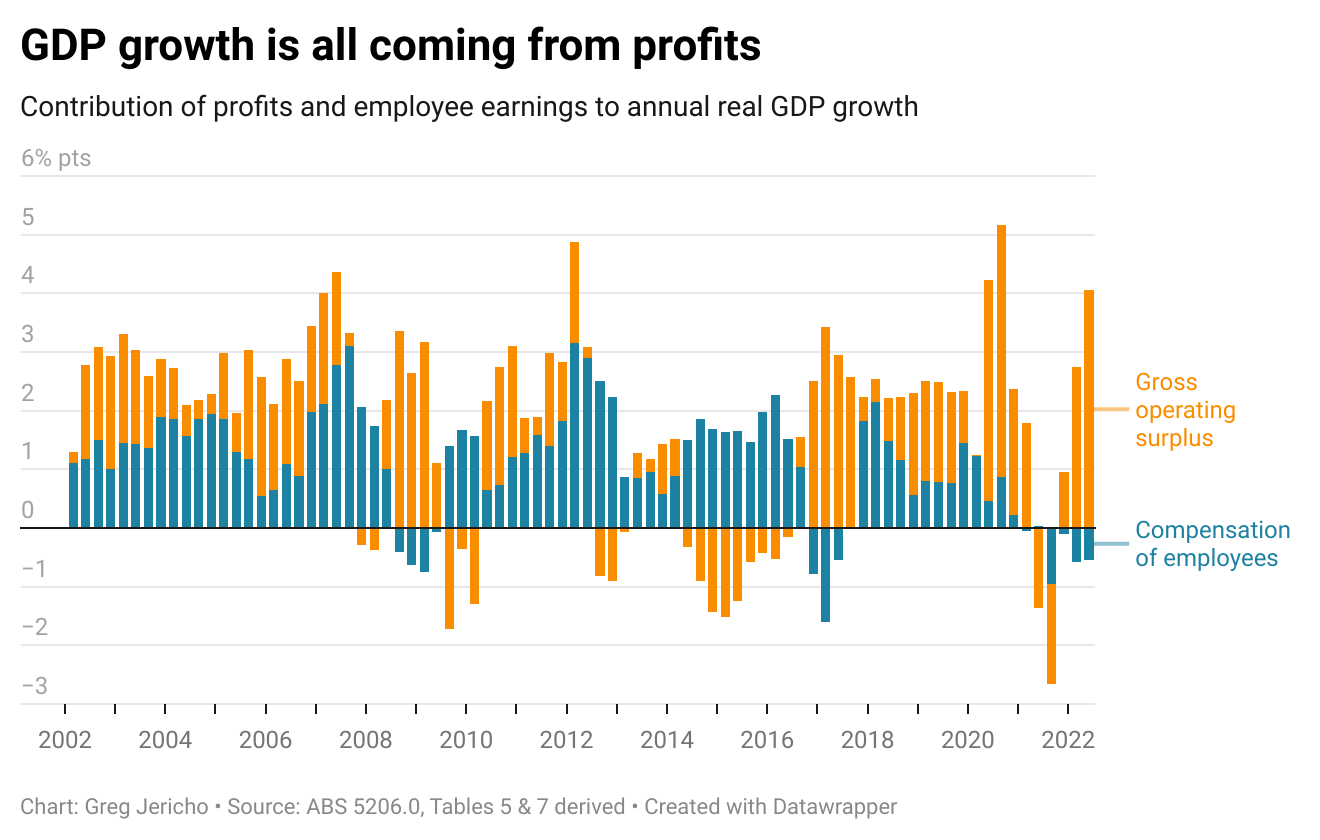
    But as labour market and fiscal policy director Greg Jericho notes in the Guardian Australia column, beneath those good numbers are a lot of problems, not the least of which is that wages continue to fail to keep up with inflation. Over the past year the total compensation of employees rose 7% but inflation in the national accounts rose 8.3%. Over the same period corporate profits went up 25%. We are at the absurd state of affairs where GDP is rising strongly, but real wages are not.

    We now have a situation where a record low share of national income is going to employees and a record high share is going to profits.

    The talk is always about lifting productivity and wages will follow, but the story for far too long now has really been productivity rising and profits following.

    The post The GDP figures show the ongoing shift of the national income to profits appeared first on The Australia Institute's Centre for Future Work.

  • An Economy That Works for People (Jobs Summit)

    In preparation for the Summit, the Australian Council of Trade Unions is publishing a series of discussion papers to spark dialogue over key issues that will be discussed at the event. The first of these papers, on the failures of past macroeconomic policy and the need for better approaches, was prepared with input from Jim Stanford, Director of the Centre for Future Work.

    The 23-page report, titled An Economy That Works for People, first reviews the legacy of the last decade of one-sided macroeconomic and labour market policies from former Coalition governments. Boosted by government actions to reduce taxes, labour costs, and regulations, corporate profits have swelled to the highest share of GDP (almost 30%) in history. But that profit has not translated into investment or innovation: at present just 37 cents of each dollar in profit is reinvested in new projects. Meanwhile, the share of GDP going to workers has never been lower since records have been kept: falling to just 45% in 2022. This redistribution of income from workers to businesses is not just a moral failure. The impact of swelling profit margins on inflation, and the drain in spending power arising from uninvested profits, are holding back Australia’s economy considerably.

    An Economy That Works for People

    The paper discusses the causes and consequences of the current surge in inflation in detail, providing conclusive evidence the problem did not arise in the labour market. To the contrary, labour costs have servedto reduce inflation: nominal unit labour costs grew only 2.1% over the last 12 months (below the RBA inflation target), while unit profit margins surged (by over 14%).

    The paper also reviews statistical evidence on Australia’s productivity growth, and in particular on the failure of productivity growth to be reflected in rising real wages. Real put per hour of work has increased 13% over the past decade: not outstanding, but still positive and steady. Real wages, in contrast, have gone nowhere — and are now falling rapidly in the face of accelerating inflation. Rather than risking an economy-wide recession with rapid interest rate hikes (which impose the worst burden on workers and indebted households), the paper calls for a more multi-dimensional and targeted approach by government (supplementing actions by the RBA) to gradually bring inflation down without causing mass unemployment.

    The paper makes 6 specific recommendations for macroeconomic reforms to ensure working Australians share fairly in the benefits of future growth. The first is to elevate full employment in decent jobs as the central goal of macroeconomic policy, and to ensure that all policy interventions (including from the RBA, the Commonwealth government, and other regulatory agencies) are consistent with that top goal.

    Release of the paper generated extensive media coverage and public debate (which was its goal!): including stories in The Guardian, the ABCThe Sydney Morning Herald, The Australian Financial Review, and The Australian. In this feature interview with 2CC Radio host Leon Delaney, Dr Stanford discusses the main recommendations of the report, and whether it is really such a ‘radical’ idea to make full employment the top goal of economic policy:

    The post An Economy That Works for People appeared first on The Australia Institute's Centre for Future Work.