Tag: Employment & Unemployment

  • Employers Steal More than 280 Hours from Workers Each Year: Go Home on Time Day Report 2023

    That’s the finding of the Australia Institute’s 2023 report, Short Changed, tracking annual work hours and unpaid overtime for Go Home On Time Day on November 22. It has also found the average worker is losing out on $11,055 a year, or $425 a fortnight, to unpaid overtime.

    Key findings:

    The Australia Institute surveyed 1,640 people between August 29 and September 6. Of those, 61% were in paid work.

    • Employees reported doing an average of 5.4 hours of unpaid work a week overall
      • Full-time employees perform an average of 6.2 hours, and casuals or part-timers four hours
      • Workers aged 18 to 29 do the most unpaid overtime (7.4 hours) a week
    • This ‘time theft’ equates to 281 hours a year or seven standard 38-hour weeks spent working for free
    • Australian employees are losing a cumulative $131 billion to unpaid work a year
    • Nearly half (46%) are not satisfied with the amount of paid work they’re doing and either want more or fewer hours:
      • A third of all workers want more paid hours (35%), but this rises to 54% for under-30s
      • Half of casuals (49%) of two in five part-timers (40%) would like more paid hours
      • Another 11% of all workers would like fewer paid hours

    “This survey shows just how uneven the labour market is. We’ve got many workers, especially casuals in insecure jobs, wanting more hours. At the same time, employers are more likely to demand long hours, including large amounts of unpaid overtime, from full-time workers,” Dr Fiona Macdonald, Policy Director, Industrial and Social at the Centre for Future Work said.

    “Record-low unemployment should have pushed both satisfaction with working hours and paid hours higher as employers scrambled to fill labour shortages. Instead, ‘time theft’ has actually blown out by 57 hours per worker since 2022 and has returned to near pandemic-era levels.

    “This dispels simplistic arguments that workers have the upper hand on employers because of recent industrial relations reforms. In fact, we’ve seen workers agree to more hours due to the cost of living crunch. Perversely, this has resulted in employees giving their bosses a free kick because many of those hours end up being unpaid.

    “Providing more protections for workers in these insecure positions, as proposed in the Closing Loopholes legislation currently before parliament, is an important priority for improving Australian labour market outcomes.”

    Visit Go Home On Time Day 2023 to read more and use our online calculator to work out your unpaid overtime.

    The post Employers Steal More than 280 Hours from Workers Each Year: Go Home on Time Day Report 2023 appeared first on The Australia Institute's Centre for Future Work.

  • The latest report from the IMF highlights the need for full-employment

    The IMF’s latest World Economic Outlook is mostly framed around trying to thread the needle of reducing inflation and cost of living rises and not crashing the economy while doing so.

    And while overall the IMF suggests the world economy is in for a “soft landing” the picture it paints for Australia is of a tough year ahead. Policy director Greg Jericho notes in his Guardian Australia column that the IMF has downgraded its expectation for growth next year from an already bad 1.7% to a historically awful 1.2%.

    Were Australia’s economy to grow this slowly through the year and avoid a recession it would be the first time that has happened. The IMF also predicts that 2025 will grow by just 2.0%. Were that to occur, it would be the first time on record that Australia’s economy has gone 3 consecutive calendar years without growth above 2%. That is hardly a “soft landing”

    The IMF also now predict unemployment will rise quicker than it expected would be the case in its previous outlook in April.

    The report highlights the need for the government and the Reserve Bank to work to deliver full employment. The current settings have the nation on course to grow so slowly for so long that the risk of the economy stalling are rising precipitously.

    The post The latest report from the IMF highlights the need for full-employment to be the aim of the government and the Reserve Bank appeared first on The Australia Institute's Centre for Future Work.

  • Insecure work is a feature of our labour market. New laws can change that.

    Chris Wright is Associate Professor in the Discipline of Work and Organisational Studies at the University of Sydney, and a member of the Centre for Future Work’s Advisory Committee. This commentary is based on his submission to the Senate Education and Employment Legislation Committee’s inquiry into the Fair Work Legislation Amendment (Closing Loopholes) Bill 2023, and originally appeared in the Sydney Morning Herald.

    * * * * *

    The Senate has started reviewing the Australian Government’s Closing Loopholes Bill. If passed, this legislation will allow minimum standards to be set for contract workers, provide stronger penalties against employers who commit wage theft and deter employers from outsourcing to circumvent enterprise bargaining.

    These measures will strengthen protections for workers who often face barriers to job security and career development.

    Australia’s current system of workplace laws was adopted at a time when enterprise bargaining and awards covered a larger share of the workforce than today. Enterprise bargaining and awards encourage employers to invest in their workers through “standard” employment arrangements underpinned by permanent contracts, decent wages and training.

    These arrangements promoting workforce investment benefit both workers and employers. Workers gain job and economic security and career progression opportunities. Employers gain loyal and satisfied workers who contribute to productivity and innovation. As the architects of the current system of workplace laws envisaged, workforce investment thus provides the basis for high-productivity business strategies, which help to make the Australian economy more internationally competitive.

    Recently, however, more businesses have opted for a different course. These businesses have tried to compete not through high-productivity strategies but instead by undercutting or evading workplace laws and by engaging workers via “non-standard” arrangements such as casual contracts or via gig economy platforms.

    The rising incidence of wage theft in which employers pay workers below their legal entitlements is evidence of this undercutting. The growing numbers of workers hired through labour hire arrangements, which some businesses have used to avoid their enterprise bargaining obligations, is evidence of evasion. So too is the emergence of gig platforms exempt from workplace laws.

    Wage theft, gig platforms and use of labour hire as an evasion tactic have become features of Australia’s modern labour market. None of these features existed when the foundations of the current system of workplace laws were first laid in the 1990s.

    As the nature of work and the labour market evolves, workplace laws must adapt in response. The Closing Loopholes Bill recognises this by allowing workers on casual contracts to convert more easily to permanent contracts, increasing protections for gig and labour hire workers and introducing new measures against employers who undercut wage laws.

    While non-standard workers have flexibility, they have little job and economic security under current laws. For instance, casual workers receive a higher hourly pay rate as compensation for this insecurity but are concentrated in the lowest-paid industries. Like their counterparts in the gig economy, casual workers are less likely to receive training than permanent workers.

    The proposed change to give casuals who work regular hours the right to convert to permanent employment will probably improve their access to good quality jobs and career development opportunities.

    Business groups have criticised the Closing Loopholes Bill for its supposedly negative impacts on productivity and innovation. They have not offered evidence supporting these claims. To the contrary, research evidence suggests that measures promoting standard employment are more likely to encourage businesses to compete through high-productivity and innovation-enhancing strategies rather than by undercutting or evading.

    Winston Churchill once said that without effective workplace laws, “the good employer is undercut by the bad and the bad by the worst… Where those conditions prevail you have not a condition of progress, but a condition of progressive degeneration”.

    Workers in Australia are increasingly missing out on legal protections under current laws. The research evidence suggests the Closing Loopholes Bill’s provisions are necessary to avoid a situation like the one Churchill described.

    The post Insecure work is a feature of our labour market. New laws can change that. appeared first on The Australia Institute's Centre for Future Work.

  • Going Backwards: NDIS Workforce and Gender Equality

    Hundreds of thousands of NDIS participants rely on this workforce to provide personal support and care on a daily basis.

    The NDIS workforce is large and growing, currently employing about a quarter of a million workers, mostly women. Pay, working conditions and career opportunities in the disability support workforce are critical to the future of women’s economic equality in Australia.

    It is a decade since the NDIS was first piloted, yet the promise for workers, that the scheme would translate into ‘greater pay, … better working conditions … (and) enough resources to do the job properly’ has not been fulfilled.

    Rather, conditions of work in the NDIS are poor and deteriorating.

    The design of the NDIS, with its market basis and poor and uneven regulatory oversight, has undermined fair pay and working conditions for disability support workers and is threatening workforce stability.

    This briefing paper reviews this evidence and argues for significant reforms to address urgent problems arising from these design flaws and regulatory failures.

    The post Going Backwards appeared first on The Australia Institute's Centre for Future Work.

  • New laws for employee-like gig workers are good but far from perfect

    The Workplace Relations Minister Tony Burke has described proposed new laws to regulate digital platform work as building a ramp with employees at the top, independent contractors at the bottom, and gig platform workers halfway up.

    The new laws will allow the Fair Work Commission to set minimum standards for ‘employee-like workers’ on digital platforms. They are a key part of reforms in the government’s Closing the Loopholes workplace relations bill introduced into parliament this week, and are part of a commitment made before the 2022 election.

    So, what will being halfway up the ramp mean for ‘employee-like’ platform workers? Under the changes, minimum standards can now be set for platform workers, including rideshare drivers, food delivery workers and care workers. Up until now, as independent contractors, digital platform workers have had very few rights, including no rights to minimum pay rates.

    With the changes, the Fair Work Commission will be able to set minimum standards for workers concerning payment terms, deductions, working time, record-keeping, insurance, consultation, representation, delegates’ rights and cost recovery and other matters.

    Other provisions in the legislation are designed to protect workers from being unfairly deactivated from platforms, which is equivalent to being unfairly dismissed, and allow collective agreements for platform workers where platform operators agree.

    The laws will apply only to ‘employee-like’ platform workers, meaning workers who are low-paid (compared to what they would be paid under an award), have low bargaining power and/or have low control over their work.

    There are some restrictions on the standards the Fair Work Commission can set for platform workers. Minimum standards cannot be set concerning overtime rates or rostering arrangements. Nor can the Commission use its standard-setting powers to turn a platform worker into an employee.

    So, ‘employee-like’ platform workers will not have all the minimum standards and rights that employees have. However, halfway up the ramp, they will be much better placed than they were with the minimal rights of independent contractors.

    Overall, these changes are very positive for platform workers and should prevent exploitation of vulnerable workers. However, the reforms stop short of responding to longstanding calls for platform workers, including rideshare, food delivery and care workers, to be treated as employees, and for platform operators to be treated as employers, an approach that has recently been agreed by the 32 member countries of the European Union.

    The proposed reforms in the Closing Loopholes bill don’t go as far as aiming to ensure that how a person is employed can’t leave them without the rights and standards most comparable workers enjoy at work. It leaves platform workers halfway up the ramp in a new worker category with lesser rights than employees.

    The creation of this new category of ‘employee-like’ worker does open up the possibility that some employers may seek to reform their workforces and business models to engage workers who are in the new cheaper worker category, in place of employees. Internationally, where a third category of worker has been created by governments in order to provide protections for low-paid independent contractors, there has been some substitution of employees for workers with less favourable conditions.

    The Closing the Loopholes approach to platform workers also suggests we need to think harder about how to support better flexibility at work.

    The platform work reforms appear to be built on an assumption it is ok for workers who need or want flexibility to have lesser standards and fewer rights at work because of this. Most platform workers value the flexibility they have in their jobs. But that does not mean they should have to trade off rights and standards. Flexibility is not a benefit that accrues only to workers. Consumers and platform operators want flexible services too.

    Originally published in The New Daily 8 September 2023

    The post New laws for ‘employee-like’ gig workers are good but far from perfect appeared first on The Australia Institute's Centre for Future Work.

  • Wages, employment and power: Call for conference papers

    The Centre for Future Work is hosting a stream at the upcoming AIRAANZ Conference.

    Join us as we continue the AIRAANZ and the Centre for Future Work traditions of bringing researchers and activists together to debate important issues in the world of work and industrial relations.

    The AIRAANZ (Association of Industrial Relations Academics of Australia and New Zealand) 2024 Conference will be held in Perth from the 31 January to 2 February 2024.

    Wages, employment and power
    Papers are sought on topics that relate to issues concerning employment, power and/or wages.

    Topics could include, but are not limited to:

    • the relationship between power and wages at the firm, industry or national level;
    • legislative reforms affecting wages, employment or power;
    • bargaining strategies to boost power and wages;
    • explanations for changing worker power;
    • job vacancies, labour shortages and wages;
    • the gendering of wages, employment or power;
    • employment, unemployment or participation amongst particular groups or industries;
    • product or labour market competition and worker power;
    • the effects of norms and institutions in labour markets;
    • the geography of power or wages;
    • the ideologies and strategies of employers, unions or the state.

    Submit your abstract to the conference organisers by 29th September.

    Feel free to get in touch with us if you have any questions about topics or the stream or would like any additional information.

    David Peetz d.peetz@griffith.edu.au, davidp@australiainstitute.org.au, +61 466 166 198 or +64 204 127 6749
    Fiona Macdonald fiona@australiainstitute.org.a, +61 437 301 065

    Abstracts must be submitted to the conference organisers via: https://consol.eventsair.com/airaanz-2024/submission-site/Site/Register.

    For AIRAANZ 2024 Conference details see: https://www.airaanz.org/conference/reimagining-industrial-relations-airaanz-2024-conference-31-jan-2-feb-2024/

    The post ‘Wages, employment and power’: Call for conference papers appeared first on The Australia Institute's Centre for Future Work.

  • The weak economy shows the Reserve Bank is not threading the needle

    The latest June quarter National Accounts released yesterday showed that without the increase in population, Australia’s economy would have shrunk for two consecutive quarters. This, as Policy Director, Greg Jericho writes in his Guardian Australia column, reveals just how weak our economy is, and how massively households have been hit by the 400 basis points rise in the cash rate.

    The Reserve Bank has talked about trying to thread the needle of lowering inflation and delivering a soft landing. But with GDP per capita falling and real household disposable income per capita now 5% below where it was a year ago, it is becoming harder to suggest the RBA has achieved its aim.

    Even when including population growth GDP only rose at all because of government spending and investment. The private sector is struggling as companies run down their inventories rather than build up supplies in the hopes of increased sales in the months to come.

    The household savings ratio is now as low as it has been since the GFC as households do what they can to pay the costs of essential items and reduce their purchase of discretionary goods and services.

    The Reserve Bank sought to dampen demand from a misguided view that demand was driving inflation. Instead, we know that inflation has largely been driven by international prices and costs and from companies taking advantage of the situation to increase their profits.

    Rather than focus purely on inflation the RBA and the government now need to be most wary of rises in unemployment. We are not in a recession yet, but should the economy continue to fail to grow aside from population unemployment will inevitably rise, and the cost of the RBA’s strategy will be felt even more so by households across the country.

    The post The weak economy shows the Reserve Bank is not threading the needle appeared first on The Australia Institute's Centre for Future Work.

  • We need more than a definition change to fix Australia’s culture of permanent casual work

    It’s that employer advocates are getting so excited about them, despite the small number of people they will affect and the small impact they will have.

    That’s not to say the changes aren’t needed. Rather, true reform of the “casual” employment system, of which this is just a first but important step, has a lot further to go to resolve the “casual problem”.

    What is the ‘casual problem’?

    This problem is that most “casual” workers aren’t really casual at all — as shown by analysis that I and colleague Robyn May did, using unpublished data from the Australian Bureau of Statistics (ABS).

    The premise for hiring them is that the work is intermittent, short-term and unpredictable. But, as you can see from the chart, the last time the ABS collected these data, a majority of “casuals” worked regular hours.
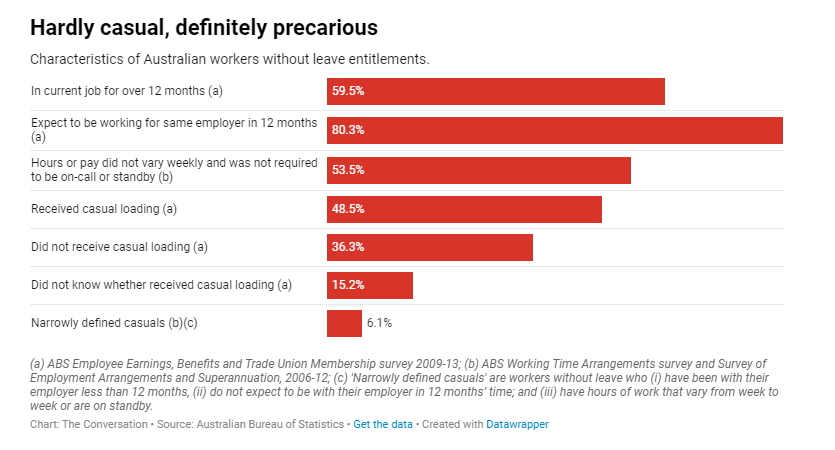
    Almost 60% of “casuals” had been in the job for more than a year. About 80% expected to still be there in a year’s time.

    Only 6% of “casuals” (1.5% of employees) worked varying hours (or were on standby), had been with their employer for a short time, and expected to be there for a short time.

    Even now, some “casuals” have been doing the same “casual” work for over 20 years.

    Permanent ‘casuals’

    All this has led to a class of “permanent casuals” – a nonsense term. They should more accurately be called “permanently insecure”.

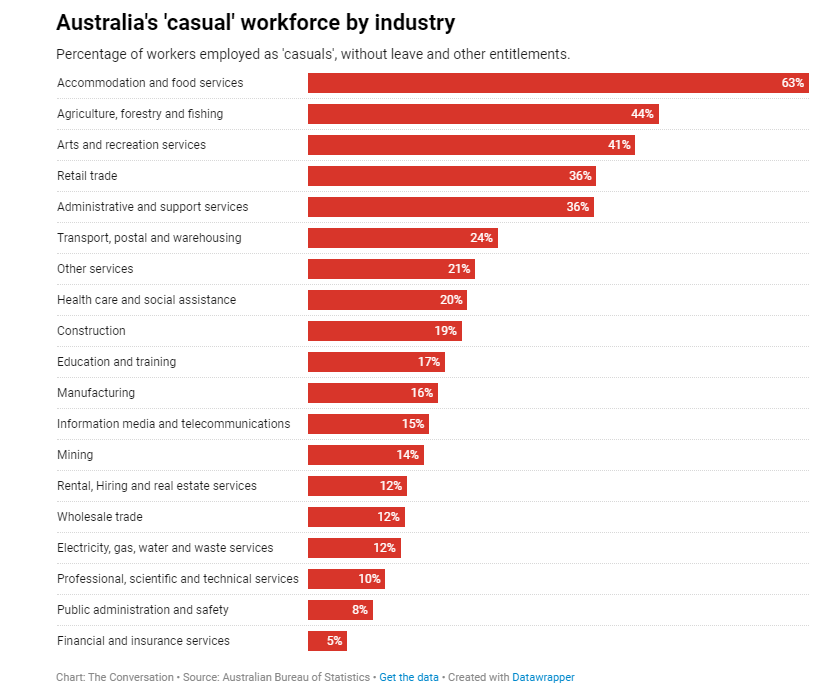
    The one thing “casuals” have in common is they’re not entitled to sick leave or annual leave, and they are in a precarious employment situation. Their contract of employment only lasts till the end of their work day.

    That means they have much less power than other workers. So little power, in fact, that barely half of them even get the casual loading they are meant to be paid in compensation for not receiving other entitlements.

    On average, low-paid “casuals” get less pay than equivalent permanent workers, despite the loading.
    Changing legal definitions

    Not many “casuals” have been brave enough to challenge this exploitative relationship. But when they did a few years ago, Australia’s courts agreed permanent casual work was nonsensical.

    To be a “casual worker”, there had to be no promise of ongoing employment. A court would judge this not just by what was in the formal contract of employment but also by what the employer actually did. If they kept hiring you, week after week, on a predictable roster, you weren’t casual.

    In 2018, mine worker Paul Skene challenged his classification as a casual worker, arguing he had done pretty much the same work, with a few changes along the way, for five years.

    The Federal Court agreed he wasn’t a casual employee and should be back-paid annual leave. Another mine worker, Robert Rossato, had a similar victory in 2020.

    Employer organisations were “outraged” by the “billions” in back pay they could be forced to pay for having misclassified ongoing workers as casuals. They lobbied the Morrison government to amend the law, and challenged the rulings in the High Court.

    The Morrison government changed the law in early 2021, to give primacy to the written contract, ignore employer behaviour, and protect employers from back-pay claims.

    Later that year the High Court overturned the Federal Court decisions, ruling it was the written employment contract that mattered. If that was worded a certain way, you couldn’t test whether a worker was “casual” by whether the employer treated them that way afterwards.

    Labor promised to overturn these interpretations, and that’s what this proposal does.

    What will the legislation change?

    The details of the government’s plan is still not clear, but it is likely it will seek to amend the Fair Work Act to revert to something close to the pre-2020 definition of casual work, with a procedural twist.

    It will again be possible to judge whether an employee is “casual” based on employer behaviour. And an employee who repeatedly works a similar roster can, after six months, demand “permanency” – meaning rights to sick leave, annual leave, and better protection against arbitrary sacking.

    The twist: until they demanded “permanency” they won’t be entitled to any leave. So employers will be protected against claims for back pay.

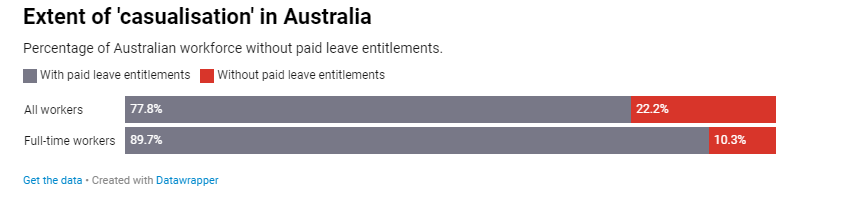
    Theoretically this could affect hundreds of thousands of “casual” workers. In reality, it will likely help far fewer.
    Suppose you’re a “casual” labour hire worker in mining. You can tell what time you’ll start work on the first Friday next June. You go to your employer — the labour hire company — and say: “Make me permanent.” The labour hire company says: “We can’t. You might not have a job tomorrow.”

    And indeed, now that you’ve asked, maybe you won’t have a job. So would you really ask?

    It will depend critically on the protections offered to workers who ask to convert, and how credible they are to workers.

    Most people only expect a few people to make the demand. Workplace relations minister Tony Burke says he believes only a “very small proportion” of “casuals” working regular shifts will do so.

    Part of that reluctance will be fear of the consequences, and part of it will be that many casuals rely on their casual loading. About half of “casuals” are on the award minimum rate, compared with 15% of “permanent” full-time workers. Most cannot afford to “choose” to trade the money for holidays and other entitlements.

    If you’re not getting the casual loading, you’ve got nothing to lose — except your job. If the power imbalance means you don’t get the loading, you won’t fancy your chances.

    So, it will just work for a small number or workers – though it’s likely to be very important to them.

    More needs to be done

    In short, this is a good step but more needs to be done.

    In most other wealthy countries all workers – including temporary workers – are entitled to annual leave. That’s not the case in Australia, because of the “casual” ruse. These laws will not change that.

    There should be universal leave entitlements. Sure, there needs to be a loading where work is unpredictable, and hence so short-term that leave entitlements would not be practical.

    But everyone else should get annual and sick leave, and minimum award wages should be high enough that low-wage workers don’t have to rely on the casual loading to get by.

    The challenge should be about how we transition to that situation.

    The post We need more than a definition change to fix Australia’s culture of permanent ‘casual’ work appeared first on The Australia Institute's Centre for Future Work.

  • Inflation is falling so let’s make sure we don’t let unemployment rise

    The latest quarterly CPI figures showed that inflation is falling dramatically and in line with that of other major economies such as the USA and Canada. This, Chief Economist, Greg Jericho writes means we have a prime opportunity to lock in the current level of low unemployment.

    Through the past year of the Reserve Bank raising interest rates, the main justification has been that the economy needs to be slowed in order to bring down demand pressures on inflation.

    What the latest figures reinforce however is that the major pressures have come from the supply side. Australia’s inflation is essentially following the same path as other nations. This is because inflation is slowing largely due to reduced world prices of commodities rather than any response to increasing interest rates.

    Indeed the largest driver of inflation in the June quarter was rental prices, which will have been in part due to investors raising their prices to deal with higher mortgage payments.

    In the past year, unemployment has remained at 3.5% while inflation has gone from 6.7% up to 8.4% and now down to 5.4% (using the monthly measures). The belief that we needed to raise unemployment to 4.5% in order to stop inflation from accelerating is a cruel approach that treats inflation in the wrong way.

    Fortunately, in spite of the RBA’s best efforts, unemployment has not yet risen. This presents Australia with a genuine chance to lock in historically low unemployment as the norm.

    Rather than pursuing higher unemployment in order to reduce inflation the RBA and the government should be pursuing policies that keep unemployment low while also reducing inflationary pressure. This can mean a price cap on essential items such as rents and energy, introducing windfall-profits taxes, and increased public housing investment to reduce housing price surges.

    Interest rates are not the only way to tackle inflation and in an environment where profits are been driven by supply-side issues and profits they are one of the worst ways.

    Full employment needs to be the target, not a mythical “non-accelerating inflation rate of unemployment” that largely justifies higher unemployment and more ho0usyheold living in poverty.

    The post Inflation is falling so let’s make sure we don’t let unemployment rise appeared first on The Australia Institute's Centre for Future Work.

  • If the unemployment rises to 4.5% who is likely to lose their job?

    The next 12 months ahead look to be a time of rising wages, and rising unemployment. The Reserve Bank is trying to raise unemployment in order to prevent rising wages. It’s target of 4.5% will see around 130,000 to 150,000 more people unemployed than is currently the case.

    Labour market policy director, Greg Jericho, in his Guardian Australia column, examines which workers are likely to be the ones who will lose their jobs.

    In a bitterly ironic point, he notes that these are the same workers whom Deputy Governor of the Reserve Bank Michele Bullock recently boasted were the ones who had gained the most from the strong employment growth of the past 18 months:

    people on lower incomes and with less education who have benefited the most from the strong labour market conditions

    More worrying is that the Reserve Bank’s own estimates suggest that the rises in unemployment over the next year will see Australia breach the “sahm Rule” of recession, in which the unemployment rate rises more than 05%pts in a year. Oddly however the RBA’s correspondence on the issue revealed in an FOI disclosure has them suggesting that for Australia the recession trigger is a 0.75% rise.

    Either way, history suggests that when unemployment rises in a year by the amount the RBA is estimating it usually keeps rising.

    The RBA’s own estimates show just how close to a recession the economy is set to go in the next year. It already looks likely to hit workers with low skills and low paid jobs, and if the RBA gets it wrong, it will quickly hit many more of society.

    The post If the unemployment rises to 4.5% who is likely to lose their job? appeared first on The Australia Institute's Centre for Future Work.