Tag: Employment & Unemployment

  • A Comprehensive and Realistic Strategy for More and Better Jobs

    Dr. Jim Stanford, Director of the Centre for Future Work, reviewed the ACTU’s paper in detail, and prepared an evaluation of its proposals and likely effects. Stanford endorsed the policy’s complementary set of expansionary macroeconomic measures, which would strengthen every major component of aggregate demand in the national economy: including government programs, capital investment, net exports, and consumer spending. He also emphasised the importance of the paper’s vision for a stronger labour market information and planning system, which will be essential to effectively match workers with jobs as the labour market tightens.

    Stanford estimated that the ACTU’s plan, if implemented consistently over a five-year period, would be capable of achieving the following outcomes:

    • Unemployment rate falling to 4 percent or lower.
    • Share of full-time work rebounding toward 75 percent of employment (since employers will be pressured by falling unemployment to create full-time jobs).
    • Underemployment rate falling to fall to 5 percent or lower.
    • Incidence of casual work declining below 20 percent.
    • Labour force participation rising by at least 2 percentage points, especially among young workers.
    • Nominal wage growth accelerating to traditional rates of 4 percent per year.

    Read the complete ACTU paper, Jobs You Can Count On.

    The post A Comprehensive and Realistic Strategy for More and Better Jobs appeared first on The Australia Institute's Centre for Future Work.

  • Job Opportunity – Research Economist

    The successful candidate will offer:

    • A graduate degree in economics or a closely related discipline.
    • Knowledge of and experience with a wide range of labour issues, preferably including: labour market statistics and trends; characteristics and determinants of employment; industrial relations and collective bargaining; wage determination and inequality; gender, racial, and demographic aspects of labour markets; the impact of technology on employment; macroeconomic policy and labour markets; and others.
    • Demonstrated ability to write to deadline for professional and popular audiences in a credible, succinct, and accessible manner.
    • Strong quantitative skills, including ability to access statistical data, analyse it (including familiarity with statistical tools), and report it in a variety of textual, tabular and graphical formats.
    • Confident communication skills, including ability to speak to public audiences, classrooms, and the media.
    • Ability to work collegially with other members of a research team.
    • Commitment to a progressive vision of work and fairness, including the goals of equality, participation, collective representation and trade unionism.

    Responsibilities of the position will include:

    • Research and completion of several project-length research papers, briefing notes, and shorter commentary articles per year on a range of topics related to labour markets and labour market policy.
    • Ongoing monitoring and analysis of labour market data and information.
    • Helping to maintain relevant websites and databases.
    • Public speaking, presentations, lectures and courses, media interviews, and related communication and educational activities.
    • Minimal office and administrative functions.

    Ability to undertake occasional out-of-town travel (including overnight travel) is essential, as is ability to successfully work in a self-managed and autonomous manner.

    The position will be offered on a one-year term-limited basis, with possibility for renewal. Salary will be commensurate with qualifications and experience.

    Applications are especially invited from women, indigenous persons, other racial and linguistic communities, people with disabilities, and other marginalised communities.

    Please forward applications (including contact information, qualifications, experience, two samples of written work, and names and contact details for two references) in confidence to cfwjob@tai.org.au. Please cite “Economist Job Application” in the subject field of your message; supporting documents should be attached in pdf format. Receipt of applications will be acknowledged by e-mail. Only candidates selected for an interview will then be contacted; no phone calls please.

    Applications must be received by 5:00 pm AEDT on Wednesday 9 October, and interviews will be conducted in Sydney on Wednesday 23 October 2019.

    The Centre for Future Work is an initiative of the Australia Institute, Australia’s leading progressive research institution. Thank you for your interest in the Centre for Future Work.

    The post Job Opportunity: Research Economist appeared first on The Australia Institute's Centre for Future Work.

  • Job Growth No Guarantee of Wage Growth

    Job Growth No Guarantee of Wage Growth

    by Dr. Anis Chowdhury

    ‘Remarkable’ jobs growth raises hopes for wages” was the headline for a recent Sydney Morning Herald opinion piece by Clancy Yeates. He bases this claim on “some brighter news on the labour market to balance the bad: there is something of a jobs boom under way”. Apparently “more jobs have been created in 2017 in net terms than any year since 2005, with 371,000 new net jobs so far this year”. Clancy Yeates also points to “the lowest number of unemployed people per unfilled position since 2012”.

    This optimism is also shared by the Treasury Secretary John Fraser. In his opening statement at the recent Senate budget estimates hearing on 25 October, he said, “We expect that a period of stronger growth and falling unemployment will lift wages in the next few years.” He further noted, “We do expect that as the cyclical constraints that have weighed on the economy recede wages growth will accelerate.”

    The RBA also holds a similar optimistic view. Philip Lowe, the RBA Governor, in his September statement observed, “Employment growth has been stronger over recent months and has increased in all states. The various forward-looking indicators point to solid growth in employment over the period ahead. … stronger conditions in the labour market should see some lift in wages growth over time.” He had the same positive view in his October statement.

    But can we really be so confident that job growth will eventually lead to wage growth? And even if it does, would it be strong enough to catch up and compensate for the losses incurred from such a long period of wage stagnation?

    Unfortunately, the answer to these questions is a resounding ‘NO’. This so-called remarkable jobs growth will not result in an eventual wage growth sufficient to close the wages gap. This has been confirmed by the latest data showing wages rose by less than expected last quarter; even a significant mandated jump in the minimum wage failed to lift the rate of growth of workers’ pay across the economy. The most broad measure of average earnings growth (derived from GDP statistics) has actually turned negative – the weakest since the mid-1960s.

    The reason for this contradiction is very simple – it is rooted in the different nature of new and old jobs. Jobs, whether part-time or full-time, are now more insecure. Just consider some recent news. The NAB has announced 6,000 job cuts by 2020 even when it announced $6.6 billion profit! Earlier Telstraconfirmed 1,400 job cuts.

    Job insecurity is not just a phenomena in the private sector. Governments – State and Commonwealth – have also joined the new trend. For example, the NSW department of Finance Services and Innovation has notified the union representing the cleaners that employment guarantees in place since 1994 “will not be extended in the new contracts from 2018”.

    The optimists seemed to have decided to ignore what Alan Greenspan, the former chairman of the US Federal Reserve, said in his Congressional hearing two decades ago (on 26 February, 1997). Explaining why “the rate of pay increase still was markedly less than historical relationships with labor market conditions would have predicted”, he said: “Atypical restraint on compensation increases … appears to be mainly the consequence of greater worker insecurity.”

    He clearly elevated job insecurity to major status in the Fed’s policy analysis. Workers have been too worried about keeping their jobs to push for higher wages. And this has been sufficient to hold down inflation without the added restraint of higher interest rates.

    But Greenspan also implied that workers’ fear of losing their jobs was not in itself a sufficient explanation for their failure to push for significant wage increases. The sense of job insecurity has to be rising over time; that is, continually getting worse. Because once the level of insecurity leveled off, and workers become accustomed to their new level of uncertainty, their confidence may revive and the upward pressure on wages would resume. That is particularly true when the unemployment rate is low, as it is today (at least officially).

    However, looking at the length of contracts, Jeff Borland, a leading Australian labour economist, finds no evidence of increased job insecurity in Australia. Others have reported similar findings, while others cite different data to indicate a growth in insecurity. A new ABS survey also showed that while there had been an increase in the number of people with more than one job since 2010-11, those doing multiple jobs as a proportion of the workforce had remained almost completely unchanged at 6%.

    Job insecurity is notoriously difficult to measure. It is not the length of contracts or whether a job is full-time or part-time, that matters. It is the constant threat of losing jobs or pay conditions despite tenure due to constant restructuring that the workers fear. It is the news like that from the ice cream manufacturer Street wanting to terminate its enterprise agreement, or announcements like the one from the NSW department of Finance Services and Innovation, which generate the sense of job insecurity.

    It is this sense of job insecurity and fear of not finding a decent job after losing one (as experienced, for example, when Holden and Toyota recently closed down) which Alan Greenspan had in mind when he calibrated Fed’s monetary policy levers. Thus, there has to be continuous restructuring in the guise of addressing falling or stagnant productivity to keep lid on wages, while the real intent is creating fears among the working class.

    When nearly half the Australian families (41%) feel job security is chief among their concerns, this supposedly remarkable jobs growth won’t generate pressure for wage growth as hoped by the optimists. “Insecure, stressed, and underemployed: The daily reality for millions of Australians”, is how David Taylor summarised the labour market in Australia. This is experienced even as profits are growing at their highest rate in two decades.

    Governments – State and Federal – should worry about rising job insecurity, instead of adding fuel to the fire with their own employment restructuring initiatives. The high level of job insecurity doesn’t just have an effect on wage growth and inflation. Recent research has found that it “cuts to the core of identity and social stability – and can push people towards extremism”. We all have a stake in creating more secure jobs, and fairly rewarding those who perform them.

    The post Job Growth No Guarantee of Wage Growth appeared first on The Australia Institute's Centre for Future Work.

  • The Paradox of Rising Underemployment and Growing Hours

    Paradoxically, underemployment and number of hours actually worked are both on the rise in Australia.

    Since 1978 from when the ABS started publishing data on the number of hours worked per month, the hours increased continuously. For example, in July 1978 slightly less than a billion hours was worked; the figure was 1.7 billion in June 2017 – a rise of 781.9 million hours worked a month. Compared with June 2008, 151.3 million more hours were worked in June 2017. The recently released Labour Account Australia, Experimental Estimates, July 2017 (by ABS) shows that between 2010/11 and 2015/16, hours actually worked increased by 5.7% from 19.15 billion hours to 20.23 billion hours.

    The rising number of hours worked should be a good news, provided it meant more income. But for the most part during this period real wages either stagnated or fell. Recent ABS data show that quarterly real wage growth stuck below 0.6% for three years, translating into an annual wage growth of just 1.9%, the lowest figure since the late 1990s, and probably the slowest rate of pay rises since the last recession.

    Hence the majority of workers are forced to work more hours in their struggle to maintain a decent living. Labour Account Australia, Experimental Estimates (July 2017) records that a good number of people work more than one job. Interestingly, increasing by 64,100 (9.2%), the growth in secondary jobs outstripped the growth in main jobs which increased by 791,700 (6.8%) over the six years to June 2016.

    It is also not surprising that people are wanting to work more hours, raising the incidence of involuntary underemployment. The most recent ABS estimate, for May 2017, shows 1.129 million Australians working fewer hours than they would like. This translates into an underemployment rate of 9.3%. When added to the current headline unemployment rate of 5.6%, we have a whopping “underutilisation” rate of around 14.9%!

    Labour exploitation is also on the rise as the unpaid overtime work gets longer. The Australia Institute’s 2016 survey (Excessive Hours and Unpaid Overtime: An Update) found that full-time workers were on average performing more than 5.1 hours a week in unpaid overtime. Part-time and casual employees work an average of 3.74 hours unpaid overtime per week. For full-time workers, average unpaid overtime is worth over $10,000 per year – or 13% of actual earnings. For part-time workers, lost income from unpaid overtime exceeds $7500 per year, and represents an even larger share (nearly 25%) of actual earnings. The lost income due to unpaid overtime represents a significant loss to workers and their families.

    Australians are putting in some of the longest hours (more than 50 hours) in the developed world, coming in 9th in a survey of OECD countries. Full-time employees are on average putting in extra 4.28 hours and part-time staff are working an hour over their contracted hours every week. ABS data show that around 30% of employed men and 11% of employed women report usual working 45 hours or more each week.

    Thus, Australian workers are over-worked and underpaid. They are both time and income poor.

    These paradoxes are not statistical quirks. They are the results of heightened job insecurity; but it is deliberate! It is caused by changes in the labour market institutions governing wage and employment conditions, designed to increase the share of profit and strengthen corporate power.

    Alan Greenspan, the former Chairman of the US Federal Reserve, made this very clear in his testimony to the Congress two decades ago (26 February, 1997). He elevated job insecurity to major status in central bank policy when he said, “Certainly other factors have contributed to ‘the softness in compensation growth” despite a low unemployment rate, but ”I would be surprised if they were nearly as important as job insecurity”.

    Workers have been too worried about keeping their jobs to push for higher wages, and this has been sufficient to hold down inflation without the added restraint of higher interest rates. He also acknowledged, “Owing in part to this subdued behavior of unit [labour] costs, profits and rates of return on capital have risen to high levels”.

    Most interestingly, according to Greenspan, widely regarded as the “guru” of present day monetary policy-makers, workers’ fear of losing jobs is not in itself sufficient; the sense of job insecurity has to be rising or getting worse to prevent any push for significant wage increases. This is because, once it levels off, and workers become accustomed to their new level of uncertainty, their confidence may revive and the upward pressure on wages resume, especially when more people find jobs and the unemployment rate drops.

    Right now, millions of Australians are feeling some level of job insecurity because of increased casualisation of employment and insufficient availability of full-time regular jobs. The increase in casual and non-permanent work is putting pressure on people to work harder for longer, and to work more hours unpaid.

    There are many reasons, from automation to slower growth of the economy, for increased job insecurity. But one factor contributed the most – the deregulation of the labour market in the name of increased flexibility. This not only involved moves from centralised to enterprise bargaining and to individual contracts, but also restrictions on union activities – both intended to weaken worker’s bargaining power and strengthen business’s hiring and firing power.

    One can easily blame successive Liberal-National Coalition Governments, starting from John Howard for this. But the Hawke-Keating Labor Government started the process, arguing that it was necessary to respond to changing global economic conditions and to remain competitive. The Hawke-Keating Government argued that linking wage bargaining to the enterprise performance would provide flexibility and hence boost productivity.

    The succeeding Howard-Costello Government increased so-called flexibility by introducing “work choices” (individual contracts) arguing the same. In 2007, Peter Costello said that the greatest risk to Australia’s prosperity is a return to centralised wage fixing: “Nothing could be a bigger threat to the Australian economy at the moment than moving away from decentralised wage fixation and going back to the past.”

    But alas; there has been no sustained boost in productivity growth. Instead, successive labour market reforms have allowed inefficient enterprises to survive. Employers  felt no pressure to upgrade technology, improve management practices or train workers to boost productivity, as both Labor and Coalition Governments, held hostage by the business group threatening to leave Australia for cheaper destinations, vied with each other to make Australia more hospitable – more “competitive” – for businesses by making labour cheaper and regulations looser.

    During 2016, Australia’s labour productivity growth was nil whereas it grew by 1.9% in OECD. Only 4 other OECD countries experienced lower productivity growth than Australia. Using the internationally comparable US Conference Board data, the Productivity Commission reported that Australia’s multi-factor productivity (MFP) growth in 2014 was negative (-0.9%) – and lower than China, India and Korea. MFP reflects the overall efficiency with which labour and capital inputs are used together in the production process. MFP growth in Australia continued to decline since the mid-1990s reaching a negative figure, i.e., declining during 2005-2010.

    The problem is well exemplified by Australia’s auto industry which survived only due to the life-line of government subsidies and some industry protection – recall the Rudd Labor Government’s $6.2 billion over the next 13 years and Abbott Government’s $900 million budget backdown. Despite all the flexibilities afforded by diluting the employment and pay conditions, one of just 13 countries in the world capable of building a car from the ground up, Australia’s 90-year history of assembling and building automobiles is coming to an end with the pulling off of the plug of government assistance.

    Therefore, the only way Australia can now compete internationally is by racing to the bottom; by lowering labour cost – cutting the penalty rates, lowering the minimum wage and diluting working conditions; in short, by underpaying the workers and forcing them to work longer hours. And this only can succeed by ensuring continued rise in job insecurity though underemployment, more spells of unemployment, more volatility in the hours the workers are expected to work and continued weakening of labour’s bargaining power.

    The post The Paradox of Rising Underemployment and Growing Hours appeared first on The Australia Institute's Centre for Future Work.
  • Dogged manufacturing sector quietly adds 40,000 jobs

    The report, A Moment of Opportunity (download full report pdf below), identifies several indicators which suggest that the economic opportunities for domestic manufacturing have improved significantly.

    The Centre for Future Work in The Australia Institute will host the National Manufacturing Summit: From Opportunity to Action at Parliament House on Wednesday 21 June 2017. Speakers will include a wide range of experts from industry, university, trade union, and financial sectors, as well as four top political spokespersons: Minister for Industry Senator Arthur Sinodinos, Shadow Minister for Industry Senator Kim Carr, Greens Industry spokesperson Senator Lee Rhiannon, and NXT leader Senator Nick Xenophon.

    “Australia’s manufacturing industry faces some daunting domestic and global challenges. But it’s not just surviving, it’s finding a way to grow, adding 40,000 new jobs last year,” Director of the Centre for Future Work, Dr Jim Stanford said.

    “That ranks manufacturing as the second biggest source of new jobs in Australia last year.”

    “Additionally, manufacturing re-invests 5% of its value added in R&D, the highest of any industry, making it an engine room for innovation in the economy.”

    New polling released as part of the report shows that Australians are very supportive of pro-active, targeted policy measures to sustain and support manufacturing (see polling results below).

    “Perhaps influenced by the negative tone of much recent commentary, Australians consistently underestimate the size of manufacturing in Australia’s economy, relative to other industries, but nonetheless recognise the value of maintaining a strong manufacturing sector.

    Specifically, there was strong support for targeted policies such as government procurement mandates (81%) and tax incentives tied to investments in domestic facilities (79%); support was strong across all age and voting groups. Australians opposed measures to attract industry by cutting wages, environmental standards, or across-the-board taxes. But measures focused on manufacturing, tied to Australian production and jobs, received overwhelming support – by a margin of up to five-to-one.

    “Both economically and politically, the smart move would be for legislators to get behind local manufacturing with targeted policies to support Australian jobs, ” Stanford said.

    The post Dogged manufacturing sector quietly adds 40,000 jobs appeared first on The Australia Institute's Centre for Future Work.
  • Economists Debunk Job-Creation Claims of Penalty Rate Cut

    A 3-person drafting committee wrote the letter and circulated it among the economics community. The committee included Stephen Koukoulas (Managing Director of Market Economics), John Quiggin (Dept. of Economics, University of Queensland), and our own Jim Stanford (Economist and Director of the Centre for Future Work). See the full letter, and list of signatories, below.

    The post Economists Debunk Job-Creation Claims of Penalty Rate Cut appeared first on The Australia Institute's Centre for Future Work.

  • Don’t Pop Champagne Corks Over Longest Growth Streak

    In this guest commentary, Prof. Anis Chowdhury – a new Associate of the Centre for Future Work, and a distinguished global economist – provides some important perspective on this longest expansion in history.

    Little to Rejoice About in Australia’s Record-Long Expansion

    by Anis Chowdhury

    On April 1, Australia will overtake the Netherlands to lay claim to the title of the longest economic expansion on record, entering our 104th quarter of economic growth, as the nation narrowly avoided slipping into a technical recession.

    With the release of the GDP figure on 1 March, the government expressed a sigh of relief. It showed that Australia’s economy grew by 1.1 per cent in the last quarter, after slipping 0.5 per cent in the three months to December 1.

    Should we rejoice at this?

    It seems, Treasurer Scott Morrison thinks so. As the government is breathing easy, the Treasurer responded by saying “Our growth continues to be above the OECD average and confirms the successful change that is taking place in our economy as we move from the largest resources investment boom in our history to broader-based growth.”

    To be fair, the Treasurer was also cautious and acknowledged that nation’s economic growth “cannot be taken for granted and is not being experienced by all Australians in all parts of the country in the same way”.

    However, with this cautionary note the Treasurer has contradicted himself. If the nation’s growth cannot be guaranteed; if all Australians in all parts of the country are not sharing the benefit of this longest stint of growth, then it is simply not broad-based; nor is it inclusive.

    The nation’s growth still comes largely from mining, agriculture, forestry and fishing, as its manufacturing sector continues to shrink. The share of manufacturing in GDP now stands at around 6 per cent which is less than half what was four decades ago. Despite the longest growth stint, Australia still remains a primary-producing, two-speed economy.

    Australia’s terms of trade — the ratio of the nation’s export prices to its import prices — grew by 9.1 per cent, thanks to strong price rises in coal and iron ore, marking a 15.6 per cent improvement on the December 2015 quarter.

    Thus, Australia’s economic growth continues to be driven by commodity price booms, behind which is the economic expansion in emerging Asian economies, mainly China and India. If these economies sneeze, Australia will catch a cold. Hence, the Treasurer is correct, the “nation’s growth cannot be guaranteed”; it cannot be sustained.

    Even if it is sustained, it is not sustainable in the sense of ensuring social stability and protecting the environment. Australia’s current development trajectory is unlikely to achieve the Agenda 2030, the most ambitious and transformative goals for sustainable development adopted by the nations of the world in September 2015 at the United Nations.

    Let us reflect on some key indicators. First, Australia’s official unemployment rate edges up to 5.9 per cent in February, from 5.7 per cent in January, while underemployment skyrocketed to 1.1 million. The staggering underemployment is more a structural problem than a result of cyclical phenomena. The rise in unemployment and underemployment happened, even when we were told that labour market flexibility would boost employment – the main argument put forward in supporting recent cuts in penalty rates.

    Second, even without the penalty rate cuts, wages growth has been stagnant. The 1.1 per cent GDP growth that technically saved the economy from a recession, was accompanied by falling employee compensations by 0.5 per cent.

    Thus, the 0.9 per cent increase in household consumption, contributing 0.5 per cent to growth, which according to the Treasurer, was a key factor in bolstering the post-mining boom economy, seems to have been debt-driven. No wonder, Australia’s household debt at close to 125 per cent of GDP, is now the third highest in the world. At 187 per cent of household income, the RBA’s worries about household debts are not unfounded.

    Third, the divide between rich and poor is growing in Australia, according to a new national survey, which found more than a quarter of households have experienced a drop in income. At the same time, the socio-economic conditions of indigenous Australians remains shamefully at the Third World level. They don’t live as long as other Australians. Their children are more likely to die as infants. And their health, education and employment outcomes are worse than non-Indigenous people. Despite promising to close this gap on health, education and employment, the 2017 “Closing the Gap” report card finds that we are failing on six out of seven key measures. With less than year until the first wave of “Closing the Gap” deadlines, the road to reducing Indigenous disadvantage appears ever longer.

    Fourth, the latest Australia’s Environment Report 2016 reveals that Australia’s biodiversity is under increased threat and has, overall, continued to decline. It also reveals that pressures on the environment has increased from coalmining and the coal-seam gas industry, habitat fragmentation and degradation, invasive species, litter in our coastal and marine environments, and greater traffic volumes in our capital cities.

    While the quality of growth and overall socio-economic well-being continue to regress, what is the response from government? Regrettably, it is the same mantra: “repair the budget”; “cut welfare expenditure”; “cut wages and employment conditions”; “cut company tax”; “cut environmental regulation”, etc.

    Why these cuts? Because they will help keep our triple A credit rating! In the words of the Treasurer, “We must take the necessary steps to keep expenditure under control structurally, to boost investment, to maintain the AAA credit rating…”

    That is a huge leap of faith in the face of contrary findings world-wide, including Australia, that these sorts of measures do not boost investment; they do not fix the structural problems in the economy; they do not close the societal divide (between the rich and the poor, between indigenous peoples and the rest of Australia); and they do not protect our biodiversity or mitigate pressure on our environment.

    Public policies for structural transformation and environmentally sound, inclusive growth are for the brave hearts, not for the meek who remain hostage to the unaccountable credit rating agencies.

    The post Don’t Pop Champagne Corks Over Longest Growth Streak appeared first on The Australia Institute's Centre for Future Work.
  • Employers’ pyrrhic penalty rates win reflects self-defeating economics

    The equity implications of the commission’s decision are odious. Store clerks and baristas are already among the least-paid, least-secure members of Australia’s workforce. The retail and hospitality workforce is disproportionately female, young and immigrant. Most work part time, and casual and labour-hire positions are common. In short, the burden of this decision will be borne by those who can least afford it.

    Penalty rate cut: how did it happen?

    Workplace reporter Nick Toscano contextualises the Fair Work Commission’s announcement on Thursday that Sunday penalty rates paid in retail, fast food, hospitality and pharmacy industries will be reduced from the existing levels.

    Remember, too, that it’s in retail and hospitality that recent scandals regarding underpayment of wages and other violations of labour law have been rife. Weakening labour standards that are already poorly enforced thus constitutes a double jeopardy for service workers.

    It’s notable that the commission only targeted low-paid service workers with this review of penalty rates. There are many other people who need to work Sundays and holidays, including emergency personnel, essential service workers, healthcare workers and others. The commission stressed it wasn’t calling for those workers to lose their penalties, too (although employers everywhere are no doubt preparing to push to extend this precedent to other industries). If it’s all about changing “cultural norms” regarding weekend work, then why have these low-paid service jobs been singled out?

    All of this says much about the political and economic context for the Fair Work Commission’s deliberations. There was no emergency in Australia’s retail and hospitality sector; no crisis that needed immediate attention. It’s not that stores and restaurants couldn’t do business on Sundays under the existing rules; any casual observer can attest to the brisk trade that now takes place right through the weekend. It’s just that those businesses would be considerably more profitable if wages were lower.

    So penalty rates became the target of a sustained pressure campaign by business, backed by conservative political leaders. The commission heard those complaints and acceded to them. Whatever the precise wording of the commission’s legislative mandate, it was never envisioned as a mechanism for rolling back employment standards; it was supposed to protect them. This decision will therefore spark a political debate not only over the merits of this specific decision, but over the commission’s overall mandate and function.

    The politics of that debate will be complicated. Coalition leaders are hiding behind the commission’s supposed neutrality – although they are clearly pleased with the decision (and many explicitly lobbied for it). Labor’s response, meanwhile, is coloured by the fact that it created this commission; Bill Shorten now promises to adjust its mandate. None of this will stop the anger among working-class families who’ll lose income because of this decision. The threat to penalty rates was a potent doorstep issue for union campaigners across Australia before the last election, which the Coalition almost lost. It will be an even hotter button in the next one.

    The economics of the rollback are even more muddled than the politics. Retail lobbyists claim the decision will unleash a surge of new job creation, but those promises are hollow. After all, the market for retail and hospitality services depends primarily on the strength of domestic consumer spending power – more so than any other part of the economy. Australians have a certain amount of disposable income. Will they shop more, and eat out more, just because stores and restaurants stay open longer? Of course not.

    To the contrary, slashing retail and hospitality wages can only undermine demand for the very services that these businesses are selling. It’s incredibly ironic that, even as the commission’s Judge Iain Ross read his judgment on live television, the Australian Bureau of Statistics was releasing yet another dismal report on national wage trends. Average weekly earnings in the period to last November grew at an annualised rate of just 0.4 per cent: slower than any other point in the history of the data, and well behind the rate of inflation. This reflects both the stagnation of hourly wages, and the continuing shift to part-time and casual work (for which retail and hospitality employers are among the worst culprits).

    So this won’t increase the amount of money Australians have to spend in shops and restaurants. Instead, there will be an incremental decline. If stores actually do stay open longer hours, the same spending must now be spread across longer operating hours, driving down productivity. Retail lobbyists should be careful what they ask for.

    Meanwhile, employment in these industries will continue to reflect bigger, structural forces. For example, the whole Australian retail sector has created precisely zero net jobs over the last three years, largely because of the structural shift to big-box retailing (which employs fewer workers per unit of sales). That’s not going to change just because big-box stores can now pay their staff $10 an hour less.

    In short, Australia’s economy isn’t held back because wages are too high. It’s held back because wages are too low. And the stagnation of wages is no accident: it’s the cumulative result of years of deliberate efforts to weaken the power of wage-setting institutions (including unions, minimum wages and awards). The Fair Work Commission chopped away a little more of that edifice this week.

    The greatest irony is that it’s retail and hospitality businesses – which led the push to cut weekend wages – that confront the weakness of household spending power most directly. Each employer may individually celebrate the prospect of paying lower wages. Yet for their industry as a whole, this decision is collectively irrational and ultimately self-defeating.

    Jim Stanford is economist and director of the Centre for Future Work at The Australia Institute.

    The post Employers’ pyrrhic penalty rates win reflects self-defeating economics appeared first on The Australia Institute's Centre for Future Work.
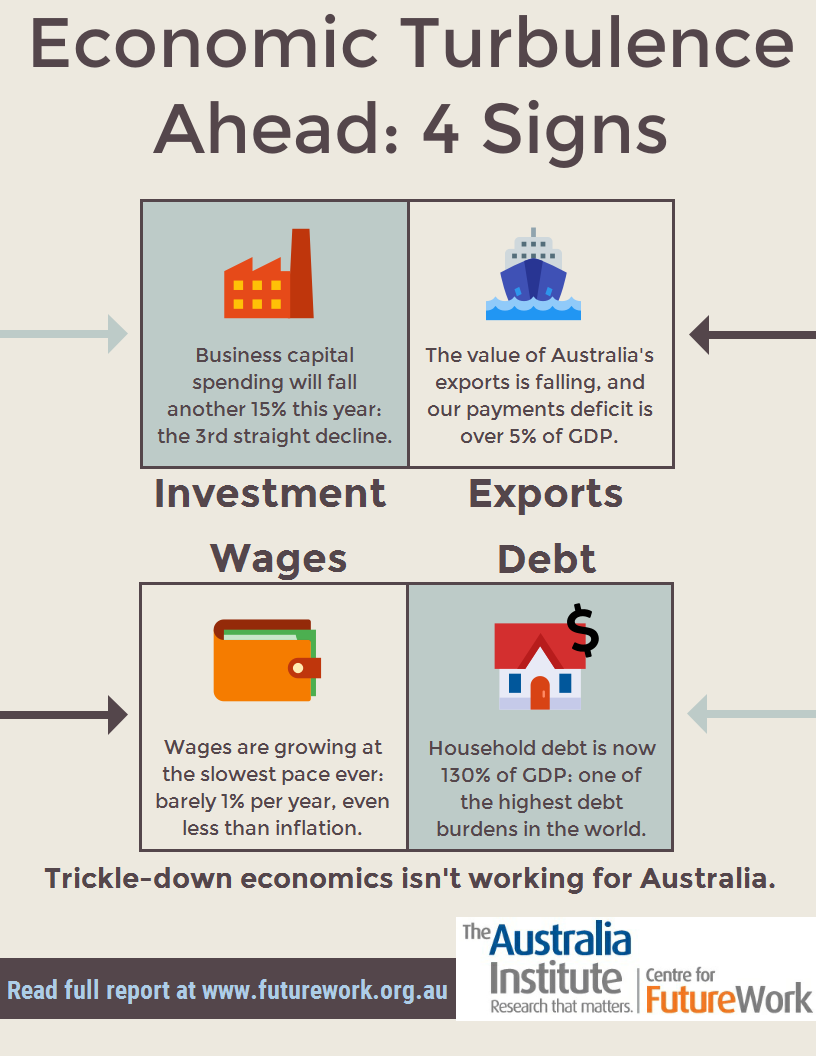
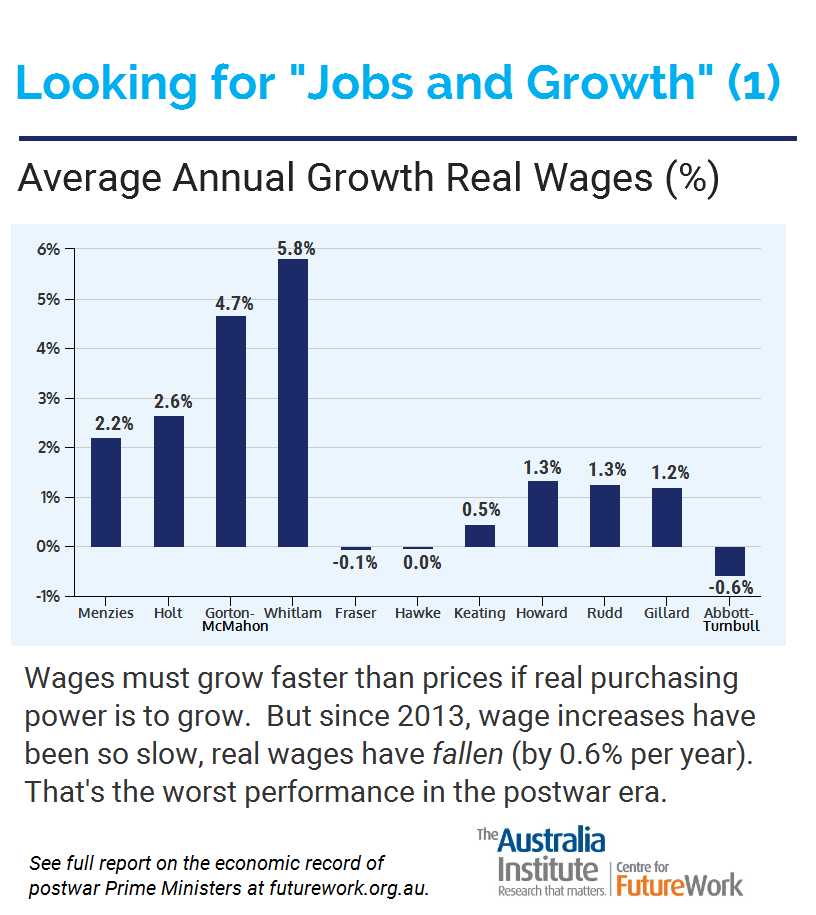
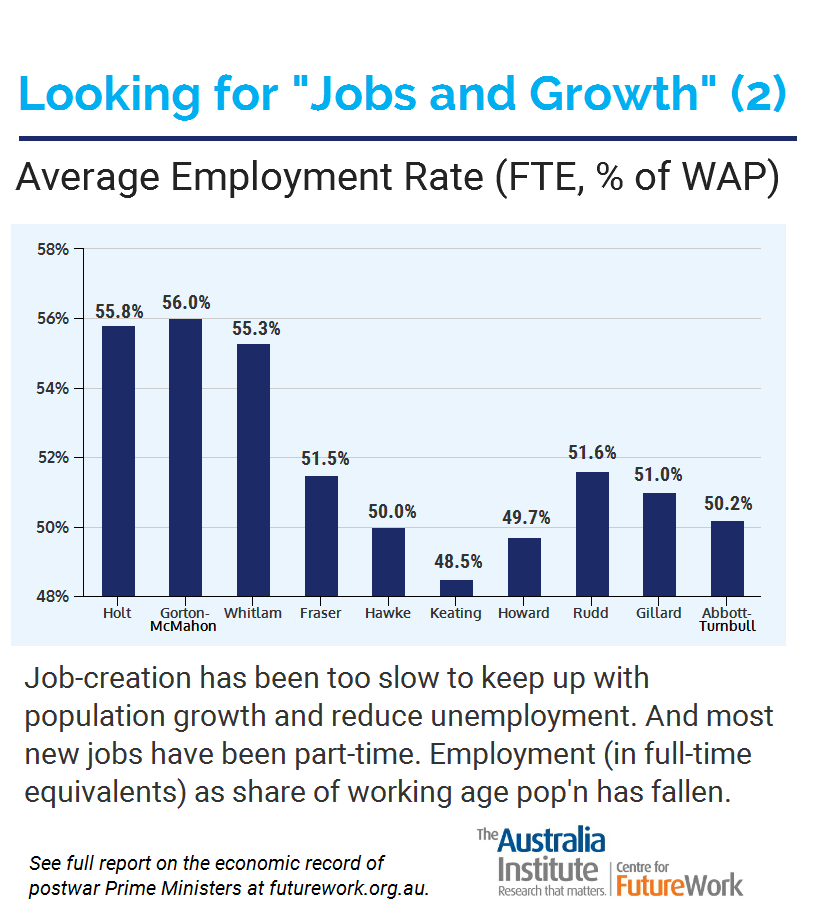
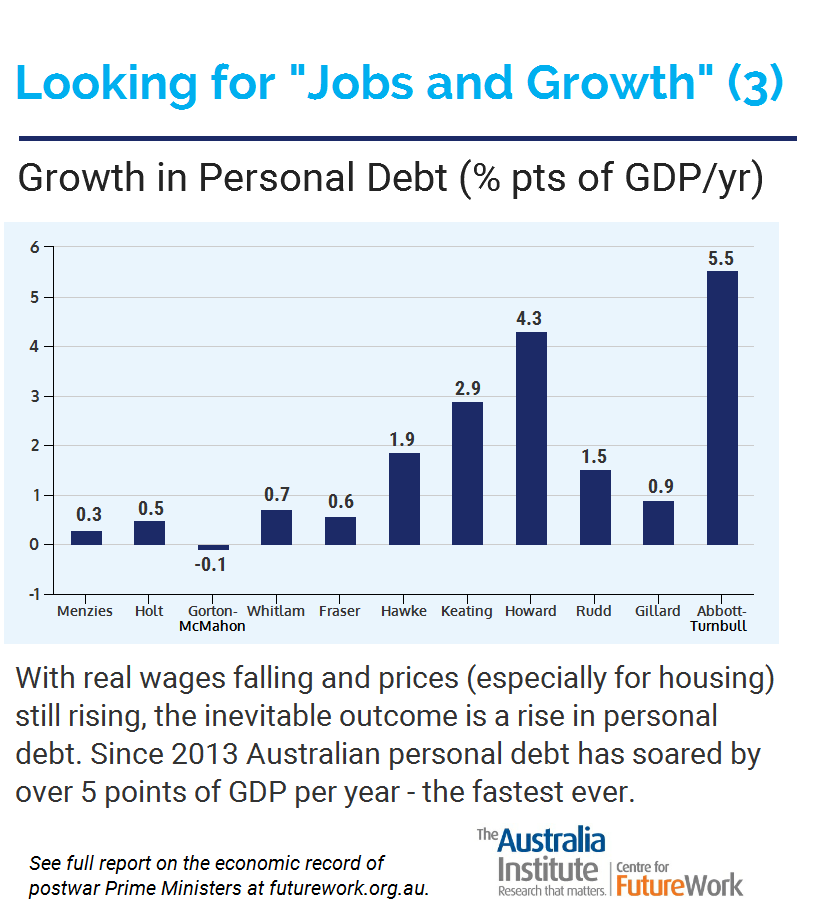
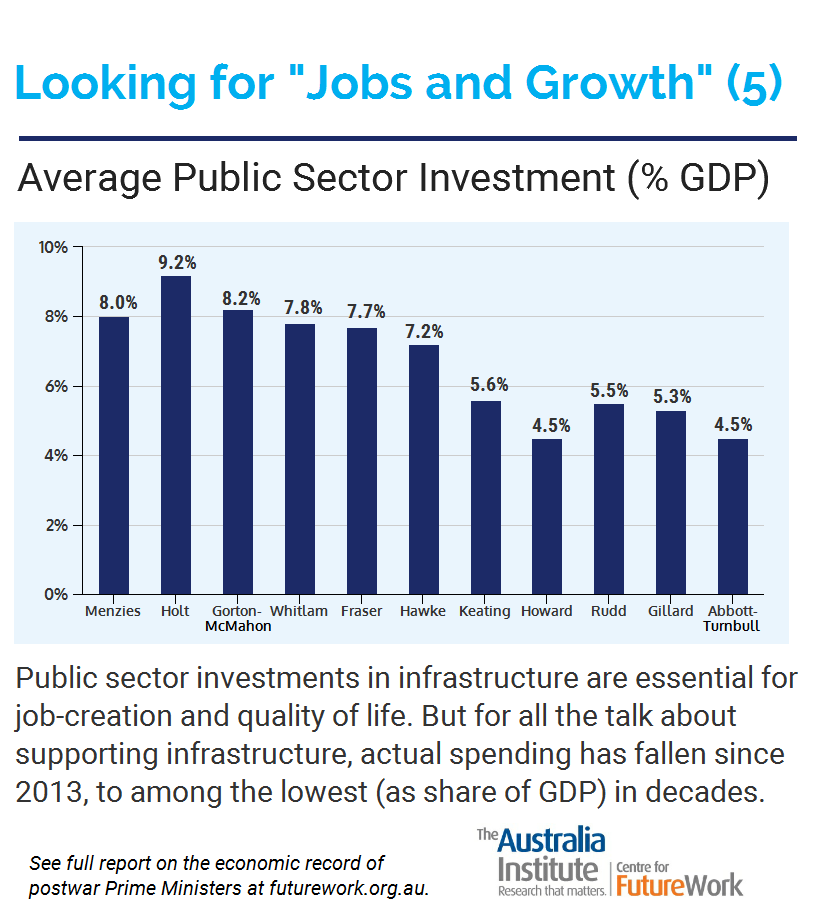
  • Looking for Jobs and Growth: Six Infographics

    The infographics summarize several of the specific economic variables considered in the full report, dating back to 1950 (and Prime Minister Menzies) in most cases.

    Average Annual Growth, Real Wages
    Average Employment Rate
    Growth in Personal Debt
    Average Annual Growth, Business Investment
    Public Sector Investment
    4 Signs of Turbulence Ahead

    The post Looking for “Jobs and Growth”: Six Infographics appeared first on The Australia Institute's Centre for Future Work.

  • Jobs and Growth… and a Few Hard Numbers

    However, the economy consists of more than just private businesses – and certainly more than the large businesses which attract the main attention from politicians and reporters.  Other stakeholders are at least as crucial for powering real economic progress: including workers, households, governments at all levels, small businesses, public and non-profit institutions, NGOs and the voluntary sector, and more.  So being “business-friendly” is no guarantee that the real economy (measured by employment, output, and incomes) will automatically improve.  Having a more complete understanding of all of the different ingredients required for economic progress is necessary, in order to properly analyze the likely impact of specific measures.

    To demonstrate the lack of correlation between a government’s stated economic orientation, and the actual performance of the real economy, this briefing paper compiles historical data on twelve standard indicators of economic performance: including employment, unemployment, real output, investment (of various forms), foreign trade, incomes, and debt burdens.  Consistent annual data is gathered going back to the 1950s, allowing for a statistical comparison of Australia’s economic record under the various post-war Prime Ministers.  We compare Australia’s economic performance under each Prime Minister, on the basis of these twelve selected indicators.

    There is no obvious correlation between these respective swings in Australia’s economic history, and the policy orientation of the government that oversaw them. And the statistical review indicates that the present government, regardless of its business-friendly credentials, has in fact presided over one of the weakest economic periods in Australia’s entire postwar history.

    The post Jobs and Growth… and a Few Hard Numbers appeared first on The Australia Institute's Centre for Future Work.