Tag: Employment & Unemployment

  • The Future of Work for Australian Graduates

    The world of work is being transformed by a complex and interdependent set of forces – including technology, changes in workplace organisation and employment relationships, environmental and demographic challenges, and more. No group of workers will confront the reality of constant change more directly than young workers. As new entrants to the labour market, they cannot count on the protection of previous structures or practices to insulate them from coming changes. They immediately face the challenges of an increasingly precarious job market – one in which less than half of all employed Australians now fill a traditional “standard” job (full-time, permanent, paid work offering normal entitlements like paid leave and superannuation).

    Holding a university degree is still a vital and valuable asset for young workers entering this challenging and unstable milieu for the first time. Individuals with university degrees are more likely to be employed, to have more stable jobs, and to be paid more. But despite this relative advantage enjoyed by university graduates, employment conditions have become much more challenging even for graduates. Rates of graduate employment in full-time work are down significantly over the past decade, and there is evidence of a growing mismatch and underutilisation of university graduates in positions that do not fully or even partly utilise their hard-won knowledge and skills. At the same time, employer complaints about supposed skills shortages and the dearth of “job-ready” graduates are as loud as ever; the report documents that those complaints need to be interpreted with considerable scepticism.

    Australia’s higher education system could do a much better job at anticipating the needs for highly-skilled workers in the future, evolving their program offerings in light of those needs, and then assisting students as they traverse their university educations and find meaningful, relevant work.

    This comprehensive new report from the Centre for Future Work, developed in conjunction with Graduate Careers Australia (an association that has worked to gather data and make recommendations regarding university graduate employment issues) provides an overview of the prospects and challenges faced by future university graduates. The report confirms that university education makes a vital, essential, and valuable contribution to Australians’ prosperity: both at an individual level for those who have attained higher education, and at the macroeconomic and social level. But it catalogues gaps and failures in crucial education-to-jobs transitions, considers the most likely factors contributing to those gaps and failures (while dispensing with some commonly-cited but unconvincing myths and stereotypes), and makes several concrete recommendations for policy change and innovation.

    Key findings of the report include:

    • Employment outcomes for university graduates have deteriorated notably since the GFC. Full-time work placements have deteriorated (from 85% in 2008 to 73% in 2018, measured by full-time employment 4 months after graduation). Many graduates report being underemployed: both quantitatively (working fewer hours than they want) and qualitatively (in jobs that do not fully or even partially use their hard-won expensive skills), and insecure work has become a big problem for graduates (like for others in the labour market).
    • Employers continue to complain about pressing “skills shortages” hampering their growth opportunities. But careful empirical data suggests this claim is questionable. Reported skills shortages in most occupations have in fact eased considerably since the GFC.
    • Another stereotype not backed up by hard data is the common assumption that STEM and technical skills are in the most short supply, and that STEM graduates will have the best employment outcomes. For example, math grads have one of the worst full-time employment placement rates of any discipline. Employers report they especially seek applicants with verbal, social, problem-solving, and communication skills.
    • Vocational degrees (tied to specific occupations, often regulated – like health care, engineering or teaching) have the best employment placement rates.
    • Therefore, the solution to graduate employment challenges must include better strategies for directly linking degrees to jobs: for example, through paid placements, occupational licensing, and accreditation.
    • Australia’s system for planning skills / higher education / job placement functions is fragmented, and often contradictory. We could learn a lot from other countries (especially in Europe) which have taken a more hands-on and direct approach to forecasting future skill requirements, planning higher education offerings accordingly, and channeling graduates directly into relevant career opportunities.
    • The report makes 9 specific recommendations to improve university-to-work transitions for future graduates, including establishing a national higher education planning capacity, and creating a timely and high-quality labour force information system.
    • An overarching recommendation in the report is a call for a new social compact for universities as major actors in Australia’s skills system. This includes increased public funding for universities attached to requirements for national policy coordination among universities, expanded employment-to-jobs programming, and stronger mechanisms connecting public research to the development of an innovation-intensive, high-value export-oriented industry policy.

    Download the full report, The Future of Work for Australian Graduates: The Changing Landscape of University-Employment Transitions in Australia, by Alison Pennington and Dr. Jim Stanford. There is also a 12-page summary report available for download. The report was commissioned by Graduate Careers Australia.

    The post The Future of Work for Australian Graduates appeared first on The Australia Institute's Centre for Future Work.

  • University-to-Job Pathways Key to Boosting Graduate Employment Outcomes

    New research shows active strategies to directly link university degrees to a job are needed, to better support university graduates as they negotiate a rapidly changing labour market.

    The report, by the Australia Institute’s Centre for Future Work, shows that employment outcomes for university graduates have deteriorated significantly since the Global Financial Crisis, with only 73% of recent university graduates finding full-time employment within 4 months of graduating – down from 85% in 2008.

    Key Findings:

    • At the individual level, a university degree is still very valuable: people who hold a university degree are more likely to be employed, more likely to be employed in a stable job, and earn higher average wages and salaries. Half of new jobs created in the coming 5 years will require a degree.
    • However, many recent graduates report being underemployed or in insecure jobs that do not utilise their specific skills—including graduates who studied technical skills or STEM subjects.
    • The report makes 9 recommendations to improve university-to-work transitions for future graduates, including establishing a national higher education planning capacity, and creating a timely and high-quality labour force information system.

    Alison Pennington, Senior Economist, Centre for Future Work:
    “Employment outcomes for university graduates have deteriorated significantly since the GFC,” says Alison Pennington, Senior Economist at the Centre for Future Work and co-author of the report.

    “Finishing tertiary education and finding a job in your field is a difficult and haphazard experience, which is leaving many graduates in jobs that do not fully, or even partially, use their hard-won and expensively acquired skills.

    “Vocational degrees, which are tied to specific occupations like health care, engineering or teaching, have the best employment placement rates. As seen in these professions, directly linking degrees to jobs through paid placements, occupational licensing and accreditation would greatly improve the situation of graduates.

    “A hands-on and direct approach that channels graduates directly into relevant career opportunities is needed. Australia could learn a lot from other countries, especially in Europe, where this is already being achieved through forecasting future skill requirements and planning higher education offerings accordingly.”

    Noel Edge, Executive Director of Graduate Careers Australia:
    “The overwhelming message from this report by the Centre for Future Work is the need for further research in graduate employment,” says Noel Edge, Executive Director of Graduate Careers Australia.

    “Research to explore the emerging work environment for tertiary education students in Australia, beyond basic government labour-market forecasting and graduate outcomes reporting, simply does not exist.”

    The report was commissioned by Graduate Careers Australia.

    The post University-to-Job Pathways Key to Boosting Graduate Employment Outcomes appeared first on The Australia Institute's Centre for Future Work.
  • Job Opportunity: Research Economist

    The successful candidate will offer:

    • A graduate degree in economics or a closely related discipline.
    • Knowledge of and experience with a wide range of labour issues, preferably including: labour market statistics and trends; characteristics and determinants of employment; industrial relations and collective bargaining; wage determination and inequality; gender, racial, and demographic aspects of labour markets; the impact of technology on employment; macroeconomic policy and labour markets; and others.
    • Demonstrated ability to write to deadline for professional and popular audiences in a credible, succinct, and accessible manner.
    • Strong quantitative skills, including ability to access statistical data, analyse it (including familiarity with statistical tools), and report it in a variety of textual, tabular and graphical formats.
    • Confident communication skills, including ability to speak to public audiences, classrooms, and the media.
    • Ability to work collegially with other members of a research team.
    • Commitment to a progressive vision of work and fairness, including the goals of equality, participation, collective representation and trade unionism.

    Responsibilities of the position will include:

    • Research and completion of several project-length research papers, briefing notes, and shorter commentary articles per year on a range of topics related to labour markets and labour market policy.
    • Ongoing monitoring and analysis of labour market data and information.
    • Helping to maintain relevant websites and databases.
    • Public speaking, presentations, lectures and courses, media interviews, and related communication and educational activities.
    • Minimal office and administrative functions.

    Ability to undertake occasional out-of-town travel (including overnight travel) is essential, as is ability to successfully work in a self-managed and autonomous manner.

    The position will be offered on a one-year term-limited basis, with possibility for renewal. Salary will be commensurate with qualifications and experience.

    Applications are especially invited from women, indigenous persons, other racial and linguistic communities, people with disabilities, and other marginalised communities.

    Please forward applications (including contact information, qualifications, experience, two samples of written work, and names and contact details for two references) in confidence to cfwjob@tai.org.au. Please cite “Economist Job Application” in the subject field of your message; supporting documents should be attached in pdf format. Receipt of applications will be acknowledged by e-mail. Only candidates selected for an interview will then be contacted; no phone calls please.

    Applications must be received by 5:00 pm AEDT on Wednesday 9 October, and interviews will be conducted in Sydney on Wednesday 23 October 2019.

    The Centre for Future Work is an initiative of the Australia Institute, Australia’s leading progressive research institution. Thank you for your interest in the Centre for Future Work.

    The post Job Opportunity: Research Economist appeared first on The Australia Institute's Centre for Future Work.

  • Jobs and a Living Wage

    The Australian policy journal Arena has published a wide-ranging article by Centre for Future Work Director Jim Stanford on the labour market issues at play in the current federal election.

    Stanford argues that the sense of “superiority” which typically accompanies economic debates during Australian election campaigns is muted in the current contest, because of the poor performance of the labour market in recent years. Unemployment and especially underemployment remain high; the quality of work has deteriorated; and wages have experienced their weakest performance since the end of the Second World War.

    Visit Arena’s website to read the full article.

    The post Jobs and a Living Wage appeared first on The Australia Institute's Centre for Future Work.

  • Turning Gigs Into Decent Jobs (Victorian On-Demand Workforce)

    The government of Victoria is holding an important inquiry into the conditions and challenges of working in the ‘on-demand’ economy: a polite euphemism for gigs. The Centre for Future Work has made a submission.

    Our submission notes that digitally-mediated on-demand production typically incorporates five broad characteristics:

    • Work is performed on an on-demand or as-needed basis. Producers only work when their services are immediately required, and there is no guarantee of ongoing engagement.
    • Work is compensated on a piece-work basis. Producers are paid for each discrete task or unit of output, not for their time.
    • Producers are required to supply their own capital equipment. This typically includes providing the place where work occurs (their home, their car, etc.), as well as any tools, equipment and materials utilised directly in production. Because individual workers’ financial capacity to provide these up-front investments is limited, the capital requirements of platform work (at least that used directly by workers) are small.
    • The entity organising the work is distinct from the end-user or final consumer of the output, implying a triangular relationship between the producer, the end-user, and the intermediary.
    • Finally, some form of digital intermediation is utilised to commission the work, engage the producer, supervise it, deliver it to the final customer, and facilitate payment. In the modern economy, this last criteria is hardly exrtaordinary: virtually any job imaginable today relies on some form of digital task allocation or management.

    Despite the media hype which on-demand platforms have generated, the scale of employment engaged in on-demand work so far is rather modest. The number of people engaged in actual productive work organised through a digital platform is small (less than 1% of the labour force), and a large (likely majority) proportion of those rely on on-demand work for only a minority of their total income. Many people have signed up to perform work through one or more of these platforms, but do not stay with the platform long, and/or do not work many hours in the role.

    Another stereotype that needs to be challenged in considering on-demand work is the common claim that these employment practices are novel and innovative. Here it is crucial to distinguish between the technical innovations which these businesses utilise, and the changes in work organisation which those models also introduce. In fact, the major organisational features of digital platform work are not new at all. These practices have been used regularly in labour markets for hundreds of years; what is novel is the use of digital technologies for organising, supervising, and compensating work in that manner. And the growth of insecure or precarious work practices is not an essentially technology-driven phenomenon. Rather, the growing precarity of work, including in digitally-mediated on-demand jobs, reflects the evolution of social relationships and power balances, more than technological innovation in its own right. Appreciating the social and regulatory dimensions of technology and work organisation contributes to a more holistic and balanced understanding of the rise of on-demand work, its consequences, and its potential remedies.

    All the core features associated with on-demand work are long-standing. The practice of on-call or contingent labour – whereby workers are employed only when directly needed – has been common for hundreds of years. In an Australian context, a famous example is the former practice of dockworkers lining up each morning (for example, along Sydney’s ‘Hungry Mile’) in hopes of attaining employment that day; other examples are common in other sectors (including minerals, forestry, manufacturing, and agriculture).

    Home-based work, and other systems in which workers supply their own capital equipment, have also been common in many applications and contexts – from the ‘putting out’ system for manufacturing textile products and housewares in the early years of the industrial revolution, to the important role played by owner-operators in many modern industries (including transportation, resources, fisheries, and personal services).

    Piece-work compensation systems also have a long if uneven history. Employers have long aimed to tie compensation directly to output (as a way of shifting responsibility for managing work effort and productivity onto workers). Yet at the same time, the use of piece-work is constrained by numerous well-known problems, including difficulties in applying them in situations which require an emphasis on quality, not just quantity of output (like most service sector activities), and where work is performed jointly by teams or larger groups of workers.

    Finally, the triangular relationship that is evident in the on-demand economy between the worker/producer, the ultimate end-user of their labour (whether a business or a consumer), and an intermediary/‘middleman’ business is also very familiar from economic history. Past examples include labour hire services, “gang-masters,” and other forms of labour supply intermediation. Under this triangulated model of employment, it can be unclear who is the actual ‘employer’; this ambiguity opens the possibility for various negative practices and outcomes, which have been recognised for years in legislation, regulation, and jurisprudence. An example is Australia’s long-standing rules regarding ‘sham contracting’, and more recent initiatives to regulate labour hire businesses in Queensland and Victoria.

    In short, the core features of on-demand work are not novel; and claims that this way of organising work is ‘new’ are not valid. Rather, on-demand businesses reflect a resurgence of very old business practices, that date back hundreds of years. So ‘gig’ employers cannot be allowed to invoke claims of technological advancement, to justify work practices that are hundreds of years old – and in many cases violate community standards and traditional labour laws.

    The post Turning ‘Gigs’ Into Decent Jobs appeared first on The Australia Institute's Centre for Future Work.

  • Million jobs not what it used to be: new report

    New analysis of labour market performance released today by The Australia Institute’s Centre for Future Work, shows Australia’s job creation performance over the past five years has been weak relative to population growth and compared to past periods of history.

    “A million jobs in five years sounds like an impressive figure, but there are now over 20 million Australians of working age, and our population is growing very rapidly. A million new jobs every five years, isn’t even enough to keep up,” says Dr. Jim Stanford, Director of the Australia Institute’s Centre for Future Work.

    “A closer look at the evidence shows that both the quantity and the quality of work being created in Australia’s labour market is inadequate to the needs of our growing population, and highlights the role part-time work has played in inflating the apparent total number of jobs created.

    “Part-time employment has accounted for almost half of all new work created since 2013. Without the this rapid expansion of part-time work, which converts a given amount of hours of work into more jobs, the growth in employment would have fallen well below one million.

    “Due to soaring part-time employment, the number of hours worked by each worker has fallen to the lowest on record. Part-time workers also experience lower hourly wages, higher casualisation, and are more dependent on the minimum conditions of modern awards.

    “Along with the declining quality of jobs, our research shows an unprecedented stagnation of wages since 2013. With nominal pay lagging behind inflation, the real purchasing power of Australian works has declined for the first time since the recession-wracked 1990s.

    “This deterioration occurred in a time when the economy was growing steadily. Instead of constituting some kind of economic triumph, the last five years really represents a lost economic opportunity.”

    The post Million jobs not what it used to be: new report appeared first on The Australia Institute's Centre for Future Work.

  • Job Creation Record Contradicts Tax-Cut Ideology

    The Australian Bureau of Statistics released its detailed biennial survey of employment arrangements this week (Catalogue 6306.0, “Employee Earnings and Hours“). Once every two years, it takes a deeper dive into various aspects of work life.

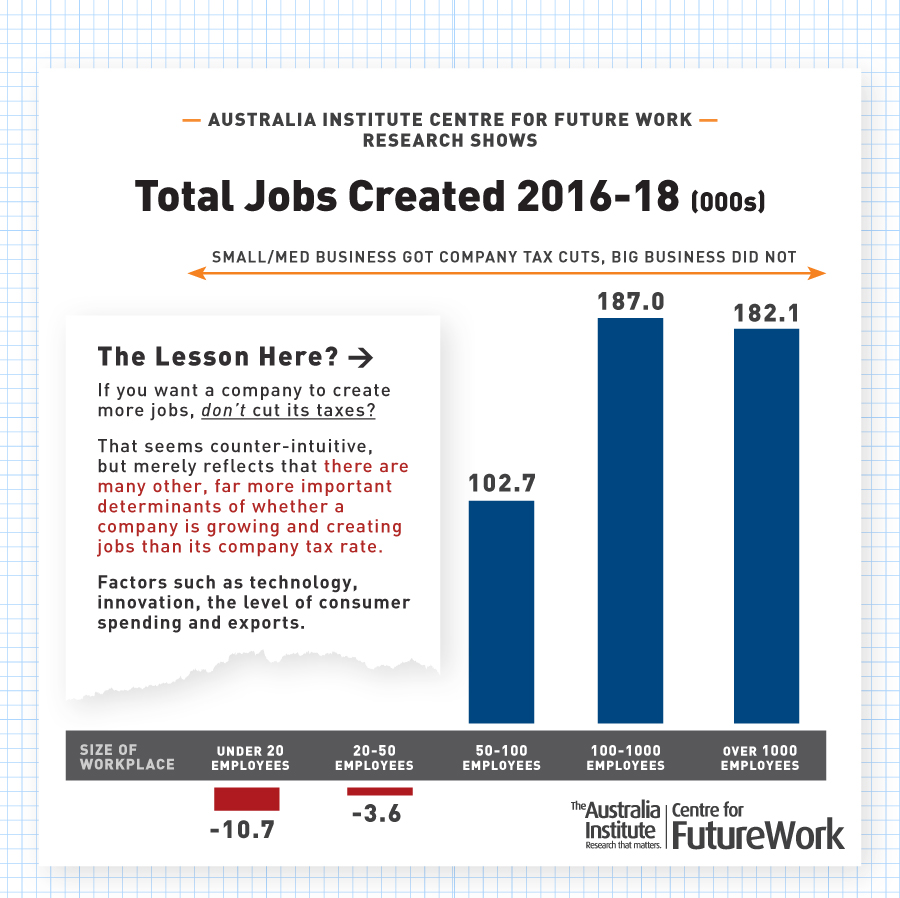
    Buried deep in the dozens of statistical tables was a very surprising breakdown of employment by size of workplace. It turns out, surprisingly, that Australia’s biggest workplaces (both private firms and public-sector agencies) have been the leaders of job-creation over the last two years.

    This runs against the common refrain that small business is the “engine of growth.” In fact, workplaces with less than 50 employees actually shed employees (14,000 in total) since 2016. Curiously, it was only smaller businesses that received the much-vaunted reduction in company tax (from 30 to 27.5 per cent), also beginning in 2016.

    Firm Size and Job Creation

    The tax rate for small and medium-sized businesses began to fall in 2016, first for the smallest firms (with turnover under $2 million), and then for firms with up to $50 million revenue. The tax is not tied to the number of employees in a business, but the vast majority of firms which have received the tax cut have less than 50 employees. Yet that is the group that has reduced its workforce since the tax cuts began to be phased in.

    In contrast, very large workplaces (with over 1000 employees) added 182,000 new jobs over the two years. Workplaces with between 100 and 1000 employees added 187,000. Very few of those workplaces would have received the reduction in company taxes (since most would exceed the $50 million annual revenue threshold).

    Workplaces between 50 and 100 employees created a net total of 103,000 new jobs between 2016 and 2018. Some of those firms would have received the tax cut, and some not — depending on the nature of the business and the amount of total turnover generated per employee.

    The data on job-creation by firm size is detailed on Table 13 of Data Cube 1, in the “Downloads” section of the ABS report. The data refers to waged employees, not including owner-managers of businesses.

    The share of small businesses (under 50 employees) in total employment declined by two percentage points — since they were reducing their workforces, while larger companies were growing. Small businesses (under 50 employees) now account for 34 per cent of all employees, compared to 36 percent in 2016.

    Why would large companies that didn’t get a tax cut create new jobs faster than companies which did benefit from the Coalition tax cuts? (The small business tax cuts are estimated to reduce federal revenues by $29.8 billion over the first decade.) Simple: there are dozens of different factors which determine whether a company is profitable or not, and whether it chooses to grow. Tax rates are just one of those variables. Others include:

    • Growth in consumer demand.
    • The company’s investments in product quality, innovation, and design.
    • Production costs.
    • Interest rates and financing costs.
    • Business confidence and expectations.
    • Management capacity.
    • International competition.

    Trends in all these other factors can easily overwhelm the marginal impact of lower tax rates. Small business sales in particular have been held back by stagnant wages among Australian workers. Even companies which experience higher profits due to lower tax rates may choose to simply accumulate those profits, or pay them out to shareholders in dividends and share buy-backs (instead of expanding payrolls). Empirical evidence shows this has been the dominant impact of U.S. business tax cuts implemented by Donald Trump.

    Changes in tax rates can even have offsetting effects which undermine business conditions and hence reduce job-creation: if the revenue lost to tax cuts results in corresponding reductions in government program spending or infrastructure investments (as seems likely), then overall business conditions might be weakened, not strengthened.

    The reduction in employment by the businesses which most benefited from the expensive business tax cuts over the past two years should lead policy-makers of all persuasions to reconsider the argument that this is an effective way to stimulate growth and job-creation. However, in October the government announced it wanted to accelerate the next stages of the small business tax cuts — taking the rate down to 25 per cent five years faster than originally planned.

    So far, the policy is akin to shooting oneself in the foot. Instead of reloading the gun to do it again even sooner, perhaps this is a good time to reconsider whether the strategy makes any sense at all.

    The post Job Creation Record Contradicts Tax-Cut Ideology appeared first on The Australia Institute's Centre for Future Work.

  • Australia’s Upside-Down Labour Market

    In this article reprinted from Western Teacher magazine (published by the State School Teachers’ Union of WA), our Director Jim Stanford tries to explain these contradictory trends.

    The article is based on a presentation to a recent SSTUWA delegates meeting in Perth.

    Cover

    Stanford provides a dual diagnosis for Australia’s labour market problems: an inadequate quantity of work, and the deteriorating quality of work. Egged on by government policies which have deliberately suppressed wages in so many workplaces, wage growth has fallen to postwar lows. This is now undermining Australia’s continued economic progress.

    In addition to diagnosing what’s gone wrong in Australia’s labour market, Stanford also explains the numerous economic benefits of stronger collective bargaining systems so that workers can receive a fairer share of the economic pie: stronger consumer spending, more stable financial conditions, stronger government revenues, and less inequality.

    To see the full issue of Western Teacher, or sign up for future editions, please visit the magazine’s website. We are grateful to Western Teacher for permission to reprint the article here!

    The post Australia’s Upside-Down Labour Market appeared first on The Australia Institute's Centre for Future Work.

  • The Year Past, and the Year to Come

    Workforce (a labour relations bulletin published by Thomson-Reuters) recently surveyed major IR figures in Australia on what they saw as the big issues in 2018, and what they expect as the major talking points for 2019. Jim Stanford, economist and Centre for Future Work director, was one of those surveyed, and here are his remarks.

    What was the most important issue or event in industrial relations this year?

    I would choose the union movement’s “Change the Rules” campaign, which really gathered focus and momentum as the year went on. Of course, unions have been dissatisfied with the state of labour laws, and the erosion of labour rights, for years. But this year, together with other community advocates, they have built a very effective and focused advocacy campaign that I think will have a major impact on labour policy in Australia. Examples of its potential include the big rallies held in Melbourne and other cities in October; the important role that the union movement’s independent door-knocking and phone-banking campaign played in the expanded majority won by the Daniel Andrews govt in Victoria; and the generally high profile of news and debates around the issues of wages and workplace fairness in the media and public commentary.

    The current atmosphere is very reminiscent of the “Your Rights at Work” initiative that the ACTU and its affiliates organised in 2006-07 – and that ended up making a significant difference in the 2007 election (when John Howard lost his seat).

    There is a qualitative difference in this incarnation of the union movement’s organising, however: while union activists obviously are hoping to influence the results of the next election, they are self-consciously and explicitly planning on a longer-run effort to shift public opinion regarding core issues of work and fairness.

    Their agenda of proposed reforms would take several years to implement: including lifting the minimum wage to a “living wage” level, modernising labour laws (so Uber drivers and other gig workers would be protected), changing the structure of enterprise bargaining to allow multi-firm and industry-wide bargaining, and more.

    And they are advancing that agenda as an independent campaign, not as an arm of the Labor party. That positions them well to continue to advance the debate after the election … whoever wins.

    By carefully focusing its energies, building a strong “boots on the ground” infrastructure in communities (including crucial marginal electorates), and building strong public support for the core values underpinning the campaign (tapping into continuing Australian faith in fairness), I think this movement will reshape both public opinion about work and wages, as well as Australia’s labour policy framework.

    What are you most/least looking forward to in 2019?

    There will be a Commonwealth election sometime during the first half of 2019 (perhaps sooner rather than later, if the current disarray in Canberra is any indication).

    I look forward to seeing labour issues – and in particular, the stagnation of wages in Australia, and the growing gap between Australia’s egalitarian tradition and the grim economic reality that most workers presently face – feature as one of the top three issues in the campaign. Most workers have had no increase in real wages over the past five years; millions have fallen behind (especially given escalating prices for housing and other essentials). The present govt knows that this festering economic frustration issue could be very damaging.

    There’s an opportunity in Australia right now to move the needle: imagine a modernised approach to labour policy: including labour standards that adapt to ongoing change in the economy (like gig jobs), a more ambitious crack-down on wage theft and other illegal practices, and a revitalisation of Australia’s commitment to a ‘fair go.’

    However, I am not looking forward to the rolling out of some pretty tired warnings and threats about how modernising labour laws and addressing inequality will somehow threaten Australia’s economic viability.

    We can expect many dire threats about how the proposals for reform will drag Australia back to the “bad old 1970s” – a time, interestingly, when GDP growth, job-creation, productivity growth, and real wage growth were all significantly superior to the current era.

    This rhetoric ignores the growing consensus among economists that more equality actually strengthens economic performance – by supporting consumer spending and aggregate demand, avoiding the economic, fiscal and social costs of exclusion and inequality, and boosting govt revenues.

    The doomsday prophecies we can expect to hear from the usual suspects should be understood as the last gasps of a vision of trickle-down economic policy that has lost its credibility, in Australia and around the world.

    The post The Year Past, and the Year to Come appeared first on The Australia Institute's Centre for Future Work.

  • Workers’ Share of Economic Pie Shrinks Again

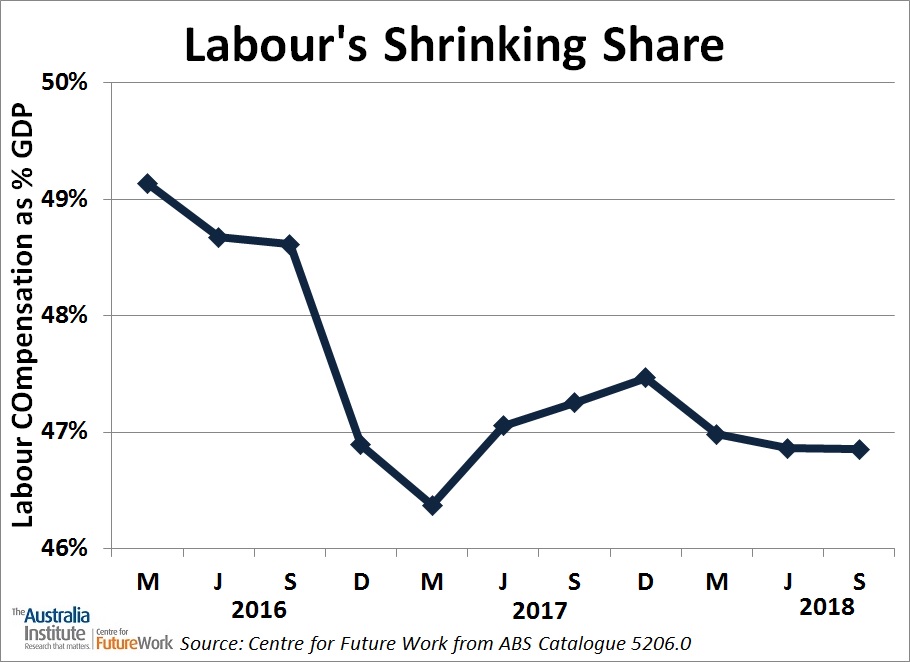
    That represents the third consecutive quarterly decline in relative labour compensation.

    Labour Share

    “A decline in the labour share of GDP indicates that workers’ wages and salaries are not keeping up with the growth of Australia’s economy,” explained Dr. Jim Stanford, Economist and Director of the Centre for Future Work. “And given that GDP growth itself was very anemic in the September quarter (expanding just 0.3%), that’s an especially weak result.”

    The labour share of GDP is now on track to set a new record low for 2018, below even last year’s average of 47.1% – which was the lowest annual average labour share recorded since the ABS began gathering modern GDP statistics in 1958.

    The weak growth of total wages reported in the GDP data was surprising, given the apparently strong increase in employment recorded over the past year. Labour compensation per employee increased by just 1.9% in the year ending in September, barely matching the increase in average consumer prices over that period. Wage growth in the private sector has been even slower.

    Despite a decline in the official unemployment rate over the past year, wages have been held back by a combination of high underemployment (workers who want more hours of work), the growing share of insecure and part-time jobs, and the erosion of traditional wage-setting institutions (including collective bargaining).

    With labour costs falling as a share of total output, profits have expanded. Corporate operating surpluses expanded by another 7.1% in the year to September, and reached their highest share of GDP (25.22%) since March, 2012.

    The Centre for Future Work reviewed the long-term decline of the labour share of Australian GDP in a recent research symposium, published in the Journal of Australian Political Economy.

    The post Workers’ Share of Economic Pie Shrinks Again appeared first on The Australia Institute's Centre for Future Work.