Tag: Economics

  • New laws for employee-like gig workers are good but far from perfect

    The Workplace Relations Minister Tony Burke has described proposed new laws to regulate digital platform work as building a ramp with employees at the top, independent contractors at the bottom, and gig platform workers halfway up.

    The new laws will allow the Fair Work Commission to set minimum standards for ‘employee-like workers’ on digital platforms. They are a key part of reforms in the government’s Closing the Loopholes workplace relations bill introduced into parliament this week, and are part of a commitment made before the 2022 election.

    So, what will being halfway up the ramp mean for ‘employee-like’ platform workers? Under the changes, minimum standards can now be set for platform workers, including rideshare drivers, food delivery workers and care workers. Up until now, as independent contractors, digital platform workers have had very few rights, including no rights to minimum pay rates.

    With the changes, the Fair Work Commission will be able to set minimum standards for workers concerning payment terms, deductions, working time, record-keeping, insurance, consultation, representation, delegates’ rights and cost recovery and other matters.

    Other provisions in the legislation are designed to protect workers from being unfairly deactivated from platforms, which is equivalent to being unfairly dismissed, and allow collective agreements for platform workers where platform operators agree.

    The laws will apply only to ‘employee-like’ platform workers, meaning workers who are low-paid (compared to what they would be paid under an award), have low bargaining power and/or have low control over their work.

    There are some restrictions on the standards the Fair Work Commission can set for platform workers. Minimum standards cannot be set concerning overtime rates or rostering arrangements. Nor can the Commission use its standard-setting powers to turn a platform worker into an employee.

    So, ‘employee-like’ platform workers will not have all the minimum standards and rights that employees have. However, halfway up the ramp, they will be much better placed than they were with the minimal rights of independent contractors.

    Overall, these changes are very positive for platform workers and should prevent exploitation of vulnerable workers. However, the reforms stop short of responding to longstanding calls for platform workers, including rideshare, food delivery and care workers, to be treated as employees, and for platform operators to be treated as employers, an approach that has recently been agreed by the 32 member countries of the European Union.

    The proposed reforms in the Closing Loopholes bill don’t go as far as aiming to ensure that how a person is employed can’t leave them without the rights and standards most comparable workers enjoy at work. It leaves platform workers halfway up the ramp in a new worker category with lesser rights than employees.

    The creation of this new category of ‘employee-like’ worker does open up the possibility that some employers may seek to reform their workforces and business models to engage workers who are in the new cheaper worker category, in place of employees. Internationally, where a third category of worker has been created by governments in order to provide protections for low-paid independent contractors, there has been some substitution of employees for workers with less favourable conditions.

    The Closing the Loopholes approach to platform workers also suggests we need to think harder about how to support better flexibility at work.

    The platform work reforms appear to be built on an assumption it is ok for workers who need or want flexibility to have lesser standards and fewer rights at work because of this. Most platform workers value the flexibility they have in their jobs. But that does not mean they should have to trade off rights and standards. Flexibility is not a benefit that accrues only to workers. Consumers and platform operators want flexible services too.

    Originally published in The New Daily 8 September 2023

    The post New laws for ‘employee-like’ gig workers are good but far from perfect appeared first on The Australia Institute's Centre for Future Work.
  • Wages, employment and power: Call for conference papers

    The Centre for Future Work is hosting a stream at the upcoming AIRAANZ Conference.

    Join us as we continue the AIRAANZ and the Centre for Future Work traditions of bringing researchers and activists together to debate important issues in the world of work and industrial relations.

    The AIRAANZ (Association of Industrial Relations Academics of Australia and New Zealand) 2024 Conference will be held in Perth from the 31 January to 2 February 2024.

    Wages, employment and power
    Papers are sought on topics that relate to issues concerning employment, power and/or wages.

    Topics could include, but are not limited to:

    • the relationship between power and wages at the firm, industry or national level;
    • legislative reforms affecting wages, employment or power;
    • bargaining strategies to boost power and wages;
    • explanations for changing worker power;
    • job vacancies, labour shortages and wages;
    • the gendering of wages, employment or power;
    • employment, unemployment or participation amongst particular groups or industries;
    • product or labour market competition and worker power;
    • the effects of norms and institutions in labour markets;
    • the geography of power or wages;
    • the ideologies and strategies of employers, unions or the state.

    Submit your abstract to the conference organisers by 29th September.

    Feel free to get in touch with us if you have any questions about topics or the stream or would like any additional information.

    David Peetz d.peetz@griffith.edu.au, davidp@australiainstitute.org.au, +61 466 166 198 or +64 204 127 6749
    Fiona Macdonald fiona@australiainstitute.org.a, +61 437 301 065

    Abstracts must be submitted to the conference organisers via: https://consol.eventsair.com/airaanz-2024/submission-site/Site/Register.

    For AIRAANZ 2024 Conference details see: https://www.airaanz.org/conference/reimagining-industrial-relations-airaanz-2024-conference-31-jan-2-feb-2024/

    The post ‘Wages, employment and power’: Call for conference papers appeared first on The Australia Institute's Centre for Future Work.
  • The weak economy shows the Reserve Bank is not threading the needle

    The latest June quarter National Accounts released yesterday showed that without the increase in population, Australia’s economy would have shrunk for two consecutive quarters. This, as Policy Director, Greg Jericho writes in his Guardian Australia column, reveals just how weak our economy is, and how massively households have been hit by the 400 basis points rise in the cash rate.

    The Reserve Bank has talked about trying to thread the needle of lowering inflation and delivering a soft landing. But with GDP per capita falling and real household disposable income per capita now 5% below where it was a year ago, it is becoming harder to suggest the RBA has achieved its aim.

    Even when including population growth GDP only rose at all because of government spending and investment. The private sector is struggling as companies run down their inventories rather than build up supplies in the hopes of increased sales in the months to come.

    The household savings ratio is now as low as it has been since the GFC as households do what they can to pay the costs of essential items and reduce their purchase of discretionary goods and services.

    The Reserve Bank sought to dampen demand from a misguided view that demand was driving inflation. Instead, we know that inflation has largely been driven by international prices and costs and from companies taking advantage of the situation to increase their profits.

    Rather than focus purely on inflation the RBA and the government now need to be most wary of rises in unemployment. We are not in a recession yet, but should the economy continue to fail to grow aside from population unemployment will inevitably rise, and the cost of the RBA’s strategy will be felt even more so by households across the country.

    The post The weak economy shows the Reserve Bank is not threading the needle appeared first on The Australia Institute's Centre for Future Work.

  • Report Reveals True Potential of Fully Funded Public Schools

    “The Case for Investing in Public Schools: The Economic and Social Benefits of Public Schooling in Australia” has found that the current inadequate funding for public schools is preventing students from reaching their full potential and is depriving the nation of the significant benefits of high levels of school completion.

    The report simulates the short-run and long-run economic benefits arising from the 15% increase in public school funding that would be required to meet the minimum resource benchmarks established through the Schooling Resource Standard (SRS).

    Key findings:

    • Inadequate funding is linked to falling school completion rates and declining relative performance in international achievement. Students from relatively disadvantaged socio-economic, regional, and Indigenous backgrounds are most likely to be affected.
    • Additional funding of $6.6 billion per year is needed for public schools to meet the SRS commitments adopted by federal and state governments a decade ago, a 15% increase in total public school funding.
    • With additional resources, the decline in high school completion rates that has occurred since 2017 could be repaired under a modest estimate, and further gains in completion (in line with historical trends) attained under an optimistic estimate.
    • The enhanced funding and resulting improvements in school completion could lead to employment, economic activity, productivity gains and social savings equal to $17.8 billion and $24.7 billion annually (in 2022 terms) after two decades.
    • These economic benefits are two to four times greater than the additional yearly cost required to fully meet the SRS for public schools.
    • Fiscal improvements resulting from these economic gains, such as increased tax revenues and reduced social expenditures, would eventually offset the incremental resources needed for full SRS funding.

    “Australia’s economic success relies heavily on the potential of our young minds,” said Dr Jim Stanford, Director of the Centre for Future Work, and co-author of the report (with Eliza Littleton and Fiona Macdonald).

    “Public schools play a critical role in ensuring that students have access to an education that provides them with choice and opportunity throughout their lives – regardless of their postcode or economic and family circumstances.

    “With stronger school completion and academic achievement, our communities thrive and our nation benefits from increased economic activity, productivity and earnings.

    “The total economic benefits arising from adequate public-school resourcing would be two to four times larger than the cost of meeting SRS funding standards. The fiscal gains associated with those economic benefits would ultimately offset the cost to government of improved public school funding.

    “Every dollar invested in public education translates into a stronger, more cohesive, and prosperous society. Let’s not rob our students, and our nation, of this opportunity,” Dr Stanford concluded.

    The post Report Reveals True Potential of Fully Funded Public Schools appeared first on The Australia Institute's Centre for Future Work.

  • The Case for Investing in Public Schools

    Public schools play a critical role in ensuring access to educational opportunity for Australians from all economic and geographical communities.

    Public schools are accessible to everyone. They provide a vital ‘public good’ service in ensuring universal access to the education that is essential for a healthy economy and society.

    However, inadequate funding for public schools – measured by persistent failure to meet minimum resource standards established through the Schooling Resource Standard (SRS) – is preventing students in public schools from fulfilling their potential. Growing evidence (including the latest NAPLAN testing results) attests to declining student completion and achievement in Australia, with major and lasting consequences for students, their families and communities, and the economy.

    In this new report, Centre for Future Work researchers Eliza Littleton, Fiona Macdonald, and Jim Stanford document the large economic and social benefits of stronger funding for public schools. The report measures three broad channels of benefits:

    1. The immediate economic footprint of public schools, including direct and indirect jobs in schools, the education supply chain, and downstream consumer industries.
    2. The labour market and productivity gains resulting from a more educated workforce.
    3. Social and fiscal benefits arising from the fact that school graduates tend to be healthier, require less support from public income programs, and are less likely to be engaged with the criminal justice system.

    Citing international and Australian evidence regarding the scale of these three channels of benefit, the report estimates that funding public schools consistent with the SRS would ultimately generate ongoing economic and fiscal benefits two to four times larger than the incremental cost of additional funding. For governments, the fiscal payback from those benefits (via both enhanced revenues and fiscal savings on health, welfare, and criminal justice expenses) would exceed the upfront investments required in meeting the SRS.

    Please see the full report, The Case for Investing in Public Schools: The Economic and Social Benefits of Public Schooling in Australia, by Eliza Littleton, Fiona Macdonald, and Jim Stanford.

    The post The Case for Investing in Public Schools appeared first on The Australia Institute's Centre for Future Work.

  • For most workers, wages are still failing to keep up with inflation

    The best news from the June quarter wage price index is that average wages rose 0.8% – the same as inflation. This means that after 11 consecutive quarters, real wages have finally stopped falling.

    That is the good news, but as Policy Director, Greg Jericho noted in his Guardian Australia column, for most workers real-wages kept falling. Only good wage growth in construction, mining, transport and warehousing, and the utility industries enabled the overall growth to be equal with inflation. For workers in all other industries, real wages kept falling.

    And for all workers, real wages in the past year have fallen sharply and are around 5.4% below where they were before the pandemic.

    These latest figures only serve to reinforce that wages are not driving inflation and there is no sign at all of a wages breakout. Indeed, annual wage growth fell in the June quarter to 3.6% from 3.7%.

    It highlights that we do not need unemployment to rise to 4.5% in order for inflation to get under the RBA’s 3% target ceiling. The current rate is more than consistent with long-term inflation of between 2% and 3%. Any further efforts to raise unemployment by increased interest rates would only hurt workers and households for no benefit.

    The post For most workers, wages are still failing to keep up with inflation appeared first on The Australia Institute's Centre for Future Work.

  • We need more than a definition change to fix Australia’s culture of permanent casual work

    It’s that employer advocates are getting so excited about them, despite the small number of people they will affect and the small impact they will have.

    That’s not to say the changes aren’t needed. Rather, true reform of the “casual” employment system, of which this is just a first but important step, has a lot further to go to resolve the “casual problem”.

    What is the ‘casual problem’?

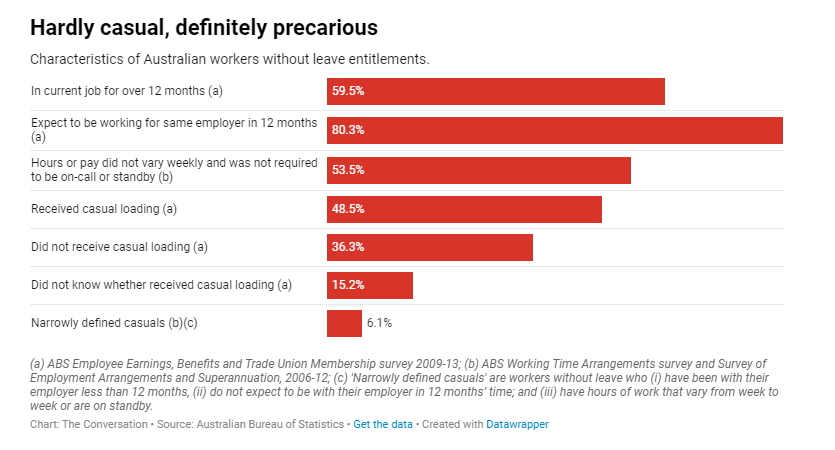
    This problem is that most “casual” workers aren’t really casual at all — as shown by analysis that I and colleague Robyn May did, using unpublished data from the Australian Bureau of Statistics (ABS).

    The premise for hiring them is that the work is intermittent, short-term and unpredictable. But, as you can see from the chart, the last time the ABS collected these data, a majority of “casuals” worked regular hours.

    Almost 60% of “casuals” had been in the job for more than a year. About 80% expected to still be there in a year’s time.

    Only 6% of “casuals” (1.5% of employees) worked varying hours (or were on standby), had been with their employer for a short time, and expected to be there for a short time.

    Even now, some “casuals” have been doing the same “casual” work for over 20 years.

    Permanent ‘casuals’

    All this has led to a class of “permanent casuals” – a nonsense term. They should more accurately be called “permanently insecure”.

    The one thing “casuals” have in common is they’re not entitled to sick leave or annual leave, and they are in a precarious employment situation. Their contract of employment only lasts till the end of their work day.

    That means they have much less power than other workers. So little power, in fact, that barely half of them even get the casual loading they are meant to be paid in compensation for not receiving other entitlements.

    On average, low-paid “casuals” get less pay than equivalent permanent workers, despite the loading.

    Changing legal definitions

    Not many “casuals” have been brave enough to challenge this exploitative relationship. But when they did a few years ago, Australia’s courts agreed permanent casual work was nonsensical.

    To be a “casual worker”, there had to be no promise of ongoing employment. A court would judge this not just by what was in the formal contract of employment but also by what the employer actually did. If they kept hiring you, week after week, on a predictable roster, you weren’t casual.

    In 2018, mine worker Paul Skene challenged his classification as a casual worker, arguing he had done pretty much the same work, with a few changes along the way, for five years.

    The Federal Court agreed he wasn’t a casual employee and should be back-paid annual leave. Another mine worker, Robert Rossato, had a similar victory in 2020.

    Employer organisations were “outraged” by the “billions” in back pay they could be forced to pay for having misclassified ongoing workers as casuals. They lobbied the Morrison government to amend the law, and challenged the rulings in the High Court.

    The Morrison government changed the law in early 2021, to give primacy to the written contract, ignore employer behaviour, and protect employers from back-pay claims.

    Later that year the High Court overturned the Federal Court decisions, ruling it was the written employment contract that mattered. If that was worded a certain way, you couldn’t test whether a worker was “casual” by whether the employer treated them that way afterwards.

    Labor promised to overturn these interpretations, and that’s what this proposal does.

    What will the legislation change?

    The details of the government’s plan is still not clear, but it is likely it will seek to amend the Fair Work Act to revert to something close to the pre-2020 definition of casual work, with a procedural twist.

    It will again be possible to judge whether an employee is “casual” based on employer behaviour. And an employee who repeatedly works a similar roster can, after six months, demand “permanency” – meaning rights to sick leave, annual leave, and better protection against arbitrary sacking.

    The twist: until they demanded “permanency” they won’t be entitled to any leave. So employers will be protected against claims for back pay.

    Theoretically this could affect hundreds of thousands of “casual” workers. In reality, it will likely help far fewer.

    Suppose you’re a “casual” labour hire worker in mining. You can tell what time you’ll start work on the first Friday next June. You go to your employer — the labour hire company — and say: “Make me permanent.” The labour hire company says: “We can’t. You might not have a job tomorrow.”

    And indeed, now that you’ve asked, maybe you won’t have a job. So would you really ask?

    It will depend critically on the protections offered to workers who ask to convert, and how credible they are to workers.

    Most people only expect a few people to make the demand. Workplace relations minister Tony Burke says he believes only a “very small proportion” of “casuals” working regular shifts will do so.

    Part of that reluctance will be fear of the consequences, and part of it will be that many casuals rely on their casual loading. About half of “casuals” are on the award minimum rate, compared with 15% of “permanent” full-time workers. Most cannot afford to “choose” to trade the money for holidays and other entitlements.

    If you’re not getting the casual loading, you’ve got nothing to lose — except your job. If the power imbalance means you don’t get the loading, you won’t fancy your chances.

    So, it will just work for a small number or workers – though it’s likely to be very important to them.

    More needs to be done

    In short, this is a good step but more needs to be done.

    In most other wealthy countries all workers – including temporary workers – are entitled to annual leave. That’s not the case in Australia, because of the “casual” ruse. These laws will not change that.

    There should be universal leave entitlements. Sure, there needs to be a loading where work is unpredictable, and hence so short-term that leave entitlements would not be practical.

    But everyone else should get annual and sick leave, and minimum award wages should be high enough that low-wage workers don’t have to rely on the casual loading to get by.

    The challenge should be about how we transition to that situation.

    The post We need more than a definition change to fix Australia’s culture of permanent ‘casual’ work appeared first on The Australia Institute's Centre for Future Work.

  • Inflation is falling so let’s make sure we don’t let unemployment rise

    The latest quarterly CPI figures showed that inflation is falling dramatically and in line with that of other major economies such as the USA and Canada. This, Chief Economist, Greg Jericho writes means we have a prime opportunity to lock in the current level of low unemployment.

    Through the past year of the Reserve Bank raising interest rates, the main justification has been that the economy needs to be slowed in order to bring down demand pressures on inflation.

    What the latest figures reinforce however is that the major pressures have come from the supply side. Australia’s inflation is essentially following the same path as other nations. This is because inflation is slowing largely due to reduced world prices of commodities rather than any response to increasing interest rates.

    Indeed the largest driver of inflation in the June quarter was rental prices, which will have been in part due to investors raising their prices to deal with higher mortgage payments.

    In the past year, unemployment has remained at 3.5% while inflation has gone from 6.7% up to 8.4% and now down to 5.4% (using the monthly measures). The belief that we needed to raise unemployment to 4.5% in order to stop inflation from accelerating is a cruel approach that treats inflation in the wrong way.

    Fortunately, in spite of the RBA’s best efforts, unemployment has not yet risen. This presents Australia with a genuine chance to lock in historically low unemployment as the norm.

    Rather than pursuing higher unemployment in order to reduce inflation the RBA and the government should be pursuing policies that keep unemployment low while also reducing inflationary pressure. This can mean a price cap on essential items such as rents and energy, introducing windfall-profits taxes, and increased public housing investment to reduce housing price surges.

    Interest rates are not the only way to tackle inflation and in an environment where profits are been driven by supply-side issues and profits they are one of the worst ways.

    Full employment needs to be the target, not a mythical “non-accelerating inflation rate of unemployment” that largely justifies higher unemployment and more ho0usyheold living in poverty.

    The post Inflation is falling so let’s make sure we don’t let unemployment rise appeared first on The Australia Institute's Centre for Future Work.

  • Hollywood actors showing that unity is strength

    When workers are united and able to collectively bargain, they can win good outcomes.

  • Public Attitudes on Issues in Higher Education

    This report, by Senior Economist Eliza Littleton, combines data from the Department of Education, the OECD, and original survey data from a national poll conducted by the Centre for Future Work to draw attention to key challenges facing public universities today. The Federal Government’s new ‘Universities Accord’ creates an important opportunity to address these challenges and put higher education back on a better path.

    The post Public Attitudes on Issues in Higher Education appeared first on The Australia Institute's Centre for Future Work.