Tag: Economics

  • Secret Weapon Overlooked in Fight Against Financial Misconduct

    The Centre for Future Work has proposed to the Commission that a system of sector-wide collective bargaining in the financial industry could establish clear and ethical benchmarks for compensation, avoiding the problem of ‘conflicted remuneration’, which is behind much of the misconduct the Royal Commission has exposed.

    The Centre for Future Work’s submission to the Royal Commission proposes a uniform compensation system, to apply across the whole industry, consistent with the principles of ethical banking:

    • Uniform compensation can be achieved via a sector-wide collective bargaining system, in which employer and union representatives negotiate standard compensation patterns to apply to all participants across the industry.
    • Compensation in each job to be tied to qualifications and experience; separate pay grids could be specified in various branches of finance (including major banks, insurance, superannuation, and financial advice).
    • Clear and enforceable limits on sales- or revenue-based incentives would be specified – eliminating what the Royal Commission has confirmed is a key motivation for misconduct.
    • Instead of depending solely on government regulators to stop misconduct, enforcement of compensation standards would become part of the regular administration of the collective agreement.

    “At present, flawed pay systems create perverse incentives for banks and brokers to push debt, insurance, and financial services to Australians,” says Dr. Jim Stanford, Director of the Centre for Future Work.

    “Financial professionals can reap tens or hundreds of thousands of dollars in commissions, bonuses and so-called ‘introducing’ fees; top executives pocket millions.

    “It is inevitable that these incentives lead sales staff and executives to sidestep or ignore basic rules and standards such as ‘know your client’ rules, fee transparency and responsible lending.

    “Consumers, many of them vulnerable, end up with expensive commitments they don’t need or – in many cases – even understand.

    “Under a sectoral agreement, hundreds of managers, union officials and delegates throughout the financial industry would be responsible for enforcing the ethical pay practices spelled out in the agreement.

    “Unfortunately, Australia’s current restrictive industrial relations laws generally prohibit collective bargaining on a multi-firm or sector-wide basis.

    “These restrictions are unusual. Most industrial countries permit, and even encourage, multi-firm, pattern, or industry-wide bargaining as an efficient way to determine consistent benchmarks for pay and conditions, and ensure that ongoing economic and productivity growth translates into rising living standards.”

    The Centre’s submission argues these restrictions on sector-wide bargaining should be reconsidered in light of the pervasive pattern of financial misconduct – and the key role of perverse compensation systems in motivating that misconduct.

    “Sectoral collective bargaining could help reform compensation and reduce financial misconduct on a uniform, industry-wide basis,” Stanford said.

    “The Royal Commission should explore standardised sector-wide collective agreements as a promising response to the problems it has documented, and the Commonwealth Government should eliminate its unusual restrictions on collective bargaining to allow this important reform.”

    The post Secret Weapon Overlooked in Fight Against Financial Misconduct appeared first on The Australia Institute's Centre for Future Work.
  • Permanent Casuals, and Other Oxymorons

    Here is a commentary from Jim Stanford, Director of the Centre for Future Work, discussing the implications of these decisions for the mis-use of casual work. The commentary was originally published on the Ten Daily website.

    Time to rethink reliance on casual work

    Casual work has become a pervasive feature of Australia’s labour market. Until the 1990s, almost all workers, even part-timers, had permanent jobs with reasonably predictable schedules and access to normal work-related entitlements (like paid holidays and sick time). But then employers became obsessed with achieving “flexibility” in hiring. Flexibility sounds like a good thing, but in practice it meant granting employers more freedom to disemploy their workers, with no notice and no severance costs. The downside for workers is lack of certainty in rostering, poor job security, and no access to paid leave. That makes it impossible to make major purchases, plan child care, or take family holidays.

    At last count, around 25 percent of paid employees in Australia (or over 2.5 million workers) were employed on a casual basis. The incidence of casual work has grown noticeably since 2012, when the mining investment boom ended and the overall labour market weakened. Casual work has grown fastest in full-time positions, and among male workers. For young workers (under 25), casual work is especially ubiquitous: 55 percent work casual. OECD data indicates that Australia now has the highest incidence of temporary work of any industrial country.

    Because it is so common, casual work has become “normalised” in the eyes of employers and policy-makers. For example, Craig Laundy, former Commonwealth Minister for the Workplace, endorsed casual work enthusiastically this year, saying it is “a completely appropriate way for many businesses and many employees to conduct their relationship.” Even business lobbyists admit that most casual staff actually work regular and predictable schedules.

    With this normalisation, many industries in Australia now rely on casual work as a permanent, core feature. Instead of using casual workers to meet temporary or seasonal fluctuations in demand, thousands of employers tap a permanent pool of casual workers to meet ongoing staffing requirements. Workers can be stuck on casual status even if they work regular shifts, for years at a time.

    In theory, employers pay a price for this super-flexibility: Australia’s casual loading rules require a 25 percent wage penalty to be paid to casual workers: compensation for lack of access to paid sick leave and holidays, and for the insecurity and instability attached to casual work. In practice, many employers do not pay this wage premium – effectively “hiding it” in lower base wages, or else evading it entirely (especially for young and foreign workers who do not understand the rules). But even if they do pay casual loading, employers should be prevented from abusing casual work as is now commonplace. After all, the inherent insecurity of casual work imposes a cost on workers and their families – a cost that grows if that insecurity is permanent.

    A series of recent legal decisions, however, is now challenging the assumption that casual work can be normal, legitimate and universal. Three particularly important cases could force employers to rethink their reliance on casual staffing:

    • A Federal Court judgment has ordered a labour hire company to pay retroactive annual leave to a mine driver who worked casual for several years, even though he was assigned to regular shifts. Employers complain this ruling somehow amounts to “double-dipping:” they claim that paying the 25 percent casual loading somehow entitles employers to deny paid holidays and other normal rights, even to long-term staff. That assumption has now been refuted.
    • The Fair Work Commission has decided to harmonise evening and Saturday penalty rates between casual and permanent workers in the retail sector. Until now, casuals were denied penalties of up to 25 percent of base wages for those shifts, compared to permanent workers. Now the penalties for casual workers will be raised to the same level as for permanent staff (although, perversely, the Commission is also in the process of cutting penalty rates for all workers on Sundays and holidays).
    • Another Fair Work Commission ruling affecting 85 different modern awards affirmed the right of casual staff to request conversion to permanent status after working regular shifts for a year. Employers can turn down those requests, but only if they would result in major changes in the applicant’s hours of work, or are otherwise “unreasonable.”

    Employers are pushing back hard against these precedents – and they seem to have the ear of the federal government. Business lobbyists predict billions in back payments arising from the annual leave decision, and are demanding legislative changes to avoid those costs. Kelly O’Dwyer, Minister for Jobs and Industrial Relations, has promised to investigate the idea. Some business groups are even proposing a brand new category of “perma-flexi” workers, who would receive a (smaller) wage loading for accepting casual status for years at a time. Anxious to preserve this highly profitable staffing practice, business leaders seem oblivious to the oxymoron inherent in their proposal for permanent casual work.

    Business complaints about the costs of treating casual workers fairly ring hollow. The 25 percent casual loading system was never intended as a carte blanche: that is, a kind of “permit” that granted employers permission to keep workers in perpetual insecurity, denied access to basic security and regular entitlements. Employers who used casual workers only where originally intended – that is, in temporary or irregular shifts – can continue to do so without significant extra costs.

    However, while promising, these recent decisions do not fully address the misuse of casual work. Casual workers should have broader options to convert to permanent status after shorter periods (say, six months) in a regular position. And the application of casual employment rules (which deny termination pay and notice of dismissal to workers, as well as access to paid leave) should be restricted to carefully-defined and genuine situations of temporary or volatile demand.

    Nevertheless, these recent decisions are an important recognition that employers have been abusing this form of employment. And they are a wake-up call to employers, who should now think hard about reducing their reliance on casual staffing – and get back to creating steady jobs that workers (and their families) can count on.

    The post “Permanent Casuals,” and Other Oxymorons appeared first on The Australia Institute's Centre for Future Work.

  • Infographic: The Shrinking Labour Share of GDP and Average Wages

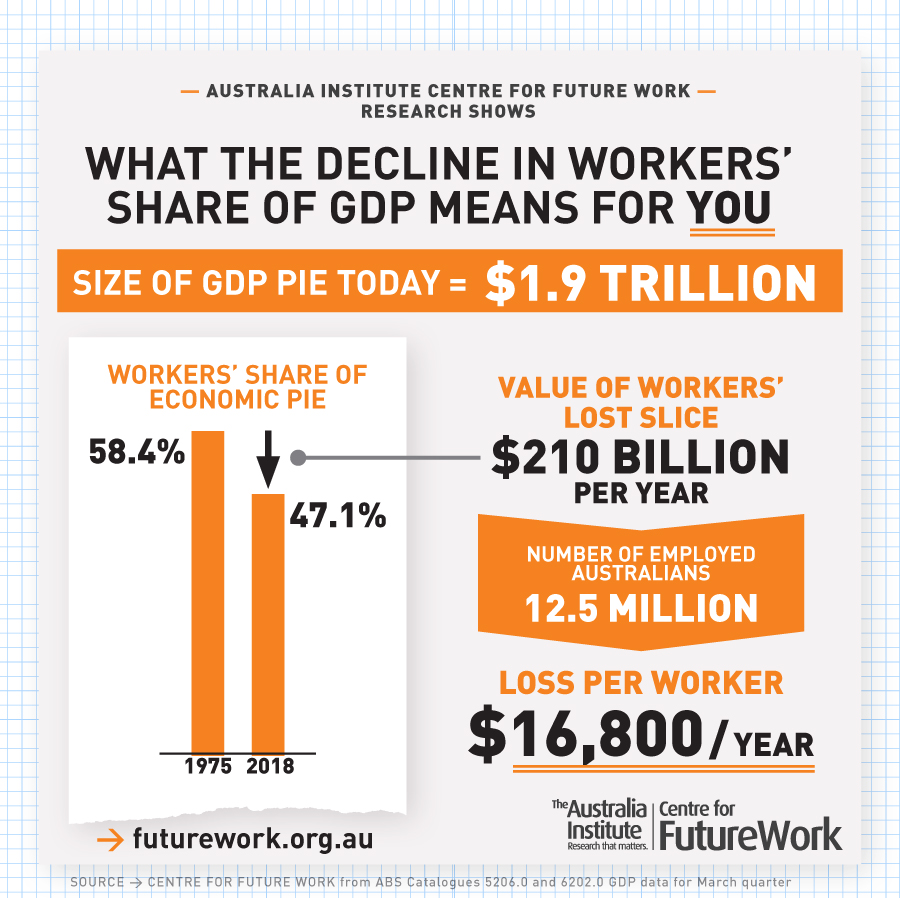
    This infographic summarises the bottom-line impact on average wage incomes for Australian workers.

    Labour Share Infographic

    In the March quarter of 2018, labour income (in wages, salaries, and superannuation contributions) accounted for 47.1% of total GDP. That is down over 11 percentage points from the peak labour share (over 58%) recorded in the same quarter of 1975. The loss of that share of GDP, given total output today, is equivalent to a redirection of some $210 billion in annual income – and the research symposium showed that almost all of that income was captured in the form of higher company profits (especially in the financial sector). If it were divided equally amongst all employed Australians, that lost income share translates into foregone income of close to $17,000 per worker.

    Many thanks to Anna Chang for her creative work on the infographic!

    The research symposium highlighted several factors that have caused the long-run shift in income distribution from workers to the business sector, and resulting growth in personal income inequality in Australia. Key factors included the erosion of union representation and collective bargaining, inadequate minimum wages, and the growing power of the financial sector.  For more details, see the articles by Jim Stanford, David Peetz, Margaret Mackenzie, Shaun Wilson, and Frances Flanagan.

    The post Infographic: The Shrinking Labour Share of GDP and Average Wages appeared first on The Australia Institute's Centre for Future Work.

  • Four Views on Basic Income, Job Guarantees, and the Future of Work

    The unprecedented insecurity of work in Australia’s economy – with the labour market buffeted by technology, globalisation, and new digital business models – has sparked big thinking about policies for addressing this insecurity and enhancing the incomes and well-being of working people. Two ideas which have generated much discussion and debate are proposals for a basic income (through which all adults would receive an unconditional minimum level of income whether they were employed or not) and a job guarantee (whereby government would ensure that every willing worker could be employed in some job, such as public works or public services, thus eliminating involuntary unemployment).

    Progressives have campaigned for generations for stronger income security programs and for a commitment to full employment by government. So these ideas have a long pedigree. However, there is great discussion over both the implementation and cost of these proposals, and their broader (and perhaps unintended) economic and political consequences.

    To shed some additional, constructive perspective on these proposals, we are pleased to present four short commentaries on basic income, job guarantees, and the future of work by four leading Australian experts on the economics and politics of work.

    The four commentaries are posted below in alphabetical order of their authors:

    • Dr. Frances Flanagan, Research Director, United Voice: The Policy and Politics of Basic Income: A Few Concerns
    • Troy Henderson, Economist, Centre for Future Work: Situating Basic Income and a Job Guarantee in a Hierarchy of Pragmatic-Utopian Reform
    • Dr. Ben Spies-Butcher, Dept. of Sociology, Macquarie University: Basic Income as a Progressive Priority
    • Dr. Jim Stanford, Economist and Director, Centre for Future Work: Work, Technology, and Basic Income: Issues to Consider

    Three of the commentaries (by Flanagan, Henderson, and Spies-Butcher) were initially presented to the recent “Reboot the Future” conference in Sydney, hosted by Greens NSW Political Education Trust. The authors expanded and edited their remarks for the purposes of this symposium. We thank the organisers for their cooperation. The fourth commentary (by Stanford) arose from recent discussions within the Centre for Future Work’s voluntary Advisory Committee. Together, we think these nuanced commentaries add valuable perspective to these important but complex policy debates.

    Our publication of these commentaries coincides with this week’s annual General Assembly of the Basic Income Earth Network (BIEN), being held this year at the University of Tampere in Finland. In a personal capacity, Centre for Future Work economist Troy Henderson is presenting at the Assembly on his Ph.D. research regarding the fiscal and labour market impacts of basic income.

    We will continue to consider the advantages and disadvantages of both these important policy proposals in future research and commentary. We thank the authors for their contributions to this discussion, and welcome further feedback!

    The post Four Views on Basic Income, Job Guarantees, and the Future of Work appeared first on The Australia Institute's Centre for Future Work.

  • Workers’ slice of Australian economic pie gets smaller

    The Australia Institute’s Centre for Future Work has today published a new research symposium documenting how workers’ slice of the national economic pie continues to get smaller.

    Key findings:

    • From peak levels of 58 per cent of GDP in the mid-1970s labour compensation — including wages, salaries, and superannuation contributions — declined to just 47 percent in 2017, their lowest level since 1960.
    • Real wages have consistently lagged behind the ongoing growth in labour productivity, meaning workers are not getting paid enough to buy back the goods and services they produce.
    • The loss of labour’s share of GDP translates into the redirection of over $200 billion in income per year from workers to other groups in society (mostly corporations).

    “In recent years, wages have barely kept up with consumer price inflation – and for many workers, they have fallen behind,” said Dr. Jim Stanford, Director of the Centre for Future Work.

    “The fact that the workers’ slice of the economic pie continues to get smaller speaks volumes about the lopsided power imbalance in today’s labour market.

    “The decline in Australia’s labour share from the 1970s peak to the present, ranks among the worst of all OECD countries, even worse than the United States.

    “Almost the entire decline in the labour share has been reflected in a corresponding increase in the share of GDP going to corporate profits – especially the financial sector.

    “In short, while the workers’ share has continued to get smaller, the share of corporate profits has continued to get larger.

    “By comparison, in some countries the labour share has been stable or rose during the same period, disproving the claim that this trend is somehow ‘universal’ or ‘inevitable’.

    “Without urgent measures to strengthen labour standards and protections, including stronger minimum wages and a restoration of meaningful collective bargaining, this decline will almost certainly continue.

    “The company tax cuts for big business now being proposed by the federal government are just the icing on top of an already-rich cake.”

    This research resulted from a special panel of experts convened by the Centre for Future Work, at the Society for Heterodox Economists conference at UNSW in Sydney last December. The papers from that panel have been peer-reviewed, and are published this week in the Journal of Australian Political Economy.

    Authors contributing to the symposium include Dr.David Peetz (Griffith University), Dr. Shaun Wilson (Macquarie University), Dr. Margaret Mackenzie (Economist, Australian Council of Trade Unions), and Dr. Jim Stanford (Economist and Director of the Centre for Future Work).

    The post Workers’ slice of Australian economic pie gets smaller appeared first on The Australia Institute's Centre for Future Work.

  • Possibly Surprising Insights on the Future of Work

    His presentation was “5 Possibly Surprising Insights on the Future of Work”.

    More detail on the issues raised in his presentation is provided in the Centre’s recent submission to the Senate Inquiry on the Future of Work and the Future of Workers.

    The post Possibly Surprising Insights on the Future of Work appeared first on The Australia Institute's Centre for Future Work.

  • Centre for Future Work at ACTUCongress18

    Come and check out our information booth in the exhibitors’ area: meet our staff, learn more about our work, and sign up for updates.

    Our Director Jim Stanford will be presenting as part of a session on The Future of Work (good title!), Tuesday July 17 at 2:15 pm in conference room P1.

    And we will be distributing copies of a brochure with links to some of our most recent research (attached below).

    We are glad that our research can support the campaign to #ChangeTheRules!

    The post Centre for Future Work at #ACTUCongress18 appeared first on The Australia Institute's Centre for Future Work.

  • Penalty rate cuts fail to ignite jobs boom

    A new report from The Australia Institute’s Centre for Future Work examined employment and working hours in the retail and hospitality industries in the year since penalty rates were first cut.

    The report found, since the initial penalty rate reduction imposed by the Fair Work Commission on 1 July 2017:

    • The retail sector in particular performed very badly relative to the rest of the economy.
    • Total employment was unchanged in the year ending in May 2018, continuing a long-term trend of employment stagnation.
    • Full-time employment declined by 50,000 positions.
    • Average weekly hours of work declined by more than a full hour, and the underemployment ratio (share of workers who want more hours) grew almost 2 percentage points.
    • The hospitality sector (accommodation and food services) experienced similar results, including weak job-creation, a loss of full-time employment, shorter average hours of work, and higher underemployment.

    “Far from experiencing a jobs boom, the retail and hospitality sectors have significantly underperformed the rest of the economy in terms of both hiring and working hours,” says Dr. Jim Stanford, Director of the Centre for Future Work.

    “Most industries where penalty rates were unchanged did far better at job-creation than the two sectors where penalty rates were cut.

    “Employer representatives argued that reducing labour costs for work on Sundays and holidays would spur a big expansion in employment, one group even predicted 40,000 new jobs. Our report found that was simply not the case.

    “Based on a number of criteria, the retail and hospitality sectors performed among the worst of any Australian industries in the year since penalty rates were first cut.

    “While lower penalty rates are not the cause of the poor performance, our research certainly disproves inflated claims by employers and government that cutting labour costs would unleash a jobs boom.

    “If we really want more jobs, we should boost wages, improve job security, and strengthen purchasing power throughout the economy. Cutting penalty rates does the opposite.”

    The post Penalty rate cuts fail to ignite jobs boom appeared first on The Australia Institute's Centre for Future Work.

  • Manufacturing Rebound Could Be Cut Short By Skills Shortage

    The new report from the Centre for Future Work identifies key factors behind the rapid emergence of skills shortages in manufacturing, including:

    • The sector’s ageing workforce, creating a looming demographic transition for skilled worker
    • The highly specific nature of manufacturing skills (across sectors and occupations), creating difficulty for workers moving from between shrinking sectors to growing sectors
    • The need for new skills and ongoing training as companies adopt advanced manufacturing techniques and new digital technologies.

    “Manufacturing is again making a positive contribution to Australia’s economic progress after over a decade of decline. We don’t want to squander this potential,” said Dr. Jim Stanford, Director of the Centre for Future Work.

    “If Australia doesn’t get its act together on vocational training, this will be a wasted opportunity for manufacturing.

    “Recent experiments with market-based vocational training have been a waste, they have damaged confidence in the skills system among both potential students and employers.

    “Stable, well-funded, high-quality public institutions must be the anchors of any successful VET system.

    “Public institutions are the only ones with the resources, the connections, and the stability to provide manufacturers with a steady supply of world-class skilled workers.

    “No sector feels the pain of the failure of vocational training more than manufacturing, precisely because advanced skills are so essential for the success of advanced manufacturing techniques.

    “Manufacturing stakeholders need to work together to strengthen vocational education and training.”

    Key principles for rebuilding vocational education in manufacturing, discussed in the report, include:

    • A greater reliance on courses and apprenticeships through public-sector TAFE (rather than private providers)
    • Phased-in retirement programs to allow senior workers to pass on their skills to new apprentices
    • Inclusion of provisions guaranteeing access to further training in industry awards and enterprise agreements.

    The report was co-authored by Dr. Jim Stanford and Dr. Tanya Carney and prepared for the Second Annual National Manufacturing Summit at Parliament House on 26 June 2018.

    The National Manufacturing Summit engages leading representatives from all parts of Australian manufacturing: businesses, peak bodies, unions, universities, the financial sector, suppliers and government. The growing problem of skills shortages is a priority focus for this year’s Summit.

    The post Manufacturing Rebound Could Be Cut Short By Skills Shortage appeared first on The Australia Institute's Centre for Future Work.

  • Advanced Skills for Advanced Manufacturing

    Australia’s manufacturing industry is at a crossroads. After years of decline, the sector has finally found a more stable economic footing, and many indicators point to an expansion in domestic manufacturing in the coming years. Manufacturing added almost 50,000 new jobs in the last year – making it one of the most important sources of new work in the whole economy.

    However, one key factor that could hold back that continuing recovery is the inability of Australia’s present vocational education and training system, damaged by years of underfunding and failed policy experimentation, to meet the needs of manufacturing for highly-skilled workers. The skills challenge facing manufacturing is all the more acute because of the transformation of the sector toward more specialised and disaggregated advanced manufacturing processes. This naturally implies greater demand for highly-trained workers, in all its occupations: production workers, licensed trades, technology specialists, and managers.

    To sustain the emerging turnaround in manufacturing, the sector has an urgent need for a concerted and cooperative effort to strengthen vocational education and training. This report contributes to that process: by cataloguing the emerging skills challenges facing manufacturing, reviewing the failures of the existing approach to vocational education in this sector (and across Australia’s economy as a whole), and proposing twelve key principles for reform.

    This report, by Dr. Tanya Carney and Dr. Jim Stanford, was prepared by the Centre for Future Work for the Second Annual National Manufacturing Summit. The Summit, held at Parliament House on 26 June 2018, will gather leading representatives from all major stakeholders in Australia’s manufacturing sector: business, unions, universities, the financial sector, suppliers and government. They will consider the industry’s prospects and identify promising, pragmatic policy measures to support a sustained industrial turnaround. It is a highly appropriate forum at which to begin a discussion about multi-partite efforts to rebuild vocational education and address the looming skills challenges facing manufacturing.

    The post Advanced Skills for Advanced Manufacturing appeared first on The Australia Institute's Centre for Future Work.