Tag: Economics

  • The Year Past, and the Year to Come

    Workforce (a labour relations bulletin published by Thomson-Reuters) recently surveyed major IR figures in Australia on what they saw as the big issues in 2018, and what they expect as the major talking points for 2019. Jim Stanford, economist and Centre for Future Work director, was one of those surveyed, and here are his remarks.

    What was the most important issue or event in industrial relations this year?

    I would choose the union movement’s “Change the Rules” campaign, which really gathered focus and momentum as the year went on. Of course, unions have been dissatisfied with the state of labour laws, and the erosion of labour rights, for years. But this year, together with other community advocates, they have built a very effective and focused advocacy campaign that I think will have a major impact on labour policy in Australia. Examples of its potential include the big rallies held in Melbourne and other cities in October; the important role that the union movement’s independent door-knocking and phone-banking campaign played in the expanded majority won by the Daniel Andrews govt in Victoria; and the generally high profile of news and debates around the issues of wages and workplace fairness in the media and public commentary.

    The current atmosphere is very reminiscent of the “Your Rights at Work” initiative that the ACTU and its affiliates organised in 2006-07 – and that ended up making a significant difference in the 2007 election (when John Howard lost his seat).

    There is a qualitative difference in this incarnation of the union movement’s organising, however: while union activists obviously are hoping to influence the results of the next election, they are self-consciously and explicitly planning on a longer-run effort to shift public opinion regarding core issues of work and fairness.

    Their agenda of proposed reforms would take several years to implement: including lifting the minimum wage to a “living wage” level, modernising labour laws (so Uber drivers and other gig workers would be protected), changing the structure of enterprise bargaining to allow multi-firm and industry-wide bargaining, and more.

    And they are advancing that agenda as an independent campaign, not as an arm of the Labor party. That positions them well to continue to advance the debate after the election … whoever wins.

    By carefully focusing its energies, building a strong “boots on the ground” infrastructure in communities (including crucial marginal electorates), and building strong public support for the core values underpinning the campaign (tapping into continuing Australian faith in fairness), I think this movement will reshape both public opinion about work and wages, as well as Australia’s labour policy framework.

    What are you most/least looking forward to in 2019?

    There will be a Commonwealth election sometime during the first half of 2019 (perhaps sooner rather than later, if the current disarray in Canberra is any indication).

    I look forward to seeing labour issues – and in particular, the stagnation of wages in Australia, and the growing gap between Australia’s egalitarian tradition and the grim economic reality that most workers presently face – feature as one of the top three issues in the campaign. Most workers have had no increase in real wages over the past five years; millions have fallen behind (especially given escalating prices for housing and other essentials). The present govt knows that this festering economic frustration issue could be very damaging.

    There’s an opportunity in Australia right now to move the needle: imagine a modernised approach to labour policy: including labour standards that adapt to ongoing change in the economy (like gig jobs), a more ambitious crack-down on wage theft and other illegal practices, and a revitalisation of Australia’s commitment to a ‘fair go.’

    However, I am not looking forward to the rolling out of some pretty tired warnings and threats about how modernising labour laws and addressing inequality will somehow threaten Australia’s economic viability.

    We can expect many dire threats about how the proposals for reform will drag Australia back to the “bad old 1970s” – a time, interestingly, when GDP growth, job-creation, productivity growth, and real wage growth were all significantly superior to the current era.

    This rhetoric ignores the growing consensus among economists that more equality actually strengthens economic performance – by supporting consumer spending and aggregate demand, avoiding the economic, fiscal and social costs of exclusion and inequality, and boosting govt revenues.

    The doomsday prophecies we can expect to hear from the usual suspects should be understood as the last gasps of a vision of trickle-down economic policy that has lost its credibility, in Australia and around the world.

    The post The Year Past, and the Year to Come appeared first on The Australia Institute's Centre for Future Work.
  • Industry-Wide Bargaining Good for Efficiency, as Well as Equity

    In this commentary, Centre for Future Work Associate Dr. Anis Chowdhury discusses the economic benefits of industry-wide collective bargaining. In addition to supporting wage growth, industry-wide wage agreements generate significant efficiency benefits, by pressuring lagging firms to improve their innovation and productivity performance. The experience of other countries (such as Germany and Singapore) suggests that this system promotes greater efficiency, as well as equity — although other wealth-sharing policies are also needed.

    Dr. Chowdhury’s full comment is posted below.

    INDUSTRY-WIDE BARGAINING CAN BOOST EFFICIENCY AS WELL AS WAGES

    by Dr. Anis Chowdhury

    In an effort to reverse long-term wage stagnation, the ACTU is calling for an end to current industrial rules which effectively prohibit sector- or industry-wide wage bargaining. Predictably, the business community is opposed. Australian Industry Group chief executive, Innes Willox, said, “The ACTU’s latest proposals would destroy jobs and the competitiveness of Australian businesses…If the ACTU got its way, unions would be able to make unreasonable claims and cripple whole industries and supply chains until employers capitulated.”

    No doubt, the issue will be a hot topic in the upcoming Federal Elections. The Labor Party conference is debating the ACTU’s call. And the Liberal-National Coalition will surely accuse Labor of capitulating to the vested interest of the union movement.

    Mr. Willox’s claim that the sector-wide wage bargaining would destroy jobs and Australia’s competitiveness has no basis. A powerful example is provided by Germany, Europe’s strongest economy. In Germany, wages, hours, and other aspects of working conditions are decided by unions, work councils (organisations complementing unions by representing workers at the firm level in negotiations), and employers’ associations. Collective wage bargaining takes place not at the company or enterprise level but at the industry and regional levels, between unions and employers’ associations. If a company recognises the trade union, all of its workers are effectively covered by the union contract.

    Yet, Germany’s competitiveness did not decline. On the contrary, Germany experiences both strong productivity growth and strong wage growth. Despite ongoing real wage improvements, unit labour costs are stable or even declining – further enhancing Germany’s competitiveness.

    How is this possible? The answer was given by more than half a century ago by two leading Australian academics – WEG Salter and Eric Russel. By de-linking productivity-based wage increases at the enterprise level and adhering to the industry-wide average productivity-based wage increases, an industry bargaining system raises relative unit labour costs of firms with below-industry-average productivity, thereby forcing them to improve their productivity or else exit the industry. At the same time, firms with above-industry-average productivity enjoy lower unit labour costs, hence higher profit rates for reinvestment. Singapore also used this approach to restructure its industry in the 1980s towards higher value-added activities, with great success.

    Trying to compete on the basis of low wages is a recipe for failure. As a matter of fact, low-wage countries typically demonstrate lower productivity; and research by a leading French economist, Edmond Malinvaud, showed that a reduction in the wage rates has a depressing effect on capital intensity. Salter’s research implies that the availability of a growing pool of low paid workers makes firms complacent with regard to innovation and technological or skill upgrading. Other researchers show that under-paid labour provides a way for inefficient producers and obsolete technologies to survive. Firms become caught in a low-level productivity trap from which they have little incentive to escape – a form of Gresham’s Law’ whereby bad labour standards drive out good. The discipline imposed on all firms as a result of negotiated industry-wide wage increases forces all of them to innovate and become more efficient.

    So, sector-wide wage bargaining is good for the economy: favouring efficient firms, stimulating investment, and lifting wages. Of course, industry-wide bargaining alone cannot solve all the problems of wage inequity or wage stagnation. It must be part of a broader suite of policy measures, to provide all-round support for greater equality and inclusive prosperity.

    In particular, we must address the system that produces sky-rocketing executive pays at the expense of workers. A lower marginal tax rate is one of the incentives for the executives to pay themselves heftily, while tax cuts are not found to boost growth or employment. Share options for CEOs, which encourage job cuts and discourage re-investment, also must be reined in. If anything that is making the Australian economy vulnerable, is growing economic disparity between self-serving executive compensation and stagnant wages for the rest of the population.

    Reforms also need to address the macroeconomic policy paradigm, where fiscal policy is focused on creating needless budget surpluses by cutting social services and public infrastructure investment. Meanwhile, monetary policy is focused on a pre-determined inflation target regardless of the economic cycle. All of this stifles economic growth prospects and increases job insecurity – both of which are detrimental for wage recovery.

    The post Industry-Wide Bargaining Good for Efficiency, as Well as Equity appeared first on The Australia Institute's Centre for Future Work.

  • On the Brink: Erosion of Enterprise Agreement Coverage

    The report shows that the number of current enterprise agreements in private Australian businesses has collapsed by 46% since the end of 2013. The number of private sector workers covered by enterprise agreements has plunged 34% in the same time. In 2017, just 12% of employed private sector workers were covered by an enterprise agreement – down from 19% in 2013.

    If current trends in renewals, new agreements, and terminations continue, less than 1800 agreements would survive to 2030, at which point just 2% of private sector workers would be covered by a collective agreement.

    The dramatic downturn in collective bargaining in Australian businesses reflects a number of simultaneous trends, creating a ‘perfect storm’ that jeopardises the future of private sector bargaining. These trends include a drop-off of renewals of expired enterprise agreements; the dramatic decline in the number of newly negotiated agreements; and a surge in terminations of agreements.

    “It is no exaggeration to conclude that collective bargaining in private businesses will go extinct in coming years if these devastating trends are not reversed,” said Alison Pennington, Economist with the Centre for Future Work and author of the report.

    The report provides a forward simulation of enterprise agreement-making if current trends in renewals, new agreements, and terminations continue. The simulation indicates that the total number of private sector enterprise agreements would fall by half (to below 6000) by 2023, and the proportion of private sector workers covered by agreements would fall below 6%. Things get worse in subsequent years, with less than 1800 agreements surviving by 2030, when only 2% of private sector workers would be covered by a collective agreement – unless urgent action is taken the change existing policies and restore effective access to collective bargaining.

    “The accelerated collapse of enterprise bargaining in the private sector has been a key cause of the unprecedented weakness in wage growth experienced in Australia since 2013,” Pennington said. “When workers have no collective voice or collective bargaining power, they have no chance of successfully negotiating better wage increases from their employers.”

    The report also shows that the rapid decline in enterprise agreement coverage for private sector workers has been mirrored by a rapid increase in the proportion of workers paid according to the minimum terms of Modern Awards.

    “The evidence is overwhelming that Australia’s current system of collective bargaining is completely inadequate for representing workers in our evolving economy, with an increasingly fragmented labour market,” Pennington concluded. “A viable collective bargaining system is essential to shared prosperity, but it will require far-reaching changes to the current rules to keep collective bargaining alive.” The report proposes several broad directions for reforming current laws and practices, to stop and reverse the dramatic decline in collective agreement coverage.

    PLEASE NOTE: This posted version of the paper corrects a previous error arising from a data coding problem which resulted in an inaccurate allocation of newly approved enterprise agreements between new and renewal agreements.

    The post On the Brink appeared first on The Australia Institute's Centre for Future Work.

  • Workers’ Share of Economic Pie Shrinks Again

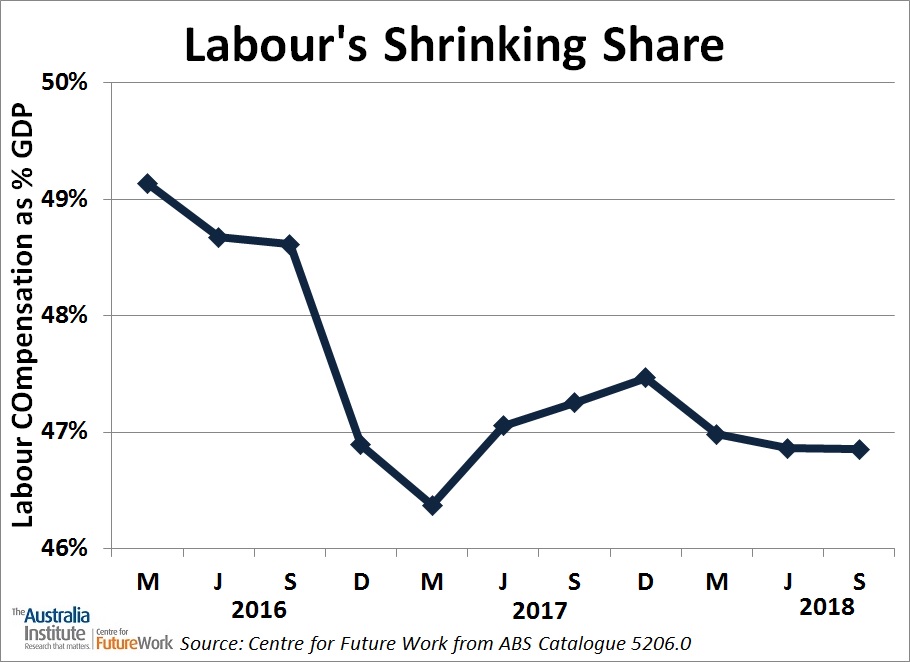
    That represents the third consecutive quarterly decline in relative labour compensation.

    Labour Share

    “A decline in the labour share of GDP indicates that workers’ wages and salaries are not keeping up with the growth of Australia’s economy,” explained Dr. Jim Stanford, Economist and Director of the Centre for Future Work. “And given that GDP growth itself was very anemic in the September quarter (expanding just 0.3%), that’s an especially weak result.”

    The labour share of GDP is now on track to set a new record low for 2018, below even last year’s average of 47.1% – which was the lowest annual average labour share recorded since the ABS began gathering modern GDP statistics in 1958.

    The weak growth of total wages reported in the GDP data was surprising, given the apparently strong increase in employment recorded over the past year. Labour compensation per employee increased by just 1.9% in the year ending in September, barely matching the increase in average consumer prices over that period. Wage growth in the private sector has been even slower.

    Despite a decline in the official unemployment rate over the past year, wages have been held back by a combination of high underemployment (workers who want more hours of work), the growing share of insecure and part-time jobs, and the erosion of traditional wage-setting institutions (including collective bargaining).

    With labour costs falling as a share of total output, profits have expanded. Corporate operating surpluses expanded by another 7.1% in the year to September, and reached their highest share of GDP (25.22%) since March, 2012.

    The Centre for Future Work reviewed the long-term decline of the labour share of Australian GDP in a recent research symposium, published in the Journal of Australian Political Economy.

    The post Workers’ Share of Economic Pie Shrinks Again appeared first on The Australia Institute's Centre for Future Work.

  • Are States Filling the Democratic Void?

    The recent Victorian election results showed Australian voters want governments to play a pro-active role delivering public services, infrastructure, improved labour standards, and sustainability. They showed that in a time of deep cynicism with federal politics, States (and Territories) can play an important role filling the democratic void left by dysfunction and policy paralysis at the Commonwealth level.

    This commentary from Alison Pennington, economist at the Centre for Future Work, explores what the energetic campaign in Victoria revealed about our unique system of dual governance and the potential for pro-active and progressive policy making. This commentary was originally published in New Matilda.

    The Victorian election: Are states filling the democratic void?

    A destructive and cynical politics is on the rise across the world with emergent right-wing populism a warning of what happens when people lose faith in political institutions.

    In Australia, the Coalition government has been characterised by ongoing austerity, the retrenchment of public resources and capability to the tune of billions of dollars, but complete paralysis on just about every other policy reform (most visibly including massive inconsistency on energy and climate policy). This has led to a democratic void in Australian society.

    Meanwhile, the recent victory of the Andrews Labor government on a bold social democratic platform of long-term investments in services, education and infrastructure projects (some with a 2050 completion date) gave Victorians a secure, positive vision of a more balanced, stable society – and voters endorsed that vision strongly.

    How is it that these two wildly different scenarios of political life can exist alongside each other?

    Many commentators have explained the Victorian election result as a mere by-product of the Coalition’s ongoing crisis (with subsequent warnings about the future of the federal Liberals). But this suggests Victorians were motivated by cynicism alone. In reality, Victorians rallied enthusiastically around a constructive, hopeful vision of State-level policy-making. Indeed, since federation, Australian communities and regions who have identified needs and desires unmet by the Commonwealth, have often turned to the state level of governance to get things done.

    The unique organisation of governance in Australia, featuring a Commonwealth composed of somewhat independent States and Territories, has preserved a realm of Australian democracy distinct from the national level of affairs. At a time of deep cynicism with federal politics, the Victorian election result shows that States can fill the democratic void left by dysfunction and tribal politics at the Commonwealth level, strengthening Australian democracy and saving it from the worst of cynical politics we see emerging elsewhere (such as Trumpism in the US).

    Where does the legitimacy of this State-based democracy come from? Despite losing (or handing over) many of their powers to the Commonwealth over time, States still retain power to administer the key public goods that Australians most value: like education, health care, civic services, and culture. These are the functions of government that people will energetically defend when they are undermined.

    While the Australian constitution allocates responsibility for big-ticket public programs like healthcare and education to the States, the Commonwealth retains powers to raise the bulk of the revenue needed to fund these expensive services. This means States operate in a contradictory financial bind: always dependent on the federal government to honour the financing of essential services that the States are constitutionally bound to provide. This gives enormous economic and political power to federal governments— a power play that has been repeated many times over Australia’s history.

    For example, a recent attempt by the Commonwealth to undermine the funding of public goods under the ‘spend within your means’ mantra was mounted in 2016, when Malcolm Turnbull and Scott Morrison tried to shift responsibility for raising revenue for public services to States. This was done without relinquishing any of the Commonwealth’s income and corporate taxation powers – all the while overseeing billions of dollars in cuts in healthcare and education in the federal Budget.

    But the constitutional and financial bind faced by State governments has gained particular significance in recent years, as decades of ‘small government’ policies wound back public services in favour of highly-subsidised private models have come to a head. Publicly-subsidised private markets in aged care, disability care, healthcare, education, VET and childcare have all been proven failures: both in the quality of services delivered, and in the standards of employment for those doing the work.

    Recent polling by the Australian Institute shows that 64 per cent of Australians want an increase in public spending funded by tax revenue from wealthy individuals and high-turnover businesses. Australians value government provision of public goods, even more than personal income tax cuts. The failure of federally-backed market experiments within spheres of life where Australians demand a proactive and productive government role, has left the political field wide open – and States are in prime strategic political terrain to fill that space.

    State action is applauded in the face of Commonwealth inaction. For instance, amidst recent turmoil in federal energy and climate policy, the Victorian, SA and ACT governments have proactively invested in renewable energy industries. And State governments in Victoria, SA, ACT and QLD have found innovative work-arounds to protect workers from new exploitative labour practices, despite the dominance of the Commonwealth in the jurisdiction of labour law: including labour hire licencing schemes, mandated minimum pay and safety conditions, and a new inquiry just launched into on-demand ‘gig’ work and its implications for the Victorian economy.

    The Victorian election results provide another clear insight into what Australians value and what they will tolerate. They confirm that Australians care about a fair society – underpinned by the public provision of healthcare and education (including a revamped TAFE sector), new infrastructure, action on renewable energy, and employment conditions that allow Australians to live a decent quality life.

    With the Andrews government’s pledges for sizeable investments in all of these endeavours ratified so strongly by voters, it shows that the failure of Commonwealth policy and politics can be mitigated by popular, publicly-minded campaigns at the State level.

    A future federal government could build on the example set by the Victorian election. It could use its much stronger policy and fiscal levers to charter a course that addresses the growing labour market power imbalances, restores the billions cut from hospitals, schools and housing, prepares our economy for a renewable energy future, and delivers a comprehensive program of tax reform.

    But until that decisive break with the failed austerity and cynicism of recent federal politics, the Victorian election results confirm that in the meantime, States can step firmly into the breach. They can and must continue to function as a key site for the expression of Australians’ demands for a more equal, inclusive, participatory society, with a proactive role for government in delivering public goods.

    The post Are States Filling the Democratic Void? appeared first on The Australia Institute's Centre for Future Work.

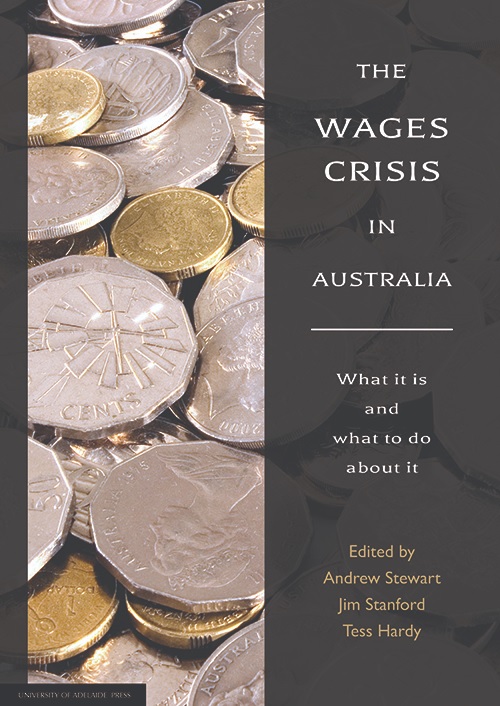
  • New Book: The Wages Crisis in Australia

    Cover

    The wage slowdown has elicited concern from economists and political leaders across the spectrum. Even Dr. Philip Lowe, Governor of the Reserve Bank of Australia, has called it a “crisis,” and suggested that faster wage growth would be beneficial for the economy.

    This new collection of 20 essays by leading labour market experts and commentators in Australia explores the causes, consequences, and potential solutions to this problem. The book is published by University of Adelaide Press. The book was launched in Melbourne on 29 November, with remarks from Natalie James, former Commonwealth Fair Work Ombudsman and Chair of the Victorian Inquiry Into the On-Demand Workforce.

    Through the links below you may access excerpts from the book, links to participating authors, and supplementary material (including commentary, other readings, and videos). Our hope is that this collection will spark a needed debate in Australia about how to get wages back on track.

    About the Editors:

    Andrew Stewart is the John Bray Professor of Law at the University of Adelaide and a Legal Consultant to the law firm Piper Alderman.

    Tess Hardy is a Senior Lecturer at Melbourne Law School, and Co-Director of the Centre for Employment and Labour Relations Law.

    Jim Stanford is Economist and Director of the Centre for Future Work at the Australia Institute.


    A digital edition of the book is available for free download from University of Adelaide Press. Paperback copies can be ordered for $60 from Federation Press; please submit inquiries to info@federationpress.com.au.

    The post New Book: The Wages Crisis in Australia appeared first on The Australia Institute's Centre for Future Work.

  • Go Home On Time Day 2018: Australians Owed $106 Billion in Unpaid Overtime

    A national survey undertaken as part of the report has shown that the average Australian worker now puts in six hours of unpaid overtime per week, which equates to working an extra two months for free every year. That’s an increase from 5.1 hours on average in last year’s survey.

    “Australians are working more unpaid overtime than ever before, and they’re paying a high price for it,” said Troy Henderson, Economist at the Centre for Future Work.

    “Time theft takes many forms, including employees staying late, coming in early, working through their lunch or other breaks, taking work home on evenings and weekends or being contacted to perform work out of hours.

    “Most Australians wouldn’t dream of working for two months without pay. But it’s spread out over the whole year, and has become part of the implicit expectations of too many jobs. ‘Time theft’ has thus become endemic across the whole labour market.

    “Today we ask that all Australians go home on time and try to limit the unpaid overtime they work. And stopping time theft is ultimately the responsibility of employers and government, too, not just individual workers: employers must value and respect the leisure time of workers, and recognise that work cannot take over our entire lives.”

    The survey indicated that even part-time and casual workers – most of whom want more paid hours of work each week – are being asked to work unpaid overtime (averaging over 4 hours per week for part-timers and almost 3 hours per week for casuals). “Given the problem of underemployment and precarious work in today’s labour market, it is especially unfair that part-time and casual workers are being pressured to work for free,” Mr. Henderson added.

    This year’s Go Home on Time Day survey also included a special questionnaire on the use of digital surveillance and monitoring in Australian workplaces. 70% of respondents said their employers use at least one form of digital surveillance or monitoring, including cameras, GPS tracking, monitoring internet or social media activity or counting keystrokes, to monitor employees – and sometimes to discipline or even dismiss them.

    “Technology can have a strong positive effect in the workplace, but our research shows it is also being used in ways that increase pressure on employees and reduce the level of trust in workplaces,” Mr. Henderson said.

    “It’s clear from our research that millions of Australians are losing out to time theft. Both underemployed workers, and those who work too much, are giving up their precious time for free. All Australian workers have the right to go home on time.”

    The post ‘Go Home On Time Day’ 2018: Australians Owed $106 Billion in Unpaid Overtime, Report Reveals appeared first on The Australia Institute's Centre for Future Work.

  • Go Home on Time Day 2018

    Please visit our special Go Home On Time Day website for more information, tips on how to get away from work on time, and free posters and shareables. There’s also an online calculator where you can estimate the value of the time theft you experience, through unpaid overtime in all its forms.

    In conjunction with Go Home On Time Day, The Centre for Future Work is releasing two new research reports on the time pressures facing Australian workers:

    Our annual update on attitudes toward working hours, the incidence of unpaid overtime and its aggregate value: Excessive Hours and Unpaid Overtime: 2018 Update, by Troy Henderson and Tom Swann. On the basis of a survey of 880 employed Australians, we estimate that the typical worker puts in 6.0 hours of unpaid overtime per week – ranging from going in early, staying late, working through lunch and tea breaks, taking work home in the evenings and weekends, responding to calls or emails out of hours, and more. That amounts to 3.25 billion hours of unpaid overtime across the whole labour market this year, worth a total of $106 billion.

    This year, our Go Home On Time Day survey also included a special section focusing on the forms, prevalence, impacts and implications of electronic and digital monitoring and surveillance in Australian workplaces. Our goal was to investigate a secondary dimension of the time pressure facing Australian workers. It is not just that work is being extended into greater portions of our days (through unpaid overtime, the use of mobile phones and computers to reach workers at any time, pressure to not fully utilise annual leave, and similar trends). In addition, even within the work day, time pressure is intensified with the expectation that every moment of work time must be used for productive purposes – an expectation that is increasingly reinforced through omnipresent systems of monitoring, performance measurement, and surveillance. The result of these twin forces is an overall inability for people to escape from the demands of work: neither at the workplace (even for short periods), nor away from it.

    Please see our companion report, Under the Employer’s Eye: Electronic Monitoring & Surveillance in Australian Workplaces, by Troy Henderson, Tom Swann and Jim Stanford.

    The post Go Home on Time Day 2018 appeared first on The Australia Institute's Centre for Future Work.

  • Excessive Hours and Unpaid Overtime: 2018 Update (GHOTD 10th anniversary)

    2018 marks the tenth annual Go Home on Time Day (GHOTD), an initiative of the Centre for Future Work at the Australia Institute that shines a spotlight on overwork among Australians, including excessive overtime that is often unpaid.

    Over many years, the Centre for Future Work and the Australia Institute have commissioned regular annual opinion polls to investigate overwork, unpaid overtime, and other instances of “time theft” in Australia. This year’s poll of 1459 Australians was conducted between September 17-26, with a sample that was nationally representative according to gender, age and state or territory.

    Of the 1459 respondents, 880 (or 60 percent) were currently in paid work. That subsample was then asked several questions regarding their hours of work, whether they wanted more work or less, and whether they worked unpaid overtime in their jobs.

    This report summarises the results of that polling, and places it in the context of national labour force trends:

    • There is growing evidence of a sharp polarisation in Australian employment patterns, between those with full-time, relatively secure jobs, and a growing portion working part-time, casual, temporary, or insecure positions.
    • In the survey, 54 percent were employed in permanent full-time jobs, while 46 percent were employed as part-time, casual or self-employed workers. In other words, almost half of the sample experienced one or more degrees of nonstandard or insecure work – broadly in line with the experience in the overall labour market.
    • Compared with last year, there was a significant increase in those wanting more paid hours (from 34 percent to 40 percent) and a decrease in those wanting fewer paid hours (from 19 percent to 15 percent). We believe this shift reflects the high levels of underemployment in Australia’s labour force, and the ongoing struggle of those in non-standard jobs to attain enough hours of work.
    • In the survey, 20 percent of full-time workers said they would prefer to work fewer hours, and 30 percent said they wanted more. 50 percent said their hours were about right.
    • By contrast, those in part-time or casual positions work far fewer and more uncertain hours, and most would prefer to work more – 54 percent of parttime workers and 63 percent of casual workers. This highlights the problems of underemployment and inadequate incomes experienced by the growing proportion of Australian workers in insecure jobs. Only 7 percent of part-time employees and 2 percent of casuals wanted fewer paid hours.
    • At the same time as many Australian workers report they would prefer more hours of paid work, the incidence of unpaid overtime is also growing: including coming in early, leaving late, working at home or on weekends, working through regular breaks and lunch hours, responding to calls or emails out of working hours, and more. Across all forms of employment, our respondents reported working an average of 6.0 hours of unpaid labour per week (up from an average of 5.1 hours in 2017 and 4.6 hours in 2016).
    • This translates into an annual average of 312 hours of unpaid overtime per worker per year across all forms of employment. Based on a standard 38-hour workweek, this is equivalent to more than 8 weeks (or 2 months) of unpaid work per worker per year.
    • Full-time workers reported the greatest incidence of unpaid overtime: on average 7.1 hours per week. This was a substantial increase from a reported 6 hours per week in last year’s survey.
    • Part-time workers worked on average 4.2 hours per week unpaid, while even casual workers worked on average 2.8 hours unpaid.
    • The aggregate value of this “time theft” is substantial. Across the workforce, we estimate the total value of unpaid overtime at $106 billion in 2018. This widespread non-payment for so much of Australians’ working time reduces family incomes, weakens consumer spending, and exacerbates the challenge of work-life balance.
    • In an era of wage stagnation, underemployment, insecure work and significant cost of living pressures, Australian workers cannot afford to give their time away to employers for free.

    The post Excessive Hours and Unpaid Overtime: 2018 Update appeared first on The Australia Institute's Centre for Future Work.

  • Under the Employer’s Eye: Electronic Monitoring & Surveillance

    This year, our survey also included a special section focusing on the forms, prevalence, impacts and implications of electronic and digital monitoring and surveillance in Australian workplaces. Our goal was to investigate a secondary dimension of the time pressure facing Australian workers. It is not just that work is being extended into greater portions of our days (through unpaid overtime, the use of mobile phones and computers to reach workers at any time, pressure to not fully utilise annual leave, and similar trends). In addition, even within the work day, time pressure is intensified with the expectation that every moment of work time must be used for productive purposes – an expectation that is increasingly reinforced through omnipresent systems of monitoring, performance measurement, and surveillance. The result of these twin forces is an overall inability for people to escape from the demands of work: neither at the workplace (even for short periods), nor away from it.

    Part I of this report begins by describing the main forms of modern electronic monitoring and surveillance (EMS) that have placed more Australian workers “under their employer’s eye.” These methods include the use of location tracking technologies, monitoring of emails and social media content, the “gamification” of work, digital methods of performance monitoring, and even electronic systems for employee discipline and dismissal. Following sections examine the various purposes of modern EMS systems, and the extent of their application. This is followed by a brief description of the legal and regulatory system governing EMS in Australia; current regulations limiting employers’ use of these systems are sparse and inconsistent. The last section of Part I discusses the direct and indirect consequences of these new forms of monitoring and surveillance for workers. It argues that the impact of omnipresent surveillance in workplaces may be contributing to the slower wage growth which has so concerned Australian economists and policy experts in recent years; because it is now easier and cheaper to monitor and “motivate” employees through surveillance and potential discipline, employers feel less pressure to provide positive economic incentives (such as job security, promotion, and higher wages) to elicit loyalty and effort from their workforces.

    Part II of the report then reports the findings of our original survey data regarding the forms, extent and impacts of EMS systems in Australian workplaces, and the attitudes of Australian workers towards these technologies and trends. We surveyed 1,459 people between 26 October and 6 November 2018, using an online survey methodology, conducted by Research Now. The sample was nationally representative with respect to gender, age and state and territory.

    The post Under the Employer’s Eye: Electronic Monitoring & Surveillance in Australian Workplaces appeared first on The Australia Institute's Centre for Future Work.