Early evidence on how the Right to Disconnect laws are working in practice.
Tag: Economics
-
Doing it Tough: Cost of Living Crisis
The current cost of living crisis in Australia has two components – the incomes that people receive, and the prices they pay for goods and services. This is what Alan Fels has recently referred to as the “two faces” of the crisis . Action to protect the living standards of Australians must address both faces of the crisis.
As part of a broader research initiative investigating the human costs of the crisis and the impact of austerity on Australian workers, the Australia Institute’s Centre for Future Work surveyed a nationally representative sample of 1014 adults living in Australia about their household income and the costs of living. The results show that:
- Almost three-quarters (72%) of respondents felt their wages had grown slower than prices over the previous year.
- Over half of respondents (53%) said their household’s financial situation was worse that it was two years ago.
- The cost of living crisis has had differential impacts. Because it has affected lower-income Australians most severely, the cost of living crisis has exacerbated inequality.
- Respondents identified higher grocery prices as the most visible source of the increased cost of living. Six out of 10 (60%) of respondents identified groceries as the purchase where they have most noticed higher prices followed by utilities (21%) and transport (7%).
- There was strong support for measures across a broad range of policy areas to address the costs of living. 64% of respondents said it was very important to lower utility costs to reduce cost of living pressures. 64% said it was very important to increase supermarket competition, 60% to lower medical costs, and 58% to increase the pace of wages growth.
The respondents to this survey supported a suite of policy initiatives designed to both reduce the cost of living, and to increase wages and income supports. In their view, addressing the cost of living crisis requires a multi-dimensional approach, rather than a singular reliance on high interest rates to slow inflation.
The report is published by the Centre for Future Work in conjunction with a one-day symposium it is hosting in Melbourne on 17 October on the crisis in living standards in Australia, and how to address it through greater investments in wages, public services, and affordable housing and energy.
The post Doing it Tough appeared first on The Australia Institute's Centre for Future Work.
-
Industrial Strategy for Domestic Wind Energy Tower Manufacturing
Policy framework for building Australian wind tower manufacturing capacity.
Authors: Phillip Toner
-
Leaving Money on the Table: SRS Underfunding
Analysis of Schooling Resource Standard underfunding.
Authors: Jim Stanford
-
Chalmers is right, the RBA has smashed the economy
Last year the government announced it was considering removing its statutory power to overrule the Reserve Bank. Thankfully it has now reconsidered that move, and the actions of the RBA over the past year serve to remind everyone that it is far from infallible.
In its May Statement on Monetary Policy the RBA looked ahead one month and estimated that in June the annual growth of household consumption would be 1.1%. When the national accounts were released last week, the actual growth was revealed to be just 0.5%.
Now obviously economic forecasting is a bit of a mugs game, but household consumption makes up half of Australia’s economy and accounted for around 45% of all the growth in the economy over the past decade so it is pretty important. It is also the area of the economy most directly affected by interest rate rises. This error of forecasting suggests that the Reserve Bank has rather poorly misread just how greatly households had been impacted by the 13 rate rises that had taken the cash rate from 0.1% in April 2022 to 4.35% in November 2023.
This error is crucial because the main reason the RBA raises rates is to reduce the ability of households to spend. Because you can’t tell your bank that you don’t really feel like paying your mortgage this month, interest rate rises force households to divert money that would have been spent on goods and services to paying your mortgage.
The problem is when you are trying to slow down half of the economy so directly, if you overdo it the entire economy begins to fall. This is what happened in the early 1980s and 1990s when interest rates were raised sharply in order to slow inflation.
And the private sector has already slowed so greatly that the only reason GDP rose in the past year was because of increased government spending.
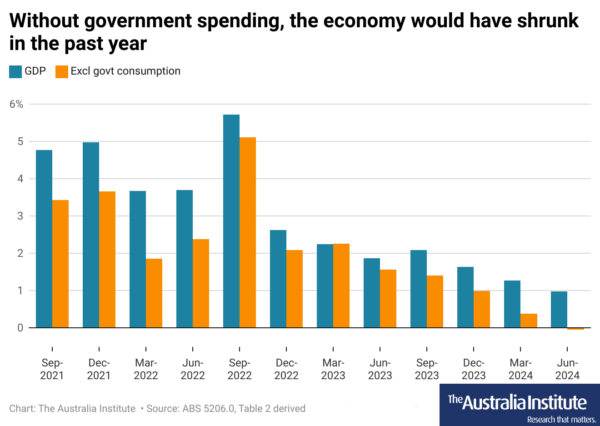
That is not a sign of a strong economy, nor a sign of one, according to the assistant governor of the RBA, Dr Sarah Hunter, that “is running a little bit hotter than we thought previously”.
Economies that are running a bit hot are ones in which households are spending a lot more than they were the year before because unemployment is falling and wages are rising well ahead of inflation. Instead we currently have a situation where unemployment has risen from 3.5% in June last year to the current level of 4.2%, household spending grew just 0.5% – well below the long-term average of 3% – and real wages in the past year rose just 0.1%.
When asked about this discrepancy between reality and the RBA’s belief, the Governor of the Reserve Bank, Michele Bullock told reporters last week that
…it’s the difference between growth rates and levels.
She noted that “it’s true that the growth rate of GDP has slowed” but that “part of monetary policy’s job has been to try and slow the growth of the economy because the level of demand for goods and services in the economy is higher than the ability of the economy to supply those goods and services. So there’s still a gap there. So even though it’s slowing, we still have this gap.”
In effect Bullock was telling people to stop worrying about the fact that household consumption was barely growing or that GDP only grew because of government spending or that GDP per capita has fallen for a record 6 consecutive quarters because the amount of consumption and GDP was too high.
This could make sense – think of it like a car travelling on a 60km/h road. If it was travelling at 80km/h and slowed to 70km/h even though it was slowing it would still be going too fast.
In essence this is what Bullock is arguing is happening to demand in the economy – it is slowing but overall there’s still too much of it.
The only problem is that this is completely wrong.
Consider the suggestion that the demand for goods and services is higher than the ability of the economy to supply those goods and services. One simple way to look at this is to see if the amount of goods and services bought per person is currently at a level consistent with the growth observed in the decade before the pandemic.
This is actually not a major test – household consumption, along with most of the economy was rather weak in the 7 or 8 years before 2020. The RBA at the time actually was hoping Australians would spend more than they did, so you would expect in an economy with too much demand that the amount of things we are buying is well above the levels of that particularly weak period.
But it is not.
As we can see from the below graph, while household spending did quickly recover after the lockdowns in 2020 and 2021, by the time the RBA began raising interest rates our level of demand for goods and services was only back to the level consistent with the pre-pandemic growth.
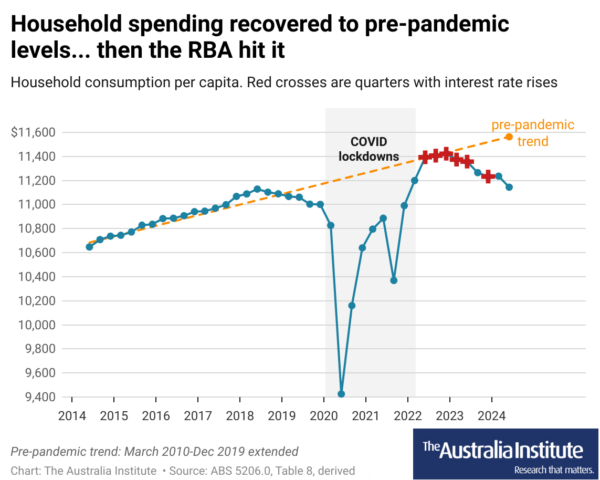
Now yes you can argue the RBA was right to increase rates at that time – to ensure our spending didn’t keep zooming up in recovery. But by the time of the 10th rate increase in March 2023, household spending per person was already falling and 0.7% below the pre-pandemic trend. When the RBA raised rates for there 12th time in June 2023, the level of demand for goods and services was 1% below the pre-pandemic trend.
At this point you might think the RBA had done enough. But after pausing for 4 months, the bank inexplicably raised rates for a 13th time in November 2023. At this stage household level of spending was 2.5% below the pre-pandemic trend.
And because interest rate rises take months to worth through the economy we now find ourselves at a point where the level of household consumption per person is 3.8% lower than would have been expected had households merely kept increasing our consumption in line with the decade before the pandemic.
In effect Australians are currently consuming almost the same amount of goods and services as they did in June 2018 and yet the head of the RBA would have us believe that is a case of excess demand.
If we look at the overall economy, the picture is much the same (see the graph at the top of the page). Australia’s level of GDP per capita did recover quickly after the lockdowns and by June 2022 was 1.4% above the pre-pandemic trend level. But the interest rates rises had an immediate impact – reducing GDP per capita in 7 of the next 8 quarters. By June 2023 the level of activity in the economy was already below pre-pandemic expectations, and when the RBA hit Australians with the 13th rate rise in November 2023, the level of GDP per capita was 1.2% below the long-term trend.
It is now 2.5% below – back at the level it was in June 2021.
The RBA has got it wrong. They were initially worried that inflation was driven by concerns of strong wage growth rather than supply side issues and corporate profits. They then tried to argue household spending was still growing too strongly. The GDP figures showed that to be woefully mistaken. They then tried to argue that while growth in the economy was slow, there was still too much demand. But again the figures show this to be mistaken.
The Treasurer Jim Chalmers stated nothing but the facts when he said earlier this month that rate rises were “smashing the economy”. The data supports his assertion, and it is time the RBA admits that their actions have not only slowed the economy but slowed it at a pace that is now harming Australians for no benefit other than the RBA saving face from its previous over-reactions.
The post Chalmers is right, the RBA has smashed the economy appeared first on The Australia Institute's Centre for Future Work.
-
Cost of living crisis hits lowest earners hardest
Research showing the cost of living crisis disproportionately affects low-income workers.
-
Public sector wages fall further behind
Analysis of public sector wage caps and their economic impact.
-
No Blood – No Job: Privacy laws and workers rights
Organisations in Australia are using blood analysis as a means of screening future employees for ‘health risks’ that they allege may impact on their performance of work.
Collecting sensitive information from blood analysis is restricted under Australia’s privacy laws. This is because the mishandling of this information can have a substantial detrimental impact on those who have provided the information. Requiring workers to submit to blood analysis is just one example of how organisations are now routinely collecting sensitive information from workers, sometimes without adhering to the requirements of privacy laws. Other examples include using fingerprint and facial recognition software and sensors that collect physiological and psychological data about workers.
The protection from arbitrary interference with a person’s privacy is a fundamental human right. Interfering with this right, by collecting sensitive personal information, should occur in limited circumstances and only where necessary. However, this report shows that some organisations in Australia, are not treating the collection of sensitive information from workers as an exception. They are collecting sensitive information as a routine step in their employment processes.
The findings of this report raise concerns about power, privacy, fairness, and the potential for discrimination in the practices being adopted by some organisations. These findings also show that Australia’s current privacy and workplace relations laws do not adequately address these concerns. Amendments to Australian privacy laws are currently being considered by the Australian Government with reforms likely to be put before the Australian Parliament before the end of 2024.
This report examines the need for new provisions within either or both privacy or workplace relations laws that set out the rights of workers to protect their sensitive information. It argues that regulation should be geared towards, not only protecting workers’ rights to privacy, but to providing a disincentive to organisations hoarding and misuse of the personal and sensitive information of workers.
The worker-centric approach called for in this report includes:
- the development of one system of regulation to protect the privacy concerns of all workers regardless of employment status or work context
- defining the collection of workers’ personal and sensitive information as high risk requiring both specific and detailed justification for the collection of this information and the genuine informed and affirmative consent of workers
- the establishment of a tripartite mechanism to assist the regulator to develop and manage processes for dealing with the privacy and related human rights concerns of workers
- the use of codes and frameworks, developed via a tripartite mechanism, to set out when and how workers’ information can be collected and used
- the development of an easy to access, and timely, worker centered mechanism to address concerns about the collection and use of workers’ information.
The post No Blood – No Job appeared first on The Australia Institute's Centre for Future Work.
-
The 9 to 5 is back! Time to put the phone on silent
If you’ve ever flicked off an email before bed, texted your boss out of hours, or received an ‘urgent’ work call after clocking off, you’ll be glad to hear some respite is just around the corner.
A new right to disconnect from work, for employees in businesses with 15 or more staff, comes into force across Australia from Monday 26th August. This is a welcome response to the growing problem of ‘availability creep’, where work demands spill over into workers’ leisure time.
The new right means most employees can now refuse to monitor and respond to unreasonable contact from their employers about work matters outside of paid work hours.
Many of us are now online and digitally connected to our workplaces 24/7. This constant connectedness can make it hard to escape work calls, texts, and emails when not actually at work.
As we are now so easily contacted anywhere and anytime, our leisure and family time has become very susceptible to interruptions from work, leading to unpaid overtime, an inability to ‘switch off’, and blurred boundaries between work and non-work time. Gone are the days of 8 hours work, 8 hours rest, and 8 hours play.
The consequences are stark. Research has shown these work practices lead to increased stress, health problems and a poor work-life balance.
The right to disconnect from work is one solution to the problems of availability creep and unpaid overtime. The Senate Select Committee on Work and Care proposed this reform to Australia’s workplace laws in early 2023 and the initiative was included in the Government’s Closing Loopholes package of workplace reforms passed by the federal parliament later that year. A similar right is in place in a number of other countries including France, Canada and the Philippines.
Australia’s new right to disconnect does not mean there is a blanket ban on contacting employees outside their scheduled work hours. Rather, it means that an employee cannot be penalised for refusing unreasonable contact.
There are many circumstances in which a manager’s attempts to contact an employee out of their work hours might be reasonable. For example, this could be where an employee is on-call and receiving an on-call allowance. Some jobs regularly require a certain amount of out of hours contact and employees’ remuneration may reflect this. However, for many workers, contact out of working hours arises from pressures that lead to overwork and unpaid overtime.
And unpaid overtime is a significant problem in Australia.
In 2023 employees responding to a Centre for Future Work survey reported working an average of 5.4 hours of unpaid overtime a week, with full-time employees reporting working an average of 6.2 hours a week of unpaid overtime. A conservative back-of-the-envelope calculation shows that’s an extra seven weeks’ work every year.
Workers should not have to monitor or respond to emails, text messages and phone calls after hours about concerns that could be raised and dealt with in their scheduled work time. Poor organisation, understaffing and reliance on overwork are not good reasons for requiring employees to be available out of hours. It is these practices that the right to disconnect is intended to challenge.
Fears that workplace flexibility will be undermined as workers exercise their rights to disconnect are largely misplaced. In organisations where flexibility is based on employees’ constant availability there may be some disruption. But this is exactly the practices that the right to disconnect should disrupt.
Flexibility can exist alongside respect for employees’ rights to switch off from work. Good flexible work practices and arrangements are those that benefit both employers and employees, and are designed through negotiation and consultation. The dissolution of boundaries between work and leisure time is not the answer.
Will individual employees be lining up to ask the Fair Work Commission to order their employers to stop contacting them? Probably not. The real potential in the right to disconnect is its ability to catalyse an evolution in workplace expectations that shifts norms away from a reliance on overwork and constant availability.
Time to put that phone on silent.The post The 9 to 5 is back! Time to put the phone on silent appeared first on The Australia Institute's Centre for Future Work.
-
Solid Foundations, Bright Future (NSW)
New South Wales has one of the most prosperous and productive economies in Australia, with a diverse base of economic activity and strong labour market. However, years of austerity have hollowed out its public sector, creating one of the proportionally smallest state public sectors in the country in terms of both economic activity and employment.
Despite the instrumental role the public sector played in navigating the state through the pandemic, weak wage growth and rising inflation have compounded the impacts of austerity, leading to significant reductions in public sector real wages. While the current government’s scrapping of the wage cap and implementation of public sector wage rises has undone some of this damage, most notably the October 2023 wage rises for public school teachers, more repair is needed.
The NSW government has a strong fiscal position with which to manage these challenges. NSW maintains nearly the highest credit rating in the country and relies on revenue bases that are both diverse and stable. Additionally, there is considerable evidence that, if needed, several options are available to increase state government revenue. As the state economy weakens in response to high interest rates and declining real incomes, the state government has the responsibility to contribute to support the economy and broader society, through expansion of public services, repair of public sector wages, and support for the most vulnerable.
The post Solid Foundations, Bright Future appeared first on The Australia Institute's Centre for Future Work.