Tag: Economics

  • Record number of people working multiple jobs reveals the problems for workers

    The Centre for Future Work’s Greg Jericho has analysed the figures and found an abnormally large number of new jobs since the pandemic have been in secondary jobs.

    In the December quarter of 2021 a record 6.4% of employees were working multiple jobs

    This unfortunately is not a pandemic-led one-off but part of a now 6-7 year trend that finds workers who are facing fewer hours, more insecure work, and getting pay rises that barely keep up with the cost of living being forced to seek another job to pay the bills. 

    See Greg’s full commentary in The Guardian: “Rise in hours worked signals post-lockdown recovery, but more people have multiple jobs than ever

    The post Record number of people working multiple jobs reveals the problems for workers appeared first on The Australia Institute's Centre for Future Work.

  • Australia’s Lopsided Economic Recovery

    In the last three months of last year, households in NSW, Victoria and the ACT came out of lockdowns and spent money propelling almost all of the economy growth in the economy.

    But while households are providing all the growth, workers are missing out on the rewards. The share of GDP going to employees hit a record low in 2021 and as government stimulus begins to be withdrawn the picture is not as optimistic as the (erratic) quarterly growth figures might suggest.

    Please see Greg’s full commentary in The Guardian: “Don’t get too excited by Australia’s rebounding economy – it’s a distorted snapshot of the true picture.”

    The post Australia’s Lopsided Economic Recovery appeared first on The Australia Institute's Centre for Future Work.

  • International Collective Bargaining Experts Explore Future System Reform

    On 10 February, Centre for Future Work hosted an exciting timely panel discussion between international collective bargaining experts titled “Beyond the Enterprise: Building Sectoral Collective Bargaining Systems in the Anglophone World”. The panel, delivered for the Association of Industrial Relations Academics of Australia and New Zealand (AIRAANZ) 2022 Conference, explored proposals across Australia, New Zealand, Britain and the US for widening bargaining scope to the multi-employer, industry-wide, or occupational level. Panelists and their presentation links are below:

    • David Madland, Senior Fellow with Center for American Progress and Senior Adviser for the American Worker Project presented on lessons from the US and Britain on strengthening unions and broad-based bargaining proposals. There is a summary of David’s presentation available here.
    • Craig Renney, Director of Policy and Economist with the New Zealand Council of Trade Unions presented on NZ’s ambitious plan to implement sectoral bargaining through Fair Pay Agreements. Craig explained how FPAs can be initiated, bargained and agreed upon. Slides for Craig’s presentation are attached below.
    • Alison Pennington, Senior Economist with Centre for Future Work presented a new sectoral bargaining system design for Australia. The dual-tiered model proposed combines both a revitalised Awards system and multi-employer bargaining. Alison proposed traditional bargaining be re-integrated into Awards, with coverage, scope and minimum wage rates redrawn and refreshed. Her presentation is attached below.
    • Emma Cannen, Nation Research Coordinator with the United Workers Union presented on the bargaining challenges experienced in Australia’s highly fragmented, insecure, feminised care services, and why sector bargaining with stronger regulation and accountability is needed. Emma’s presentation can be viewed below.

    Jim Stanford, Economist and Director at Centre for Future Work chaired the panel.

    The AIRAANZ panel follows release of the 13-article Special Issue Global Lessons for Stronger Collective Bargaining Systems prepared by academic researchers and trade unionists from five countries for the peer-reviewed journal Labour and Industry. The Issue co-edited by Alison Pennington and Jim Stanford adopts a multi-dimensional approach to collective bargaining revitalisation, investigating the role of bargaining in skills and education, unemployment insurance and other social insurance policies, and industry policy – in addition to specific industrial relations matters.

    The final published versions of all articles in the Special Issue are available through Labour and Industry, or through your local library. All commentaries in the Issue freely accessible until end-March 2022.

    The post International Collective Bargaining Experts Explore Future System Reform appeared first on The Australia Institute's Centre for Future Work.

  • Loss of Bargaining Power Explains Wage Stagnation

    Our Policy Director Greg Jericho writes in Guardian Australia that claims of a “wages breakout” remain purely a scare campaign from employer groups determined to keep wages low. He finds that once again real wages are failing to keep pace with productivity and that as a result no pressure on inflation is coming from wage claims, but instead workers are missing out. With levels of unemployment now associated with much lower wage growth than in the past, it is clear the power imbalance in wage negotiations has shifted drastically away from workers.

    The post Loss of Bargaining Power Explains Wage Stagnation appeared first on The Australia Institute's Centre for Future Work.

  • Interest Rates and the Federal Election

    Inflation is occurring off the back of the largest government intervention and the lowest interest rates in post-WWII history. But while the economy is performing better than might have been expected when the pandemic first occurred it would be a mistake now to quickly reduce economic support from the public sector.

    After the global financial crisis, worries about debt and deficit took precedence over the strength of the economy. At a time when government borrowing rates still remain historically low, the need to improve productivity through infrastructure and support in areas such as education and health, as well as equality improvements through high a higher Jobseeker rate, should take precedence in the upcoming federal budget.

    The post Interest Rates and the Federal Election appeared first on The Australia Institute's Centre for Future Work.

  • Digging Deeper Into Australia’s Unemployment Rate

    In his weekly column for The Guardian Australia, Centre for Future Work Policy Director Greg Jericho unpacks the numbers behind the current unemployment rate, and compares it to the situation in 1974 when unemployment was last below 4%.

    The column considers several factors contributing to the current unemployment rate, including:

    • The flattening of labour supply due to border closures during the pandemic.
    • Lower female labour force participation (especially in full-time work).
    • The general growth in part-time work, including for men.

    Please see Greg’s full column, “Australia’s 4% unemployment in isolation hides what’s really going on in the labour market,” in The Guardian Australia.

    The post Digging Deeper Into Australia’s Unemployment Rate appeared first on The Australia Institute's Centre for Future Work.

  • Power, Not Just Supply and Demand, Vital to Future Wage Growth

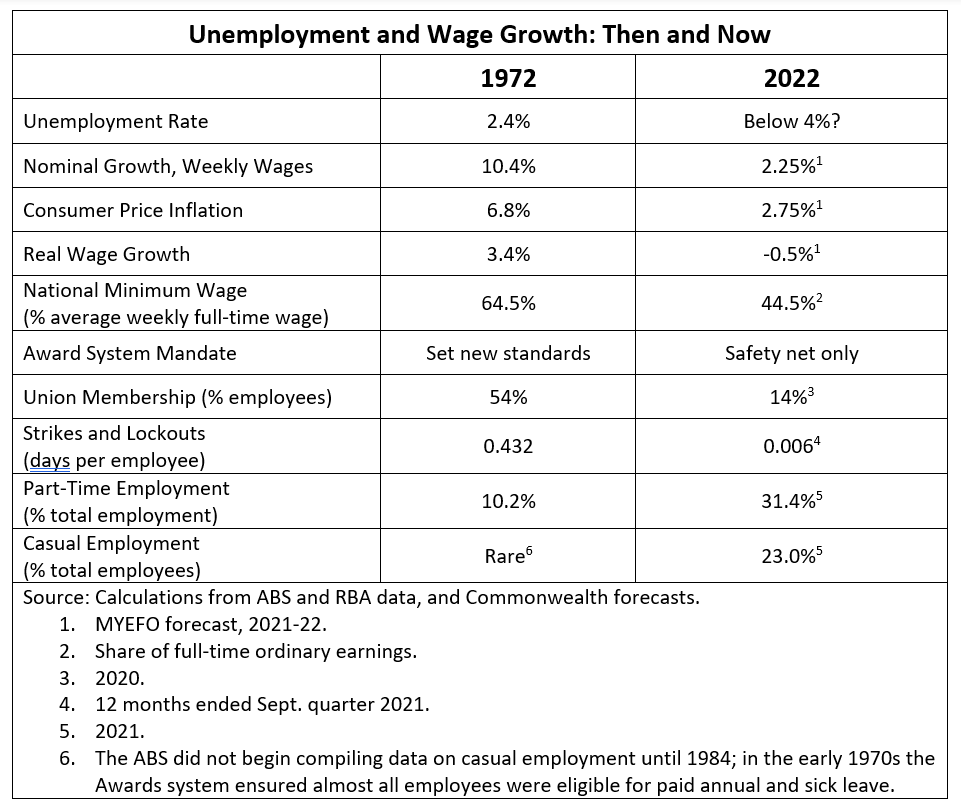
    Will a low unemployment rate be sufficient to solve the crisis in Australian wages? In this article published in The Conversation, Centre for Future Work Director Jim Stanford argues that the historic restructuring of Australia’s labour market institutions over the last half-century (since the last time unemployment was below 4%) will continue to undermine wages, despite apparently tight labour markets.

    This table compares regulatory and institutional parameters today, compared to fifty years ago. Across multiple dimensions (including the minimum wage, the Awards system, unions and collective bargaining, and job security), workers have lost the bargaining power they need to win higher wages. Hence labour costs remain suppressed, and business profits hit records, even as unemployment declines.

    Labour Institutions Then and NowPlease see Jim’s full article, “Why there’s no magic jobless rate to increase Australians’ wages,” at The Conversation.

    The post Power, Not Just Supply and Demand, Vital to Future Wage Growth appeared first on The Australia Institute's Centre for Future Work.

  • Rebuilding Vehicle Manufacturing in Australia (EVs)

    Global automotive manufacturing is rapidly transitioning to the production of Electric Vehicles (EVs) in line with technological advancements and the global community’s commitment to addressing climate change. This transition presents an enormous opportunity for Australia to rebuild its vehicle manufacturing industry, taking advantage of our competitive strengths in renewable energy, extractive industries, manufacturing capabilities, and skilled workers.

    Australia possesses many of the crucial elements for an EV manufacturing industry: rich mineral reserves, an advanced industrial base, a highly skilled workforce, and consumer interest. But what it lacks is an overarching, coordinating and strategic national industry policy. Global experience shows that this is central to EV-oriented industrial transformation. Australia can play an important role in global EV manufacturing industries but developing a strategy to realise this will require active government policy responses to both the challenges and opportunities at hand.

    Australia’s natural resource endowments and industrial capabilities make EV industry development a viable economic and social strategy. Our moral obligations to create a sustainable future make it essential public policy. This report illustrates how Australia can rebuild a vehicle manufacturing industry, on a sustainable ecological foundation, and meet our international environmental obligations. The report covers several important related dimensions of the issue:

    • How an EV manufacturing strategy can add value to Australia’s existing exports of primary resources – connecting them to innovative, sustainable manufacturing industries;
    • Developing supply and value chain linkages to the global EV industry by increasing the capability for innovation and advanced manufacturing amongst small and medium-sized enterprises;
    • The central role of Australia’s education systems in delivering sustainable industry-focused training and skills development, to provide workers with career pathways shaped by lifelong access to education and learning;
    • How active government intervention can coordinate economic sectors in an innovative and strategically oriented industry policy driving sustainable economic and technological transformation; and
    • Understanding the importance of automotive manufacturing to our industrial future, its role in redesigning transport systems, investing in new technology and gearing production systems to meet social and environmental requirements.

    To make the case for a national EV manufacturing policy, this paper reviews existing literature and presents relevant data to show that an EV industry in Australia is not just desirable – but it can also lead the sustainable transformation of Australia’s economy.

    The paper is arranged as follows. The next section provides an overview of the Australian national EV policy landscape and the international context, to identify trends and opportunities in EV manufacturing.

    The bulk of the paper is then dedicated to reviewing four key ‘Building Blocks’ of an industry policy: the resources sector, skilled labour, supply chain capabilities and capital assets, and the capacity of government to develop a policy response that assembles these key elements as the foundation for rebuilding Australian manufacturing with EVs at the centre.

    In mapping this foundation of an EV manufacturing policy, the subsequent section cautions that an EV industry is not a panacea for addressing the broader climate crisis and creating a sustainable economy. It argues, however, that a sustainable EV industry should be considered as a major driver of industrial transformation alongside other positive cultural and environmental changes within Australian society.

    The conclusion summarises the paper’s overarching theme that Australia can build a strong EV manufacturing industry with the right policy settings and government actions. It makes several specific recommendations to get the ball rolling on developing these settings – including recommendations touching on industry planning, energy requirements, consumer demand, resource use, supply chain developments, skills and training, and government support.

    The post Rebuilding Vehicle Manufacturing in Australia appeared first on The Australia Institute's Centre for Future Work.
  • Australia ready to become sustainable EV-making powerhouse: new research

    The new report, Rebuilding Vehicle Manufacturing in Australia: Industrial Opportunities in an Electrified Future, has found Australia is uniquely blessed with advantages to attract and retain EV manufacturing and rebuild the nation’s car-making capacity. This potential, however, will not be met without major government action.

    “When it comes to creating an EV manufacturing sector, Australia enjoys advantages other nations would die for: rich reserves of lithium and rare earths, strong industrial infrastructure, a highly skilled workforce, powerful training capacity, abundant renewable energy options, and untapped consumer potential,” said Dr Mark Dean, the report’s lead author.

    “And contrary to popular belief, we wouldn’t be starting from scratch. Thanks to the resilience of our remaining automotive manufacturing supply chain, a surprising amount of auto manufacturing work – including components, specialty vehicles, and engineering – still exists here.”

    But Dr Dean said his research found Australia’s advantages would count for little without significant government support. The report makes a number of recommendations including:

    • Establishing an EV Manufacturing Industry Commission
    • Using tax incentives to encourage firms involved in the extraction of key minerals – primarily lithium and rare earths – with local manufacturing capabilities, especially emerging Australian EV battery industries
    • Introducing a long-term strategy for vocational training, ensuring the establishment of skills to service major EV manufacturers looking to set up operations Australia
    • Offering major global manufacturers incentives (tax incentives, access to infrastructure, potential public capital participation, etc) to global manufacturers to set up – especially in Australian regions undergoing transition from carbon-intensive industries
    • Introducing local procurement laws for the rapid electrification of government vehicle fleets

    “No nation builds a major industry without its government taking a proactive role. Our new research shows there’s no excuse for inaction, because there are a huge range of powerful levers our government could be pulling,” Dr Dean said.

    “If we capture the moment we’ll capture abundant benefits: creating tens of thousands of regional manufacturing jobs, reducing our dependence on raw resource extraction, reinforcing our accelerating transition toward non-polluting energy sources, and spurring innovation, research, and engineering activity in Australia. We just need our government to act.”

    The post Australia ready to become sustainable EV-making powerhouse: new research appeared first on The Australia Institute's Centre for Future Work.

  • Of 3’s, and Other Important Labour Market Numbers

    Prime Minister Scott Morrison set tongues wagging this week with a confident pledge that Australia’s unemployment rate could have “a 3 in front of it” this year. It’s a theme that will loom large in his campaign for reelection later this year.

    In this commentary, Centre for Future Work Director Jim Stanford considers whether a low unemployment rate is an accurate indicator of the state of the labour market — and whether, even if achieved, it would reignite wage growth and solve other problems holding back Australia’s labour market.

    The unemployment rate was 4.2% in December, so Mr Morrison’s prediction may not be as brave as might seem: it would only take a .3-point drop to achieve that magical ‘3’. The official unemployment rate often bounces by more than that (in either direction) in any given month, purely due to measurement errors or shifts in recorded labour force participation. So his prediction will likely come true. But is it the economic triumph that he and his political allies will claim?

    A lower unemployment rate is obviously better than a higher unemployment rate. But the unemployment rate itself has lost much of its value as an indicator of the state of the labour market. There are large pools of unutilised and underutilised labour in our economy that are not captured by the official unemployment measure.

    Equally important, assumptions that a historically low unemployment rate will automatically correct many of the labour market problems that Australia has experienced in recent years are misplaced. Problems like wage stagnation, falling real wages, income inequality and poverty (even among employed people), and the economic exclusion of sectors of society (such as indigenous and immigrant communities, and people with disability) all require more concerted and targeted actions to fix.

    Please see Jim’s full commentary: Of 3’s, and Other Important Labour Market Numbers.

    The post Of 3’s, and Other Important Labour Market Numbers appeared first on The Australia Institute's Centre for Future Work.