Tag: Economics

  • Pandemic Workforce Crisis Requires TAFE Investment in Early Childhood Education: Report

    The research report launched today, ‘Educating for Care: Meeting Skills Shortages in an Expanding ECEC Industry’ has called for the sector to be treated as an ‘industry of national strategic importance’ with greater investment in TAFE to train staff.

    Key Findings:

    • The number of job vacancies in Early Childhood Education and Care sector have doubled since the pandemic with providers reporting 6000 job vacancies per month
    • Australia is failing to train & retain its ECEC workforce, problem is set to worsen as 41,500 new graduates will be required per year by 2030
    • Beyond direct benefits, ECEC expansion boosts productivity across the economy by unlocking labour market participation of parents
    • Early childhood education enhances the long-term potential of Australia’s economy by providing children with education opportunities to expand lifetime learning, employment, & incomes
    • Among the 10 key recommendations, is that ECEC should be viewed as an ‘industry of national strategic importance’, similar to the manufacturing industry

    “Workforce shortages have been a problematic reality of the pandemic, both within the Early Childhood Education sector and across the broader economy,” said Dr. Mark Dean, Distinguished Research Fellow at the Carmichael Centre, and report author.

    “The early childhood education and care workforce crisis is set to get worse. This represents a huge opportunity: greater investment in TAFE training and secure jobs can unlock economic growth and deliver better outcomes for our children and the Australian economy.

    “It would be foolish to overlook the full and proper funding of Australia’s state- and territory-based TAFE systems in our post-pandemic economic reconstruction, rather than seeing it as an essential component.

    “To tackle the problem, education and care for preschool-aged children should be provided by well-trained and experienced workers. Like any industry, attracting and retaining quality early childhood education staff will require quality, secure jobs.

    “To meet the workforce needs of expanded ECEC coverage, ramping up high-quality vocational education for ECEC workers must be an immediate and highest-order priority.

    “A vital prerequisite in this effort is establishing a stable, professional, well-supported ECEC workforce, by providing extensive education and training of ECEC workers, and their entry to secure, well-paid career pathways.”

    The post Pandemic Workforce Crisis Requires TAFE Investment in Early Childhood Education to Boost Economy: Report appeared first on The Australia Institute's Centre for Future Work.
  • Educating for Care: ECEC Skills Shortages

    Building a stronger, more accessible, and high-quality ECEC system is not just a top-ranking social priority for several reasons:

    • The ECEC sector supports hundreds of thousands of jobs.
    • It directly creates billions of dollars of value-added in the Australian economy.
    • It generates further demand for other sectors – both upstream, in its own supply chain, and downstream in consumer goods and services industries that depend on the buying power of ECEC workers.
    • It facilitates work and production throughout the rest of Australia’s economy, by allowing parents to work – although that goal would be much better achieved if Australia had a more comprehensive, universal, and public ECEC system.
    • ECEC enhances the long-term potential of Australia’s economy, and all of society, by providing young children with high-quality education opportunities – that are proven to expand their lifetime learning, employment, and income outcomes, and enrich their families and communities.

    Australia’s current market-based system for ECEC funding and service provision is incapable of meeting the needs of parents, families, and the broader economy. A drift to the market-based provision of ECEC services has undermined public provision in Australia and diminished the quality of service and the conditions under which it is delivered.

    From this crisis-ridden starting point, the staff recruitment and retention challenge in ECEC will become much worse, if in fact Australia were to make a long-term commitment to expand ECEC provision to adequately meet the needs of working parents (and the entire economy).

    Much public debate over the viability of expanded ECEC, putting Australia on a par with other leading industrial nations, has focused on the fiscal dimensions of that undertaking: how would we pay for it?

    If Australia is going to expand its ECEC system in line with the needs of working parents and employers, increasing funding to the Nordic-level average for ECEC must be considered, and ramping up high-quality vocational education for ECEC workers must be an immediate and highest-order priority to meet the workforce needs of expanded ECEC coverage.

    A long-term commitment to improved funding and service delivery, ideally aimed at matching Nordic-level coverage and quality benchmarks, would require a larger, better-trained, better-supported, and better-compensated workforce. A pro-active strategy for sustainable workforce development should be developed and implemented with input from all stakeholders, including ECEC providers, unions, VET institutions (particularly TAFEs), and government.

    The best possible education and care to Australian preschool-aged children should also be provided by the most highly trained and experienced workers – employed in delivering a public or not-for-profit service, and well-trained in public vocational education delivered through the TAFEs.

    In this sense, developing a universal public ECEC system is a natural analogue to developing a universal public VET system: building a world-class public ECEC system, staffed with top-notch graduates from public TAFEs, provides a dual source of economic and social benefit.

    Meeting the goals of high-quality ECEC services thus means recognising that the full and proper funding of Australia’s state- and territory-based TAFE systems must be an essential component of post-pandemic economic reconstruction.

    An active industry policy for ECEC will set the direction for the de-marketisation of ECEC services, with higher levels of government funding facilitating a vastly expanded system of ECEC in Australia.

    A vital prerequisite in this effort is establishing a stable, professional, well-supported ECEC workforce, by providing extensive education and training of ECEC workers, and their entry to secure, well-paid career pathways. This can only be achieved by fully funding the training and development of a regular pipeline of trained ECEC workers, led first and foremost by greater investment in publicly funded, TAFE-delivered education and skills, new mandates for workforce qualifications and staffing levels, and health and wellbeing quality frameworks that neutralise cost-competitive approaches to delivering ECEC services.

    The post Educating for Care appeared first on The Australia Institute's Centre for Future Work.
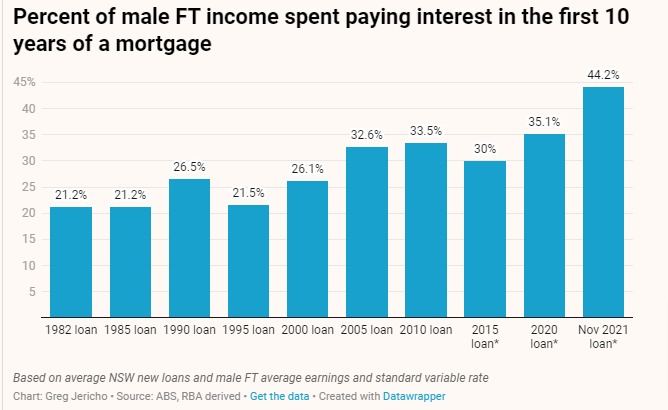
  • Rate rises are going to cause a housing affordability crunch

    But that is about to change.

    The signal that interest rates are going to rise by possibly 2.5% points over the next 18 months means that for new mortgage holders the cost of repaying a mortgage is going to be harder than ever before – harder even than when interest rates hit 17% in 1990.

    It is a hit that will only exacerbate standard of living problems as wages will struggle to keep up with the rising cost of of holding a mortgage – especially given the belief that wage rises need to be contained below inflation rises continues in economic debate.

    The post Rate rises are going to cause a housing affordability crunch appeared first on The Australia Institute's Centre for Future Work.
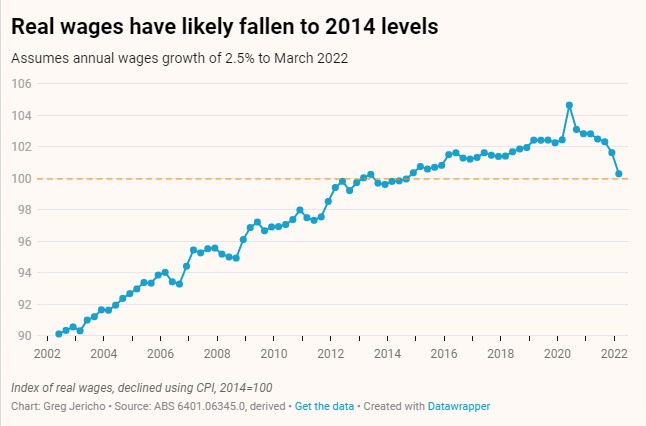
  • High inflation means real wages have plummeted

    Labour market policy director, Greg Jericho, notes in his column in Guardian Australia that even if wages have increased by 2.5% in the next release (up from 2.3% in the 12 months to December) real wages will have fallen 2.5% in the past 12 months.

    That would mean real wages would be back at 2014 levels and barely above where they were when the LNP took office in September 2013.

    Worse still for low-income earners, in the past 12 months the prices of non-discretionary items rose 6.6%. For those whose income goes more towards paying essential bills than does the average household, the pain of these price rises has been much higher. Their real wages have likely fallen by more than 3% in the past 12 months.

    This is why any gloating about a recovery from the pandemic must be tempered to consider the reality of workers’ lives. It is not enough to point to lower unemployment if real wages are falling faster than they ever have outside of the introduction of the GST – especially for lower income earners.

    That is not a recovery; that is a failure.

    With interest rate rises now very much on the way, without wage rises that account for inflation and properly reward for increases in productivity, workers standard of living is set to fall and see them back where they were nearly a decade ago.

    The post High inflation means real wages have plummeted appeared first on The Australia Institute's Centre for Future Work.

  • Free Undergraduate Education to Save Universities and Jobs: Report

    The next federal government can save universities, make undergraduate education free for all Australians and employ tens of thousands of staff securely by lifting the public spend on higher education to just one per cent of GDP, according to a landmark new report.

    The Australia Institute’s Centre For Future Work report shows, if the federal government brings its annual investment in higher education into line with the OECD average, we could fix the destruction inflicted by the COVID pandemic and make universities more accessible and affordable for all Australians.

    Following decades of funding cuts, government inaction and the pandemic, more than 40,000 jobs were lost in public tertiary education in the 12 months to May 2021, 35,000 of those at public universities.

    National Tertiary Education Union (NTEU) National President Dr Alison Barnes said “Higher education needs to be made a priority in this election. The future of hundreds of thousands of staff and millions of students depends on it.

    “The state of the sector now is deeply concerning. It is the consequence of the Morrison Government’s decision to exclude universities from JobKeeper, hike student fees, cut funding per student place, entrench casualisation and decimate curiosity-driven research funding.

    “Thousands of jobs have been lost at public universities and the staff who are left are being kept on casual or short-term contracts. Those staff can’t plan for their future and often have their pay stolen by money-hungry universities who have built their business models on wage theft and insecure work.

    “The next Australian Government could remove the financial barrier to higher education, employ more than 26,000 staff in secure full-time jobs, restore research funding, reduce the over-reliance on casual staff and establish a new higher education agency to improve governance.

    “Free undergraduate education would be transformative for current and future students who are now facing more expensive degrees, mounting student debt and even the threat of being kicked off HECS if they don’t pass their courses.”

    Australia Institute economist and the report’s author Eliza Littleton said “As devastating as the pandemic has been for Australia’s universities, the sector was being distorted and damaged by corporatisation, casualisation, and privatisation long before COVID arrived.

    “Australia needs an ambitious national vision for higher education that re-aligns the sector with its public service mission, and with the needs of students, staff, and wider society.

    “Australia can choose a future for higher education that facilitates a stronger economy, social mobility and enhanced democracy – all the while generating a source of high-quality careers for many thousands of Australians.”

    The report’s recommendations include:

    • Free undergraduate education for Australian students
    • Adequate public funding for universities
    • Fully-funded research
    • Measures to ensure secure employment
    • Improved higher education governance
    • Caps on vice-chancellor salaries; and
    • Transparency in data collection.

    The post Free Undergraduate Education to Save Universities and Jobs: Report appeared first on The Australia Institute's Centre for Future Work.

  • At the Crossroads: Post-COVID future of Australian universities

    The report analyses the current worrying state of Australia’s higher education sector based on current funding and policy trends, and provides an ambitious national vision for higher education that re-aligns the sector with its public service mission.

    At the Crossroads, authored by Eliza Littleton, identifies seven key policy initiatives including free higher education for domestic students, that if implemented, would put Australia’s public universities on a path toward full revitalisation.

    Key Findings:

    • Delivering free undergraduate education for domestic students, an expanded public research program, thousands of secure jobs, and a new national governance body for the sector would cost an estimated $6.9 billion per year in additional higher education funding. This funding would generate almost 27,000 additional jobs (FTE) in higher education through easing workload pressures, additional researching funding and staffing a new independent higher education agency.
    • Since 2013, Federal Government funding for higher education has declined in real terms by 2.6%, despite a 23% increase in student enrolments.
    • Federal Government funding as a percentage of university revenue has more than halved since the 1980s, declining from 80% in 1989 to only 33% in 2019. In Budget 2022-23, the government forecasts a cut to real university funding of 3.4% over the forward estimates.
    • Universities responded to the pandemic shock with dramatic job cuts. In the 12 months to May 2021, 40,000 jobs in public tertiary education were lost, with 88% of these losses estimated within public universities.
    • The Federal Government’s Job-Ready Graduates reforms result in a reduction in government spending on student learning of $1 billion per year, while student contributions increase $414 million per year.
    • In the face of COVID shocks, sustained international student fee intake combined with reduced teaching costs through online distance education and job cuts have primed universities for healthy surpluses this financial year. Despite that, universities are continuing with measures that further downsize and casualise their workforces,
    • Reduced government spending and university deregulation has led to teaching and learning crisis. Rampant casualisation, short-term contract use, excessive workloads, and wage theft characterise employment arrangements in Australia’s universities.

    The report recommends several measures to revitalise Australia’s public universities:

    • Free undergraduate education for domestic students
    • Adequate public funding for universities
    • Fully-funded research
    • Measures to provide secure employment
    • Improved higher education governance
    • Caps on vice-chancellor salaries; and
    • Transparency in data collection.

    The post At the Crossroads appeared first on The Australia Institute's Centre for Future Work.

  • We (still) need to talk about insecure work

    Taking this perspective to task in a piece for The New Daily, Jim Stanford and Mark Dean discuss how a much broader range of forms of insecure work face many workers in Australia today, with the issue not getting any better. This is not even a trend created by unavoidable conditions created by the pandemic; it has rather been a deliberate outcome of the federal government’s labour market policies. Simply pretending it isn’t an issue won’t make it go away; nor will it provide us with sustainable solutions to the precarious situation that will keep facing more and more workers until the problem of insecure work is adequately addressed

    The post We (still) need to talk about insecure work appeared first on The Australia Institute's Centre for Future Work.

  • The election campaign needs to be more than a quiz show

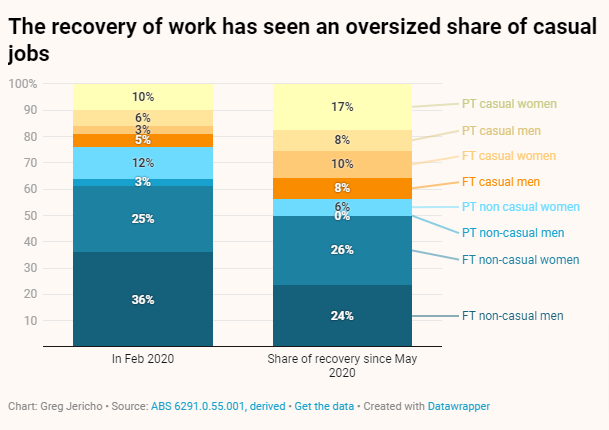
    Labour market and fiscal policy director, Greg Jericho writes in his Guardian Australia column that the recovery from the depths of the pandemic has overwhelmingly been on the backs of casual workers. It also has seen a large increase in the gap between people on JobSeeker and the number of unemployed. The rise of low paying, insecure work that has helped bolster the employment figures has also meant people who are working but still earning less than enough to keep out of poverty is remaining high.

    The post The election campaign needs to be more than a quiz show appeared first on The Australia Institute's Centre for Future Work.

  • Universal Public Early Child Education in Australia Would Pay For Itself: Research Report

    Making Early Child Education and Care (ECEC) universal in Australia would pay for itself by unlocking women’s labour supply, boosting GDP and growing government revenues by billions, according to new research from the Australia Institute’s Centre for Future Work.

    With cost of living shaping up as a key election issue, policy experts say boosted funding would ease the pressure on families, while boosting the economy.

    Key Findings:

    • ECEC funding is lower in Australia than other countries, yet private revenues (mostly paid by parents) are higher. Australian parents currently pay more but get less
    • Matching the ECEC funding levels of Nordic countries would generate 292,000 new jobs, directly, downstream and via increased women’s employment
    • If Australian women had the same participation and full-time employment rates as Nordic women Australia’s GDP would be some $132b per year higher
    • Government funding for public and non-profit childcare generates one-third more employment and GDP than funding for private for-profit firms
    • The economic activity supported by expanded funding for public and non-profit ECEC centres would boostAustralian GDP by a further $35b
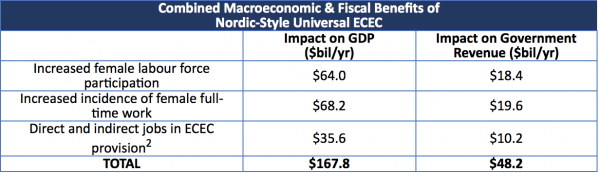
    • The combined boost to GDP would create an additional $48b in government revenue, more than the cost of providing the childcare services in the first place

    “This is a program that literally pays for itself,” said report author and Senior Economist at the Australia Institute, Matt Grudnoff.

    “This would create tens of billions of dollars in new GDP, hundreds of thousands of jobs and billions of dollars in government revenue – above and beyond the cost of providing those services in the first place.

    “A high-quality, accessible, and non-profit Early Child Education and Care system would facilitate the expanded paid work effort of hundreds of thousands of Australian women, helping close the gender pay gap.

    “At a moment when employers are complaining about a labour shortage, there is an obvious answer: support hundreds of thousands of women to increase their labour supply.

    “Expanded ECEC must be done right, to maximise the potential economic and social benefits. Funding must be directed to not-for-profit and public centres which put top priority on quality – not subsidising the profits of private investors who see children as a profit centre, not a social priority.

    “Childcare is a significant cost-of-living issue for many families with many spending more on childcare than groceries or utilities.

    “This is one of the smartest investments we could make for parents, for employment and for our society. It’s a no-brainer.”

    The report, The Economic Benefits of High-Quality Universal Early Child Education compared ECEC funding levels in Australia to other OECD countries.

    The below table summarises the combined impacts on GDP and tax revenues (for all levels of government) from the increase in labour force participation and full-time work by women, and the direct and indirect jobs associated with ECEC supply.

    The post Universal Public Early Child Education in Australia Would Pay For Itself: Research Report appeared first on The Australia Institute's Centre for Future Work.

  • The Economic Benefits of High-Quality Universal Early Child Education

    A universal ECEC system should be viewed as a fundamental goal for the future Australian economy. Achieving the superior quality and economic benefits of the Nordic systems cannot be done instantly, of course. But our ECEC policies should be reoriented and expanded, with a universal, publicly-delivered, high-quality, and affordable system akin to the Nordic benchmark as its end goal. That will require more substantial investments in ECEC funding, and its reallocation toward the not-for-profit and public facilities which deliver the best quality, and the largest economic benefits.

    The post The Economic Benefits of High-Quality Universal Early Child Education appeared first on The Australia Institute's Centre for Future Work.