Tag: Economics

  • The biggest real wages fall on record

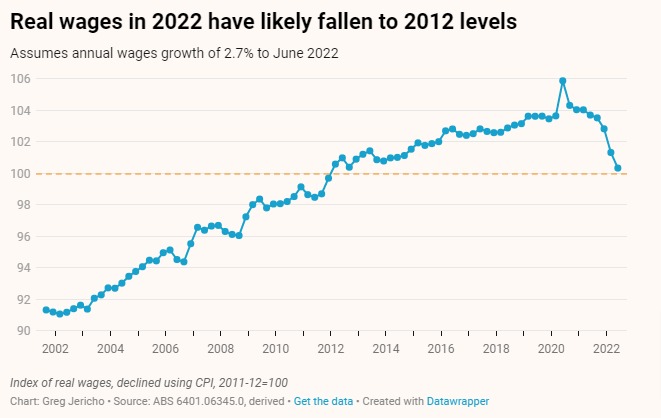
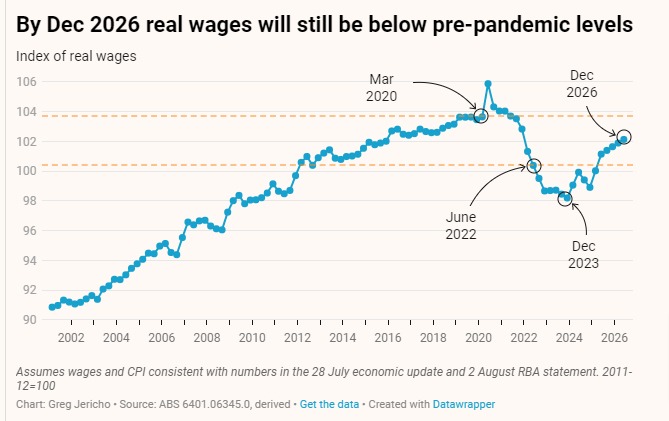
    In his column in Guardian Australia, Labour Market and Fiscal Policy Director, Greg Jericho, notes that while nominal wage grew 2.6% in the past year, real wages fell 3.3%. That fall has taken workers’ purchasing power back to 2012 levels.

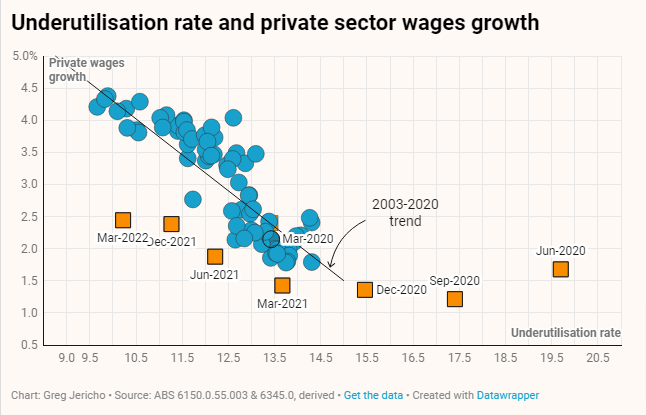
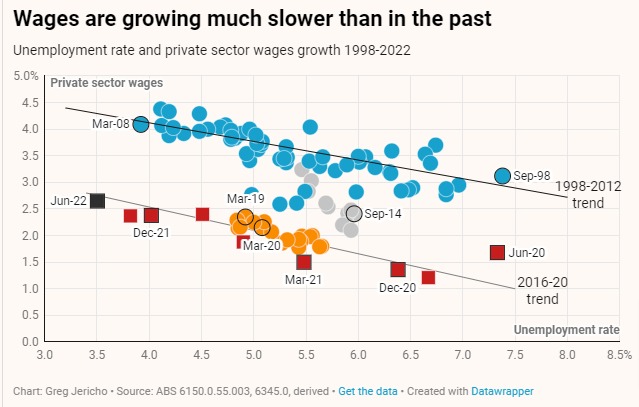
    This lack of strong wages growth despite unemployment being at nearly 50 year lows highlights just how skewed the bargaining system is against employees. In the past, unemployment this low would have been delivering wages well above 4%.

    The weak public-sector wages growth also reveals the impact of public-sector wage caps. For 6 consecutive quarters the annual growth of public-sector wages has been below that of the private sector. No longer does the public sector guide and support private-sector wages. This is the result of instituting arrangements which prevent a natural bargaining process to occur and in a time of rising inflation produce a massive fall in real wages for public-sector workers.

    In the past year wages in the education system, for example, rose just 2.3% on average, meaning teachers real wages fell 3.7% in the past year.

    While the real wages fall is terrible, it is likely worse for many families.

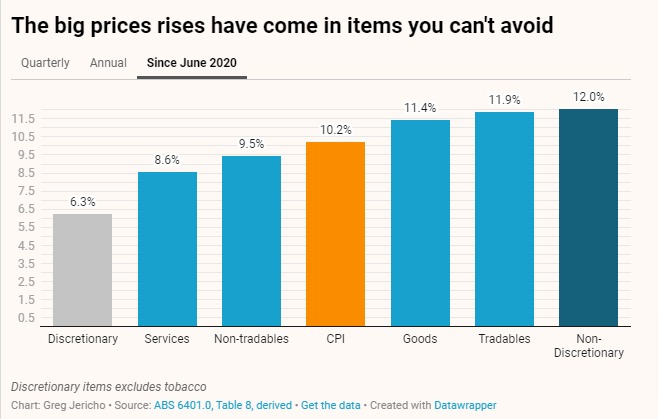
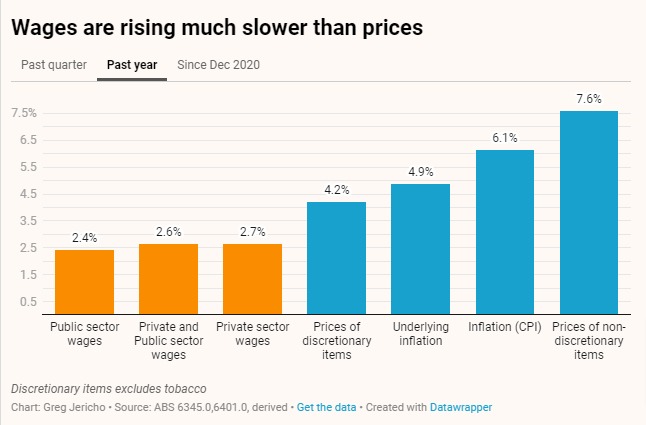
    The Bureau of Statistics estimates that households on average spend around 60% of their weekly expenses on essential/non-dictionary items. But because the prices of those items rose by 7.6% over the past year compared to average inflation of 6.1%, any households that need to spend a greater share of their income on essential items would have seen their real wages fall even further. For a family that spends 80% of their weekly budget on essential items, real wages fell by 4% – a truly horrific experience.

    The wages data confirm that there is no wages breakout that is driving inflation, instead workers are being left behind while companies produce record profits.

    The Jobs and Skills Summit in September must address this imbalance.

    The post The biggest real wages fall on record appeared first on The Australia Institute's Centre for Future Work.

  • The latest taxation statistics reveal the massive gender pay gap across the whole economy

    The 2019-20 taxation statistics released this week by the ATO provide a plethora of data that reveals with precision the salaries of people by location, occupation age and importantly, gender.

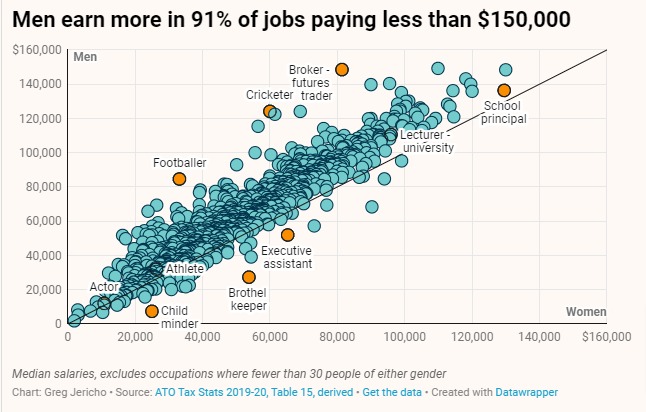
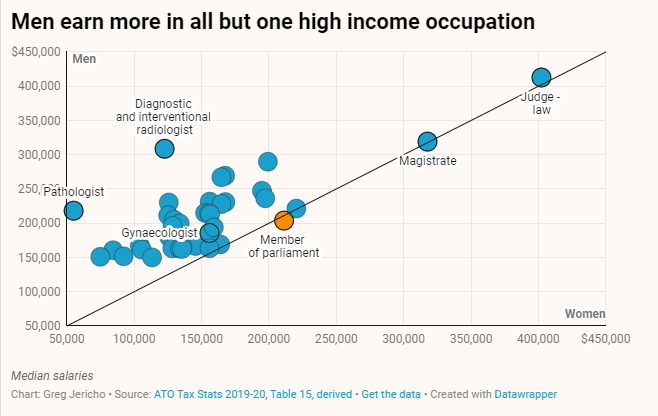
    Labour market and fiscal policy director, Greg Jericho, undertook a deep dive into the data. He notes in his column in Guardian Australia that in 91% of over 1,000 separate occupation groups from Nightclub DJ through to Magistrates and Judges, men have a higher median income than do women.

    The data reveals that women are less likely to work in higher paying occupations, and perhaps more damning those occupations with high levels of female participation are more likely to be low paid than are jobs which are mostly done by men.

    It is clear that work traditionally done by women is much lower paid than stereotypically traditional male jobs.

    But it is not just those occupations where the imbalance occurs. Even in jobs where women are the majority of workers, men will likely have a higher median salary and be more likely to be paid over $90,000 a year and be within the top two tax brackets.

    Women for example make up 57% of a journalists, and yet account for just 46% of all journalists earnings between $90,000 and $180,000 and a mere 36% of those earning above $180,000.

    The data highlights that the gender pay gap is not just about being paid the same hourly rate for the same work, but who gets the opportunity to work more hours, and who is more likely to be given roles that pay higher wages.

    It reveals a deep structural issue within our economy in which even in jobs largely done by women, the men in those occupations will most likely be paid more.

    The post The latest taxation statistics reveal the massive gender pay gap across the whole economy appeared first on The Australia Institute's Centre for Future Work.

  • An Economy That Works for People (Jobs Summit)

    In preparation for the Summit, the Australian Council of Trade Unions is publishing a series of discussion papers to spark dialogue over key issues that will be discussed at the event. The first of these papers, on the failures of past macroeconomic policy and the need for better approaches, was prepared with input from Jim Stanford, Director of the Centre for Future Work.

    The 23-page report, titled An Economy That Works for People, first reviews the legacy of the last decade of one-sided macroeconomic and labour market policies from former Coalition governments. Boosted by government actions to reduce taxes, labour costs, and regulations, corporate profits have swelled to the highest share of GDP (almost 30%) in history. But that profit has not translated into investment or innovation: at present just 37 cents of each dollar in profit is reinvested in new projects. Meanwhile, the share of GDP going to workers has never been lower since records have been kept: falling to just 45% in 2022. This redistribution of income from workers to businesses is not just a moral failure. The impact of swelling profit margins on inflation, and the drain in spending power arising from uninvested profits, are holding back Australia’s economy considerably.

    An Economy That Works for People

    The paper discusses the causes and consequences of the current surge in inflation in detail, providing conclusive evidence the problem did not arise in the labour market. To the contrary, labour costs have servedto reduce inflation: nominal unit labour costs grew only 2.1% over the last 12 months (below the RBA inflation target), while unit profit margins surged (by over 14%).

    The paper also reviews statistical evidence on Australia’s productivity growth, and in particular on the failure of productivity growth to be reflected in rising real wages. Real put per hour of work has increased 13% over the past decade: not outstanding, but still positive and steady. Real wages, in contrast, have gone nowhere — and are now falling rapidly in the face of accelerating inflation. Rather than risking an economy-wide recession with rapid interest rate hikes (which impose the worst burden on workers and indebted households), the paper calls for a more multi-dimensional and targeted approach by government (supplementing actions by the RBA) to gradually bring inflation down without causing mass unemployment.

    The paper makes 6 specific recommendations for macroeconomic reforms to ensure working Australians share fairly in the benefits of future growth. The first is to elevate full employment in decent jobs as the central goal of macroeconomic policy, and to ensure that all policy interventions (including from the RBA, the Commonwealth government, and other regulatory agencies) are consistent with that top goal.

    Release of the paper generated extensive media coverage and public debate (which was its goal!): including stories in The Guardian, the ABCThe Sydney Morning Herald, The Australian Financial Review, and The Australian. In this feature interview with 2CC Radio host Leon Delaney, Dr Stanford discusses the main recommendations of the report, and whether it is really such a ‘radical’ idea to make full employment the top goal of economic policy:

    The post An Economy That Works for People appeared first on The Australia Institute's Centre for Future Work.

  • Rate rises look set to dramatically slow the economy

    This is expected to have a dramatic impact on the economy with the Governor of the Reserve Bank announcing that the RBA expects GDP growth in 2023 and 2024 to be just 1.75%.

    Labour market and fiscal policy director, Greg Jericho, in his Guardian Australia column, notes that this would be the the first time since the 1990 recession that there have been 2 consecutive years of growth below 2%.

    The steep rise in rates, and the prospect of more to come suggests that the Reserve Bank’s efforts to curb inflation are likely to come at a high cost for workers.

    The past year has seen the biggest fall in real wages since the introduction of the GST and current estimates from the Treasury and the Reserve Bank suggest further falls to come until the end of next year. By that point real wages would be more than 5% below pre-pandemic levels – a truly disastrous result in what is supposedly a recovery period.

    The post Rate rises look set to dramatically slow the economy appeared first on The Australia Institute's Centre for Future Work.

  • Interest Rate Hikes Will Hurt Workers to Protect Profits

    In this commentary, Centre for Future Work Associate Dr Anis Chowdhury challenges the wisdom of this strategy. Since current inflation is related more to supply chain disruptions and other global pressures, higher interest rates will do more harm than good – and shift national income even further toward the owners of capital, instead of working Australians.

    Interest Rates Hikes Will Hurt Workers to Protect Profits

    by Dr Anis Chowdhury

    The Reserve Bank’s latest interest rate hike, the fourth in a series and with more to come, will certainly slow economic activity and raise unemployment. It will hurt families, especially of the working class, who played no role in the current bout of inflation.

    Treasurer Jim Chalmers warned Parliament, “Families will now have to make more hard decisions about how to balance the household budget in the face of other pressures like higher grocery prices, and higher car prices and the cost of other essentials”.

    This is bad news, especially since many will also lose their jobs as the economy slows.

    But it didn’t have to be like this – had the RBA and other policy-makers cared to seriously consider what is driving inflation, and been less dogmatic about their inflation target and how to reach it. Many seem to have forgotten the Labor Government’s own successful experience of addressing inflation in the 1980s through social dialogue, reducing price pressures without causing unemployment to rise. Those lessons should be relearned today.

    What is driving current price rises?

    The primary source of current price pressure is not surging demand, soaring wages, or a household spending spree fueled by pent-up demand and one-off pandemic financial supports. Indeed, as RBA Governor Philip Lowe has acknowledged, “The household saving rate remains higher than it was before the pandemic and many households have built up large financial buffers”.

    Even the labour market tightening and skills shortages seen in some sectors are not the result of surging aggregate demand, but rather mostly due to the impacts of the pandemic on labour supply (including via restrictions on the inflow of migrant workers).

    Instead, the primary driver of current inflation is supply bottlenecks and blockages of goods, caused by a perfect storm of global problems: the pandemic, the war in Ukraine, and climate change’s effect on agricultural supply (and hence prices of food).

    Interest rate hikes cannot fix supply bottlenecks; instead, they will exacerbate supply problems, by discouraging investment in new capacity and infrastructure. Interest rate hikes will also impose collateral damages on government finance, in addition to causing job losses and economic hardship for struggling families.

    The Treasurer’s warning to brace for bigger real wage cuts than previously flagged is no comfort for the ordinary workers who already saw their income share in GDP steadily decline during the past four decades – while the share of GDP going to capital owners in profits continued to rise, setting record highs during the pandemic.

    A recent report from the Australia Institute found that rising prices in Australia are actually driving corporations’ profits to record highs amid a cost-of-living crisis for the rest of us. This has been enabled in large part by lack of competition. Big corporations in energy, transportation, supermarkets, and other sectors use their oligopolistic power to raise prices (and profits) far above what would be necessary simply to cover higher input costs.

    A recent study published in the UNSW Law Journal documented widespread price gouging in Australia: “a notorious practice” involving “pricing high-demand essentials at levels significantly higher than what is commonly considered acceptable, reasonable or fair”. During recent crises, including the Black Summer bushfires and then the COVID pandemic, unethical businesses exploited public desperation for basic consumer goods and services, such as hygiene products, staple foods, and utility services, to raise their profit margins.

    Why raise interest rates?

    The RBA knows it cannot fix supply shortages. Yet still it raises the interest rate, calls it a “forward-looking” strategy, and claims it will stem inflationary expectations and higher wage demands. Basically, this is a tactic to scare workers: in essence, saying to workers they must not ask for compensating wage gains or for restoring their share of domestic income, lest the Bank inflict more pain through losing jobs and livelihoods.

    Central bankers around the world sugar-coat this scare tactic by saying, “It’s short-term pain for long-term gain”. That’s easy for them to say, as no central banker ever lost his/her job for such actions, or have tasted this “short-term pain” (which can actually affect a worker and their family for decades via lost work and suppressed incomes).

    This view also ignores the fact that labour’s bargaining power has significantly declined compared to previous inflationary episodes, due to the erosion of collective bargaining and other institutional supports for wages, new technology, out-sourcing and globalisation. All these factors have driven the steady declines in labour income share and real wages. They also mean that fears of a 1970s-style “wage-price spiral” are not credible.

    The interest rate: a blunt tool

    The dogmatic stance of central bankers will cause more damage than it avoids. Even when inflation is rising, higher interest rates are not the right policy tool to tackle the problem for several reasons.

    First, the interest rate only addresses symptoms, not the root causes, of inflation. Inflation is often understood as the overheating of an economy. Like a fever, overheating of an economy can be due to many causes – fever and overheating are just symptoms. Interest rates, like Panadols or Aspirins, may relieve the overheating, but the treatment requires investigations into the root causes and appropriate medications.

    Second, changes in the interest rate affect all sectors – without distinguishing sectors that need expansion and hence credit support, from sectors that are less productive or inefficient and hence should be credit-constrained. Just as taking too many Panadols or Aspirins can have fatal side effects, hiking interest rates too often and too high can kill productive and efficient businesses along with less productive and inefficient ones.

    Third, the overall interest rate does not distinguish between households and businesses. Higher interest rates may encourage households to save, but will dampen business capital spending. Thus, overall economy-wide demand will shrink, discouraging investment in new technology, plant and equipment as well as skill-upgrading. Thus, higher interest rates adversely affect the long-term productive capacity of an economy.

    Fourth, higher interest rates will raise the debt burden for governments, business and households. Global debt burdens have been on the rise since the 2008-2009 global financial crises, and even more dramatically during the COVID crisis. Those debts (especially sovereign government debts) are manageable so long as economic growth remains robust and interest rates low. Current monetary policy, however, will negatively affect both factors: raising rates and slowing growth. That could set the stage for debt problems down the road.

    Monetary tightening will have implications for fiscal policy, too. A slower economy implies less tax revenues and more social security payments. Government is already under pressure to continue pandemic support measures, such as financial assistance for workers without paid sick leave as well as cost-of-living supports. Planned Stage Three tax cuts, if they go ahead, would further undermine Commonwealth government revenues. For state governments, heavily reliant on stamp duties, a collapse of the housing market would devastate their budget bottom-lines.

    Paradoxically, higher interest rates can even feed into higher costs of living, as indebted households’ debt-servicing costs (especially on mortgages) rise. The cost of living would also rise if businesses with market power pass on their own higher interest costs to consumers through still higher prices.

    Policy innovation

    As mentioned earlier, the current inflationary surge is due to supply shortages of key products, such as food and fuel. Therefore, the long-term solution requires expansion of supply and removal of bottlenecks. Perversely, however, higher interest rates force overall demand to shrink down to match aggregate supply. That can slow price increases, but leaves underlying supply constraints for key products unaddressed – hence not addressing the underlying causes of inflation.

    Therefore, policymakers should consider innovative and more appropriate policy tools to respond to current price pressures. The focus of anti-inflationary policy should be changed radically from suppressing domestic demand to enhancing supply and productivity; from restricting credit indiscriminately to easing financing constraints for key and ‘sun-rise’ industries (e.g., renewable energy) while tightening financial conditions for inefficient (e.g., polluting) and speculative activities (e.g., real estate).

    This would mean designing macroeconomic policies to support industrialisation and economic diversification. Instead of reacting to inflationary symptoms with a lone blunt policy tool (the interest rate), policymakers should wield a mix of fiscal and monetary policy levers: using them to unlock supply bottlenecks, enhance productivity, and encourage savings and productive investments (especially to decarbonise the economy).

    Each of these goals needs innovative and customised policy tools, rather than a one-size-fits-all reliance on interest rates to throw cold water over the entire economy.

    Social partnership

    Inflation and responses to it inevitably involve social conflicts over economic distribution. The ‘social dialogue’ approach of Labor Prime Minister Bob Hawke contrasted with the more confrontational approaches of Margaret Thatcher and Ronald Reagan – and their deliberate use of punishing interest rates to inflict long recessions in the 1980s.

    In contrast, social dialogue in Australia not only brought down inflation and unemployment simultaneously in the 1980s, but also enabled difficult reforms – including floating exchange rates and lower import tariffs. That set the stage for sustained economic growth in years to come.

    The new Labor Government needs to earnestly begin rebuilding that model of social partnership to confront not only current inflation challenges, but the more existential threats of climate change and shifts in the global order.

    The government must also not miss the opportunity to review the RBA’s mandate and operations, including better balancing its board with a more representative variety of stakeholders (including workers). The economy does not work in a vacuum, and should not be entrusted to technocrats. Policies and reforms affect real lives and livelihoods. The RBA needs to understand, and hear, the voices and preferences of all Australians, not just financiers and employers.

    The post Interest Rate Hikes Will Hurt Workers to Protect Profits appeared first on The Australia Institute's Centre for Future Work.
  • A decade of real wages growth lost as prices soar ahead of wages growth

    Given prices grew 6.1%, but wages are expected only to achieve around 2.7% growth in the 12 months to June, it remains abundantly clear that inflation is not being driven by labour costs. Indeed given real wages have likely fallen around 3.4% in the past year, wages are currently extremely deflationary.

    Real wages have now fallen for 8 consecutive quarters sending the purchasing power of employees back to 2012 levels.

    While the economy has rebounded and profits have risen strongly with that of prices, the “recovery” from the pandemic has very much been on the backs of workers who have effectively lost a decade’s worth of growth in real wages.

    Even worse, given the greatest price rises have occurred for essential commodities, it is clear low to median income workers are hurting much more than those who devote less of their spending on essentials than does the average household.

    All this is occurring with unemployment at near 50-year lows. It is now abundantly clear that the labour market systematically disempowers employees and needs to be reformed.

    The post A decade of real wages growth lost as prices soar ahead of wages growth appeared first on The Australia Institute's Centre for Future Work.
  • The Job Summit needs to produce a fairer labour market

    This has not happened by accident or some “invisible hand” of the free market. Decades of industrial relations legislation has purposefully reduced the ability for workers to organise and bargain for better wages.

    Labour market policy director, Greg Jericho writes in Guardian Australia that we are now also seeing for the first time a shift in the relationship between wages and underutilisation.

    These changes have meant that employees are receiving ever smaller slices of the national income pie.

    The past 24 years have also displayed that theory of increasing productivity resulting in better wages, works better in the economic textbook than reality. In just 7 of those 24 years, have real wages outgrown productivity – and 4 of those year were because of highly unusual cases of productivity actually declining.

    The Job Summit in September needs to be a time for a reset – a time to acknowledge that the labour market is not fairly weighted and that workers are not getting their fair share.

    The post The Job Summit needs to produce a fairer labour market appeared first on The Australia Institute's Centre for Future Work.
  • Are Wages or Profits Driving Australia’s Inflation?

    Labour costs have played an insignificant role in the recent increase in inflation, accounting for just 15 percent of economy wide price increases while profits have played an overwhelming role, accounting for about 60 percent of recent inflation.

    The post Are Wages or Profits Driving Australia’s Inflation? appeared first on The Australia Institute's Centre for Future Work.
  • Will curing inflation cause a recession?

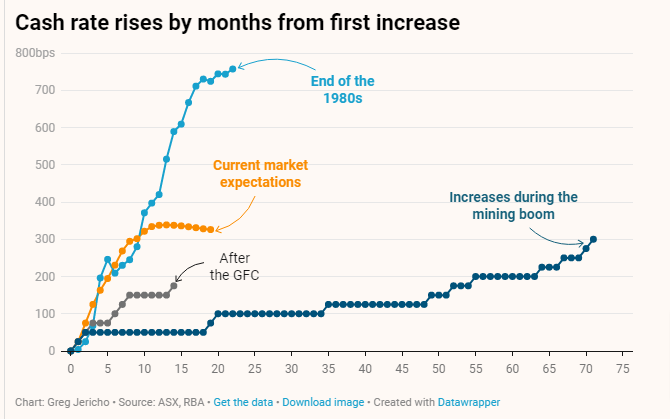
    Labour market and fiscal policy director, Greg Jericho writes in Guardian Australia that the rising level of inflation, which combined with low wages growth has led to massive falls in real wages, has many Australians wondering if increasing interest rates is going bring the economy to a halt.

    He writes that for now a recession is unlikely, but the risks remain. Previous periods of sharply increasing rates have been followed by rising unemployment, and the current market expectations for the cash rate rising above 3.5% within a year would certainly create a massive brake on the economy.

    The story from overseas is also worrying, with the United States battling even higher inflation than Australia and suggestions that the market is already pricing in a recession.

    It all highlights that while today’s labour force figures are on the surface very promising, they also show just how affected the economy continues to be by the pandemic. Nearly 300,000 employed in June worked zero hours because of sickness or injury – well over double the usual amount.

    The nearly 50-year low unemployment rates are also failing to lead to wages growth anywhere near what would have been expected in previous years, let alone at a level that is keeping up with inflation.

    While inflationary pressure do remain, the risk that the Reserve Bank will raise rates too high and too fast remains very much in place – especially given the lack of wages growth.

    The post Will “curing” inflation cause a recession? appeared first on The Australia Institute's Centre for Future Work.
  • Profits push up prices too, so why is the RBA governor only talking about wages?

    Reserve Bank of Australia governor Phillip Lowe has invoked memories of the 1970s, warning wage growth must be restrained to contain Australia’s surging inflation.

    In the 1970s, Lowe said last week, “we got into trouble because wages growth responded mechanically to the higher inflation rate”. Now, with inflation above 5%, and tipped to reach 7% by the end of the year, he wants want people to keep in mind an “anchoring point” for wage growth of 3.5%.

    That 3.5% represents the central bank’s long-standing judgement that wage growth equal to the RBA’s ideal inflation target (2.5%) plus productivity growth (typically more than 1% a year, currently above 2%) is economically sustainable.

    Lowe says “if wage increases become common in the 4% and 5% range” that will make it harder to get inflation back to his target. But that prospect seems so remote it’s a wonder why he focused on it. Particularly when he said nothing about about the role of ever higher profits on increasing prices.

    Wages increases aren’t the problem.

    Nominal wage growth has languished well below that 3.5% benchmark since 2012. The last time wages grew at more than 4% was 2009.

    Over the past decade, wages have fallen further and further behind the level implied by the RBA’s magic formula. During this time Lowe (governor since 2016) repeatedly cited weak wages as a key factor keeping inflation below the bank’s 2-3% target – but nothing happened.

    So why is he now ringing alarm bells about wages growing too fast? It’s not at all clear when broad wage growth will even regain 3.5%, let alone surge faster.

    The Fair Work Commission’s decision this month to raise the minimum wage by 5.2% and wages for other award-covered workers by 4.6% will boost the pay for about a quarter of workers. But even that can’t be considered “inflationary” by any stretch of imagination. In real terms, the minimum wage will fall again this year, as it did last year.

    Most other workers have little chance of doing as well.

    Wage gains from enterprise bargaining agreements (covering about 35% of workers) remain subdued. In the latest 12-month period they delivered an average increase of just 2.6%.

    For the 38% of workers on individual contracts – now the most common pay-setting method in Australia’s individualised labour market – there is even less reason to expect wage growth to suddenly accelerate.

    Profits have played a bigger role

    Labour is not the only component in production costs: a considerable profit margin is also built into final prices. In fact, after decades of capital’s share of GDP increasing while labour’s declines, those profits have become more important in price-setting.

    That’s a big change from the 1970s, when the narrative about wage-driven inflation became so firmly locked into the national policy discourse.

    Indeed, by the end of 2021, corporations made 62 cents in gross profit for every dollar they paid in labour compensation. That’s the highest in history – and more than twice the rate in the 1970s.

    Yet while the RBA warns darkly about rising labour costs, the growing importance of profits in driving higher prices is not mentioned. This reflects an ideological bias that wages are a “cost” item that must be tightly controlled, while profit is assumed to be a legitimate “reward” to businesses that efficiently supply the market with something valuable.

    Calculating profit costs
    The Australian Bureau of Statistics calculates several measures of unit labour costs – the cost of employing labour per “unit” of production. It does not publish a measure of “unit profit cost” – what gets paid in profit per unit of production. But perhaps it should. That might motivate greater attention to the role of profit margins in current inflation.

    In lieu of ABS data, however, we can create a broad measure of unit profit cost by comparing the growth of nominal corporate profits to the growth of real output (similar to the methodology for measuring unit labour costs).

    As shown in the following graph, since the start of the COVID-19 pandemic unit profit cost has surged 24%, compared with a 4% increase in the nominal unit labour cost (which, being over two years, is still below the RBA’s inflation target.

    Blaming the victims
    Warnings about wages misdiagnose the source of current inflation. They blame the victims of falling real wages for a problem they did not cause.

    The RBA acknowledges the upsurge in inflation was initially fuelled by COVID-19 disruptions – including supply chain problems, global energy prices and major (but temporary) shifts in the composition of consumer demand.

    But corporations with pricing power (particularly potent in sectors like energy, housing and groceries) took advantage of those disruptions to fatten their profit margins. They have profited from inflation, while workers lost out.

    Now workers are being told they must swallow further real wage cuts to fix the inflation that enriched their employers.

    Once the RBA confronts the issue of inflated profits as both a cause and a consequence of current inflation, we then might discuss labour’s role. Until then, workers are justified in fighting to protect their real incomes.

    The post Profits push up prices too, so why is the RBA governor only talking about wages? appeared first on The Australia Institute's Centre for Future Work.