Tag: COVID-19

  • Snatching Defeat from the Jaws of Victory: Labour Market Implications of Australia’s Failed COVID Strategy

    The resulting surge in infections has been among the worst in the industrialised world (worse than the U.S. now, as shown in the following graph from Our World in Data). The implications of this massive outbreak for work, workers, production, and the economy have been as predictable as they are devastating. One-third or more of workers in the most-affected regions cannot attend work: because they contracted COVID, were exposed to it, or must care for others (like children barred from child care and soon, possibly, schools).

    Our Centre for Future Work team has been active in highlighting the risks of ‘letting it rip’, analysing the failures of isolation and income support programs, and reminding everyone that keeping workers healthy must be the first priority in keeping the economy healthy. Here is a selection of our recent interventions:
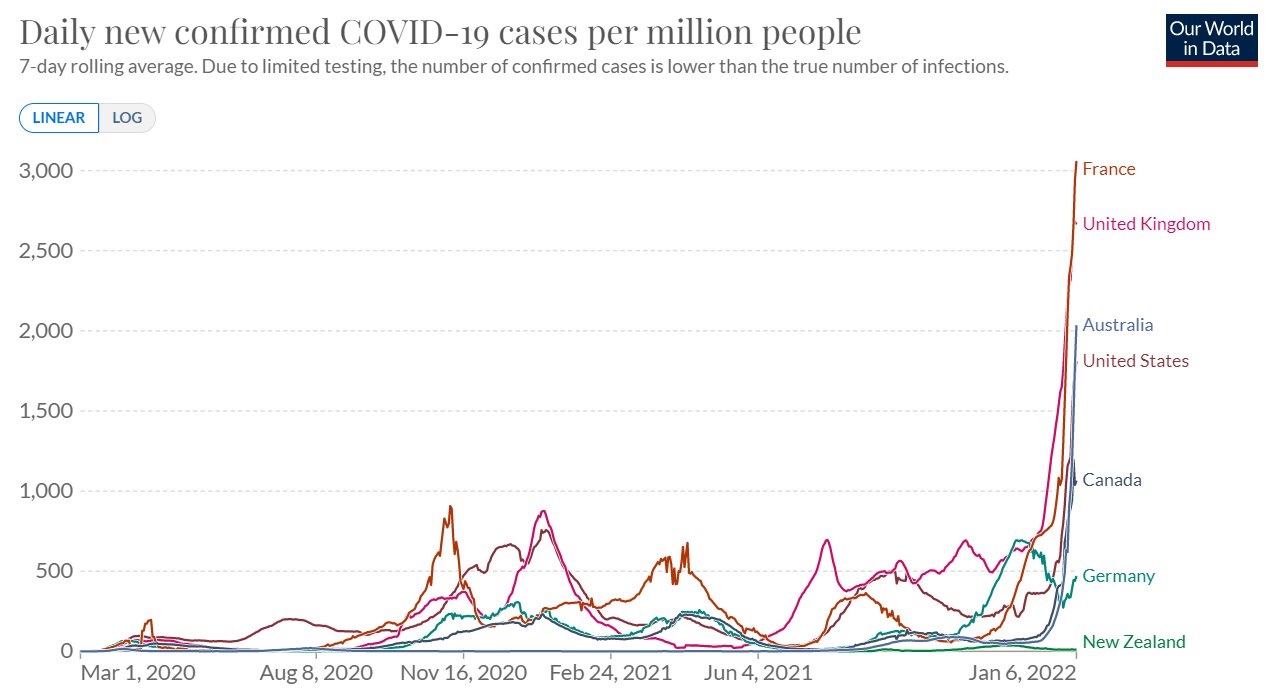
    New COVID Cases per Million (7-day rolling)

    • Our Director Jim Stanford reminded policy-makers in this commentary in The Conversation that human labour is the critical input to production at all stages of value-added and supply chains, and if policy-makers acknowledged the centrality of work to the economy they would not have made such destructive choices. The article was reposted by the ABC, the Sydney Morning Herald, and other platforms, and viewed over a half-million times.
    • Senior Economist Alison Pennington has exposed the flaws in government isolation and testing systems. For example, she highlighted the perverse incentives created by the NSW government’s punitive $1000 fine for failing to register a positive RAT test — never mind the governments’ failures to make tests available, and support workers (with necessary income benefits) to isolate. Her analysis was shared thousands of times, and featured in multiple news coverage (including News.com, The New Daily, and Yahoo Finance) of the flawed NSW policy.
    • Alison further detailed the flaws in changes to the Commonwealth government’s isolating support payments, in this commentary in The New Daily. By punitively excluding hundreds of thousands from isolation benefits, the policy will accelerate contagion and make supply chain problems even worse down the road.
    • Our experts have been featured in numerous other reports on the supply chain problems arising from the Omicron surge, including these reports on Channel 10, Today, The Age, ABC Online, and The Guardian.
    • Our Economist Dan Nahum linked the surge in Omicron contagion to the spread of insecure work arrangements in Australian workplaces. And the Centre’s previous work on how COVID has accentuated the dominance of casual and insecure work in Australia’s labour market shows that without urgent action to improve job quality, the labour market will be even more vulnerable to the inevitable future disruptions from this continuing crisis.

    Our team of experts will continue monitoring the dangerous labour market developments arising from Omicron, and flawed government responses to it. Please watch our site and follow our Twitter feed for regular updates.

    The post Snatching Defeat from the Jaws of Victory: Labour Market Implications of Australia’s Failed COVID Strategy appeared first on The Australia Institute's Centre for Future Work.

  • International COVID-19 Income Supports: An Update

    In several countries, governments with stronger commitments to public health and safety, and a more inclusive and equitable recovery from COVID-19, have been more cautious and incremental in scaling back government interventions. Some have also made permanent improvements to income security and other policies whose shortcomings became more apparent during the pandemic. In Australia, however, the phase-out of COVID-19 wage subsidies and income supports was accelerated and premature – perhaps more so than any other major industrial country. A new comparison of COVID support policies across numerous industrial countries confirms the economic and public health risks of the rapid elimination of Australia’s COVID programs.

    This briefing paper, prepared by Alison Pennington and Jim Stanford, catalogues a selection of international income support measures introduced in response to the COVID-19 pandemic, and reports on recent changes in those programs as vaccinations roll out and economies have re-opened. This catalogue allows us to make a comparative assessment of the level and coverage of Australia’s provisions, in relation to other jurisdictions.

    After summarising the status of Australia’s Commonwealth-administered COVID-era payments, other countries are surveyed, organised into two groups: those with income support programs still in place, and those whose programs had been eliminated at time of writing. A conclusion summarises the comparison, which confirms that Australia has been an outlier among industrial countries in the speed with which emergency COVID-19 measures were eliminated.

    The post International COVID-19 Income Supports: An Update appeared first on The Australia Institute's Centre for Future Work.

  • Eight free weeks: Time stolen from employees skyrockets during COVID

    The number of hours stolen from Australians by employers has skyrocketed during the COVID-19 pandemic, with the average employee now providing eight full-time weeks of free work per year.

    17 November 2021 marks Go Home on Time Day, run by the Australia Institute’s Centre for Future Work, and now in its thirteenth year.

    Key findings from this year’s Go Home on Time Day report:

    • The average employed Australian is performing 6.13 hours of unpaid work each week in 2021, up from 5.25 in 2020, and 4.62 in 2019.
    • That time theft equates to 319 hours per year, or over eight standard 38-hour work weeks per worker.
    • This unpaid overtime represents the loss of $125 billion in income from Australian workers in the past year, or $461.60 per worker every fortnight.
    • COVID-19 appears to have accelerated Australia’s time theft crisis, with 26% of workers reporting their employers’ expectations of their availability increased during the pandemic.
    • Amidst the growth in working from home during COVID, employers are using new technologies to pressure and monitor employees. 39% of workers report their employers are remotely monitoring them through technology like webcams and keystroke counters.
    • Young workers aged 18-29 performed the most unpaid overtime (8.17 hours per week)

    “This year Australian workers are taking home a smaller share of GDP than we have ever seen before. Yet, time-theft is rife and bosses are stealing record amounts of unpaid time from workers,” said Dan Nahum, economist at the Australia Institute’s Centre for Future Work.

    “Arriving at work early, staying late, working through breaks, working nights and weekends, taking calls or emails out of hours – there are a host of ways employers steal time from their employees, and we see them all being used prodigiously.

    “COVID-19 has made the situation worse, indicating work-from-home does not necessarily improve work life in favour of employees. Instead we’re seeing further incursion of work into people’s personal time and their privacy. In many cases it’s making it easier for employers to undercut Australian minimum standards around hours, overtime, and penalty rates.

    “Alarmingly work-from-home arrangements have been accompanied by innovative surveillance methods, with 39 per cent of employees saying their employers remotely monitor their activity and a further 17 per cent unsure whether they were being electronically monitored or not. When one in three workers say they are being monitored via webcam and 30 per cent say their every keystroke is being recorded, it’s clear our industrial laws are not keeping pace with tech.

    “If Australians want to stop this alarming theft of billions of hours of time, and hundreds of billions of dollars of income, policymakers need to strengthen workers’ power to demand reasonable, stable hours of limit, and fair payment for every hour they work. This is all the more important with so many Australians working from their own homes.”

    Mr Nahum said it was an injustice that many Australians report being eager for more paid hours while contributing free ones to their boss.

    “Half the part-time and casual workers in this country report they are keen for more paid hours, yet the average part-timer is giving away over 4.5 hours a week and the average casual just over 5 hours,” Mr Nahum said.

    “These are worker efforts that should end up as wages in someone’s pocket, not a boost to a profit column.”

    The post Eight free weeks: Time stolen from employees skyrockets during COVID appeared first on The Australia Institute's Centre for Future Work.

  • Working From Home, or Living at Work? (GHOTD 2021)

    2021 marks the thirteenth annual Go Home on Time Day (GHOTD), an initiative of the Centre for Future Work at the Australia Institute that shines a spotlight on overwork among Australians, including excessive overtime that is often unpaid.

    Last year’s report emphasised that 2020 had been extraordinary and difficult, and 2021 has brought little reprieve. Australia remains caught in ongoing and interacting twin crises: a public health crisis and an economic crisis. Each influences and reinforces the other.

    Around a third of employed Australians continue to perform at least some of their work from home. As a result, the standard scenario of workers ‘staying late at the workplace’, which largely framed our analysis of excessive work time before the pandemic, is now supplemented by a different dimension of excessive work and unpaid overtime. Now we must consider whether home work will become the “new normal” for many workers even after the acute phase of the pandemic finally passes – and what new pressures on working hours, work-life balance, and unpaid overtime are unleashed by the work-from-home phenomenon.

    Whether working from home or at a formal workplace, the problem of unpaid overtime (whereby workers are not paid for a significant portion of their work) continues to be severe. In fact, the estimated incidence of this ‘time theft’ has increased substantially compared with 2020. In many cases, people’s responsibilities in their home lives have increased in response to the health and social crisis, accentuating a double burden of unpaid work – one that is experienced disproportionately by women.

    Since 2009, the Centre for Future Work and the Australia Institute have commissioned an annual survey to investigate overwork and unpaid overtime in Australia. This year’s poll of 1604 Australians was conducted between 24 and 27 August, with a sample that was nationally representative according to gender, age and state or territory. Of the 1604 respondents, 1048 (or 65%) were currently in paid work.

    Our survey asked respondents about unpaid hours of work, preferences for more or fewer hours, family and caring responsibilities, and the balance between work and non-work life during COVID-19. This year’s survey also asked about electronic surveillance practices implemented by employers to monitor those working from home, and what workers thought about returning to the on-site workplace as the COVID-19 pandemic abates.

    This report summarises the results of that polling, and places it in the context of national labour force trends.

    The post Working From Home, or Living at Work? appeared first on The Australia Institute's Centre for Future Work.

  • Insecure Workers Have Been the Shock Troops of the COVID-19 Pandemic: New Report

    New research from the Australia Institute’s Centre for Future Work confirms that workers in casual and insecure jobs have borne the lion’s share of job losses during the COVID-19 pandemic – both the first lockdowns in 2020, and the more recent Delta-wave of closures.

    Key Findings:

    • Since May, workers in casual and part-time jobs have suffered over 70% of job losses from renewed lockdowns and workplace closures.
    • Casual workers have been 8 times more likely to lose work than permanent staff. Meanwhile, part-time workers have been 4.5 times more likely to lose work than full-timers.
    • The report documents the disproportionate concentration of insecure work among women, young workers, and in the retail and hospitality sectors. Women hold over 53% of all casual jobs, but only 48% of permanent roles.
    • Average wages are much lower in insecure jobs. Casual workers, on average, earn 26% less per hour and 52% less per week than permanent workers – contrary to the common assumption that casual workers receive higher wages to offset their lack of entitlements and job protections.
    • The research estimates that if casual workers received the same hourly wages as permanent staff, overall wage incomes in Australia would grow by $30 billion per year, or 3.5%. That would mark a welcome change from the past eight consecutive years of record-low wage growth.
    • The report also shows that less than half of working Australians now hold a permanent, full-time waged job with entitlements. The traditional norm of a ‘standard’ job has been eroded on all sides by part-time jobs, casual work, temporary and contractor jobs, precarious forms of self-employment, and (more recently) on-demand gig work.

    “Workers in insecure jobs have been the shock troops of the pandemic,” said Dr Jim Stanford, director of the Australia Institute’s Centre for Future Work, and report author.

    “They suffered by far the deepest casualties during the first round of layoffs. Then they were sent back into battle, as the economy temporarily recovered. But now their livelihoods are being shot down again, in mass numbers.

    “It is bad enough that workers in these jobs do not receive basic entitlements like paid sick leave or severance protections. But even when they are working, they are paid far less than other workers.

    “The long-term and multi-faceted expansion of insecure work, in all its forms, is ripping apart economic and social stability in Australia.”

    “Recent changes in labour law, which confirm the right of employers to use casual labour in any position — even stable long-term roles — will lead to further expansion of insecure work once the pandemic is over. New pathways for workers to convert to permanent status have numerous limitations and exemptions, and will not significantly affect growing job insecurity.”

    The post Insecure Workers Have Been the ‘Shock Troops’ of the COVID-19 Pandemic: New Report appeared first on The Australia Institute's Centre for Future Work.

  • Shock Troops of the Pandemic: Casual and Insecure Work in COVID

    New research confirms that workers in casual and insecure jobs have borne the lion’s share of job losses during the COVID-19 pandemic – both the first lockdowns in 2020, and the more recent second wave of closures.

    Since May, workers in casual and part-time jobs have suffered over 70% of job losses from renewed lockdowns and workplace closures. Casual workers have been 8 times more likely to lose work than permanent staff. And part-timers have been 4.5 times more likely to lose work than full-timers.

    “Workers in insecure jobs have been the shock troops of the pandemic,” said Jim Stanford, Economist with the Centre for Future Work and author of the report. “They suffered by far the deepest casualties during the first round of layoffs. Then they were sent back into battle, as the economy temporarily recovered. But now their livelihoods are being shot down again, in mass numbers.”

    The post Shock Troops of the Pandemic appeared first on The Australia Institute's Centre for Future Work.

  • Post-COVID-19 policy responses to climate change: beyond capitalism?

    As Australia moves further away from anything resembling a sustainable pathway to reach these goals (i.e., $90bn submarines that we will not see for at least 20 years but no meaningful action on climate change), a new Labour and Industry article – co-authored by Laurie Carmichael Distinguished Research Fellow Mark Dean and Centre for Future Work Associate, Professor Al Rainnie analyses four alternative responses proposed by Australian unions, climate change groups and grassroots community organisations.

    The purpose of this article has been to identify the range of options that government is capable of pursuing and which, with sensible political choices, can adopt as strategy today. Absent the current federal government’s political will to make long-term choices, Australia is yet to settle on a coordinated policy response that plans and directs the sustainable development of our economy.

    Urgent action is needed to shape policymaking with a strategic, long-term vision that restores the active, interventionist role of government in building an economy capable of overcoming crisis.

    The post Post-COVID-19 policy responses to climate change: beyond capitalism? appeared first on The Australia Institute's Centre for Future Work.

  • An Avoidable Catastrophe: Pandemic Job Losses in Higher Education

    Now, 18 months after the borders were first closed, things are getting worse for universities, not better. New research from the Centre for Future Work confirms that tertiary education has been hit by bigger job losses this year than any other non-agricultural sector in the economy.

    The new report, An Avoidable Catastrophe: Pandemic Job Losses in Higher Education and their Consequences, was prepared by Eliza Littleton and Jim Stanford. It shows that total employment in tertiary education in the first half of 2021 fell by 40,000 positions compared to year-earlier levels. Most of the job losses were permanent, full-time positions — and all of them were at public institutions.

    During the first months of the pandemic, casual staff were the first university employees to lose their jobs as universities grappled with the sudden loss of international student fees and other impacts of the pandemic. This year, however, the job losses are both much larger, and targeted at permanent full-time staff. This indicates that universities are undertaking a more permanent downsizing and casualisation of their workforce, on expectation that border closures are likely to persist — and the Commonwealth government will continue to refuse targeted assistance necessary to preserve the universities’ instruction and research capacities.

    The report urges the Commonwealth government to provide special temporary assistance to universities until borders can reopen and revenues return to normal. Targeted support of $3.75 billion would allow the universities to replace and preserve the jobs cut so far this year. Preserving the functions of Australian universities is especially vital at a moment when the economy is undergoing lasting structural changes as a consequence of the pandemic, and hence more students will need higher education opportunities to support the resulting employment transitions. Moreover, the pandemic also reinforced that the need for top-quality research (including in health sciences) is more urgent than ever.

    The post An Avoidable Catastrophe appeared first on The Australia Institute's Centre for Future Work.

  • When the Show Cannot Go On: Rebooting Australia’s Arts & Entertainment Sector After COVID-19

    New research from the Australia Institute’s Centre for Future Work, written by Senior Economist Alison Pennington and Monash University’s Ben Eltham, reveals the ongoing, devastating impact of COVID-19 on Australia’s arts and entertainment sector and provides a series of recommendations to government that would reboot the creative sector following the crisis.

    Key Findings:

    • The arts and entertainment sector is a significant employer in Australia that makes a substantial contribution to the economy.
    • More people work in broad cultural industries (over 350,000) than many other areas of the economy that are receiving greater policy supports, including aviation (40,500) and coal mining (48,900).
    • Despite years of significant funding pressures and policy neglect, the arts and entertainment sector contributed $17 billion in GDP to the Australian economy in 2018-19.
    • However, due to their disproportionately insecure and precarious labour market conditions, arts and entertainment sector workers are experiencing significant ruptures in their employment arrangements due to COVID-19 and the federal government has not adequately responded to the scale and severity of the crisis.
    • Looking ahead, adequate support to rebuild the sector should include: expanding funding to community arts organisations and artists; introducing a new Commonwealth creative fellowships program; creating a whole-of-Australia public streaming platform; introducing an Australian content quota on all services, including international streaming platforms; introducing a digital platforms levy to fund a merged-content production fund; better coordinating cultural policy between federal, state and local government levels, especially during the COVID-19 recovery; and strengthening pay and conditions for arts and entertainment sector workers.

    Quotes attributable to Ben Eltham, School of Media, Film and Journalism, Monash University:

    “COVID-19 has badly damaged Australia’s arts and cultural sector. Rolling lockdowns and health restrictions have devastated the live entertainment sector. Around the world, millions of artists and cultural workers have been thrown out of work by the pandemic,” Eltham said.

    “Tens of thousands of artists now face lockdowns across major cities without adequate protections for their jobs, incomes and productions.

    “The Morrison government’s policy response to the crisis has been late and inadequate. The Morrison government’s attacks on universities, the ABC and local production quotas are all bad news for the future of Australian culture.

    “The pandemic has changed the way we think about creativity and culture. Australians have turned to the arts in their time of need, embracing cultural pastimes during extended lockdowns. We have rediscovered the value of culture, even as the pandemic has spread.

    “Old arguments about government spending have been turned on their head. For many artists, JobKeeper was the first time they had been able to draw a steady, liveable income from their craft. The massive cash injection shows that Australians can afford a better society and culture if we want.”

    Quotes attributable to Alison Pennington, Senior Economist, Centre for Future Work at the Australia Institute:

    “Destructive market-first policies eroded the richness and diversity of arts and culture in Australia long-before COVID-19 hit. Endless short-term grant cycles and philanthropic dependency is not a place the arts and culture sector should “snap back” to,” Pennington said.

    “Australia needs a total public-led reboot of the arts. This cultural reconstruction must ensure that the sector does not just survive the pandemic, but stands ready to flourish on the other side. It must lay the groundwork for a sustainable, vibrant future for the arts and culture, built through ambitious public investment and planning across many sectors of our cultural economy.

    “Australia’s arts and cultural sector needs an ambitious public investment program to provide reliable funding for arts organisations from the grassroots-up, provide arts education to all children, and rebuild cultural labour markets to ensure that artists and cultural workers earn decent, living incomes.”

    The post When the Show Cannot Go On: Rebooting Australia’s Arts & Entertainment Sector After COVID-19 appeared first on The Australia Institute's Centre for Future Work.

  • Creativity in Crisis: Rebooting Arts and Entertainment After COVID

    Culture is an inescapable part of what it means to be human. We can no more imagine a life without the arts than we can imagine a life without language, custom, or ritual. Australia is home to the oldest continuing cultural traditions on the planet, and some of the world’s most renowned actors, musicians and artists. But while we have a proud story to tell, the future of Australian culture looks increasingly uncertain.

    New research from the Centre for Future Work, by Senior Economist Alison Pennington and Monash University’s Ben Eltham, reveals the ongoing, devastating impact of COVID-19 on Australia’s arts and entertainment sector and provides a series of recommendations to government that would reboot the creative sector after the crisis.

    The post Creativity in Crisis: Rebooting Australia’s Arts and Entertainment Sector After COVID appeared first on The Australia Institute's Centre for Future Work.