Tag: Climate & Energy

  • Gas companies are profiting off of human misery – we need a windfall profits tax

    But none of these profits have come from either management decisions or productive investments. The price rise has not come from any economic improvements. No, they have come only from an illegal invasion that is causing great human misery.

    Labour market and fiscal policy director Greg Jericho notes research suggests that the gas sector has accrued around $26bn in profits due to price rises affected by the Russian invasion. He argues that all of these profits should be garnered in taxation – a view that echoes that of former Treasurer Secretary Ken Henry.

    This revenue would be enough to cover the cost of rewiring the nation and greatly assist the tradition to renewables.

    But the problem of revenue are much deeper than the need for a windfall profits tax.

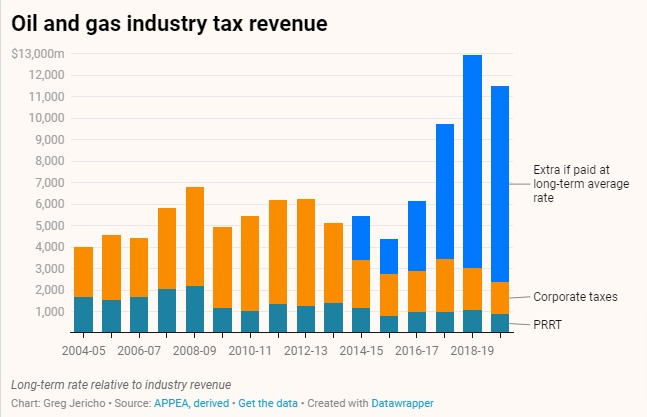
    Jericho’s analysis of industry data reveals that the industry pays much less company tax relative to production than it did in the past.

    Had the industry paid the same level of company tax relative to revenue that is had in the decade prior to the opening of the Gladstone port, in 2019-20 alone, an extra $9.1bn in tax revenue would have been raised.

    Oil and gas are Australia’s resources. Not only are their emissions causing climate change but the profits are largely headed overseas, and more than in the past not flowing through into taxation.

    As Australians demand better and wider government services, and the costs of dealing with climate change grow ever higher, we need to ensure the fossil fuel companies pay their rightful share.

    The post Gas companies are profiting off of human misery – we need a windfall profits tax appeared first on The Australia Institute's Centre for Future Work.
  • The election campaign needs to tackle climate change

    And yet, as policy director Greg Jericho notes in his column in Guardian Australia, the issue has been virtually ignored in the election campaign thus far – with most focus being on the “costs” of reducing emissions rather than a focus on the need to do so, or that the cost of renewable energy has fallen so far that “maintaining emission-intensive systems may, in some regions and sectors, be more expensive than transitioning to low emission systems”.

    There need to be a focus on the jobs in a low-emissions economy rather than a belief that Australia can keep avoiding the reality of climate change.

    The post The election campaign needs to tackle climate change appeared first on The Australia Institute's Centre for Future Work.

  • Post-COVID-19 policy responses to climate change: beyond capitalism?

    As Australia moves further away from anything resembling a sustainable pathway to reach these goals (i.e., $90bn submarines that we will not see for at least 20 years but no meaningful action on climate change), a new Labour and Industry article – co-authored by Laurie Carmichael Distinguished Research Fellow Mark Dean and Centre for Future Work Associate, Professor Al Rainnie analyses four alternative responses proposed by Australian unions, climate change groups and grassroots community organisations.

    The purpose of this article has been to identify the range of options that government is capable of pursuing and which, with sensible political choices, can adopt as strategy today. Absent the current federal government’s political will to make long-term choices, Australia is yet to settle on a coordinated policy response that plans and directs the sustainable development of our economy.

    Urgent action is needed to shape policymaking with a strategic, long-term vision that restores the active, interventionist role of government in building an economy capable of overcoming crisis.

    The post Post-COVID-19 policy responses to climate change: beyond capitalism? appeared first on The Australia Institute's Centre for Future Work.

  • Employment Aspects of the Transition from Fossil Fuels

    Released following the UN Climate Ambition Summit (12 Dec), which highlighted the need for Australia to accelerate the phase-out of fossil fuels, the report finds that delaying climate policy cannot protect the quantity or quality of fossil fuel jobs, which will inevitably decline as the global energy system shifts quickly to renewables. To best protect these workers and communities, pro-active transition planning must start now.

    Key findings of the report include:

    • With strong commitments to alternative employment creation (including, but not limited to, jobs in renewable energy projects), a transition away from fossil fuels can occur without involuntary layoffs or severe disruption to communities.
    • Direct employment in fossil fuel industries is relatively small, just 1% of total Australian employment, and in any single year the overall economy produces twice as many new jobs, as are employed in total in fossil fuel industries.
    • Health care and social services employs 13 times as many people as fossil fuels. At current rates, it would take just two years of new work in health care alone to fully offset all current jobs in fossil fuel industries.
    • Fossil fuel jobs are especially important in some communities, but the number of such communities is small. In just 11 out of 350 Australian communities do fossil fuel jobs make up over 5% of local employment. Strong, focused supports, paid for by the country as a whole, can help those communities adapt to the coming change.
    • Examples of previous transitions in other countries (including Germany, Canada, and Spain) confirm that fossil fuel sectors can be phased out with no involuntary redundancies.

    Dr Jim Stanford, Economist and Director of the Centre for Future Work, and author of the report, highlighted the benefits of long-term planning, an announced timetable, and pro-active transition supports (including supported early retirement, job mobility across sites as fossil fuels phase out, and ambitious regional development and diversification efforts) to avoiding involuntary redundancies or economic damage to regional communities.

    “In fact if managed well, most people currently employed in the fossil fuel industry will not even need to find alternative work: as the industry gradually winds down, most will transition directly from fossil fuel work into retirement, or other forms of voluntary severance.”

    The report was commissioned by HESTA, the industry super fund in the health care sector, and a leader in adjusting its investment portfolio to be consistent with the movement toward net-zero emissions. Mary Delahunty, HESTA’s Head of Impact, noted that “Investment back into a nation’s ‘caring economy’ – health, education and social services – is the most effective way to stimulate economic activity and creates higher-quality, more sustainable, long-term growth.”

    “This report demonstrates that with appropriate investment this can go even further, supporting a manageable, sustainable phase-out of fossil fuel jobs,” Delahuunty added.

    “HESTA was the first major Australian super fund to commit to a total portfolio ‘net zero by 2050’ emissions target as part of our ambitious Climate Change Transition Plan. Supporting a planned transition is crucial to us achieving these ambitious goals and to protecting the long-term value of our members’ investments.”

    The post Employment Aspects of the Transition from Fossil Fuels in Australia appeared first on The Australia Institute's Centre for Future Work.

  • Australian Workplaces Unprepared for Rising Heat Stress in Light of Climate Change

    Heading in to next Summer season, new research published today by the Centre for Future Work, outlines why working in extreme heat is a growing and urgent issue for workers, and what can be done by Governments and workplaces to mitigate these risks.

    Key findings:

    • Heat stress poses serious health and safety risks for many workers across Australia, and Australia must act on the causes of rising temperatures and changing weather patterns.
    • Four key groups of workers are at high risk of heat stress:
      • Workers who work inside, in environments with poor climate control, or whose work requires them to be exposed to heat and humidity;
      • Outdoor workers, especially those who are weather-exposed;
      • Workers moving between different climates as part of their work (i.e., moving between extreme heat and cold); and
      • Workers whose roles expose them to situational extreme heat, such as emergency workers and firefighters.
    • Current labour protections, including health and safety laws, are inadequate.
      • Many workers say that OHS policies might appear to offer protection, but in practice it is simply not the case.
      • Workers say that employers do not want work to stop even when heat stress risk is very high, and that employers prioritise productivity over worker health and safety.
      • The hazardous heatwaves, air quality, and bushfire smoke over the recent Black Summer has emphasised the inadequacy of current OHS regulations.
    • The conditions of a person’s employment fundamentally shape their experience of heat stress. Workers who are employed casually, who work in labour hire arrangements, or who are gig workers, often have less capacity to take action on the effects of heat stress.
    • Recommendations include:
      • The Australian Federal and State Governments must urgently review the management of the current and likely impacts of climate change for workers, and develop national and state-based regulatory frameworks that provide strong protection in relation to heat stress and bushfire smoke.
      • Governments and employers must be required to provide adequate resourcing for at-risk workers.
      • Policymakers should strengthen current laws to ensure workers do not lose income when unable to work due to heat stress.

    “Last year’s devastating Black Summer bushfires highlighted that for many workers across Australia, appropriate policies and plans are not always in place to ensure that they are protected from dangerous heat stress related conditions that could cause illness or injury to themselves or others,” said Dr. Elizabeth Humphrys, associate at the Australia Institute’s Centre for Future Work and co-author of the report.

    “Workers need to be afforded greater protections to ensure their health and safety are paramount in extreme heat conditions. Our research shows that current workplace conditions are woefully inadequate, while climate change will only serve to make conditions worse.

    “To protect workers and the wider community, not only must policymakers act to mitigate the impacts of heat stress, but they must also act on the causes of the climate heating, itself.”

    The post Australian Workplaces Unprepared for Rising Heat Stress in Light of Climate Change appeared first on The Australia Institute's Centre for Future Work.

  • State Income Taxes Would Promote Inequality and Debt

    The latest “big idea” on tax policy from the Coalition government is to grant independent income tax powers to the states. This would be accompanied by a devolution of funding responsibility for big-ticket services like health care, hospitals, and schools. Prime Minister Turnbull argues that forcing state governments to raise the money they spend will lead to more accountability and efficiency in public service delivery. And it’s a politically convenient response to the demands from states for more revenues: “If you need it so much, go out and raise it yourself.”

    While this trial balloon serves a short-run political function for a government struggling to define its agenda, it would be a terrible way to organize long-run fiscal affairs in a diverse, federal country. Canada’s experience with tax devolution is an appropriate cautionary tale. Like Australia, Canada is a federal country with a complex division of government responsibilities, a vast resource-dependent economy, and big economic and social gaps between regions.

    Canada’s ten provinces have the power to set their own personal income and company taxes. They also set province-specific GST rates. The result is enormous variation in tax rates (and rules). Top marginal provincial income tax rates range from 11.25 percent in Alberta, to over 25 percent in Quebec and New Brunswick. Provincial GST rates range from zero in Alberta, to almost 10 percent in Quebec. In each case, provincial taxes are in addition to those levied by the federal government (with its own GST of 5 percent, and a top marginal federal income tax of 33 percent). Each province also sets its own rules regarding coverage, eligible deductions, and tax brackets, complicating inter-provincial business.

    It’s not just that individuals must pay tax twice, to different levels of government. (In fact, at tax-filing time, taxpayers must fill out two forms to separately determine what they owe to the federal and provincial governments.) More damaging are the long-run fiscal and social mechanisms set in motion by interprovincial tax disharmony.

    Provinces enjoying stronger economic conditions can reduce their tax rates, yet still raise adequate revenue. This sparks a destructive race-to-the-bottom in tax rates that undermines government revenues in all provinces.

    The worst example of this occurred during the resource boom of the 2000s. Oil-rich Alberta adopted a low flat-tax applying to all taxpayers (no matter how wealthy). This helped the Conservative government there get reelected. But it exacerbated demands in other provinces (especially neighboring British Columbia and Saskatchewan) to reduce their own taxes in tandem. Well-off Canadians (especially those receiving business or investment income) can easily establish multiple “residences,” allowing them to pay tax in the lowest-rate province.

    Smaller, poorer provinces bear the brunt. Consider New Brunswick, in Canada’s poorer east, with a population of just 750,000. Its top marginal income tax rate is more than twice as high as Alberta’s (and New Brunswickers also pay an 8-point GST premium). This makes it all the harder to retain young talent, attract investment, and catch up to the rest of the country. Underfunding provincial schools won’t help economic recovery, either.

    By undermining fiscal capacity, tax competition has also contributed to the escalation of provincial debt. Some provinces (like New Brunswick) now owe over 40 percent of their GDP in provincial debt (on top of their share of federal debt, another 33 percent of GDP). Alberta and other higher-income provinces have virtually no debt. Yet indebted provinces pay higher interest rates than Ottawa, resulting in many billions of dollars of avoidable debt service charges. It would be much cheaper for both revenues and debts to be managed centrally, minimizing both tax competition and interest rates.

    The Coalition’s most unbelievable claim is that tax devolution will end fiscal squabbles between the governments. That was the theory in Canada in 1977, when the federal government transferred 13.5 percentage points of income tax powers to the provinces, to fund provincially-delivered health and education programs. Forty years later, however, the squabbling is louder than ever. The provinces cannot single-handedly fund public services from their own revenues (especially given the destructive effects of tax competition). So Ottawa still transfers $65 billion per year to the provinces (one-quarter of all federal spending). And debates over those transfers are as intense as ever. Right now, for example, the provinces are furious over a unilateral reduction in federal health transfers.

    Federalism is a messy business. And that’s probably how it should be: the whole idea is to ensure a healthy balance between national and regional interests. But the hope that a one-time tax transfer to lower governments can somehow fix all problems of funding and accountability is pure fantasy.

    The post State Income Taxes Would Promote Inequality and Debt appeared first on The Australia Institute's Centre for Future Work.