Tag: Climate & Energy

  • Climate crisis escalates cost-of-living pressures

    The report identifies three key areas where the climate crisis is directly driving up costs for Australians: insurance, food, and energy.

    These sectors combined have accounted for over a fifth of the consumer price inflation experienced in Australia since 2022.

    Key findings:

    • Insurance premiums have soared due to an increase in natural disasters, with some households now spending over seven weeks of gross income just to cover home insurance
    • Food prices have risen by 20% since 2020, with climate-related disruptions wiping out harvests and making it harder for some regions to grow food
    • Energy costs remain high due to a reliance on fossil fuels, underinvestment in renewables, and fossil fuel exports forcing Australians to compete with the global market for Australia’s resources
    • The impacts of the climate crisis are disproportionately affecting lower-income and regional households, who are already feeling the financial strain more severely

    The report underscores the need for urgent climate action to protect Australian households from these escalating costs. Addressing the root causes of climate change is essential to lowering future risks and alleviating the economic strain that millions of Australians are facing.

    “Insurance costs keep on rising and, while competition across big business sectors is needed, the thing that is driving insurance costs is climate change,” said Richard Dennis, Executive Director at The Australia Institute.

    “The only way to keep insurance costs down is to keep fossil fuel emissions down. The more we heat the climate, the more expensive storms, floods and fires will be and, in turn, the more insurance will cost. It’s time we started to tax the fossil fuel companies to fund the damage that their previous emissions are already causing.”

    As the world’s second-largest fossil fuel exporter and fifth largest producer, Australia’s actions are making a significant contribution to the problem.

    “The increasing frequency and severity of natural disasters driven by climate change have resulted in higher payouts for insurance companies and rising premiums for homeowners,” said Mark Ogge, Principal Advisor at The Australia Institute.

    “One in 20 Australian households now spend more than seven weeks’ worth of gross income just to pay for home insurance and in many regional areas, where household incomes are lower, the burden is even heavier.

    “As climate change continues to fuel more frequent disasters, entire suburbs or towns could become uninsurable.

    “Food prices have also surged and in some regions growing certain crops is becoming harder and harder, making food insecurity worse, and even without price-gouging by retailers like Coles and Woolworths, prices are expected to keep rising due to the ongoing climate crisis.”

    “Meanwhile, Australia’s energy sector keeps using expensive fossil fuels and there is serious underinvestment in renewable energy solutions which provide far cheaper electricity

    “Exposure to global prices for fossil fuels due to coal and gas exports has driven up local electricity costs and even if Australia moves away from international pricing, the continued risk of climate disasters damaging critical infrastructure will ensure that energy prices remain high for the foreseeable future.”

    The post Climate crisis escalates cost-of-living pressures appeared first on The Australia Institute's Centre for Future Work.
  • Most Coalition voters back right to disconnect

    It comes as the federal opposition pushes amendments to the Fair Work Amendment Bill 2024 – subject to a Senate inquiry due to be handed down today – to scrap the right. The Coalition has vowed to overturn the legislation if it wins government.

    Key findings:

    The Australia Institute’s Centre for Future Work surveyed 1,017 Australians about the right to disconnect in late January, before the bill passed parliament.

    • Three-quarters (76%) supported the federal government legislating a right to disconnect, while 11% were opposed.
    • Support for legislating a right to disconnect was high across the political spectrum.
    • Greens (90%) and Labor voters (83%) were the most supportive. This was followed by two-thirds of Coalition voters (66%). Just 18% of Coalition voters opposed it.
    • Three in four ‘independent/other’ voters (77%) and 61% of One Nation voters supported legislating a right to disconnect.

    “The opposition appears determined to remain out of touch with its own voters by pledging to roll back the very policies they support,” said Dr Fiona Macdonald, Policy Director, Industrial and Social at the Centre for Future Work.

    “The Coalition joined the business lobby in claiming the right to disconnect would cause the sky to fall in. They were wrong. Instead, this survey finds most Australians across the political spectrum back the legislation to stop work encroaching into their personal and family time.

    “We know that unpaid overtime is endemic. Our research shows employers are stealing more than 280 hours a year from their workers. This average employee loses $11,055 a year to unpaid overtime.

    “The implementation of the right to disconnect is a commonsense step towards rectifying this exploitative imbalance.”

    The Senate Education and Employment Legislation Committee is due to report on the Fair Work Amendment Bill 2024 today.

    The post Most Coalition voters back right to disconnect appeared first on The Australia Institute's Centre for Future Work.

  • The gas industry is laughing at us as they make more money but not more tax

    Australia produces more than six times the amount of gas needed to supply our manufacturing industry, power stations and homes. But more than 80% either heads overseas as LNG exports or is used to convert natural gas into LNG:

    We export much more gas than we used to. In the 2000s we exported around 14m tonnes of LNG a year. Now, due to the opening of the Gladstone LNG terminal, we send 83mt overseas – the second most of any nation.

    But more production and more revenue has not led to more tax, even though the petroleum resources rent tax (PRRT) is in place to supposedly raise revenue from windfall profits such as those generated by the gas industry after the Russian invasion of Ukraine.

    When Australia exported 15.4mt of LNG in 2008-09, the government raised $2.2bn in PRRT. In 2022-23, exports had increased 437% to 83mt but PRRT revenue was up just 7% to $2.4bn.

    Did gas suddenly become unprofitable?

    No, the problem is that the PRRT is open to manipulation that enables companies to use costs to reduce their PRRT liability such that it appears they are never making “super profits”.

    In last year’s budget, the government finally proposed limiting the deductions to the PRRT in any year to 90% of LNG project revenues. Alas that proposal also had a punchline. The government announced the changes would raise an extra $2.4bn in PRRT over the next four years. That was roughly a 30% increase in tax.

    Thirty per cent!

    You would think the gas industry would launch the mother of all campaigns against it. But no. They loved it.

    The day it was announced the gas industry peak body recommended bipartisan support as the changes “would see more revenue collected earlier”. The key word was “earlier”. It won’t raise more tax; it just moves some tax from later to earlier.

    But it won’t even do that.

    In December’s midyear economic and fiscal outlook, the government announced it was revising down its estimate of how much PRRT would be raised over the next four years.

    How much did it reduce its estimate by?

    You guessed it: $2.4bn.

    We need to change the way the PRRT operates, we need to tax our gas more and we need to do it now.

    The post The gas industry is laughing at us as they make more money but not more tax appeared first on The Australia Institute's Centre for Future Work.

  • Australia is an energy super power, we need to use that power for good

    As the Australian Government continues to pursue policies notionally designed to reduce our greenhouse gas emissions, a great store has been placed in Australia becoming a “renewable energy superpower”. However as Labour Market and Fiscal Policy Director, Greg Jericho, notes in his Guardian Australia column, Australia already is an energy superpower. But we fail to use that power for good.

    Australia is either the world’s largest or second-largest exporter of metallurgical coal, thermal coal and LNG. And yet we have not sought to use this power to pursue policies that would reduce demand for fossil fuels and transition the world towards renewable energy. Instead, we placate mining companies and give no timeline to end coal and gas use. We continue to approve new coal mines and fail to insert a climate-change trigger into environment protection legislation that determines whether new mines can be approved.

    Given September this year was the hottest September on record, after August this year being the hottest August on record, July this year being the hottest July on record and June this year being the hottest June on record, the time for action that reduces Australia’s and the world’s emissions is urgent and critical.

    Climate change is one area where Australia can legitimately take a leading role in global affairs, our power as an energy producer and supplier of fossil fuels which continue to exacerbate climate change demands we show this leadership.

    For too long Australian governments have cowered before mining companies, now it’s the time to realise we have the minerals they want now and in the future when renewable energy becomes the dominant power and thus we can dictate terms.

    Leadership requires the grasping of power and using it for good.

    The post Australia is an energy super power, we need to use that power for good appeared first on The Australia Institute's Centre for Future Work.

  • Australia’s emissions are rising at a time they need to fall quickly

    The latest Quarterly Greenhouse Gas Emissions data came and went last Friday with little coverage. As Policy Director, Greg Jericho writes in his Guardian Australia column this meant that much of the terrible news was missed.

    In the past year, Australia’s greenhouse gas emissions have increased with the rise in transport emissions undoing any of the good that comes from falling emissions out of the electricity sector. At a time when we should be on a clear path to reducing emissions by at least 43% below the 2005 level by 2030, we are heading in the opposite direction.

    The figures also highlight the weakness of our 2030 target. The only reason we are even halfway to achieving that cut is because Australia includes land use in its calculations. Without including the faux cuts in emissions that come from using 2005 and the massive land-clearing that occurred that year as a baseline, Australia’s emissions would be just 1.6% below 2005 levels.

    Next week the June quarter GDP figures will be released. We know exactly when they will be released and they will receive massive coverage, including a press conference by the Treasurer soon after 11:30am on Wednesday. By contrast, the quarterly greenhouse gas emissions data is released at random times with now warning and without any minister fronting media to discuss, explain and defend the government’s policies.

    We need to treat the greenhouse gas emissions release with the same level of attention we give to GDP, and we need to demand what the government is doing to ensure in 3 months time with the next release the figures will show a fall, rather than a rise.

    The post Australia’s emissions are rising at a time they need to fall quickly appeared first on The Australia Institute's Centre for Future Work.

  • Urgent Need for Australia’s Climate Industry Policy

    And the interest is coming from all sides.

    At Labor’s recent national conference, the Electrical Trade Union (ETU) led a successful motion demanding the Commonwealth government invest big money to support domestic clean technology industries.

    The Business Council of Australia (BCA) released last week a report that called for a reinvigorated government industry policy to develop advanced manufacturing and renewable sectors, among others.

    Several landmark reports, including by the Centre for Future Work, have all reached the same conclusion: Government must invest big in industry policy to accelerate the clean energy transition and build Australian renewable industries.

    No doubt about climate crisis

    Business, unions, and civil society are all singing from the same sheet. Clearly, something has changed – but why?

    The past year has seen tectonic shifts in the global policy landscape.

    The climate crisis is now impossible to ignore.

    The past eight years have been the eight hottest on record – and July may have been the hottest month in 120,000 years. The northern hemisphere has been buffeted by floods, fires and natural disasters, and Australia is anxiously anticipating the coming El Niño summer.

    The costs of climate inaction are clear. However, awareness is also growing of the profound opportunities of climate action.

    In the United States, President Joe Biden has embraced climate action as an economic and jobs opportunity. Decarbonisation has been put at the heart of his administration’s “modern American industrial strategy”.

    The Inflation Reduction Act (IRA) and the Infrastructure and Jobs Act direct between $US750 billion and $US1.2 trillion to expand clean tech manufacturing, renewable energy generation, and sustainable infrastructure.

    In just its first year, this legislation has driven massive private sector investment, and already created more than 170,000 new green jobs.

    In China, long-term government investment and industry planning in renewable tech has given that country global dominance in the clean energy supply chain.

    Last year, the Chinese government invested $US546 billion into clean energy – more than the rest of the world combined. This included the installation of 107GW of solar output, roughly equivalent to the entire historical installed capacity of the US.

    The International Energy Agency (IEA) estimates China holds 60 per cent of global manufacturing capacity for most clean technologies.

    The rush is on to keep up

    Suddenly, the world is rushing to keep up with the US and China’s investment.

    The European Union now plans to invest more than $US1 trillion into renewables over the next decade and the EU is expected to reach 2030 clean energy targets years ahead of schedule.

    The governments of Japan, Canada, South Korea, India, and even Saudi Arabia are also all investing substantially in clean tech manufacturing.

    Back in Australia, senior government ministers declare their ambitions to make Australia a “renewable energy superpower”. But it takes more than just aspiration to achieve that.

    Across the world, big money is being spent empowering renewable industries. The global clean technology race has begun, and Australia is barely on the track.

    The Australian government must act now.

    Promisingly, the Commonwealth government set aside funding in the 2023 budget to investigate the changing global, clean energy, industrial landscape and prepare Australian policy responses before the end of this year.

    This suggests the government already realises its present policies – including the National Reconstruction Fund, the Powering the Regions Fund, and the Clean Energy Finance Corporation – are inadequate to this competitive challenge.

    The bottom line is that we need to spend more – much more.

    Centre for Future Work research presented to the recent National Manufacturing Summit estimates Australia must spend between $83 billion to $138 billion over the next decade to proportionately match the US IRA in fiscal supports.

    The ETU and the Australian Manufacturing Workers Union (AMWU) have gone further, suggesting a total investment of $152 billion.

    More than just spending

    But spending alone is not the answer.

    To ensure a new Australian industry policy actually works to drive decarbonisation, rebuild manufacturing, secure supply chains, and create secure, well-paid jobs, that money must be spent effectively.

    This means any government support for private industry comes with conditions attached, particularly concerning fair pay, secure working arrangements, and rights to collective bargaining.

    This means planning and co-ordination across various levels of government, the private sector, trade unions, and other stakeholders to ensure policy has maximum impact and money is spent where it is needed most.

    This means developing an expanded, skilled, and inclusive workforce through investment in apprenticeships and TAFEs.

    This means ongoing performance monitoring, backed by enforceable
    requirements (like claw-back provisions) to ensure businesses receiving public finance are accountable to public expectations.

    And beyond just grants and subsidies, government should not be afraid to make direct, public equity investment in private, clean-technology companies.

    This ensures the Australian public will share in the profits of successful subsidised ventures, not just bear the cost of unsuccessful ones.

    The growing consensus around the need for a new Australian industry policy provides an opportunity to reshape the Australian economy, rebuild manufacturing, and create thousands of secure jobs – all while acting on the climate crisis.

    It’s time for the Commonwealth government to make it happen.

    The post Urgent Need for Australia’s Climate Industry Policy appeared first on The Australia Institute's Centre for Future Work.

  • Manufacturing the Energy Revolution

    That is the finding of a major new report from the Centre for Future Work. The report catalogues new incentives for production of batteries, electric vehicles, renewable energy generation and transmission equipment, and other renewable energy products provided under the Biden Administration’s Inflation Reduction Act and parallel public programs.

    Many other industrial countries, including the EU, China, Japan, Korea, and Canada have already implemented major new incentives to support the expansion of the manufactured products and technologies that will be required for those systems.

    Australia is considering its response, but with no clear announced strategy yet.

    The report provides evidence that the U.S. incentives and content requirements are sparking an unprecedented expansion in manufacturing investment in the U.S. and other industrial countries.

    This response confirms that active climate industrial policies are having an outsized effect on the volume and location of sustainable manufacturing investment. It also confirms that Australia must move quickly to respond to this new industrial landscape, or risk losing its chance to leverage our renewable energy resources into lasting, diversified industrial growth.

    The report notes that Australia has many advantages in the global race for sustainable manufacturing – including an unmatched endowment of renewable energy sources and ample deposits of critical minerals. However, the painful legacy of decades of policy neglect for domestic manufacturing has left Australia’s industrial base in poor shape to seize the opportunities being opened up by the global energy transition.

    The report estimates the proportional fiscal effort that would be required to match the American IRA in the Australian context. The government would need to commit $83 to $138 billion over 10 years in fiscal supports and incentives to match U.S. benchmarks.

    The report also catalogues several qualitative best practices that should be incorporated in the Australian response to the IRA, to generate maximum economic, social and environmental impact: including strong labour and environmental standards attached to subsidized projects, public equity participation, and parallel investments in training for workers to fill the new jobs.

    The paper was released at the 4th National Manufacturing Summit, being held at Old Parliament House in Canberra from 830am to 430 pm on Thursday, August 3, co-sponsored by Weld Australia, the Centre for Future Work, and several industry bodies.

    The post Manufacturing the Energy Revolution appeared first on The Australia Institute's Centre for Future Work.

  • Australia at risk of exclusion from renewable manufacturing boom

    Australia risks being left out of lucrative new markets for renewable energy-related manufacturing unless government provides an urgent, domestic response to match powerful incentives introduced by the U.S and several other industrial nations.

    The finding is published in a new report released today by the Australia Institute’s Centre for Future Work, as part of the 4th National Manufacturing Summit, being held in Canberra.

    Key points:

    • There is an overseas manufacturing boom in the productions of batteries, electric vehicles, renewable energy generation and transmission equipment, and other renewable energy products.
    • This boom is being driven by incentives provided by the Biden Administration’s Inflation Reduction Act, and similar supports in the EU, China, Japan, Korea, and Canada.
    • Meanwhile, Australia is considering its response, but no clear strategy has been announced.
    • The report estimates the proportional investment required to match the American IRA in the Australian context at between $83 to $138 billion over 10 years in fiscal supports and incentives to match U.S. benchmarks.
    • Several qualitative best practices should also be included in the Australian response to the IRA to generate maximum economic, social, and environmental impact: these include strong labour and environmental standards attached to subsidised projects, public equity participation, and parallel investments in training for workers to fill the new jobs.

    “The extraordinary response by industry to the U.S. measures confirms that these policies are having an outsized effect on the volume and location of sustainable manufacturing investment,” said Dr. Jim Stanford, Director of the Centre for Future Work and co-author of the report.

    “It also confirms that Australia must move quickly with its response to this new industrial landscape, or risk losing its chance to leverage our renewable energy resources into lasting, diversified industrial growth.”

    Charlie Joyce, a research fellow at the Centre and co-author of the report, noted: “The global race for clean technology manufacturing is well underway, and Australia is barely on the track.”

    “Australia has many advantages when compared to other competitors in this market, including an unmatched endowment of renewable energy sources and ample deposits of critical minerals.

    “However, the painful legacy of decades of policy neglect for domestic manufacturing has left our industrial base in poor shape to seize the opportunities opening up ahead of us.”

    “If we don’t support domestic manufacturing to quickly enhance its production, skills, and technological capabilities, all that will happen is we will replace one set of unprocessed minerals: coal, oil and gas; with another: raw lithium and related critical minerals.”

    “Without action, most of the spin-off benefits of the renewable energy revolution for industry, technology, value-added and diversification will pass us by,” said Mr. Joyce.

    The report estimates the proportional investment required to match the American IRA in the Australian context at between $83 to $138 billion over 10 years in fiscal supports and incentives to match U.S. benchmarks.

    “That is a big fiscal ask by any standards, but not out of reach for Australia,” said Dr. Stanford. “But the common claim that Australia cannot afford to undertake proportionately equivalent measures is not convincing.”

    “Our federal budget is in much better shape than the U.S. And the government has committed to other, less pressing priorities which are just as expensive – such as nuclear submarines, Stage 3 tax cuts, and ongoing fossil fuel subsidies.”

    Please see the full report, Manufacturing the Energy Revolution: Australia’s Position in the Global Race for Sustainable Manufacturing, by Charlie Joyce and Jim Stanford.

    The paper is being released at the 4th National Manufacturing Summit, being held at Old Parliament House in Canberra from 8.30am to 4.30 pm on Thursday, August 3, co-sponsored by Weld Australia, the Centre for Future Work, and several industry bodies.

    The post Australia at risk of exclusion from renewable manufacturing boom appeared first on The Australia Institute's Centre for Future Work.

  • Jailing climate protestor Violet Coco shows anti-protest laws have gone too far

    The anti-protest laws that have swept the country are a threat to us all, even if you’ve never attended a protest in your life. Governments are writing and passing laws which authorise companies to legally cause harm to our community and environment, while jailing individuals seeking to stop such harm through non-violent protest.

    The draconian jail sentence handed down to climate protestor Violet Coco is grossly disproportionate and should ring alarm bells for anyone concerned about living in a free and fair democracy.

    Coco was part of a protest that stopped one lane of traffic on the Sydney Harbour Bridge for 28 minutes and she has been sentenced to jail for 15 months and refused bail. Jail is supposed to be a last resort, but this is a harsh sentence that would usually be reserved for breaching an AVO, or for serious and repeated property and theft offences. For comparison, a Canberra man was recently sentenced to 15 months jail for his role in kidnapping, beating and waterboarding another man over a dispute about missing drugs. Violet Coco was peaceful and didn’t physically harm anyone yet received a similar sentence. Are we really content to be a country that doles out prison sentences for the crime of mildly inconveniencing people?

    No matter if you support or oppose their methods, non-violent protest can be an act of community service. Like the pain signals our brain sends us when we are injured – protest is one way we know there is an injury to our community or to our natural environment that needs to be stopped or repaired.

    Draconian anti-protest laws have now been passed in several states including New South Wales, Victoria and more recently Tasmania. The laws have passed with the support of both the Labor and Liberal parties and are mainly targeted at environmental and climate protestors, though you can bet that governments won’t stop with environmental protestors.

    The purpose of these anti-protest laws is not to protect the community, but to limit the right to protest and to protect business interests above democratic interests. In its submission on Tasmania’s new anti-protest laws, the Australia Institute Tasmania, said: “[The law] continues to preference businesses’ ability to carry out work over the right of people to protest by giving broad powers to police to arrest peaceful protestors and imposing harsh penalties”.

    Tasmania’s laws could see a community member protesting the destruction of old growth forests on a forestry site face a penalty of over $13,000 or two years in prison. Obstructing a business while trespassing risks one year imprisonment. These are similar penalties to those who trespass while holding a gun, drug another person or perpetrate aggravated assault. Under Tasmania’s new laws, holding a placard will be treated roughly the same as holding a gun.

    We know these laws aren’t passed to protect the interests of the Australian community because while Violet Coco is going to jail for causing a temporary traffic jam, companies that cause real and lasting damage to the environment and the community get away virtually scot free.

    For example, no executive from Rio Tinto went to jail for permanently destroying 46,000 years of world history and heritage in the Juukan Gorge rock shelters.. No coal company executive has ever been jailed for helping to cause climate change, which is turbo-charging the extreme weather events wreaking havoc and billions of dollars in damages upon communities across the country every year. Australia has one of the worst extinction rates for mammals, yet for decades we have chosen to exempt native forest logging from our national environmental laws that are supposed to protect threatened species, something the federal Labor government is now seeking to rectify. Companies are routinely authorised by governments to cause harm to community and to our natural environment while individuals are punished for peacefully protesting to stop such harms.

    Often it is governments that impose harms on the community. Until the Freedom Rides of the 1960s, public pools were still segregated in parts of Australia, prohibiting Aboriginal people from swimming with white people. Homosexuality was a crime in Tasmania until 1997 when years of protest resulted in gay law reforms, and let us not forget equal marriage has only been legal for five years. And former Greens Leader Bob Brown was once shot at during protests against logging at Tasmania’s Farmhouse Creek and he was arrested again this year, fighting the same fight to protect Australia’s forests.

    Whether it be the struggle for basic human rights, like the abolition of slavery, women’s suffrage and the fight for equal marriage, or to struggle to protect our natural world from destruction, like the battle to end whaling in the Southern Ocean, or to stop the destruction of the Amazon rainforest—many just causes are radical until they become inevitable.

    The Franklin River blockade saw around 1500 people arrested and 600 jailed, including Bob Brown who spent 19 days in Risdon Prison. But the day after his release in 1983, he was elected as the first Green in Tasmania’s Parliament. The Franklin River flows freely today thanks to those protestors. Australians owe a debt of gratitude to all those protestors who have been willing to risk jail to stand up for what’s right. But just because protestors are willing to risk jail, does not make harsh jail sentences for protests any less draconian or anti-democratic.

    Some people may not agreewith the methods of climate protestors, but causing a traffic jam is hardly a reason to send someone to jail for more than a year. Especially not when climate change is fuelling extreme weather events that are severely impacting Australians across the country. It is imperative that all of us fight to repeal the anti-democratic laws that have been passed by state governments around the country. Because the reality is that the right to peacefully protest is as fundamental to a healthy democracy as free and fair elections.

    The post Jailing climate protestor Violet Coco shows anti-protest laws have gone too far appeared first on The Australia Institute's Centre for Future Work.

  • Rough times ahead for Australia’s economy as oil, gas and coal companies celebrate

    As Labour market and Fiscal Policy Director, Greg Jericho, notes in in his Guardian Australia column, the OECD predicts in both 2023 and 2024 Australia’s economy will grow by less than 2%. In the past such weak growth has been associated with recessions. And while a recession is not predicted, unlike for the UK and Germany, the OECD also notes the risks that lie ahead.

    One major problem is that most nations around the world are lifting interest rates to attempt to slow their economies and thus reduce inflation. The OECD notes however that when nations act in concert the impact of higher interest rates on slowing the economy is greater, while the impact on slowing inflation is weaker.

    Given Australia has a higher proportion of mortgage holders with variable rates this increases the risk that higher interest rates will slow our economy more than in other nations, and still have less impact on inflation.

    But one sector of the economy are rejoicing at the current conditions that are causing the rising inflation – energy companies.

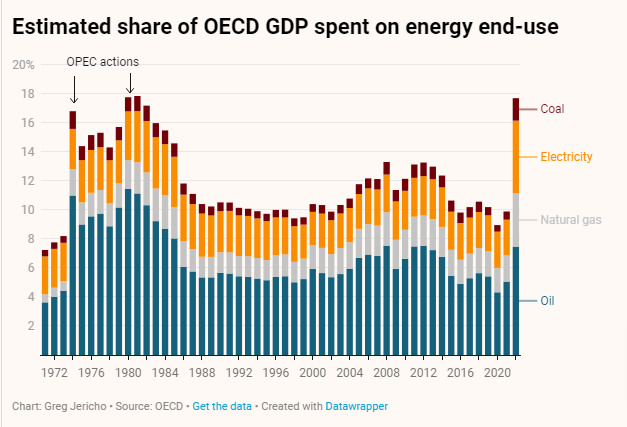
    The OECD notes that the share of GDP being spent on energy by OECD nations is higher now than it was during the OPEC crisis in 1974 and 1980. The evidence again is clear that a windfall profits tax should be levied on coal, oil and gas companies who a reaping massive profits while the cost of living rises sharply for households.

    The post Rough times ahead for Australia’s economy as oil, gas and coal companies celebrate appeared first on The Australia Institute's Centre for Future Work.