Blog

  • Economic Aspects of Paid Domestic Violence Leave Provisions

    Economic insecurity is one of the greatest factors inhibiting victims of domestic violence from escaping violent situations at home. To address that problem unions and employers have developed paid domestic violence leave provisions which allow victims to attend legal proceedings, medical appointments, or other events or activities related to the violence they have experienced, without risk of lost income or employment. Proposals have now been made to extend that provision to more Australian workers, by including a paid domestic violence leave provision in the Modern Awards (presently being reviewed by the Fair Work Commission), and/or by including it as a universal entitlement under the National Employment Standards.

    This report considers the likely impact of such an extension on the payroll costs of employers, and finds it to be so small it would be difficult to measure: we estimate that incremental payments to workers taking the leave would amount to one-fiftieth of one percent (0.02%) of current payrolls.

    These findings refute recent statements by Commonwealth Finance Minister Mathias Cormann, who recently described domestic violence leave as “another cost on our economy that will have an impact on our international competitiveness.” His government has opposed extending the provision — at least not until the Fair Work Commission has completed its review.

    The idea that a 0.02 percent increment to payrolls (less than one hundredeth of a percent of last year’s increase in average weekly wages) would even be noticed internationally, let alone undermine our “competitiveness,” is not credible. Worse yet, this argument misunderstands the nature of competitiveness in a modern, innovation-driven economy. Cementing a reputation as a safe, high-quality, inclusive place to live is beneficial to national competitiveness, and paid leave for victims of domestic violence would be an important symbol of Australia’s commitment in that regard.

    The post Economic Aspects of Paid Domestic Violence Leave Provisions appeared first on The Australia Institute's Centre for Future Work.

  • ABCC will do nothing for housing prices: Report

    Prime Minister Turnbull blamed construction workers and their union for the high cost of housing, when he re-introduced the ABCC bill in Parliament last month, claiming the bill would help “young Australian couples that can’t afford to buy a house because their costs are being pushed up by union thuggery.”

    But new research from the Centre for Future Work shows there is no statistical correlation between construction unionization or construction wages, and the soaring cost of housing.

    “The government’s claim that construction labour costs explain the rising price of housing has no basis in evidence,” Director of the Centre for Future Work, Jim Stanford said.

    “The suggestion that restricting union activity in construction can somehow deflate the great Australian property bubble reveals a critical misunderstanding of the Australian housing market.”

    The study provides detailed statistics regarding housing prices, union membership, wage growth, total construction costs, and replacement building costs. The report finds that:

    • Construction wages have grown more slowly than the Australian average over the last five years.
    • Real wage gains in construction have been slower than real productivity growth, and hence real unit labour costs in construction have declined.
    • Construction labour accounts for only 17-22 percent of the total costs of new building.
    • Construction costs, in turn, account for less than half the market value of residential property.
    • Construction labour costs correspond to less than 10 percent of housing prices (and even less than that in Australia’s biggest cities).
    • Construction labour accounts for about the same proportion of a house purchase as real estate commissions and stamp duty.

    “Homes in Australia are fast becoming unaffordable, even for the workers who build them. On average, a construction worker now needs 9.2 years of pre-tax earnings to purchase a median home – up 25 percent from just four years ago.

    “If the government is genuine in its desire to make housing more affordable in Australia, it should turn its attention to the real causes of the problem. Better policy responses would include measures to cool off property speculation, more carefully regulate the banking sector, and reform property-related taxes,” Dr Stanford said.

    The post ABCC will do nothing for housing prices: Report appeared first on The Australia Institute's Centre for Future Work.

  • Hard to Get Away: Is the paid holiday under threat? (GHOTD 2016)

    The focus of this year’s Go Home on Time Day is the threat to the “Great Aussie Holiday.” Thanks to the rise of precarious work in all its forms, a growing share of Australian workers (about one-third, according to our research) have no access to something we once took for granted: a paid annual holiday. Moreover, about half of those who ARE entitled to paid annual leave, don’t use all of their weeks – in many cases because of work-related pressures. And recent decisions by the Fair Work Commission allowing for the “cash out” of annual leave, mean that this great cultural institution – the Aussie holiday – is very much in jeopardy.

    Check out our special in-depth report, prepared by Troy Henderson of the University of Sydney, documenting these multiple threats to the Aussie holiday, and cataloguing the many economic, social, and health consequences that occur when we don’t get a break from work.

    The post Hard to Get Away: Is the paid holiday under threat in Australia? appeared first on The Australia Institute's Centre for Future Work.

  • New figures show Australians taking less annual leave

    “This year, Go Home On Time Day will focus on the need for Australian workers to be entitled to, and to feel safe in taking their holiday leave,” Director of The Australia Institute’s Centre for Future Work, Jim Stanford said.

    The Centre for Future Work, which is coordinating this year’s event, published a report which revealed growing number of Australian workers do not qualify for, or are not taking their entitled paid holiday leave.

    A study of 891 workers showed:

    • Almost one-third (32%) don’t have access to paid holiday leave.
    • Over half of those with annual leave didn’t take their whole entitlement.
    • That result would equate, across the whole labour market, to 48 million unused holiday days, worth $11.1 billion – annually.

    “About half of those who responded cited work-related pressures as inhibiting their leave: including being too busy, having too much to do, being reluctant to ask, or worried it would affect their job security or promotion chances.

    “We don’t want to see a nation of empty beaches, unblackened sausages and grandparents waiting too long between visits.

    “We do want to see refreshed workers who have had the chance to spend some quality time with their families,” Stanford said.

    The Unpaid Overtime Calculator app has been used by thousands of Australians, collecting data on excessive hours of work, this year including the provision and use of holiday leave.

    In addition to the growing inaccessibility of paid holidays, the survey data also revealed that the average full-time worker in Australia loses 5.1 hours per week to unpaid overtime – or 264 hours per year. Workers donate $116 billion dollars’ worth of hours to their bosses, every year.

    The post New figures show Australians taking less annual leave appeared first on The Australia Institute's Centre for Future Work.

  • Go Home on Time: Wednesday 23 November

    This year’s Go Home on Time Day is Wednesday, November 23. Visit our special Go Home on Time Day website for more information, to download posters and other materials, and use our online calculator to estimate the value of YOUR unpaid overtime.

    The focus of this year’s Go Home on Time Day is the threat to the “Great Aussie Holiday.” Thanks to the rise of precarious work in all its forms, a growing share of Australian workers (about one-third, according to our research) have no access to something we once took for granted: a paid annual holiday. Moreover, about half of those who ARE entitled to paid annual leave, don’t use all of their weeks – in many cases because of work-related pressures. And recent decisions by the Fair Work Commission allowing for the “cash out” of annual leave, mean that this great cultural institution – the Aussie holiday – is very much in jeopardy.

    Check out our special in-depth report, Hard to Get Away: Is the paid holiday under threat in Australia?, prepared by Troy Henderson of the University of Sydney, documenting these multiple threats to the Aussie holiday, and cataloguing the many economic, social, and health consequences that occur when we don’t get a break from work.

    We have also updated our regular calculations of the value of workers’ time that is effectively “stolen” each year by employers through massive amounts of unpaid overtime regularly worked in all industries and occupations: Excessive Hours and Unpaid Overtime: An Update.

    The post Go Home on Time: Wednesday 23 November appeared first on The Australia Institute's Centre for Future Work.

  • What’s Wrong With Privatization?

    Our Director Jim Stanford recently spoke with Unions NSW about this surprising development, and the general flaws in the argument for privatization.

    The post What’s Wrong With Privatization? appeared first on The Australia Institute's Centre for Future Work.

  • Denying The Downside Of Globalization Won’t Stop Populism

    Treasurer Scott Morrison recently started pushing back, delivering a staunch defense of globalization to an audience in Sydney. Like other world leaders responding to the wave of populism, Mr. Morrison doubled down with strong claims about the universal, lasting benefits of free trade. Australians may be anxious about their economic future, he conceded. But don’t blame globalization.

    Globalization “increases our living standards and always has,” Mr. Morrison bluntly proclaimed. Free trade, immigration and inward foreign investment are “the very sources of … prosperity.” Resisting globalization, he suggested, is like thinking “we can pull the doona over our head and insulate ourselves.”

    Denying any potential downside to globalization, and deriding critics as hiding from reality, will not defuse the wave of anger that put four One Nation senators into Parliament. Contrary to Mr. Morrison’s claims, there is ample evidence that Australia’s trade performance has deteriorated badly in recent years, despite –- or perhaps because of -– the acceleration of free trade.

    Globalization, as currently practiced, is imposing real, lasting damage in many parts of Australia, and producing a fertile political environment for nationalism and xenophobia. The political and policy responses to that danger must go beyond denial.

    Mr. Morrison stressed the effectiveness of his government’s trade agenda, especially what he called new “export trade deals” with China, Korea, and Japan. (This curious terminology deliberately neglects that free trade agreements are also intended to facilitate imports!) “The results are there to see,” he said.

    Or are they? As a share of GDP, Australia’s exports have declined significantly since the turn of the century, even as government inked several free trade pacts. Services exports also contracted relative to GDP. And ironically, Australia did worse with its free trade partners, than with the world as a whole.

    For example, we now have one year of experience under free trade with Japan and Korea. Perversely, Australian exports to both countries declined in the first year: by 9 percent for Korea, and 16 percent to Japan. Yet Australia’s imports from Japan and Korea surged by 14 percent and 24 percent, respectively.

    Therefore, Australia enjoyed more exports, and a better trade balance, without free trade than with it. In the first months of free trade with China, Australia’s exports are also declining. Similarly, under Australia’s trade pacts with the U.S., Thailand, Singapore and Chile, imports grew much faster than exports — and in some cases exports didn’t grow at all.

    There’s little reason to believe that new deals being pursued by Canberra (with India, Indonesia and the Trans Pacific Partnership) would have any better results.

    The cumulation of many bilateral trade deficits is an overall global payments imbalance that is driving Australia deeply into international debt. Australia’s current account deficit reached $77.5 billion last year: the biggest ever (in nominal terms). Relative to GDP, that’s the second-largest of any OECD country — behind only the U.K. (another hotbed of populism). It’s even worse than precarious emerging economies (like Brazil, South Africa or Turkey).

    Mr. Morrison actually celebrated this large international deficit last week, suggesting it allows Australia to invest more and grow faster. But he has it perfectly backwards. Business investment is contracting rapidly in Australia, not growing. And with Australia buying so much more from the rest of the world than it sells, we end up with less production, fewer jobs and less income. The gap can be offset with growing international debt, but only for a while.

    This miserable trade performance is clearly contributing to Australia’s weak labour market: declining total hours of employment, disappearing full-time jobs and unprecedented wage stagnation. So disaffected Australians aren’t making it up when they conclude their prospects have diminished, and no amount of boosterism can change that reality.

    Moreover, they have sound reasons to blame globalization as one important factor (certainly not the only one) for their predicament.

    If Mr. Morrison and other free-traders want to truly counter the divisive and dangerous ideas of nationalism and xenophobia, they should start by acknowledging that globalization does indeed have a downside, not just an upside. Then they must move to implement policies -– like balanced trade, job creation, stronger income security, and better vocational education — to assist those Australians who have been harmed by it.

    The post Denying The Downside Of Globalization Won’t Stop Populism appeared first on The Australia Institute's Centre for Future Work.

  • The Flawed Economics of Cutting Penalty Rates

    It was a “sleeper” issue in the recent election, and led to the defeat of some high-profile Liberal candidates. But now the debate over penalty rates for work on weekends and public holidays shifts to the Fair Work Commission. The economic arguments in favour of cutting penalties (as advocated by lobbyists for the retail and hospitality sectors) are deeply flawed.

    Penalty rates for working on weekends were an important “sleeper” issue in the recent federal election. On the surface, both Labor and the Coalition agreed the future of penalty rates would be determined by the Fair Work Commission. But that superficial consensus couldn’t hide deep differences in what the respective parties were actually hoping for. Labor explicitly urged the FWC to maintain existing penalties: double-time on Sundays, and time-and-a-half for Saturdays. Many Coalition candidates, on the other hand, endorsed a reduction in penalties – consistent with the views of business lobbyists who want lower operating costs on weekends.

    At the grass-roots level, meanwhile, the issue resonated strongly with significant numbers of voters. Union activists launched an 18-month “Save Our Weekend” campaign, knocking on tens of thousands of doors in marginal seats before the election was even called. Opinion polls showed strong support for retaining (or even increasing) weekend penalty rates; respondents opposed cutting penalties by two-to-one margins, or more. The swing against the Coalition in ridings targeted by the penalty rates campaign was nearly twice as large (6 percentage points) as the national swing.

    Penalty rates will remain a charged issue in the political arena. But for now, the main attention shifts to the FWC, whose decision is expected in coming weeks. The Commission should reject the entreaties of retail and restaurant employers for lower penalties, because the economic case for cutting penalties looks shakier all the time.

    Employers in all sectors routinely claim that cutting wages will strengthen job-creation. But this purported trade-off between compensation and employment is refuted by macroeconomic evidence. Indeed, historical data suggest higher wages are more often associated with stronger employment outcomes, not weaker: in part because household consumption spending (which depends directly on wages) is crucial for overall spending power and hence economic vitality. The retail and hospitality industries have been the most aggressive advocates of weaker penalty rates. Yet ironically, it is in these sectors that the argument for wage-cutting is weakest of all.

    After all, employment in stores and restaurants depends directly on the level of consumer spending. And this demand constraint is more binding in domestic service sectors than any other part of the economy. In export-oriented industries, employers can at least pretend that lower labour costs will boost sales (by undercutting foreign competition and hence winning new business). Even here the argument is not convincing, since in practice global competitiveness depends more on productivity, quality, and innovation than on low wages. But in non-traded domestic sectors, where Australians produce services for other Australians, the logic falls apart completely.

    Remember, Australian consumers already spend far more than they earn. That’s why average consumer debt is growing rapidly: now equal to 125 percent of national GDP. How could making it less costly for shops and cafes to open on weekends, somehow unleash new reservoirs of spending power, and stimulate tens of thousands of new jobs? In macroeconomic terms it’s simply not possible.

    Keeping businesses open for longer hours on weekends, doesn’t mean consumers have more money in their wallets. Instead, the same amount of retail and hospitality spending must now be spread across longer opening hours. If anything, that hurts productivity and profitability, and will eventually lead to the closure of some retail and hospitality firms that were already operating on the financial edge.

    It’s the same reason why opening a new shopping mall cannot, on its own, increase total employment levels. Unless there are other factors driving an expansion in broader incomes and spending, opening one store must inevitably lead to a closure somewhere else.

    It’s especially laughable to hope that cheaper weekend labour could somehow attract new business to Australia’s stores and cafes. Are penalty rate opponents expecting a surge in tourists from China, perhaps – who were just waiting for cheaper Sunday shopping before booking their trips?

    In short, the very industries pushing hardest for reduced penalties – retail and hospitality – are the ones most dependent on the spending power of domestic consumers. Hence they would directly experience the most economic blowback from their own wage cuts.

    Indeed, there is abundant evidence that unprecedented stagnation in wages is already undermining growth and job creation. Nominal wages are inching along at their slowest pace in recorded history (barely 1 percent per year). Real wages, adjusted for inflation, have been falling since 2013. Economists of all persuasions have highlighted the resulting weakness in household incomes as a key factor behind sluggish growth, rising personal debt, and unemployment and underemployment.

    Ultimately, rolling back penalties would simply constitute a major effective wage cut for workers who are already among the worst-paid in society. It will exacerbate the broader wage stagnation that is holding back Australian growth. And it will whet the appetites of other employers for more wage suppression – now on grounds of “keeping up” with the advantages granted to retail and hospitality.

    Australia needs higher wages, not lower. Let’s hope the Fair Work Commission sees this big picture.

    The post The Flawed Economics of Cutting Penalty Rates appeared first on The Australia Institute's Centre for Future Work.
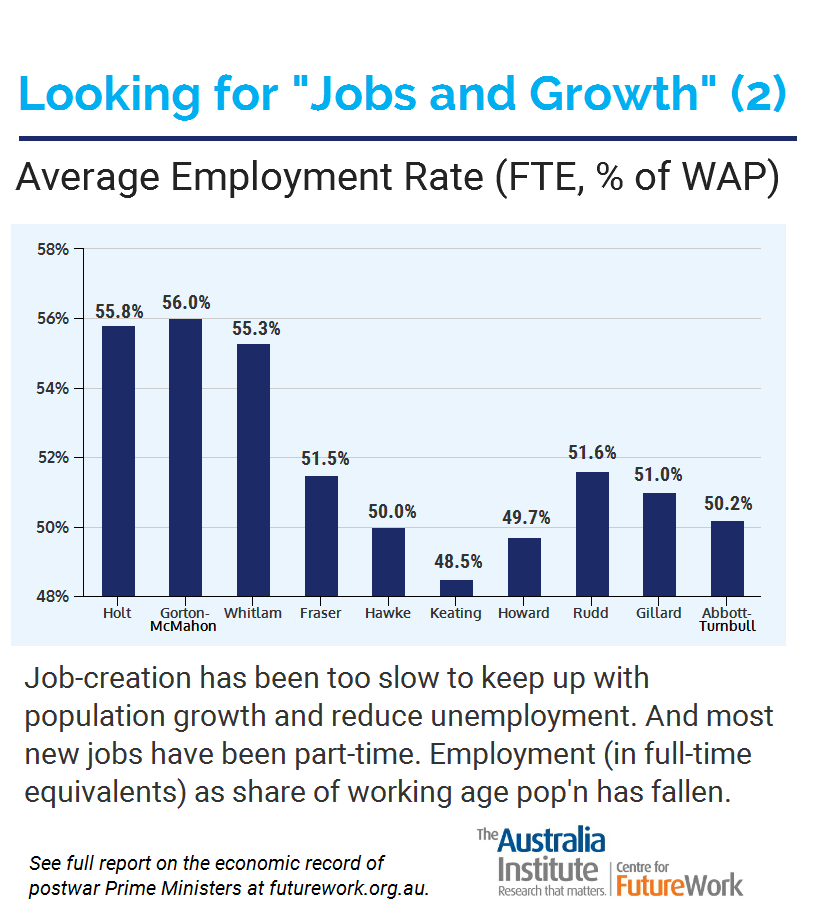
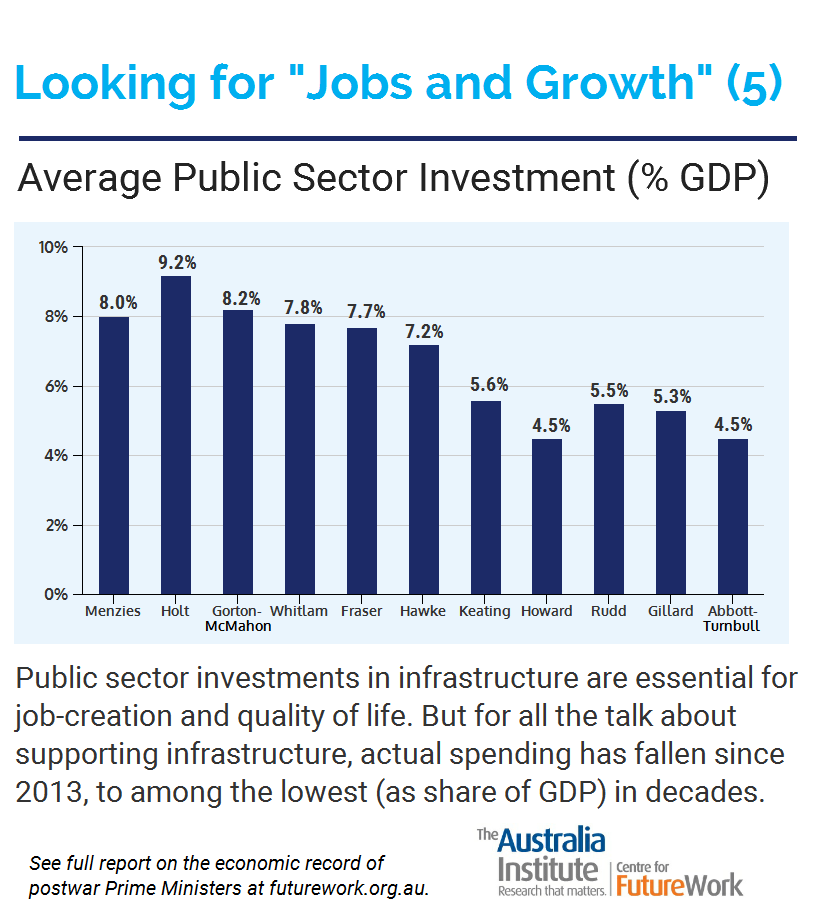
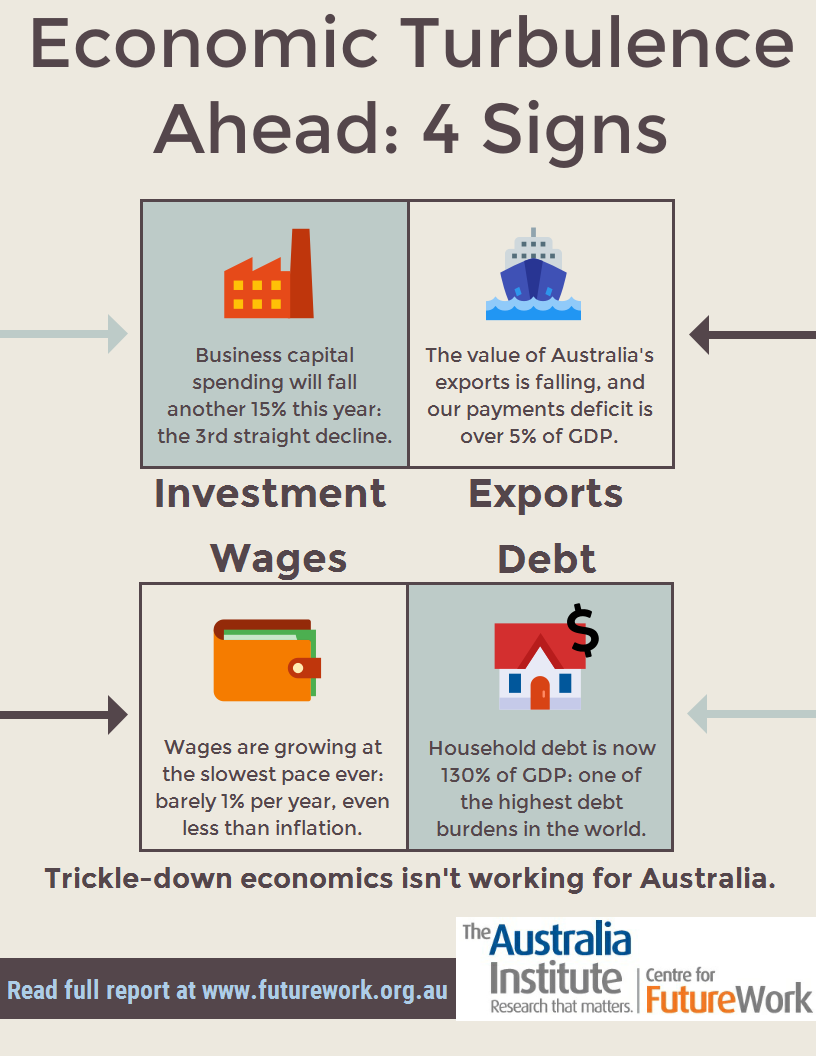
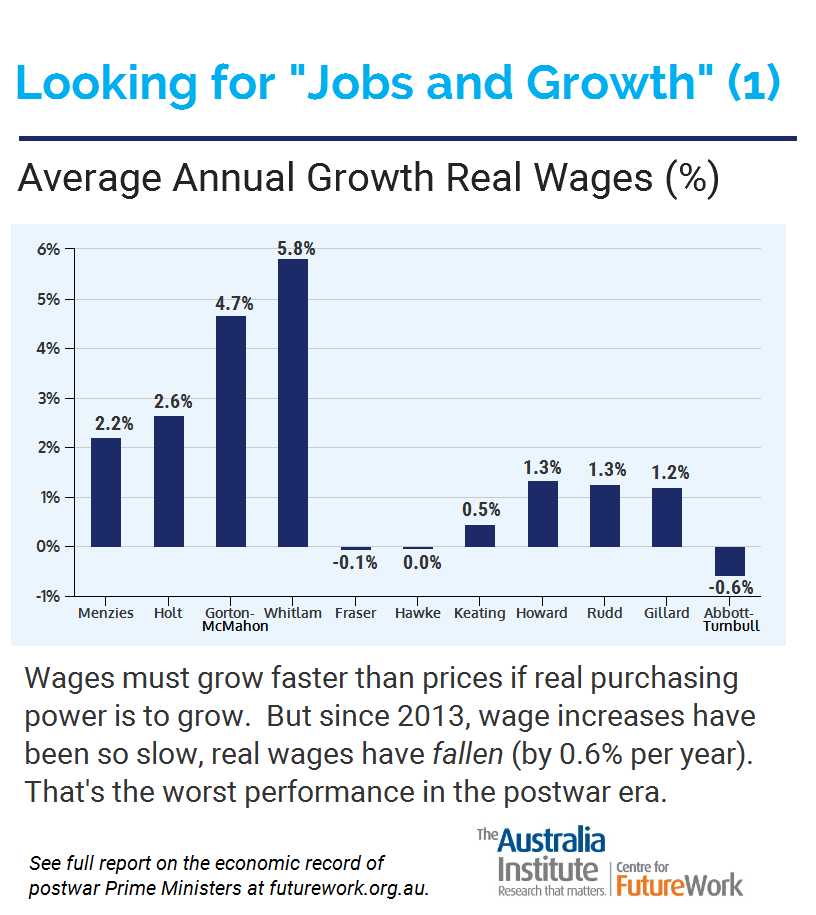
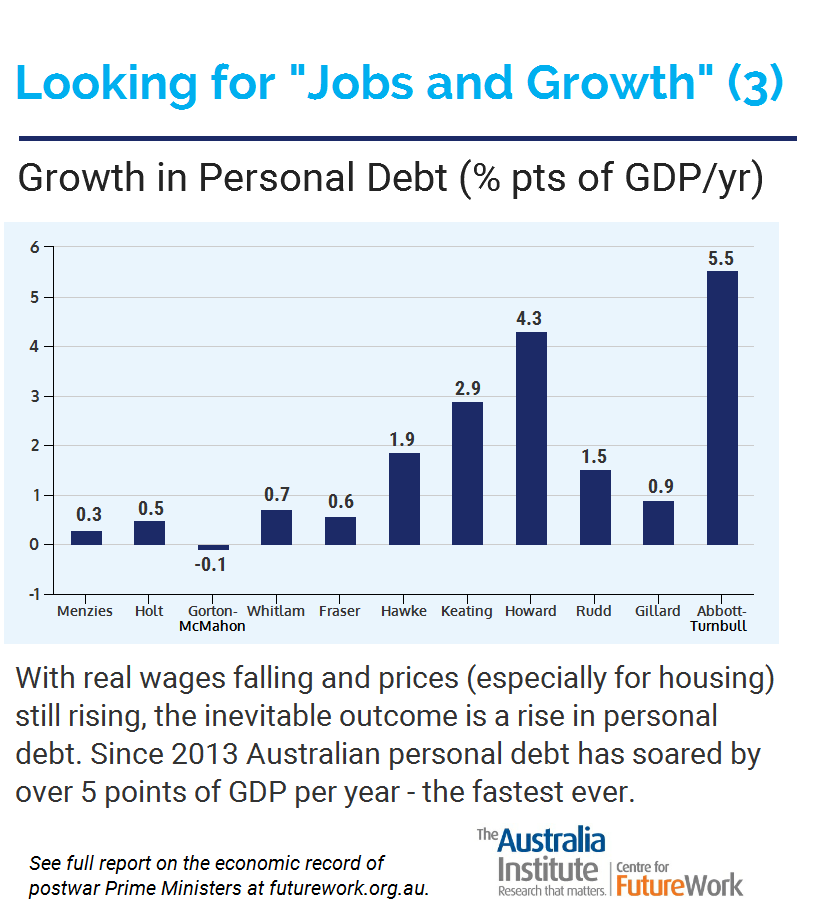
  • Looking for Jobs and Growth: Six Infographics

    The infographics summarize several of the specific economic variables considered in the full report, dating back to 1950 (and Prime Minister Menzies) in most cases.

    Average Annual Growth, Real Wages
    Average Employment Rate
    Growth in Personal Debt
    Average Annual Growth, Business Investment
    Public Sector Investment
    4 Signs of Turbulence Ahead

    The post Looking for “Jobs and Growth”: Six Infographics appeared first on The Australia Institute's Centre for Future Work.
  • Manufacturing (Still) Matters

    The problems in Australia’s manufacturing sector are well-known, and many Australians have concluded that the decline in manufacturing is inevitable and universal: that high-wage countries like Australia must accept the loss of manufacturing as an economic reality. But international statistics disprove this pessimism. Worldwide, manufacturing is growing, not shrinking, including in many advanced high-wage countries.

    Australians are purchasing more manufactured products, not less. Manufacturing is not an “old” industry: it is in fact the most innovation-intensive sector of the entire economy, generating better-than-average productivity growth, good jobs, and exports. Most importantly, manufacturing possesses several key structural features that make it vital to the economic success of any economy – including Australia’s. This study documents the damaging decline of Australian manufacturing, a decline that has accelerated in recent years. It explains the unique features of manufacturing (including innovation-intensity, productivity, income-generating capacity, export-orientation, and complex supply chains) that endow it with a national economic importance. It shows that Australia has done much worse than other high-wage countries (even smaller more remote ones) at maintaining manufacturing: in fact, manufacturing employment is now smaller as a share of total employment in Australia than in any other advanced country (even Luxembourg!).

    The paper lists ten key policy levers that have been invoked in other countries to support manufacturing – and which could play a positive role here, too, so long as government gives the sector the attention and priority it needs to succeed. The paper concludes with public opinion research showing that Australians agree, by very large majorities, that manufacturing is crucial to the national economy, supports good jobs and high living standards, and should be a national priority for policy-makers.

    The post Manufacturing (Still) Matters appeared first on The Australia Institute's Centre for Future Work.