Blog

  • Job Creation Record Contradicts Tax-Cut Ideology

    The Australian Bureau of Statistics released its detailed biennial survey of employment arrangements this week (Catalogue 6306.0, “Employee Earnings and Hours“). Once every two years, it takes a deeper dive into various aspects of work life.

    Buried deep in the dozens of statistical tables was a very surprising breakdown of employment by size of workplace. It turns out, surprisingly, that Australia’s biggest workplaces (both private firms and public-sector agencies) have been the leaders of job-creation over the last two years.

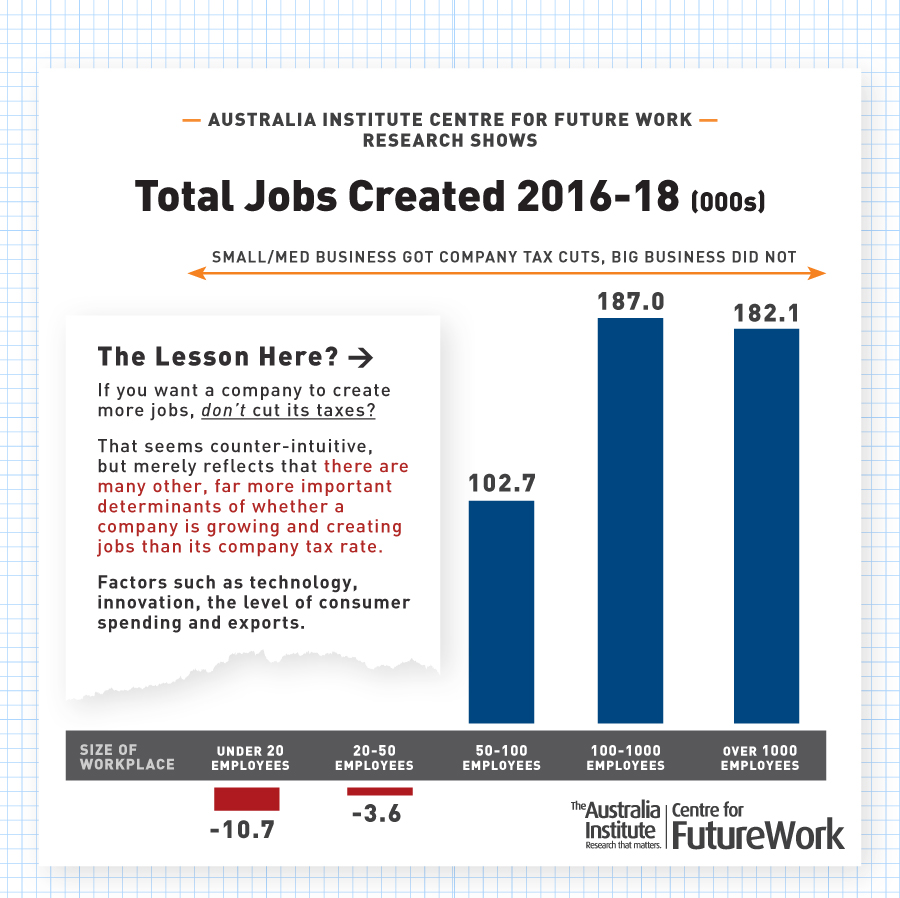
    This runs against the common refrain that small business is the “engine of growth.” In fact, workplaces with less than 50 employees actually shed employees (14,000 in total) since 2016. Curiously, it was only smaller businesses that received the much-vaunted reduction in company tax (from 30 to 27.5 per cent), also beginning in 2016.
    Firm Size and Job Creation

    The tax rate for small and medium-sized businesses began to fall in 2016, first for the smallest firms (with turnover under $2 million), and then for firms with up to $50 million revenue. The tax is not tied to the number of employees in a business, but the vast majority of firms which have received the tax cut have less than 50 employees. Yet that is the group that has reduced its workforce since the tax cuts began to be phased in.

    In contrast, very large workplaces (with over 1000 employees) added 182,000 new jobs over the two years. Workplaces with between 100 and 1000 employees added 187,000. Very few of those workplaces would have received the reduction in company taxes (since most would exceed the $50 million annual revenue threshold).

    Workplaces between 50 and 100 employees created a net total of 103,000 new jobs between 2016 and 2018. Some of those firms would have received the tax cut, and some not — depending on the nature of the business and the amount of total turnover generated per employee.

    The data on job-creation by firm size is detailed on Table 13 of Data Cube 1, in the “Downloads” section of the ABS report. The data refers to waged employees, not including owner-managers of businesses.

    The share of small businesses (under 50 employees) in total employment declined by two percentage points — since they were reducing their workforces, while larger companies were growing. Small businesses (under 50 employees) now account for 34 per cent of all employees, compared to 36 percent in 2016.

    Why would large companies that didn’t get a tax cut create new jobs faster than companies which did benefit from the Coalition tax cuts? (The small business tax cuts are estimated to reduce federal revenues by $29.8 billion over the first decade.) Simple: there are dozens of different factors which determine whether a company is profitable or not, and whether it chooses to grow. Tax rates are just one of those variables. Others include:

    • Growth in consumer demand.
    • The company’s investments in product quality, innovation, and design.
    • Production costs.
    • Interest rates and financing costs.
    • Business confidence and expectations.
    • Management capacity.
    • International competition.

    Trends in all these other factors can easily overwhelm the marginal impact of lower tax rates. Small business sales in particular have been held back by stagnant wages among Australian workers. Even companies which experience higher profits due to lower tax rates may choose to simply accumulate those profits, or pay them out to shareholders in dividends and share buy-backs (instead of expanding payrolls). Empirical evidence shows this has been the dominant impact of U.S. business tax cuts implemented by Donald Trump.

    Changes in tax rates can even have offsetting effects which undermine business conditions and hence reduce job-creation: if the revenue lost to tax cuts results in corresponding reductions in government program spending or infrastructure investments (as seems likely), then overall business conditions might be weakened, not strengthened.

    The reduction in employment by the businesses which most benefited from the expensive business tax cuts over the past two years should lead policy-makers of all persuasions to reconsider the argument that this is an effective way to stimulate growth and job-creation. However, in October the government announced it wanted to accelerate the next stages of the small business tax cuts — taking the rate down to 25 per cent five years faster than originally planned.

    So far, the policy is akin to shooting oneself in the foot. Instead of reloading the gun to do it again even sooner, perhaps this is a good time to reconsider whether the strategy makes any sense at all.

    The post Job Creation Record Contradicts Tax-Cut Ideology appeared first on The Australia Institute's Centre for Future Work.

  • The REAL Diary of an Uber Driver

    A version of this commentary originally appeared on the 10 Daily website.

    The REAL Diary of an Uber Driver

    by Jim Stanford

    ABC recently announced plans for a new 6-part television drama called “Diary of an Uber Driver.” It’s hard to imagine that an Uber driver’s actual life would make for riveting TV viewing. Here’s an illustrative account I have constructed, based on observations and real conversations with ride-share drivers:

    5:25 am. Shower and quick breakfast. Uber says I can “work when I want.” So why am I up at 5? Because that’s when there’s customers.

    6:10 am. Got one ride to the City, now deadheading back to suburb where the app says they need cars. 20 minutes of my time, plus petrol, down the tube.

    7:38 am. Been waiting 7 minutes for fare to come out of her house; I can charge her extra – but she’ll likely give me 2 stars out of 5 on the customer rating.

    8:12 am. Asshole office guy demands to get out at a traffic island. Totally illegal. If I refuse, I’ll lose stars.

    8:35 am. Driving obnoxious kid and dad to school. Kid waving a stuffed animal out the window, dangerous and illegal. If I tell the dad to stop it, I’ll lose more stars.

    9:20 am. Buy petrol. Price up another 3 cents. Apparently I operate an “independent” business, but I can’t raise my price when costs rise. In fact, I never even touch the money – it all goes through the app.

    9:28 am. Next door at Aldi’s buying bottled water, candies, and gum. $16. Customers expect the perks – and I gotta buy them, or lose my stars.

    10:35 am. Been waiting 15 minutes without a fare. Waits that long cut my effective hourly wage by a third. Think I’ll go home and go back to sleep.

    3:20 pm. Back on the app. Deadhead back to the City for rush hour.

    5:17 pm. Waiting 3 minutes in no-stopping zone for guy who said he’d be right there. Risking big ticket. Could move, would lose stars.

    6:20 pm. Cop eyes me at traffic light as I accept next fare on the app. I know it’s illegal, but it’s the only way to work it. If he fines me ($484 and 4 demerits), that’s 3 days’ net pay. I’m lucky.

    7:18 pm. Arrogant stockbroker gives me 2 stars, even though nothing went wrong. Why? Maybe it was my skin colour, not my service.

    8:25 pm. Drunken kids demand I go through McDonald’s. If I refuse, 2 stars for sure. Car now smells like French fries. And they spilled Coke on my carpet; another cleaning. They give me 2 stars anyway. I could give them 2 stars (as their rating), but it doesn’t matter. The customer is always right, and they’ll always get a driver. I might not find another job.

    9:38 pm. Another 15 minute wait for next fare. I suspect I’m being punished by the algorithm: it sends more jobs to preferred drivers.

    10:33 pm. More drunks, demanding to play Spotify through my sound system. Cranking it to the max. Stars at risk if I complain.

    1:18 am. Slow night, too many drivers out there. Getting very tired. Uber limits me to 18 hours work in any 24 (gosh); gotta sign off soon. I could always switch to Lyft and drive a few more hours. App sends rah-rah message that I could get to $250 for the day with a couple more fares.

    1:52 am. Deadhead home. App tells me I made $276, 15 hours on-line. That’s before petrol ($60 today), vehicle costs, data costs, and the damn gum. I’ll be lucky to keep half that. Didn’t make the minimum wage today… what else is new?

    This doesn’t make for feel-good viewing, by any definition. So what is ABC thinking?

    The mini-series is a spin-off from a blog and subsequent book by Ben Phillips, who began driving for Uber in Sydney after his own small business went belly-up. His writing describes many strange encounters with weird customers and other characters. The series will also draw in his own personal angst – including fears about becoming a father.

    In short, it’s like Taxi Driver for the gig-economy: a chronicle of mini-dramas compiled by a neurotic driver, ferrying colourful passengers around the big, lonely city. There will surely be entertainment value in some scenarios. But it’s hardly an accurate portrayal of the mind-numbing, exploitive reality of ride-share driving. And the whole concept raises questions that the broadcaster and its viewers should ponder carefully.

    For starters, why is the ABC naming a TV series after a corporation? Uber is the best-known ride-share company, sure, but there are many competitors. Moreover, conventional taxis are still a mainstay of urban transportation – and taxi drivers surely have as many interesting stories as Phillips. Taxis, however, are old-fashioned, while Uber is “cool.” ABC is riding the coattails of Uber’s brand by naming the whole show after it. Unfortunately, this also provides profile and endorsement to a troubled and controversial American corporation – one gearing up for a potential $120 billion (U.S.) stock offering.

    Let’s set that ethical issue aside. An even bigger concern is that the series will whitewash, even glamorise, a highly exploitative employment practice whose legitimacy and even legality is under siege in courtrooms and parliaments around the world. Uber has recently lost precedent-setting legal cases in France, Italy, the U.K., the U.S., and Canada. More challenges are underway, including in Australia.

    Uber has been avoiding the risks, costs, and responsibilities that come with directly employing drivers – inconveniences like minimum wages, workers’ compensation, paid holidays, and more. Drivers pay all vehicle costs (including depreciation, maintenance, tires, petrol, phone and insurance). Uber controls all payments (through the app), deducting booking fees and a fat 27.5% commission; the driver is stuck with all other costs (including GST), hoping there’s enough left at the end to buy groceries. They can be fired for inadequate consumer ratings (logged through the app’s 5-star system). Uber claims its drivers are “entrepreneurs,” not employees – but that fiction is crumbling in the face of myriad legal challenges.

    In practice, many Uber drivers make well under the minimum wage: my 2018 research indicated average pay (after vehicle expenses) of $14.62 per hour across 6 Australian cities; other surveys suggest even less. Other issues faced by drivers include dismissal without severance or recourse; traffic fines (including for operating the Uber app while driving); unlimited competition (there’s no cap on how many drivers can sign on); and deadening, dangerous hours. Little wonder 90% or more of Uber drivers quit within a year.

    It’s hard to believe this series will portray the ugly side of ride-share driving. Instead, working for Uber will come off as a humble but meaningful vocation: one where human interaction (rather than earning the minimum wage) is the main remuneration. At a moment when the exploitive practices of Uber and other gig employers are finally receiving critical attention around the world, this smells like corporate propaganda, not high-quality drama.

    The post The REAL Diary of an Uber Driver appeared first on The Australia Institute's Centre for Future Work.
  • Australia’s Upside-Down Labour Market

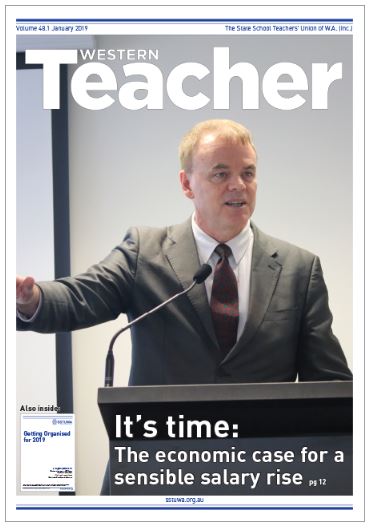
    In this article reprinted from Western Teacher magazine (published by the State School Teachers’ Union of WA), our Director Jim Stanford tries to explain these contradictory trends.

    The article is based on a presentation to a recent SSTUWA delegates meeting in Perth.

    Cover

    Stanford provides a dual diagnosis for Australia’s labour market problems: an inadequate quantity of work, and the deteriorating quality of work. Egged on by government policies which have deliberately suppressed wages in so many workplaces, wage growth has fallen to postwar lows. This is now undermining Australia’s continued economic progress.

    In addition to diagnosing what’s gone wrong in Australia’s labour market, Stanford also explains the numerous economic benefits of stronger collective bargaining systems so that workers can receive a fairer share of the economic pie: stronger consumer spending, more stable financial conditions, stronger government revenues, and less inequality.

    To see the full issue of Western Teacher, or sign up for future editions, please visit the magazine’s website. We are grateful to Western Teacher for permission to reprint the article here!

    The post Australia’s Upside-Down Labour Market appeared first on The Australia Institute's Centre for Future Work.

  • Rebuilding Vocational Training in Australia

    Ironically, the manufacturing recovery could be short-circuited by looming shortages of appropriately skilled workers. This seems unbelievable — given so much downsizing in manufacturing employment that occurred between 2001 and 2015. But a combination of structural change within the sector, the ageing of the current workforce, and the failure of Australia’s vocational education system (crippled by a bizarre experiment in publicly-subsidized private delivery) means that recovering manufacturers may be unable to find the skilled workers they need.

    A recent feature article in Australian Welding magazine highlighted the Centre for Future Work’s research into the problems of the current VET system, the implications for manufacturing, and 12 key reforms urgently needed to repair the situation.

    The feature article is extracted from a detailed paper (co-authored by Tanya Carney and Jim Stanford) on the evolving skills requirements of the manufacturing sector, and the failure of a privatised, fragmented VET system to meet those needs. That paper was unveiled at the 2018 National Manufacturing Summit in Canberra.

    “Stable, well-funded, high-quality public institutions must be the anchors of any successful VET system. Public institutions are the only ones with the resources, the connections, and the stability to provide manufacturers with a steady supply of world-class skilled workers.”

    Please see the full 4-page article in Australian Welding magazine with our proposals for rebuilding a high-quality, modern VET system to meet the needs of manufacturing and other Australian industries.

    We are grateful to Australian Welding and Weld Australia for permission to reprint this article!

    The post Rebuilding Vocational Training in Australia appeared first on The Australia Institute's Centre for Future Work.

  • New Video: Australia Needs a Pay Rise!

    ANAPR Logo

    The video highlights the problems of wage stagnation in Australia’s economy, and the need to “Change the Rules” – including proposals for sector-wide collective bargaining practices, especially important in low-wage sectors such as early child education. The video has great graphics and production values, and is accompanied by a useful infographic. Download short and long versions of the film, and the infographic, through the links below:

    Shorter version (2:45)

    Longer version (4:03)

    Infographic

    ANAPR Logo

    Many thanks to the team at United Voice and Flip for their talented work on this project!

    The post New Video: Australia Needs a Pay Rise! appeared first on The Australia Institute's Centre for Future Work.

  • The Year Past, and the Year to Come

    Workforce (a labour relations bulletin published by Thomson-Reuters) recently surveyed major IR figures in Australia on what they saw as the big issues in 2018, and what they expect as the major talking points for 2019. Jim Stanford, economist and Centre for Future Work director, was one of those surveyed, and here are his remarks.

    What was the most important issue or event in industrial relations this year?

    I would choose the union movement’s “Change the Rules” campaign, which really gathered focus and momentum as the year went on. Of course, unions have been dissatisfied with the state of labour laws, and the erosion of labour rights, for years. But this year, together with other community advocates, they have built a very effective and focused advocacy campaign that I think will have a major impact on labour policy in Australia. Examples of its potential include the big rallies held in Melbourne and other cities in October; the important role that the union movement’s independent door-knocking and phone-banking campaign played in the expanded majority won by the Daniel Andrews govt in Victoria; and the generally high profile of news and debates around the issues of wages and workplace fairness in the media and public commentary.

    The current atmosphere is very reminiscent of the “Your Rights at Work” initiative that the ACTU and its affiliates organised in 2006-07 – and that ended up making a significant difference in the 2007 election (when John Howard lost his seat).

    There is a qualitative difference in this incarnation of the union movement’s organising, however: while union activists obviously are hoping to influence the results of the next election, they are self-consciously and explicitly planning on a longer-run effort to shift public opinion regarding core issues of work and fairness.

    Their agenda of proposed reforms would take several years to implement: including lifting the minimum wage to a “living wage” level, modernising labour laws (so Uber drivers and other gig workers would be protected), changing the structure of enterprise bargaining to allow multi-firm and industry-wide bargaining, and more.

    And they are advancing that agenda as an independent campaign, not as an arm of the Labor party. That positions them well to continue to advance the debate after the election … whoever wins.

    By carefully focusing its energies, building a strong “boots on the ground” infrastructure in communities (including crucial marginal electorates), and building strong public support for the core values underpinning the campaign (tapping into continuing Australian faith in fairness), I think this movement will reshape both public opinion about work and wages, as well as Australia’s labour policy framework.

    What are you most/least looking forward to in 2019?

    There will be a Commonwealth election sometime during the first half of 2019 (perhaps sooner rather than later, if the current disarray in Canberra is any indication).

    I look forward to seeing labour issues – and in particular, the stagnation of wages in Australia, and the growing gap between Australia’s egalitarian tradition and the grim economic reality that most workers presently face – feature as one of the top three issues in the campaign. Most workers have had no increase in real wages over the past five years; millions have fallen behind (especially given escalating prices for housing and other essentials). The present govt knows that this festering economic frustration issue could be very damaging.

    There’s an opportunity in Australia right now to move the needle: imagine a modernised approach to labour policy: including labour standards that adapt to ongoing change in the economy (like gig jobs), a more ambitious crack-down on wage theft and other illegal practices, and a revitalisation of Australia’s commitment to a ‘fair go.’

    However, I am not looking forward to the rolling out of some pretty tired warnings and threats about how modernising labour laws and addressing inequality will somehow threaten Australia’s economic viability.

    We can expect many dire threats about how the proposals for reform will drag Australia back to the “bad old 1970s” – a time, interestingly, when GDP growth, job-creation, productivity growth, and real wage growth were all significantly superior to the current era.

    This rhetoric ignores the growing consensus among economists that more equality actually strengthens economic performance – by supporting consumer spending and aggregate demand, avoiding the economic, fiscal and social costs of exclusion and inequality, and boosting govt revenues.

    The doomsday prophecies we can expect to hear from the usual suspects should be understood as the last gasps of a vision of trickle-down economic policy that has lost its credibility, in Australia and around the world.

    The post The Year Past, and the Year to Come appeared first on The Australia Institute's Centre for Future Work.

  • Industry-Wide Bargaining Good for Efficiency, as Well as Equity

    In this commentary, Centre for Future Work Associate Dr. Anis Chowdhury discusses the economic benefits of industry-wide collective bargaining. In addition to supporting wage growth, industry-wide wage agreements generate significant efficiency benefits, by pressuring lagging firms to improve their innovation and productivity performance. The experience of other countries (such as Germany and Singapore) suggests that this system promotes greater efficiency, as well as equity — although other wealth-sharing policies are also needed.

    Dr. Chowdhury’s full comment is posted below.

    INDUSTRY-WIDE BARGAINING CAN BOOST EFFICIENCY AS WELL AS WAGES

    by Dr. Anis Chowdhury

    In an effort to reverse long-term wage stagnation, the ACTU is calling for an end to current industrial rules which effectively prohibit sector- or industry-wide wage bargaining. Predictably, the business community is opposed. Australian Industry Group chief executive, Innes Willox, said, “The ACTU’s latest proposals would destroy jobs and the competitiveness of Australian businesses…If the ACTU got its way, unions would be able to make unreasonable claims and cripple whole industries and supply chains until employers capitulated.”

    No doubt, the issue will be a hot topic in the upcoming Federal Elections. The Labor Party conference is debating the ACTU’s call. And the Liberal-National Coalition will surely accuse Labor of capitulating to the vested interest of the union movement.

    Mr. Willox’s claim that the sector-wide wage bargaining would destroy jobs and Australia’s competitiveness has no basis. A powerful example is provided by Germany, Europe’s strongest economy. In Germany, wages, hours, and other aspects of working conditions are decided by unions, work councils (organisations complementing unions by representing workers at the firm level in negotiations), and employers’ associations. Collective wage bargaining takes place not at the company or enterprise level but at the industry and regional levels, between unions and employers’ associations. If a company recognises the trade union, all of its workers are effectively covered by the union contract.

    Yet, Germany’s competitiveness did not decline. On the contrary, Germany experiences both strong productivity growth and strong wage growth. Despite ongoing real wage improvements, unit labour costs are stable or even declining – further enhancing Germany’s competitiveness.

    How is this possible? The answer was given by more than half a century ago by two leading Australian academics – WEG Salter and Eric Russel. By de-linking productivity-based wage increases at the enterprise level and adhering to the industry-wide average productivity-based wage increases, an industry bargaining system raises relative unit labour costs of firms with below-industry-average productivity, thereby forcing them to improve their productivity or else exit the industry. At the same time, firms with above-industry-average productivity enjoy lower unit labour costs, hence higher profit rates for reinvestment. Singapore also used this approach to restructure its industry in the 1980s towards higher value-added activities, with great success.

    Trying to compete on the basis of low wages is a recipe for failure. As a matter of fact, low-wage countries typically demonstrate lower productivity; and research by a leading French economist, Edmond Malinvaud, showed that a reduction in the wage rates has a depressing effect on capital intensity. Salter’s research implies that the availability of a growing pool of low paid workers makes firms complacent with regard to innovation and technological or skill upgrading. Other researchers show that under-paid labour provides a way for inefficient producers and obsolete technologies to survive. Firms become caught in a low-level productivity trap from which they have little incentive to escape – a form of Gresham’s Law’ whereby bad labour standards drive out good. The discipline imposed on all firms as a result of negotiated industry-wide wage increases forces all of them to innovate and become more efficient.

    So, sector-wide wage bargaining is good for the economy: favouring efficient firms, stimulating investment, and lifting wages. Of course, industry-wide bargaining alone cannot solve all the problems of wage inequity or wage stagnation. It must be part of a broader suite of policy measures, to provide all-round support for greater equality and inclusive prosperity.

    In particular, we must address the system that produces sky-rocketing executive pays at the expense of workers. A lower marginal tax rate is one of the incentives for the executives to pay themselves heftily, while tax cuts are not found to boost growth or employment. Share options for CEOs, which encourage job cuts and discourage re-investment, also must be reined in. If anything that is making the Australian economy vulnerable, is growing economic disparity between self-serving executive compensation and stagnant wages for the rest of the population.

    Reforms also need to address the macroeconomic policy paradigm, where fiscal policy is focused on creating needless budget surpluses by cutting social services and public infrastructure investment. Meanwhile, monetary policy is focused on a pre-determined inflation target regardless of the economic cycle. All of this stifles economic growth prospects and increases job insecurity – both of which are detrimental for wage recovery.

    The post Industry-Wide Bargaining Good for Efficiency, as Well as Equity appeared first on The Australia Institute's Centre for Future Work.

  • On the Brink: Erosion of Enterprise Agreement Coverage

    The report shows that the number of current enterprise agreements in private Australian businesses has collapsed by 46% since the end of 2013. The number of private sector workers covered by enterprise agreements has plunged 34% in the same time. In 2017, just 12% of employed private sector workers were covered by an enterprise agreement – down from 19% in 2013.

    If current trends in renewals, new agreements, and terminations continue, less than 1800 agreements would survive to 2030, at which point just 2% of private sector workers would be covered by a collective agreement.

    The dramatic downturn in collective bargaining in Australian businesses reflects a number of simultaneous trends, creating a ‘perfect storm’ that jeopardises the future of private sector bargaining. These trends include a drop-off of renewals of expired enterprise agreements; the dramatic decline in the number of newly negotiated agreements; and a surge in terminations of agreements.

    “It is no exaggeration to conclude that collective bargaining in private businesses will go extinct in coming years if these devastating trends are not reversed,” said Alison Pennington, Economist with the Centre for Future Work and author of the report.

    The report provides a forward simulation of enterprise agreement-making if current trends in renewals, new agreements, and terminations continue. The simulation indicates that the total number of private sector enterprise agreements would fall by half (to below 6000) by 2023, and the proportion of private sector workers covered by agreements would fall below 6%. Things get worse in subsequent years, with less than 1800 agreements surviving by 2030, when only 2% of private sector workers would be covered by a collective agreement – unless urgent action is taken the change existing policies and restore effective access to collective bargaining.

    “The accelerated collapse of enterprise bargaining in the private sector has been a key cause of the unprecedented weakness in wage growth experienced in Australia since 2013,” Pennington said. “When workers have no collective voice or collective bargaining power, they have no chance of successfully negotiating better wage increases from their employers.”

    The report also shows that the rapid decline in enterprise agreement coverage for private sector workers has been mirrored by a rapid increase in the proportion of workers paid according to the minimum terms of Modern Awards.

    “The evidence is overwhelming that Australia’s current system of collective bargaining is completely inadequate for representing workers in our evolving economy, with an increasingly fragmented labour market,” Pennington concluded. “A viable collective bargaining system is essential to shared prosperity, but it will require far-reaching changes to the current rules to keep collective bargaining alive.” The report proposes several broad directions for reforming current laws and practices, to stop and reverse the dramatic decline in collective agreement coverage.

    PLEASE NOTE: This posted version of the paper corrects a previous error arising from a data coding problem which resulted in an inaccurate allocation of newly approved enterprise agreements between new and renewal agreements.

    The post On the Brink appeared first on The Australia Institute's Centre for Future Work.

  • Are States Filling the Democratic Void?

    The recent Victorian election results showed Australian voters want governments to play a pro-active role delivering public services, infrastructure, improved labour standards, and sustainability. They showed that in a time of deep cynicism with federal politics, States (and Territories) can play an important role filling the democratic void left by dysfunction and policy paralysis at the Commonwealth level.

    This commentary from Alison Pennington, economist at the Centre for Future Work, explores what the energetic campaign in Victoria revealed about our unique system of dual governance and the potential for pro-active and progressive policy making. This commentary was originally published in New Matilda.

    The Victorian election: Are states filling the democratic void?

    A destructive and cynical politics is on the rise across the world with emergent right-wing populism a warning of what happens when people lose faith in political institutions.

    In Australia, the Coalition government has been characterised by ongoing austerity, the retrenchment of public resources and capability to the tune of billions of dollars, but complete paralysis on just about every other policy reform (most visibly including massive inconsistency on energy and climate policy). This has led to a democratic void in Australian society.

    Meanwhile, the recent victory of the Andrews Labor government on a bold social democratic platform of long-term investments in services, education and infrastructure projects (some with a 2050 completion date) gave Victorians a secure, positive vision of a more balanced, stable society – and voters endorsed that vision strongly.

    How is it that these two wildly different scenarios of political life can exist alongside each other?

    Many commentators have explained the Victorian election result as a mere by-product of the Coalition’s ongoing crisis (with subsequent warnings about the future of the federal Liberals). But this suggests Victorians were motivated by cynicism alone. In reality, Victorians rallied enthusiastically around a constructive, hopeful vision of State-level policy-making. Indeed, since federation, Australian communities and regions who have identified needs and desires unmet by the Commonwealth, have often turned to the state level of governance to get things done.

    The unique organisation of governance in Australia, featuring a Commonwealth composed of somewhat independent States and Territories, has preserved a realm of Australian democracy distinct from the national level of affairs. At a time of deep cynicism with federal politics, the Victorian election result shows that States can fill the democratic void left by dysfunction and tribal politics at the Commonwealth level, strengthening Australian democracy and saving it from the worst of cynical politics we see emerging elsewhere (such as Trumpism in the US).

    Where does the legitimacy of this State-based democracy come from? Despite losing (or handing over) many of their powers to the Commonwealth over time, States still retain power to administer the key public goods that Australians most value: like education, health care, civic services, and culture. These are the functions of government that people will energetically defend when they are undermined.

    While the Australian constitution allocates responsibility for big-ticket public programs like healthcare and education to the States, the Commonwealth retains powers to raise the bulk of the revenue needed to fund these expensive services. This means States operate in a contradictory financial bind: always dependent on the federal government to honour the financing of essential services that the States are constitutionally bound to provide. This gives enormous economic and political power to federal governments— a power play that has been repeated many times over Australia’s history.

    For example, a recent attempt by the Commonwealth to undermine the funding of public goods under the ‘spend within your means’ mantra was mounted in 2016, when Malcolm Turnbull and Scott Morrison tried to shift responsibility for raising revenue for public services to States. This was done without relinquishing any of the Commonwealth’s income and corporate taxation powers – all the while overseeing billions of dollars in cuts in healthcare and education in the federal Budget.

    But the constitutional and financial bind faced by State governments has gained particular significance in recent years, as decades of ‘small government’ policies wound back public services in favour of highly-subsidised private models have come to a head. Publicly-subsidised private markets in aged care, disability care, healthcare, education, VET and childcare have all been proven failures: both in the quality of services delivered, and in the standards of employment for those doing the work.

    Recent polling by the Australian Institute shows that 64 per cent of Australians want an increase in public spending funded by tax revenue from wealthy individuals and high-turnover businesses. Australians value government provision of public goods, even more than personal income tax cuts. The failure of federally-backed market experiments within spheres of life where Australians demand a proactive and productive government role, has left the political field wide open – and States are in prime strategic political terrain to fill that space.

    State action is applauded in the face of Commonwealth inaction. For instance, amidst recent turmoil in federal energy and climate policy, the Victorian, SA and ACT governments have proactively invested in renewable energy industries. And State governments in Victoria, SA, ACT and QLD have found innovative work-arounds to protect workers from new exploitative labour practices, despite the dominance of the Commonwealth in the jurisdiction of labour law: including labour hire licencing schemes, mandated minimum pay and safety conditions, and a new inquiry just launched into on-demand ‘gig’ work and its implications for the Victorian economy.

    The Victorian election results provide another clear insight into what Australians value and what they will tolerate. They confirm that Australians care about a fair society – underpinned by the public provision of healthcare and education (including a revamped TAFE sector), new infrastructure, action on renewable energy, and employment conditions that allow Australians to live a decent quality life.

    With the Andrews government’s pledges for sizeable investments in all of these endeavours ratified so strongly by voters, it shows that the failure of Commonwealth policy and politics can be mitigated by popular, publicly-minded campaigns at the State level.

    A future federal government could build on the example set by the Victorian election. It could use its much stronger policy and fiscal levers to charter a course that addresses the growing labour market power imbalances, restores the billions cut from hospitals, schools and housing, prepares our economy for a renewable energy future, and delivers a comprehensive program of tax reform.

    But until that decisive break with the failed austerity and cynicism of recent federal politics, the Victorian election results confirm that in the meantime, States can step firmly into the breach. They can and must continue to function as a key site for the expression of Australians’ demands for a more equal, inclusive, participatory society, with a proactive role for government in delivering public goods.

    The post Are States Filling the Democratic Void? appeared first on The Australia Institute's Centre for Future Work.

  • Workers’ Share of Economic Pie Shrinks Again

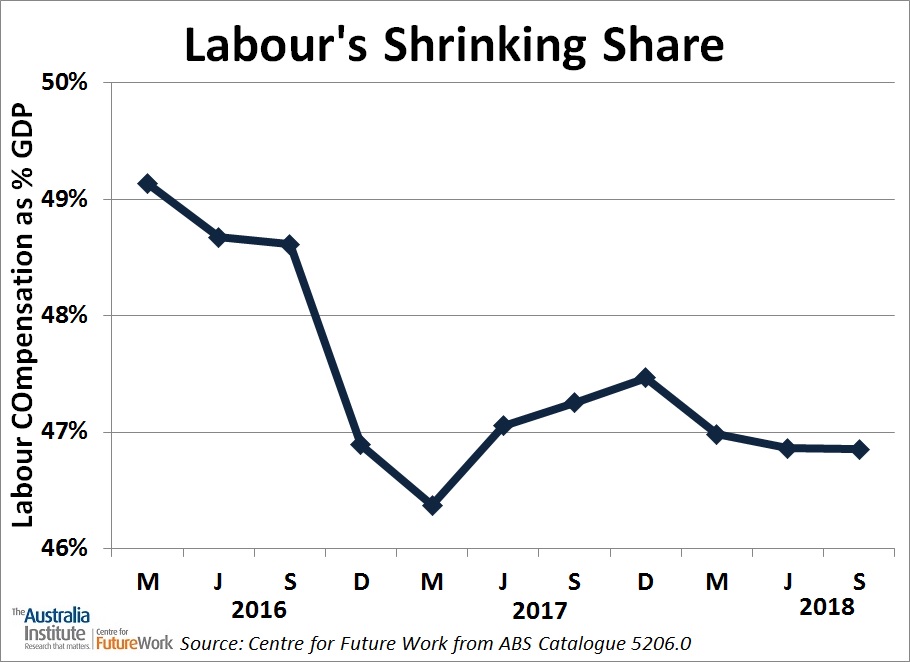
    That represents the third consecutive quarterly decline in relative labour compensation.

    Labour Share

    “A decline in the labour share of GDP indicates that workers’ wages and salaries are not keeping up with the growth of Australia’s economy,” explained Dr. Jim Stanford, Economist and Director of the Centre for Future Work. “And given that GDP growth itself was very anemic in the September quarter (expanding just 0.3%), that’s an especially weak result.”

    The labour share of GDP is now on track to set a new record low for 2018, below even last year’s average of 47.1% – which was the lowest annual average labour share recorded since the ABS began gathering modern GDP statistics in 1958.

    The weak growth of total wages reported in the GDP data was surprising, given the apparently strong increase in employment recorded over the past year. Labour compensation per employee increased by just 1.9% in the year ending in September, barely matching the increase in average consumer prices over that period. Wage growth in the private sector has been even slower.

    Despite a decline in the official unemployment rate over the past year, wages have been held back by a combination of high underemployment (workers who want more hours of work), the growing share of insecure and part-time jobs, and the erosion of traditional wage-setting institutions (including collective bargaining).

    With labour costs falling as a share of total output, profits have expanded. Corporate operating surpluses expanded by another 7.1% in the year to September, and reached their highest share of GDP (25.22%) since March, 2012.

    The Centre for Future Work reviewed the long-term decline of the labour share of Australian GDP in a recent research symposium, published in the Journal of Australian Political Economy.

    The post Workers’ Share of Economic Pie Shrinks Again appeared first on The Australia Institute's Centre for Future Work.