The new report, Rebuilding Vehicle Manufacturing in Australia: Industrial Opportunities in an Electrified Future, has found Australia is uniquely blessed with advantages to attract and retain EV manufacturing and rebuild the nation’s car-making capacity. This potential, however, will not be met without major government action.
“When it comes to creating an EV manufacturing sector, Australia enjoys advantages other nations would die for: rich reserves of lithium and rare earths, strong industrial infrastructure, a highly skilled workforce, powerful training capacity, abundant renewable energy options, and untapped consumer potential,” said Dr Mark Dean, the report’s lead author.
“And contrary to popular belief, we wouldn’t be starting from scratch. Thanks to the resilience of our remaining automotive manufacturing supply chain, a surprising amount of auto manufacturing work – including components, specialty vehicles, and engineering – still exists here.”
But Dr Dean said his research found Australia’s advantages would count for little without significant government support. The report makes a number of recommendations including:
Establishing an EV Manufacturing Industry Commission
Using tax incentives to encourage firms involved in the extraction of key minerals – primarily lithium and rare earths – with local manufacturing capabilities, especially emerging Australian EV battery industries
Introducing a long-term strategy for vocational training, ensuring the establishment of skills to service major EV manufacturers looking to set up operations Australia
Offering major global manufacturers incentives (tax incentives, access to infrastructure, potential public capital participation, etc) to global manufacturers to set up – especially in Australian regions undergoing transition from carbon-intensive industries
Introducing local procurement laws for the rapid electrification of government vehicle fleets
“No nation builds a major industry without its government taking a proactive role. Our new research shows there’s no excuse for inaction, because there are a huge range of powerful levers our government could be pulling,” Dr Dean said.
“If we capture the moment we’ll capture abundant benefits: creating tens of thousands of regional manufacturing jobs, reducing our dependence on raw resource extraction, reinforcing our accelerating transition toward non-polluting energy sources, and spurring innovation, research, and engineering activity in Australia. We just need our government to act.”
Jericho shows that inflation measurements can very widely for different types of household. Those with limited incomes (including government benefit recipients), who spend more of their income on ‘non-discretionary’ items, face an especially large threat to their real living standards as inflation picks up.
Prime Minister Scott Morrison set tongues wagging this week with a confident pledge that Australia’s unemployment rate could have “a 3 in front of it” this year. It’s a theme that will loom large in his campaign for reelection later this year.
In this commentary, Centre for Future Work Director Jim Stanford considers whether a low unemployment rate is an accurate indicator of the state of the labour market — and whether, even if achieved, it would reignite wage growth and solve other problems holding back Australia’s labour market.
The unemployment rate was 4.2% in December, so Mr Morrison’s prediction may not be as brave as might seem: it would only take a .3-point drop to achieve that magical ‘3’. The official unemployment rate often bounces by more than that (in either direction) in any given month, purely due to measurement errors or shifts in recorded labour force participation. So his prediction will likely come true. But is it the economic triumph that he and his political allies will claim?
A lower unemployment rate is obviously better than a higher unemployment rate. But the unemployment rate itself has lost much of its value as an indicator of the state of the labour market. There are large pools of unutilised and underutilised labour in our economy that are not captured by the official unemployment measure.
Equally important, assumptions that a historically low unemployment rate will automatically correct many of the labour market problems that Australia has experienced in recent years are misplaced. Problems like wage stagnation, falling real wages, income inequality and poverty (even among employed people), and the economic exclusion of sectors of society (such as indigenous and immigrant communities, and people with disability) all require more concerted and targeted actions to fix.
Greg Jericho will join the Centre on 1 February as Policy Director: Labour Market and Fiscal. Greg is an economist and well-known columnist for The Guardian in Australia; he currently teaches at the University of Canberra. He will continue writing his Guardian column, while overseeing new research projects for the Centre on issues of employment, wages, insecure work, and related topics.
Dr Fiona Macdonald will join the Centre on 1 March as Policy Director: Industrial and Social. Fiona is presently Vice-Chancellor’s Senior Research Fellow at the School of Management, RMIT University, and an internationally recognised expert on caring labour, gender and work, and industrial relations policy. She has published extensively on the Awards system, working conditions and compensation in human and caring services, and violence at workplaces. Fiona will oversee new research at the Centre on industrial relations reform, social policy, and caring labour.
The two Policy Directors join the Centre’s existing research team, which includes: Economist and Director Jim Stanford; Senior Economist Alison Pennington; Economist Dan Nahum; and Mark Dean, Distinguished Research Fellow at the Carmichael Centre.
“This is a critical moment in the history of work and industrial relations in Australia,” said Dr Stanford, the Centre’s Director. “The addition of Greg Jericho and Fiona Macdonald to our team will greatly enhance our capacity to investigate the threats facing work and workers, and to develop progressive policy responses that could achieve a better future of work.”
“I am very excited to join the Centre for Future Work,” said Jericho. “At such a crucial moment, being able to push the policy debate in the interests of fairness for workers is of utmost importance. I look forward to working with the great team at the Centre and the Australia Institute to continue producing quality research that leads the political and policy debates.”
“As a long-time admirer of the Centre, I am thrilled to be joining its research team,” said Dr. Macdonald. “I look forward to contributing to the Centre’s important work, including in the vital areas of the care economy and gender equality. Work is changing rapidly, and the Centre’s research empowers those working for a fairer, more equal labour market.”
Greg Jericho will work out of the Australia Institute’s central office in Canberra. Fiona Macdonald will be based in Melbourne.
Greg Jericho can be followed on Twitter at @GrogsGamut. Fiona Macdonald can be followed at @DrFionaMac.
The resulting surge in infections has been among the worst in the industrialised world (worse than the U.S. now, as shown in the following graph from Our World in Data). The implications of this massive outbreak for work, workers, production, and the economy have been as predictable as they are devastating. One-third or more of workers in the most-affected regions cannot attend work: because they contracted COVID, were exposed to it, or must care for others (like children barred from child care and soon, possibly, schools).
Our Centre for Future Work team has been active in highlighting the risks of ‘letting it rip’, analysing the failures of isolation and income support programs, and reminding everyone that keeping workers healthy must be the first priority in keeping the economy healthy. Here is a selection of our recent interventions:
Our Director Jim Stanford reminded policy-makers in this commentary in The Conversation that human labour is the critical input to production at all stages of value-added and supply chains, and if policy-makers acknowledged the centrality of work to the economy they would not have made such destructive choices. The article was reposted by the ABC, the Sydney Morning Herald, and other platforms, and viewed over a half-million times.
Senior Economist Alison Pennington has exposed the flaws in government isolation and testing systems. For example, she highlighted the perverse incentives created by the NSW government’s punitive $1000 fine for failing to register a positive RAT test — never mind the governments’ failures to make tests available, and support workers (with necessary income benefits) to isolate. Her analysis was shared thousands of times, and featured in multiple news coverage (including News.com, The New Daily, and Yahoo Finance) of the flawed NSW policy.
Alison further detailed the flaws in changes to the Commonwealth government’s isolating support payments, in this commentary in The New Daily. By punitively excluding hundreds of thousands from isolation benefits, the policy will accelerate contagion and make supply chain problems even worse down the road.
Our experts have been featured in numerous other reports on the supply chain problems arising from the Omicron surge, including these reports on Channel 10, Today, The Age, ABC Online, and The Guardian.
Our Economist Dan Nahum linked the surge in Omicron contagion to the spread of insecure work arrangements in Australian workplaces. And the Centre’s previous work on how COVID has accentuated the dominance of casual and insecure work in Australia’s labour market shows that without urgent action to improve job quality, the labour market will be even more vulnerable to the inevitable future disruptions from this continuing crisis.
Our team of experts will continue monitoring the dangerous labour market developments arising from Omicron, and flawed government responses to it. Please watch our site and follow our Twitter feed for regular updates.
Ask chief executives where value comes from and they will credit their own smart decisions that inflate shareholder wealth. Ask logistics experts how supply chains work and they will wax eloquent about ports, terminals and trucks. Politicians, meanwhile, highlight nebulous intangibles like “investor confidence” – enhanced, presumably, by their own steady hands on the tiller.
The reality of value-added production and supply is much more human than all of this. It is people who are the driving force behind production, distribution and supply.
Labour – human beings getting out of bed and going to work, using their brains and brawn to produce actual goods and services – is the only thing that adds value to the “free gifts” we harvest from nature. It’s the only thing that puts food on supermarket shelves, cares for sick people and teaches our children.
Even the technology used to enhance workers’ productivity – or sometimes even replace them – is ultimately the culmination of other human beings doing their jobs. The glorious complexity of the whole economy boils down to human beings, using raw materials extracted and tools built by other human beings, working to produce goods and services.
A narrow, distorted economic lens
The economy doesn’t work if people can’t work. So the first economic priority during a pandemic must be to keep people healthy enough to keep working, producing, delivering and buying.
That some political and business leaders have, from the outset of COVID-19, consistently downplayed the economic costs of mass illness, reflects a narrow, distorted economic lens. We’re now seeing the result – one of the worst public policy failures in Australia’s history.
The result is an unprecedented, and preventable, economic catastrophe. This catastrophe was visited upon us by leaders – NSW Premier Dom Perrotet and Prime Minister Scott Morrison in particular – on the grounds they were protecting the economy. Like a Mafia kingpin extorting money, this is the kind of “protection” that can kill you.
NSW Premier Dominic Perrottet’s decision to relax COVID-19 restrictions in December has turned into both a health and economic disaster. Bianca De Marchi/AAP
Effect as bad as lockdowns
On a typical day in normal times, between 3% and 4% of employed Australians miss work due to their own illness. Multiple reports from NSW indicate up to half of workers are now absent due to COVID: because they contracted it, were exposed to it, or must care for someone (like children barred from child care) because of it. With infections still spreading, this will get worse in the days ahead.
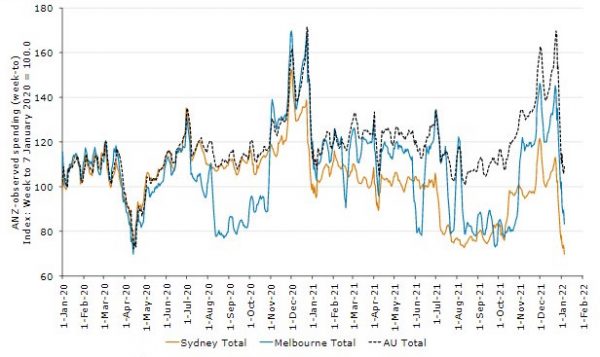
Staffing shortages have left hospitals in chaos, supermarket shelves empty, supply chains paralysed. ANZ Bank data, for example, shows economic activity in Sydney has fallen to a level lower than the worst lockdowns.
Spending in Sydney and Melbourne now near lockdown conditions
ANZ Research
If relaxing health restrictions in December (as Omicron was already spreading) was motivated by a desire to boost the economy, this is an own-goal for the history books.
Relaxing isolation rules
Now the response to Omicron ravaging labour supply is to relax isolation requirements for workers who have contracted, or been exposed to, COVID-19.
The first step was to shift the goalposts on “test, trace, isolate and quarantine” arrangements by redefining “close contact”.
On December 29 the Prime Minister said it was important to move to a new definition “that enables Australia to keep moving, for people to get on with their lives”. The next day National Cabinet approved a definition such that only individuals having spent at least four hours indoors with a COVID-infected person needed to isolate.
Australians certainly want supply chains to keep moving. That won’t happen by simply pretending someone with three hours and 59 minutes of face-to-face indoor contact with Omicron is safe. Putting asymptomatic but exposed and potentially infected people back to work will only accelerate the spread.
The second step has been to reduce the isolation period for those who do pass this tougher “close contact” test. At its December 30 meeting National Cabinet agreed to a standard isolation period of seven days (ten days in South Australia), down from 14 days.
For “critical workers” in essential services including food logistics, the NSW and Queensland governments have gone even further, allowing employers to call them back to work so long as they are asymptomatic.
Employers will use this change to pressure exposed and even sick workers to return to work, risking their own health, colleagues, customers, and inevitably spreading the virus further.
Copying US COVID protocols only guarantees US-style infection rates. In fact, since 5 January, Australia’s seven-day rolling average infections per million now exceed that of the US.
Our Wold in Data, CC BY
From one of the best COVID responses in the world to one of the worst, Australia has snatched defeat from the jaws of victory.
It’s not too late to limit the carnage
The idea that health considerations had to be balanced with economic interests was always a false dichotomy. A healthy economy requires healthy workers and healthy consumers.
The Omicron surge has created an economic emergency that will be difficult to endure.
But it’s not too late to limit further avoidable contagion. Infection prevention practices (including masks, capacity limits, prohibitions on group indoor activities, PPE and distancing in workplaces, and free and accessible rapid tests) must be restored and enforced.
Income supports for workers who stay home must be restored. Staffing strategies need to emphasise steady, secure jobs, rather than outsourcing and gig arrangements which have facilitated contagion.
Above all, our policy makers need to remember the economy is composed of human beings, and refocus their attention on keeping people healthy. Protecting people is the only thing that can protect the economy.
On the heels of new data showing further erosion of Australia’s collective bargaining system, researchers and practitioners from five countries have identified best practices from other countries that could strengthen collective bargaining and lift wages.
Key findings of the research include:
The Ardern government in New Zealand has implemented a new sector-wide bargaining system (called ‘Fair Pay Agreements’) that could be a model for similar changes in Australia. It would enhance workers’ ability to win more stable jobs and higher wages in highly fragmented industries (like security, cleaning or childcare).
New Zealand-style reforms could also improve the effectiveness of Australia’s pay equity legislation. Recent changes in New Zealand’s pay equity system prove that wider scope for bargaining can address persistent gendered pay discrimination. One recent enterprise agreement in Australia (covering public sector workers in Victoria) has already applies that model here.
Nordic and continental European countries have used coordinated sectoral bargaining systems to enhance vocational training and technology adoption. Australia could learn from that experience to better integrate skills programs with secure job pathways.
In Germany, a combination of sector-wide bargaining over wages and other core compensation, combined with workplace-level consultations (under that country’s ‘works council’ system), produces employment outcomes that are both flexible and fair.
“The erosion of collective bargaining has been a major factor in Australia’s record-weak wage growth over the past decade,” said Alison Pennington, Senior Economist at the Centre for Future Work and co-editor (with Dr. Jim Stanford) of the special issue.
“This research confirms that other countries are implementing innovative and powerful measures to strengthen collective bargaining and support a healthier post-COVID recovery. Australia should learn from those countries and take urgent measures to stop the decline of collective bargaining here.”
“A wealth of experience from other countries proves collective bargaining can be strengthened and modernised, to provide workers with a decent shot at fair compensation and better jobs. Unfortunately, Australian governments seem more obsessed with vilifying and policing unions, instead of engaging them as full and constructive partners. The resulting erosion of collective bargaining will only lead to even weaker wages in the future,” said Pennington.
New data released this week from the Commonwealth government confirm that collective bargaining coverage has declined further during the pandemic, with 600,000 workers losing enterprise agreement coverage since end-2019. That erosion of collective bargaining has been a key reason for Australia’s record-weak wage growth.
The newly released special issue of Labour and Industry contains 13 contributions from academics, union leaders, and practitioners around the world.
“Australian workers need an effective system of collective bargaining that goes beyond the legal entity that directly employs them,” said Tim Kennedy, Secretary of the United Workers Union, and co-author one of the articles in the special issue. “This is a vital mechanism to ensure workers have greater control over the safety of their work, across sectors, industries, franchises, labour hire arrangements, supply chains – or however work is configured.”
“Australia is currently deprived of the skill formation benefits that arise from strong sectoral collective bargaining between social partners in Nordic nations,” said Andrew Scott, Professor of Politics and Policy at Deakin University, and author of another article in the special issue.
“It’s exacerbating deficiencies in our training arrangements, evident in high rates of misalignment between jobs and skills. Australia can learn much from the Nordic countries’ superior economic and social policy outcomes that arise from well-integrated skills and collective bargaining systems,” said Professor Scott.
The research is the culmination of a two-year project coordinated by the Centre for Future Work at the Australia Institute.
The Victorian State Government’s policy to cap the rates of local government has cost the Victorian economy 7,425 direct and indirect jobs in 2021-22, and has reduced GDP by up to $890 million in 2021-22, according to new research from the Australia Institute’s Centre for Future Work.
Key Findings
The Victorian Government’s rate caps have reduced employment in Victoria (counting both direct local government jobs, and indirect private sector positions) by up to 7425 jobs in 2021-22. They have also reduced GDP by up to $890 million in 2021-22. The costs of suppressed local government revenues, and corresponding austerity in the delivery of local government services, will continue to grow with each passing year if the policy is maintained.
Rates on property are the largest single source of revenue to local governments in Victoria. Of total Victorian local government revenue in 2019-20 ($11.7 billion), rates accounted for $5.6 billion or almost half. Since 2016-17, the Victorian state government has capped the amounts local governments can collect from their ratepayers.
The rate cap policy, imposed by the Victorian state government on local governments, interferes with the mission of service delivery and expanded, secure employment.
The local government sector in Victoria employs about 50,000 people in a wide range of services and occupations, including road planning and maintenance, home and aged care, waste disposal, libraries, childcare, school crossing supervision, maternal and child health, the State Emergency Service, and environmental management.
The rate cap policy becomes more restrictive as the overall economy slows rather than less restrictive, since the rate cap is tied to inflation indexes which tend to slow when the economy is weak.
The rate caps act as a brake on recovery and growth by embedding a dynamic of self-fulfilling fiscal restraint and austerity.
Victoria’s rate cap policy has inhibited a normal trend of expanding and improving local government services in line with population growth, rising living standards, and economic expansion.
“Rate caps are an arbitrary policy which ties growth in overall rates revenue to price indexes which have nothing to do with demand for services or democratic accountability,” said Dan Nahum, economist at the Australia Institute’s Centre for Future Work.
“It’s not even the case that ratepayers necessarily save any money as a result of the rate cap. There has been a shift to other forms of revenue-raising that are less progressive and socially equitable.
“Rates bills are calculated based on relative property valuations – so even if local governments are collecting less from rates overall than they would in the absence of the cap, if your property value has gone up relative to others in your community, then your rates payments do as well.
“There is no evidence that rate caps makes local councils ‘more efficient’. Instead, it simply takes money out of much-needed council services and robs local communities of employment opportunities.
“Far from protecting ratepayers and residents, rate caps hurt them. Rate caps compromise service delivery, negatively impact employment and wages amongst residents employed in the local government sector, result in higher fees collected through other revenue tools, and reduce local government expenditures flowing back into the private sector.
“There is simply no good economic reason for rate caps. By abolishing the rate caps policy, the Victorian Government could create jobs and stimulate the economy post-COVID.”
The Victorian Government’s policy of capping of local government rates revenue in Victoria is a regressive move on economic, social and democratic grounds. By arbitrarily tying the growth in total rates revenue in each local government area to price indexes, the state government restricts the ability of local governments to respond to the COVID-19 crisis with expanded, secure employment and service offerings.
Rates on property are the largest single source of revenue to local governments in Victoria. Of total Victorian local government revenue in 2019-20 ($11.7 billion), rates accounted for $5.6 billion or almost half. Since 2016-17, the Victorian state government has capped the amounts local governments can collect from their ratepayers.
New research by the Centre for Future Work, commissioned by the Australian Services Union, finds that the imposition of rate caps has cost up to 7425 jobs in 2021-22, counting both direct local government employment and indirect private sector jobs. They have also reduced GDP by up to $890 million in 2021-22. The costs of suppressed local government revenues, and corresponding austerity in the delivery of local government services, will continue to grow with each passing year if the policy is maintained.
The rate cap policy becomes more restrictive as the overall economy slows, since the rate cap is tied to inflation indexes which tend to slow when the economy is weak.
The local government sector in Victoria employs about 50,000 people in a wide range of services and occupations, including road planning and maintenance, home and aged care, waste disposal, libraries, childcare, school crossing supervision, maternal and child health, the State Emergency Service, and environmental management.
The rate caps act as a brake on recovery and growth by embedding a dynamic of self-fulfilling fiscal restraint and austerity. Additionally, there has been a shift to other forms of local government revenue-raising that are less progressive and socially equitable, such as fees and fines.
Rates bills are calculated based on relative property valuations – so even if local governments are collecting less from rates overall than they would in the absence of the cap, growth in a particular ratepayer’s payments may well exceed the overall cap.
The rate cap policy inhibits a normal trend of expanding and improving local government services in line with population growth, rising living standards, and economic expansion – as well as interfering with the democratically-expressed preferences of local government voters.