Blog

  • Yesterday’s Tomorrow Today – a new podcast from the Carmichael Centre

    Laurie Carmichael believed that a worker-centred agenda for technological change was important to achieving better outcomes for society, with workers and their unions playing a pivotal role in shaping technology and skills for social progress.

    The films reviewed in Yesterday’s Tomorrow Today often depict the opposite of a worker-led future of technological change. It’s the aim of the podcast to break down what this looks like, and to suggest what an alternative future – one that benefits workers and humanity – might look like.

    Listeners of YTT can expect podcast episodes to feature accessible political-economic analysis laced with good humour, reflections on accurate (and not-so-accurate) predictions of a future shaped by the neoliberal surveillance state, and a rotating list of special guests, including Dr Jim Stanford, Lily Raynes (Anne Kantor Fellow at the Centre for Future Work), Matt Grudnoff (Senior Economist at The Australia Institute) and more to come.

    Don’t forget to like and subscribe to Yesterday’s Tomorrow Today wherever you get your podcasts and be sure to leave a review – this is what helps other listeners to find and subscribe to YTT, making sure we can keep reaching working people far and wide.

    Listen to the first episode – a review of 1987’s RoboCop – and what it warned us about deindustrialisation, gentrification, privatisation and police militarisation (also available on Apple Podcasts, Google Podcasts and Spotify).

    The post Yesterday’s Tomorrow Today – a new podcast from the Carmichael Centre at the Centre for Future Work appeared first on The Australia Institute's Centre for Future Work.

  • The UK shows how bad the Stage 3 tax cuts will be

    Fiscal Policy Director, Greg Jericho, notes in his Guardian Australia column that there are big lessons for Australia.

    The Stage 3 tax cuts are a case of terrible economics masquerading as a growth strategy. Trickledown economics does not work, never has, and this week we have discovered that even the markets agree.

    Rather than destroy your tax base, governments need to care about sustaining a broad revenue base that works to reduce inequality and fund services and investments that drives productivity and helps those who most need it.

    Trickledown economics has never worked and was always just fraudulent spin designed to hide its real aim of giving rich and powerful people tax cuts at the expense of others.

    This week has shown that no one even believes the lie anymore.

    The post The UK shows how bad the Stage 3 tax cuts will be appeared first on The Australia Institute's Centre for Future Work.

  • Work in the Care Economy Vital for Future Well-Being

    Our Policy Director for Industrial and Social issues, Dr Fiona Macdonald, recently discussed these issues in a feature conversation with Richard Aedy on the ABC RN program, The Money. They discussed the size of the care workforce, the challenges faced by care providers and participants alike, and the need for government reform.

    The post Work in the Care Economy Vital for Future Well-Being appeared first on The Australia Institute's Centre for Future Work.

  • International Seafarers Suffer $65 Million in Wage Theft Annually in Australian Waters

    Seafarers working on foreign-registered freight ships in Australian waters face regular theft of wages and other entitlements due to legal loopholes and lax enforcement of labour standards, according to a new research report published today by the Australia Institute’s Centre for Future Work.

    The report, titled Robbed At Sea, examines records of wage inspections conducted over the last decade by the International Transport Federation (ITF), a global federation of maritime and other transportation unions. The ITF sponsors a small team of 4 inspectors in Australia, to conduct spot checks of international vessels visiting our ports.

    Key points:

    • Over the last decade, in close to 5000 inspections in Australian ports the ITF found 70% of ships failing to meet minimum international standards for wage payment and other core labour standards – with resulting recovery orders totaling $38 million over that time.
    • But the ITF team can only inspect a tiny fraction of all foreign vessels visiting Australian ports: about 450 per year, or just 2.5% of visits by foreign-registered ships in that time. On the basis of reasonable assumptions regarding the prevalence of wage theft in the other, uninspected ships, the report estimates total wage theft from international seafarers across the Australian shipping industry of some $65 million per year.
    • Seafarers on foreign-registered vessels (often flying ‘flags of convenience’ to evade labour and tax rules) usually come from low-wage developing countries, and have little power to resist exploitation by unethical ship owners, contractors, and sub-contractors.
    • Stronger rules in port countries (like Australia) are necessary to offer greater protection while they are in Australian waters. But the report identified several loopholes and enforcement failures that explain why these seafarers are routinely exploited, even when delivering cargo from one Australian port to another.

    “Australia prides itself on being a country that respects the rule of law, and a fair go for workers. Yet we are allowing some of the most vulnerable workers in the entire global economy to be ruthlessly and knowingly exploited, right here in our own waters,” said Rod Pickette, co-author of the report.

    “Repeated inspections have confirmed routine wage theft and other exploitation in our ports,” said Lily Raynes, co-author of the report.

    “But those inspections are just the tip of the iceberg. Clearly this exploitation is a normal feature of international shipping, and Australia has both a moral and an economic responsibility to stop it within our jurisdiction,” Ms Raynes said.

    The report makes ten specific recommendations for reducing the incidence of wage theft from international seafarers in Australian waters.

    Report Recommendations Include:

    • Closing a current legal loophole which allows foreign-registered ships to conduct two trips between Australian ports without needing to respect the Fair Work Act or the Seagoing Industry Award
    • Strengthening inspection resources for the Australian Maritime Safety Authority and the Fair Work Ombudsman to ensure that existing rules are better respected

    The report was prepared in cooperation with the International Transport Federation’s Australian Shipping Inspectorate.

    It is being released to commemorate World Maritime Day (Thursday, 29 September) – an annual opportunity to raise awareness about the risks and exploitation faced in international seafarers.

    The post International Seafarers Suffer $65 Million in Wage Theft Annually in Australian Waters appeared first on The Australia Institute's Centre for Future Work.
  • They didn’t cause the inflation, but workers are expected to cure it

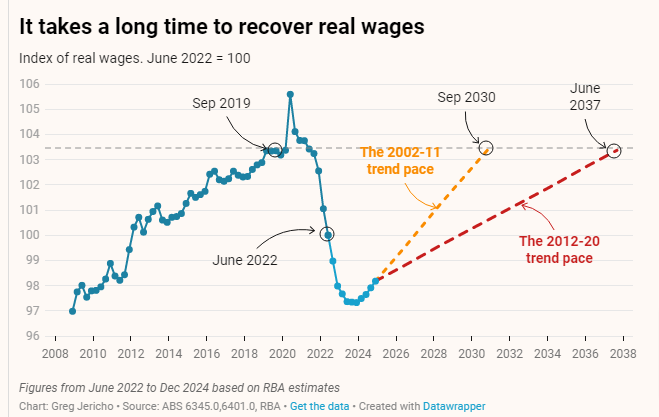
    In his Guardian column, Policy Director Greg Jericho notes that given real wages have already fallen for 2 straight years any further falls will take workers’ purchasing power backwards to where it was more than a decade ago. This however is viewed as being “worse than the alternative” of inflation growth above 3%.

    He notes that over the past 2 years the profit margins of many industries, and most especially the mining industry, have risen and have themselves fuelled inflation. But company profits are never expected to suffer, wages however are always viewed as either the culprit of inflation or the means to reduce it. The vast increase in mining profits, largely due to the Russian invasion of Ukraine, also highlights the urgent need for a windfall profits tax.

    Using the RBA’s own estimates Jericho calcuates that by the end of next year real wages will be back at 2008 levels and even with the most optimistic outlook they will not return to 2019 levels until 2030.

    The Reserve Bank’s strategy of sharply increasing interest rates risk slowing the economy into a recession even though real wages are already falling faster and for longer than they have in modern times.

    The post They didn’t cause the inflation, but workers are expected to cure it appeared first on The Australia Institute's Centre for Future Work.
  • The latest data shows just how bad housing affordability is

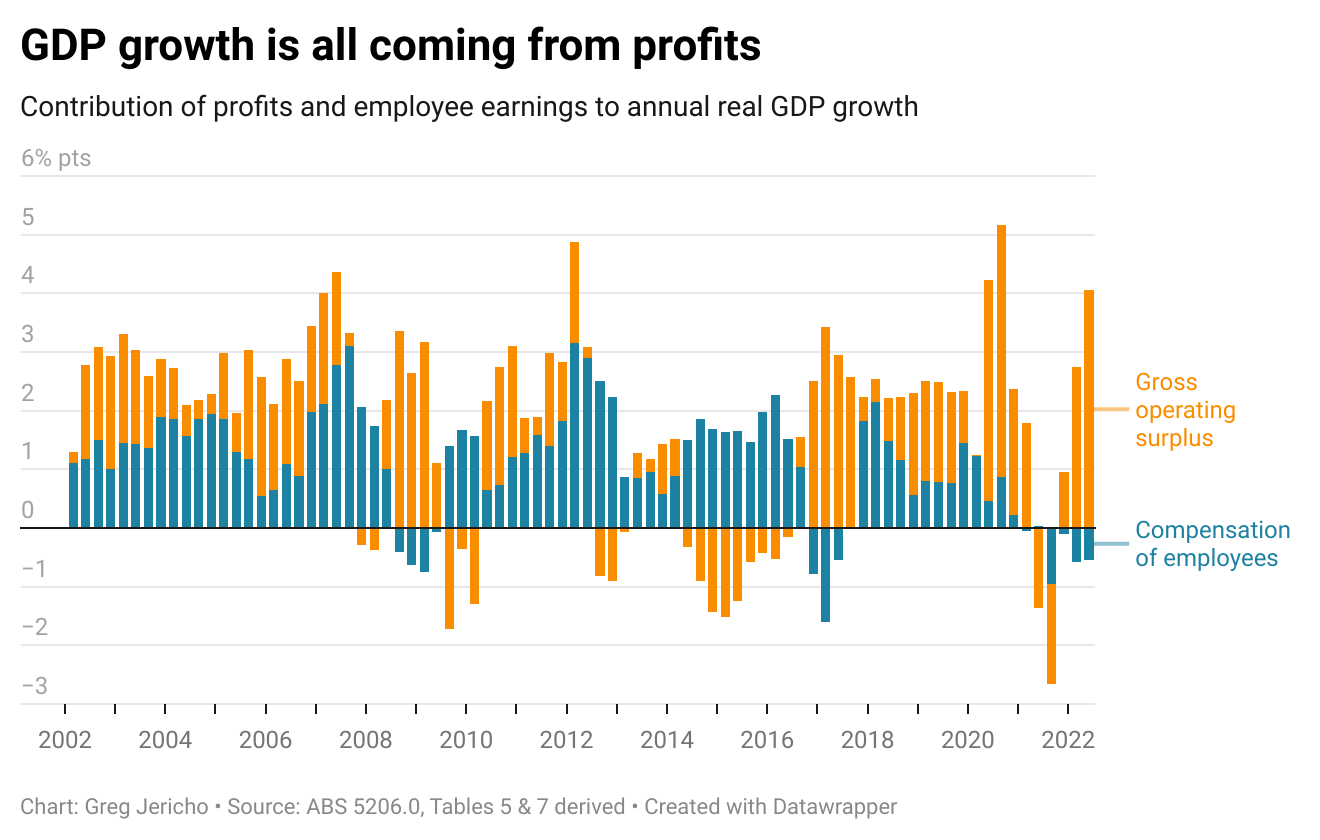
    But while the latest data from the ABS shows prices fell on average 2% across the nation in the June quarter, policy director Greg Jericho notes in his Guardian column that price remains well above what they were prior the pandemic.

    During the GFC the majority of the stimulus measures directed towards construction were on public works – most notably the Building the Education Revolution. During the pandemic, however, the Morrison government targeted the housing market with its HomeBuilder program in conjunction with the Reserve Bank’s cutting interest rates. These served to set fire to the market as prices soared and affordability plummeted.

    In June 2020, the average dwelling price in Australia was $689,400. That was around 13.4 times the average annual household disposable income of $51,487. Now the average household disposable income is up to $56,129, while the average dwelling price is now some 16.4 times that at $921,500.

    Even worse, ten years ago the average dwelling price was just 11.4 times.

    Housing policy has for too long been driven by keeping prices rising, and combined with flat income growth, it has seen a generation of Australians left out of the housing market.

    The post The latest data shows just how bad housing affordability is appeared first on The Australia Institute's Centre for Future Work.
  • The GDP figures show the ongoing shift of the national income to profits

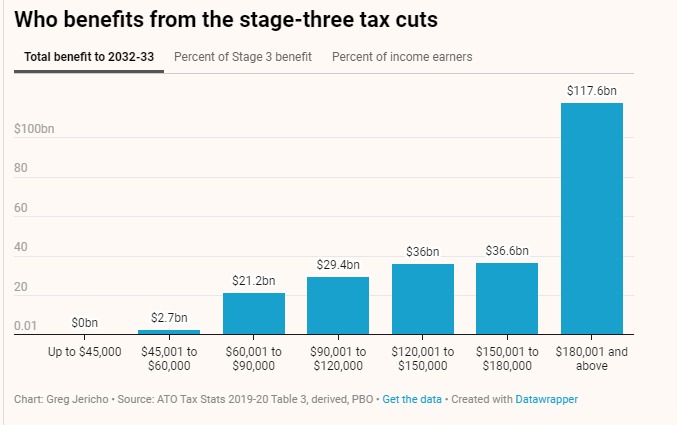
    But as labour market and fiscal policy director Greg Jericho notes in the Guardian Australia column, beneath those good numbers are a lot of problems, not the least of which is that wages continue to fail to keep up with inflation. Over the past year the total compensation of employees rose 7% but inflation in the national accounts rose 8.3%. Over the same period corporate profits went up 25%. We are at the absurd state of affairs where GDP is rising strongly, but real wages are not.

    We now have a situation where a record low share of national income is going to employees and a record high share is going to profits.

    The talk is always about lifting productivity and wages will follow, but the story for far too long now has really been productivity rising and profits following.

    The post The GDP figures show the ongoing shift of the national income to profits appeared first on The Australia Institute's Centre for Future Work.
  • The PBO reveals just how much the Stage 3 tax cuts favour the wealthy

    As labour market and fiscal policy director, Greg Jericho notes in his Guardian Australia column, the PBO estimates that of the $243.5bn that the tax cuts will cost in their first 9 years, 48% will go to people earning over $180,000, and 77% will go to the richest 25%.

    In the first year of operation, the richest 1% of income earners will get the same benefit from the tax cuts as will the poorest 65%.

    Greg Jericho notes that in 2024-25, $12.7bn of the $17.7bn annual cost of the tax cuts that year will go to those earning above $120,000. That is almost the same amount expected to be spent on Jobseeker payments that year.

    The Stage 3 cuts are designed to favour the wealthy and reduce the level of revenue which in turn will force cuts to spending and programs that assist the most vulnerable.

    The post The PBO reveals just how much the Stage 3 tax cuts favour the wealthy appeared first on The Australia Institute's Centre for Future Work.
  • Market power costs consumers, workers and the whole economy

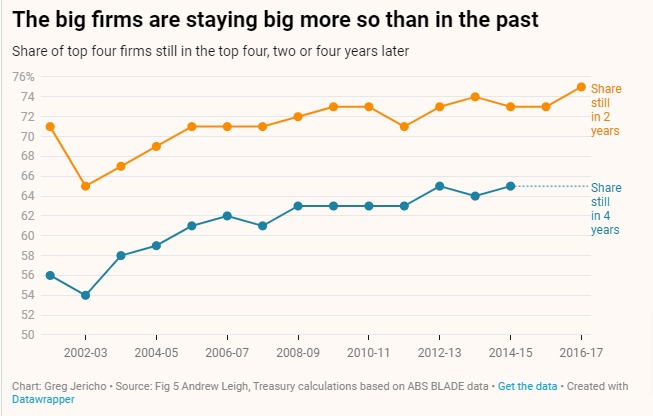
    But a speech by the assistant minister for competition, Andrew Leigh, reveals that businesses themselves and the way in which the major players are allowed to dominate industries is a significant drag on productivity growth.

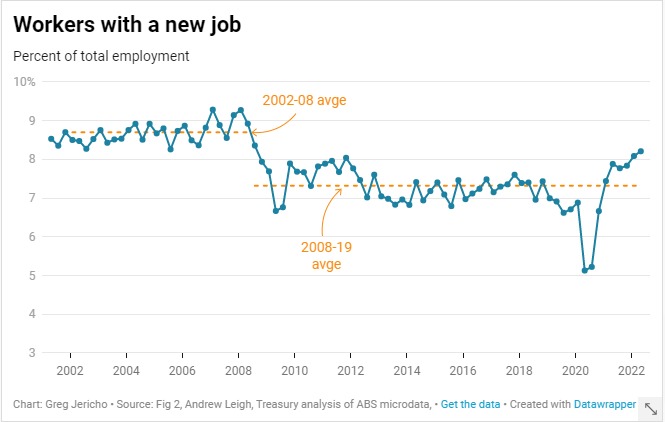
    In his Guardian Australia column, labour market and fiscal policy director Greg Jericho, reviews Dr Leigh’s speech and notes that over the past 20 years market concentration has increased across the whole economy. Over this time there has been a fall in the percent of new firms entering industries and also in established firms leaving. This produces a more sluggish economy where the need to innovate and pursue more productive operations is diminished. It also leads to firms being able to markup their prices by more each year as they consolidate their power, and also feel less need to offer better wages as the competition for labour falls.

    While wages growth crucially requires fair bargaining arrangements that enables workers to negotiate better wages, when workers have fewer options to pursue better paying jobs at other more productive workplaces, the number of workers switching jobs declines and so too does the market pressure to pay wages.

    Dr Leigh notes that this “decline in economic dynamism” needs greater policy focus, and his speech is an excellent corrective to the belief that improved productivity is all about taking away worker rights and giving more power to businesses to hire and fire.

    Australian business groups and many on the conservative side of politics love to talk up free-market competition, but the past 20 years has shown the markets are less about competition and more about concentration. And while profits have risen, workers and households have been left worse off.

    The post Market power costs consumers, workers and the whole economy appeared first on The Australia Institute's Centre for Future Work.