Blog

  • Wealth inequality across generations will only fuel voter disenchantment

    While income inequality is an often discussed topic, wealth inequality is just as pernicious though often less discussed issue. Worse still the inequality of wealth across generations has lasting impacts for people into retirement.

    Policy director Greg Jericho writes in his Guardian Australia column how economic policies of the past few decades has served to provide those with wealth more of it, while depriving younger people of gaining a foothold that previous generations had.

    The issue is most acute with housing. Housing affability is often debated with some suggesting that because of lower interest rate than in the past owning a home is not as difficult as in the past. But the reality is that the size of the mortgage relative to incomes is so much greater than in the past that even with lower interest rates payments account for much more income than they used to. Whereas for those entering the housing market in the 1980s one incomes was often more than enough, now two incomes is a necessity.

    But what is often forgotten is that while interest rates were higher at times in the 1980s and 1990s those rates fell and with them did the payments all the while incomes rose. As a result those who bought homes in the 1980s and 1990s saw their repayments as a share of income fall to very low levels – levels unheard of now.

    And while the arguments about whether housing is more or less affordable can turn on definitions of affordability, the fact is that for the first time fewer than half of people aged 30-34 own their own home. That’s not through choice, but through the reality of a housing market that is locking out younger people.

    This in turn sees younger generations have less wealth at their age than did their parents and grandparents.

    It is little surprise that Millennials are not becoming more conservative in their voting as they age in the same way that did Baby Boomers and Gen Xers. The wealth inequality will have ongoing repercussions for political parties who have in the past taken it as given that older voters will vote for them.

    The post Wealth inequality across generations will only fuel voter disenchantment appeared first on The Australia Institute's Centre for Future Work.
  • Minimum wages and inflation (2023)

    New research from the Centre for Future Work at the Australia Institute has revealed how rises in the minimum wage have almost no impact on inflation and given the collapse in the value of the minimum wage in real terms over the past 2 years, a 7% increase is a necessary recompense for Australia’s lowest paid workers.

    Each year the Fair Work Commission conducts the Annual Wage Review (AWR) which determines the national minimum and award wages. And each year it is met with a chorus of cries from business groups, conservative politicians and commentators that Australia’s economy will surely break should the minimum wage be raised too much.

    Over the past two years however, the minimum wage has risen by less than inflation, causing a significant decline in the real purchasing power of millions of workers covered by the Modern Award system. This marks the first time in a quarter-century that the minimum wage has had a deflationary impact on the economy (that is, increased by less than the inflation rate) over successive years.

    Despite this fall, once again, submissions from business groups to this year’s AWR have called for rises below inflation, and have cited concerns about a wage-price spiral as justification for advocating a further erosion of low-paid worker’s living standards.

    But research by Greg Jericho and Jim Stanford shows that minimum wage increases over the past 25 years have had little to no impact on inflation at all. It also demonstrates that a 1% increase in the minimum wage and all Modern Award wages – even if completely passed through into higher prices – would result in a virtually undetectable 0.06% increase in economy-wide prices. So small is this that a mere 0.2% fall in profits would be enough to cancel any impact on prices at all.

    The research reveals that the call from the Australian Council of Trade Unions for a 7% increase in the national minimum wage would make up a portion (but not all) of the real wage losses, workers have experienced in the past two years. Even if fully passed on in higher prices, with no reduction in current record-high business profits, a 7% minimum wage hike would at most translate into an increase of just 0.4% in economy-wide prices.

    Alternatively, that 0.4% rise could be offset by just a 1.4% reduction in total corporate profits.

    With inflation passing its peak, there is no cause for concern that a minimum wage rise of 7% (equal to the annual rate to the March quarter) would add fuel to the inflation fire.

    This reinforces recent research by the Centre for Future Work that profit margins are presently at record highs in Australia, because companies have increased prices since the pandemic far more than their own input costs. This gives companies ample cushion to absorb the cost of higher minimum wages, with no impact on prices at all.

    In sum, the impact of minimum wage increases on average prices is thus little more than a rounding error. But for the 20% of employees who earn either the national minimum wage or wages set under Modern Awards, a strong minimum wage increase will be vital. It will ensure that the lowest paid, who have already been most hurt by inflation, are not forced to suffer more due to an inflationary upsurge that was ultimately spurred by higher profits, not wages.

    The post Minimum wages and inflation appeared first on The Australia Institute's Centre for Future Work.
  • With the impact of rate rises still to come the RBA is wise to pause

    Since April the Reserve Bank has increased the cash rate by 350 basis points from 0.1% to 3.60% – the fastest and largest increase since the late 1980s. But as policy director Greg Jericho notes in his Guardian Australia column, perhaps as much as a third of the rate rises have yet to fully flow through to the economy.

    While the interest rate of new mortgages has risen the full amount, the average rate of all mortgages has only risen around 209 basis points – with many mortgage holders still yet to have their repayments increase due to the rate rates in December, let alone those in February and March.

    The Reserve Bank noted this in its statement and stressed the need to gather more information before deciding whether to increase rates or keep them steady.

    The most recent GDP figures show the economy overall has slowed and the signs of inflation are that the peak has been reached and much like the USA, it is not heading down. While the path to 3% inflation might take some time there seems little sense of long-term expectations rising and the 350 basis points worth of rises makes it clear the RBA is prepared to act if it believes inflation is accelerating.

    The Centre For Future Work has been calling for a pause in the rates and it welcomes this decision by the RBA. There is minimal risk from observing the data after 10 successive rate rises. And workers whose wages have not kept pace with inflation will be relieved that the RBA is paying heed to warnings that slowing the economy too fast in an environment where inflation has peaked only increases the risks of sending the economy into a recession

    The post With the impact of rate rises still to come the RBA is wise to pause appeared first on The Australia Institute's Centre for Future Work.

  • Profits and Inflation in Mining and Non-Mining Sectors

    A previous report from the Centre showed that 69% of excess inflation (above the Reserve Bank’s 2.5% target) since end-2019 arose from higher unit corporate profit margins, while only 18% was due to labour costs. The new research provides detail on the distribution of those excess profits across different sectors in the Australian economy.

    By far the biggest profits were recorded in the mining sector, where corporate operating profits surged 89% since the onset of the pandemic. Those profits resulted from sky-high prices for fossil fuel energy (including petroleum products, gas, and coal). Thanks to those price hikes, the mining sector now captures over half of all corporate profits in the entire Australian economy.

    Less spectacular but significant increases in corporate profits are visible in several other sectors of the economy, too – not just mining. Profits swelled rapidly in wholesale trade, manufacturing, transportation, and other strategic sectors.

    In these strategic industries, businesses could exploit supply chain disruptions, consumer desperation, and oligopolistic market power to increase prices well beyond production costs.

    In other sectors (including arts & recreation, hospitality, and telecommunications) profits have been flat or falling since the pandemic.

    Early signs in 2023 that inflation (and corporate profits) had peaked, and were returning to normal, have been thrown into question by a renewed threat of profit-price inflation: the OPEC+ cartel decided earlier this month to curtail oil production to boost world prices.

    Policy-makers need to acknowledge the role of record profits in driving recent inflation – and develop alternative policy responses (such as price caps in strategic markets, excess profit taxes, and targeted fiscal support for working and low-income households) to manage current inflation in a fairer and more effective way.

    The post Profits and Inflation in Mining and Non-Mining Sectors appeared first on The Australia Institute's Centre for Future Work.

  • Stop the fear, give workers a fair pay rise

    It took roughly one day after the New South Wales election for conservative media groups to begin spreading fear about union power and public sector wage blowouts. But as labour market policy director, Greg Jericho writes in his Guardian Australia column these fears are massively overblown and also ignore the reality of how much workers have lost out over the past few years.

    In NSW public-sector wages grew just 2.5% in 2022, well below private-sector wage growth in that state and massively below inflation which rose 7.6% in that state last year.

    Public-sector wage caps were notionally introduced to get the budget back into surplus, but that was just a fib – once the budget returned to surplus the caps remained. The purpose of the wage caps has always been to drive down private-sector wage growth, a point made abundantly clear by former Treasurer Matt Kean when he told an audience at a Business NSW function that removing the public-sector wage cap would see their companies “competing for labour against the public service who were paying huge wage increases.”

    But the reality is the wage cap not only keeps private-sector wages down it has smashed the living standard of public sector workers whose real wages are now more than 5% lower than they were 2 years ago.

    The fear of wage rises must stop.

    The post Stop the fear, give workers a fair pay rise appeared first on The Australia Institute's Centre for Future Work.

  • The Fiscal, Economic, and Public Health Dangers of Water Privatisation (NSW)

    But beyond the obvious importance of good water systems to life, health, and well-being, the water system also constitutes a valuable economic asset in the overall portfolio of public enterprise (see box). Investments in high-quality water and sewage systems represent enormous sums of fixed capital. The financial and operational dimensions of water systems are significant to the fiscal and macroeconomic functioning of the whole state economy.

    In this context, suggestions that the Sydney Water system might be sold to private investors raise a wide range of significant concerns: regarding the efficiency and safety of their continued operation, access to healthy and affordable water services for state residents, and the economic implications for customers, workers, and state government itself. A new research report from the Centre for Future Work reviews some of those concerns, and considers the likely consequences of Sydney Water’s potential privatisation.

    Main findings of the report include:

    • Sydney Water represents an essential public asset, important for both economic as well as public health reasons
    • Sydney Water boasts total assets of almost $24 billion, public equity of $8 billion, annual revenues of $2.8 billion, and dividend and tax payments to the people of NSW that averaged $870 million per year since 2018
    • The state earns far more from dividend payments arising from its equity in Sydney Water, than it would pay in interest on an equivalent amount of public debt
    • Selling the utility would impose a significant fiscal cost on the state through lost dividend and tax revenues
    • Experience with privately-owned water systems in other countries suggests water charges would rise significantly under private ownership, largely because of higher interest costs, higher debt, and higher dividend payouts
    • Based on UK and US studies, Sydney Water customers could see their annual water bills grow under private ownership by 39% to 59% (or by an average of between $174 and $264 per customer per year).

    The report was commissioned by the NSW & ACT Branch of the Australian Services Union.

    The post The Fiscal, Economic, and Public Health Dangers of Water Privatisation appeared first on The Australia Institute's Centre for Future Work.

  • The housing market has cooled, but housing unaffordability remains a long way off

    The most recent data on the value of dwelling around Australia reveals the prices in most capital cities have fallen over the past year and are likely to keep doing so for some months. But the data also shows that housing affordability remains a long way from repairing the decades of damage.

    In his Guardian Australia column, policy director, Greg Jericho, notes that the impact of interest rate rises has definitely caused the housing market to come off the boil. In most capital cities median house prices are now below what they were a year ago. Coming as this does off data suggesting wages are not rising as fast as the Reserve Bank feared, and amid the ructions in the USA financial system after the Silicon Valley Bank collapse, the Reserve Bank certainly has enough reason to not raise rates again.

    But while the fall in house prices does help those trying to buy a home, the decrease in affordability is highlighted by the fact that while house prices are mostly below what they were a year ago, they are well above what they were 2 years ago in all capital cities. And those rises have been well above the growth in wages in that time.

    Jericho notes that in Sydney for example, wages and house prices from 2003-2013 largely rose in line but over the past decade house prices have surged above wages. Had prices instead continued to rise in line with wages the median house price in Sydney would now be $863,000 rather than $1,270,000.

    This disconnect is replicated around the country with house prices being some 60% above what they would have been had they risen along with wages. In Hobart the current median house price of $727,000 is some 133% above the price it would have been had they rinse in line with wages in Tasmania of $297,000.

    This disconnect highlights the need for tax reform of the housing market, an increase in supply including increased median density housing, and especially public housing.

    And above all we need wages to no longer be left behind.

    The post The housing market has cooled, but housing unaffordability remains a long way off appeared first on The Australia Institute's Centre for Future Work.

  • The Times They Aren’t A-Changin (enough) — gender & work

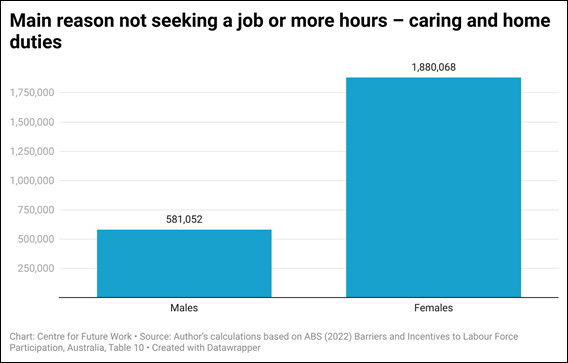
    This report examines the barriers to closing the gender gap by reviewing Australia’s position within the industrial countries of the OECD. The report also uses data from the ABS and the ATO to highlight gender disparities across all levels of income, ranges of occupation and ages, as well as disparities regarding who undertakes the greater share of unpaid work.

    One clear concern is gender segregation, where either men or women dominate an occupation or industry. Men have higher average salaries than women in 95% of all occupations, including those where women dominate the workforce. For example, women account for 99% of all midwives, and yet are paid on average 19% less.

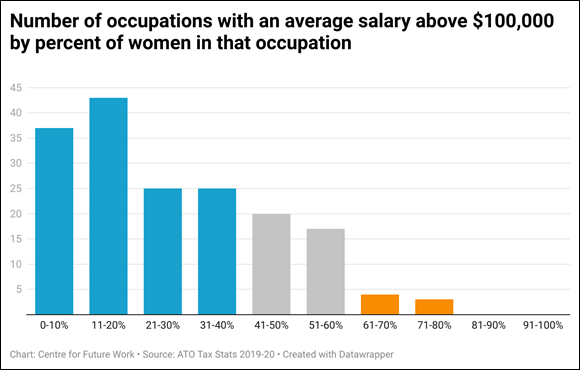
    We identify 80 occupations in which men make up 80% or more of the workforce; these occupations have an average salary above $100,000. In contrast, no occupation where women make up that share of the workforce has such a high average salary. This highlights how segregation has reinforced massive differences in pay.

    The report recommends policies to promote greater access to childcare and parental leave for both parents, family-friendly work practices, and the lifting of wages for industries dominated by women – most urgently in the care sector.

    The post The Times They Aren’t A-Changin (enough) appeared first on The Australia Institute's Centre for Future Work.

  • Women Earn $1m less than men & $136,000 Less in Super over Working Life

    New research released on International Women’s Day reveals Australian women earn $1.01m less over their working lives than men, based on median income data.

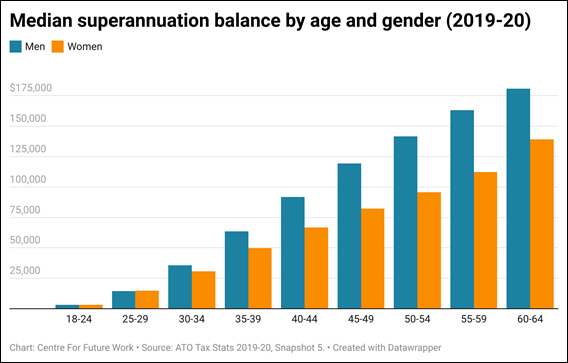
    Women earn $136,000 less in superannuation over their working lives than men, based on median income data. Women earning the median wage will accumulate approximately $393,676 in super, $151,000 below what is considered a ‘comfortable retirement’. The average super balance in Australia in 2023 is $150k.

    Experts say if the gender pay gap was eliminated women would be $3 billion per week better off.

    Despite the gender pay gap narrowing slowly, based on data from the past decade it will only be eradicated by the year 2053 when more than 60% of the current workforce will be retired.

    Key Points:

    • Australian women on a median income will earn $1.01m less over their working lives on average than their male counterparts.
    • Australian women on a median income will earn $136,000 less in superannuation over their working lives than their male counterparts.
      • Women earning the median wage will accumulate approximately $393,676 in super, $151,000 below what is considered a ‘comfortable retirement.
      • The average super balance in Australia in 2023 is $150k.
    • Experts say if the gender pay gap was eliminated women would be $3 billion per week better off.
    • The gender pay gap is narrowing so slowly that it will not fully close for another 30 years until 2053. At that stage 60% of people currently working will have retired.
    • The Gender wage gap in Australia (15.3%) is more than double what it is in New Zealand (6.7%)
    • The gender gap occurs across all occupations and industries:
      • Men have higher average salaries than women in 95% of all occupations, including those where women dominate the workforce. For example, women account for 99% of all midwives, and yet are paid on average 19% less.
        • 80 occupations in which men make up 80% or more of the workforce have an average salary above $100,000.
        • By contrast zero occupations in which women make up 80% or more of the workforce have an average salary above $100,000.

    “For the average woman in Australia, the gender pay gap will be more than $1.01m over her working life, based on conservative estimates,” said Senior Economist Eliza Littleton from the Australia Institute’s Centre for Future Work.

    “There’s been a noisy political debate about super in Australia for the past week, but this data shows that based on median income data Australian women will earn $136,000 less than their male counter parts over their working life. When you consider that the average super balance in Australia right now is approximately $150,000, that’s a huge disparity.

    “Australian women continue to be paid less than men on average across all industries and occupations, costing us more than $3b across the economy each week.

    “We know that older women are one of the most vulnerable groups when it comes to poverty and homelessness in Australia.

    “Australian women shouldn’t have to wait until the year 2053 for substantive equality. We deserve equity today and our research makes several sensible policy recommendations for the Labor Government to action.”

    Policy recommendations:

    • Greater access to free or more affordable earlier childhood education & care: Australia Institute research shows if Australia had the same labour force participation rates as Nordic countries do, then the economy would be $60 billion, or 3.2% of GDP, larger (Grudnoff and Denniss, 2020).
    • More paid parental leave for both parents: Australia’s PPL scheme is well behind international standards. The OECD average PPL scheme is 60 weeks in total, with 24.6 weeks reserved for mothers, 10.4 weeks for fathers and 25.4 weeks that can be flexibly distributed (OECD, 2022). With a 20-week scheme, Australia unsurprisingly ranks low – 30th out of 38 countries for the duration of paid leave entitlements. Extending leave entitlements and encouraging a more even distribution of childcare would help reduce the career and financial penalty of having children both for all parents, but especially women. Additionally, making it mandatory for superannuation to be paid while a person is taking paid parental leave would help to reduce the gendered super gap.
    • Greater family-friendly work practices: Some workplaces and workers have managed to maintain flexible working arrangements, but this should be standardised, expanded and embedded in employment relations frameworks to make balancing work and care more achievable across the workforce. Breaking down rigid job design in male-dominated jobs could also help with reducing entrenched gendered segregation by industry and occupation.
    • Deliberate policy to lift the wages for industries dominated by women — most urgently in the care sector: Women dominated sectors, especially in the care industry are among the lowest paid work. The 2021 Royal Commission into Aged Care Quality and Safety recommended that gig work, independent contracting and other ‘indirect’ employment arrangements be restricted in the publicly-funded aged care sector. This needs to be agreed to.
    • Address insecure work: Further reforms should include rights to family-friendly working time arrangements and stable work as minimum standards for all employees in the National Employment Standards.
    • Full recommendations in attached report

    The post Women Earn $1m less than men & $136,000 Less in Super over Working Life appeared first on The Australia Institute's Centre for Future Work.

  • Australian Inflation Reflects a Historic Redistribution from Workers to Bosses

    Meanwhile, business profits have expanded strongly through this inflationary episode. Companies haven’t just passed along higher input costs to their customers. Rather, they have taken advantage of the conjuncture of factors related to the pandemic (supply shortages and disruptions, consumer desperation and pent-up demand, and oligopolistic pricing power) to push up prices far higher than needed to cover their own costs.

    The result has been a process of ‘profit-price inflation’: higher profit margins are both a cause and consequence of rapid inflation. Centre for Future Work Director Jim Stanford discusses the distributional impacts of recent inflation in this new commentary for The Conversation: Underlying Australia’s inflation problem is a historic shift of income from workers to corporate profits

    The post Australian Inflation Reflects a Historic Redistribution from Workers to Bosses appeared first on The Australia Institute's Centre for Future Work.