Category: Research Reports

  • Advanced Skills for Advanced Manufacturing

    Australia’s manufacturing industry is at a crossroads. After years of decline, the sector has finally found a more stable economic footing, and many indicators point to an expansion in domestic manufacturing in the coming years. Manufacturing added almost 50,000 new jobs in the last year – making it one of the most important sources of new work in the whole economy.

    However, one key factor that could hold back that continuing recovery is the inability of Australia’s present vocational education and training system, damaged by years of underfunding and failed policy experimentation, to meet the needs of manufacturing for highly-skilled workers. The skills challenge facing manufacturing is all the more acute because of the transformation of the sector toward more specialised and disaggregated advanced manufacturing processes. This naturally implies greater demand for highly-trained workers, in all its occupations: production workers, licensed trades, technology specialists, and managers.

    To sustain the emerging turnaround in manufacturing, the sector has an urgent need for a concerted and cooperative effort to strengthen vocational education and training. This report contributes to that process: by cataloguing the emerging skills challenges facing manufacturing, reviewing the failures of the existing approach to vocational education in this sector (and across Australia’s economy as a whole), and proposing twelve key principles for reform.

    This report, by Dr. Tanya Carney and Dr. Jim Stanford, was prepared by the Centre for Future Work for the Second Annual National Manufacturing Summit. The Summit, held at Parliament House on 26 June 2018, will gather leading representatives from all major stakeholders in Australia’s manufacturing sector: business, unions, universities, the financial sector, suppliers and government. They will consider the industry’s prospects and identify promising, pragmatic policy measures to support a sustained industrial turnaround. It is a highly appropriate forum at which to begin a discussion about multi-partite efforts to rebuild vocational education and address the looming skills challenges facing manufacturing.

    The post Advanced Skills for Advanced Manufacturing appeared first on The Australia Institute's Centre for Future Work.
  • The Dimensions of Insecure Work: A Factbook

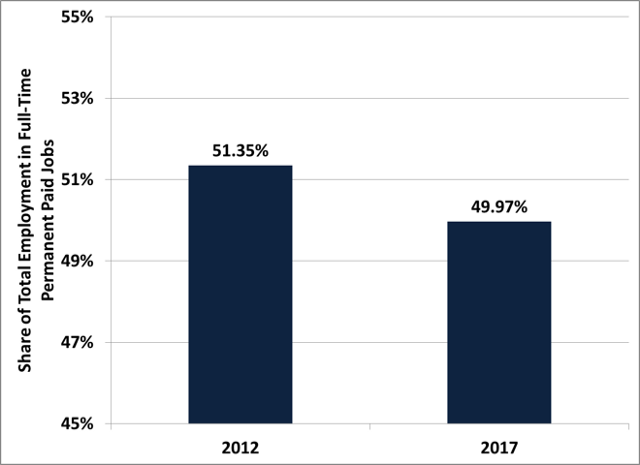
    Share of Workers in Full-Time Paid Employment with Leave Entitlements. Source: Centre for Future Work calculations from ABS Catalogues 6291.0.55.003, EQ04 (2017), and 6333.0 Tables 2.3 and 9.1 (2012).

    The report, The Dimensions of Insecure Work: A Factbook, reviews eleven statistical indicators of the growth in employment insecurity over the last five years: including part-time work, short hours, underemployment, casual jobs, marginal self-employment, and jobs paid minimum wages under modern awards.

    All these indicators of job stability have declined since 2012, thanks to a combination of weak labour market conditions, aggressive profit strategies by employers, and passivity by labour regulators. Together, these trends have produced a situation where over 50 per cent of Australian workers now experience one or more of these dimensions of insecurity in their jobs - and less than half have access to “standard,” more secure employment.

    “Australians are rightly worried about the growing insecurity of work, especially for young people,” said Dr. Jim Stanford, one of the co-authors of the report. “Many young people are giving up hope of finding a permanent full-time job, and if these trends continue, many of them never will.”

    The report also documents the low and falling earnings received by workers in insecure jobs. While real wages for those in permanent full-time positions (the best-paid category) have grown, wages for casual workers have declined. And part-time workers in marginal self-employed positions (including so-called “gig” workers) have fared the worst: with real wages falling 26 percent in the last five years.

    “Given current labour market conditions and lax labour standards, employers are able to hire workers on a ‘just-in-time’ basis,” Dr. Stanford said. “They employ workers only when and where they are most needed, and then toss them aside. This precariousness imposes enormous risks and costs on workers, their families, and the whole economy.”

    Dr. Stanford called on policy-makers to address growing precarity with stronger rules to protect workers in insecure jobs (such as provisions for more stable schedules, and options to transition to permanent from casual work). He also stressed the need for economic policies that target the creation of permanent full-time jobs.

    The post The Dimensions of Insecure Work in Australia appeared first on The Australia Institute's Centre for Future Work.

  • Subsidising Billionaires: Net Incomes of UberX Drivers in Australia

    The report considers gross revenues generated by a typical urban fare (traveling 10 km, and taking 22 minutes to complete), according to UberX’s published rate schedule. After deducting Uber’s various fees, net taxes, and the costs of providing and maintaining the vehicle, the driver is left with an average of just $8.29 from that fare (barely one-third of the gross revenue they collect). Accounting for unpaid time spent waiting for the next fare and collecting the passenger from their pick-up point, this translates into a net hourly wage (before personal income tax) of $14.62 per hour. This is well below the national statutory minimum wage, and less than half the level of the weighted-average minimum wage (including casual loading and penalty rates for evening and weekend work) that would apply to waged employees under Australia’s Passenger Vehicle Transportation Award. The underpayment of UberX drivers in Australia constitutes a subsidy paid by them to the company amounting to hundreds of millions of dollars per year; and this underpayment of drivers (in Australia and elsewhere) has been essential to the dramatic expansion of Uber’s market value (most recently estimated at almost $50 billion U.S.).

    These findings confirm that the use of digital platforms to organise and compensate irregular work, and the ability of businesses (including large global firms like Uber) to classify their workers as independent businesses in their own right, are undermining the effectiveness of traditional labour market protections (such as the minimum wage, superannuation entitlements, paid leave, and others). The report calls on Australian lawmakers and regulators to urgently address the gaps in existing labour laws, to ensure that traditional labour protections are available to workers in the “gig economy.”

    The post Subsidising Billionaires: Simulating the Net Incomes of UberX Drivers in Australia appeared first on The Australia Institute's Centre for Future Work.

  • Excessive Hours, Unpaid Overtime and the Future of Work (GHOTD 2017)

    2017 marks the ninth annual Go Home On Time Day (GHOTD), an initiative of the Centre for Future Work at the Australia Institute aimed at highlighting the incidence of overwork among Australians, including excessive overtime (often unpaid). To investigate the prevalence of overwork and unpaid overtime, we commissioned a survey of over 1400 Australians on the incidence of overwork and Australian attitudes toward it. The results are surprising.

    Our full report, Excessive Hours, Unpaid Overtime and the Future of Work, by Troy Henderson and Tom Swann, summarises the polling, and considers the implications for labour market policies. Highlights include:

    • There is growing evidence of polarisation in Australian employment patterns, between those with full-time, relatively secure jobs, and a growing portion working part-time, casual, temporary, or insecure positions. Barely half of working Australians are now employed in standard full-time jobs, with the rest in part-time, casual or self-employed positions.
    • Many full-time workers want to work fewer hours, but most of those in part-time or casual positions want more hours. The coexistence of overwork and underemployment is evidence that labour market polarisation and insecurity is hurting the work lives of millions of Australians.
    • Across all forms of employment, Australians work an average of 5.1 hours of unpaid labour per week (up from 4.6 hours in 2016). This unpaid labour represents between 14 percent and 20 percent of the total time spent working by Australian employees.
    • The aggregate value of this “time theft” is large and growing. We estimate the total value of unpaid overtime in the national economy at over $130 billion in 2016-2017, up from $116 billion last year.
    • There would be significant economic, social, and health benefits from providing workers with stronger protections against unpaid overtime, and finding ways to better share available work.

    Our report also investigates Australians’ attitudes toward new technology in the workplace, including computerisation, automation, and digital platforms (or “gigs”):

    • Australians agree that there are significant potential benefits from new technology, and that those benefits could be experienced by businesses, consumers, and workers. Benefits for workers could include higher incomes, shorter working hours, or a combination of the two.
    • When asked which benefits they would prefer, Australians generally want to see both higher incomes and shorter working hours. 60 percent want to see higher incomes (either on their own, or in conjunction with shorter working hours), while 57 percent want to see shorter working hours (either on their own, or in conjunction with higher incomes). Australians want to see a balance between a higher material standard of living, and more time off to enjoy that standard of living.
    • However, when thinking about their own workplaces, Australians fear employers will use new technology primarily to reduce employment levels (rather than increasing incomes or reducing average working hours). 57 percent of workers think their employer will respond to new technology by reducing employment. Only 18 percent expect shorter working hours to be the outcome of technological change, and only 14 percent expect higher incomes.
    • This suggests that while Australians see the potential of new technology to improve their lives, they worry that the implementation of new technology may not translate into gains for workers.

    The jarring coexistence of overwork and underemployment, and the contradiction between Australians’ optimism regarding the potential benefits of technology and their fears about what will happen in their specific workplaces, both suggest a need for more pro-active labour market strategies to share work across all groups of workers, and to enhance the security and stability of jobs. To translate the promise of new technology into concrete benefits for workers (both higher incomes and more leisure time) will require effective measures to limit overtime (including unpaid overtime), enhance the stability of work (especially for workers in the growing number of non-standard jobs), and give workers more say in how new technology is managed.

    The post Excessive Hours, Unpaid Overtime and the Future of Work appeared first on The Australia Institute's Centre for Future Work.

  • Economic Impacts of Reductions In Penalty Rates 2017

    The workforce employed in these predominantly low-wage service sectors already experiences several dimensions of precarious and insecure work arrangements, including a heavy incidence of part-time work, casual work, and irregular hours. The income derived from penalty rates makes an important contribution to the incomes of these workers – who already struggle with balancing their personal and household budgets given these generally irregular work arrangements. Reductions in weekend income will make matters worse for a group which is already struggling. This workforce includes a disproportionate share of relatively disadvantaged populations, including women, young workers, and immigrant workers.

    The post Economic Impacts of Reductions In Penalty Rates for Sunday & Holiday Work appeared first on The Australia Institute's Centre for Future Work.

  • Manufacturing: A Moment of Opportunity

    In conjunction with the National Manufacturing Summit, titled “From Opportunity to Action,” at Parliament House in Canberra on June 21, 2017, the Centre for Future Work has released a new research paper on the opportunities to sustain and expand manufacturing jobs in Australia.

    Our new report, Manufacturing: A Moment of Opportunity, by Jim Stanford and Tom Swann, challenges the general tone of pessimism which accompanies many discussions about manufacturing in Australia. Manufacturing has survived a brutal decade of global and domestic challenges. It’s still here, it’s still one of Australia’s largest employers, and it still makes a disproportionate and strategic contribution to overall national prosperity. Even more interesting, there are some intriguing signs that manufacturing might be turning a corner.

    The paper also presents new public opinion research showing that Australians continue to express strong support for manufacturing and its role in the economy. Australians consistently underestimate the size and performance of manufacturing — perhaps influenced by the negative tone of much reporting of the sector. But they deeply value its importance as a source of good jobs, exports, and national prosperity. And they will support — by margins of five-to-one — targeted policies to help manufacturing succeed here.

    The post Manufacturing: A Moment of Opportunity appeared first on The Australia Institute's Centre for Future Work.

  • Economic Aspects of Paid Domestic Violence Leave Provisions

    Economic insecurity is one of the greatest factors inhibiting victims of domestic violence from escaping violent situations at home. To address that problem unions and employers have developed paid domestic violence leave provisions which allow victims to attend legal proceedings, medical appointments, or other events or activities related to the violence they have experienced, without risk of lost income or employment. Proposals have now been made to extend that provision to more Australian workers, by including a paid domestic violence leave provision in the Modern Awards (presently being reviewed by the Fair Work Commission), and/or by including it as a universal entitlement under the National Employment Standards.

    This report considers the likely impact of such an extension on the payroll costs of employers, and finds it to be so small it would be difficult to measure: we estimate that incremental payments to workers taking the leave would amount to one-fiftieth of one percent (0.02%) of current payrolls.

    These findings refute recent statements by Commonwealth Finance Minister Mathias Cormann, who recently described domestic violence leave as “another cost on our economy that will have an impact on our international competitiveness.” His government has opposed extending the provision — at least not until the Fair Work Commission has completed its review.

    The idea that a 0.02 percent increment to payrolls (less than one hundredeth of a percent of last year’s increase in average weekly wages) would even be noticed internationally, let alone undermine our “competitiveness,” is not credible. Worse yet, this argument misunderstands the nature of competitiveness in a modern, innovation-driven economy. Cementing a reputation as a safe, high-quality, inclusive place to live is beneficial to national competitiveness, and paid leave for victims of domestic violence would be an important symbol of Australia’s commitment in that regard.

    The post Economic Aspects of Paid Domestic Violence Leave Provisions appeared first on The Australia Institute's Centre for Future Work.

  • Hard to Get Away: Is the paid holiday under threat? (GHOTD 2016)

    The focus of this year’s Go Home on Time Day is the threat to the “Great Aussie Holiday.” Thanks to the rise of precarious work in all its forms, a growing share of Australian workers (about one-third, according to our research) have no access to something we once took for granted: a paid annual holiday. Moreover, about half of those who ARE entitled to paid annual leave, don’t use all of their weeks – in many cases because of work-related pressures. And recent decisions by the Fair Work Commission allowing for the “cash out” of annual leave, mean that this great cultural institution – the Aussie holiday – is very much in jeopardy.

    Check out our special in-depth report, prepared by Troy Henderson of the University of Sydney, documenting these multiple threats to the Aussie holiday, and cataloguing the many economic, social, and health consequences that occur when we don’t get a break from work.

    The post Hard to Get Away: Is the paid holiday under threat in Australia? appeared first on The Australia Institute's Centre for Future Work.

  • Manufacturing (Still) Matters

    The problems in Australia’s manufacturing sector are well-known, and many Australians have concluded that the decline in manufacturing is inevitable and universal: that high-wage countries like Australia must accept the loss of manufacturing as an economic reality. But international statistics disprove this pessimism. Worldwide, manufacturing is growing, not shrinking, including in many advanced high-wage countries.

    Australians are purchasing more manufactured products, not less. Manufacturing is not an “old” industry: it is in fact the most innovation-intensive sector of the entire economy, generating better-than-average productivity growth, good jobs, and exports. Most importantly, manufacturing possesses several key structural features that make it vital to the economic success of any economy – including Australia’s. This study documents the damaging decline of Australian manufacturing, a decline that has accelerated in recent years. It explains the unique features of manufacturing (including innovation-intensity, productivity, income-generating capacity, export-orientation, and complex supply chains) that endow it with a national economic importance. It shows that Australia has done much worse than other high-wage countries (even smaller more remote ones) at maintaining manufacturing: in fact, manufacturing employment is now smaller as a share of total employment in Australia than in any other advanced country (even Luxembourg!).

    The paper lists ten key policy levers that have been invoked in other countries to support manufacturing – and which could play a positive role here, too, so long as government gives the sector the attention and priority it needs to succeed. The paper concludes with public opinion research showing that Australians agree, by very large majorities, that manufacturing is crucial to the national economy, supports good jobs and high living standards, and should be a national priority for policy-makers.

    The post Manufacturing (Still) Matters appeared first on The Australia Institute's Centre for Future Work.

  • Workin 9 to 5.30: Unpaid overtime and work life balance (GHOTD 2015)

    Go Home on Time Day 2015 report on unpaid overtime.

    Authors: Molly Johnson

    Download the full report.