Category: Opinions

  • We need more than a definition change to fix Australia’s culture of permanent casual work

    It’s that employer advocates are getting so excited about them, despite the small number of people they will affect and the small impact they will have.

    That’s not to say the changes aren’t needed. Rather, true reform of the “casual” employment system, of which this is just a first but important step, has a lot further to go to resolve the “casual problem”.

    What is the ‘casual problem’?

    This problem is that most “casual” workers aren’t really casual at all — as shown by analysis that I and colleague Robyn May did, using unpublished data from the Australian Bureau of Statistics (ABS).

    The premise for hiring them is that the work is intermittent, short-term and unpredictable. But, as you can see from the chart, the last time the ABS collected these data, a majority of “casuals” worked regular hours.
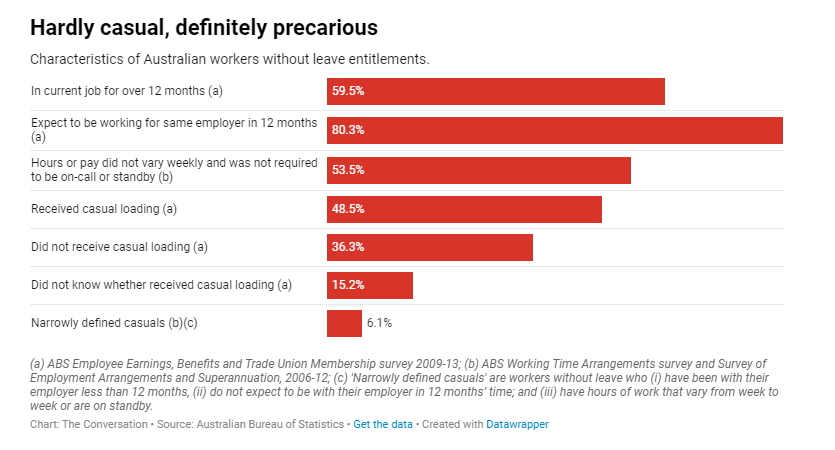
    Almost 60% of “casuals” had been in the job for more than a year. About 80% expected to still be there in a year’s time.

    Only 6% of “casuals” (1.5% of employees) worked varying hours (or were on standby), had been with their employer for a short time, and expected to be there for a short time.

    Even now, some “casuals” have been doing the same “casual” work for over 20 years.

    Permanent ‘casuals’

    All this has led to a class of “permanent casuals” – a nonsense term. They should more accurately be called “permanently insecure”.

    The one thing “casuals” have in common is they’re not entitled to sick leave or annual leave, and they are in a precarious employment situation. Their contract of employment only lasts till the end of their work day.

    That means they have much less power than other workers. So little power, in fact, that barely half of them even get the casual loading they are meant to be paid in compensation for not receiving other entitlements.

    On average, low-paid “casuals” get less pay than equivalent permanent workers, despite the loading.
    Changing legal definitions

    Not many “casuals” have been brave enough to challenge this exploitative relationship. But when they did a few years ago, Australia’s courts agreed permanent casual work was nonsensical.

    To be a “casual worker”, there had to be no promise of ongoing employment. A court would judge this not just by what was in the formal contract of employment but also by what the employer actually did. If they kept hiring you, week after week, on a predictable roster, you weren’t casual.

    In 2018, mine worker Paul Skene challenged his classification as a casual worker, arguing he had done pretty much the same work, with a few changes along the way, for five years.

    The Federal Court agreed he wasn’t a casual employee and should be back-paid annual leave. Another mine worker, Robert Rossato, had a similar victory in 2020.

    Employer organisations were “outraged” by the “billions” in back pay they could be forced to pay for having misclassified ongoing workers as casuals. They lobbied the Morrison government to amend the law, and challenged the rulings in the High Court.

    The Morrison government changed the law in early 2021, to give primacy to the written contract, ignore employer behaviour, and protect employers from back-pay claims.

    Later that year the High Court overturned the Federal Court decisions, ruling it was the written employment contract that mattered. If that was worded a certain way, you couldn’t test whether a worker was “casual” by whether the employer treated them that way afterwards.

    Labor promised to overturn these interpretations, and that’s what this proposal does.

    What will the legislation change?

    The details of the government’s plan is still not clear, but it is likely it will seek to amend the Fair Work Act to revert to something close to the pre-2020 definition of casual work, with a procedural twist.

    It will again be possible to judge whether an employee is “casual” based on employer behaviour. And an employee who repeatedly works a similar roster can, after six months, demand “permanency” – meaning rights to sick leave, annual leave, and better protection against arbitrary sacking.

    The twist: until they demanded “permanency” they won’t be entitled to any leave. So employers will be protected against claims for back pay.

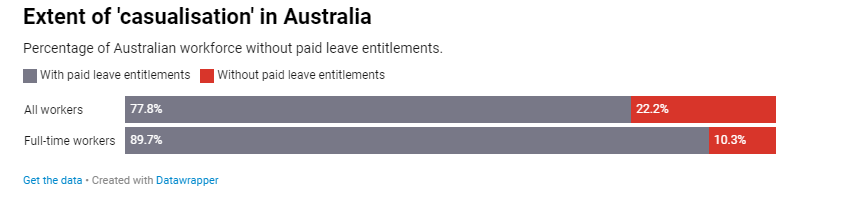
    Theoretically this could affect hundreds of thousands of “casual” workers. In reality, it will likely help far fewer.
    Suppose you’re a “casual” labour hire worker in mining. You can tell what time you’ll start work on the first Friday next June. You go to your employer — the labour hire company — and say: “Make me permanent.” The labour hire company says: “We can’t. You might not have a job tomorrow.”

    And indeed, now that you’ve asked, maybe you won’t have a job. So would you really ask?

    It will depend critically on the protections offered to workers who ask to convert, and how credible they are to workers.

    Most people only expect a few people to make the demand. Workplace relations minister Tony Burke says he believes only a “very small proportion” of “casuals” working regular shifts will do so.

    Part of that reluctance will be fear of the consequences, and part of it will be that many casuals rely on their casual loading. About half of “casuals” are on the award minimum rate, compared with 15% of “permanent” full-time workers. Most cannot afford to “choose” to trade the money for holidays and other entitlements.

    If you’re not getting the casual loading, you’ve got nothing to lose — except your job. If the power imbalance means you don’t get the loading, you won’t fancy your chances.

    So, it will just work for a small number or workers – though it’s likely to be very important to them.

    More needs to be done

    In short, this is a good step but more needs to be done.

    In most other wealthy countries all workers – including temporary workers – are entitled to annual leave. That’s not the case in Australia, because of the “casual” ruse. These laws will not change that.

    There should be universal leave entitlements. Sure, there needs to be a loading where work is unpredictable, and hence so short-term that leave entitlements would not be practical.

    But everyone else should get annual and sick leave, and minimum award wages should be high enough that low-wage workers don’t have to rely on the casual loading to get by.

    The challenge should be about how we transition to that situation.

    The post We need more than a definition change to fix Australia’s culture of permanent ‘casual’ work appeared first on The Australia Institute's Centre for Future Work.

  • Inflation is falling so let’s make sure we don’t let unemployment rise

    The latest quarterly CPI figures showed that inflation is falling dramatically and in line with that of other major economies such as the USA and Canada. This, Chief Economist, Greg Jericho writes means we have a prime opportunity to lock in the current level of low unemployment.

    Through the past year of the Reserve Bank raising interest rates, the main justification has been that the economy needs to be slowed in order to bring down demand pressures on inflation.

    What the latest figures reinforce however is that the major pressures have come from the supply side. Australia’s inflation is essentially following the same path as other nations. This is because inflation is slowing largely due to reduced world prices of commodities rather than any response to increasing interest rates.

    Indeed the largest driver of inflation in the June quarter was rental prices, which will have been in part due to investors raising their prices to deal with higher mortgage payments.

    In the past year, unemployment has remained at 3.5% while inflation has gone from 6.7% up to 8.4% and now down to 5.4% (using the monthly measures). The belief that we needed to raise unemployment to 4.5% in order to stop inflation from accelerating is a cruel approach that treats inflation in the wrong way.

    Fortunately, in spite of the RBA’s best efforts, unemployment has not yet risen. This presents Australia with a genuine chance to lock in historically low unemployment as the norm.

    Rather than pursuing higher unemployment in order to reduce inflation the RBA and the government should be pursuing policies that keep unemployment low while also reducing inflationary pressure. This can mean a price cap on essential items such as rents and energy, introducing windfall-profits taxes, and increased public housing investment to reduce housing price surges.

    Interest rates are not the only way to tackle inflation and in an environment where profits are been driven by supply-side issues and profits they are one of the worst ways.

    Full employment needs to be the target, not a mythical “non-accelerating inflation rate of unemployment” that largely justifies higher unemployment and more ho0usyheold living in poverty.

    The post Inflation is falling so let’s make sure we don’t let unemployment rise appeared first on The Australia Institute's Centre for Future Work.

  • Hollywood actors showing that unity is strength

    When workers are united and able to collectively bargain, they can win good outcomes.

  • The key legislation changes that will help workers get a better deal

    However, with recent changes to industrial relations laws, and with unemployment at record low levels, some workers are now in a better position to bargain for better pay and conditions.

    Slow wages growth, low bargaining coverage and high levels of insecure work are good indicators of how workplace power imbalances have stifled prospects for many employees.

    Over the last decade Australia’s wage growth has been at its weakest since the middle of the last century, coverage of workers by enterprise agreements has rapidly eroded, and over a third of workers are now in insecure casual, labour hire or fixed-term jobs.

    Bargaining hobbled

    Despite low unemployment – meaning there are fewer workers available to fill vacancies – employees have not been able to bargain for higher pay and the real value of wages has been declining.

    Industrial relations reforms passed by parliament in late 2022 are designed to restore some balance to the workplace.

    The changes don’t mean there is a massive shift of power to workers but, with the removal of some barriers to bargaining, there should be greater opportunity for employees to gain improvements at work.

    At the present time, the labour market is tight and employers are competing to find and retain workers so they may be prepared to offer higher wages and other benefits.

    Already, unions representing early childhood education and care workers have applied to use a new multi-employer bargaining option – which came into force last month – to seek a pay increase for these low-paid workers.

    While it will be some time before we see any outcomes, there is early evidence that other bargaining reforms are getting workplace bargaining moving after years of decline. Certainly some employers may now be more ready to negotiate enterprise agreements to avoid being roped into multi-employer agreements.

    Other non-bargaining reforms introduced as part of the 2022 Secure Jobs, Better Pay package attracted much less attention than bargaining changes during last year’s debates over the new laws.

    However, these other changes are not insignificant for working conditions.

    The right to flexible work

    More than half of all employees now have new rights to request flexible work, including employees who are parents of children of school age or younger, carers and workers aged 55 or over, those with a disability or people experiencing or supporting someone experiencing family violence.

    Before the flexibility changes, which came into effect in June, some limited flexible work rights already existed. However, now there is much greater onus on employers to show there are reasonable business grounds if they wish to refuse employees’ requests for flexible work.

    While this is no guarantee that all employees can access the flexibility they need, it has potential to be a game-changer in some workplaces through pushing employers to find ways to organise work for greater employee-friendly flexibility.

    Research shows that Australians are some of the most stressed and overworked of all workers worldwide. We know we need better-work life balance.

    Post-pandemic, there is widespread experience of more flexible work arrangements and greater recognition of the benefits of flexible work.

    There is some impetus to lock in more employee-friendly flexibility, and workers are having some success in achieving these changes through collective bargaining.

    Working lives are longer than ever, including as the retirement age has just been increased to 67 years.

    Along with pay increases that stop the decline in the value of wages, bargaining for better work-life balance will continue to be important.

    The post The key legislation changes that will help workers get a better deal appeared first on The Australia Institute's Centre for Future Work.

  • If the unemployment rises to 4.5% who is likely to lose their job?

    The next 12 months ahead look to be a time of rising wages, and rising unemployment. The Reserve Bank is trying to raise unemployment in order to prevent rising wages. It’s target of 4.5% will see around 130,000 to 150,000 more people unemployed than is currently the case.

    Labour market policy director, Greg Jericho, in his Guardian Australia column, examines which workers are likely to be the ones who will lose their jobs.

    In a bitterly ironic point, he notes that these are the same workers whom Deputy Governor of the Reserve Bank Michele Bullock recently boasted were the ones who had gained the most from the strong employment growth of the past 18 months:

    people on lower incomes and with less education who have benefited the most from the strong labour market conditions

    More worrying is that the Reserve Bank’s own estimates suggest that the rises in unemployment over the next year will see Australia breach the “sahm Rule” of recession, in which the unemployment rate rises more than 05%pts in a year. Oddly however the RBA’s correspondence on the issue revealed in an FOI disclosure has them suggesting that for Australia the recession trigger is a 0.75% rise.

    Either way, history suggests that when unemployment rises in a year by the amount the RBA is estimating it usually keeps rising.

    The RBA’s own estimates show just how close to a recession the economy is set to go in the next year. It already looks likely to hit workers with low skills and low paid jobs, and if the RBA gets it wrong, it will quickly hit many more of society.

    The post If the unemployment rises to 4.5% who is likely to lose their job? appeared first on The Australia Institute's Centre for Future Work.

  • Bolstered by a biased tax system, house prices keep rising

    Despite rising interest rates, the latest figures from the Bureau of Statistics show that Australia’s house prices rebounded in the March quarter of this year. Policy director Greg Jericho writes in his Guardian Australia column that since the beginning of the pandemic property prices around Australia have risen 26% while at the same time average household disposable income has increased just 8%.

    This disparity has massive consequences for affordability. Had for example the median property price in Sydney risen in line with household incomes since June 2020, instead of being $1.15m it would be $954,000 – a $196,000 difference.

    Underlying the strength of the market even in the face of rising interest rates is the fact that Australia’s tax system is biased towards property investors.

    The most recent taxation statistics covering 2020-21 showed for the first time the number of investors recording property net profits was greater than those recording a loss. Such a situation only occurred because of the record low interest rates at the time. We know that the past 12 months will have seen a large spike in the number of people negative gearing their properties and thus not surprisingly housing remains an attractive investment not in spite of rising interest rates, but because of rising interest rates.

    The post Bolstered by a biased tax system, house prices keep rising appeared first on The Australia Institute's Centre for Future Work.

  • Blame Game on Inflation has Only Just Begun

    That’s because inflation never affects all prices and incomes evenly. Some prices shoot up, while others grow slowly or decline. Some incomes keep pace with rising prices (or even outpace them), while others lag far behind. Thus the impacts of inflation are always uneven. And this sparks economic and political controversy.

    This distributional conflict is readily visible in current Australian inflation. As prices took off after the lockdowns, corporate profits surged dramatically, reaching their highest share of GDP ever by 2022.

    Meanwhile, wages – which were historically weak even before the pandemic – lagged far behind. In the last two years, consumer prices rose 12.5% (and more for essentials, like food and energy). Average wages grew less than half as much – barely 6% – in the same time.

    That means the purchasing power of workers’ wages is falling. It’s the biggest and fastest real wage cut in postwar history – and record profits from those higher prices are the corollary of workers’ falling real incomes.

    Despite the fact that wages have lagged, not led, recent inflation, the powers-that-be are still targeting workers to bear the brunt of the anti-inflation effort. The Reserve Bank is now using high interest rates to cool off employment and slow wage growth.

    This inflation has produced clear winners, and clear losers. So it’s a myth to proclaim that inflation “hurts all Australians,” pretending we can all join together in a shared national effort to wrestle prices to the ground.

    Our Centre for Future Work published research showing just how lopsided the impacts of inflation have been in Australia. We analysed official national accounts data from the ABS, including income flows, output data, and changes in average economy-wide prices.

    From end-2019 (just before the pandemic) to September 2022 (latest data at the time), higher corporate unit profits accounted for 69% of excess inflation (over and above the RBA’s 2.5% target). Unit labour costs accounted for just 18%, and other stakeholders (including small business) the remainder.

    This confirmed that workers are the victims of inflation, not its cause, and raised big questions about the RBA’s determination to target wages (not profits) for tough anti-inflation medicine. Our findings sparked widespread interest and anger. So business peak bodies, and business-friendly commentators, have launched a steady stream of attacks against our report since its release in February.

    RBA and Treasury officials also disagree with our conclusions. They have not challenged our actual numbers: indeed, internal RBA memos replicated and confirmed our finding that wider corporate profit margins account for the lion’s share of higher prices since 2019.

    But despite this evidence, these officials deny soaring corporate profits are a concern in the anti-inflation battle. Profits grew most dramatically in the energy and mining industries, they say. This is certainly true – due in part to sky-high prices paid by Australians for petrol, gas, and other resource-intensive products. So we can’t magically exclude this super-profitable sector from our analysis of inflation, nor our plan for tackling it.

    They also claim profits outside of mining have not increased. This is false: non-mining profits have been less spectacular than resources, but profit margins have widened significantly, reinforcing inflation. Consumers are reminded of this every time they visit a supermarket, book an airline ticket, or try to rent an apartment.

    In sum, these arguments cannot deny that business has profited mightily from the current inflation – especially, but not solely, in energy and mining – while workers have suffered.

    A flip side of this class conflict over inflation was starkly visible last week, when the Fair Work Commission announced a 5.75% increase in Award wages. That doesn’t quite keep up with inflation, but it sure helps.

    Within minutes, the same corporate lobbyists so offended by our research, lined up to denounce the wage increase as inflationary. They want Australia’s lowest-paid workers, whose living standards have already declined, to sacrifice further. Little wonder business peak bodies hate ay public attention on their own record profits.

    The blame game over inflation will get more heated in the months ahead. Inflation is likely to ease, as many of the unique post-pandemic factors (supply chains, energy price shock, pent-up demand) that underpinned firms’ price increases gradually abate. But real wages have fallen – and workers, understandably, want to repair that damage.

    So workers will demand wage gains in excess of inflation. And by all rights, they deserve that. That need not cause further inflation, especially if record high profit margins come back to earth.

    Corporations, however, want to sustain their record profits as long as possible. They want to keep wages down, and the RBA seems determined to help. So buckle up: the great Aussie debate over inflation is just getting started.

    Jim Stanford is Economist and Director of the Centre for Future Work at the Australia Institute, and the author of Profit-Price Spiral: The Truth About Australia’s Inflation.

    The post Blame Game on Inflation has Only Just Begun appeared first on The Australia Institute's Centre for Future Work.

  • The economy is slowing as households get smashed by yet more rate rises

    The March quarter saw Australia’s economy grow a rather pathetic 0.2% and fall 0.3% in per capita terms. As policy director Greg Jericho writes in his Guardian Australia column, the economy is slowing at a pace that normally would see the Reserve Bank thinking about cutting rates.

    And yet as poor as these figures are, worse is likely to come as the March quarter does not include the two most recent rate rises and only a small amount of the impact from the rate rises in February and March. Both the Treasury and the RBA estimate the Australian economy will go backwards on a per capita basis over the next year and these figures suggest their estimates are if anything too optimistic.

    Households are reducing their savings as wages fail to keep up with inflation. Over the past 2 quarters, household consumption grew at an annualised pace of just 1%. Whenever household consumption has grown that slow the economy has either been in a recession or teetered on the edge.

    And yet despite acknowledging there was uncertainty over household spending, the RBA on Tuesday decided to raise rates in order to essentially slow household spending.

    All they have done is once again hit households that already need a standing 8 count.

    The figures pleasingly showed that total wages are now growing solidly due to both increased employment and better wage growth. But this has not come at the expense of profits, indeed corporate profits in the March quarter rose 3.2% – faster than the 2% increase in unit labour costs. Real unit labour costs rose just 0.2% in the March quarter while real unit profit costs rose 1%.

    This again highlights that profits more than wages drive inflation, and raising rates to slow wage growth by raising unemployment is a poor monetary policy that only risks an unnecessary recession.

    The post The economy is slowing as households get smashed by yet more rate rises appeared first on The Australia Institute's Centre for Future Work.

  • The level of public housing needs to return to previous levels

    There is rarely a debate in Australia that generates more heat than housing. The causes of housing unaffordability and the solutions to it are varied and often get bogged down in power plays and political scaremongering. But as policy director Greg Jericho notes, building more homes is a pretty obvious solution, and more public housing needs to be at the forefront.

    The NSW Productivity Commission this week released a report into housing in NSW that recommended “Building more homes where people want to live.” To this end it suggested raising average apartment heights in suburbs close to the CBD, allowing more development near transport hubs and encouraging townhouses and other medium-density development.

    All of this is worthy. And if combined with the reform of the negative gearing and the capital gains discount will do much good.

    But the report noted that “New South Wales experienced a 45% surge in priority applicant households on the social housing register, with 6,519 priority social housing applicants waiting for assistance as at 30 June 2022”. And yet it did not mention public housing or any social housing solutions at all.

    In the past public housing was a much greater share of Australia’s housing market.

    In 1983 14 public housing building approvals were made for every 100 private sector ones. Now it’s 1.7:100.

    The level of new housing per head of population has fallen and it is thus little wonder that house prices have risen beyond the means of many.

    We need more housing and we desperately need more public housing.

    In the 2019 election campaign, the ALP pledged 250,000 new houses over 10 years. That has now become 30,000 over 5 years under the proposed Housing Fund. It is time for more ambition from the government and more housing for low and middle income earners.

    The post The level of public housing needs to return to previous levels appeared first on The Australia Institute's Centre for Future Work.

  • Real wages falls and interest rates rises signal tough times for households

    The Australian economy – like all economies – is about people. And yet too often company profits are used as a judge of economic health. Throughout the pandemic and in the years since, company profits have soared while the real wages of workers has fallen. This situation is inherently unsustainable with an economy dependent upon household consumption. As policy director Greg Jericho writes in his Guardian Australia column, we are beginning to see households struggle to keep going.

    The Budget delivered this month by Treasurer Jim Chalmers revealed that the next financial year starting in little over a month is set to be one of the worst in the past 40 years. Household consumption is expected to rise just 1.5% – the 5th worst since 1985-86. Even worse if we account for an expected 1.7% rise in population this means in a per capita sense, real household spending is about to fall.

    And when household spending slows, so too does the entire economy.

    We have already see the beginnings of this with sharp slowing in the volume of retail spending being done, all while the amount of money we are spending rises. In effect we are paying more for less. This means the “nominal” figures in the retail trade data hides the weakness in the economy and the pain households are going through.

    With mortgage repayments rising nearly 80% in the past year, households are switching from spending in shops and on services that employ people, to paying off their loans – driving up the profits of banks ever more, but in doing so actually slowing the economy.

    The Reserve Bank is getting what it wanted – a slowing economy, less money being spent and rising unemployment. But with conditions only seen in recessions expected in the next year, the risk that this slowing will lead to the economy stopping completely is rising, and the Reserve Bank must not raise rates any further and be extremely mindful of the pain they have already caused to households struggling from the fastest increase in loan repayments in over 30 years at the same time as real wage fall faster than they have on record.

    The post Real wages falls and interest rates rises signal tough times for households and the economy appeared first on The Australia Institute's Centre for Future Work.