Category: Opinions

  • The REAL Diary of an Uber Driver

    A version of this commentary originally appeared on the 10 Daily website.

    The REAL Diary of an Uber Driver

    by Jim Stanford

    ABC recently announced plans for a new 6-part television drama called “Diary of an Uber Driver.” It’s hard to imagine that an Uber driver’s actual life would make for riveting TV viewing. Here’s an illustrative account I have constructed, based on observations and real conversations with ride-share drivers:

    5:25 am. Shower and quick breakfast. Uber says I can “work when I want.” So why am I up at 5? Because that’s when there’s customers.

    6:10 am. Got one ride to the City, now deadheading back to suburb where the app says they need cars. 20 minutes of my time, plus petrol, down the tube.

    7:38 am. Been waiting 7 minutes for fare to come out of her house; I can charge her extra – but she’ll likely give me 2 stars out of 5 on the customer rating.

    8:12 am. Asshole office guy demands to get out at a traffic island. Totally illegal. If I refuse, I’ll lose stars.

    8:35 am. Driving obnoxious kid and dad to school. Kid waving a stuffed animal out the window, dangerous and illegal. If I tell the dad to stop it, I’ll lose more stars.

    9:20 am. Buy petrol. Price up another 3 cents. Apparently I operate an “independent” business, but I can’t raise my price when costs rise. In fact, I never even touch the money – it all goes through the app.

    9:28 am. Next door at Aldi’s buying bottled water, candies, and gum. $16. Customers expect the perks – and I gotta buy them, or lose my stars.

    10:35 am. Been waiting 15 minutes without a fare. Waits that long cut my effective hourly wage by a third. Think I’ll go home and go back to sleep.

    3:20 pm. Back on the app. Deadhead back to the City for rush hour.

    5:17 pm. Waiting 3 minutes in no-stopping zone for guy who said he’d be right there. Risking big ticket. Could move, would lose stars.

    6:20 pm. Cop eyes me at traffic light as I accept next fare on the app. I know it’s illegal, but it’s the only way to work it. If he fines me ($484 and 4 demerits), that’s 3 days’ net pay. I’m lucky.

    7:18 pm. Arrogant stockbroker gives me 2 stars, even though nothing went wrong. Why? Maybe it was my skin colour, not my service.

    8:25 pm. Drunken kids demand I go through McDonald’s. If I refuse, 2 stars for sure. Car now smells like French fries. And they spilled Coke on my carpet; another cleaning. They give me 2 stars anyway. I could give them 2 stars (as their rating), but it doesn’t matter. The customer is always right, and they’ll always get a driver. I might not find another job.

    9:38 pm. Another 15 minute wait for next fare. I suspect I’m being punished by the algorithm: it sends more jobs to preferred drivers.

    10:33 pm. More drunks, demanding to play Spotify through my sound system. Cranking it to the max. Stars at risk if I complain.

    1:18 am. Slow night, too many drivers out there. Getting very tired. Uber limits me to 18 hours work in any 24 (gosh); gotta sign off soon. I could always switch to Lyft and drive a few more hours. App sends rah-rah message that I could get to $250 for the day with a couple more fares.

    1:52 am. Deadhead home. App tells me I made $276, 15 hours on-line. That’s before petrol ($60 today), vehicle costs, data costs, and the damn gum. I’ll be lucky to keep half that. Didn’t make the minimum wage today… what else is new?

    This doesn’t make for feel-good viewing, by any definition. So what is ABC thinking?

    The mini-series is a spin-off from a blog and subsequent book by Ben Phillips, who began driving for Uber in Sydney after his own small business went belly-up. His writing describes many strange encounters with weird customers and other characters. The series will also draw in his own personal angst – including fears about becoming a father.

    In short, it’s like Taxi Driver for the gig-economy: a chronicle of mini-dramas compiled by a neurotic driver, ferrying colourful passengers around the big, lonely city. There will surely be entertainment value in some scenarios. But it’s hardly an accurate portrayal of the mind-numbing, exploitive reality of ride-share driving. And the whole concept raises questions that the broadcaster and its viewers should ponder carefully.

    For starters, why is the ABC naming a TV series after a corporation? Uber is the best-known ride-share company, sure, but there are many competitors. Moreover, conventional taxis are still a mainstay of urban transportation – and taxi drivers surely have as many interesting stories as Phillips. Taxis, however, are old-fashioned, while Uber is “cool.” ABC is riding the coattails of Uber’s brand by naming the whole show after it. Unfortunately, this also provides profile and endorsement to a troubled and controversial American corporation – one gearing up for a potential $120 billion (U.S.) stock offering.

    Let’s set that ethical issue aside. An even bigger concern is that the series will whitewash, even glamorise, a highly exploitative employment practice whose legitimacy and even legality is under siege in courtrooms and parliaments around the world. Uber has recently lost precedent-setting legal cases in France, Italy, the U.K., the U.S., and Canada. More challenges are underway, including in Australia.

    Uber has been avoiding the risks, costs, and responsibilities that come with directly employing drivers – inconveniences like minimum wages, workers’ compensation, paid holidays, and more. Drivers pay all vehicle costs (including depreciation, maintenance, tires, petrol, phone and insurance). Uber controls all payments (through the app), deducting booking fees and a fat 27.5% commission; the driver is stuck with all other costs (including GST), hoping there’s enough left at the end to buy groceries. They can be fired for inadequate consumer ratings (logged through the app’s 5-star system). Uber claims its drivers are “entrepreneurs,” not employees – but that fiction is crumbling in the face of myriad legal challenges.

    In practice, many Uber drivers make well under the minimum wage: my 2018 research indicated average pay (after vehicle expenses) of $14.62 per hour across 6 Australian cities; other surveys suggest even less. Other issues faced by drivers include dismissal without severance or recourse; traffic fines (including for operating the Uber app while driving); unlimited competition (there’s no cap on how many drivers can sign on); and deadening, dangerous hours. Little wonder 90% or more of Uber drivers quit within a year.

    It’s hard to believe this series will portray the ugly side of ride-share driving. Instead, working for Uber will come off as a humble but meaningful vocation: one where human interaction (rather than earning the minimum wage) is the main remuneration. At a moment when the exploitive practices of Uber and other gig employers are finally receiving critical attention around the world, this smells like corporate propaganda, not high-quality drama.

    The post The REAL Diary of an Uber Driver appeared first on The Australia Institute's Centre for Future Work.
  • Australia’s Upside-Down Labour Market

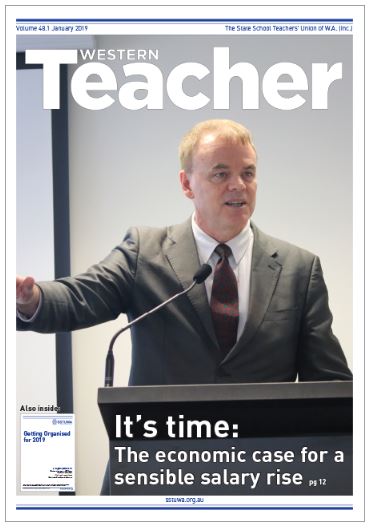
    In this article reprinted from Western Teacher magazine (published by the State School Teachers’ Union of WA), our Director Jim Stanford tries to explain these contradictory trends.

    The article is based on a presentation to a recent SSTUWA delegates meeting in Perth.

    Cover

    Stanford provides a dual diagnosis for Australia’s labour market problems: an inadequate quantity of work, and the deteriorating quality of work. Egged on by government policies which have deliberately suppressed wages in so many workplaces, wage growth has fallen to postwar lows. This is now undermining Australia’s continued economic progress.

    In addition to diagnosing what’s gone wrong in Australia’s labour market, Stanford also explains the numerous economic benefits of stronger collective bargaining systems so that workers can receive a fairer share of the economic pie: stronger consumer spending, more stable financial conditions, stronger government revenues, and less inequality.

    To see the full issue of Western Teacher, or sign up for future editions, please visit the magazine’s website. We are grateful to Western Teacher for permission to reprint the article here!

    The post Australia’s Upside-Down Labour Market appeared first on The Australia Institute's Centre for Future Work.

  • The Year Past, and the Year to Come

    Workforce (a labour relations bulletin published by Thomson-Reuters) recently surveyed major IR figures in Australia on what they saw as the big issues in 2018, and what they expect as the major talking points for 2019. Jim Stanford, economist and Centre for Future Work director, was one of those surveyed, and here are his remarks.

    What was the most important issue or event in industrial relations this year?

    I would choose the union movement’s “Change the Rules” campaign, which really gathered focus and momentum as the year went on. Of course, unions have been dissatisfied with the state of labour laws, and the erosion of labour rights, for years. But this year, together with other community advocates, they have built a very effective and focused advocacy campaign that I think will have a major impact on labour policy in Australia. Examples of its potential include the big rallies held in Melbourne and other cities in October; the important role that the union movement’s independent door-knocking and phone-banking campaign played in the expanded majority won by the Daniel Andrews govt in Victoria; and the generally high profile of news and debates around the issues of wages and workplace fairness in the media and public commentary.

    The current atmosphere is very reminiscent of the “Your Rights at Work” initiative that the ACTU and its affiliates organised in 2006-07 – and that ended up making a significant difference in the 2007 election (when John Howard lost his seat).

    There is a qualitative difference in this incarnation of the union movement’s organising, however: while union activists obviously are hoping to influence the results of the next election, they are self-consciously and explicitly planning on a longer-run effort to shift public opinion regarding core issues of work and fairness.

    Their agenda of proposed reforms would take several years to implement: including lifting the minimum wage to a “living wage” level, modernising labour laws (so Uber drivers and other gig workers would be protected), changing the structure of enterprise bargaining to allow multi-firm and industry-wide bargaining, and more.

    And they are advancing that agenda as an independent campaign, not as an arm of the Labor party. That positions them well to continue to advance the debate after the election … whoever wins.

    By carefully focusing its energies, building a strong “boots on the ground” infrastructure in communities (including crucial marginal electorates), and building strong public support for the core values underpinning the campaign (tapping into continuing Australian faith in fairness), I think this movement will reshape both public opinion about work and wages, as well as Australia’s labour policy framework.

    What are you most/least looking forward to in 2019?

    There will be a Commonwealth election sometime during the first half of 2019 (perhaps sooner rather than later, if the current disarray in Canberra is any indication).

    I look forward to seeing labour issues – and in particular, the stagnation of wages in Australia, and the growing gap between Australia’s egalitarian tradition and the grim economic reality that most workers presently face – feature as one of the top three issues in the campaign. Most workers have had no increase in real wages over the past five years; millions have fallen behind (especially given escalating prices for housing and other essentials). The present govt knows that this festering economic frustration issue could be very damaging.

    There’s an opportunity in Australia right now to move the needle: imagine a modernised approach to labour policy: including labour standards that adapt to ongoing change in the economy (like gig jobs), a more ambitious crack-down on wage theft and other illegal practices, and a revitalisation of Australia’s commitment to a ‘fair go.’

    However, I am not looking forward to the rolling out of some pretty tired warnings and threats about how modernising labour laws and addressing inequality will somehow threaten Australia’s economic viability.

    We can expect many dire threats about how the proposals for reform will drag Australia back to the “bad old 1970s” – a time, interestingly, when GDP growth, job-creation, productivity growth, and real wage growth were all significantly superior to the current era.

    This rhetoric ignores the growing consensus among economists that more equality actually strengthens economic performance – by supporting consumer spending and aggregate demand, avoiding the economic, fiscal and social costs of exclusion and inequality, and boosting govt revenues.

    The doomsday prophecies we can expect to hear from the usual suspects should be understood as the last gasps of a vision of trickle-down economic policy that has lost its credibility, in Australia and around the world.

    The post The Year Past, and the Year to Come appeared first on The Australia Institute's Centre for Future Work.

  • Industry-Wide Bargaining Good for Efficiency, as Well as Equity

    In this commentary, Centre for Future Work Associate Dr. Anis Chowdhury discusses the economic benefits of industry-wide collective bargaining. In addition to supporting wage growth, industry-wide wage agreements generate significant efficiency benefits, by pressuring lagging firms to improve their innovation and productivity performance. The experience of other countries (such as Germany and Singapore) suggests that this system promotes greater efficiency, as well as equity — although other wealth-sharing policies are also needed.

    Dr. Chowdhury’s full comment is posted below.

    INDUSTRY-WIDE BARGAINING CAN BOOST EFFICIENCY AS WELL AS WAGES

    by Dr. Anis Chowdhury

    In an effort to reverse long-term wage stagnation, the ACTU is calling for an end to current industrial rules which effectively prohibit sector- or industry-wide wage bargaining. Predictably, the business community is opposed. Australian Industry Group chief executive, Innes Willox, said, “The ACTU’s latest proposals would destroy jobs and the competitiveness of Australian businesses…If the ACTU got its way, unions would be able to make unreasonable claims and cripple whole industries and supply chains until employers capitulated.”

    No doubt, the issue will be a hot topic in the upcoming Federal Elections. The Labor Party conference is debating the ACTU’s call. And the Liberal-National Coalition will surely accuse Labor of capitulating to the vested interest of the union movement.

    Mr. Willox’s claim that the sector-wide wage bargaining would destroy jobs and Australia’s competitiveness has no basis. A powerful example is provided by Germany, Europe’s strongest economy. In Germany, wages, hours, and other aspects of working conditions are decided by unions, work councils (organisations complementing unions by representing workers at the firm level in negotiations), and employers’ associations. Collective wage bargaining takes place not at the company or enterprise level but at the industry and regional levels, between unions and employers’ associations. If a company recognises the trade union, all of its workers are effectively covered by the union contract.

    Yet, Germany’s competitiveness did not decline. On the contrary, Germany experiences both strong productivity growth and strong wage growth. Despite ongoing real wage improvements, unit labour costs are stable or even declining – further enhancing Germany’s competitiveness.

    How is this possible? The answer was given by more than half a century ago by two leading Australian academics – WEG Salter and Eric Russel. By de-linking productivity-based wage increases at the enterprise level and adhering to the industry-wide average productivity-based wage increases, an industry bargaining system raises relative unit labour costs of firms with below-industry-average productivity, thereby forcing them to improve their productivity or else exit the industry. At the same time, firms with above-industry-average productivity enjoy lower unit labour costs, hence higher profit rates for reinvestment. Singapore also used this approach to restructure its industry in the 1980s towards higher value-added activities, with great success.

    Trying to compete on the basis of low wages is a recipe for failure. As a matter of fact, low-wage countries typically demonstrate lower productivity; and research by a leading French economist, Edmond Malinvaud, showed that a reduction in the wage rates has a depressing effect on capital intensity. Salter’s research implies that the availability of a growing pool of low paid workers makes firms complacent with regard to innovation and technological or skill upgrading. Other researchers show that under-paid labour provides a way for inefficient producers and obsolete technologies to survive. Firms become caught in a low-level productivity trap from which they have little incentive to escape – a form of Gresham’s Law’ whereby bad labour standards drive out good. The discipline imposed on all firms as a result of negotiated industry-wide wage increases forces all of them to innovate and become more efficient.

    So, sector-wide wage bargaining is good for the economy: favouring efficient firms, stimulating investment, and lifting wages. Of course, industry-wide bargaining alone cannot solve all the problems of wage inequity or wage stagnation. It must be part of a broader suite of policy measures, to provide all-round support for greater equality and inclusive prosperity.

    In particular, we must address the system that produces sky-rocketing executive pays at the expense of workers. A lower marginal tax rate is one of the incentives for the executives to pay themselves heftily, while tax cuts are not found to boost growth or employment. Share options for CEOs, which encourage job cuts and discourage re-investment, also must be reined in. If anything that is making the Australian economy vulnerable, is growing economic disparity between self-serving executive compensation and stagnant wages for the rest of the population.

    Reforms also need to address the macroeconomic policy paradigm, where fiscal policy is focused on creating needless budget surpluses by cutting social services and public infrastructure investment. Meanwhile, monetary policy is focused on a pre-determined inflation target regardless of the economic cycle. All of this stifles economic growth prospects and increases job insecurity – both of which are detrimental for wage recovery.

    The post Industry-Wide Bargaining Good for Efficiency, as Well as Equity appeared first on The Australia Institute's Centre for Future Work.

  • Are States Filling the Democratic Void?

    The recent Victorian election results showed Australian voters want governments to play a pro-active role delivering public services, infrastructure, improved labour standards, and sustainability. They showed that in a time of deep cynicism with federal politics, States (and Territories) can play an important role filling the democratic void left by dysfunction and policy paralysis at the Commonwealth level.

    This commentary from Alison Pennington, economist at the Centre for Future Work, explores what the energetic campaign in Victoria revealed about our unique system of dual governance and the potential for pro-active and progressive policy making. This commentary was originally published in New Matilda.

    The Victorian election: Are states filling the democratic void?

    A destructive and cynical politics is on the rise across the world with emergent right-wing populism a warning of what happens when people lose faith in political institutions.

    In Australia, the Coalition government has been characterised by ongoing austerity, the retrenchment of public resources and capability to the tune of billions of dollars, but complete paralysis on just about every other policy reform (most visibly including massive inconsistency on energy and climate policy). This has led to a democratic void in Australian society.

    Meanwhile, the recent victory of the Andrews Labor government on a bold social democratic platform of long-term investments in services, education and infrastructure projects (some with a 2050 completion date) gave Victorians a secure, positive vision of a more balanced, stable society – and voters endorsed that vision strongly.

    How is it that these two wildly different scenarios of political life can exist alongside each other?

    Many commentators have explained the Victorian election result as a mere by-product of the Coalition’s ongoing crisis (with subsequent warnings about the future of the federal Liberals). But this suggests Victorians were motivated by cynicism alone. In reality, Victorians rallied enthusiastically around a constructive, hopeful vision of State-level policy-making. Indeed, since federation, Australian communities and regions who have identified needs and desires unmet by the Commonwealth, have often turned to the state level of governance to get things done.

    The unique organisation of governance in Australia, featuring a Commonwealth composed of somewhat independent States and Territories, has preserved a realm of Australian democracy distinct from the national level of affairs. At a time of deep cynicism with federal politics, the Victorian election result shows that States can fill the democratic void left by dysfunction and tribal politics at the Commonwealth level, strengthening Australian democracy and saving it from the worst of cynical politics we see emerging elsewhere (such as Trumpism in the US).

    Where does the legitimacy of this State-based democracy come from? Despite losing (or handing over) many of their powers to the Commonwealth over time, States still retain power to administer the key public goods that Australians most value: like education, health care, civic services, and culture. These are the functions of government that people will energetically defend when they are undermined.

    While the Australian constitution allocates responsibility for big-ticket public programs like healthcare and education to the States, the Commonwealth retains powers to raise the bulk of the revenue needed to fund these expensive services. This means States operate in a contradictory financial bind: always dependent on the federal government to honour the financing of essential services that the States are constitutionally bound to provide. This gives enormous economic and political power to federal governments— a power play that has been repeated many times over Australia’s history.

    For example, a recent attempt by the Commonwealth to undermine the funding of public goods under the ‘spend within your means’ mantra was mounted in 2016, when Malcolm Turnbull and Scott Morrison tried to shift responsibility for raising revenue for public services to States. This was done without relinquishing any of the Commonwealth’s income and corporate taxation powers – all the while overseeing billions of dollars in cuts in healthcare and education in the federal Budget.

    But the constitutional and financial bind faced by State governments has gained particular significance in recent years, as decades of ‘small government’ policies wound back public services in favour of highly-subsidised private models have come to a head. Publicly-subsidised private markets in aged care, disability care, healthcare, education, VET and childcare have all been proven failures: both in the quality of services delivered, and in the standards of employment for those doing the work.

    Recent polling by the Australian Institute shows that 64 per cent of Australians want an increase in public spending funded by tax revenue from wealthy individuals and high-turnover businesses. Australians value government provision of public goods, even more than personal income tax cuts. The failure of federally-backed market experiments within spheres of life where Australians demand a proactive and productive government role, has left the political field wide open – and States are in prime strategic political terrain to fill that space.

    State action is applauded in the face of Commonwealth inaction. For instance, amidst recent turmoil in federal energy and climate policy, the Victorian, SA and ACT governments have proactively invested in renewable energy industries. And State governments in Victoria, SA, ACT and QLD have found innovative work-arounds to protect workers from new exploitative labour practices, despite the dominance of the Commonwealth in the jurisdiction of labour law: including labour hire licencing schemes, mandated minimum pay and safety conditions, and a new inquiry just launched into on-demand ‘gig’ work and its implications for the Victorian economy.

    The Victorian election results provide another clear insight into what Australians value and what they will tolerate. They confirm that Australians care about a fair society – underpinned by the public provision of healthcare and education (including a revamped TAFE sector), new infrastructure, action on renewable energy, and employment conditions that allow Australians to live a decent quality life.

    With the Andrews government’s pledges for sizeable investments in all of these endeavours ratified so strongly by voters, it shows that the failure of Commonwealth policy and politics can be mitigated by popular, publicly-minded campaigns at the State level.

    A future federal government could build on the example set by the Victorian election. It could use its much stronger policy and fiscal levers to charter a course that addresses the growing labour market power imbalances, restores the billions cut from hospitals, schools and housing, prepares our economy for a renewable energy future, and delivers a comprehensive program of tax reform.

    But until that decisive break with the failed austerity and cynicism of recent federal politics, the Victorian election results confirm that in the meantime, States can step firmly into the breach. They can and must continue to function as a key site for the expression of Australians’ demands for a more equal, inclusive, participatory society, with a proactive role for government in delivering public goods.

    The post Are States Filling the Democratic Void? appeared first on The Australia Institute's Centre for Future Work.

  • Permanent Casuals, and Other Oxymorons

    Here is a commentary from Jim Stanford, Director of the Centre for Future Work, discussing the implications of these decisions for the mis-use of casual work. The commentary was originally published on the Ten Daily website.

    Time to rethink reliance on casual work

    Casual work has become a pervasive feature of Australia’s labour market. Until the 1990s, almost all workers, even part-timers, had permanent jobs with reasonably predictable schedules and access to normal work-related entitlements (like paid holidays and sick time). But then employers became obsessed with achieving “flexibility” in hiring. Flexibility sounds like a good thing, but in practice it meant granting employers more freedom to disemploy their workers, with no notice and no severance costs. The downside for workers is lack of certainty in rostering, poor job security, and no access to paid leave. That makes it impossible to make major purchases, plan child care, or take family holidays.

    At last count, around 25 percent of paid employees in Australia (or over 2.5 million workers) were employed on a casual basis. The incidence of casual work has grown noticeably since 2012, when the mining investment boom ended and the overall labour market weakened. Casual work has grown fastest in full-time positions, and among male workers. For young workers (under 25), casual work is especially ubiquitous: 55 percent work casual. OECD data indicates that Australia now has the highest incidence of temporary work of any industrial country.

    Because it is so common, casual work has become “normalised” in the eyes of employers and policy-makers. For example, Craig Laundy, former Commonwealth Minister for the Workplace, endorsed casual work enthusiastically this year, saying it is “a completely appropriate way for many businesses and many employees to conduct their relationship.” Even business lobbyists admit that most casual staff actually work regular and predictable schedules.

    With this normalisation, many industries in Australia now rely on casual work as a permanent, core feature. Instead of using casual workers to meet temporary or seasonal fluctuations in demand, thousands of employers tap a permanent pool of casual workers to meet ongoing staffing requirements. Workers can be stuck on casual status even if they work regular shifts, for years at a time.

    In theory, employers pay a price for this super-flexibility: Australia’s casual loading rules require a 25 percent wage penalty to be paid to casual workers: compensation for lack of access to paid sick leave and holidays, and for the insecurity and instability attached to casual work. In practice, many employers do not pay this wage premium – effectively “hiding it” in lower base wages, or else evading it entirely (especially for young and foreign workers who do not understand the rules). But even if they do pay casual loading, employers should be prevented from abusing casual work as is now commonplace. After all, the inherent insecurity of casual work imposes a cost on workers and their families – a cost that grows if that insecurity is permanent.

    A series of recent legal decisions, however, is now challenging the assumption that casual work can be normal, legitimate and universal. Three particularly important cases could force employers to rethink their reliance on casual staffing:

    • A Federal Court judgment has ordered a labour hire company to pay retroactive annual leave to a mine driver who worked casual for several years, even though he was assigned to regular shifts. Employers complain this ruling somehow amounts to “double-dipping:” they claim that paying the 25 percent casual loading somehow entitles employers to deny paid holidays and other normal rights, even to long-term staff. That assumption has now been refuted.
    • The Fair Work Commission has decided to harmonise evening and Saturday penalty rates between casual and permanent workers in the retail sector. Until now, casuals were denied penalties of up to 25 percent of base wages for those shifts, compared to permanent workers. Now the penalties for casual workers will be raised to the same level as for permanent staff (although, perversely, the Commission is also in the process of cutting penalty rates for all workers on Sundays and holidays).
    • Another Fair Work Commission ruling affecting 85 different modern awards affirmed the right of casual staff to request conversion to permanent status after working regular shifts for a year. Employers can turn down those requests, but only if they would result in major changes in the applicant’s hours of work, or are otherwise “unreasonable.”

    Employers are pushing back hard against these precedents – and they seem to have the ear of the federal government. Business lobbyists predict billions in back payments arising from the annual leave decision, and are demanding legislative changes to avoid those costs. Kelly O’Dwyer, Minister for Jobs and Industrial Relations, has promised to investigate the idea. Some business groups are even proposing a brand new category of “perma-flexi” workers, who would receive a (smaller) wage loading for accepting casual status for years at a time. Anxious to preserve this highly profitable staffing practice, business leaders seem oblivious to the oxymoron inherent in their proposal for permanent casual work.

    Business complaints about the costs of treating casual workers fairly ring hollow. The 25 percent casual loading system was never intended as a carte blanche: that is, a kind of “permit” that granted employers permission to keep workers in perpetual insecurity, denied access to basic security and regular entitlements. Employers who used casual workers only where originally intended – that is, in temporary or irregular shifts – can continue to do so without significant extra costs.

    However, while promising, these recent decisions do not fully address the misuse of casual work. Casual workers should have broader options to convert to permanent status after shorter periods (say, six months) in a regular position. And the application of casual employment rules (which deny termination pay and notice of dismissal to workers, as well as access to paid leave) should be restricted to carefully-defined and genuine situations of temporary or volatile demand.

    Nevertheless, these recent decisions are an important recognition that employers have been abusing this form of employment. And they are a wake-up call to employers, who should now think hard about reducing their reliance on casual staffing – and get back to creating steady jobs that workers (and their families) can count on.

    The post “Permanent Casuals,” and Other Oxymorons appeared first on The Australia Institute's Centre for Future Work.

  • Insecure work: The New Normal

    In this commentary article published originally by Ten Daily, Our Director Dr. Jim Stanford summarises the findings of the Centre’s recent report on “The Dimensions of Insecure Work.”

    If You Have A Stable Full-Time Job You’re An Endangered Species

    Ask any young job-seeker about their prospects of finding a permanent full-time job, and they won’t know whether to laugh or cry. Sure, they might get a few hours of work here, a few hours there: piecing together disparate “gigs” in hopes of paying the rent.

    But landing a permanent full-time job with a regular salary and basic benefits (like paid holidays and superannuation)? Dream on.

    It’s no surprise that young workers experience the insecurity of modern work most brutally: they don’t have experience, seniority, or connections to help them in their hunt. But precarious work now affects Australians of any age, in all sectors of the economy, not just those trying to break in. What was once considered a “standard” job – the kind where you know where and when you will work, and how much you will earn – now feels like the exception, not the rule. And in fact, the hard numbers now confirm it: insecure work has indeed become the new normal.

    With co-author Dr. Tanya Carney, I recently assembled data on eleven different dimensions of job insecurity, based on official statistics from the Australian Bureau of Statistics and other government sources. We considered many aspects of the problem: including the rise of part-time work, casual jobs, people working very short hours, temporary foreign workers, and workers in nominally “self-employed” positions.

    In every case, there has been a marked increase in insecurity in recent years. A turning point was reached in 2012, as the mining investment boom (that underpinned several years of strong job conditions) turned down. That boom, and associated macroeconomic expansion, had masked longer-run structural shifts in the nature of employment – but only for a while. But now, since 2012, the sea-change in employment relationships is starkly visible.

    It was when we put all of these different indicators of insecurity together, that a startling conclusion became clear. The standard “job” has been whittled away on all sides – by part-time work, by casual and temporary jobs, by shifting more tasks to supposedly independent contractors and self-employed gig workers. And in 2017, for the first time since these statistics have been collected, the proportion of employed Australians filling a standard job fell below 50 percent. Less than half of employed Australians now work in a permanent full-time paid position with basic entitlements (like sick pay and paid holidays).

    In other words, most employed Australians experience one or more dimensions of insecurity in their jobs. Insecure work, once on the margins of the labour market, is now the norm. In fact, many workers experience multiple aspects of this insecurity.

    For example, part-time marginally self-employed workers are among the most insecure of all. They have no employees of their own; most aren’t even incorporated. They get a tax number, and then scrabble from gig to gig – accepting outsourced work from large firms who once hired actual employees to perform these tasks. Their incomes, low to start with, have declined a shocking 26 percent in real terms since 2012. They now make, on average, barely one-third as much as a typical paid full-time permanent employee.

    Surprisingly, some defenders of the status quo in Australia’s labour market deny any problem with job security. For example, Craig Laundy, Australia’s Minister for Small Business, claims insecure work is not actually more common, and defends casual work as “a completely appropriate way for many businesses and many employees to conduct their relationship.” Business lobbyists also deny work has become any less secure.

    But this flies in the face of both the official statistics, and the lived experience of millions of Australians struggling to find stable employment. And the increasing precarity of modern work in turn produces a spate of economic, social and political consequences. Households can’t predict their future income; they also can’t make long-run financial commitments (like buying a home, supporting children through higher education, or saving for retirement). Consumer spending and financial stability suffer, as does growth and job-creation.

    Politically, the frustration of millions of Australians about this chronic insecurity will inevitably bubble up at the polling booths. Job insecurity has reached a tipping point, now that less than half of all employed workers fill standard permanent full-time jobs. Sooner or later, a political tipping point will also be reached: as Australians react against the erosion of the ideal of a “fair go.”

    For this reason, hopeful politicians should be ready to present convincing ideas for restoring job stability and shared prosperity, in the lead-up to the next Commonwealth election. Denying that there is even a problem, will not likely do the trick.

    Jim Stanford is Economist and Director of the Centre for Future Work at the Australia Institute. With Tanya Carney he is co-author of The Dimensions of Insecure Work: A Factbook.

    The post Insecure work: The New Normal appeared first on The Australia Institute's Centre for Future Work.

  • Wages Crisis Has Obvious Solutions

    This recent commentary, by Centre for Future Work Director Jim Stanford, appears in the March 2018 issue of Australian Options magazine, and is reprinted with permission.

    Wage Crisis Has Obvious Solutions

    By Jim Stanford

    When the head of the central bank declares wages are too low, and urges workers to demand more money, you know you have a problem.

    After all, central bankers are traditionally the “party poopers” of the economy: they are the ones who march in and take away the punch bowl, as soon as the party gets rolling. Yet here was Governor Philip Lowe, Governor of the Reserve Bank of Australia, urging party-goers to turn up the volume. It’s like he was pouring bottles of straight tequila into the punchbowl, instead of taking it away – desperately trying to turn a boring flop into a wild shindig.

    Mr. Lowe made his surprising call at a conference last year on Australia’s economic outlook at Australian National University. He said weak wage growth was holding back national purchasing power and economic growth, and contributing to too-low inflation (which has languished below his bank’s official 2.5 percent target for several years running).

    But while his acknowledgement of the consequences of wage stagnation was refreshing, his diagnosis of the causes was incomplete and unconvincing. In fact, Governor Lowe almost seemed to blame the victims of wage stagnation – namely, Australia’s workers – for the problem. They were unduly worried about losing their jobs to robots or imports, he suggested; they should feel more “confident” in asking for higher wages. He has clearly not experienced the reality of Australia’s dog-eat-dog labour market in recent years, or felt the desperation that drives workers, especially young workers, to accept any job on offer.

    (Incidentally, the RBA’s own enterprise agreement signed last year will raise base wages by just 2 percent per year over the next 3 years … below the bank’s own inflation target!)

    While mainstream economists and policy-makers belatedly recognise the economic and social damage resulting from weak wages (even Treasurer Scott Morrison frets about the negative effect of slow wage growth on his budget balance), they’ve been distinctly reticent to connect the dots about the causes of the problem – and its obvious solutions. Lowe, Morrison, and their colleagues pretend wages will pick up automatically as the economy grows and the labour market tightens. But with official unemployment only a tick above 5 percent (still the RBA /Treasury estimate of “full employment,” according to their discredited but still operational NAIRU model), yet wages still decelerating, this faith in a market solution is increasingly far-fetched.

    Measuring the Slowdown

    The stagnation of Australian wages is visible by many indicators. The most common “headline” source is the ABS’s quarterly Wage Price Index, which reports an index of wages calculated from a representative sample of jobs (the methodology is similar to the Consumer Price Index). The WPI therefore measures changes in average hourly compensation holding constant the bundle of jobs which make up the overall labour market.

    However, one important factor in weak wages has been the changing composition of work. In particular, the growth of part-time, casual, and irregular jobs has undermined the overall level (and stability) of labour incomes. These changes are not captured in the WPI. Similarly, changes in average hours worked per week (due to growing part-time work) are also excluded from the WPI. So the WPI data understates the true extent of the wage slowdown.

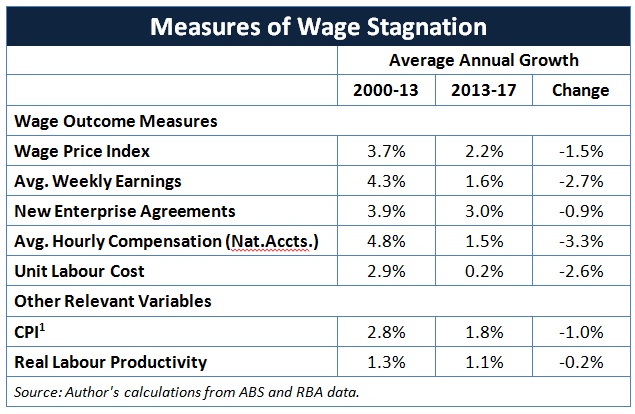
    Other ways of measuring the wage slowdown show an even bigger drop-off in wage growth. These include average weekly earnings, the pay increases specified in enterprise agreements, and estimates of average labour compensation generated through GDP statistics. Trends in all these indicators are summarised in the accompanying table. Whatever measure is chosen, it is clear that there has been a dramatic slowdown in wage growth – especially visible since 2013.

    Annual wage growth fluctuated around 4 to 5 percent during the first decade of the century. Wage growth fell sharply but temporarily during the GFC – but then quickly regained pre-crisis norms from 2011 through 2013. After 2013, however, wage growth has decelerated dramatically: to 2 percent or even lower. In fact, by the broadest measure of labour compensation (wages, salaries, and superannuation contributions paid per hour of work), there has been virtually no nominal wage growth in the past year. Consumer prices, meanwhile, continue to grow at around 2 percent per year (and even faster, if escalating housing prices are taken into account). Real earnings, therefore, are flat or falling.

    What is “Normal” Wage Growth?

    Any shortfall in wage growth below the pace of consumer price increases (corresponding to a decline in the real purchasing power of workers’ incomes) is a clear sign of labour market dysfunction. But even flat real wages (ie. nominal wages that just keep pace with inflation) are problematic. After all, wages are supposed to reflect ongoing growth in real labour productivity (or at least that’s what the economics textbooks tell us). So wages should actually consistently grow faster than consumer price inflation, to fairly reflect the enhanced real output of each hour of labour.

    Therefore, a “normal” benchmark for wage growth might be the sum of long-run consumer price inflation (the RBA’s 2.5 percent target) plus average productivity growth (running around 1.5 percent per year over the past three decades). That suggests a “normal” benchmark for annual nominal wage growth should be 4 percent per year. Australian wage growth in the pre-GFC period generally fit that definition of “normal.” But since 2013 wages shifted to a significantly lower trajectory.

    Joining the Dots

    Contrary to the assumptions of free-market economics, there is no guarantee that wages will automatically grow in line with labour productivity, as a result of automatic market mechanisms. Power is always a key factor in income distribution. And labour markets never “clear,” so that labour supply (the number of workers) equals labour demand (the number of jobs). In fact, inflation-targeting policy deliberately aims to maintain a certain level of unemployment (5 percent is the target in Australia) to suppress wage demands and protect profits.

    The systematic and structural disempowerment of workers and their unions over the neoliberal era is therefore the most relevant factor in the deceleration of wage growth, and the erosion of labour’s share of total GDP. Some obvious indicators of that dramatic shift in economic and political power include:

    • A steady erosion in the real “bite” of minimum wages, which have fallen from 60 percent of median wages in 1990 to around 45 percent today.
    • The collapse of trade union membership in the face of legal restrictions, harassment, and full-protection for “free riders.” Today just 9 percent of private sector workers, and less than 5 percent of young workers, are union members.
    • A corresponding collapse in collective industrial action. Adjusted for the size of the workforce, the frequency of strikes and other industrial disputes has declined by 97 percent from the 1970s to the present decade.
    • The relegation of industry awards to a baseline “safety net,” instead of a system for supporting ongoing progress in wages and working conditions.
    • The generally pro-business shifts in economic policy, including tax cuts, deregulation, privatisation, and globalisation, which have also shifted economic power in favour of employers and hence indirectly suppressed wage growth.

    To begin to rebuild wage growth, restore labour’s share of GDP, and achieve greater equality in labour incomes will require a comprehensive, multidimensional effort to restore the power of all these wage-supporting institutions. The ACTU is tackling this challenge with gusto, with its ambitious “Change the Rules” campaign. The goal is to propose a consistent, holistic vision for repairing the institutions that support workers and their wages – and then building a strong grass roots campaign to push politicians of all stripes to adopt that vision.

    On the other hand, if we follow the advice of Scott Morrison and Philip Lowe, and simply wait for supply and demand forces to rescue wages from their current doldrums, we are going to be waiting a very long time.

    The post Wages Crisis Has Obvious Solutions appeared first on The Australia Institute's Centre for Future Work.

  • The Difference Between Trade and Free Trade

    U.S. President Donald Trump’s recent trade policies (including tariffs on steel and aluminium that could affect Australian exports) have raised fears of a worldwide slide into protectionism and trade conflict. Trump’s approach has been widely and legitimately criticised. But his argument that many U.S. workers have been hurt by the operation of current free trade agreements is legitimate; conventional economic claims that free trade benefits everyone who participates in it, have been discredited by the reality of large trade imbalances, deindustrialization, and displacement.

    Can progressives respond to the real harm being done by current trade rules, without endorsing Trump-like actions – which will almost certainly hurt U.S. workers more than they will help? Centre for Future Work Director Jim Stanford has proposed several key principles to guide a progressive vision of international trade: one that would capture the potential benefits of greater trade in goods and services, while managing the downsides (instead of denying that there are any downsides).

    Dr. Stanford’s commentary was recently published in the Australian Guardian. The column generated follow-up coverage and commentary in Australia and internationally. For example, here is an interview with Phillip Adams on ABC Radio National’s Late Night Live.

    Here is an edited version of Dr. Stanford’s commentary:

    Progressives Alternatives to So-Called Free Trade Deals

    U.S. President Donald Trump’s bellicose policies, including new tariffs on steel and aluminium, have raised fears of a worldwide slide into protectionism and trade conflict. Trump’s unilateral and xenophobic approach to trade policy is reprehensible and dangerous from any perspective. But many progressives feel conflicted about Trump’s actions. After all, he is challenging business-friendly trade deals (including the TPP and NAFTA) which labour, social and environmental advocates opposed for years. And while his policies will clearly make life worse for working and poor people in the U.S., he is nevertheless speaking to their actual experience: unlike free trade defenders, who continue to pretend that the tide of globalisation has lifted all boats.

    But many progressives feel conflicted about Trump’s actions. After all, he is challenging business-friendly trade deals (including the TPP and NAFTA) which labour, social and environmental advocates opposed for years. And while his policies will clearly make life worse for working and poor people in the U.S., he is nevertheless speaking to their actual experience: unlike free trade defenders, who continue to pretend that the tide of globalisation has lifted all boats.

    Given Trump’s domination of the debate, progressives need to work quickly to distinguish our critique of globalisation from his. In particular, we must flesh out a vision of trade policy reforms that would genuinely help those harmed by globalisation, while rejecting the nationalism and racism that underlies Trump’s appeal.

    Established policy elites still ridicule Trump’s belief that trade deals have contributed to the misery and inequality afflicting working class communities in America (and, for that matter, Australia). For them, globalisation must produce winners but no losers. And they trot out theoretical economic models (premised on assumptions of full employment and costless adjustment) to buttress their case. They concede the gains from trade may not have been evenly shared. But they deny that globalisation has anything to do with the erosion of living standards experienced in so many once-prosperous working communities.

    This patronising denial is precisely what got Trump elected in the first place. It’s not that depressed industrial towns in Pennsylvania, Ohio, and Wisconsin (the states that put Trump over the top) didn’t “share in the benefits” of free trade. It’s that their economic viability was destroyed by it.

    Acknowledging that globalisation produces losers as well as winners, allows us to imagine policies to moderate the downsides of trade – and purposefully share the upsides. The next step is to make a crucial distinction between trade and ‘free trade.’ The former is the pragmatic day-to-day flow of goods and services between countries. The latter is the set of specific, lopsided rules embodied in the plethora of trade and investment agreements enacted over the last generation.

    These ‘free trade’ rules often have very little to do with actual trade: describing tariff elimination, for example, usually takes up just a tiny part of the text of each trade deal. The rest is devoted to a raft of provisions securing and protecting the rights of private companies to do business anywhere they want, on predictable and favourable terms.

    Proof of the dissonance between trade and ‘free trade’ is provided by Australia’s lacklustre trade performance over the last two decades. Exports of actual goods and services constitute a smaller share of total GDP today, than at the turn of the century. Sure, the volume of resource exports has surged – not surprisingly, since that’s what our trading partners wanted. But resource prices have been shaky, and meanwhile our other value-added exports flagged badly. If the goal of all the free trade agreements signed since then (a dozen) was to boost Australia’s exports, they failed miserably. But of course, that wasn’t the goal: the deals were actually intended to cement a business-friendly policy environment, even in sectors that have nothing to do with international trade.

    Progressives can endorse mutually beneficial international trade, and even international flows of direct investment, without accepting the lopsided, business-dominated vision of ‘free trade’ agreements. In fact, a progressive approach to managing globalisation would actually boost real trade more effectively: by supporting purchasing power on all sides, and avoiding the contractionary race-to-the-bottom unleashed by current free trade rules.

    Here are several key principles central to a more hopeful and inclusive vision of globalisation:

    Preserve the power to regulate: Free trade deals assume government intervention in markets (regulating prices, service standards, investment, and more) is inherently illegitimate and wasteful; they establish “ratchet” rules to limit regulation and public ownership, and lock-in deregulation over time. The failure of market competition in so many areas – in Australia’s case, including electricity, vocational education, and employment services – reaffirms that trade deals must not inhibit governments from regulating businesses, no matter where they are owned.

    Eliminate investment preferences: ‘Free trade’ deals proffer all kinds of preferences and rights for businesses and investors that have no necessary connection at all to actual trade. Chief among these are the unique quasi-judicial rights and powers granted to corporations (such as investor-state dispute settlement panels); these are an affront to democracy. Progressive trade policy would abolish these preferences, and subject corporations and their owners to the same laws and processes the rest of us face. Similarly, progressive trade deals would aim to relax monopoly patent rights (for drug companies and others), rather than strengthening them.

    Manage capital and currencies: Foreign direct investments in real businesses that produce actual goods and services can certainly benefit host communities, but only so long as those operations are subject to normal public interest and regulatory oversight. Retaining the capacity to regulate foreign investment is essential to capturing maximum benefits from foreign investment. On the other hand, volatile, speculative flows of financial capital and foreign exchange have less upside, and more downside. In particular, rules should prevent the common practice of suppressing exchange rates to gain artificial advantage in international competition.

    Social clauses that mean something: Most ‘free trade’ deals, the TPP included, feature token language about protecting labour and environmental standards. These provisions are window-dressing: responding to fears that global competition will spark a downward spiral in social standards. Typically these clauses simply commit signatories to follow their own laws – with no requirement that those laws are decent to start with. Progressive trade deals would have safeguards that are enforceable, including requiring participating jurisdictions to respect universal standards or lose preferential trade rights. Where trade partners have different standards (such as, for example, levying varying degrees of carbon pricing), border adjustments must be permitted so that trade competition does not undermine environmental and social progress.

    Balanced adjustment: Trade and investment flows never automatically settle at a balanced position – even if a “level playing field” in labour and environmental standards was actually achieved. That’s because competition always has uneven effects, producing both winners and losers. Countries that experience loss of employment and production through global competition (a possibility denied by free trade theory, but commonplace in practice) must be supported with measures to safeguard domestic employment, facilitate adjustment, and boost exports. Chronic surplus countries (like China and Germany) must recycle excess earnings into expanding their own imports, thus bearing a fair share of adjustment – rather than forcing deficit countries to do all the heavy lifting.

    Active, inclusive domestic policies: Opposition to trade liberalisation is relatively mild in the highly trade-exposed social-democratic countries of Europe: like the Nordic countries, Germany, and Netherlands. Their extensive networks of social protections provide average workers with reasonable confidence they won’t be economically tossed aside for any reason: whether trade competition, or some other disruption. That’s why a key component of progressive trade policy must be a general commitment to social protection, inclusion, and job-creation. A general context of security and equity better facilitates adjustments of any kind, in response to any source of change. Indeed, collecting healthy taxes from successful industries, and reinvesting them in priorities like infrastructure, training, and communities, is precisely how to harvest the much-trumpeted gains from trade – and pro-actively share them throughout society. That’s much more feasible than hoping those benefits will somehow trickle down of their own accord.

    Claims by policy elites that international trade is the engine of all progress are vastly overblown. Our well-being mostly depends on what we do with our skills, energies and innovation right here at home. But real international trade and investment, properly managed, can certainly make a contribution to prosperity. And progressives can advance a vision of a more balanced, inclusive globalisation that has nothing in common with Donald Trump.

    The post The Difference Between Trade and ‘Free Trade’ appeared first on The Australia Institute's Centre for Future Work.

  • Job Growth No Guarantee of Wage Growth

    Job Growth No Guarantee of Wage Growth

    by Dr. Anis Chowdhury

    ‘Remarkable’ jobs growth raises hopes for wages” was the headline for a recent Sydney Morning Herald opinion piece by Clancy Yeates. He bases this claim on “some brighter news on the labour market to balance the bad: there is something of a jobs boom under way”. Apparently “more jobs have been created in 2017 in net terms than any year since 2005, with 371,000 new net jobs so far this year”. Clancy Yeates also points to “the lowest number of unemployed people per unfilled position since 2012”.

    This optimism is also shared by the Treasury Secretary John Fraser. In his opening statement at the recent Senate budget estimates hearing on 25 October, he said, “We expect that a period of stronger growth and falling unemployment will lift wages in the next few years.” He further noted, “We do expect that as the cyclical constraints that have weighed on the economy recede wages growth will accelerate.”

    The RBA also holds a similar optimistic view. Philip Lowe, the RBA Governor, in his September statement observed, “Employment growth has been stronger over recent months and has increased in all states. The various forward-looking indicators point to solid growth in employment over the period ahead. … stronger conditions in the labour market should see some lift in wages growth over time.” He had the same positive view in his October statement.

    But can we really be so confident that job growth will eventually lead to wage growth? And even if it does, would it be strong enough to catch up and compensate for the losses incurred from such a long period of wage stagnation?

    Unfortunately, the answer to these questions is a resounding ‘NO’. This so-called remarkable jobs growth will not result in an eventual wage growth sufficient to close the wages gap. This has been confirmed by the latest data showing wages rose by less than expected last quarter; even a significant mandated jump in the minimum wage failed to lift the rate of growth of workers’ pay across the economy. The most broad measure of average earnings growth (derived from GDP statistics) has actually turned negative – the weakest since the mid-1960s.

    The reason for this contradiction is very simple – it is rooted in the different nature of new and old jobs. Jobs, whether part-time or full-time, are now more insecure. Just consider some recent news. The NAB has announced 6,000 job cuts by 2020 even when it announced $6.6 billion profit! Earlier Telstraconfirmed 1,400 job cuts.

    Job insecurity is not just a phenomena in the private sector. Governments – State and Commonwealth – have also joined the new trend. For example, the NSW department of Finance Services and Innovation has notified the union representing the cleaners that employment guarantees in place since 1994 “will not be extended in the new contracts from 2018”.

    The optimists seemed to have decided to ignore what Alan Greenspan, the former chairman of the US Federal Reserve, said in his Congressional hearing two decades ago (on 26 February, 1997). Explaining why “the rate of pay increase still was markedly less than historical relationships with labor market conditions would have predicted”, he said: “Atypical restraint on compensation increases … appears to be mainly the consequence of greater worker insecurity.”

    He clearly elevated job insecurity to major status in the Fed’s policy analysis. Workers have been too worried about keeping their jobs to push for higher wages. And this has been sufficient to hold down inflation without the added restraint of higher interest rates.

    But Greenspan also implied that workers’ fear of losing their jobs was not in itself a sufficient explanation for their failure to push for significant wage increases. The sense of job insecurity has to be rising over time; that is, continually getting worse. Because once the level of insecurity leveled off, and workers become accustomed to their new level of uncertainty, their confidence may revive and the upward pressure on wages would resume. That is particularly true when the unemployment rate is low, as it is today (at least officially).

    However, looking at the length of contracts, Jeff Borland, a leading Australian labour economist, finds no evidence of increased job insecurity in Australia. Others have reported similar findings, while others cite different data to indicate a growth in insecurity. A new ABS survey also showed that while there had been an increase in the number of people with more than one job since 2010-11, those doing multiple jobs as a proportion of the workforce had remained almost completely unchanged at 6%.

    Job insecurity is notoriously difficult to measure. It is not the length of contracts or whether a job is full-time or part-time, that matters. It is the constant threat of losing jobs or pay conditions despite tenure due to constant restructuring that the workers fear. It is the news like that from the ice cream manufacturer Street wanting to terminate its enterprise agreement, or announcements like the one from the NSW department of Finance Services and Innovation, which generate the sense of job insecurity.

    It is this sense of job insecurity and fear of not finding a decent job after losing one (as experienced, for example, when Holden and Toyota recently closed down) which Alan Greenspan had in mind when he calibrated Fed’s monetary policy levers. Thus, there has to be continuous restructuring in the guise of addressing falling or stagnant productivity to keep lid on wages, while the real intent is creating fears among the working class.

    When nearly half the Australian families (41%) feel job security is chief among their concerns, this supposedly remarkable jobs growth won’t generate pressure for wage growth as hoped by the optimists. “Insecure, stressed, and underemployed: The daily reality for millions of Australians”, is how David Taylor summarised the labour market in Australia. This is experienced even as profits are growing at their highest rate in two decades.

    Governments – State and Federal – should worry about rising job insecurity, instead of adding fuel to the fire with their own employment restructuring initiatives. The high level of job insecurity doesn’t just have an effect on wage growth and inflation. Recent research has found that it “cuts to the core of identity and social stability – and can push people towards extremism”. We all have a stake in creating more secure jobs, and fairly rewarding those who perform them.

    The post Job Growth No Guarantee of Wage Growth appeared first on The Australia Institute's Centre for Future Work.