Category: Opinions

  • Responding to the Economic Emergency

    That’s the core message of new analysis by Centre for Future Work Director Dr. Jim Stanford, published today by the Australian journal New Matilda.

    Stanford’s article outlines the immediate economic measures needed to both confront the health emergency and prevent households and firms from collapsing:

    • Immediate mobilization of resources to protect health: including more staff at health facilities, quick deployment of off-site and mobile testing capacities, home support for people quarantined or recovering, and quick expansion of equipment and facilities where possible.
    • Income protection for workers: including for casuals, self-employed, gig-workers, and many part-timers who don’t have effective access to sick pay. Incomes must be protected for all workers (regardless of employment status), through mandated special payments (as proposed by the ACTU).
    • Other direct income supplements: similar to the one-time payments distributed in 2009, as well as more targeted aid (like higher Newstart).
    • Debt relief and business assistance: emergency financing will be needed to keep firms viable in many industries (including airlines, other transportation, tourism, and hospitality). Other parts of society also need protection from creditors; foreclosures and evictions should be prohibited, and other personal and credit card debts deferred.

    But Stanford also discusses the longer-run challenge that will face the Australian economy: the pandemic is imposing a shock that is far too powerful and all-encompassing for private market players to autonomously recover from. The economy will need unprecedented and lasting investments by government to repair and expand public infrastructure and services, and directly put Australians back to work:

    “There is enormous need for urgent rebuilding required in our economy and our communities. Repairing and strengthening health care infrastructure comes first, but other priorities, too, are urgent: like sustainable transit, green energy, non-market housing, aged care and early child education. The case for mobilising resources under the leadership of governments and public institutions, and employing millions of Australians to do that work, is compelling. We can repair the damage of this crisis (and better prepare for the next one), deliver valuable services, and create millions of jobs. All we need is the willingness to imagine a different model of organizing and leading economic activity.”

    Please read the full article, We Need Wage Guarantees And Radical Restructure, Not More ‘Stimulus’, published by New Matilda.

    The post Responding to the Economic Emergency appeared first on The Australia Institute's Centre for Future Work.

  • Financialisation and the Productivity Slowdown

    Financialisation and the Productivity Conundrum

    by Anis Chowdhury

    There has been much angst at the slower or stagnant productivity growth experienced recently in Australia. Ross Gittins, the Sydney Morning Herald’s much respected Economics Editor, summarised some of the discussions reflecting on the causes and remedies of the productivity problem in his recent piece, ‘Productivity problem? Start at the bottom, not the top’ (SMH, 2 March 2020).

    The phenomenon of slow productivity growth is neither unique to Australia nor recent. It has been observed globally over the past few decades, especially in the developed world, as highlighted in recent reports on global economic health (e.g. United Nations, World Economic Situation and Prospects 2020, and the World Bank’s Global Economic Prospects 2020). The trend accelerated since the global financial crisis (GFC) of 2008-2009, as emphasised by Maurice Obstfeld, IMF’s former Chief Economist, at the joint BIS-IMF-OECD conference on weak productivity (10 January 2018).

    The UN report notes that “as firms around the globe have become more reluctant to invest, productivity growth has continued to decelerate.” It attributes much of the slowdown to significantly lower contributions from capital deepening (investment in machinery, technology, etc.). Subdued productivity growth is also proposed as one of the reasons for slow growth of real wages and falling share of labour income in GDP, contributing to rising inequality – although even more rapid productivity growth is no guarantee, of course, of rising wages or greater equality.

    The World Bank report observes that to rekindle productivity growth, a comprehensive approach is necessary for “facilitating investment in physical, intangible, and human capital; encouraging reallocation of resources towards more productive sectors; fostering firm capabilities to reinvigorate technology adoption and innovation; and promoting a growth-friendly macroeconomic and institutional environment.”

    While similar observations can also be found in the OECD and IMF reports, none offer explanations as to why this is happening, that reach beyond orthodox excuses – like uncertainty due to Brexit and US-China trade tensions. The Bank of International Settlements (BIS), OECD and IMF also included such factors as unconventional monetary policy (very low or negative real interest rates) and financial frictions (e.g. firm-level financial fragilities and tightening credit conditions) as possible causes of weak investment and the productivity slowdown since the GFC.

    Financialisation

    However, one can trace the deeper cause of the long-term declining trend in productivity growth since the 1970s to financialisation: that is, the dominance of finance over the real economy. This is visible globally in the increasing role of financial motives, financial markets, financial actors and financial institutions in the operation of the domestic and international economies.

    Beginning with the collapse of the Bretton Woods system in August 1971, when President Nixon unilaterally withdrew US commitment to gold convertibility of currencies, the process of financialisation gathered pace in the 1980s. This coincided with the neoliberal counter revolution against Keynesian economics, and the coming to power of Margaret Thatcher in the UK and Ronald Reagan in the US. All this ushered in an era of multinational corporation-led globalisation. In turn, this led to rapid growth of international trade, foreign direct investment and capital flows – all mutually reinforcing – and the consolidation of finance’s domination over the real economy.

    Several features of this era of financialisation have direct implications for productivity. They include:

    • Rapid expansion of financial markets, and the proliferation of financial institutions, instruments and services with the de-regulation and liberalisation of the financial system, blurring the distinction between speculative and patient investors;
    • The banking sector becoming more concentrated, less regionalised and more internationalised with the decline of mutual, co-operative and State ownership of banks and financial institutions;
    • Financial intermediation shifting from banks and other institutions to financial markets, thus the axiomatic ‘invisible hand’ of supposedly anonymous, self-regulating financial markets replacing the ‘visible hand’ of relationship banking;
    • Nonfinancial corporations increasingly deriving profitability from their financial as opposed to their productive activities;
    • Financial institutions increasingly becoming owners of equity, and real decision-making power shifting from corporate boardrooms to global financial markets pursuing shareholder value;
    • Managerial remuneration packages increasingly becoming linked to short-term profitability and share price performance rather than to longer-term growth prospects.

    These features, by and large, have adversely affected levels of real capital investment and innovation, due to the inexorable pressure of financial interests for the pursuit of short-term profits and dividends. Shareholders (most of whom are financial institutions) demand from corporations a bigger, faster distribution of profits. The lower retention of profits ratio, and share buybacks to boost share price together imply reduced internal finance for real investment, R&D, and technology upgrading.

    Corporate managers act in the interests of the financial sector as they too profit personally from increasing stock market valuations – often linked to reduction of employment. This has meant chronic job insecurity and underinvestment in on-the-job training. Increased insecurity also discourages workers to invest in their own skill upgrading.

    Thus, the overall effect of financialisation on investment, technology adoption, skill upgrading has been negative, with adverse consequences for productivity and decent jobs.

    Misallocation

    An overgrown financial system also costs the economy on a daily basis by attracting too many talented workers to ultimately unproductive careers in the financial sector. Talented students are disproportionately attracted to finance courses in preference to liberal arts or social sciences; moreover, bright engineering and science graduates are increasingly engaged in the financial sector, where they can earn many times more. Research at BIS shows that when skilled labour works in finance, the financial sector grows more quickly at the expense of the real economy – disproportionately harming R&D intensive industries.

    In his Fred Hirsch Memorial Lecture (15 May 1984), Nobel Laureate James Tobin doubted the value of “throwing more and more of our resources, including the cream of our youth, into financial activities remote from the production of goods and services, into activities that generate high private rewards disproportionate to the social productivity.”

    Rent seeking

    Luigi Zingales titled his 2015 presidential address to the American Finance Association, ‘Does finance benefit society?’. While acknowledging the need for a sophisticated financial sector, he doubted whether the growth of the financial sector in the last forty years has

    been beneficial to society. He argued on the basis of both theory and empirical evidence that a large component of that growth has been pure rent seeking.

    According to Gerry Epstein and Juan Antonio Montecino, the US financial sector captured rents “through a variety of mechanisms including anticompetitive practices, the marketing of excessively complex and risky products, government subsidies such as financial bailouts, and even fraudulent activities… By overcharging for products and services, financial firms grab a bigger slice of the economic pie at the expense of their customers and taxpayers.”

    Robert Jenkins listed more ‘misdeeds’ of UK banks. These range from mis-selling (e.g. of payment protection insurance, interest rate swaps), manipulation of markets (e.g. precious metals markets, US Treasury Market auction/client sales, energy markets), aiding and abetting tax evasion and money laundering for violent drug cartels, collusion with Greek authorities to mislead EU policy makers on meeting Euro criteria, and more.

    All this sounds too familiar to us in Australia after the Hayne Royal Commission into misconduct in the financial services industry.

    A drag on the real sector

    The power of finance has become a drag on the development of the real sector in a number of ways.

    First, the manner in which the financial sector has grown has not been conducive for

    real investment and savings. Finance has failed to act as an intermediary between savers and investors, and to allocate and monitor funds for real investment.

    Second, the growth of financial markets and speculation have diverted resources into

    what are essentially zero-sum games.

    Third, the rush to financial liberalisation and the failures of the regulatory systems produced more frequent financial crises, with increasing depth and width. An over-abundance of (cash) finance is used primarily to fund a proliferation of short-term, high-risk investments in newly developed financial instruments, such as derivatives — Warren Buffett’s ‘financial weapons of mass destruction’ that blew up the global financial system in 2007–08.

    Thus, real capital formation which increases overall economic output has slowed down, as profit owners, looking for the highest returns in the shortest possible time, reallocate their investments to more profitable financial markets.

    With financial speculators now panicking in the face of the spread of the COVID-19 virus, in the context of inflated and debt-heavy financial valuations, we could be poised for another chapter in this repeating saga.

    Way out

    No amount of corporate tax cuts or suppression of labour rights in the name of structural reform will solve the productivity conundrum. What is really required is the taming of finance.

    Finance can positively contribute to economic progress, but only when the ‘ephor’ is ‘governed’ and ‘directed’ by State regulation to structure accumulation and distribution into socially useful directions.

    The earlier era of financialisation during the late 19th century and early 20th century ended with the Great Depression. John Maynard Keynes wrote in ‘The Grand Slump of 1930’, “there cannot be a real recovery . . . until the ideas of lenders and the ideas of productive borrowers are brought together again . . . .”. He thought, “seldom in modern history has the gap between the two been so wide and so difficult to bridge.”

    Fortunately, the policymakers listened to Keynes and regulated finance to serve the real economy. This produced nearly three decades of the ‘golden age’ of capitalism, ending in the 1970s.

    But the gap between finance and the real economy is now even wider and more difficult to bridge. It will require a lot of political will and courage to confront the very powerful finance capital which has changed the rules of the game to facilitate rent-seeking practices of a self-serving global elite.

    Dr. Anis Chowdhury is an Adjunct Professor at Western Sydney University (School of Social Sciences) and the University of New South Wales (School of Business, ADFA), and an Associate of the Centre for Future Work.

    The post Financialisation and the Productivity Slowdown appeared first on The Australia Institute's Centre for Future Work.

  • Meet the New Boss, Same as the Old Boss

    Stanford highlights seven ways in which the nature of work and employment is demonstrating a fundamental continuity, despite changes in technology and work organisation: ranging from the predominance of wage labour in the economy, to employers’ continuing interest in extracting maximum labour effort for the least possible labour cost.

    “I have started to conclude there is more constancy than change in the world of work. In particular, the central power relationships that shape employment in a capitalist economy are not fundamentally changing: to the contrary, they are being reinforced… As a result, I suspect the future of work will look a lot like its past, at least as it has existed over the past two centuries. Where work is concerned, it is truly a case of ‘back to the future.’”

    Stanford rejects the common assumption that changes in employment relationships (such as the rise of “gig” jobs, and other forms of precarious work) are driven primarily by technology–stressing instead the importance of discrete choices within enterprises and society as a whole about what kinds of technology are developed, and how they are implemented. Improvements in work are certainly possible, but only when workers are able to exert active, organised pressure on employers and governments.

    Please read Stanford’s full commentary, Meet the New Boss, Same as the Old Boss (‘Who’ soundtrack optional!).

    The post Meet the New Boss, Same as the Old Boss appeared first on The Australia Institute's Centre for Future Work.

  • Paid Parental Leave for Fathers Advances Parental Equality

    In this commentary, Centre for Future Work Economist Alison Pennington reports on a timely roundtable discussion held with work/care policy experts on Iceland’s “father’s quota” parental leave system, and the future for paid parental leave in Australia – co-hosted with the Nordic Policy Centre.

    Research presented by leading Icelandic academic Dr. Ásdís Aðalbjörg Arnalds on the day shows that paid parental leave for both parents at wage replacement levels is key to building more equal workplaces, families and communities, and a modern dual work/care model.

    The post Paid Parental Leave for Fathers Advances Parental Equality appeared first on The Australia Institute's Centre for Future Work.

  • Stuck-in-the-Mud Workers Not to Blame for Wage Stagnation

    In this commentary, which originally appeared in 10 Daily, Dr Jim Stanford argues that Treasury has mis-identified the true source of the problem. With so few decent job opportunities available, it’s rational that many workers would choose to stick with their current jobs – despite stagnant wages and poor conditions.

    When in Doubt, Blame the Workers

    Blaming the victim is a long and dishonourable tradition in labour policy debate. Unemployed workers on the dole for months at a time? Clearly they aren’t looking hard enough for work. Low-wage workers stuck in dead-end jobs? Clearly they didn’t invest in their own “human capital.” Young workers facing a never-ending series of gigs? Clearly they don’t have the discipline to stick with a real job.

    A new highwater mark in this lamentable practice was surely set this week with a research paper from the Commonwealth Treasury. The report examined historically weak growth in Australian wages over the last several years. It proposed a novel but far-fetched explanation: workers are failing to leave their existing jobs to seek out better-paying opportunities elsewhere. This stick-in-the-mud attitude explains why wages aren’t growing.

    The formal paper contained all sorts of statistical cautions and academic nuances. But that was lost on the legion of gleeful pundits who seized on its findings, pointing their accusing fingers at complacent, “stubborn” workers for their own low wages. Never mind obvious actions that could directly boost wages: things like raising the minimum wage, restoring collective bargaining (which has all but disappeared from private sector workplaces), or abolishing the Commonwealth government’s own strict 2% limit on wage increases for its own employees.

    No, it’s far easier to ascribe record-low wage growth to some perverse characteristic of the workers themselves. After all, the forces of supply and demand are always working their magic: allocating resources efficiently and ensuring everyone gets paid according to their “productivity.” If that payment isn’t enough to live on – well, that must be your fault, not the market’s.

    In this approach the Treasury follows in the footsteps of other efforts by economic experts to ascribe blame for lousy wages anywhere but on Australia’s labour policies – which for many years have been premised on the assumption that government should stay out of the way, and let private market forces do their thing.

    For example, consider Dr Philip Lowe, Governor of the Reserve Bank of Australia. Even he expresses grave concern about the consequences of weak wage growth, highlighting the dangers to economic growth, consumer finances, and even social stability. But he, too, has ultimately blamed workers for the problem: they are not demanding enough from their bosses, perhaps because they’ve been overly intimidated by fears of job loss arising from about globalisation and robots.

    The Productivity Commission has also weighed in with a robust defense of existing labour market practices; if anything, they say, market forces should be further freed, not reined in. For example, its chair recently proposed eliminating current requirements that enterprise agreements (including those implemented unilaterally by employers, with no union involvement) cannot undercut minimum standards specified in Modern Awards. Will weakening these minimum protections somehow drive wages up? That’s hard to believe – but in any event, if workers really want higher wages, he said, they must acquire the right skills and boost their productivity.

    We should be deeply suspicious of any economic theory that rests on an assumption of collective irrationality by large numbers of people: like Australia’s 12-million-strong workforce. It is true that workers are less likely to voluntarily quit their jobs in recent years – certainly less than the heady 2000s, when many could quit a job one day and get a better paying one the next. Instead, workers are now imbued with a deep sense of insecurity.

    Especially if you’re in the lucky minority who holds a permanent full-time job with normal entitlements (like paid holidays and superannuation), you will naturally be tempted to hang onto it – not because you are unimaginative and lazy, but because you know full well there aren’t many other opportunities out there. Quality jobs are in short supply. And there are almost 3 million underutilised Australians (including unemployed, underemployed, and marginally attached workers) who need and want one. In that context it’s hardly irrational to hold onto your current job. Rather, it’s a predictable response to insecurity.

    Moreover, the insecurity and powerlessness felt by workers is no accident. It’s the deliberate outcome of a generation of labour and social policies predicated precisely on instilling fear and discipline among workers – assuming that will lead to greater obedience and productivity. Newstart has been frozen for a generation; protections against dismissal have been dismantled; steady jobs have been casualised or converted into gigs.

    In that context, there’s little hope of successfully demanding a raise from your boss: more likely, they’ll brand you a troublemaker and not renew your contract. And with strong restrictions on union activity and collective bargaining, there is little institutional possibility for workers to wield collective bargaining power.

    Even if Australia’s workers were to suddenly and collectively develop itchy feet, and abandon their posts en masse in search of greener pastures, wages would still be stuck in the doldrums: there are too many workers chasing too few jobs, and there are no institutional supports (like collective bargaining) to help workers win a better share of the pie.

    But never mind. The high priests of economic policy would still come up with other reason to blame the victims for their own plight – not the system. Perhaps their choice of music. Or their insistence on eating smashed avocado for Sunday brunch. Or their bad planning in being born into families without inherited wealth.

    After six hard years of virtually zero real wage growth, maybe this is a good time to look at what’s wrong with the way Australia’s labour market is working. Instead of blaming the workers who can’t get a raise.

    The post Stuck-in-the-Mud’ Workers Not to Blame for Wage Stagnation appeared first on The Australia Institute's Centre for Future Work.

  • Where To Now for Union Campaign?

    Workplace Express is Australia’s leading labour policy and industrial relations newsletter. Please visit its website to subscribe.

    Where to Now For Unions?: Experts

    Reprinted from Workplace Express, May 27, 2019.

    Future union membership numbers will depend on how effectively unions organise without being able to rely on the political system delivering changes to workplace laws, according to an expert on employment relations.

    In the immediate aftermath of the Morrison Government’s election win, Griffith University’s Professor David Peetz said it was likely that it would be harder to grow union membership under the Coalition than under Labor.

    “In the end, it’s up to unions to organise effectively, they can’t rely on the political system to deliver what they would like, even though it can’t be denied that politics makes a big difference,” he told Workplace Express.

    Whether union membership would fall under three more years with the Coalition in power depended on a range factors, said Peetz, including the government’s ability to pass inhibiting legislation; the movement’s own organising performance; and the effects of underemployment, which both put a brake on union bargaining power and reduced wages growth.

    “Has the focus on political campaigning taken the edge away from workplace organisation, or has it reinforced it?” said Peetz.

    “Will union activists feel so disillusioned by the election result that they give up?

    “Or will they put more effort into workplace action in recognition of the failure of political action?

    “I think these are all things that will become clearer over the next couple of years.”

    Deal ‘protections’ weaker at the margins: Peetz

    Union membership is currently running at less than 15% of the workforce, with unions having a stronghold in the public or government sector thanks to nurses, teachers, public servants and police (see Related Article).

    However, private sector membership remains a weak point, amid a shift away from enterprise bargaining to award coverage.

    Peetz, who is currently a visiting fellow at City University of New York, said the fall in enterprise bargaining coverage was mostly a delayed result of the decline in union density.

    “EB coverage held up for a while because it suited some employers to stick with union bargaining arrangements when unions were weaker,” he said.

    “But eventually a point had to come where those employers would decide to circumvent unions altogether and/or the award simply caught up with what the EB rates were.

    “Of course it means that fewer people are now getting the ‘protection’ of EBAs, but that protection was getting weaker at the margins anyway, and the bigger picture is the decline in the proportion of people getting the ‘protection’ of unions.”

    Peetz said the biggest impact would be felt in non-union workplaces.

    “In unionised workplaces, it’s workers’ own experiences of unions that will determine how well or badly unions go.

    “Unionism is, to use econo-speak, an ‘experience good’.

    “There, unions’ future is very much in their hands.

    “In non-union workplaces, where quite a few employees have no direct experience of unions – or it was so long ago it’s not really relevant – the ideology that comes through the media is more important, and the question of who’s in government and what they say and do, and what employers with government support do, and what the media themselves do, becomes more important.”

    Private sector bargaining ‘out of reach’: Pennington

    Last year, the Centre for Future Work released a report, On the Brink, contending that enterprise bargaining was on the edge of collapse, largely due to its abandonment by the private sector (see Related Article).

    The report, by Centre economist Alison Pennington, said that more than half of the reduction in private sector coverage is due to the termination or expiry of large agreements in the retail sector and the accommodation and food service sector.

    She found that private sector agreements dropped by 46% between December 2013 and June 2018 (from 22,638 to 10,333), while the number of employees under agreements fell by 34% (from 1,950,561 to 1,288,100).

    Last week, Pennington told Workplace Express that new data from the Department of Jobs showed the number of employees covered by enterprise bargaining has shrunk by another 170,000 in the six months to December 2018.

    She did not expect to see any reversal of the trend without reforms to the bargaining systems and freeing unions from restrictive “anti-organising laws”.

    “What it says, for me, is that bargaining rights are out of reach for the vast majority of private sector workers.”

    Nonetheless, Pennington says that private sector union membership is unlikely to fall further than what she believes to be levels already below 10%.

    And on a positive note for unions, she argued the Changes the Rules campaign was successful in terms of recruiting members, with some unions doing “a lot better than others”.

    Union campaign heard: Stanford

    Centre for Future Work director, Professor Jim Stanford, also said the ACTU campaign succeeded in its first aim to “influence the debate” in the lead-up to the election on wage stagnation, work exploitation and job security.

    “Now the question is how do convert that public opinion that workers need fairer treatment into policy reform given the government that’s in power,” said Stanford.

    “That will be challenging, but it’s not impossible because the Coalition has to keep an eye on where people are at.”

    Stanford said the Coalition could not be “deaf” to public opinion on wage stagnation and job security, and the same was true for the FWC, which last year awarded a 3.5% in minimum wages.

    “I think they [the Commission] heard the concerns about wage stagnation and they recognised they had a role to play.

    “I think the public education and organising that the union movement did will still pay dividends, even with a generally hostile government in power.

    “The wage crisis is not going to go away and I think Australians are well aware are that their pay packers are going nowhere relative to consumer prices.

    “That combination of continued wage suppression with an awakened, angry population … is a pretty potent mix.”

    ‘Remain bold,’ Forsyth tells ACTU

    RMIT University’s Professor Anthony Forsyth has argued on his blog that unions can still tap into “deep problems” in the workplace that Labor sought to address.

    These problems included underpayments, “dodgy” labour hire contractors, workers trapped in long-term casual engagement and the widespread use of rolling, fixed-term contracts.

    “We still have the collapse of collective bargaining in the private sector, and employer ‘work-arounds’ to avoid negotiating an enterprise agreement or get out of an existing one,” says Forsyth.

    “We still don’t have the basis for a real living wage.

    “Rather than shrinking back to a ‘small target’ strategy, as is now being contemplated in other policy areas, I reckon the ACTU should remain bold in its reform ambitions.

    “It should make a more substantive case for ‘changing the rules’ with strong underlying research that precisely measures the nature of the current problems (such as the nature and incidence of ‘insecure work’, a concept that business groups constantly debunk in the media).”

    But Forsyth argued that “organising and connecting with workers on the ground in new and innovative ways” are also essential, as shown by United Voice’s ‘Hospo Voice’ initiative and both the Young Workers Centre and Migrant Workers Centre at Victorian Trades Hall Council.

    “As the National Union of Workers and United Voice put it in the context of their current amalgamation proposal: ‘We need to change the rules, but we also need to change the game’.”

    The post Where To Now for Union Campaign? Workplace Express appeared first on The Australia Institute's Centre for Future Work.

  • Minimum Wage to Rise 3% for 2019-20

    The Fair Work Commission has announced a 3% hike in Australia’s national Minimum Wage.

  • Denying Wages Crisis Won’t Make It Go Away

    Even as Australian voters express great concern over stagnant wages, and strong support for policy measures to boost wages (like restoring penalty rates and lifting minimum wages), business leaders continue to claim that wages are doing just fine, thank you.

    In this commentary, Centre for Future Work director Jim Stanford challenges this attitude of denial. The empirical evidence is overwhelming, he argues, that traditional wage mechanisms have broken down in Australia – and as a result workers are not getting a healthy share of the productivity they produce.

    Denying Wages Crisis Won’t Make it Go Away

    by Jim Stanford

    As the great novelist Isaac Asimov wrote, “The easiest way to solve a problem is to deny it exists.” Business-oriented commentators have adopted that advice with gusto, during current public debates over the unprecedented weakness of Australian wages.

    Since 2013 average wages have been growing at about 2% per year. That’s the slowest sustained growth since the end of the Second World War. Wages have barely kept up with consumer prices in this time, which means that workers haven’t had a real wage increase (measured by the purchasing power of their incomes) in six years.

    Meanwhile, in contrast to the freeze in real wages, labour productivity has continued to move ahead: by around 1% per year. The traditional assumption that real wages will automatically reflect higher labour productivity was never justified. Productivity growth creates economic space for higher wages (without impinging on profit margins), but there’s never a guarantee that productivity growth will automatically trickle down to the workers who produce it. Workers need the power to demand and win those increases. Nowadays, however, there’s no visible link between wages and productivity at all.

    The grim trend in wages has sparked grassroots anger in working class families and communities across Australia. Workers have seen prices for many essentials growing, and their wages barely — if at all — keeping up. The promise of a “fair go,” and the dream of middle-class prosperity, seems further and further away. Labor leader Bill Shorten declared that the current election would be “a referendum on wages.” Given the bubbling frustration among Aussie battlers, that prediction is credible: and if it comes true, would pose a direct challenge to both the credibility of the business community, and the electoral fortunes of the current government.

    So defenders of the status quo are now invoking a healthy dose of denial. (And, no, we don’t mean the river in Africa!). They deny there is anything untoward about recent wage trends. They deny that inequality is getting worse. And they deny the role of institutional changes (like weaker labour laws and declining unions) in explaining those trends.

    In other words, there’s nothing to worry about. Nothing to see here, folks. And certainly nothing to justify changing the direction of labour policy in Australia — which for over 30 years has focused on suppressing wages, not stimulating them.

    A good example of this denial in action was provided this week by a long commentary from Michael Stutchbury, editor-in-chief of the Australian Financial Review. The article argues that the focus of union campaigners and social advocates on wage stagnation and growing inequality is unjustified, and that Australian workers have in fact been treated fairly. His specific claims include:

    • Real wages are higher than they were 15 years ago.
    • Real wages have kept pace with productivity growth, and workers have received their “fair share” of productivity gains.
    • Labour is receiving the same share of GDP as it did 60 years ago — and to the extent that the capital share of national income has grown, that has also benefited workers (who he terms “quasi-capitalists”).
    • There has been no significant increase in inequality.
    • Taking steps to restore union bargaining power and reform other labour institutions are not necessary, and wouldn’t work anyway.

    Similar claims have been advanced by other business-friendly commentators and conservative politicians — all pushing back against the ambitious demands of the #ChangeTheRules movement to strengthen wage-supporting policies and institutions (like minimum wages, penalty rates, and collective bargaining). But Stutchbury’s commentary is notable both for the scope of his claims, and for his aggressive dismissal that there’s anything wrong with Australia’s labour market at all. Let’s review the facts relating to each of his major claims in turn:

    #1 Real wages are higher than they were 15 years ago

    Yes, real wages are higher than they were 15 years ago. But they are not higher than they were 6 years ago. As explored thoroughly in the recent collection of research published by the University of Adelaide Press (The Wages Crisis in Australia), Australia’s wage trajectory changed dramatically beginning around 2013. That’s when nominal wage growth decelerated suddenly: from traditional annual increases of 3.5 to 5% per year, to an average of 2% since then. Consequently, real wages have been stagnant. Ignoring this sudden and notable change by stretching the frame of comparison further back in history does not erase the painful memory of the last several years. As the song goes, “What have you done for me lately?”

    Selective time frames cannot defuse the stark statistical reality: since the Liberal-National Coalition took office in 2013, real living standards for Australians have stagnated or (for many) declined. That’s not solely due to the government’s own wage-suppressing policies: which have included measures like capping public sector wage growth, attacking unions, and underfunding public services. But they certainly made matters worse.

    Figure 1: Real Weekly Wages, 1995–2018
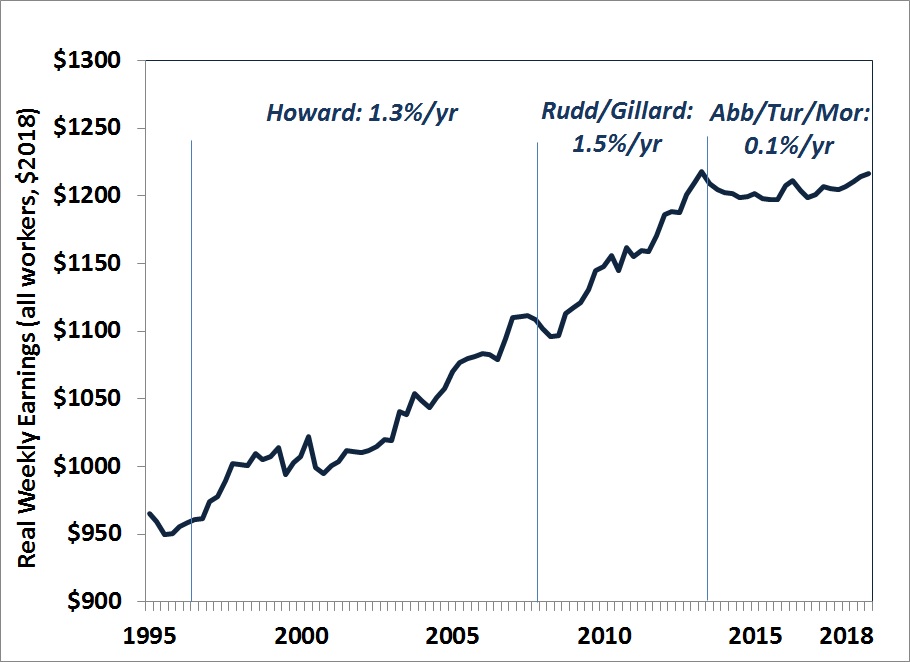
    Figure 1

    Source: Author’s calculations from ABS Catalogues 6302.0 and 6401.0.

    #2 Real wages have kept pace with productivity growth

    This claim is clearly false over any meaningful time horizon. Labour productivity has been chugging along since the turn of the century, at an average rate of about 1.25%. Some years it grows faster, some years slower. Productivity growth measures tend to be especially volatile, since they are computed as the implicit ratio of other, separately collected statistics (namely, total output and total hours worked). Some years reported productivity doesn’t seem to grow at all; some years it seems to grow very quickly.

    Even before the cessation of real wage growth around 2013, real wages were consistently lagging well behind productivity growth. Since then, of course, real wages have stopped growing at all, so the gap between wages and productivity has widened. From 2000 to the present, real wages have grown half as much as real labour productivity.

    Figure 2: Labour Productivity and Real Wages, 2000–2018
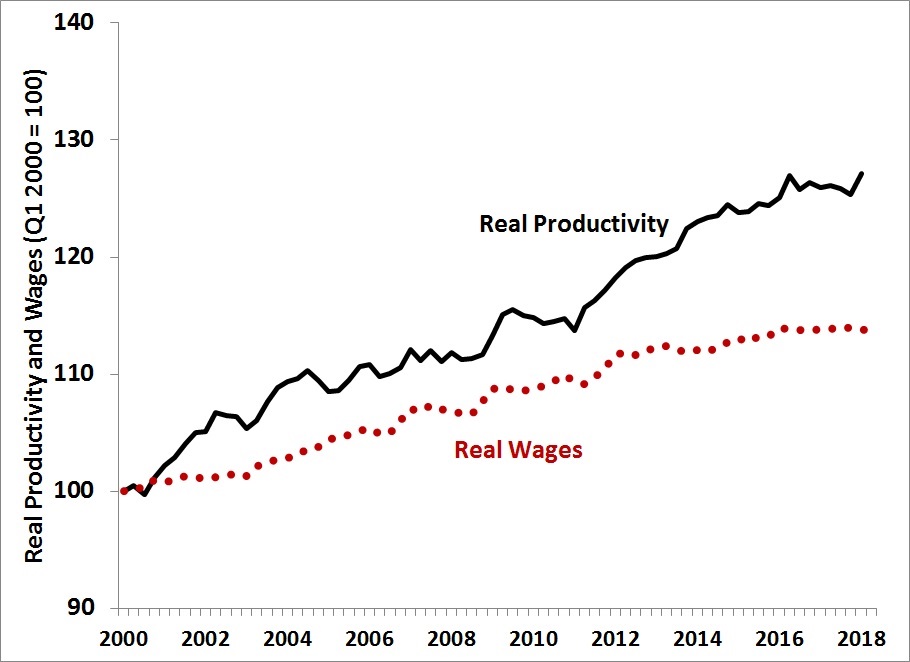
    Figure 2

    <>Source: Author’s calculations from ABS Catalogues 5206.0, 6345.0, and 6401.0.

    Stutchbury, like some other analysts, makes much of the difference between two different methods of measuring real wages: nominal wages can be deflated by consumer prices (which matter most to workers, as depicted in Figure 2) or by the average prices of the output they produce (which matter most to their bosses). Those two price series can move in different directions for a while: usually because of the price volatility of the natural resource exports that make up a significant share of Australia’s GDP. Hence the real “consumer” wage can differ from the real “producer” wage.

    But over the long-run the two price measures have moved in step, and hence the choice of deflator does not affect the conclusion that wages and productivity are no longer tied at the hip (in fact, they never were). Stutchbury actually concedes that if we use producer prices (rather than consumer prices), real wages have in fact lagged behind productivity (or, as he optimistically puts it, they “haven’t quite kept pace”). But then he makes a silk purse out of this sow’s ear by arguing that the relative cheapening of labour will stimulate more job-creation (another hollow business promise). In this mindset, it doesn’t really matter whether wages are keeping up with productivity, or not: everything is awesome in any event.

    #3 Labour’s share of GDP is the same as it was 60 years ago

    Unlike Stutchbury’s other claims, this one is actually true — but his interpretation of the statistic is hilariously one-sided. The labour share of GDP is defined as the total value of labour compensation (including wages, salaries, and other compensation including superannuation contributions) relative to the total output of the economy. It’s a rough-and-ready, but convenient, summary measure of workers’ overall share of the economic pie they help bake. Its evolution depends directly on the relationship between real wages and labour productivity discussed above. If productivity grows faster than real wages (as has been the case), then the labour share of GDP must decline — it’s arithmetically inevitable.

    Workers’ share of Australian GDP grew steadily through the vibrant economic expansion of the initial postwar decades, for several reasons. Waged employment became the dominant way for Australians to support themselves (replacing farming and small business activity). Real wages grew rapidly, driven by industrialisation, strong unions, and Australia’s then-ambitious set of egalitarian distributional policies. The labour share peaked in the mid-1970s, and then entered a long, irregular decline. (For more details and analysis of that decline, please see our special research symposium.)

    Figure 3: Labour Compensation as Share of Australian GDP, 1960–2018
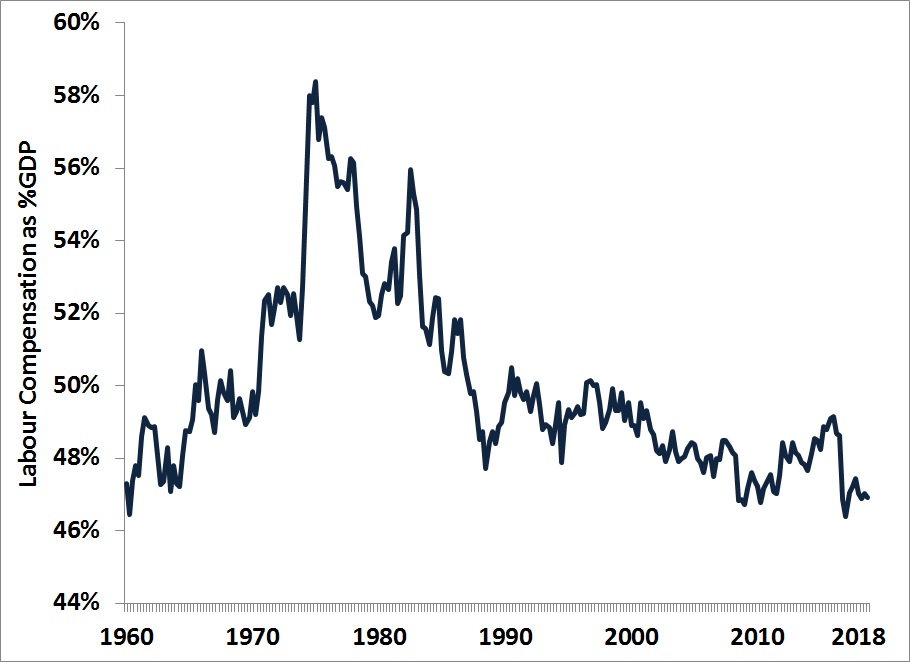
    Figure 3

    Source: Author’s calculations from ABS Catalogue 5206.0.

    <>By 2018, labour compensation averaged just under 47% of total GDP. That’s the lowest in six decades — in fact, the lowest of any calendar year since the ABS began collecting quarterly GDP data in 1959. Strictly speaking, Stutchbury is correct to say that the labour share of GDP is roughly the same as it was 60 years ago. But not many people could look at Figure 3 above, and conclude that “nothing happened”!

    To the contrary, the figure actually tells a dramatic story about the enormous swings of Australia’s postwar economic and social history. Several decades of expansive, inclusive growth, propelled by an ambitious commitment to redistribution and a growing social wage, pushed the labour share up. That was followed by several decades of active efforts to suppress wages, retrench public services, and reallocate income to business and investors. That drove the labour share back down. In essence, the relative gains Australian workers made during the postwar “Golden Age” have now been fully reversed. And there’s no reason to assume that the downhill trend in Figure 3 will suddenly and autonomously stop — without a multidimensional effort to rebuild the institutions that underpin workers’ capacity to demand and win a bigger share of the pie.

    Stutchbury suggests that the decline in labour’s share of GDP partly reflects accounting treatment of property ownership — reflected in a category of income the ABS calls “gross operating surplus for dwellings.” This claim is thoroughly unconvincing. The share of labour compensation in total GDP declined by over 10 percentage points since peaking in the mid-1970s. That was almost perfectly offset by a mirror-image increase (of over 9 percentage points of GDP) in the share of gross corporate profits in GDP. Clearly, the dominant story has been one of redistribution of income from workers to their employers.

    Accounting estimates of “operating surplus” on dwellings (some owner-occupied, some not) has also grown, but more modestly (less than 3 percentage points over the same period), and not at all since 1990 (when Australian home-ownership rates plateaued). And that flow of imputed income has begun shrinking since 2016, pulled down by the accelerating deflation of the property bubble. To suggest that workers have been compensated for declining relative wages by the side-effects of a property bubble (that made some look like “millionaires” on paper) is ridiculous. In reality, the increase in imputed property income has been more than offset by the decline in mixed income on small business (which has fallen by almost 4 percentage points of GDP since 1975); this may imply a shift in the focus of small-scale entrepreneurship from running real businesses, to investing in property.

    Stutchbury’s claim that workers themselves are now “quasi-capitalists” is familiar, far-fetched, and self-serving. He argues that because of the importance of superannuation funds in overall capital ownership, workers have a direct stake in the growing dominance ands profitability of business in Australian society, But suppressing wages over your entire working life, in hopes of gaining some incremental income from your super investments late in life, is obviously a chump’s game. It ignores the myriad of other factors that will undermine the income of those workers when they retire: not least being the direct correlation between stagnant wages and corresponding suppression of the superannuation contributions paid by employers (which are fixed as a proportion of those wages).

    #4 There has been no significant increase in inequality

    Coalition politicians and other defenders of the status quo have been making this claim for years. Many point to indicators showing that inequality was actually slightly worse in 2008 (just before the GFC hit, when business profits and stock market valuations peaked) than at present. That’s because the loss of (inflated) asset after the crisis had disproportionate impact on the rich people who own most of those assets. (Try not to cry.) But that’s hardly a sign that Australia is somehow becoming a fairer, more sharing society. And measured over a longer-term horizon, there is no doubt that income distribution in Australia has become more polarised.

    An especially dramatic indicator of rising inequality is the about-face in the share of total income received by the richest 1% of Australian households. That share declined steadily through the egalitarian postwar decades, falling by half between 1950 and 1980 (to 4.4% of total personal income). Lest we feel too sorry for the unfortunate souls in the 1%, their slice of the pie was still 4.4 times larger than proportional — and, of course, they also benefited (like other Australians) from the rapid growth in total incomes (the total pie) during that period. Since then, the deliberate redirection of national income from wages to profits, and the disproportionate salary increases received by top executives and other well-off individuals, have propelled the top income share right back to where it started. By 2015, the richest Australians had fully recouped the relative losses they experienced during the postwar Golden Age. The plutocracy had been restored.

    Figure 4: Income Share of Top 1% of Households
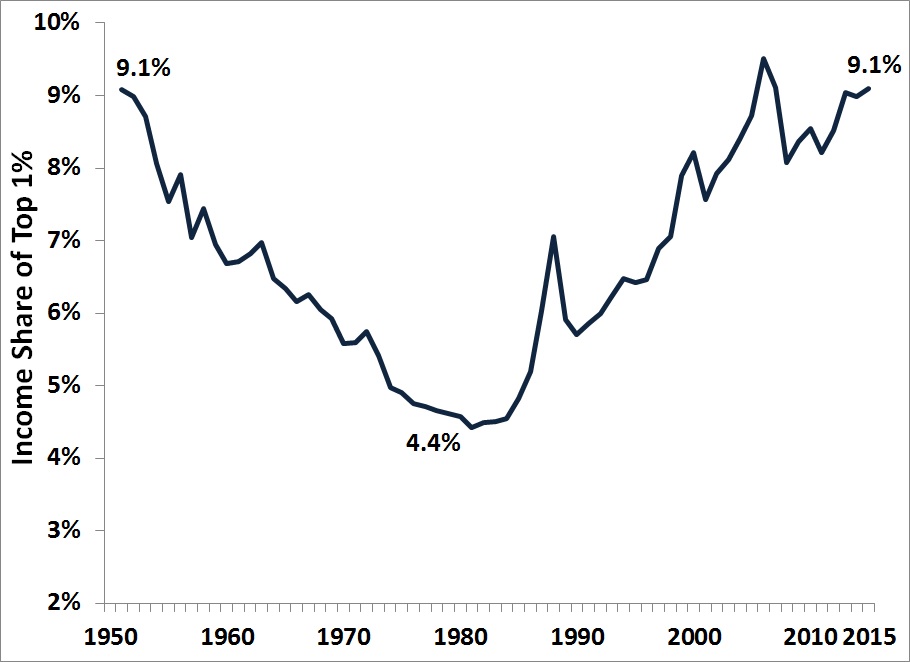
    Figure 4

    Source: World Inequality Database.

    Many other statistics confirm the long-run growth of inequality in Australia over the past generation of business-oriented neoliberal economic and social policy. Other measures of income polarisation (like the Gini coefficient, or the ratio of incomes of the top tenth of households to the bottom tenth) confirm wider inequality today, compared to the 1980s. Australia was once renowned as one of the most egalitarian countries in the world, with income distribution comparable to Scandinavia. Today we rank in the lower-third of industrial countries according to equality — and getting worse.

    #5 Stronger unions and labour rules won’t make a difference

    Commentators like Stutchbury don’t support unions in the first place. And they deny that workers have any problems that unions could help solve. Nevertheless, they want to nip in the bud any stirring of sentiment that restoring collective bargaining (and other wage-supporting measures, like minimium wages, penalty rates, or a stronger awards system) would make any difference. To this end he cites a recent RBA discussion paper as evidence that stronger unions would not solve the problem — a problem which, recall, Stutchbury believes doesn’t exist.

    Stutchbury’s reference to RBA research is misleading on several grounds. First, he assigns the finding to the Reserve Bank itself, when in fact he refers to a discussion paper written by two of its researchers (James Bishop and Iris Chan). The paper explicitly warns that its views and conclusions should not be attributed to the RBA (but Stutchbury did anyway).

    Second, the discussion paper does not argue that stronger unions would not affect wages, contrary to Stutchbury’s implication. Rather, it makes a much narrower, highly nuanced empirical claim: it suggests that the decline of union membership in recent decades has not been associated with a reduction in the impact of unions on wage gains in enterprise agreements (EAs). The paper explicitly does not consider other potential channels through which unions influence wages — such as via the level or growth of wages for workers who are not covered by EAs, or via the impact of unions on the terms of modern awards or individual contracts. (We will explore the specific methodology and findings of that discussion paper elsewhere; see also recent work by Alison Pennington which describes in detail the dramatic decline of enterprise bargaining in Australia’s private sector.)

    The core claim of the Bishop-Chan paper is that the proportion of Australian workers covered by the terms of an enterprise agreement which had some kind of union involvement has not changed much in recent years. Therefore, the slowdown in wages cannot be attributed to the erosion of union bargaining power; unions are as involved in wage bargaining as in the past. We believe this claim is both empirically wrong and analytically misleading.

    Data from the federal government itself confirms a dramatic fall in the share of employees covered by current federally registered EAs since 2013 — not coincidentally, exactly as the unprecedented stagnation of Australian wages took hold. Current EA coverage has plunged by over one-third in just 6 years. The decline in coverage has been especially severe in private sector workplaces, where less than 12% of workers now benefit from the protection of a collective agreement.

    Figure 5: Coverage by Current Federally-Registered Enterprise Agreements (% Employees)
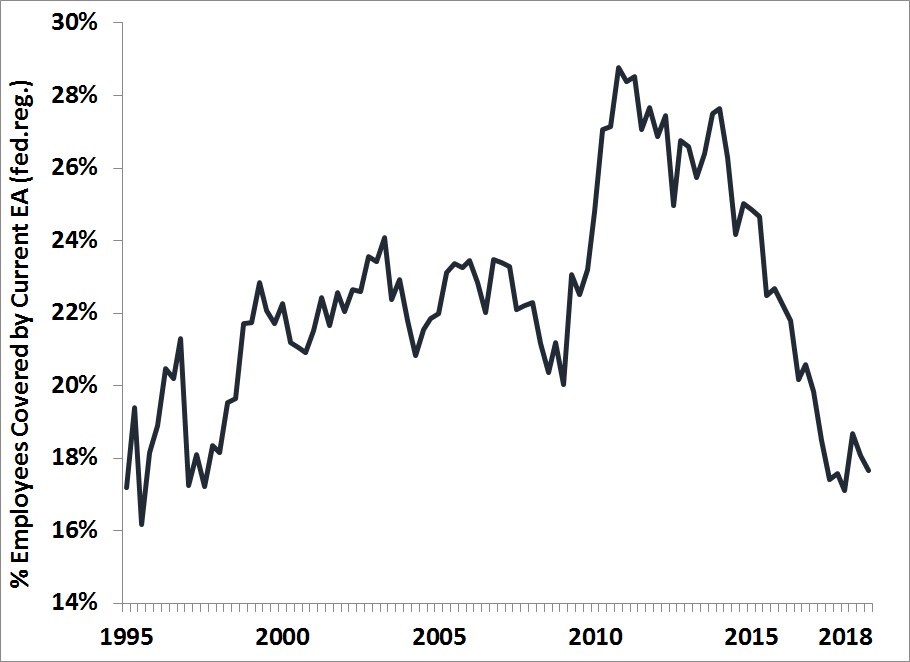
    Figure 5

    <>Source: Author’s calculations from Dept. of Small Business and Jobs data and ABS Catalogue 6291.055.003.

    Figure 5 does not include all collective agreements: around 5% of Australian workers are covered by agreements registered with state industrial relations commissions — almost all in public sector situations — which are not counted in the federal database. But that share has also shrunk in recent years, so the total erosion in EA coverage has been even worse than portrayed in Figure 5. Alternative data on EA coverage (from the ABS) includes the large number of workplaces in Australia with expired EAs: contracts that still exist on paper, but which (except for rare exceptions) no longer mandate wage increases. It is clearly illegitimate to assume that expired EAs have the same force as current ones, especially regarding wage growth.

    The Bishop-Chan paper focuses on EAs with “union involvement”. About 90% of the workers portrayed in Figure 5 are covered by enterprise agreements which feature some form of union involvement (as recorded by the Fair Work Commission); this statistic is crucial for the authors’ conclusion that union power has not waned. But the FWC’s definition of “union involvement” is very broad, and cannot be interpreted as proof of unions’ continuing bargaining power. A union can play no role at all in negotiating an enterprise agreement, yet still “sign on” to that agreement in order to formalise its legal right to play a role in enforcing its provisions (for whatever members it represents in that workplace). That union will then be identified by the FWC as being involved in that EA, even if its participation in the “bargaining” process was non-existent. This minimal level of “union involvement” in EA-making has become more common due to declining union membership and resulting resource constraints — which have made it effectively impossible for many unions to perform their traditional role in collective bargaining in all the workplaces where their members work. This grim reality helps to explain the dramatic increase in the number of expired, non-renegotiated enterprise agreements that has been a key factor in the rapid decline of EA coverage.

    Despite the challenges they face (including Australia’s uniquely intrusive restrictions on union access and activity, dues collection, and industrial action), unions still exert a powerful influence on wages. Average wages for union members in Australia are 27% higher than for non-members. And annual wage increases specified in EAs have averaged more than 1 full percentage point higher than the overall (slowing) growth in wages since 2013.

    Joining a union, and getting covered by a genuinely negotiated collective agreement, are still sure-fire ways to lift your wages. But the empirical evidence is crystal clear that the proportion of Australian workers benefiting from these supports has shrunk dramatically, and this is undeniably linked to the simultaneous and unprecedented deceleration in wage growth. “Changing the rules” to revitalise collective bargaining, and provide workers with some bargaining power to offset the current dominance of employers over wage determination, would make a huge difference to Australia’s stagnant incomes. And that’s exactly what has made commentators like Stutchbury so nervous.

    * * * * *

    Competing claims to being the “best economic managers” traditionally play an important role in Australian election campaigns, and the current contest is no exception. But for the large majority of Australians whose economic well-being depends, first and foremost, on the earnings they generate from paid employment, the jargon is ringing painfully hollow. From the standpoint of wages, the last six years have been the most disappointing since the end of the Second World War.

    Many factors help to explain the miserable performance of wages since 2013. But the phenomenon is not universal: in several countries, including Germany and Japan, wage growth has accelerated during this period, not slowed down, and Australia’s wage slowdown since 2013 has been the worst of any major industrial country. Active government policy has certainly played an important role in this poor performance. Within months of his 2013 appointment as the Abbott government’s Employment Minister, Eric Abetz was warning darkly of the dangers of a 1970s-style “wages breakout” — and implementing policies (starting with strict caps for public sector workers) to prevent it. Well, Mr. Abetz and his colleagues got what they asked for: wage growth plunged to unprecedented lows, and shows no robust indication of an imminent rebound. As federal Treasurer Mathias Cormann later let slip, this downward “flexibility” of wages is in fact a “design feature” of Australia’s current labour policy framework. His accidental assertion was as true as it was surprising.

    Since wages are the major source of income for most Australians, this turn of events has been deeply unpopular. Campaigners from unions and anti-poverty groups have emphasised the dangers of stagnant wages and inequality, and are receiving strong public support. Opposition politicians have proposed far-reaching measures to reinvigorate wage growth. But the current government would rather talk about something else — and by denying there is a problem, business leaders and sympathetic commentators are trying to help turn the page.

    Their efforts are unbelievable on statistical grounds. And they’re unlikely to be much more effective on a political level.

    Dr. Jim Stanford is Economist and Director of the Centre for Future Work, based at the Australia Institute @JimboStanford

    The post Denying Wages Crisis Won’t Make It Go Away appeared first on The Australia Institute's Centre for Future Work.
  • Jobs and a Living Wage

    The Australian policy journal Arena has published a wide-ranging article by Centre for Future Work Director Jim Stanford on the labour market issues at play in the current federal election.

    Stanford argues that the sense of “superiority” which typically accompanies economic debates during Australian election campaigns is muted in the current contest, because of the poor performance of the labour market in recent years. Unemployment and especially underemployment remain high; the quality of work has deteriorated; and wages have experienced their weakest performance since the end of the Second World War.

    Visit Arena’s website to read the full article.

    The post Jobs and a Living Wage appeared first on The Australia Institute's Centre for Future Work.

  • Job Creation Record Contradicts Tax-Cut Ideology

    The Australian Bureau of Statistics released its detailed biennial survey of employment arrangements this week (Catalogue 6306.0, “Employee Earnings and Hours“). Once every two years, it takes a deeper dive into various aspects of work life.

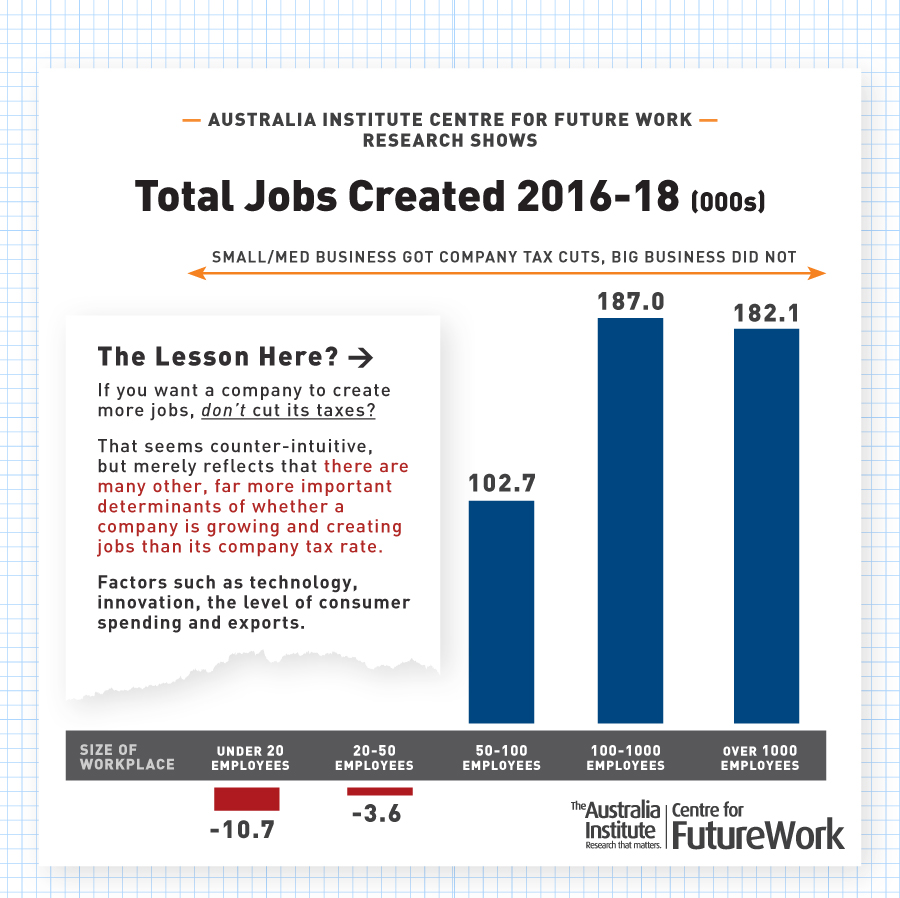
    Buried deep in the dozens of statistical tables was a very surprising breakdown of employment by size of workplace. It turns out, surprisingly, that Australia’s biggest workplaces (both private firms and public-sector agencies) have been the leaders of job-creation over the last two years.

    This runs against the common refrain that small business is the “engine of growth.” In fact, workplaces with less than 50 employees actually shed employees (14,000 in total) since 2016. Curiously, it was only smaller businesses that received the much-vaunted reduction in company tax (from 30 to 27.5 per cent), also beginning in 2016.

    Firm Size and Job Creation

    The tax rate for small and medium-sized businesses began to fall in 2016, first for the smallest firms (with turnover under $2 million), and then for firms with up to $50 million revenue. The tax is not tied to the number of employees in a business, but the vast majority of firms which have received the tax cut have less than 50 employees. Yet that is the group that has reduced its workforce since the tax cuts began to be phased in.

    In contrast, very large workplaces (with over 1000 employees) added 182,000 new jobs over the two years. Workplaces with between 100 and 1000 employees added 187,000. Very few of those workplaces would have received the reduction in company taxes (since most would exceed the $50 million annual revenue threshold).

    Workplaces between 50 and 100 employees created a net total of 103,000 new jobs between 2016 and 2018. Some of those firms would have received the tax cut, and some not — depending on the nature of the business and the amount of total turnover generated per employee.

    The data on job-creation by firm size is detailed on Table 13 of Data Cube 1, in the “Downloads” section of the ABS report. The data refers to waged employees, not including owner-managers of businesses.

    The share of small businesses (under 50 employees) in total employment declined by two percentage points — since they were reducing their workforces, while larger companies were growing. Small businesses (under 50 employees) now account for 34 per cent of all employees, compared to 36 percent in 2016.

    Why would large companies that didn’t get a tax cut create new jobs faster than companies which did benefit from the Coalition tax cuts? (The small business tax cuts are estimated to reduce federal revenues by $29.8 billion over the first decade.) Simple: there are dozens of different factors which determine whether a company is profitable or not, and whether it chooses to grow. Tax rates are just one of those variables. Others include:

    • Growth in consumer demand.
    • The company’s investments in product quality, innovation, and design.
    • Production costs.
    • Interest rates and financing costs.
    • Business confidence and expectations.
    • Management capacity.
    • International competition.

    Trends in all these other factors can easily overwhelm the marginal impact of lower tax rates. Small business sales in particular have been held back by stagnant wages among Australian workers. Even companies which experience higher profits due to lower tax rates may choose to simply accumulate those profits, or pay them out to shareholders in dividends and share buy-backs (instead of expanding payrolls). Empirical evidence shows this has been the dominant impact of U.S. business tax cuts implemented by Donald Trump.

    Changes in tax rates can even have offsetting effects which undermine business conditions and hence reduce job-creation: if the revenue lost to tax cuts results in corresponding reductions in government program spending or infrastructure investments (as seems likely), then overall business conditions might be weakened, not strengthened.

    The reduction in employment by the businesses which most benefited from the expensive business tax cuts over the past two years should lead policy-makers of all persuasions to reconsider the argument that this is an effective way to stimulate growth and job-creation. However, in October the government announced it wanted to accelerate the next stages of the small business tax cuts — taking the rate down to 25 per cent five years faster than originally planned.

    So far, the policy is akin to shooting oneself in the foot. Instead of reloading the gun to do it again even sooner, perhaps this is a good time to reconsider whether the strategy makes any sense at all.

    The post Job Creation Record Contradicts Tax-Cut Ideology appeared first on The Australia Institute's Centre for Future Work.