Category: Opinions

  • A slap-dash budget revealing a government with no idea why it is in power

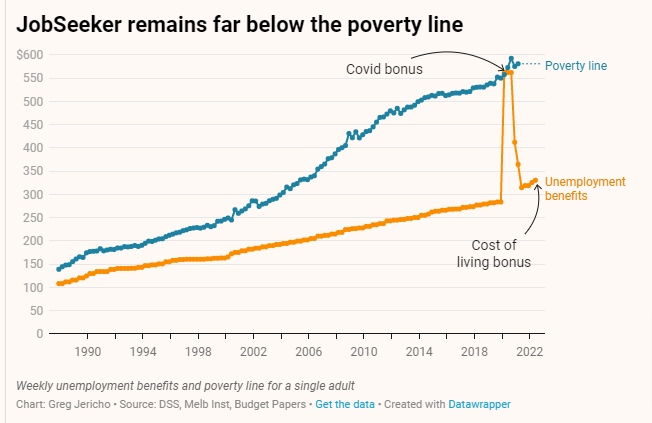
    But as Fiscal and Labour Market Policy Director, Greg Jericho notes in his Guardian Australia column, the slap-dash and short-term nature of the measures reveals this government has lost any real reason for governing.

    From the extra bonus of the low-middle income tax offset with no taper, which is now being used by businesses to argue against raising the minimum wage and the relative lack of concern about those in poverty while trying to exist on JobSeeker, this budget has all the hallmarks of an effort made up at the last minute and where poll numbers were more important than any economic figures.

    The post A slap-dash budget revealing a government with no idea why it is in power appeared first on The Australia Institute's Centre for Future Work.

  • Alison Pennington: Budget billions wasted as real wages go backwards

    The federal government’s budget would have us believe that the cost of living is a sudden problem because of higher oil prices.

    But the real reason people are feeling the pinch is because their real wages are going backwards.

    The budget forecasts wage growth of 2.75 per cent in 2021-22, below inflation which is forecast to grow by 4.25 per cent. That’s a real wage cut of 1.5 per cent.

    The budget will increase the low-and-middle-income tax offset, but then scrap it at the end of this financial year. The fuel excise will be reduced for six months.

    Complex tax-bracket-shifting schemes are a good way to distract from powerful wage suppression policies. While we’re calculating “how much do I get”, these policies entrench insecure work, cap public sector pay, and stop collective bargaining. These measures hit workers every pay packet, not just at tax time.

    The amount workers get from the tax cuts is nothing compared to normal wage increases. For the 15 years to 2012, private-sector wages grew about 3.5 per cent per year. For someone on $70,000, that’s about $2500 more in one year.

    Distracting the income-strapped

    This budget is about trying to distract the income-strapped with temporary solutions that do nothing to help in the long-run. Alongside time-bound tax cuts are $250 one-off payments to income support recipients – thousands of people who permanently languish below the poverty line.

    The government is also hoping people believe in magical free-market fairies – that lower unemployment will finally unlock wages growth. As though holding a job automatically equips workers with bargaining power.

    The “record funding” fairies were out in full force, too. The Treasurer says “record funding” has been allocated in schools, hospitals, mental health, aged care, women’s safety and disability health. But if you reduce spending to rock-bottom, every marginal increase in spending with population growth can be called “record funding”.

    If it’s not enough funding to meet demand, then it can still be “record funding” for some. Shockingly, public school funding will be cut by $560 million over the next three years. Meanwhile, JobKeeper-subsidy-dripping private schools will get $2.6 billion more over the forward estimates. It’s not a budget without blows.

    Cuts to workers’ pay

    Worse, this budget signals more cuts to workers’ pay. The budget has earmarked reducing legislated minimum redundancy payments for part-time workers. This will disproportionately affect women.

    Women’s chronically low wages and poor job quality receive no attention. Hundreds of thousands of women in underfunded healthcare and social services need government to front up and fund their pay increases. This budget is proof the biggest barrier to Australian women’s progress isn’t glass ceilings, but their own government.

    This government will balls up any opportunity to address structural gender inequality. A new paid parental leave (PPL) scheme will combine the paltry two-week Dad and Partner Pay with the existing 18-week program for a combined 20 weeks. Packaged as empowering “family choice”, it will remove any incentive for fathers to take leave.

    PPL payment at minimum wage will continue to push women into primary caring roles. This is because men earn almost one-third more than women on average. That’s not women’s “choice”.

    Governments have wage-booting tools to deal with the higher cost of living. Across the ditch, New Zealand just increased the minimum wage by 6 per cent, recognising its frontline lowest-paid workers have offered the most in the pandemic, and been hit the hardest.

    Genuine cost-of-living help overlooked

    Along with boosting minimum wages, there are other options for helping workers deal with high inflation. The government could lower the cost of living by ending fee-for-service practices in all the areas they fund – child care, aged care, and disability care. Under the current government, out-of-pocket healthcare costs have increased almost three times more than CPI.

    And there’s not much hope for youth in this budget. Presented with a future of declining living standards, political dysfunction and ecological catastrophe, young people are given just $206 million in mental health funding. They can talk to someone on the phone while the world burns.

    The bottom rungs on the economic-opportunity ladder have been eliminated and youth can’t get up. Tens of thousands of educated capable youth languish in dead-end jobs. Sacrificed by a government that would rather turn unemployment into a misery industry than to create secure, career-building jobs.

    Billions of waste

    The government is wasting billions of dollars paying off their friends in business without conditions to invest in higher wages. Before this Budget, $291 billion in public spending was ploughed into a “business-led recovery” from COVID. On businesses responsibility to reinvest post-war record-high profits, there’s an eery silence.

    And in this budget, we have zero assurances new business subsidies will be invested in the real economy – people, capital, research – rather than more profit-padding.

    On budget eve, Morrison attempted to hat-tip a bygone conservative era. He said “families” will be key to winning the upcoming election. But he never invested in them, instead putting them in a pressure cooker of record-low wage growth and high living costs.

    The government was struck by enormous luck this budget. Extra revenue to play with and they’ve thrown it all away. Hundreds of billions in government spending and no era-defining economic reforms.

    Cos-of-living pressures wouldn’t be as acute if people had almost a decade of normal wages growth. But the truth is, the government has pursued wage suppression over the entire nine years it has been in power.

    The post Alison Pennington: Budget billions wasted as real wages go backwards appeared first on The Australia Institute's Centre for Future Work.
  • A short-term budget with no vision or coherency

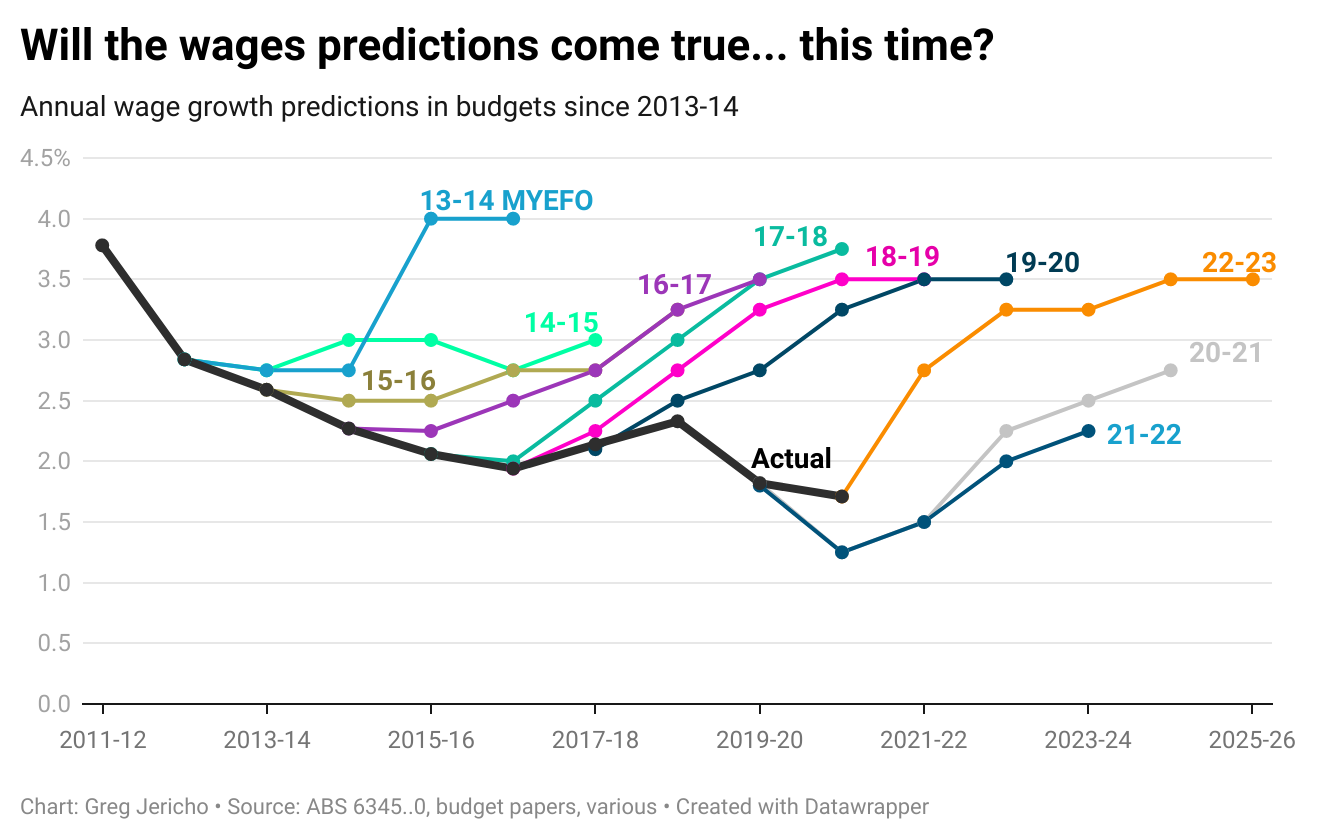
    With the opportunity to use windfall gains in revenue to begin the fix of structural issues in the economy dealing with the low paid and essential services, the government instead has thrown money at voters in the hopes of re-election.

    The Centre’s Fiscal Director, Greg Jericho, goes through the budget numbers and finds that despite predictions of once again strong wage growth, the underlying assumptions are overly optimistic and would even still leave workers worse off than they were in the middle of 2019 until 2025.

    The budget forecasts are for strong growth now, while the money is being pumped out, but once that ends we find yourself back with the same middling growth we had prior to the pandemic.

    The post A short-term budget with no vision or coherency appeared first on The Australia Institute's Centre for Future Work.
  • In next week’s budget watch out for the tax cut that won’t cut your tax

    And while there will be the usual attempts to suggest better wages growth is just around the corner and those on low-to-middle income earners are benefitting the most, we should watch out for the almost guaranteed spin around tax cuts. 

    The Centre’s Fiscal Policy director, Greg Jericho, notes in his Guardian Australia column that the low-to-middle income tax offset (LMITO) was meant to be discarded when the Stage 2 tax cuts were introduced. However because doing so would have delivered no net benefit to people earning below $90,000 the government extended the offset in the 2020 budget. 

    It extended the offset again last year claiming it was providing tax relief to “10 million low-and-middle income earners” despite it actually doing nothing other than keeping the tax rate of those workers at the same level.

    We can expect the same to occur next week. 

    Budget spin is always a sight to behold, but we are now at the point where income earners are being told they are getting a tax cut that does not actually see them pay any less tax.

    Meanwhile the Stage 3 tax cut that will deliver a cut of up to 4.5% for those earning $200,000 remains in place.

    Spin and imaginary tax cuts for some; truly excessive tax cuts for others.

    The post In next week’s budget watch out for the tax cut that won’t cut your tax appeared first on The Australia Institute's Centre for Future Work.

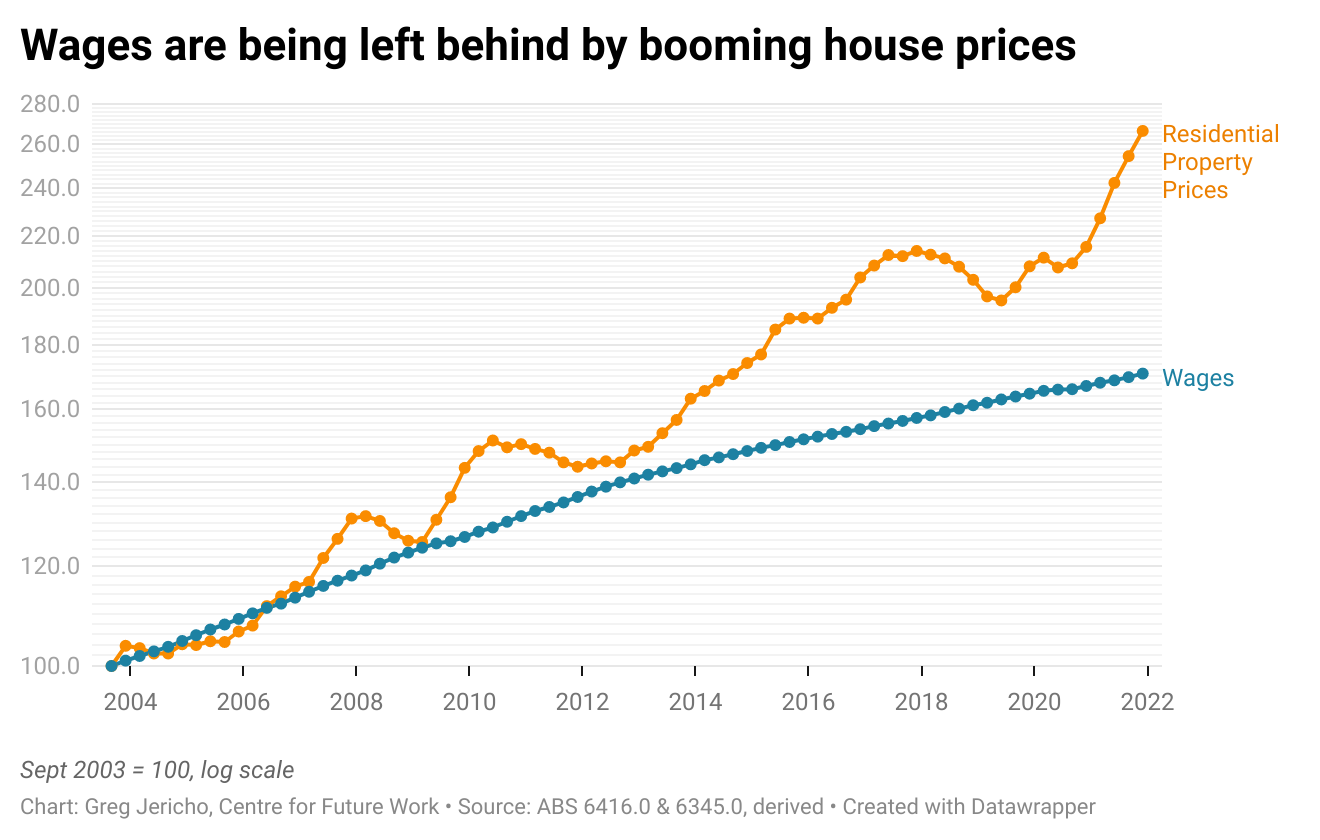
  • Flat wages and booming house prices cause housing affordability to plunge

    A decade ago the medium-priced house in Sydney was equivalent to 5.8 times the annual income of a median household; now it is 10.8 times that income. 

    Greg Jericho examines the issue in his column in Guardian Australia and drills down to look at the affordability of housing across the nation and finds a shocking, yet unsurprising tale – and one that deserves a much greater focus in the coming election campaign than is currently the case 

    https://www.datawrapper.de/_/GmaeJ/

    The post Flat wages and booming house prices cause housing affordability to plunge appeared first on The Australia Institute's Centre for Future Work.

  • Record number of people working multiple jobs reveals the problems for workers

    The Centre for Future Work’s Greg Jericho has analysed the figures and found an abnormally large number of new jobs since the pandemic have been in secondary jobs.

    In the December quarter of 2021 a record 6.4% of employees were working multiple jobs

    This unfortunately is not a pandemic-led one-off but part of a now 6-7 year trend that finds workers who are facing fewer hours, more insecure work, and getting pay rises that barely keep up with the cost of living being forced to seek another job to pay the bills. 

    See Greg’s full commentary in The Guardian: “Rise in hours worked signals post-lockdown recovery, but more people have multiple jobs than ever

    The post Record number of people working multiple jobs reveals the problems for workers appeared first on The Australia Institute's Centre for Future Work.

  • Australia’s Lopsided Economic Recovery

    In the last three months of last year, households in NSW, Victoria and the ACT came out of lockdowns and spent money propelling almost all of the economy growth in the economy.

    But while households are providing all the growth, workers are missing out on the rewards. The share of GDP going to employees hit a record low in 2021 and as government stimulus begins to be withdrawn the picture is not as optimistic as the (erratic) quarterly growth figures might suggest.

    Please see Greg’s full commentary in The Guardian: “Don’t get too excited by Australia’s rebounding economy – it’s a distorted snapshot of the true picture.”

    The post Australia’s Lopsided Economic Recovery appeared first on The Australia Institute's Centre for Future Work.

  • Loss of Bargaining Power Explains Wage Stagnation

    Our Policy Director Greg Jericho writes in Guardian Australia that claims of a “wages breakout” remain purely a scare campaign from employer groups determined to keep wages low. He finds that once again real wages are failing to keep pace with productivity and that as a result no pressure on inflation is coming from wage claims, but instead workers are missing out. With levels of unemployment now associated with much lower wage growth than in the past, it is clear the power imbalance in wage negotiations has shifted drastically away from workers.

    The post Loss of Bargaining Power Explains Wage Stagnation appeared first on The Australia Institute's Centre for Future Work.

  • Interest Rates and the Federal Election

    Inflation is occurring off the back of the largest government intervention and the lowest interest rates in post-WWII history. But while the economy is performing better than might have been expected when the pandemic first occurred it would be a mistake now to quickly reduce economic support from the public sector.

    After the global financial crisis, worries about debt and deficit took precedence over the strength of the economy. At a time when government borrowing rates still remain historically low, the need to improve productivity through infrastructure and support in areas such as education and health, as well as equality improvements through high a higher Jobseeker rate, should take precedence in the upcoming federal budget.

    The post Interest Rates and the Federal Election appeared first on The Australia Institute's Centre for Future Work.

  • Digging Deeper Into Australia’s Unemployment Rate

    In his weekly column for The Guardian Australia, Centre for Future Work Policy Director Greg Jericho unpacks the numbers behind the current unemployment rate, and compares it to the situation in 1974 when unemployment was last below 4%.

    The column considers several factors contributing to the current unemployment rate, including:

    • The flattening of labour supply due to border closures during the pandemic.
    • Lower female labour force participation (especially in full-time work).
    • The general growth in part-time work, including for men.

    Please see Greg’s full column, “Australia’s 4% unemployment in isolation hides what’s really going on in the labour market,” in The Guardian Australia.

    The post Digging Deeper Into Australia’s Unemployment Rate appeared first on The Australia Institute's Centre for Future Work.