Category: Opinions

  • Australia dumps its care crisis on the Pacific

    A report by the Centre for Future Work at The Australia Institute and Public Services International has also found that when workers get to Australia, many are being deskilled, underpaid and exploited.

    Care workers have been added to the Pacific Australia Labor Mobility (PALM) scheme, traditionally aimed at seasonal agriculture workers like fruit pickers. This has led to skilled health workers – like nurses – quitting their jobs to take up better paid but lower skilled jobs in Australia.

    The report details the harrowing state of the health systems in Fiji, Papua New Guinea, Samoa, the Solomon Islands and Vanuatu. Many health services and hospitals have been decimated, operating at 30-40 percent capacity or below.

    The research reveals that not only are Pacific workers doing lower-skilled care jobs in Australia, they are vulnerable to poor treatment, due to their visa status.

    “Workers have the right to cross borders for a better life for themselves and their families,” said Fiona Macdonald, Director of the Centre for Future Work at The Australia Institute.

    “But the current system is broken. It is rich countries taking from poor countries and giving nothing back. Australia and New Zealand are offloading their own care crises to their Pacific neighbours.

    “Australia has vowed to invest in the health systems of its Pacific neighbours, not destroy them. It should be helping to build better, safer health facilities and train workers, not lure them away.

    “We are taking workers out of a system already at breaking point, giving them jobs which are below their skill level and failing to protect them from exploitation and mistreatment.

    “The recruiting and labour hire systems, including international schemes like PALM, need urgent reform. This should start with meaningful dialogue with the workers themselves.”

    The post Australia dumps its care crisis on the Pacific – new report appeared first on The Australia Institute's Centre for Future Work.

  • Australia does not have a productivity crisis

    Like the rest of the world, productivity has been sluggish since the COVID pandemic, but that is largely due to businesses failing to adequately invest in machinery, equipment, technology and skills, at a time when many are recording record profits.

    The research also reveals that disappointing productivity is not the cause of the problems facing Australian households, like falling real wages, high prices, high interest rates and the unaffordability of housing.

    Key findings:

    • If real wages had grown at the same rate of productivity since 2000, average wages would be 18% – or $350 per week – higher.
    • Australian businesses now invest less than half as much in research and development as those in other OECD countries.
    • Higher productivity does not automatically “trickle down” to workers in terms of improved wages or living standards.
    • Productivity benefits are trending toward high-paid executives, shareholders and profits, rather than workers.
    • Business claims that productivity can be improved by wage cuts, tax cuts, deregulation or reduced unionisation are false.
    • The idea that workers should “tighten their belts and make do with less” to improve productivity is a lie.

    “Productivity has become an excuse for big, profitable businesses to do whatever they like,” said Greg Jericho, Chief Economist at The Australia Institute‘s Centre for Future Work.

    “Peter Dutton said he’d tear up the new right-to-disconnect laws, saying they hampered productivity, as if allowing employers to call staff any time of the day or night would somehow make them more efficient. This research dispels that kind of nonsense.

    “Australia’s so-called ‘productivity crisis’ is massively exaggerated. Low productivity is not to blame for the problems facing households today, like soaring interest rates, prices or low wage growth.

    “This research also shows that sluggish productivity is caused by companies investing far less in things like machinery, equipment and research.

    “The benefits of productivity should not go straight to profits, shareholders or fat cat CEOs. They should be shared with workers in the form of wages which grow at a similar rate.

    “That way productivity would deliver its true purpose: to provide economic prosperity and a higher quality of life for everyone.”

    The post Australia does not have a “productivity crisis” – new research appeared first on The Australia Institute's Centre for Future Work.

  • Chalmers is right, the RBA has smashed the economy

    Last year the government announced it was considering removing its statutory power to overrule the Reserve Bank. Thankfully it has now reconsidered that move, and the actions of the RBA over the past year serve to remind everyone that it is far from infallible.

    In its May Statement on Monetary Policy the RBA looked ahead one month and estimated that in June the annual growth of household consumption would be 1.1%. When the national accounts were released last week, the actual growth was revealed to be just 0.5%.

    Now obviously economic forecasting is a bit of a mugs game, but household consumption makes up half of Australia’s economy and accounted for around 45% of all the growth in the economy over the past decade so it is pretty important. It is also the area of the economy most directly affected by interest rate rises. This error of forecasting suggests that the Reserve Bank has rather poorly misread just how greatly households had been impacted by the 13 rate rises that had taken the cash rate from 0.1% in April 2022 to 4.35% in November 2023.

    This error is crucial because the main reason the RBA raises rates is to reduce the ability of households to spend. Because you can’t tell your bank that you don’t really feel like paying your mortgage this month, interest rate rises force households to divert money that would have been spent on goods and services to paying your mortgage.

    The problem is when you are trying to slow down half of the economy so directly, if you overdo it the entire economy begins to fall. This is what happened in the early 1980s and 1990s when interest rates were raised sharply in order to slow inflation.

    And the private sector has already slowed so greatly that the only reason GDP rose in the past year was because of increased government spending.
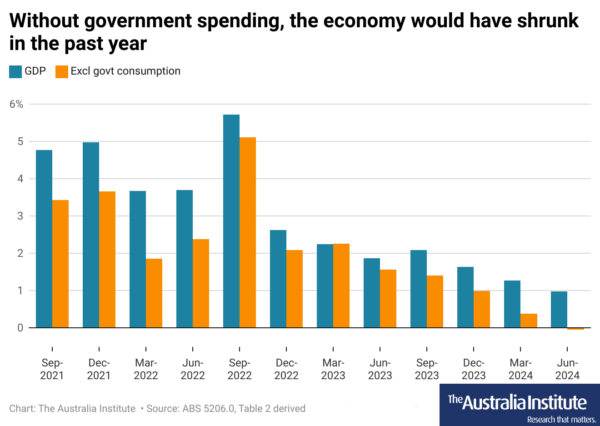
    That is not a sign of a strong economy, nor a sign of one, according to the assistant governor of the RBA, Dr Sarah Hunter, that “is running a little bit hotter than we thought previously”.

    Economies that are running a bit hot are ones in which households are spending a lot more than they were the year before because unemployment is falling and wages are rising well ahead of inflation. Instead we currently have a situation where unemployment has risen from 3.5% in June last year to the current level of 4.2%, household spending grew just 0.5% – well below the long-term average of 3% – and real wages in the past year rose just 0.1%.

    When asked about this discrepancy between reality and the RBA’s belief, the Governor of the Reserve Bank, Michele Bullock told reporters last week that

    …it’s the difference between growth rates and levels.

    She noted that “it’s true that the growth rate of GDP has slowed” but that “part of monetary policy’s job has been to try and slow the growth of the economy because the level of demand for goods and services in the economy is higher than the ability of the economy to supply those goods and services. So there’s still a gap there. So even though it’s slowing, we still have this gap.”

    In effect Bullock was telling people to stop worrying about the fact that household consumption was barely growing or that GDP only grew because of government spending or that GDP per capita has fallen for a record 6 consecutive quarters because the amount of consumption and GDP was too high.

    This could make sense – think of it like a car travelling on a 60km/h road. If it was travelling at 80km/h and slowed to 70km/h even though it was slowing it would still be going too fast.

    In essence this is what Bullock is arguing is happening to demand in the economy – it is slowing but overall there’s still too much of it.

    The only problem is that this is completely wrong.

    Consider the suggestion that the demand for goods and services is higher than the ability of the economy to supply those goods and services. One simple way to look at this is to see if the amount of goods and services bought per person is currently at a level consistent with the growth observed in the decade before the pandemic.

    This is actually not a major test – household consumption, along with most of the economy was rather weak in the 7 or 8 years before 2020. The RBA at the time actually was hoping Australians would spend more than they did, so you would expect in an economy with too much demand that the amount of things we are buying is well above the levels of that particularly weak period.

    But it is not.

    As we can see from the below graph, while household spending did quickly recover after the lockdowns in 2020 and 2021, by the time the RBA began raising interest rates our level of demand for goods and services was only back to the level consistent with the pre-pandemic growth.
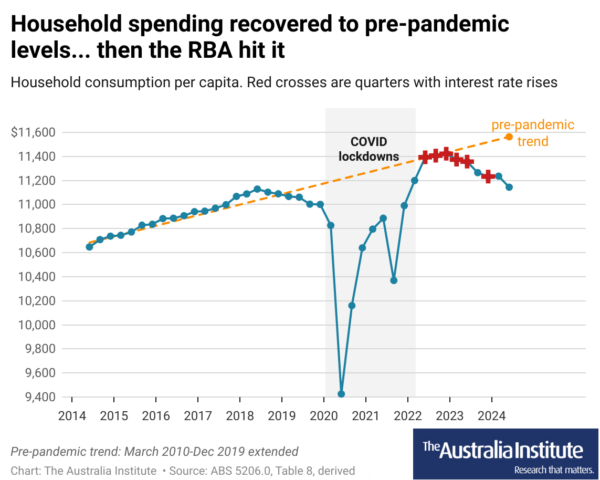
    Now yes you can argue the RBA was right to increase rates at that time – to ensure our spending didn’t keep zooming up in recovery. But by the time of the 10th rate increase in March 2023, household spending per person was already falling and 0.7% below the pre-pandemic trend. When the RBA raised rates for there 12th time in June 2023, the level of demand for goods and services was 1% below the pre-pandemic trend.

    At this point you might think the RBA had done enough. But after pausing for 4 months, the bank inexplicably raised rates for a 13th time in November 2023. At this stage household level of spending was 2.5% below the pre-pandemic trend.

    And because interest rate rises take months to worth through the economy we now find ourselves at a point where the level of household consumption per person is 3.8% lower than would have been expected had households merely kept increasing our consumption in line with the decade before the pandemic.

    In effect Australians are currently consuming almost the same amount of goods and services as they did in June 2018 and yet the head of the RBA would have us believe that is a case of excess demand.

    If we look at the overall economy, the picture is much the same (see the graph at the top of the page). Australia’s level of GDP per capita did recover quickly after the lockdowns and by June 2022 was 1.4% above the pre-pandemic trend level. But the interest rates rises had an immediate impact – reducing GDP per capita in 7 of the next 8 quarters. By June 2023 the level of activity in the economy was already below pre-pandemic expectations, and when the RBA hit Australians with the 13th rate rise in November 2023, the level of GDP per capita was 1.2% below the long-term trend.

    It is now 2.5% below – back at the level it was in June 2021.

    The RBA has got it wrong. They were initially worried that inflation was driven by concerns of strong wage growth rather than supply side issues and corporate profits. They then tried to argue household spending was still growing too strongly. The GDP figures showed that to be woefully mistaken. They then tried to argue that while growth in the economy was slow, there was still too much demand. But again the figures show this to be mistaken.

    The Treasurer Jim Chalmers stated nothing but the facts when he said earlier this month that rate rises were “smashing the economy”. The data supports his assertion, and it is time the RBA admits that their actions have not only slowed the economy but slowed it at a pace that is now harming Australians for no benefit other than the RBA saving face from its previous over-reactions.

    The post Chalmers is right, the RBA has smashed the economy appeared first on The Australia Institute's Centre for Future Work.

  • Public sector wages fall further behind

    Analysis of public sector wage caps and their economic impact.

  • Why Australian wages are stuck

    Analysis of the structural factors keeping Australian wages stagnant.

  • Fixing the work and care crisis means tackling insecure and unpredictable work

    The Fair Work Commission is examining how to reduce insecurity and unpredictability in part-time and casual work to help employees better balance work and care.

    The Commission is reviewing modern awards that set out terms and conditions of employment for many working Australians to consider how workplace relations settings in awards impact on work and care. This follows a 2023 finding by the Senate Select Committee Inquiry into Work and Care last year that there is a “work and care crisis”.

    The Select Committee’s final report noted “too many Australians are working in conditions that lack predictable hours and thus pay”, making it difficult to manage their care responsibilities with paid work.

    Insufficient income to meet family needs, inability to plan, inability to access suitable care, high stress levels and lack of time for life are some of the negative impacts of insecure and unpredictable part-time and casual work for workers with caring responsibilities.

    Women are overrepresented in part-time and casual jobs, as they continue to provide most unpaid care for children, elderly parents, and sick or disabled family members. Among women, casual employment is most common among 15 to 34 year-olds, while for men it is highest among those aged 65 years and older. Women’s casual employment is linked to child-rearing.

    Pay rates in casual jobs are often lower than for employees in equivalent permanent part-time and full-time jobs, despite casual loadings. Underemployment is also high and unpredictable working hours are common among casual and part-time employees, including in services sectors such as retail and care. In both sectors, insecure casual jobs provide workers with very little control over their work hours. Lack of control over hours is often a feature of permanent part-time jobs as well as casual jobs

    In a job with unpredictable hours it can be extremely difficult to organise and manage the costs of care. For example, for parents, uncertainty of working hours and income can make access to reliable and affordable childcare impossible. Unpredictable short-hours rosters can make it barely worth working at all as income may not cover the costs of formal childcare.

    Good quality, secure part-time jobs have long been regarded as essential for greater gender equality in employment, including as part-time jobs can support better sharing of care among men and women. However, the expansion of part-time work in the Australian economy since the 1980s has been an expansion of casual and part-time jobs that are highly insecure, often low-paid and with poorer conditions, protections and entitlements than most full-time jobs.

    It is possible to make casual and part-time jobs more secure and predictable. The Fair Work Commission’s analysis of industrial awards shows that there are many provisions in awards applying to part-time and casual employment that contribute to insecurity and lack of predictability. Award provisions include, for example, short minimum payments periods, broken shifts, poor guarantees around minimum and regular hours of work, little or no payment for travel time between different work locations, little or no notice of roster changes and poor compensation for being on-call.

    Secure work and a living wage are fundamental to good work and care arrangements. Secure work doesn’t just mean ongoing work or protection from unfair dismissal. Secure work entails adequate and predictable work hours, reasonable flexibility of working time, compensation for unsocial hours, safety at work and access to union representation.

    Worker-carers should also have rights to carer’s leave and personal leave, regardless of their employment arrangements. Systems of portable leave entitlements could help all workers manage care and work at all stages of their working lives. These and other leave entitlements would have the benefit of supporting a better sharing of care.

    The Fair Work Commission’s will complete its review in the middle of 2024. It is to be hoped that this leads to improved working conditions for worker carers, enabling men and women to care and work without paying the price through job insecurity.

    The post Fixing the work and care crisis means tackling insecure and unpredictable work appeared first on The Australia Institute's Centre for Future Work.

  • On International Women’s Day: How the Fair Work Commission Can Really Take On the Gender Pay Gap

    This International Women’s Day, it is time to call on Australia’s workplace umpire, the Fair Work Commission, to finally close the gender pay gap.

    Half a century after the commission’s predecessor granted women “equal pay for equal work” in a landmark case in 1969, the gap remains between 12% and 21%.

    Amendments to the Fair Work Act by the incoming Labor government in 2022 gave it new tools to close the gap by addressing the undervaluation of work in traditionally female-dominated occupations.

    If it uses these tools to their full potential, 2024 will be a landmark year in the genuine achievement of equal pay for equal work.

    What we’ve been doing hasn’t much worked

    Traditionally in Australia, addressing gender-based undervaluation has relied on two approaches.

    The first has been to argue the business case for gender equality – convincing employers they’ll be rewarded for “doing the right thing”.

    The second has been to bring equal pay cases to tribunals.

    Unfortunately, neither approach has been successful. In particular, pushing for equal remuneration through tribunals has been time-consuming and expensive.

    These tribunals, historically working on models of male full-time wage earners, have struggled to understand the undervaluation of work performed predominantly by women.

    The commission’s new tools

    The commission’s act has been rewritten to require it “to promote job security and gender equality.”
    It also has the power to make equal remuneration orders either on its own initiative or on application in order to bring about equal pay for work of equal or comparable value.

    A further new development is the establishment of expert panels to assist in gender-related cases. Advice from gender experts should assist in overcoming historical gender biases in commission decisions.

    Perhaps the most promising tool is the change to the commission’s modern awards objective, which requires it to eliminate gender-based undervaluation of work and provide workplace conditions that facilitate women’s full economic participation each time it reviews an award.

    Among other things, this requirement is likely to result in provisions that ensure part-time work is treated equally to full-time work and ensure a better balance between work and caring responsibilities.

    Amending awards is likely to be particularly important for women given that almost three in five of the workers on awards are women. Men are mainly on negotiated agreements.

    If the commission wanted to, it could hold a wide-ranging inquiry into the many factors that have contributed to gender-based undervaluation of women’s work.

    It could also review entire industries and occupations that are female-dominated, upgrading multiple awards at the same time. This would avoid lengthy and costly reviews of individual awards.

    What’s likely in 2024

    The Fair Work Commission’s resolve to make lasting change will be tested by several matters currently before it.

    The commission is due to issue its final decision in the case lodged by the Australian Nursing and Midwifery Federation, the Health Services Union, and the United Workers Union on the value of the work done by workers in aged care.

    An initial interim decision delivered in 2022 awarded some – but not all – of these workers a 15% increase, finding that work in feminised industries had been historically undervalued and the reason for that undervaluation is likely to be gender-based”.

    Workplace Relations Minister Tony Burke backed the decision, saying it was merely the “first step”.

    Another application, for nurses and midwives outside of aged care, was lodged by the Australian Nursing and Midwifery Federation in February this year.

    The commission has already started the process of grappling with gender-based undervaluation in modern awards, commissioning research that documents the segregation of women and men into different occupations and industries.

    Further research documenting the history of a select group of female-dominated modern awards and identifying the extent to which common elements indicate gender-based undervaluation, is due to be released in April.

    It will feed into the annual wage review due by the middle of the year.

    How to be bold

    Gender-based undervaluation of women’s work won’t be eradicated by incremental adjustments.

    Here are three bold steps the commission could take:

    • grant a minimum interim 12% increase (one estimate of Australia’s national gender pay gap) across the board for female-dominated awards in this year’s annual wage review
    • develop new systems for classifying work and ascribing work value, breaking with the previous standards built around skills and qualifications in male dominated occupations
    • better consider the uneven bargaining power in industries such as nursing where governments fund care work and try to restrain costs.

    The changes to the Fair Work Act that allow multi-employer bargaining are a start, but unlikely alone to correct the undervaluation of women’s work.

    In female-dominated industries where collective bargaining is non-existent or ineffective, the commission should step in and further increase wages.

    The Fair Work Commission has been given the tools. This should be the year it applies them.

    The post On International Women’s Day: How the Fair Work Commission Can Really Take On the Gender Pay Gap appeared first on The Australia Institute's Centre for Future Work.

  • The gas industry is laughing at us as they make more money but not more tax

    Australia produces more than six times the amount of gas needed to supply our manufacturing industry, power stations and homes. But more than 80% either heads overseas as LNG exports or is used to convert natural gas into LNG:

    We export much more gas than we used to. In the 2000s we exported around 14m tonnes of LNG a year. Now, due to the opening of the Gladstone LNG terminal, we send 83mt overseas – the second most of any nation.

    But more production and more revenue has not led to more tax, even though the petroleum resources rent tax (PRRT) is in place to supposedly raise revenue from windfall profits such as those generated by the gas industry after the Russian invasion of Ukraine.

    When Australia exported 15.4mt of LNG in 2008-09, the government raised $2.2bn in PRRT. In 2022-23, exports had increased 437% to 83mt but PRRT revenue was up just 7% to $2.4bn.

    Did gas suddenly become unprofitable?

    No, the problem is that the PRRT is open to manipulation that enables companies to use costs to reduce their PRRT liability such that it appears they are never making “super profits”.

    In last year’s budget, the government finally proposed limiting the deductions to the PRRT in any year to 90% of LNG project revenues. Alas that proposal also had a punchline. The government announced the changes would raise an extra $2.4bn in PRRT over the next four years. That was roughly a 30% increase in tax.

    Thirty per cent!

    You would think the gas industry would launch the mother of all campaigns against it. But no. They loved it.

    The day it was announced the gas industry peak body recommended bipartisan support as the changes “would see more revenue collected earlier”. The key word was “earlier”. It won’t raise more tax; it just moves some tax from later to earlier.

    But it won’t even do that.

    In December’s midyear economic and fiscal outlook, the government announced it was revising down its estimate of how much PRRT would be raised over the next four years.

    How much did it reduce its estimate by?

    You guessed it: $2.4bn.

    We need to change the way the PRRT operates, we need to tax our gas more and we need to do it now.

    The post The gas industry is laughing at us as they make more money but not more tax appeared first on The Australia Institute's Centre for Future Work.

  • RBA rate rises are hurting workers most

    How RBA interest rate rises are falling hardest on working Australians.

  • More loopholes to close on insecure work and a new right to disconnect from work

    This means Australia’s employment laws will be further amended to tackle the problems of insecurity and low pay, with the changes targeting casual employment and gig platform work arrangements. The package also includes a new right for employees to disconnect from work outside their paid work time.

    A new definition of casual employment will be included in the Fair Work Act, making it harder for employers to classify their employees as casual when, in reality, the employees are required to work regular hours for a continuing and indefinite period. The legislation also establishes a new pathway for casual employees to seek permanent status.

    The casual employment changes should go some way to stopping and reversing the growth of so-called ‘permanent casual’ arrangements, which have become widespread. Workers in these arrangements are actually in permanent jobs while they are given casual employment status.

    Casual employment means lower pay, little or no job security and no right to paid leave. Lack of employment security in casual employment creates all sorts of other insecurities for workers, such as limiting access to finance, secure housing and childcare. According to government estimates, there are over 850,000 casual employees who could be eligible to seek permanency under the legislation.

    Gig worker or ‘employee-like’ reforms in the Closing Loopholes package aim to address low pay and poor working conditions experienced by workers on digital platforms who are engaged as independent contractors, are low-paid and/or have very limited bargaining power, such as delivery riders and rideshare drivers. The Fair Work Commission will now be able to make orders for minimum standards for these digital platform workers.

    This ‘employee-like’ reforms extend the scope of Australia’s Fair Work Act to provide protections and rights to vulnerable workers, who are not employees. This should prove to be an effective response to the challenges facing vulnerable ‘gig workers as argued by the Centre for Future Work’s David Peetz has argued in a recent Centre for Future Work report on self-employment.

    Closing Loopholes also includes a ‘right to disconnect’ from work, an initiative of the Greens, included to get the minor party’s support for the bill. In future, employees will have a right to refuse to respond to contact from their employers outside their scheduled hours if the contact is unreasonable.

    Go Home on Time Day research conducted in 2022 by the Centre for Future Work found that 8 out of every 10 workers supported a right to disconnect. This level of support is not surprising, given the amount of unpaid overtime workers are doing. In 2023, the Centre for Future Work reported employees are, on average, working 5.8 hours a week — total of 280 hours, or 7 weeks, a year of unpaid overtime per employee.

    The new right to disconnect is a practical solution for many employees that should also assist to shift cultures in workplaces where reliance on unpaid overtime has become the norm.

    Some employer groups are arguing the Closing Loopholes legislation ‘goes too far’. To the contrary, if there is a weakness in the legislation, it is that it does not always account for power imbalances in the relationship between employees and employers. And this may limit the effectiveness of the some of the new provisions.

    As a result of amendments put forward by independent David Pocock and the two Jacqui Lambie Network senators in response to employers’ concerns, a number of the bill’s provisions will be weaker in the final legislation than they were in the government’s original bill.

    The amended bill passed by the Senate yesterday provides greater scope for employers to refuse casual employees’ requests for permanent status. The proposed prohibition on employers unreasonably contacting employees out of work hours has been removed. In the amended bill the prohibition is now on employers punishing employees who refuse to monitor and respond to unreasonable contact.

    The Closing Loopholes part 2 reforms are welcome changes that will limit some of the damage and disadvantage caused by insecure work and the encroachment of (unpaid) work into life outside work.

    The post More loopholes to close on insecure work … and a new right to disconnect from work appeared first on The Australia Institute's Centre for Future Work.