Category: Media Releases

  • Penalty rate cuts fail to ignite jobs boom

    A new report from The Australia Institute’s Centre for Future Work examined employment and working hours in the retail and hospitality industries in the year since penalty rates were first cut.

    The report found, since the initial penalty rate reduction imposed by the Fair Work Commission on 1 July 2017:

    • The retail sector in particular performed very badly relative to the rest of the economy.
    • Total employment was unchanged in the year ending in May 2018, continuing a long-term trend of employment stagnation.
    • Full-time employment declined by 50,000 positions.
    • Average weekly hours of work declined by more than a full hour, and the underemployment ratio (share of workers who want more hours) grew almost 2 percentage points.
    • The hospitality sector (accommodation and food services) experienced similar results, including weak job-creation, a loss of full-time employment, shorter average hours of work, and higher underemployment.

    “Far from experiencing a jobs boom, the retail and hospitality sectors have significantly underperformed the rest of the economy in terms of both hiring and working hours,” says Dr. Jim Stanford, Director of the Centre for Future Work.

    “Most industries where penalty rates were unchanged did far better at job-creation than the two sectors where penalty rates were cut.

    “Employer representatives argued that reducing labour costs for work on Sundays and holidays would spur a big expansion in employment, one group even predicted 40,000 new jobs. Our report found that was simply not the case.

    “Based on a number of criteria, the retail and hospitality sectors performed among the worst of any Australian industries in the year since penalty rates were first cut.

    “While lower penalty rates are not the cause of the poor performance, our research certainly disproves inflated claims by employers and government that cutting labour costs would unleash a jobs boom.

    “If we really want more jobs, we should boost wages, improve job security, and strengthen purchasing power throughout the economy. Cutting penalty rates does the opposite.”

    The post Penalty rate cuts fail to ignite jobs boom appeared first on The Australia Institute's Centre for Future Work.
  • Manufacturing Rebound Could Be Cut Short By Skills Shortage

    The new report from the Centre for Future Work identifies key factors behind the rapid emergence of skills shortages in manufacturing, including:

    • The sector’s ageing workforce, creating a looming demographic transition for skilled worker
    • The highly specific nature of manufacturing skills (across sectors and occupations), creating difficulty for workers moving from between shrinking sectors to growing sectors
    • The need for new skills and ongoing training as companies adopt advanced manufacturing techniques and new digital technologies.

    “Manufacturing is again making a positive contribution to Australia’s economic progress after over a decade of decline. We don’t want to squander this potential,” said Dr. Jim Stanford, Director of the Centre for Future Work.

    “If Australia doesn’t get its act together on vocational training, this will be a wasted opportunity for manufacturing.

    “Recent experiments with market-based vocational training have been a waste, they have damaged confidence in the skills system among both potential students and employers.

    “Stable, well-funded, high-quality public institutions must be the anchors of any successful VET system.

    “Public institutions are the only ones with the resources, the connections, and the stability to provide manufacturers with a steady supply of world-class skilled workers.

    “No sector feels the pain of the failure of vocational training more than manufacturing, precisely because advanced skills are so essential for the success of advanced manufacturing techniques.

    “Manufacturing stakeholders need to work together to strengthen vocational education and training.”

    Key principles for rebuilding vocational education in manufacturing, discussed in the report, include:

    • A greater reliance on courses and apprenticeships through public-sector TAFE (rather than private providers)
    • Phased-in retirement programs to allow senior workers to pass on their skills to new apprentices
    • Inclusion of provisions guaranteeing access to further training in industry awards and enterprise agreements.

    The report was co-authored by Dr. Jim Stanford and Dr. Tanya Carney and prepared for the Second Annual National Manufacturing Summit at Parliament House on 26 June 2018.

    The National Manufacturing Summit engages leading representatives from all parts of Australian manufacturing: businesses, peak bodies, unions, universities, the financial sector, suppliers and government. The growing problem of skills shortages is a priority focus for this year’s Summit.

    The post Manufacturing Rebound Could Be Cut Short By Skills Shortage appeared first on The Australia Institute's Centre for Future Work.

  • For First Time, Less than Half of Workers Have a Standard Job

    A new report by the Centre for Future Work at the Australia Institute looks at the growing insecurity of work in Australia.

    The report reviews 11 statistical indicators of the growth in employment insecurity over the last five years, including: part-time work, short hours, underemployment, casual jobs, marginal self-employment, and jobs paid minimum wages under modern awards.

    All these indicators of job stability have declined since 2012, leading to a majority of Australian workers now experiencing one or more of these indicators of job – and less than half have access to what was once considered a ‘standard job’.

    “Australians are rightly worried about the growing insecurity of work. We are now seeing less than half of employed Australians holding a ‘standard job’, with dependable hours, pay, and benefits” said Dr. Jim Stanford, director of the Centre for Future Work.

    “In particular, many young people are giving up hope of finding a permanent full-time job – and if these trends continue, many of them never will.”

    The report also documents the low and falling earnings received by workers in insecure jobs:

    • While real wages for those in the best paid job category – permanent full-time jobs – have grown, wages for casual workers have declined.
    • Part-time workers in marginal self-employed positions (including so-called ‘gig economy’ workers) have fared the worst, with real wages falling 26 percent in the last five years.

    “Given current labour market conditions and lax labour standards, employers are able to hire workers on a ‘just-in-time’ basis, employing workers only when and where they are most needed and then tossing them aside afterwards,” said Dr Stanford.

    “This insecurity imposes enormous risks and costs on workers, their families, and the whole economy.”

    Dr. Stanford called on policy-makers to address growing job precarity with stronger rules to protect workers in insecure jobs, such as provisions for more stable schedules, and options to transition to from casual work to permanent positions. He also stressed the need for economic policies that target the creation of permanent full-time jobs.

    The post For First Time, Less than Half of Workers Have a ‘Standard Job’ appeared first on The Australia Institute's Centre for Future Work.

  • Government Spending Power Could Support Stronger Wage Growth

    New research from the Centre for Future Work at The Australia Institute demonstrates a strong connection between government spending and working conditions across the economy.

    “Weak labour market conditions, including record-weak wage growth, could be improved by linking public spending in all forms to improved job quality and compensation,” said Dr. Jim Stanford, Director of the Centre for Future Work.

    The Centre for Future Work report finds three main avenues through which government spending could lift wages and working conditions:

    1. Direct work and production undertaken within government and its departments and agencies (the public sector).
    2. Arms-length service-producing organisations which depend on government funding (the non-profit sector).
    3. Private-sector firms which supply government and public agencies with goods and services (the private sector).

    “It is ironic that Treasurers are always praying for stronger wage growth with every year’s budget in order to generate stronger growth and stronger revenues. Yet governments don’t pursue obvious opportunities to actually achieve that wage growth by linking labour standards to their own expenditure policies,” said Dr Stanford.

    “This is clearly a lost opportunity. Australia’s government sector is by far the single largest part of Australia’s economy.

    “This economic footprint, if wielded consistently to achieve higher wages and better jobs, could have a powerful impact on labour market outcomes.”

    Australian government economic footprint at a glance:

    • Total expenditures of over $660 billion per year, equal to 36 percent of Australia’s GDP.
    • Expenditures on current production of public goods and services of over $330 billion per year (18.5 percent of GDP), and further spending on capital investments of over $85 billion (another 5 percent of GDP).
    • Direct public sector employment of close to 2 million workers, with millions more jobs indirectly dependent on government injections of spending power.
    • Fiscal support for public and community services by arms-length non-profit agencies, worth at least another 4 percent of GDP.
    • Goods and services procured from private-sector suppliers equivalent to around 10 percent of GDP (or about $175 billion per year).

    The post Government Spending Power Could Support Stronger Wage Growth appeared first on The Australia Institute's Centre for Future Work.

  • Don’t blame it on the deficit: WA

    Contrary to calls for fiscal austerity and public sector downsizing, being made in response to the emergence of fiscal deficits in WA, the report showed that budget deficits played a useful role in stabilizing the economy during times of economic downturn, and will automatically recede as the economy recovers.

    “In reality there should be no alarm about the WA state deficit. Deficits are acceptable, and positive, during periods of weak economic growth.” says the Australia Institute’s Senior Economist, Dr. Cameron Murray.

    “In fact, that deficit merely confirms that state fiscal policy is doing what it is supposed to: providing essential public services and providing a solid base for private-sector economic activity.”

    “It is wrong to immediately conclude that the only response to a deficit must be some combination of cutting spending, reducing public sector employment, freezing or reducing public sector wages, and selling public assets.”

    The report found public sector payrolls grew modestly through the 2014-17 period. That modest growth, in contrast to the contraction in private payrolls, supported a cumulative total of $3 billion dollars in additional GDP; $1.3 billion in additional consumer spending; and $450 million in additional state revenues.

    “During WA’s recession we’ve seen compensation growth slow down in both the public and private sectors,” says Murray.

    “Importantly however, the modest, continuing wage growth we did see in the public sector acted as an automatic stabiliser, reducing the severity of WA’s downturn.”

    Total economic activity, including economic activity in the private sector, was also found to be higher as a result of the government slowly but steadily increasing its spending on public servants and the services they provide.

    “Those deficits arose in the wake of the slowdown in mining activity and corresponding deceleration of employment and economic growth, and over-zealous fiscal austerity is not the solution.”

    “Continuing growth in public sector wages and maintaining public spending during weak economic periods generates positive spillover effects for the rest of the economy,” says Murray.

    More recently, positive signs of recovery in the state economy are quickly and automatically producing a reduction in the size of the deficit. The report recommends the state government focus on supporting that continuing recovery, rather than reducing the government’s own contribution to it.

    The post Don’t blame it on the deficit: WA appeared first on The Australia Institute's Centre for Future Work.

  • Dogged manufacturing sector quietly adds 40,000 jobs

    The report, A Moment of Opportunity (download full report pdf below), identifies several indicators which suggest that the economic opportunities for domestic manufacturing have improved significantly.

    The Centre for Future Work in The Australia Institute will host the National Manufacturing Summit: From Opportunity to Action at Parliament House on Wednesday 21 June 2017. Speakers will include a wide range of experts from industry, university, trade union, and financial sectors, as well as four top political spokespersons: Minister for Industry Senator Arthur Sinodinos, Shadow Minister for Industry Senator Kim Carr, Greens Industry spokesperson Senator Lee Rhiannon, and NXT leader Senator Nick Xenophon.

    “Australia’s manufacturing industry faces some daunting domestic and global challenges. But it’s not just surviving, it’s finding a way to grow, adding 40,000 new jobs last year,” Director of the Centre for Future Work, Dr Jim Stanford said.

    “That ranks manufacturing as the second biggest source of new jobs in Australia last year.”

    “Additionally, manufacturing re-invests 5% of its value added in R&D, the highest of any industry, making it an engine room for innovation in the economy.”

    New polling released as part of the report shows that Australians are very supportive of pro-active, targeted policy measures to sustain and support manufacturing (see polling results below).

    “Perhaps influenced by the negative tone of much recent commentary, Australians consistently underestimate the size of manufacturing in Australia’s economy, relative to other industries, but nonetheless recognise the value of maintaining a strong manufacturing sector.

    Specifically, there was strong support for targeted policies such as government procurement mandates (81%) and tax incentives tied to investments in domestic facilities (79%); support was strong across all age and voting groups. Australians opposed measures to attract industry by cutting wages, environmental standards, or across-the-board taxes. But measures focused on manufacturing, tied to Australian production and jobs, received overwhelming support – by a margin of up to five-to-one.

    “Both economically and politically, the smart move would be for legislators to get behind local manufacturing with targeted policies to support Australian jobs, ” Stanford said.

    The post Dogged manufacturing sector quietly adds 40,000 jobs appeared first on The Australia Institute's Centre for Future Work.

  • Pain of penalty rate cuts can not be avoided through transition measures

    Analysis from The Australia Institute’s Centre for Future Work has shown that proposals for phasing in lower penalty rates for work on Sundays and holidays will not “protect” the workers affected by those cuts, and in some cases would make things worse.

    Simulations of various proposals from political and business leaders for deferring lower penalty rates, making offsetting adjustments in base wages, and/or “grandfathering” the wages of people already employed in the sector, suggest that none are capable of truly avoiding the resulting hardship.

    “Taking several years to implement a painful, damaging policy does not erase the impacts of that policy,” said Jim Stanford, Economist and Director of The Centre for Future Work, and the report’s author.

    “There appears to be a lack of understanding by some as to how much Sunday and holiday wages will fall under these proposals. A wage cut of that scale can’t be disguised simply by introducing it in stages.”

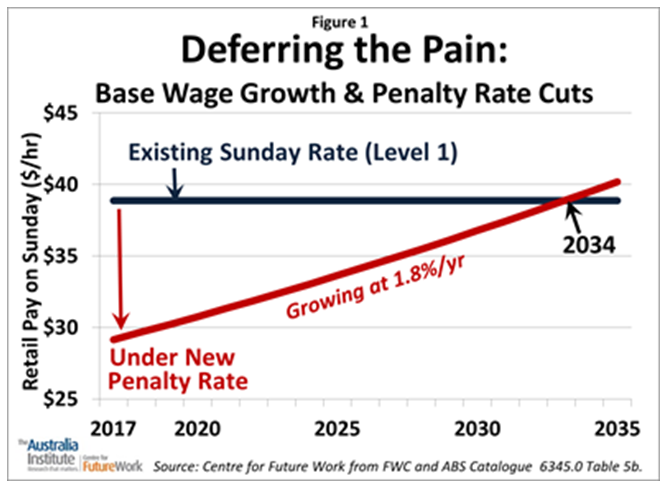
    The Centre’s report investigates the Prime Minister’s suggestion that penalty rate cuts could be “offset” by the impact of normal wage increases over time. At current rates of wage growth, it would take 17 years until higher base wages for retail workers fully offset the effect of lower penalty rates on nominal incomes.

    CFW Pen rate

    Making matters worse, ongoing inflation during those 17 years would reduce the real purchasing power of wages by 22 percent: almost equal to the reduction in Sunday pay proposed.

    Another transition proposal is to lift the minimum wage for retail and hospitality workers – either gradually or all at once. The report shows that this would substantially increase weighted average labour costs across retail and hospitality sectors by up to 25 percent (since the higher base wage must be paid to workers on other days of the week, too). This approach would be fiercely resisted by retail and hospitality employers.

    “Grandfathering” wages of existing retail and hospitality workers is also not feasible, largely because employers can easily reschedule existing workers to other days of the week, or even end their employment altogether.

    “The reduction in penalty rates for retail and hospitality workers will have a significant, negative impact on hundreds of thousands of employees, who are already among Australia’s most low-paid, insecure workers.

    “It is impossible to imagine a phase-in system to protect their compensation, when the whole point of this decision is to reduce it,” Stanford said.

    Stanford noted that lower penalty rates will exacerbate the problem of wage stagnation, which he argues is a more serious threat to growth and job-creation in Australia than penalty rates.

    The post Pain of penalty rate cuts can not be avoided through transition measures appeared first on The Australia Institute's Centre for Future Work.

  • Cutting penalty rates will reinforce wage stagnation

    The Fair Work Commission’s decision to reduce penalty rates for Sundays and holidays in retail and hospitality jobs will reinforce wage stagnation and further widen income inequality, which is bad news for the economy as a whole, according to Dr. Jim Stanford, Director of the Centre for Future Work at the Australia Institute.

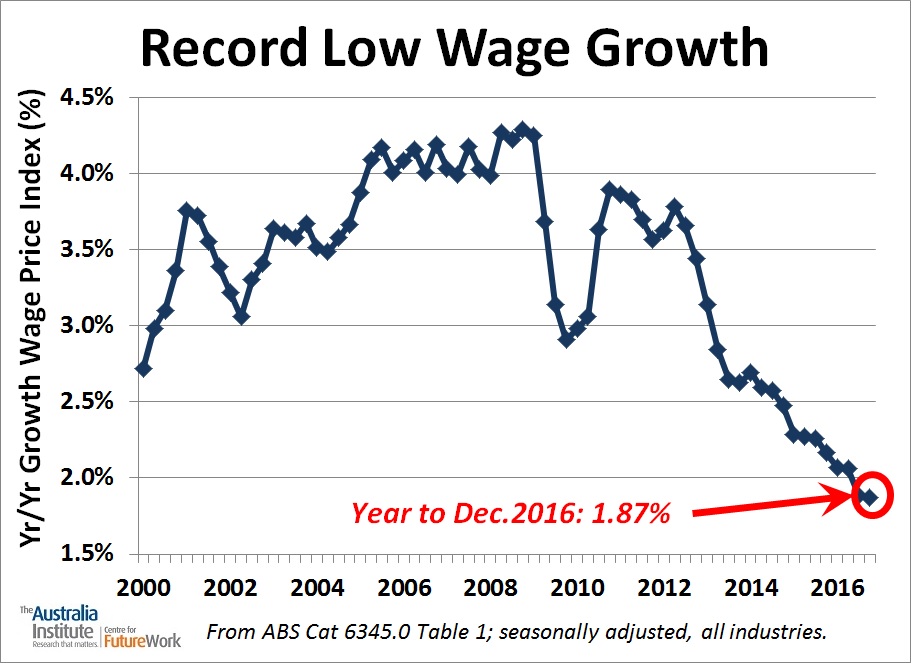
    “It’s painfully ironic that the Fair Work Commission’s decision was released just a day after the ABS confirmed the pace of Australian wages had already slowed to the worst in the history of their data,” Dr. Stanford said.

    “With household incomes going nowhere, and the economy slowing accordingly, now is the time to support the wages of low-income workers, not suppress them further.”

    “The economic argument that business will open longer, creating jobs has no basis. It will simply spread limited demand, and therefore jobs, over a longer period without increased employment.”

    ABS data released on Wednesday showed annual wage increases in the year to December 2016 fell to just 1.87 percent. Wages in retail and hospitality already lag far behind economy-wide averages, and part-time and casual jobs are the norm.

    Record low wage growth

    “Worse yet, workers in these sectors also face widespread wage fraud and violation of minimum wage laws, as documented at employers like 7-11 stores and Domino’s Pizza.”

    “By cutting Sunday and holiday penalty rates to as low as 125 percent, the Commission’s decision will significantly damage incomes for workers who already face precarious schedules and incomes.”

    Dr. Stanford was especially critical of claims that lower weekend wages will spur new job-creation in retail and hospitality.

    “It is elementary economics that employment in service sectors like retail and restaurants is constrained by the level of consumer demand, not by the level of wages.”

    “Lower wages will not lead to lower prices, they cannot boost consumer spending, and they will not create new jobs. In fact, by further suppressing labour incomes, this decision will undermine economic growth and job-creation even further.”

    “The idea that more businesses will open up on a Sunday and this will lead to more employment is also flawed logic. Since total demand will remain unchanged, a business will simply sell the same amount over 7 days instead of 6 days,” Stanford said.

    Read our previous polling of public attitudes to cutting penalty rates.

    The post Cutting penalty rates will reinforce wage stagnation appeared first on The Australia Institute's Centre for Future Work.

  • ABCC will do nothing for housing prices: Report

    Prime Minister Turnbull blamed construction workers and their union for the high cost of housing, when he re-introduced the ABCC bill in Parliament last month, claiming the bill would help “young Australian couples that can’t afford to buy a house because their costs are being pushed up by union thuggery.”

    But new research from the Centre for Future Work shows there is no statistical correlation between construction unionization or construction wages, and the soaring cost of housing.

    “The government’s claim that construction labour costs explain the rising price of housing has no basis in evidence,” Director of the Centre for Future Work, Jim Stanford said.

    “The suggestion that restricting union activity in construction can somehow deflate the great Australian property bubble reveals a critical misunderstanding of the Australian housing market.”

    The study provides detailed statistics regarding housing prices, union membership, wage growth, total construction costs, and replacement building costs. The report finds that:

    • Construction wages have grown more slowly than the Australian average over the last five years.
    • Real wage gains in construction have been slower than real productivity growth, and hence real unit labour costs in construction have declined.
    • Construction labour accounts for only 17-22 percent of the total costs of new building.
    • Construction costs, in turn, account for less than half the market value of residential property.
    • Construction labour costs correspond to less than 10 percent of housing prices (and even less than that in Australia’s biggest cities).
    • Construction labour accounts for about the same proportion of a house purchase as real estate commissions and stamp duty.

    “Homes in Australia are fast becoming unaffordable, even for the workers who build them. On average, a construction worker now needs 9.2 years of pre-tax earnings to purchase a median home – up 25 percent from just four years ago.

    “If the government is genuine in its desire to make housing more affordable in Australia, it should turn its attention to the real causes of the problem. Better policy responses would include measures to cool off property speculation, more carefully regulate the banking sector, and reform property-related taxes,” Dr Stanford said.

    The post ABCC will do nothing for housing prices: Report appeared first on The Australia Institute's Centre for Future Work.

  • New figures show Australians taking less annual leave

    “This year, Go Home On Time Day will focus on the need for Australian workers to be entitled to, and to feel safe in taking their holiday leave,” Director of The Australia Institute’s Centre for Future Work, Jim Stanford said.

    The Centre for Future Work, which is coordinating this year’s event, published a report which revealed growing number of Australian workers do not qualify for, or are not taking their entitled paid holiday leave.

    A study of 891 workers showed:

    • Almost one-third (32%) don’t have access to paid holiday leave.
    • Over half of those with annual leave didn’t take their whole entitlement.
    • That result would equate, across the whole labour market, to 48 million unused holiday days, worth $11.1 billion – annually.

    “About half of those who responded cited work-related pressures as inhibiting their leave: including being too busy, having too much to do, being reluctant to ask, or worried it would affect their job security or promotion chances.

    “We don’t want to see a nation of empty beaches, unblackened sausages and grandparents waiting too long between visits.

    “We do want to see refreshed workers who have had the chance to spend some quality time with their families,” Stanford said.

    The Unpaid Overtime Calculator app has been used by thousands of Australians, collecting data on excessive hours of work, this year including the provision and use of holiday leave.

    In addition to the growing inaccessibility of paid holidays, the survey data also revealed that the average full-time worker in Australia loses 5.1 hours per week to unpaid overtime – or 264 hours per year. Workers donate $116 billion dollars’ worth of hours to their bosses, every year.

    The post New figures show Australians taking less annual leave appeared first on The Australia Institute's Centre for Future Work.