Category: Media Releases

  • Exit Poll: Overwhelming Majority of Australians Want Wage Growth in Line with Cost of Living

    As the Fair Work Commission prepares to announce this year’s increase in the national minimum wage, new polling data shows that the vast majority of Australians support lifting wages to keep up with rising inflation.

    The Australia Institute conducted a special exit poll, surveying a nationally representative sample of 1,424 Australians on the evening of Saturday May 21, following the federal election. Among other questions, the survey asked about voters’ attitudes towards cost of living and low wage growth.

    Key Findings:

    • An overwhelming majority of Australians (83%) support wage increases that keep up with cost of living, only 10% disagree.
      • Strong support for boosting wages to keep up with inflation was expressed across all voting intentions (Coalition 79% agree, 13% disagree; Labor 88% agree, 8% disagree; Greens 83% agree, 11% disagree; PHON 70% agree, 14% disagree; IND/other 84% agree, 7% disagree.)
    • In this context, criticism directed at Mr. Albanese during the election campaign for agreeing that wage increases should keep pace with inflation more likely hurt the Coalition campaign, not the Labor leader.
      • 39% of respondents felt Labor was best placed to address the issues of wages and the cost of living, compared to 26% who felt the Coalition had the stronger position.
    • Almost two in three Australians (65%) believe their nominal incomes have lagged behind inflation in the past year.
      • Regarding what can be done to ameliorate this problem, Australians were evenly divided: about half of respondents believe government policies can significantly alter the course of wage growth, while the other half do not.

    “Our research shows that while conservative commentators might be alarmed at the idea that wages should increase as fast as prices, among the voting public the idea seems reasonable and fair,” said Dr Jim Stanford, Economist and Director of the Centre for Future Work.

    “There is no economic basis for the view that wages keeping up with inflation will only cause further inflation. The current cost of living crisis is clearly due to factors (like supply chain disruptions and global energy prices) that have nothing to do with Australian wages.

    “Unit labour costs in Australia are falling, not increasing. Workers should not be punished further with falling real wages for a problem they did not create.

    “Wages can and should keep pace with rising prices to protect the real living standards of Australian workers, while the true causes of inflation are addressed.”

    The post Exit Poll: Overwhelming Majority of Australians Want Wage Growth in Line with Cost of Living appeared first on The Australia Institute's Centre for Future Work.
  • Joseph E. Stiglitz Australian Speaking Tour: July 2022

    Nobel Laureate, former World Bank Chief Economist, and best-selling author Professor Joseph E. Stiglitz will visit Australia in July 2022 to discuss the need to expand the role of governments, unions, and civil society.

    The tour, hosted by the Australia Institute, will see Professor Stiglitz speak at a wide range of events for the general public, policymakers, unions, civil society, investors and philanthropists.

    “Professor Joseph Stiglitz is not only one of the world’s leading intellectuals and policy advisers, he has a unique ability to translate complex economic issues into language that both engages and informs, something essential for our democracy to flourish,” said Ben Oquist, executive director of the Australia Institute.

    “The Australia Institute is delighted to host such a guest at such an important time in Australia’s economic policy debates. The essential and expanding role for government in driving economic prosperity is too little discussed. We hope this tour can help address that deficit.”

    Professor Stiglitz will visit Sydney, Hobart, Canberra, and Melbourne in July 2022

    The post Joseph E. Stiglitz Australian Speaking Tour: July 2022 ‘The Role of Government in the Modern Economy’ appeared first on The Australia Institute's Centre for Future Work.

  • One in Five Worked with COVID Symptoms; Sick Leave Entitlements Must Be Strengthened

    Almost one in five Australians (and a higher proportion of young workers) acknowledge working with potential COVID symptoms over the course of the pandemic, according to new opinion research released today by the Australia Institute’s Centre for Future Work.

    The research confirms the public health dangers of Australia’s patchwork system of sick leave and related entitlements, as new ABS data released today indicates 32% of Australian households had one or more members exhibiting COVID symptoms in April.

    Key Findings:

    • More than one in three (37%) employed Australians have no access to statutory paid sick leave entitlements (including workers hired under casual employment arrangements, and self-employed workers). Another 12% had access only to pro-rated part-time entitlements.
    • When the pandemic hit Australia, therefore, barely half (51%) of employed workers could count on regular full-time income if they had to stay home from work.
    • Almost one in five respondents (19%), and a higher proportion of young workers (29%), acknowledged working with potential COVID symptoms at some point during the pandemic. This highlights the public health dangers of Australia’s patchwork system of sick leave and related entitlements.
    • Polling results also confirm that a significant proportion of workers (17%) also attended work after exposure to someone possibly infected with COVID.
    • Given inadequate sick pay entitlements and the surprising share of workers attending work in violation of public health advice, perhaps it is not surprising that 18% of workers did not feel safe attending their normal workplaces during the pandemic.
    • Australia’s sick pay entitlements are clearly inadequate to allow workers to stay home from work when health advice requires it. The expansion of non-standard and insecure forms of work (including part-time work, casual jobs, contractor positions, and ‘gigs’) has heightened concern that many workers do not have the effective ability to stay home from work for health reasons.
    • Government should expand sick pay entitlements to cover all workers, and also implement strategies to limit and reduce the incidence of insecure work: including by constraining employers’ use of ‘permanent casual’ arrangements, sham contracting, and on-demand gigs, none of which provide normal and healthy paid leave entitlements.
    • Unfortunately, the current Federal Government has done the opposite by reinforcing the shift toward insecure working arrangements – including through its 2021 amendments to the Fair Work Act, which cemented and expanded employers’ rights to hire workers on a casual basis (with no sick pay) in virtually any job they wish.

    “Our research shows that too many workers are not following public health guidelines and isolation instructions, to the detriment of their own health, and the health of their colleagues and the broader community,” said Dr Jim Stanford, economist and director of the Australia Institute’s Centre for Future Work.

    “Millions of workers have either used up all the paid sick leave they are entitled to, or do not receive sick pay entitlements in the first place. There is no doubt this has contributed to the epidemic of people attending work with possible COVID symptoms.

    “With incomplete sick leave coverage, workers face a devil’s choice: between staying home to protect themselves, their colleagues and the public; or going to work regardless simply to make ends meet.

    “The policy implications of this analysis are clear. The government needs to expand sick pay entitlements to cover all workers, including those in casual employment and self-employed situations.”

    The post One in Five Worked with COVID Symptoms; Sick Leave Entitlements Must Be Strengthened appeared first on The Australia Institute's Centre for Future Work.

  • Wages Will Continue to Lag Without Targeted Wage-Boosting Measures: New Report

    A comprehensive review of Australian wage trends indicates that wage growth is likely to remain stuck at historically weak levels despite the dramatic disruptions experienced by the Australian labour market through the COVID-19 pandemic. The report finds that targeted policies to deliberately lift wages are needed to break free of the low-wage trajectory that has become locked in over the past nine years.

    The report, The Wages Crisis: Revisited, authored by three of Australia’s leading labour policy experts: Professor Andrew Stewart from Adelaide Law School, Dr Jim Stanford from the Centre for Future Work, and Associate Professor Tess Hardy from Melbourne Law School, updates analysis and recommendations from their 2018 edited book, The Wages Crisis in Australia.

    The report shows that annual nominal wage growth recovered after initial lockdowns during the pandemic – but rebounded only to the same slow pace (just above 2% per year) recorded for several years prior to COVID. Unprecedented fluctuations in employment and labour supply, including a significant decline in the official unemployment rate, do not seem to have altered wage growth, which is still tracking at the slowest sustained pace in post-war history.

    “It is striking that despite so much turmoil in our labour market during and after the pandemic, wage growth is still stuck at historically weak rates,” noted Professor Andrew Stewart.

    The research found little correlation between the lasting slowdown in wage growth after 2013, and changes in supply-and-demand balances in the labour market.

    “Traditional market forces did not cause the wages crisis, and market forces are unlikely to be able to fix it – even with a relatively low unemployment rate,” said Dr Jim Stanford.

    Instead, the authors identified nine policy and institutional factors which were more important in explaining the deceleration of wages, including: the erosion of collective bargaining coverage; inadequate minimum wages; pay restraint imposed on public sector workers; and widespread wage theft.

    The problem of restrained compensation in public and human services reaches further than just the pay caps imposed directly on public servants. Wages in publicly funded services (like aged care, the NDIS, and early child education) are also held back by inadequate funding and weak labour standards in those programs.

    The report makes special mention of the need to improve wages in aged care, in the wake of the recent Royal Commission’s finding that wages in the sector must be improved as a top priority in improving care standards and attracting the new workers the sector needs.

    “A combination of underfunding, outsourcing, and precarious employment has suppressed wages for some of the most important jobs in our economy,” commented Associate Professor Tess Hardy. “The Aged Care Royal Commission identified this problem, and directed government to solve it, but so far the government has done nothing to improve wages.”

    The authors suggest that nominal wages should grow faster than 4% per year in coming years, to restore healthy relationships with productivity growth, inflation, and national income distribution. But a resuscitation of wage growth will not occur without proactive wage-boosting policies.

    The authors list five broad measures to quickly support wage growth. One is a proposal for a new statutory definition of employment. This would prevent businesses from drafting contracts that present workers as being self-employed, even if in reality they have no business of their own. The authors predict that such arrangements will become far more widespread, including in the growing gig economy, in the wake of two recent decisions by the High Court.

    “The High Court has said that employment status has to be determined by what your contract says, not what you actually do. That opens the door to much wider use of contractor models, even when the actual conditions of work clearly indicate an employment-like relationship”, said Prof Stewart. “Without urgent action to prevent minimum wage laws being avoided in that way, the negative impacts on wages will steadily become much worse.”

    The post Wages Will Continue to Lag Without Targeted Wage-Boosting Measures: New Report appeared first on The Australia Institute's Centre for Future Work.

  • Pandemic Workforce Crisis Requires TAFE Investment in Early Childhood Education: Report

    The research report launched today, ‘Educating for Care: Meeting Skills Shortages in an Expanding ECEC Industry’ has called for the sector to be treated as an ‘industry of national strategic importance’ with greater investment in TAFE to train staff.

    Key Findings:

    • The number of job vacancies in Early Childhood Education and Care sector have doubled since the pandemic with providers reporting 6000 job vacancies per month
    • Australia is failing to train & retain its ECEC workforce, problem is set to worsen as 41,500 new graduates will be required per year by 2030
    • Beyond direct benefits, ECEC expansion boosts productivity across the economy by unlocking labour market participation of parents
    • Early childhood education enhances the long-term potential of Australia’s economy by providing children with education opportunities to expand lifetime learning, employment, & incomes
    • Among the 10 key recommendations, is that ECEC should be viewed as an ‘industry of national strategic importance’, similar to the manufacturing industry

    “Workforce shortages have been a problematic reality of the pandemic, both within the Early Childhood Education sector and across the broader economy,” said Dr. Mark Dean, Distinguished Research Fellow at the Carmichael Centre, and report author.

    “The early childhood education and care workforce crisis is set to get worse. This represents a huge opportunity: greater investment in TAFE training and secure jobs can unlock economic growth and deliver better outcomes for our children and the Australian economy.

    “It would be foolish to overlook the full and proper funding of Australia’s state- and territory-based TAFE systems in our post-pandemic economic reconstruction, rather than seeing it as an essential component.

    “To tackle the problem, education and care for preschool-aged children should be provided by well-trained and experienced workers. Like any industry, attracting and retaining quality early childhood education staff will require quality, secure jobs.

    “To meet the workforce needs of expanded ECEC coverage, ramping up high-quality vocational education for ECEC workers must be an immediate and highest-order priority.

    “A vital prerequisite in this effort is establishing a stable, professional, well-supported ECEC workforce, by providing extensive education and training of ECEC workers, and their entry to secure, well-paid career pathways.”

    The post Pandemic Workforce Crisis Requires TAFE Investment in Early Childhood Education to Boost Economy: Report appeared first on The Australia Institute's Centre for Future Work.

  • Free Undergraduate Education to Save Universities and Jobs: Report

    The next federal government can save universities, make undergraduate education free for all Australians and employ tens of thousands of staff securely by lifting the public spend on higher education to just one per cent of GDP, according to a landmark new report.

    The Australia Institute’s Centre For Future Work report shows, if the federal government brings its annual investment in higher education into line with the OECD average, we could fix the destruction inflicted by the COVID pandemic and make universities more accessible and affordable for all Australians.

    Following decades of funding cuts, government inaction and the pandemic, more than 40,000 jobs were lost in public tertiary education in the 12 months to May 2021, 35,000 of those at public universities.

    National Tertiary Education Union (NTEU) National President Dr Alison Barnes said “Higher education needs to be made a priority in this election. The future of hundreds of thousands of staff and millions of students depends on it.

    “The state of the sector now is deeply concerning. It is the consequence of the Morrison Government’s decision to exclude universities from JobKeeper, hike student fees, cut funding per student place, entrench casualisation and decimate curiosity-driven research funding.

    “Thousands of jobs have been lost at public universities and the staff who are left are being kept on casual or short-term contracts. Those staff can’t plan for their future and often have their pay stolen by money-hungry universities who have built their business models on wage theft and insecure work.

    “The next Australian Government could remove the financial barrier to higher education, employ more than 26,000 staff in secure full-time jobs, restore research funding, reduce the over-reliance on casual staff and establish a new higher education agency to improve governance.

    “Free undergraduate education would be transformative for current and future students who are now facing more expensive degrees, mounting student debt and even the threat of being kicked off HECS if they don’t pass their courses.”

    Australia Institute economist and the report’s author Eliza Littleton said “As devastating as the pandemic has been for Australia’s universities, the sector was being distorted and damaged by corporatisation, casualisation, and privatisation long before COVID arrived.

    “Australia needs an ambitious national vision for higher education that re-aligns the sector with its public service mission, and with the needs of students, staff, and wider society.

    “Australia can choose a future for higher education that facilitates a stronger economy, social mobility and enhanced democracy – all the while generating a source of high-quality careers for many thousands of Australians.”

    The report’s recommendations include:

    • Free undergraduate education for Australian students
    • Adequate public funding for universities
    • Fully-funded research
    • Measures to ensure secure employment
    • Improved higher education governance
    • Caps on vice-chancellor salaries; and
    • Transparency in data collection.

    The post Free Undergraduate Education to Save Universities and Jobs: Report appeared first on The Australia Institute's Centre for Future Work.

  • Universal Public Early Child Education in Australia Would Pay For Itself: Research Report

    Making Early Child Education and Care (ECEC) universal in Australia would pay for itself by unlocking women’s labour supply, boosting GDP and growing government revenues by billions, according to new research from the Australia Institute’s Centre for Future Work.

    With cost of living shaping up as a key election issue, policy experts say boosted funding would ease the pressure on families, while boosting the economy.

    Key Findings:

    • ECEC funding is lower in Australia than other countries, yet private revenues (mostly paid by parents) are higher. Australian parents currently pay more but get less
    • Matching the ECEC funding levels of Nordic countries would generate 292,000 new jobs, directly, downstream and via increased women’s employment
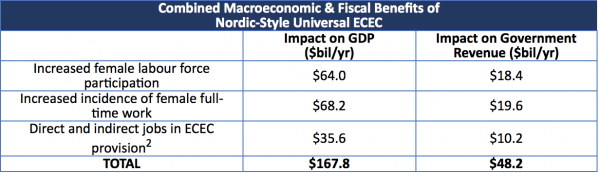
    • If Australian women had the same participation and full-time employment rates as Nordic women Australia’s GDP would be some $132b per year higher
    • Government funding for public and non-profit childcare generates one-third more employment and GDP than funding for private for-profit firms
    • The economic activity supported by expanded funding for public and non-profit ECEC centres would boostAustralian GDP by a further $35b
    • The combined boost to GDP would create an additional $48b in government revenue, more than the cost of providing the childcare services in the first place

    “This is a program that literally pays for itself,” said report author and Senior Economist at the Australia Institute, Matt Grudnoff.

    “This would create tens of billions of dollars in new GDP, hundreds of thousands of jobs and billions of dollars in government revenue – above and beyond the cost of providing those services in the first place.

    “A high-quality, accessible, and non-profit Early Child Education and Care system would facilitate the expanded paid work effort of hundreds of thousands of Australian women, helping close the gender pay gap.

    “At a moment when employers are complaining about a labour shortage, there is an obvious answer: support hundreds of thousands of women to increase their labour supply.

    “Expanded ECEC must be done right, to maximise the potential economic and social benefits. Funding must be directed to not-for-profit and public centres which put top priority on quality – not subsidising the profits of private investors who see children as a profit centre, not a social priority.

    “Childcare is a significant cost-of-living issue for many families with many spending more on childcare than groceries or utilities.

    “This is one of the smartest investments we could make for parents, for employment and for our society. It’s a no-brainer.”

    The report, The Economic Benefits of High-Quality Universal Early Child Education compared ECEC funding levels in Australia to other OECD countries.

    The below table summarises the combined impacts on GDP and tax revenues (for all levels of government) from the increase in labour force participation and full-time work by women, and the direct and indirect jobs associated with ECEC supply.

    The post Universal Public Early Child Education in Australia Would Pay For Itself: Research Report appeared first on The Australia Institute's Centre for Future Work.

  • New Research: Australia’s Skills System Continues to Crumble After COVID

    Australia’s vocational education and training (VET) system shows growing signs of erosion, fragmentation and dysfunction, according to new research from the Australia Institute’s Centre for Future Work.

    The research reveals a grim picture of a VET system starved of consistent funding or focus, fragmenting into scattered offerings of non-accredited and ‘micro-credential’ courses, mostly provided by private for-profit training companies. Furthermore, several high-profile government announcements during the pandemic designed to address skilled labour shortages have not altered the VET system’s worrying trajectory.

    Key findings:

    • The report recommends a stronger focus on a more pro-active, hands-on approach to workforce training and planning.
    • A new approach to training would support training in comprehensive, quality, accredited qualifications, rather than short-term fragments of training, with revitalised TAFE institutes leading the nation’s skills reconstruction process.
    • The report proposes that a minimum 70% of public VET funding be reallocated through the TAFE system.
    • New supports announced during COVID boosted government VET funding by $1.6 billion in 2019-20 from its five-year low. However deep and long-standing problems with Australia’s VET system have not been resolved – and in some cases, worsened.
    • All VET enrolment growth between 2015-20 has been in non-accredited training, growing by almost 70,000 enrolments, while properly regulated, accredited program enrolments have plunged by over 500,000.
    • Apprenticeship numbers showed a partial rebound in 2020-21 after eight years of marked decline – but Australia still has 173,000 fewer apprentices and trainees in training than it had in 2012, one-third below 2012 levels.
    • Empirical evidence shows rising apprenticeships ‘on the books’ are not being matched by any rise in completions. The number of apprenticeship and traineeship completions collapsed to a new low in the year ending June 2021, with just 77,000 completions – down almost two-thirds from 2013.
    • Government wage subsidies are creating strong incentives for employers to recycle heavily subsidised short-term apprentices. No requirements on employers to ensure apprentices finish programs, offer jobs after completion, and lower 5-10% subsidy rates under the government’s companion program Completing Apprenticeships combine to reinforce apprentice ‘churn’.
    • Three key feminised sectors facing huge shortages of qualified labour (nursing, education, and welfare programs) have all seen continued decline in numbers of apprentices.
    • Three in five (60%) new apprentices in-training over the year to June 2021 were men.
    • In 2021, the proportion of government-subsidised students studying with TAFE fell to less than half of all government-funded VET students (49%) – an historic low. 33% were attending for-profit private providers.
    • TAFE staffing and funding have also eroded further, as federal VET subsidies are diverted in favour of private for-profit providers. Failed market-based policies and TAFE defunding has seen over 8,800 full-time equivalent TAFE positions cut since 2012 across five states and territories.
    • Without renewed investment in TAFE programs, the significant annual economic benefits generated by the stock of TAFE-trained skilled workers in the labour force estimated at $92.5 billion per year will decay

    “Continued decline in enrolments and eight years of declining apprenticeship completions make it very clear: Australia’s domestic skills pipeline is in disarray,” said Alison Pennington, senior economist at the Australia Institute’s Centre for Future Work.

    “Deep failures in VET policy reflect broader failures of Australian economic policy to encourage far-sighted investments of any kind in the economy: physical capital, innovation, or skills.

    “Government COVID-era skills policies throw money at employers taking on apprentices and trainees, but have failed to fix the training system. There is no evidence the skills pipeline has been either protected or replenished under current VET policies.

    “Feminised industries with the most pressing labour shortages continue to see weak participation in accredited programs, traineeships, and apprenticeships. 3 in 5 of the additional apprentices and trainees in training over the year to June 2021 were men.

    “Once again, women’s jobs and demands have been deprioritised in favour of the optics of high-vis photo-ops.

    “Australia must commit to rebuilding the TAFE system’s leading role in reliable vocational education – the national skills policy infrastructure that can restore Australia’s long-term investment vision in its people, skills, and innovative sustainable industries.”

    The post New Research: Australia’s Skills System Continues to Crumble After COVID appeared first on The Australia Institute's Centre for Future Work.

  • Australia ready to become sustainable EV-making powerhouse: new research

    The new report, Rebuilding Vehicle Manufacturing in Australia: Industrial Opportunities in an Electrified Future, has found Australia is uniquely blessed with advantages to attract and retain EV manufacturing and rebuild the nation’s car-making capacity. This potential, however, will not be met without major government action.

    “When it comes to creating an EV manufacturing sector, Australia enjoys advantages other nations would die for: rich reserves of lithium and rare earths, strong industrial infrastructure, a highly skilled workforce, powerful training capacity, abundant renewable energy options, and untapped consumer potential,” said Dr Mark Dean, the report’s lead author.

    “And contrary to popular belief, we wouldn’t be starting from scratch. Thanks to the resilience of our remaining automotive manufacturing supply chain, a surprising amount of auto manufacturing work – including components, specialty vehicles, and engineering – still exists here.”

    But Dr Dean said his research found Australia’s advantages would count for little without significant government support. The report makes a number of recommendations including:

    • Establishing an EV Manufacturing Industry Commission
    • Using tax incentives to encourage firms involved in the extraction of key minerals – primarily lithium and rare earths – with local manufacturing capabilities, especially emerging Australian EV battery industries
    • Introducing a long-term strategy for vocational training, ensuring the establishment of skills to service major EV manufacturers looking to set up operations Australia
    • Offering major global manufacturers incentives (tax incentives, access to infrastructure, potential public capital participation, etc) to global manufacturers to set up – especially in Australian regions undergoing transition from carbon-intensive industries
    • Introducing local procurement laws for the rapid electrification of government vehicle fleets

    “No nation builds a major industry without its government taking a proactive role. Our new research shows there’s no excuse for inaction, because there are a huge range of powerful levers our government could be pulling,” Dr Dean said.

    “If we capture the moment we’ll capture abundant benefits: creating tens of thousands of regional manufacturing jobs, reducing our dependence on raw resource extraction, reinforcing our accelerating transition toward non-polluting energy sources, and spurring innovation, research, and engineering activity in Australia. We just need our government to act.”

    The post Australia ready to become sustainable EV-making powerhouse: new research appeared first on The Australia Institute's Centre for Future Work.

  • As collective bargaining erodes in Australia, solutions from other countries could strengthen bargaining and lift wages

    On the heels of new data showing further erosion of Australia’s collective bargaining system, researchers and practitioners from five countries have identified best practices from other countries that could strengthen collective bargaining and lift wages.

    Key findings of the research include:

    • The Ardern government in New Zealand has implemented a new sector-wide bargaining system (called ‘Fair Pay Agreements’) that could be a model for similar changes in Australia. It would enhance workers’ ability to win more stable jobs and higher wages in highly fragmented industries (like security, cleaning or childcare).
    • New Zealand-style reforms could also improve the effectiveness of Australia’s pay equity legislation. Recent changes in New Zealand’s pay equity system prove that wider scope for bargaining can address persistent gendered pay discrimination. One recent enterprise agreement in Australia (covering public sector workers in Victoria) has already applies that model here.
    • Nordic and continental European countries have used coordinated sectoral bargaining systems to enhance vocational training and technology adoption. Australia could learn from that experience to better integrate skills programs with secure job pathways.
    • In Germany, a combination of sector-wide bargaining over wages and other core compensation, combined with workplace-level consultations (under that country’s ‘works council’ system), produces employment outcomes that are both flexible and fair.

    “The erosion of collective bargaining has been a major factor in Australia’s record-weak wage growth over the past decade,” said Alison Pennington, Senior Economist at the Centre for Future Work and co-editor (with Dr. Jim Stanford) of the special issue.

    “This research confirms that other countries are implementing innovative and powerful measures to strengthen collective bargaining and support a healthier post-COVID recovery. Australia should learn from those countries and take urgent measures to stop the decline of collective bargaining here.”

    “A wealth of experience from other countries proves collective bargaining can be strengthened and modernised, to provide workers with a decent shot at fair compensation and better jobs. Unfortunately, Australian governments seem more obsessed with vilifying and policing unions, instead of engaging them as full and constructive partners. The resulting erosion of collective bargaining will only lead to even weaker wages in the future,” said Pennington.

    New data released this week from the Commonwealth government confirm that collective bargaining coverage has declined further during the pandemic, with 600,000 workers losing enterprise agreement coverage since end-2019. That erosion of collective bargaining has been a key reason for Australia’s record-weak wage growth.

    The newly released special issue of Labour and Industry contains 13 contributions from academics, union leaders, and practitioners around the world.

    “Australian workers need an effective system of collective bargaining that goes beyond the legal entity that directly employs them,” said Tim Kennedy, Secretary of the United Workers Union, and co-author one of the articles in the special issue. “This is a vital mechanism to ensure workers have greater control over the safety of their work, across sectors, industries, franchises, labour hire arrangements, supply chains – or however work is configured.”

    “Australia is currently deprived of the skill formation benefits that arise from strong sectoral collective bargaining between social partners in Nordic nations,” said Andrew Scott, Professor of Politics and Policy at Deakin University, and author of another article in the special issue.

    “It’s exacerbating deficiencies in our training arrangements, evident in high rates of misalignment between jobs and skills. Australia can learn much from the Nordic countries’ superior economic and social policy outcomes that arise from well-integrated skills and collective bargaining systems,” said Professor Scott.

    The research is the culmination of a two-year project coordinated by the Centre for Future Work at the Australia Institute.

    The post As collective bargaining erodes in Australia, solutions from other countries could strengthen bargaining and lift wages appeared first on The Australia Institute's Centre for Future Work.