A 7% minimum wage rise would have a virtually undetectable impact on economy-wide prices.
Category: Media Releases
-
Women Earn $1m less than men & $136,000 Less in Super over Working Life
New research released on International Women’s Day reveals Australian women earn $1.01m less over their working lives than men, based on median income data.
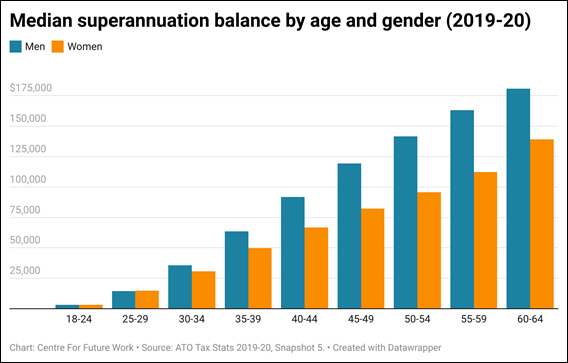
Women earn $136,000 less in superannuation over their working lives than men, based on median income data. Women earning the median wage will accumulate approximately $393,676 in super, $151,000 below what is considered a ‘comfortable retirement’. The average super balance in Australia in 2023 is $150k.
Experts say if the gender pay gap was eliminated women would be $3 billion per week better off.
Despite the gender pay gap narrowing slowly, based on data from the past decade it will only be eradicated by the year 2053 when more than 60% of the current workforce will be retired.
Key Points:
- Australian women on a median income will earn $1.01m less over their working lives on average than their male counterparts.
- Australian women on a median income will earn $136,000 less in superannuation over their working lives than their male counterparts.
- Women earning the median wage will accumulate approximately $393,676 in super, $151,000 below what is considered a ‘comfortable retirement.
- The average super balance in Australia in 2023 is $150k.
- Experts say if the gender pay gap was eliminated women would be $3 billion per week better off.
- The gender pay gap is narrowing so slowly that it will not fully close for another 30 years until 2053. At that stage 60% of people currently working will have retired.
- The Gender wage gap in Australia (15.3%) is more than double what it is in New Zealand (6.7%)
- The gender gap occurs across all occupations and industries:
- Men have higher average salaries than women in 95% of all occupations, including those where women dominate the workforce. For example, women account for 99% of all midwives, and yet are paid on average 19% less.
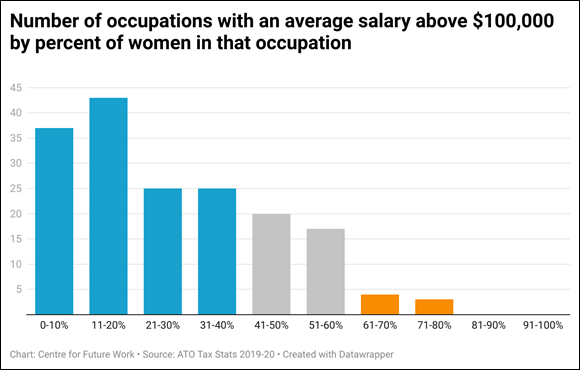
- 80 occupations in which men make up 80% or more of the workforce have an average salary above $100,000.
- By contrast zero occupations in which women make up 80% or more of the workforce have an average salary above $100,000.
- Men have higher average salaries than women in 95% of all occupations, including those where women dominate the workforce. For example, women account for 99% of all midwives, and yet are paid on average 19% less.
“For the average woman in Australia, the gender pay gap will be more than $1.01m over her working life, based on conservative estimates,” said Senior Economist Eliza Littleton from the Australia Institute’s Centre for Future Work.
“There’s been a noisy political debate about super in Australia for the past week, but this data shows that based on median income data Australian women will earn $136,000 less than their male counter parts over their working life. When you consider that the average super balance in Australia right now is approximately $150,000, that’s a huge disparity.
“Australian women continue to be paid less than men on average across all industries and occupations, costing us more than $3b across the economy each week.
“We know that older women are one of the most vulnerable groups when it comes to poverty and homelessness in Australia.
“Australian women shouldn’t have to wait until the year 2053 for substantive equality. We deserve equity today and our research makes several sensible policy recommendations for the Labor Government to action.”
Policy recommendations:
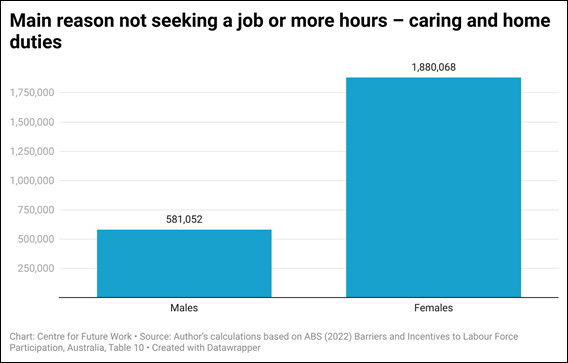
- Greater access to free or more affordable earlier childhood education & care: Australia Institute research shows if Australia had the same labour force participation rates as Nordic countries do, then the economy would be $60 billion, or 3.2% of GDP, larger (Grudnoff and Denniss, 2020).
- More paid parental leave for both parents: Australia’s PPL scheme is well behind international standards. The OECD average PPL scheme is 60 weeks in total, with 24.6 weeks reserved for mothers, 10.4 weeks for fathers and 25.4 weeks that can be flexibly distributed (OECD, 2022). With a 20-week scheme, Australia unsurprisingly ranks low – 30th out of 38 countries for the duration of paid leave entitlements. Extending leave entitlements and encouraging a more even distribution of childcare would help reduce the career and financial penalty of having children both for all parents, but especially women. Additionally, making it mandatory for superannuation to be paid while a person is taking paid parental leave would help to reduce the gendered super gap.
- Greater family-friendly work practices: Some workplaces and workers have managed to maintain flexible working arrangements, but this should be standardised, expanded and embedded in employment relations frameworks to make balancing work and care more achievable across the workforce. Breaking down rigid job design in male-dominated jobs could also help with reducing entrenched gendered segregation by industry and occupation.
- Deliberate policy to lift the wages for industries dominated by women — most urgently in the care sector: Women dominated sectors, especially in the care industry are among the lowest paid work. The 2021 Royal Commission into Aged Care Quality and Safety recommended that gig work, independent contracting and other ‘indirect’ employment arrangements be restricted in the publicly-funded aged care sector. This needs to be agreed to.
- Address insecure work: Further reforms should include rights to family-friendly working time arrangements and stable work as minimum standards for all employees in the National Employment Standards.
- Full recommendations in attached report
The post Women Earn $1m less than men & $136,000 Less in Super over Working Life appeared first on The Australia Institute's Centre for Future Work.
-
Profit-Price Spiral: Excess Profits Fuelling Inflation & Interest Rates, not Wages
The dramatic expansion of business profits has gone mostly ignored by the RBA and other macroeconomic policy-makers, who have focused instead on a supposed ‘wage-price’ spiral which does not exist. This suggests the focus of the RBA on wage restraint is misplaced and unfair, and that interest rates would be far lower today if companies had not gouged customers at the checkout.
The report Profit-Price Spiral: The Truth Behind Australia’s Inflation (attached) comes in the same week supermarket giants Woolworths and Coles posted soaring profits, with banks, gas and petrol companies posting similarly soaring returns.
Key Findings:
- A Profit-Price spiral is the main driver of inflation in Australia, rather than a supposed “Wage-Price” spiral, which does not exist
- As of the September quarter of 2022 (most recent data available), Australian businesses increased prices by a total of $160 billion per year over and above their higher expenses for labour, taxes, and other inputs, and over and above profits generated by growth in real economic output
- Without the inclusion of those excess profits in final prices for Australian-made goods and services, inflation since the pandemic would have been much slower: an annual average of 2.7% per year, barely half of the 5.2% annual average actually recorded since end-2019.
- That pace of inflation would have fallen within the RBA’s target inflation band (equal to its 2.5% target, plus-or-minus 0.5%)
- Excess corporate profits account for 69% of additional inflation beyond the RBA’s target. Rising unit labour costs account for just 18% of that inflation
- The RBAs 9 back-to-back interest rate rises would have been unlikely without excess profits and prices based on the RBA’s own policy framework
- Real wages in Australia fell 4.5% in 2022, the largest fall on record
“This empirical evidence shows excess corporate profits are the main culprit driving inflation, not workers’ wages,” said Dr. Jim Stanford from the Australia Institute’s Centre for Future Work.
“For Australians doing it tough this data would be aggravating.
“We’ve been told a story that workers need to restrict wage growth and accept a permanent reduction in living standards in order to fix inflation. This evidence shows that’s an economic fairytale.
“ABS data shows that without excess price hikes through the pandemic, inflation would likely be within the RBA target band, and hence there would be no need for the nine extreme, back-to-back interest rate rises that are crushing households and mortgage holders, fuelling the cost-of-living crisis.
“The pain experienced by workers through current inflation contrasts sharply with unprecedented increases in business profitability at the same time.
“Through this episode of post-COVID inflation, real wages have declined rapidly, labour’s share of GDP has declined, and corporate profits have set records. That is completely opposite from the experience of the 1970s, when real wages rose, labour’s share of GDP increased, and corporate profit margins fell.
“History confirms that fears of a 1970s-style ‘wage price spiral’ are simply not justified or grounded in reality. Instead, inflation in Australia since the pandemic clearly reflects a profit-price dynamic.”
The new report ‘Profit-Price Spiral: The Truth Behind Australia’s Inflation’ is attached and comes from the Australia Institute’s Centre for Future Work, by Dr. Jim Stanford.
Supermarkets, banks and petrol companies have recently posted huge profits:
- On Thursday Qantas posted $1.4b half-year profits, tripling revenues
- On Wednesday Woolworths posted a 25% rise in profits. Supermarket profits have soared on the strength of rapid food price inflation.
- On Tuesday Coles net profit grew 11% in the latest half-year result announced Monday, beating forecasts.
- On Wednesday Santos posted a 221% annual profit
- Ampol, Australia’s largest oil refiner, reported a 30% increase in first-half net profit, buoyed by soaring petrol prices.
- Commonwealth Bank posted a record $5.1b billion profit, up 9%, buoyed by extra interest income from rising interest rates.
The post Profit-Price Spiral: Excess Profits Fuelling Inflation & Interest Rates, not Wages appeared first on The Australia Institute's Centre for Future Work.
-
Carmichael Centre Announces Appointment of Prof. David Peetz as Laurie Carmichael Distinguished Research Fellow
The Carmichael Centre at the Australia Institute’s Centre for Future Work is proud to announce the appointment of Prof. David Peetz, one of Australia’s most outstanding labour policy experts, as the new Laurie Carmichael Distinguished Research Fellow.
Prof. Emeritus Peetz has recently retired from a long career at Griffith University, where he served as Professor of Employment Relations at the Centre for Work, Organisation and Wellbeing.
He is also a Fellow of the Academy of Social Sciences in Australia, and author of several important books on labour policy, including: Unions in a Contrary World (1998), Brave New Workplace (2006), and The Realities and Futures of Work (2019).
Prof. Peetz has provided expert opinion in numerous labour policy forums at the state and Commonwealth level, including providing research and expert input to the Fair Work Commission, and heading an independent review of the Queensland workers compensation system.
“David Peetz has been a powerful and influential voice for a more balanced and fair approach to labour policy and employment relations for many years,” said Jim Stanford, Director of the Centre for Future Work, host of the Carmichael Centre.
“His appointment as Distinguished Research Fellow will greatly enhance the capacity and influence of the Carmichael Centre, at a pivotal moment in Australia’s economic and political history,” concluded Dr. Jim Stanford.
Remarks from Professor David Peetz:
“The choices we make about labour policy now will shape society for decades, maybe permanently. So it’s an outstanding opportunity to be able to contribute to the formation of those choices through the work of the Carmichael Centre,” Professor Peetz concluded.
Prof. Peetz will serve a three-year term as Distinguished Research Fellow. The Carmichael Centre was established in 2021 to undertake research and education activities related to the legacy of Laurie Carmichael, the long-time Australian union leader who passed away in 2018.
The post Carmichael Centre Announces Appointment of Prof. David Peetz as Laurie Carmichael Distinguished Research Fellow appeared first on The Australia Institute's Centre for Future Work.
-
Australians Working 6 Weeks Unpaid Overtime, Costing Economy Over $92 Billion: GHOTD Report
New research shows Australian workers are on average working 6 weeks unpaid overtime per year, costing over $92 billion dollars in unpaid wages across the economy. The average worker is losing over $8,000 per year or $315 per fortnight due to what researchers have branded “time theft”.
23 November 2022 marks Go Home on Time Day, an initiative run by the Australia Institute’s Centre for Future Work, and now in its fourteenth year.
Economists have recommended a ‘Right to Disconnect’ to tackle what they say is the systemic problem of unpaid overtime. The research reveals that employers are profiting from 2.5 billion hours of time theft worth over $92 billion in unpaid wages amid a cost-of-living crisis and declining real wages.
Key Findings:
- The average Australian worker performs 6 weeks unpaid overtime per year, worth over $8,000 per worker per year
- The ‘Right to Disconnect’ is supported by six in seven (84%) workers, and has recently been recommended by the Senate Select Committee on Work & Care
- Across the workforce, this equates to $92 billion in lost income per year, roughly the same as the Commonwealth’s annual expenditure on healthcare
- Workers share of national income is at an all-time low of 44% in 2022, while the profit share of income is at an almost record high of 30%
- Respondents reported 4.3 hours of unpaid work per week, equivalent to 15% of total working hours. This equates to 224.3 hours per year per worker, or six standard 38- hour work weeks.
- Across the whole labour market, over half of all workers (56%) are unsatisfied with their working hours
- Almost one in two (46%) workers in Australia reported that they wanted more paid hours
- 84% workers support the Federal Government legislating a ‘Right to Disconnect’ that directs employers to avoid contacting workers outside of work hours, unless in an emergency, with only 8% who oppose
Negative impacts from unpaid overtime:
- The most commonly experienced negative consequences were physical tiredness (35%), followed by stress and anxiety (32%), and being mentally drained (31%), each affecting around a third of workers.
- Over a quarter of workers reported that overtime interfered with their personal life and relationships (27%), and 17% responded that it led to disrupted or unfulfilling non-work time.
- One in five workers identified that working outside scheduled hours negatively affected their relationship with work, with 22% who reported reduced motivation to work and 19% experienced poor job satisfaction.
“Our research shows unpaid overtime is a systemic, multibillion-dollar problem which robs Australian workers of time and money,” said Eliza Littleton, research economist at the Australia Institute and report author.
“This is time theft. Unpaid overtime harms our quality of life and reduces our time with family, friends, and those we care for.
“This Go Home on Time Day, our research reveals that unpaid overtime is robbing Australian workers and the economy of over $92 billion per year. This time theft only further exacerbates our current cost of living crisis.
“With workers share of national income at the lowest point ever, a focus on reducing unpaid overtime would improve quality of life and ease the cost of living pressure for millions.
“The prevalence of overtime suggests that ‘availability creep’ has eroded the boundaries between work and life.
“Workplace laws could be updated, including creating a ‘Right to Disconnect’ as recommended by the Senate Select Committee into Work & Care, and as exists for employees of Victoria Police, and Queensland Teachers”
The post Australians Working 6 Weeks Unpaid Overtime, Costing Economy Over $92 Billion: Go Home on Time Day Report appeared first on The Australia Institute's Centre for Future Work.
-
The Reserve Bank needs to acknowledge the failures of the inflation target
One clear example of the bias of a low-inflation target is the stagnant growth of real household income per capita during the years prior to the pandemic when inflation growth was below the Reserve Bank’s target rate of 2%.
For a record 33 straight months from September 2016 through May 2019 while real household incomes flatlined, the Reserve Bank kept the cash rate stable at 1.5% despite throughout all this period inflation was below 2%.
And yet as soon as inflation goes above the target ceiling of 3% the Reserve Bank seeks to increase interest rates quickly to reduce economic activity and also wages growth, even though wages lag well behind inflation.
“As the Federal Government undertakes its review of the RBA’s mandate and operations, these broad political-economic dimensions of monetary policy must be considered carefully,” said Dr Greg Jericho, Labour Market and Fiscal Policy Director at the Centre for Future Work.
“There is no evidence at all that a tight labour market, rising wages, or labour costs more generally have anything to do with the surge in inflation since the COVID pandemic. To the contrary, the evidence is clear that wages have had a dampening impact on inflation in this period.
“The Reserve Bank and the Federal Government need to take a more careful, balanced look at the nature, causes, and consequences of the upsurge in inflation since the pandemic, before leaping to conclusions that are unjustified – and imposing policy responses that do more harm than good.
“Since the end of 2019 real wages have fallen 3.1% and are expected to fall even further. The inability of wages to keep up with inflation has seen real wages fall back to 2012 levels. This highlights how the real victims of rising inflation have been workers, and the last thing they should be asked to do is suffer even more in the interests of pursuing an arbitrary inflation target.”
The post The Reserve Bank needs to acknowledge the failures of the inflation target appeared first on The Australia Institute's Centre for Future Work.
-
International Seafarers Suffer $65 Million in Wage Theft Annually in Australian Waters
Seafarers working on foreign-registered freight ships in Australian waters face regular theft of wages and other entitlements due to legal loopholes and lax enforcement of labour standards, according to a new research report published today by the Australia Institute’s Centre for Future Work.
The report, titled Robbed At Sea, examines records of wage inspections conducted over the last decade by the International Transport Federation (ITF), a global federation of maritime and other transportation unions. The ITF sponsors a small team of 4 inspectors in Australia, to conduct spot checks of international vessels visiting our ports.
Key points:
- Over the last decade, in close to 5000 inspections in Australian ports the ITF found 70% of ships failing to meet minimum international standards for wage payment and other core labour standards – with resulting recovery orders totaling $38 million over that time.
- But the ITF team can only inspect a tiny fraction of all foreign vessels visiting Australian ports: about 450 per year, or just 2.5% of visits by foreign-registered ships in that time. On the basis of reasonable assumptions regarding the prevalence of wage theft in the other, uninspected ships, the report estimates total wage theft from international seafarers across the Australian shipping industry of some $65 million per year.
- Seafarers on foreign-registered vessels (often flying ‘flags of convenience’ to evade labour and tax rules) usually come from low-wage developing countries, and have little power to resist exploitation by unethical ship owners, contractors, and sub-contractors.
- Stronger rules in port countries (like Australia) are necessary to offer greater protection while they are in Australian waters. But the report identified several loopholes and enforcement failures that explain why these seafarers are routinely exploited, even when delivering cargo from one Australian port to another.
“Australia prides itself on being a country that respects the rule of law, and a fair go for workers. Yet we are allowing some of the most vulnerable workers in the entire global economy to be ruthlessly and knowingly exploited, right here in our own waters,” said Rod Pickette, co-author of the report.
“Repeated inspections have confirmed routine wage theft and other exploitation in our ports,” said Lily Raynes, co-author of the report.
“But those inspections are just the tip of the iceberg. Clearly this exploitation is a normal feature of international shipping, and Australia has both a moral and an economic responsibility to stop it within our jurisdiction,” Ms Raynes said.
The report makes ten specific recommendations for reducing the incidence of wage theft from international seafarers in Australian waters.
Report Recommendations Include:
- Closing a current legal loophole which allows foreign-registered ships to conduct two trips between Australian ports without needing to respect the Fair Work Act or the Seagoing Industry Award
- Strengthening inspection resources for the Australian Maritime Safety Authority and the Fair Work Ombudsman to ensure that existing rules are better respected
The report was prepared in cooperation with the International Transport Federation’s Australian Shipping Inspectorate.
It is being released to commemorate World Maritime Day (Thursday, 29 September) – an annual opportunity to raise awareness about the risks and exploitation faced in international seafarers.
The post International Seafarers Suffer $65 Million in Wage Theft Annually in Australian Waters appeared first on The Australia Institute's Centre for Future Work.