The video highlights the problems of wage stagnation in Australia’s economy, and the need to “Change the Rules” – including proposals for sector-wide collective bargaining practices, especially important in low-wage sectors such as early child education. The video has great graphics and production values, and is accompanied by a useful infographic. Download short and long versions of the film, and the infographic, through the links below:
Shorter version (2:45)
Longer version (4:03)
Infographic
Many thanks to the team at United Voice and Flip for their talented work on this project!
The wage slowdown has elicited concern from economists and political leaders across the spectrum. Even Dr. Philip Lowe, Governor of the Reserve Bank of Australia, has called it a “crisis,” and suggested that faster wage growth would be beneficial for the economy.
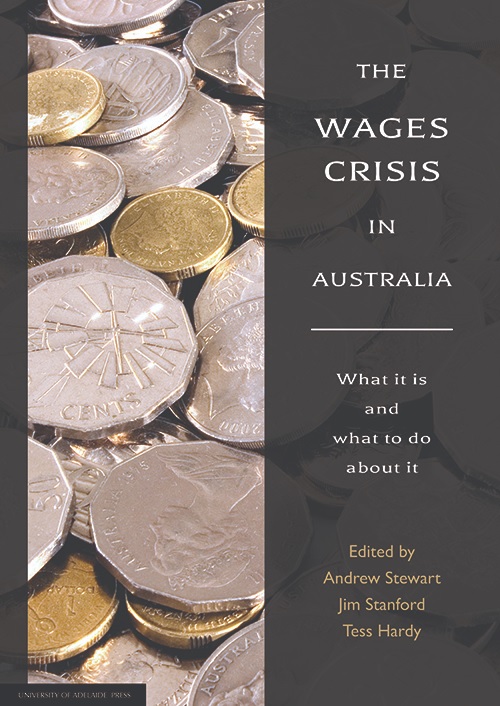
This new collection of 20 essays by leading labour market experts and commentators in Australia explores the causes, consequences, and potential solutions to this problem. The book is published by University of Adelaide Press. The book was launched in Melbourne on 29 November, with remarks from Natalie James, former Commonwealth Fair Work Ombudsman and Chair of the Victorian Inquiry Into the On-Demand Workforce.
Through the links below you may access excerpts from the book, links to participating authors, and supplementary material (including commentary, other readings, and videos). Our hope is that this collection will spark a needed debate in Australia about how to get wages back on track.
About the Editors:
Andrew Stewart is the John Bray Professor of Law at the University of Adelaide and a Legal Consultant to the law firm Piper Alderman.
Tess Hardy is a Senior Lecturer at Melbourne Law School, and Co-Director of the Centre for Employment and Labour Relations Law.
Jim Stanford is Economist and Director of the Centre for Future Work at the Australia Institute.
Please visit our special Go Home On Time Day website for more information, tips on how to get away from work on time, and free posters and shareables. There’s also an online calculator where you can estimate the value of the time theft you experience, through unpaid overtime in all its forms.
In conjunction with Go Home On Time Day, The Centre for Future Work is releasing two new research reports on the time pressures facing Australian workers:
Our annual update on attitudes toward working hours, the incidence of unpaid overtime and its aggregate value: Excessive Hours and Unpaid Overtime: 2018 Update, by Troy Henderson and Tom Swann. On the basis of a survey of 880 employed Australians, we estimate that the typical worker puts in 6.0 hours of unpaid overtime per week – ranging from going in early, staying late, working through lunch and tea breaks, taking work home in the evenings and weekends, responding to calls or emails out of hours, and more. That amounts to 3.25 billion hours of unpaid overtime across the whole labour market this year, worth a total of $106 billion.
This year, our Go Home On Time Day survey also included a special section focusing on the forms, prevalence, impacts and implications of electronic and digital monitoring and surveillance in Australian workplaces. Our goal was to investigate a secondary dimension of the time pressure facing Australian workers. It is not just that work is being extended into greater portions of our days (through unpaid overtime, the use of mobile phones and computers to reach workers at any time, pressure to not fully utilise annual leave, and similar trends). In addition, even within the work day, time pressure is intensified with the expectation that every moment of work time must be used for productive purposes – an expectation that is increasingly reinforced through omnipresent systems of monitoring, performance measurement, and surveillance. The result of these twin forces is an overall inability for people to escape from the demands of work: neither at the workplace (even for short periods), nor away from it.
Please see our companion report, Under the Employer’s Eye: Electronic Monitoring & Surveillance in Australian Workplaces, by Troy Henderson, Tom Swann and Jim Stanford.
This infographic summarises the bottom-line impact on average wage incomes for Australian workers.
In the March quarter of 2018, labour income (in wages, salaries, and superannuation contributions) accounted for 47.1% of total GDP. That is down over 11 percentage points from the peak labour share (over 58%) recorded in the same quarter of 1975. The loss of that share of GDP, given total output today, is equivalent to a redirection of some $210 billion in annual income – and the research symposium showed that almost all of that income was captured in the form of higher company profits (especially in the financial sector). If it were divided equally amongst all employed Australians, that lost income share translates into foregone income of close to $17,000 per worker.
Many thanks to Anna Chang for her creative work on the infographic!
The research symposium highlighted several factors that have caused the long-run shift in income distribution from workers to the business sector, and resulting growth in personal income inequality in Australia. Key factors included the erosion of union representation and collective bargaining, inadequate minimum wages, and the growing power of the financial sector. For more details, see the articles by Jim Stanford, David Peetz, Margaret Mackenzie, Shaun Wilson, and Frances Flanagan.
Come and check out our information booth in the exhibitors’ area: meet our staff, learn more about our work, and sign up for updates.
Our Director Jim Stanford will be presenting as part of a session on The Future of Work (good title!), Tuesday July 17 at 2:15 pm in conference room P1.
And we will be distributing copies of a brochure with links to some of our most recent research (attached below).
We are glad that our research can support the campaign to #ChangeTheRules!
Share of Workers in Full-Time Paid Employment with Leave Entitlements. Source: Centre for Future Work calculations from ABS Catalogues 6291.0.55.003, EQ04 (2017), and 6333.0 Tables 2.3 and 9.1 (2012).
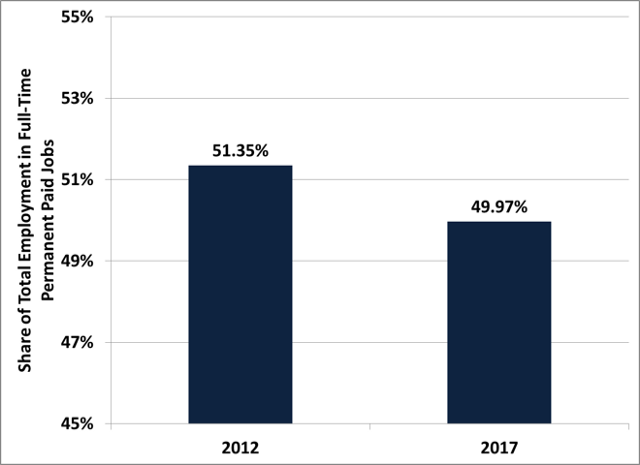
The report, The Dimensions of Insecure Work: A Factbook, reviews eleven statistical indicators of the growth in employment insecurity over the last five years: including part-time work, short hours, underemployment, casual jobs, marginal self-employment, and jobs paid minimum wages under modern awards.
All these indicators of job stability have declined since 2012, thanks to a combination of weak labour market conditions, aggressive profit strategies by employers, and passivity by labour regulators. Together, these trends have produced a situation where over 50 per cent of Australian workers now experience one or more of these dimensions of insecurity in their jobs - and less than half have access to “standard,” more secure employment.
“Australians are rightly worried about the growing insecurity of work, especially for young people,” said Dr. Jim Stanford, one of the co-authors of the report. “Many young people are giving up hope of finding a permanent full-time job, and if these trends continue, many of them never will.”
The report also documents the low and falling earnings received by workers in insecure jobs. While real wages for those in permanent full-time positions (the best-paid category) have grown, wages for casual workers have declined. And part-time workers in marginal self-employed positions (including so-called “gig” workers) have fared the worst: with real wages falling 26 percent in the last five years.
“Given current labour market conditions and lax labour standards, employers are able to hire workers on a ‘just-in-time’ basis,” Dr. Stanford said. “They employ workers only when and where they are most needed, and then toss them aside. This precariousness imposes enormous risks and costs on workers, their families, and the whole economy.”
Dr. Stanford called on policy-makers to address growing precarity with stronger rules to protect workers in insecure jobs (such as provisions for more stable schedules, and options to transition to permanent from casual work). He also stressed the need for economic policies that target the creation of permanent full-time jobs.
Dr. Jim Stanford, Director of the Centre for Future Work, reviewed the ACTU’s paper in detail, and prepared an evaluation of its proposals and likely effects. Stanford endorsed the policy’s complementary set of expansionary macroeconomic measures, which would strengthen every major component of aggregate demand in the national economy: including government programs, capital investment, net exports, and consumer spending. He also emphasised the importance of the paper’s vision for a stronger labour market information and planning system, which will be essential to effectively match workers with jobs as the labour market tightens.
Stanford estimated that the ACTU’s plan, if implemented consistently over a five-year period, would be capable of achieving the following outcomes:
Unemployment rate falling to 4 percent or lower.
Share of full-time work rebounding toward 75 percent of employment (since employers will be pressured by falling unemployment to create full-time jobs).
Underemployment rate falling to fall to 5 percent or lower.
Incidence of casual work declining below 20 percent.
Labour force participation rising by at least 2 percentage points, especially among young workers.
Nominal wage growth accelerating to traditional rates of 4 percent per year.
“Trump tax cuts: Scott Morrison warns business will abandon Australia while we are at the beach” was the Sydney Morning Herald headline, reporting on the Coalition Government’s scare tactics to press through its tax cuts gift for business. The Treasurer used the opportunity of the Trump tax cuts to issue this “dire” warning. However, his claim does not withstand some basic empirical scrutiny.
Fact 1: Australia is not a high tax country
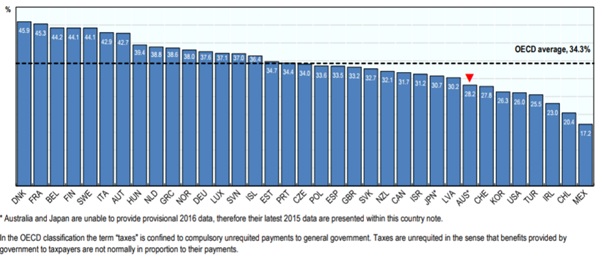
Our overall tax take is one of the lowest among the 35 OECD countries. If Mr. Morrison was correct, then by now there should have been a tsunami of investment flowing here from 27 OECD countries with higher tax-GDP ratios than that of Australia’s 28.2% in 2016. Australia’s overall tax ratio is well below the OECD average of 34%, and also below neighbouring New Zealand’s tax take of 32.1% of GDP.
Here are reported tax ratios for 27 OECD countries, 2016.
Fact 2: Australia’s effective corporate tax is far below its statutory 30% rate
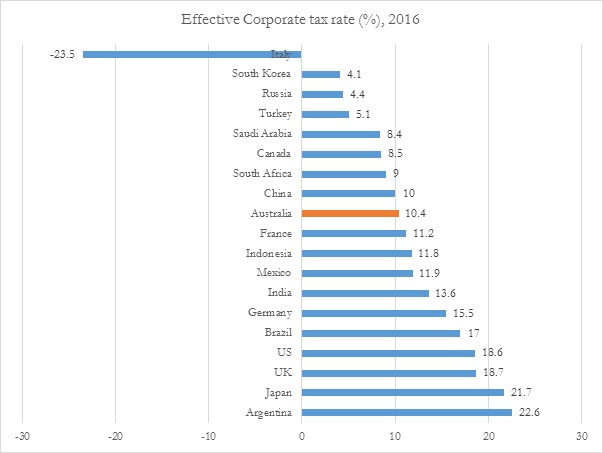
Australian companies may seem to face a higher statutory corporate tax rate, but once they go through all their deductions and credits they don’t end up paying an unusually high amount compared to companies in other nations. The average effective rate (10.4%) is barely one-third the statutory rate. In fact, more than a third of large companies did not pay any corporate taxes in 2016 according to the recently released ATO data.
Fact 3: Tax is low on companies’ lists of factors influencing investment location decision
For example, the OECD noted, “it is not always clear that a tax reduction is required (or is able) to attract FDI. Where a higher corporate tax burden is matched by well-developed infrastructure, public services and other host country attributes attractive to business… tax competition from relatively low-tax countries not offering similar advantages may not seriously affect location choice. Indeed, a number of large OECD countries with relatively high effective tax rates are very successful in attracting FDI.”
This is corroborated by the most recent World Bank survey of enterprises, which found that tax incentives are not high on the list of critical factors affecting inflows of foreign direct investment. The IMF’s recent research also reports that the net impact of corporate tax cuts to incentivise private investment is quite often negative on government revenues. The pre-tax profitability of Australian businesses has also tended to exceed that in other countries, and this is surely more important in motivating investment flows.
Fact 4: Rigorous studies of past US tax cuts did not find a positive link between tax cuts and economic or employment growth
For example, the oft-cited examples of the Reagan or Bush tax cuts do not in fact demonstrate that tax cuts cause growth. Admitted by President Reagan’s former chief economist, Martin Feldstein, the vast majority of growth during the Reagan era was due to expansionary monetary policy that slashed interest rates massively to help the economy bounce back from a severe recession in 1982. Increased defence spending and an expanded labour force due to an influx of baby boomers also boosted the economy. In another study with Doug Elmendorf, the former Congressional Budget Office Director, Martin Feldstein found no evidence that the 1981 tax cuts increased employment.
The 2001 and 2003 Bush tax cuts also failed to spur growth. Between 2001 and 2007 the economy grew at a lacklustre pace—real per-capita income rose by 1.5% annually, compared to 2.3% over the 1950-2001 period. Interestingly, the two sectors that grew most rapidly in this period were housing and finance, which were not affected by the 2001 and 2003 tax cuts. Moreover, by 2006, prime-age males were working the same hours as in 2000 (before the tax cuts), and women were working less – both facts inconsistent with the view that lower tax rates raise labour supply.
Fact 5: The most infamous case of tax cuts in the US State of Kansas was a colossal failure
Governor Sam Brownback promised that a moderate tax cut for individuals and a big tax cut for businesses would be “like a shot of adrenaline into the heart of the Kansas economy.” Unfortunately, however, despite his 2012 tax cuts, the Kansas economy remained moribund, while neighbouring states surged ahead. In the process, the Kansas state budget was left in tatters. No wonder that the Republican-led state legislature reversed most of Brownback’s tax cuts in the face of poor growth and pressing public spending needs.
Therefore, if Mr. Morrison is serious about repairing the budget, or stimulating growth and employment, then he should be concentrating on raising more revenues (not less) and investing in the nation – instead of cutting basic services to fund his tax cuts for the rich. He should be looking at the facts, instead of resorting to scare tactics.
A graduate degree in economics or a closely related discipline.
Knowledge of and experience with a wide range of labour issues, preferably including: labour market statistics and trends; characteristics and determinants of employment; industrial relations and collective bargaining; wage determination and inequality; gender, racial, and demographic aspects of labour markets; the impact of technology on employment; macroeconomic policy and labour markets; and others.
Demonstrated ability to write to deadline for professional and popular audiences in a credible, succinct, and accessible manner.
Strong quantitative skills, including ability to access statistical data, analyse it (including familiarity with statistical tools), and report it in a variety of textual, tabular and graphical formats.
Confident communication skills, including ability to speak to public audiences, classrooms, and the media.
Ability to work collegially with other members of a research team.
Commitment to a progressive vision of work and fairness, including the goals of equality, participation, collective representation and trade unionism.
Responsibilities of the position will include:
Research and completion of several project-length research papers, briefing notes, and shorter commentary articles per year on a range of topics related to labour markets and labour market policy.
Ongoing monitoring and analysis of labour market data and information.
Helping to maintain relevant websites and databases.
Public speaking, presentations, lectures and courses, media interviews, and related communication and educational activities.
Minimal office and administrative functions.
Ability to undertake occasional out-of-town travel (including overnight travel) is essential, as is ability to successfully work in a self-managed and autonomous manner.
The position will be offered on a one-year term-limited basis, with possibility for renewal. Salary will be commensurate with qualifications and experience.
Applications are especially invited from women, indigenous persons, other racial and linguistic communities, people with disabilities, and other marginalised communities.
Please forward applications (including contact information, qualifications, experience, two samples of written work, and names and contact details for two references) in confidence to cfwjob@tai.org.au. Please cite “Economist Job Application” in the subject field of your message; supporting documents should be attached in pdf format. Receipt of applications will be acknowledged by e-mail. Only candidates selected for an interview will then be contacted; no phone calls please.
Applications must be received by 5:00 pm AEDT on Wednesday 9 October, and interviews will be conducted in Sydney on Wednesday 23 October 2019.
The Centre for Future Work is an initiative of the Australia Institute, Australia’s leading progressive research institution. Thank you for your interest in the Centre for Future Work.