Category: Articles

  • Young Workers are Shock Troops of Precarious Labour Market

    The National Youth Commission into Youth Employment and Transitions has been holding an inquiry in communities across Australia to document the situation of young workers, who are experiencing much lower rates of employment and income than other workers.

    Stanford’s submission argued that young workers are like the “shock troops” of the precarious labour market: the ones sent in first to confront an especially dangerous situation. The rise of precarious work in all its forms – part-time work, casual jobs, labour hire, temporary positions, marginal self-employment, and digitally mediated ‘gigs’ – now dominates youth employment patterns. And that situation will not automatically disappear as young workers get older and gain experience. Rather, evidence suggests that without policy measures to stabilise and improve jobs, this will be a permanent shift that gradually affects most workers. Already, less than half of employed Australians are working in a ‘traditional’ full-time permanent wages jobs with normal entitlements (like paid holidays, sick leave, and superannuation). For young workers, that ratio is less than one in five.

    Stanford argued for targeted measures to stimulate more youth hiring into stable positions, an ambitious effort to rebuild vocational education in Australia and strengthen pipelines to post-education jobs, and a broader commitment to full-employment macroeconomic policy.

    The post Young Workers are “Shock Troops” of Precarious Labour Market appeared first on The Australia Institute's Centre for Future Work.

  • Five Contrarian Insights on the Future of Work

    1. Work is not disappearing; it can’t.
    2. Technology is not accelerating.
    3. “Gigs” aren’t even new.
    4. Technology is often more about relationships than productivity.
    5. Skills are not a magic bullet.

    The commentary was prepared for the My Labour, Our Future conference held last month in Montreal, Canada to mark the 100th Anniversary of the founding of the International Labour Organization. We thank the organizers and the Atkinson Foundation for permission to repost the paper.

    The post Five Contrarian Insights on the Future of Work appeared first on The Australia Institute's Centre for Future Work.

  • Job Opportunity: Research Economist

    The successful candidate will offer:

    • A graduate degree in economics or a closely related discipline.
    • Knowledge of and experience with a wide range of labour issues, preferably including: labour market statistics and trends; characteristics and determinants of employment; industrial relations and collective bargaining; wage determination and inequality; gender, racial, and demographic aspects of labour markets; the impact of technology on employment; macroeconomic policy and labour markets; and others.
    • Demonstrated ability to write to deadline for professional and popular audiences in a credible, succinct, and accessible manner.
    • Strong quantitative skills, including ability to access statistical data, analyse it (including familiarity with statistical tools), and report it in a variety of textual, tabular and graphical formats.
    • Confident communication skills, including ability to speak to public audiences, classrooms, and the media.
    • Ability to work collegially with other members of a research team.
    • Commitment to a progressive vision of work and fairness, including the goals of equality, participation, collective representation and trade unionism.

    Responsibilities of the position will include:

    • Research and completion of several project-length research papers, briefing notes, and shorter commentary articles per year on a range of topics related to labour markets and labour market policy.
    • Ongoing monitoring and analysis of labour market data and information.
    • Helping to maintain relevant websites and databases.
    • Public speaking, presentations, lectures and courses, media interviews, and related communication and educational activities.
    • Minimal office and administrative functions.

    Ability to undertake occasional out-of-town travel (including overnight travel) is essential, as is ability to successfully work in a self-managed and autonomous manner.

    The position will be offered on a one-year term-limited basis, with possibility for renewal. Salary will be commensurate with qualifications and experience.

    Applications are especially invited from women, indigenous persons, other racial and linguistic communities, people with disabilities, and other marginalised communities.

    Please forward applications (including contact information, qualifications, experience, two samples of written work, and names and contact details for two references) in confidence to cfwjob@tai.org.au. Please cite “Economist Job Application” in the subject field of your message; supporting documents should be attached in pdf format. Receipt of applications will be acknowledged by e-mail. Only candidates selected for an interview will then be contacted; no phone calls please.

    Applications must be received by 5:00 pm AEDT on Wednesday 9 October, and interviews will be conducted in Sydney on Wednesday 23 October 2019.

    The Centre for Future Work is an initiative of the Australia Institute, Australia’s leading progressive research institution. Thank you for your interest in the Centre for Future Work.

    The post Job Opportunity: Research Economist appeared first on The Australia Institute's Centre for Future Work.

  • Scourge Pricing: Understanding and Challenging Uber’s Business Model

    Her presentation discussed the historical, economic, and moral context for the rise of “gig-economy” businesses, such as Uber. She reviewed Uber’s business model, and the company’s recent IPO, in detail, arguing that it depends on underpayment of its drivers – who for all practical purposes are “employees,” even if current labour laws do not always explicitly recognise them as such.

    Growing competition, regulatory and legal problems, and growing resistance to the ultra-precarious and low-wage incomes offered in this type of work suggest that the future success of digital platform businesses like Uber is very much in doubt.

    Pennington also referenced findings of our previous paper estimating the net incomes of Uber-X drivers in 6 Australian cities.

    Please view Alison Pennington’s full presentation below.

    The post Scourge Pricing’: Understanding and Challenging Uber’s Business Model appeared first on The Australia Institute's Centre for Future Work.

  • Economics 101 for the ABCC

    But why is the ABCC, established to police construction workers and their unions, now going after steelworkers? It claims that since the factory they work at sells steel to construction sites, it is in effect part of the construction industry. But that claim, if taken seriously, means that the whole economy – and all workers – are subject to the ABCC’s crusade.

    In this commentary, Jim Stanford explains the basic economics of supply chains to the autocrats at the ABCC.

    Economics 101 for the ABCC

    by Jim Stanford

    Democratic-minded people of any political stripe were shocked by the announcement last week that the Australian Building and Construction Commission (ABCC) will take legal action against individual steelworkers who participated in a union protest march last October.  The ABCC was reestablished by the Coalition government in 2016 to supposedly uphold the rule of law in construction. But almost all of its actions are taken against unions, it mostly ignores employers. It was obviously created as part of a broader government effort to vilify, harass, and hamstring trade unions.

    Now the ABCC is pressing charges against 53 workers at Liberty OneSteel (and 1 union organiser) who missed work to attend a union-organised protest march in Melbourne – where they joined 150,000 other demonstrators. The Commission argues the workers’ participation constituted an unauthorised “strike,” and hence they should be punished far more severely than if they had simply missed a day’s work (say, to go fishing). They now face personal fines of up to $42,000 each: if all 54 are convicted and receive the maximum penalty, the fines would total over $2.25 million.

    This intimidation and repression against peaceful political protest is both abhorrent and frightening. In a normal democratic country, this sort of repression would be dismissed in the courts as a blatant violation of democratic rights – and morally rejected by civil society as a step toward totalitarianism. It is only because of Australia’s unusual, even bizarre history of top-down state policing of industrial relations that this police-state activity is somehow “normalised.”

    One of the most shocking aspects of the ABCC’s crusade, however, is that it isn’t even directed at the construction industry: the targeted individuals all work at a steel factory. The Commission argues that since some of the steel produced by OneSteel is used in building construction, the factory is considered part of the construction sector (as per the terms of the Building and Construction Industry Improvement (BCII) Act).

    That argument, if taken seriously, would grant the ABCC power to police workers and their political activity throughout the entire Australian economy. It is a matter of simple economics that any industry in the economy purchases inputs (both goods and services) from dozens of other industries. For the minions at the ABCC who may have never studied economics, this is called a “supply chain.” And thanks to technology, outsourcing, and globalisation, supply chains are longer and more complex than ever.

    In fact, if the entire construction supply chain is considered part of “construction,” then essentially the whole economy is construction. Because virtually every industry in the country sells something to construction companies.

    To see this, check out the Australian Bureau of Statistics’ magnificent annual “input-output table.”  It’s a number-cruncher’s dream: a gigantic matrix that describes the cross-cutting supply chains that feed into every industry. The ABCC might wish to review the latest edition before getting too carried away with its hunt for subversives in every closet.

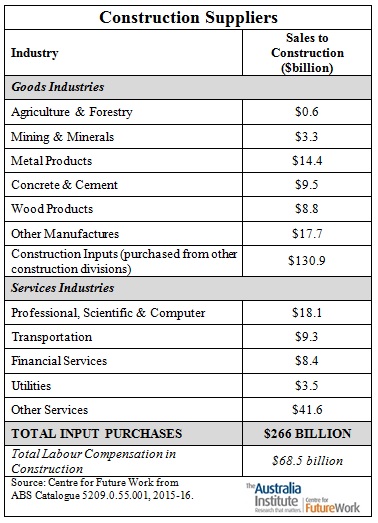
    The ABS table includes 113 different industries. Of those, fully 109 sell something to the construction industry. This includes everything from raw materials to sophisticated manufactures, from scientific laboratories to catering. The table below lists a few of the biggest construction suppliers – both goods and services. But virtually no part of the national economy is not connected somehow to construction.

    Construction Suppliers

    In total, construction firms purchase over one-quarter of a trillion dollars’ worth of supplies and services from those 109 industries (including purchases from other divisions of construction). In fact, the input purchases of the construction industry are four times bigger than the wages and salaries paid to construction workers – revealing again that the ABCC’s obsession with policing construction labour is mightily misplaced.

    Here are some of the more interesting sectors which report sales to the construction industry in the ABS tables:

    • Fishing and hunting ($70 million): Perhaps for trophies of big game to hang over the fireplace mantles of luxury homes?
    • Bakery products ($50 million): Donuts and pies, ‘nuff said.
    • Beer manufacturing ($4 million): This seems at first to be a gross underestimation. However, keep in mind that input-output tables do not include goods and services consumed by construction workers on their own time (in which case, this figure would surely measure in the billions!). Rather, it only includes purchases (tax deductible, of course) made by the companies. You can guess who drank the beer.
    • Veterinary medicines ($7 million): Must be for the nasty pit bulls at construction sites.
    • Gambling ($59 million): Given Australia’s speculative property bubble, it’s not a stretch to consider the whole housing industry to be a form of “gambling”!
    • Public order and safety ($769 million): That’s a biggie: security guards, CCTV cameras, and safety supplies. Conceivably the inflated salaries of the ABCC executives might even show up here: since they act in essence like a state police force.

    Of the 113 industries tracked by the input-output tables, only 4 do not report any sales to the construction sector. But even those sectors probably have some connection to the builders – perhaps once or twice removed:

    • Aquaculture: Construction purchasers buy from the fishing and hunting sector, but not from aquaculture. They must think wild salmon tastes better.
    • Library and other information services: Contrary to classist stereotypes, construction workers do indeed read books.
    • Primary and secondary education: The industry spends a lot on vocational and tertiary education; but school-level training isn’t counted (perhaps because it was completed before construction workers started their jobs).
    • Residential care and social assistance: This is certainly a necessary input for many construction workers – but only after they retire, are injured, or made redundant, and hence have left the industry.

    In short, basic economics confirms that the construction industry’s supply chains stretch into virtually every nook and cranny of the whole economy. If the overzealous autocrats at the ABCC are serious that their dominion extends to anyone who supplies construction, then their dominion extends to all of us.

    And that is an important, if unintended, lesson. If we allow this outrageous attack on the fundamental rights of assembly and expression of construction workers to proceed, then we are all ultimately vulnerable to the same repression. An injury to one really is an injury to all.

    The post Economics 101 for the ABCC appeared first on The Australia Institute's Centre for Future Work.

  • Budget 2019-20: Ooops, They Did It Again!

    So the 2019-20 Commonwealth budget, tabled Tuesday evening by Treasurer Josh Frydenberg, featured another valiant prediction that fast wage growth is indeed still “just around the corner.” Despite a slowdown in wage growth in the last months of 2018, this budget simply replicates last year’s wage forecast – but delayed by one more year. Crucially, there is no discussion justifying why Australian workers might have confidence in this year’s forecast, when the last five so widely missed the mark (and always in the same direction).

    Our analysis of the 2019-20 Commonwealth budget focuses on the wages crisis facing Australian workers, and challenges the claim that cutting personal tax cuts can somehow compensate workers for the fact that their wages are not growing.

    Annual wage increases generate compounding benefits for workers and their families: since each year’s raise is applied against a larger and larger base. That cannot happen with tax cuts: to the contrary, their incremental effect can only shrink over time (as tax rates get lower and lower). Moreover, tax cuts always come with a significant cost: the loss of foregone public services, income supports and infrastructure that is the inevitable consequence of government’s shrinking revenue base.

    The tax cuts in this budget increase disposable incomes for workers by less than 1% (and by zero for the lowest-wage workers). In contrast, just one year of a normal wage increases delivers several times more benefits. And annual increases over three years (the term of the next government) delivers benefits dozens of times larger.

    Please read and share our full analysis of the 2019-20 budget below, which explains in detail how tax cuts cannot compensate for stagnant wages. You are also invited to view and share this short video summarising the argument (prepared with the help of our colleagues at the Australia Institute).

    The post Budget 2019-20: Ooops, They Did It Again! appeared first on The Australia Institute's Centre for Future Work.

  • 124 Labour Policy Experts Call for Measures to Promote Stronger Wage Growth

    The letter has generated substantial media coverage, including articles in the ABC, The Guardian, and The New Daily.

    A comprehensive story also appeared in Workplace Express, which we attached below with the journal’s permission. (To subscribe to Workplace Express for comprehensive coverage of labour policy issues, please visit their site.)

    Richard Denniss, Chief Economist at the Australia Institute, also tied the open letter into his powerful column on the causes of wage stagnation.

    The open letter was initiated and circulated by the 3 co-editors of a recent collection of research essays on the wages slowdown (The Wages Crisis in Australia: What it is and what to do about it, published by the University of Adelaide Press):

    • Prof. Andrew Stewart, John Bray Professor of Law, Adelaide Law School
    • Dr. Jim Stanford, Economist and Director, Centre for Future Work
    • Dr. Tess Hardy, Senior Lecturer and Co-Director, Centre for Employment and Labour Relations Law, University of Melbourne

    “There is a growing and legitimate concern in Australia over the erosion of real living standards. Boosting wage growth is the best way to reinvigorate the promise of shared prosperity that is essential to a healthy and productive society,” said Dr. Stanford.

    “This is not a problem that is going to fix itself”, added Professor Stewart. “We need to see a policy response from governments at all levels – and an acceptance that lifting wage growth can help the economy, not harm it.

    Dr. Hardy said, “The problem of stagnant wages is a complex one. While there is no singular or straightforward solution, it is increasingly clear that combatting the current wages crisis will require concrete and decisive action.”

    Included among 124 co-signers of the letter are numerous distinguished policy experts, including:

    Prof. Roy Green, Emeritus Professor, Innovation Adviser, and former Dean of Business School, University of Technology Sydney: “In current conditions, wage increases can be a significant driver of growth and productivity through the incentive effect on capital investment, and the demand effect on capacity expansion. Keeping wages depressed is not only disadvantageous for workers but it is bad for business and the wider economy.”

    Prof. Sara Charlesworth, Distinguished Professor of Gender, Work and Regulation in the School of Management at RMIT University: “Wages fully reflecting the value of the work women undertake are vital to their well-being and fundamental to gender equality.”

    Prof. John Quiggin, ARC Australian Laureate Fellow, School of Economics, University of Queensland: “For decades, government policy has been designed to weaken unions and push wages down. It’s time to put that process into reverse.”

    The post 124 Labour Policy Experts Call for Measures to Promote Stronger Wage Growth appeared first on The Australia Institute's Centre for Future Work.

  • A Historic Opportunity to Change Direction

    In a broad overview of the current problems in Australia’s labour market, and the weaknesses of existing labour market policies, Stanford argues that the prospects are ripe for a fundamental shift in the emphasis of Australian industrial laws and labour standards.

    “A combination of political and macroeconomic factors has created a historic opportunity to turn away from the individualised, market-driven labour market policy that has prevailed since the 1980s, in favour of a more interventionist and egalitarian approach,” Stanford writes.

    He provides evidence on the dual failure of Australia’s job market: there is not enough work for those who want and need it, and the quality of work has deteriorated badly. Both of those problems have undermined wage growth in recent years. But longer-term structural changes in labour market and industrial policies are also to blame: “The deterioration in job quality and distributional outcomes is the long-term legacy of the post-1980s shift away from Australia’s earlier tradition of equality-seeking institutional structures and regulatory practice.”

    Stanford argues that deep political and economic changes are opening a once-in-a-generation possibility for a redirection of labour and workplace policies. The political shift reflects more than just the traditional “horse race” between leading parties, as an election approaches. Rather, they reveal growing public frustration over the evaporation of the “fair go” and the dimming prospects for inclusive prosperity. These political shifts have broken the traditional bipartisan endorsement of business-friendly labour policies which shaped Australia’s labour market over the last generation.

    At the same time, major macroeconomic challenges are reinforcing the need for a future Australian government to consider a different approach to supporting incomes and growth. The effects of restrictive labour policies on wages and inequality were moderated and disguised for some years by Australia’s vibrant investment and growth conditions. But now growth is slowing dramatically (due to the property price downturn, weak consumer finances, and weak business investment), and so the harsh effects of employer-oriented workplace policies are being felt undiluted by millions of working Australians.

    “There is growing sentiment among many researchers, industrial relations practitioners and worker advocates that Australia’s current industrial relations and labour policy regime (with its reliance on an eroding enterprise bargaining system, its severe constraints on union membership and activity and its network of fraying statutory protections) is in need of fundamental and multidimensional change,” Stanford concludes.

    Dr. Stanford’s review article, “A Turning Point for Labour Market Policy in Australia,” appears in Economic and Labour Relations Review, a peer-reviewed journal based at UNSW. Free public access to the article has been provided by the journal for a limited time: please visit this site to see the full article.

    Stanford’s review was also reported in a feature article by The Saturday Paper‘s Mike Seccombe on the important role that wages and workplace issues will play in the coming federal election campaign.

    The post A Historic Opportunity to Change Direction appeared first on The Australia Institute's Centre for Future Work.

  • 8 Things to Know About the Living Wage

    As the debate heats up, here’s a quick guide to 8 things you need to know about the living wage:

    #1. The debate is new. But the idea is old. And it was invented in Australia!

    In 1907 a conciliation and arbitration judge named H.B. Higgins decreed (in the famous “Sunshine Harvester” case) that wages should be sufficient to meet the “normal needs of an average employee, regarded as a human being in a civilized community.”  He actually calculated the wage that would be required for a full-time worker (then assumed male) to adequately support himself, his wife, and three children. At the time, the living wage was 7 shillings (or around 70 cents) per day.

    Of course, our idea of a standard “family” has changed a lot since then. We have fewer kids, and most women now work for pay outside of the home. But the idea of linking the minimum wage, to the actual costs associated with a minimum decent standard of living, is still valid.

    #2. Working for minimum wage is a recipe for poverty.

    From that humble beginning in 1907, Australia’s minimum wage evolved over time. It’s now adjusted annually by the Fair Work Commission. But the link to the concrete costs of running a household has been abandoned. These days the Commission looks at various factors (including profits, inflation, employment trends, and inequality) in setting the minimum. But it does not explicitly consider whether a minimum wage is sufficient to pay for basic living costs. And in reality, it is not.

    A full-time worker on the national minimum wage today ($18.93 per hour) makes $719 per week – and that assumes they work a full 38-hour schedule.  (In reality, most low-wage workers can’t get enough hours of work, on top of their low hourly rate.)  That’s only about 45% of average weekly earnings for all Australian workers.  And it’s certainly not enough to run a household, and pay for a decent standard of living. So Australia’s minimum wage is certainly well below a true “living wage.” Minimum wage workers, especially those with any dependents, are likely to live in poverty.

    #3: How do you measure the living wage?

    A common international threshold for defining low income is at 60% of the median earnings of full-time workers. (The median is the point exactly half-way between the top and the bottom of the income distribution; it differs from the average, which is unduly pulled up by a few very high-earners at the top.) Median earnings for full-time employees in Australia are presently close to $1500 per week. The minimum wage would thus have to increase to $23 per hour or more, to ensure that a full-time worker reached 60% of the median.

    Another method of calculating a living wage is to gather data on the actual costs of operating a basic household for a specific family type (often assumed to be two adults and two children, but other configurations are possible). In addition to the necessities of life (food, clothing, and shelter), a living wage must also allow for other expenses associated with full and healthy participation in society: such as internet, transportation, school supplies, a minimal level of entertainment expenses, insurance, and more. There are no luxuries in this budget – just a basic, decent standard of living consistent with modern social expectations.

    After adjusting for income taxes and transfers (like the family tax benefit and the child care subsidy), we then calculate the pre-tax income required to meet that basic standard of living. That in turn can be converted into an hourly living wage, by assuming a certain amount of paid work by the adults in the household (perhaps one working full-time and one working part-time).

    This “bottom-up” methodology has been utilised by living wage campaigns in several countries – but not yet Australia. The research confirms that current minimum wages are not compatible with healthy families and communities. The estimated living wage benchmark can then be used to lobby for increases in the legal minimum – or even to push individual employers to voluntarily pay a living wage.

    #4. For a generation, Australia’s minimum wage has lagged behind a living wage.

    In 1985 Australia’s minimum wage equaled 65% of median earnings (above that 60% threshold discussed above). It declined steadily relative to overall wages over the next two decades. Successive governments were focused on reducing wages, and fostering more dog-eat-dog competition in labour markets. (Last week Finance Minister Mathias Cormann actually admitted his government was trying to keep wages low as a matter of policy.)

    Over time, the minimum wage declined to a low of 52% of median wages in 2008. It bounced back slightly since then, helped along by a decent minimum wage hike (of 3.5%) last year. But the minimum wage still falls well short of any conception of a true living wage.

    #5. Isn’t Australia’s minimum wage higher than in other countries?

    It’s certainly higher than in America: where the minimum wage has been frozen at $7.25 for the last decade. It’s now equal to just 33% of median wages there – by far the lowest of any industrial country. No wonder many millions of full-time workers there still live in poverty. Not exactly a role model for Australia.

    In dollar terms, Australia’s minimum wage is higher than many countries. Some business lobbyists even complain Australia already has one of the “highest minimum wage in the world.”  But that claim is not true in any meaningful sense. Living costs are also very high in Australia compared to elsewhere. And international wage comparisons must consider deviations in exchange rates and other factors. It’s better to compare minimum wages across countries using the ratio of minimum to median wages discussed above.  By that standard, Australia’s minimum wage ratio is below several other countries, including France (the highest), Israel, Portugal, New Zealand, and even Turkey.

    #6: New Zealand is increasing its minimum wage – and fast.

    In fact, our neighbours across the ditch are quickly putting Australia’s minimum wage to shame. The minimum wage there (presently $16.50 per hour) is already higher as a share of median wages (above 60%) than in Australia. But the new Labour-Greens-NZ First government has been increasing it substantially, as one of its first policies. The minimum wage will grow 25% over the government’s four-year term – by which time it will equal approximately 68% of median wages.

    #7: Economists have changed their mind on minimum wages.

    Business leaders and market-friendly economists used to argue that increasing the minimum wage will inevitably cause unemployment. After all, they believed, if something is more expensive, people will buy less of it (the “buyers,” in this case, being employers). But this simplistic logic has been thoroughly discredited by a whole new generation of economic research on the effects of minimum wages on employment. Starting with a path-breaking study of minimum wages and fast food employment in New Jersey in the 1990s (by economists David Card and Alan Krueger), economists now realise the traditional supply-and-demand story is wrong.

    In fact, they have discovered several reasons why higher minimum wages do not have any significant negative impact on employment – and in some cases can actually lead to higher employment. These reasons include:

    • Improving labour force participation and retention among low-wage workers.
    • Reducing job turnover and the costs of searching for new jobs and new workers.
    • Offsetting the uncompetitive “monopsony” power of very large employers, which otherwise restrict their own hiring in order to help suppress wages.
    • Boosting consumer spending by putting more money in workers’ pockets – an effect which is especially beneficial for small business.

    Hundreds of studies of minimum wages in various countries have found little impact on employment in either direction. Even Australia’s Reserve Bank confirmed that recent increases in the minimum wage had no visible negative effect on employment.

    Further counter-evidence that higher minimum wages do not destroy jobs – and lower minimum wages do not create them – is provided by the experience of Australia’s recent cut in penalty rates for retail and hospitality workers on Sundays and holidays. Employers said this reduction in wages would lead to more jobs and longer hours. However, research by the Centre for Future Work showed those two sectors have been among the worst job-creators in Australia’s economy since penalty rates were cut. In fact, the retail sector eliminated 50,000 full-time jobs in the year under lower penalty rates.

    #8: A living wage would reduce poverty and boost incomes.

    In sum, higher minimum wages have little impact on employment one way or the other. Job-creation depends mostly on macroeconomic conditions and aggregate purchasing power. Higher minimum wages are proven to lift incomes for low-wage workers and reduce inequality. Committing to a true living wage in Australia, would ensure that people who work full-time, year-round are lifted out of poverty, and provide a badly-needed boost to Australia’s stagnant wages. It would be a powerful step in creating a fairer labour market.

    Median wage data from ABS catalogue 6306.0, “Employee Earnings and Hours.” Average wage data from ABS catalogue 6302.0, “Average Weekly Earnings.” Both refer to 2018.

    The post 8 Things to Know About the Living Wage appeared first on The Australia Institute's Centre for Future Work.
  • Rebuilding Vocational Training in Australia

    Ironically, the manufacturing recovery could be short-circuited by looming shortages of appropriately skilled workers. This seems unbelievable — given so much downsizing in manufacturing employment that occurred between 2001 and 2015. But a combination of structural change within the sector, the ageing of the current workforce, and the failure of Australia’s vocational education system (crippled by a bizarre experiment in publicly-subsidized private delivery) means that recovering manufacturers may be unable to find the skilled workers they need.

    A recent feature article in Australian Welding magazine highlighted the Centre for Future Work’s research into the problems of the current VET system, the implications for manufacturing, and 12 key reforms urgently needed to repair the situation.

    The feature article is extracted from a detailed paper (co-authored by Tanya Carney and Jim Stanford) on the evolving skills requirements of the manufacturing sector, and the failure of a privatised, fragmented VET system to meet those needs. That paper was unveiled at the 2018 National Manufacturing Summit in Canberra.

    “Stable, well-funded, high-quality public institutions must be the anchors of any successful VET system. Public institutions are the only ones with the resources, the connections, and the stability to provide manufacturers with a steady supply of world-class skilled workers.”

    Please see the full 4-page article in Australian Welding magazine with our proposals for rebuilding a high-quality, modern VET system to meet the needs of manufacturing and other Australian industries.

    We are grateful to Australian Welding and Weld Australia for permission to reprint this article!

    The post Rebuilding Vocational Training in Australia appeared first on The Australia Institute's Centre for Future Work.