Category: Articles

  • Call for Applications: Laurie Carmichael Distinguished Fellow

    We have launched a search for the first Carmichael Fellow. Please see the below call for applications for further information. Applications close at midnight (AEDT) on Monday, 18 January. Thank you for your interest in the Carmichael Centre!

    The post Call for Applications: Laurie Carmichael Distinguished Fellow appeared first on The Australia Institute's Centre for Future Work.
  • Profile: Combining Economics and Social Justice

    We are pleased to reprint (download below), with kind permission from In the Black, this profile, titled The People’s Economist. Many thanks to the journal and to Ms. Leggatt for the generous article!

    The post Profile: Combining Economics and Social Justice appeared first on The Australia Institute's Centre for Future Work.

  • A Women’s Agenda for COVID-Era Reconstruction

    Alison Pennington, Senior Economist with the Centre for Future Work assisted The Australian Council of Trade Unions (ACTU) preparing the timely report Leaving Women Behind: The Real Cost of the COVID Recovery. The report documents the gendered impacts of the crisis and the federal government’s COVID-era policies, and outlines a public investment strategy to undo the damage of the crisis, and ensure women play an equal role in an inclusive economic recovery.

    To mark the release of ACTU’s report, the Australian Trade Union Institute hosted a webinar with ACTU President Michele O’Neil, Centre for Future Work’s Alison Pennington, Karen Batt (CPSU VIC), Helen Gibbons (UWU) and Julia Fox (SDA). The session presented the main report findings and considered how they might support campaigns for a gender-inclusive recovery.

    The full 38-page ACTU report is available below together with Alison’s presentation slides presented for the ATUI webinar.

    The post A Women’s Agenda for COVID-Era Reconstruction appeared first on The Australia Institute's Centre for Future Work.

  • Feature Interviews: Worker Voice in a Changing World of Work

    Video recordings of the interviews are available here:

    The videos were recorded for a 5-week on-line course Power, Politics and Influence at Work run by the University of Manchester. The Centre’s staff are featured alongside several leading scholars, trade union activists and international agencies such as the ILO/Oxfam.

    Academics and researchers Tony Dundon, Miguel Martinez Lucio, Emma Hughes and Roger Walden designed the course for labour and NGO activists and students interested in labour market equalities, work and employment. Registration is free.

    The post Feature Interviews: Worker Voice in a Changing World of Work appeared first on The Australia Institute's Centre for Future Work.

  • Budget’s Illusory Hope for Business-Led Recovery

    Key conclusions of our analysis include:

    • This budget says explicitly that Australia’s economic reconstruction after COVID-19 is to be trusted almost entirely to private business – helped along with generous tax cuts and business subsidies.
    • The need to strengthen public services (like health care, child care, and higher and vocational education) is largely ignored, as is the need to preserve and strengthen income security programs (with the phase-out of JobKeeper and cuts to JobSeeker going ahead).
    • Tax cuts, whether targeted at businesses or high-income households, will have little impact on actual spending and job-creation.
    • The government needs a more forceful, hands-on, and sustained reconstruction plan to ensure that the economy does not get ‘stuck’ in its current state of partial recovery. That needs much more public sector leadership, vision, and funding.
    • The government admits that wage growth is going to get weaker before it gets stronger – but is doing nothing about that critical problem (which will undermine consumer spending far more than tax cuts will stimulate it).

    Download our full review of the 2020-21 budget below.

    The post Budget’s Illusory Hope for Business-Led Recovery appeared first on The Australia Institute's Centre for Future Work.

  • Webinar: How TAFE Can Drive Australia’s Skills and Jobs Recovery

    To mark National TAFE Day and the release of new research by the Centre for Future Work on the economic and social benefits of the TAFE system, The Australia Institute hosted a timely discussion on how the TAFE system can drive a COVID-era skills and jobs recovery with ACTU President Michele O’Neil, Correna Haythorpe, federal president of the Australian Education Union, and Alison Pennington, Senior Economist at the Centre for Future Work.

    The webinar was presented as part of the Australia Institute’s widely acclaimed Economics of a Pandemic webinar series and explored why the TAFE system has been in turmoil, the historic role it has played generating a more skilled workforce and productive economy, and how we can fix it.

    The post Webinar: How TAFE Can Drive Australia’s Skills and Jobs Recovery appeared first on The Australia Institute's Centre for Future Work.

  • Repairing Universities & Skills Key to Meeting COVID-Era Challenges

    Our Senior Economist Alison Pennington was interviewed by UTS The Social Contract podcast on how COVID-19 is reshaping relations between universities, government and industry. 

    Alison explains how the pandemic economic crisis presents significant challenges to Australia’s fragmented, underfunded and unplanned skills system wounded from decades of failed marketisation policies, and why sustained public investments in skills and jobs pathways will be essential to solving our economic and social challenges. 

    Listen to the episode on Whooshkaa. She is joined by Megan Lilly, head of Workforce Development at the Australian Industry Group.

    The post Repairing Universities & Skills Key to Meeting COVID-Era Challenges appeared first on The Australia Institute's Centre for Future Work.

  • Webinar: Protecting Jobs and Incomes During the Pandemic

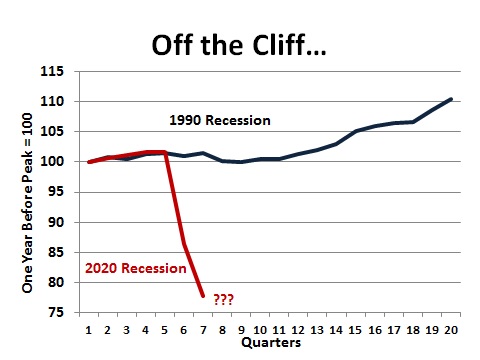
    Jim titled his presentation “Off the Cliff”, highlighting that the immediate shutdown of so much of Australia’s work and production is producing an economic contraction unlike anything experienced in history.

    Comparing Recessions

    Watch a video recording of the webinar:

    And/or download Jim’s slides below.

    This webinar was part of the Australia Institute’s weekly pandemic webinar series.

    The post Webinar: Protecting Jobs and Incomes During the Pandemic appeared first on The Australia Institute's Centre for Future Work.

  • Open Letter From Economists and Policy Experts: Wage Subsidy to Protect Jobs During Pandemic

    The letter and the full list of signatories is reprinted below. It has been forwarded to Prime Minister Morrison.

    Public Statement from Economists and Public Policy Experts:

    A Wage Subsidy to Protect Jobs During the Coronavirus Shutdown

    The unprecedented public health measures required to deal with the COVID-19 pandemic are causing a dramatic shutdown of work and production in several key sectors of Australia’s economy. Immediate full or partial closures of activity are occurring in several consumer-facing industries (such as hospitality, retail, airlines, recreation and personal services). But before long, spillover losses will be experienced in other sectors, too: including wholesale trade and logistics, manufacturing, business services, education, and others. Consumer and business confidence has been deeply shocked, and that will magnify the negative economic effects of the pandemic.

    The coming recession will be unprecedented in Australian history – in both its speed and its depth. Without immediate action, we expect that 1-2 million workers, or even more, could lose their jobs in coming weeks. That would drive unemployment to 15% or higher, overwhelm income support programs, and leave hundreds of thousands of businesses unable to function – even after the immediate health danger passes.

    This is a dangerous and dramatic moment in Australia’s economic history. It is imperative that the federal and state governments act immediately and powerfully to protect Australian workers and businesses from the worst of the coming downturn. Important steps have been taken to expand access and benefit levels for income support payments to Australian workers (including casuals, contractors, and gig workers) losing work because of the pandemic. This is a helpful, but on its own inadequate, response. Government must also act forcefully to prevent mass job losses in coming weeks – not just provide support to those who do lose work.

    In this regard, we recommend that the Commonwealth government immediately implement a large-scale wage subsidy scheme, similar to those already enacted in several other industrial countries (including, variously, the UK, Denmark, New Zealand, the Netherlands, South Korea, and Ireland). Under these programs, government directly pays to employers (for a limited period of time) a majority portion of wages (between 70 and 90%) to cover the wages of workers who would otherwise be stood down from their positions. The measure can apply to non-standard workers (including contractors and self-employed). It can also be integrated with measures to support short time working as an alternative to complete redundancy. The wage subsidy is paid to firms experiencing severe losses of revenue and business (beyond a specified threshold). It would cover most of the wage bills for workers who can no longer work for economic reasons, up to a specified ceiling (perhaps the level of full-time median earnings). This program will be expensive – but governments everywhere have recognised that this unprecedented crisis requires them to do everything in their power to protect people, jobs, communities and the economy.

    To date, Australia’s response to the pandemic has been uncertain, inconsistent and inadequate. Immediate, powerful action to keep millions of Australians in their jobs, instead of pushing them into an overloaded and complex Centrelink system, would significantly ease the pandemic’s painful economic effects. It would underpin financial stability for millions of households through the coming terrible weeks or months. And it would preserve the viability of hundreds of thousands of Australian businesses, allowing them to resume work and production as soon as the health restrictions are eased.

    We the undersigned support the proposal for a strong wage subsidy program to keep workers in employment through the coming downturn, and we urge the Commonwealth government to implement such a policy quickly.

    Download full list of signatories below.

    The post Open Letter From Economists and Policy Experts: Wage Subsidy to Protect Jobs During Pandemic appeared first on The Australia Institute's Centre for Future Work.