Category: Articles

  • More Resources on Australia’s Wages Crisis

    Our Centre continues to develop resources documenting the dimensions and causes of declining real wages, and countering the claim that trying to protect real living standards (by boosting wages at least as fast as inflation) will somehow cause hyperinflation and economic ruin.

    Our new landmark report, The Wages Crisis: Revisited, provides comprehensive data on the scale of Australia’s wage slowdown – which began in earnest around 2013. Even after the dramatic events of the COVID-19 pandemic, and the surprising decline in the official unemployment rate (now slightly below 4%), wage growth has only regained the same sluggish pace demonstrated for several years before COVID. And with consumer price inflation accelerating, weak nominal wage growth is now corresponding to major erosion in real wages.
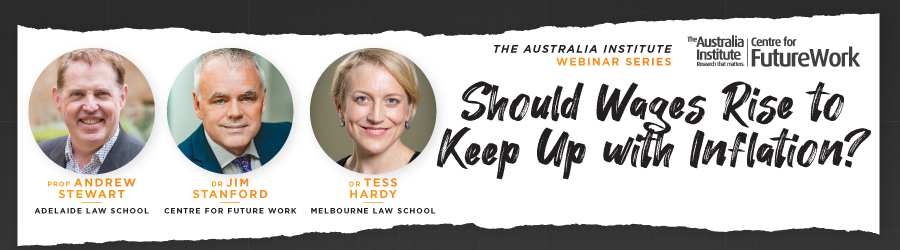
    The three authors of that report – Prof Andrew Stewart from the Adelaide Law School, Assoc Prof Tess Hardy from Melbourne Law School, and the Centre for Future Work’s Director Jim Stanford – participated in a webinar hosted by our colleagues at the Australia Institute. They reviewed the main findings of the report, and answered several questions from the audience about the wages crisis and possible solutions. The webinar was hosted by Ebony Bennett, Deputy Director of the Australia Institute.

    Our team has also been working to analyse the implications of the latest wages data for real incomes, macroeconomic performance – and the federal election, in which wages have emerged as a major point of contention. Please see the following analysis from our team:

    Our team will continue to research the dimension, causes, consequences, and potential solutions to the worsening wages crisis in the coming weeks — no matter who wins Saturday’s election!

    The post More Resources on Australia’s Wages Crisis appeared first on The Australia Institute's Centre for Future Work.
  • Webinar: Changes to the SCHADS Award and Next Steps to Improve Job Quality

    We recently hosted a special webinar to discuss the Commission’s changes, their significance, and what comes next in the struggle to improve and properly value work in human services.

    The webinar featured two representatives from the Australian Services Union, which was centrally involved in the campaign for these changes: Emeline Gaske, Assistant National Secretary for the ASU, and Michael Robson, National Industrial Coordinator. They reviewed the economic and policy context for the review, the specific changes that have been announced, how they will be implemented, and the next steps in lifting the quality of work in these vital sectors. The conversation was chaired by our Policy Director for Industrial and Social issues, Dr. Fiona Macdonald.

    The post Webinar: Changes to the SCHADS Award and Next Steps to Improve Job Quality in Human Services appeared first on The Australia Institute's Centre for Future Work.

  • International Collective Bargaining Experts Explore Future System Reform

    On 10 February, Centre for Future Work hosted an exciting timely panel discussion between international collective bargaining experts titled “Beyond the Enterprise: Building Sectoral Collective Bargaining Systems in the Anglophone World”. The panel, delivered for the Association of Industrial Relations Academics of Australia and New Zealand (AIRAANZ) 2022 Conference, explored proposals across Australia, New Zealand, Britain and the US for widening bargaining scope to the multi-employer, industry-wide, or occupational level. Panelists and their presentation links are below:

    • David Madland, Senior Fellow with Center for American Progress and Senior Adviser for the American Worker Project presented on lessons from the US and Britain on strengthening unions and broad-based bargaining proposals. There is a summary of David’s presentation available here.
    • Craig Renney, Director of Policy and Economist with the New Zealand Council of Trade Unions presented on NZ’s ambitious plan to implement sectoral bargaining through Fair Pay Agreements. Craig explained how FPAs can be initiated, bargained and agreed upon. Slides for Craig’s presentation are attached below.
    • Alison Pennington, Senior Economist with Centre for Future Work presented a new sectoral bargaining system design for Australia. The dual-tiered model proposed combines both a revitalised Awards system and multi-employer bargaining. Alison proposed traditional bargaining be re-integrated into Awards, with coverage, scope and minimum wage rates redrawn and refreshed. Her presentation is attached below.
    • Emma Cannen, Nation Research Coordinator with the United Workers Union presented on the bargaining challenges experienced in Australia’s highly fragmented, insecure, feminised care services, and why sector bargaining with stronger regulation and accountability is needed. Emma’s presentation can be viewed below.

    Jim Stanford, Economist and Director at Centre for Future Work chaired the panel.

    The AIRAANZ panel follows release of the 13-article Special Issue Global Lessons for Stronger Collective Bargaining Systems prepared by academic researchers and trade unionists from five countries for the peer-reviewed journal Labour and Industry. The Issue co-edited by Alison Pennington and Jim Stanford adopts a multi-dimensional approach to collective bargaining revitalisation, investigating the role of bargaining in skills and education, unemployment insurance and other social insurance policies, and industry policy – in addition to specific industrial relations matters.

    The final published versions of all articles in the Special Issue are available through Labour and Industry, or through your local library. All commentaries in the Issue freely accessible until end-March 2022.

    The post International Collective Bargaining Experts Explore Future System Reform appeared first on The Australia Institute's Centre for Future Work.

  • Centre for Future Work Announces Two Senior Appointments

    Greg Jericho will join the Centre on 1 February as Policy Director: Labour Market and Fiscal. Greg is an economist and well-known columnist for The Guardian in Australia; he currently teaches at the University of Canberra. He will continue writing his Guardian column, while overseeing new research projects for the Centre on issues of employment, wages, insecure work, and related topics.

    Dr Fiona Macdonald will join the Centre on 1 March as Policy Director: Industrial and Social. Fiona is presently Vice-Chancellor’s Senior Research Fellow at the School of Management, RMIT University, and an internationally recognised expert on caring labour, gender and work, and industrial relations policy. She has published extensively on the Awards system, working conditions and compensation in human and caring services, and violence at workplaces. Fiona will oversee new research at the Centre on industrial relations reform, social policy, and caring labour.

    The two Policy Directors join the Centre’s existing research team, which includes: Economist and Director Jim Stanford; Senior Economist Alison Pennington; Economist Dan Nahum; and Mark Dean, Distinguished Research Fellow at the Carmichael Centre.

    “This is a critical moment in the history of work and industrial relations in Australia,” said Dr Stanford, the Centre’s Director. “The addition of Greg Jericho and Fiona Macdonald to our team will greatly enhance our capacity to investigate the threats facing work and workers, and to develop progressive policy responses that could achieve a better future of work.”

    “I am very excited to join the Centre for Future Work,” said Jericho. “At such a crucial moment, being able to push the policy debate in the interests of fairness for workers is of utmost importance. I look forward to working with the great team at the Centre and the Australia Institute to continue producing quality research that leads the political and policy debates.”

    “As a long-time admirer of the Centre, I am thrilled to be joining its research team,” said Dr. Macdonald. “I look forward to contributing to the Centre’s important work, including in the vital areas of the care economy and gender equality. Work is changing rapidly, and the Centre’s research empowers those working for a fairer, more equal labour market.”

    Greg Jericho will work out of the Australia Institute’s central office in Canberra. Fiona Macdonald will be based in Melbourne.

    Greg Jericho can be followed on Twitter at @GrogsGamut. Fiona Macdonald can be followed at @DrFionaMac.

    The post Centre for Future Work Announces Two Senior Appointments appeared first on The Australia Institute's Centre for Future Work.

  • Snatching Defeat from the Jaws of Victory: Labour Market Implications of Australia’s Failed COVID Strategy

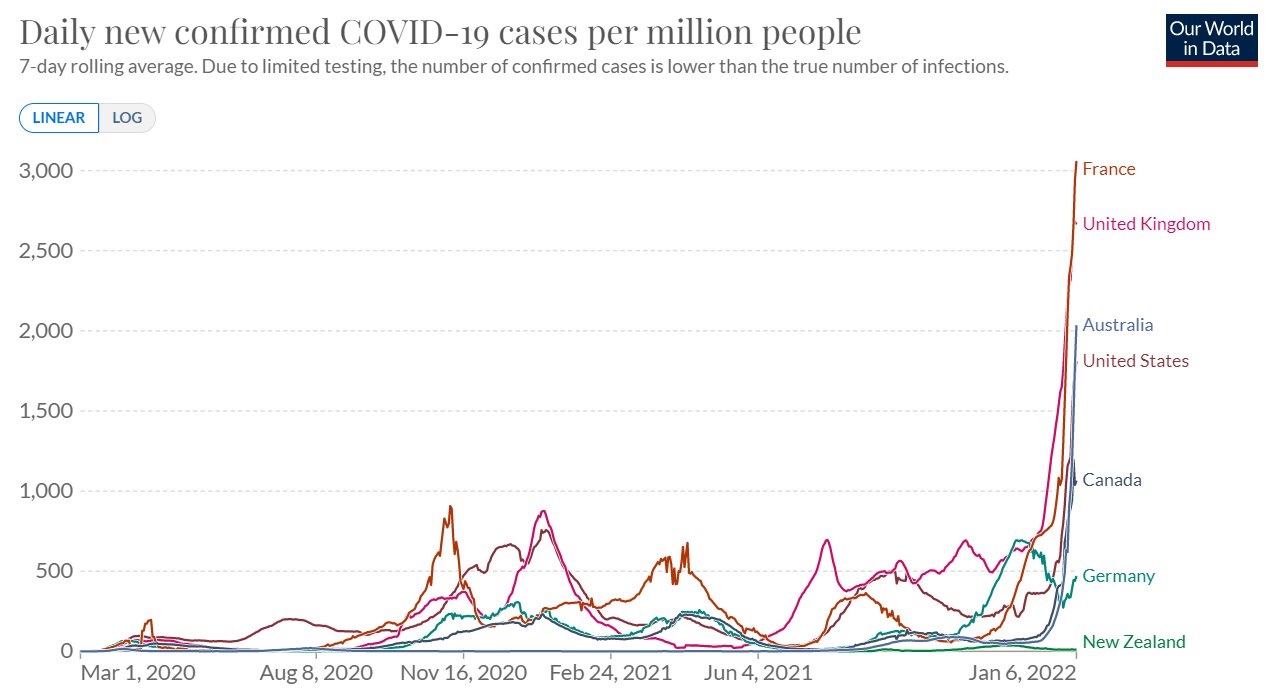
    The resulting surge in infections has been among the worst in the industrialised world (worse than the U.S. now, as shown in the following graph from Our World in Data). The implications of this massive outbreak for work, workers, production, and the economy have been as predictable as they are devastating. One-third or more of workers in the most-affected regions cannot attend work: because they contracted COVID, were exposed to it, or must care for others (like children barred from child care and soon, possibly, schools).

    Our Centre for Future Work team has been active in highlighting the risks of ‘letting it rip’, analysing the failures of isolation and income support programs, and reminding everyone that keeping workers healthy must be the first priority in keeping the economy healthy. Here is a selection of our recent interventions:

    New COVID Cases per Million (7-day rolling)

    • Our Director Jim Stanford reminded policy-makers in this commentary in The Conversation that human labour is the critical input to production at all stages of value-added and supply chains, and if policy-makers acknowledged the centrality of work to the economy they would not have made such destructive choices. The article was reposted by the ABC, the Sydney Morning Herald, and other platforms, and viewed over a half-million times.
    • Senior Economist Alison Pennington has exposed the flaws in government isolation and testing systems. For example, she highlighted the perverse incentives created by the NSW government’s punitive $1000 fine for failing to register a positive RAT test — never mind the governments’ failures to make tests available, and support workers (with necessary income benefits) to isolate. Her analysis was shared thousands of times, and featured in multiple news coverage (including News.com, The New Daily, and Yahoo Finance) of the flawed NSW policy.
    • Alison further detailed the flaws in changes to the Commonwealth government’s isolating support payments, in this commentary in The New Daily. By punitively excluding hundreds of thousands from isolation benefits, the policy will accelerate contagion and make supply chain problems even worse down the road.
    • Our experts have been featured in numerous other reports on the supply chain problems arising from the Omicron surge, including these reports on Channel 10, Today, The Age, ABC Online, and The Guardian.
    • Our Economist Dan Nahum linked the surge in Omicron contagion to the spread of insecure work arrangements in Australian workplaces. And the Centre’s previous work on how COVID has accentuated the dominance of casual and insecure work in Australia’s labour market shows that without urgent action to improve job quality, the labour market will be even more vulnerable to the inevitable future disruptions from this continuing crisis.

    Our team of experts will continue monitoring the dangerous labour market developments arising from Omicron, and flawed government responses to it. Please watch our site and follow our Twitter feed for regular updates.

    The post Snatching Defeat from the Jaws of Victory: Labour Market Implications of Australia’s Failed COVID Strategy appeared first on The Australia Institute's Centre for Future Work.

  • What Next for Casual Work? Professor Andrew Stewart webinar recording

    What do these new developments mean for the further spread of casual and precarious work? What are the other implications of the High Court ruling for future employer strategies? And what options remain for limiting the spread of casual and insecure work? To examine these matters and their implications, we were recently joined by renowned labour law expert Professor Andrew Stewart from the University of Adelaide.

    Andrew’s highly informative presentation can be viewed below:

    The post What Next for Casual Work? Professor Andrew Stewart webinar recording appeared first on The Australia Institute's Centre for Future Work.

  • Fair Pay Agreements: How Workers in NZ Are Getting Their Share

    The Centre for Future Work hosted a special webinar with Craig Renney, Economist & Director of Policy for the New Zealand Council of Trade Unions. In the recorded webinar, Craig explains key FPA policy details including design & coverage of the system, and how FPAs can lift wages and labour standards, stop the ‘race to the bottom’, and rebuild worker bargaining power in NZ. The webinar is the first in the Centre’s exciting new webinar series exploring key labour market topics related to work, wages, and fairness. Hosted by our Senior Economist Alison Pennington.

    Craig Renney’s presentation slides presented for the webinar are available below.

    The Centre for Future Work has published research on several ambitious progressive labour reforms pursued in New Zealand. For more, please read Workplace Policy Reform in New Zealand: What are the Lessons for Australia?, by Alison Pennington.

    The post Fair Pay Agreements: How Workers in NZ Are Getting Their Share appeared first on The Australia Institute's Centre for Future Work.

  • The Broken Bargain: Australia’s Growing Wages Crisis with Sally McManus

    Even prior to the COVID-19 pandemic, wage growth in Australia was anemic.

    Historically, a working class with power to organise and bargain, and a broad commitment to the social wage ensured Australia’s wealth was shared. But the last 30 years have seen a dramatic shift of the share of Australia’s prosperity going to profit and away from working people.The shift in the distribution of GDP from the mid-1970s to today has transferred 10% of GDP directly from workers to corporate profits. That’s more than $200 billion – or almost $20,000 per waged worker – per year.

    Australians are facing a wages crisis, and Government actions and inactions are making this problem worse.

    In conversation with Australia Institute Deputy Director Ebony Bennett, and Centre for Future Work Director Jim Stanford, Sally McManus outlines the reasons why wage growth is so poor, and the way back for working people to once again be at the heart of a strong economy.

    Recorded live on 14 July 2021, as part of the Australia Institute’s 2021 webinar series. A transcript of Sally McManus’s speech is available below.

    The post The Broken Bargain: Australia’s Growing Wages Crisis with Sally McManus appeared first on The Australia Institute's Centre for Future Work.

  • A Review of Lapsis

    Writer-director Noah Hutton has shrewdly crafted a science-fiction world that closely resembles our own. The premise of the film is that quantum computing has revolutionised the world’s financial markets, further exploding the dominance of the financial industry. The shabby underbelly of this quantum computing revolution is the rise of ‘cabling’ — workers managed by an algorithm, via an app, dragging cables through the woods between one quantum computing node and another.

    Read Economist Dan Nahum’s review of Lapsis.

    The post A Review of Lapsis appeared first on The Australia Institute's Centre for Future Work.

  • Video: Myth & Reality About Technology, Skills & Jobs

    But what if technology isn’t all it’s cracked up to be? And what if you invest in learning the current hot coding language, only to see it replaced by something totally different as soon as you graduate?

    In this 30-minute video, Centre for Future Work Economist and Director Dr. Jim Stanford takes on several myths related to technology and jobs.

    He argues that technology is neither exogenous nor neutral: innovation reflects the priorities (and the power) of those who have the resources to pay for it. By some indicators, jobs are becoming less technology-intensive — and this is undermining job security and living standards. Finally, we need a more holistic and democratic approach to skills and training: one that respects the all-round interests of workers as human beings (not just ‘producers’), and accepts that skills alone are no guarantee of decent, fair jobs in the future.

    The video is an excellent, free resource for adult education workshops, career development courses, and union meetings.

    The post Video: Myth & Reality About Technology, Skills & Jobs appeared first on The Australia Institute's Centre for Future Work.