Submission on aged care workforce conditions to the Productivity Commission.
Authors: Fiona Macdonald
Submission on aged care workforce conditions to the Productivity Commission.
Authors: Fiona Macdonald
A comprehensive review of Australian wage trends indicates that wage growth is likely to remain stuck at historically weak levels despite the dramatic disruptions experienced by the Australian labour market through the COVID-19 pandemic. The report finds that targeted policies to deliberately lift wages are needed to break free of the low-wage trajectory that has become locked in over the past nine years.
The report, The Wages Crisis: Revisited, authored by three of Australia’s leading labour policy experts: Professor Andrew Stewart from Adelaide Law School, Dr Jim Stanford from the Centre for Future Work, and Associate Professor Tess Hardy from Melbourne Law School, updates analysis and recommendations from their 2018 edited book, The Wages Crisis in Australia.
The report shows that annual nominal wage growth recovered after initial lockdowns during the pandemic – but rebounded only to the same slow pace (just above 2% per year) recorded for several years prior to COVID. Unprecedented fluctuations in employment and labour supply, including a significant decline in the official unemployment rate, do not seem to have altered wage growth, which is still tracking at the slowest sustained pace in post-war history.
The research found little correlation between the lasting slowdown in wage growth after 2013, and changes in supply-and-demand balances in the labour market. Traditional market forces did not cause the wages crisis, and market forces are unlikely to be able to fix it – even with a relatively low unemployment rate.
Instead, the authors identified nine policy and institutional factors which were more important in explaining the deceleration of wages, including: the erosion of collective bargaining coverage; inadequate minimum wages; pay restraint imposed on public sector workers; and widespread wage theft.
The problem of restrained compensation in public and human services reaches further than just the pay caps imposed directly on public servants. Wages in publicly funded services (like aged care, the NDIS, and early child education) are also held back by inadequate funding and weak labour standards in those programs. The report makes special mention of the need to improve wages in aged care, in the wake of the recent Royal Commission’s finding that wages in the sector must be improved as a top priority in improving care standards and attracting the new workers the sector needs.
The authors suggest that nominal wages should grow faster than 4% per year in coming years, to restore healthy relationships with productivity growth, inflation, and national income distribution. But a resuscitation of wage growth will not occur without proactive wage-boosting policies.
The authors list five broad measures to quickly support wage growth. One is a proposal for a new statutory definition of employment. This would prevent businesses from drafting contracts that present workers as being self-employed, even if in reality they have no business of their own. The authors predict that such arrangements will become far more widespread, including in the growing gig economy, in the wake of two recent decisions by the High Court.
The post The Wages Crisis Revisited appeared first on The Australia Institute's Centre for Future Work.
Building a stronger, more accessible, and high-quality ECEC system is not just a top-ranking social priority for several reasons:
Australia’s current market-based system for ECEC funding and service provision is incapable of meeting the needs of parents, families, and the broader economy. A drift to the market-based provision of ECEC services has undermined public provision in Australia and diminished the quality of service and the conditions under which it is delivered.
From this crisis-ridden starting point, the staff recruitment and retention challenge in ECEC will become much worse, if in fact Australia were to make a long-term commitment to expand ECEC provision to adequately meet the needs of working parents (and the entire economy).
Much public debate over the viability of expanded ECEC, putting Australia on a par with other leading industrial nations, has focused on the fiscal dimensions of that undertaking: how would we pay for it?
If Australia is going to expand its ECEC system in line with the needs of working parents and employers, increasing funding to the Nordic-level average for ECEC must be considered, and ramping up high-quality vocational education for ECEC workers must be an immediate and highest-order priority to meet the workforce needs of expanded ECEC coverage.
A long-term commitment to improved funding and service delivery, ideally aimed at matching Nordic-level coverage and quality benchmarks, would require a larger, better-trained, better-supported, and better-compensated workforce. A pro-active strategy for sustainable workforce development should be developed and implemented with input from all stakeholders, including ECEC providers, unions, VET institutions (particularly TAFEs), and government.
The best possible education and care to Australian preschool-aged children should also be provided by the most highly trained and experienced workers – employed in delivering a public or not-for-profit service, and well-trained in public vocational education delivered through the TAFEs.
In this sense, developing a universal public ECEC system is a natural analogue to developing a universal public VET system: building a world-class public ECEC system, staffed with top-notch graduates from public TAFEs, provides a dual source of economic and social benefit.
Meeting the goals of high-quality ECEC services thus means recognising that the full and proper funding of Australia’s state- and territory-based TAFE systems must be an essential component of post-pandemic economic reconstruction.
An active industry policy for ECEC will set the direction for the de-marketisation of ECEC services, with higher levels of government funding facilitating a vastly expanded system of ECEC in Australia.
A vital prerequisite in this effort is establishing a stable, professional, well-supported ECEC workforce, by providing extensive education and training of ECEC workers, and their entry to secure, well-paid career pathways. This can only be achieved by fully funding the training and development of a regular pipeline of trained ECEC workers, led first and foremost by greater investment in publicly funded, TAFE-delivered education and skills, new mandates for workforce qualifications and staffing levels, and health and wellbeing quality frameworks that neutralise cost-competitive approaches to delivering ECEC services.
The post Educating for Care appeared first on The Australia Institute's Centre for Future Work.
The report analyses the current worrying state of Australia’s higher education sector based on current funding and policy trends, and provides an ambitious national vision for higher education that re-aligns the sector with its public service mission.
At the Crossroads, authored by Eliza Littleton, identifies seven key policy initiatives including free higher education for domestic students, that if implemented, would put Australia’s public universities on a path toward full revitalisation.
Key Findings:
The report recommends several measures to revitalise Australia’s public universities:
The post At the Crossroads appeared first on The Australia Institute's Centre for Future Work.
Taking this perspective to task in a piece for The New Daily, Jim Stanford and Mark Dean discuss how a much broader range of forms of insecure work face many workers in Australia today, with the issue not getting any better. This is not even a trend created by unavoidable conditions created by the pandemic; it has rather been a deliberate outcome of the federal government’s labour market policies. Simply pretending it isn’t an issue won’t make it go away; nor will it provide us with sustainable solutions to the precarious situation that will keep facing more and more workers until the problem of insecure work is adequately addressed
The post We (still) need to talk about insecure work appeared first on The Australia Institute's Centre for Future Work.
A universal ECEC system should be viewed as a fundamental goal for the future Australian economy. Achieving the superior quality and economic benefits of the Nordic systems cannot be done instantly, of course. But our ECEC policies should be reoriented and expanded, with a universal, publicly-delivered, high-quality, and affordable system akin to the Nordic benchmark as its end goal. That will require more substantial investments in ECEC funding, and its reallocation toward the not-for-profit and public facilities which deliver the best quality, and the largest economic benefits.
The post The Economic Benefits of High-Quality Universal Early Child Education appeared first on The Australia Institute's Centre for Future Work.
This failure is all the more regrettable given the enormous discretionary fiscal resources which the government has at its disposal: the budget projects $133 billion in extra tax revenues over the next five years, compared to its MYEFO projections just three months ago, thanks to strong economic growth and rising nominal GDP. But instead of ploughing those revenues into reforming human services (like health, aged care, early child education, or disability services), undertaking a genuine policy to revitalise domestic manufacturing, or accelerating the energy transition, the government has prioritised one-time cash handouts to entice voters in the upcoming election.
In this comprehensive budget overview, the Centre for Future Work’s team of economists unpacks the budget, considers its effects, and suggests alternatives.
Our report reviews all aspects of the budget’s impacts on work and workers, including: wages, employment forecasts, vocational education and higher education, women workers and caring labour, labour standards enforcement, and manufacturing and energy jobs.
Please also check out these rapid-response budget commentaries from two of our economists:
“Six graphs that reveal the sugar-hit election strategy,” by Policy Director Greg Jericho in the Guardian Australia.
“Budget billions wasted as real wages go backwards,” by Senior Economist Alison Pennington in The New Daily.
The post Budget Analysis 2022-23 appeared first on The Australia Institute's Centre for Future Work.
Analysis of VET system fragmentation and policy failures during COVID.
Authors: Alison Pennington
The report, by Jim Stanford (the Centre’s Director) and Alia Armistead, looks in detail at the Tomago aluminium smelter in the Hunter region of NSW. It is Australia’s largest smelter, and is currently powered through electricity mostly sourced from coal-fired generation. The facility has pledged to move to renewable power sources by 2030 – and the new report confirms that this would underpin long-term industrial and economic benefits felt in all parts of the country.
The report reviews the worrisome deindustrailisation of Australia’s foothold in the global aluminium industry. Australia’s exports of raw bauxite have grown rapidly, but value-added aluminium manufacturing (including smelting) has declined. This undermines employment, exports, and spin-off jobs.
The study also reports results of macroeconomic simulations of the overall impacts of the Tomago facility on the national economy (including employment, incomes, GDP, and government revenue). These effects, because of the economic linkages between the smelter, its supply chain, and the consumer goods and services industries which depend on its continued existence, are very large. Our results indicate the Tomago facility ultimately supports:
The study makes several recommendations for supporting Tomago’s transition to renewable energy, and enhancing Australia’s value-added aluminium presence. These include:
The post Sustainable Industrial Jobs in the Hunter appeared first on The Australia Institute's Centre for Future Work.
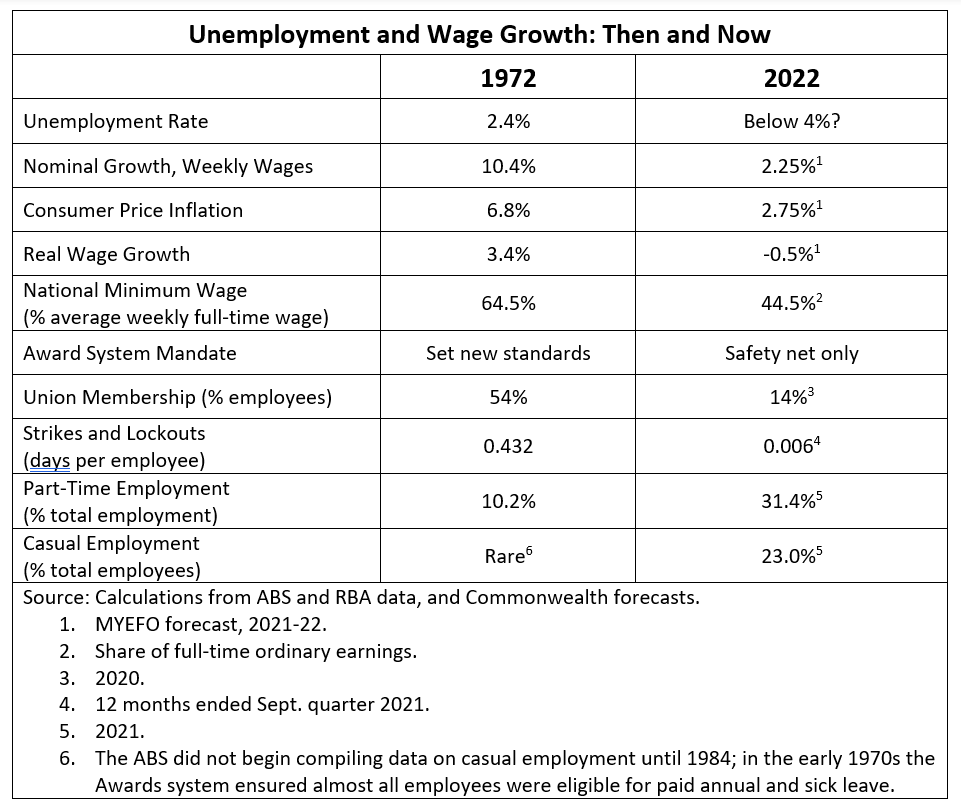
Will a low unemployment rate be sufficient to solve the crisis in Australian wages? In this article published in The Conversation, Centre for Future Work Director Jim Stanford argues that the historic restructuring of Australia’s labour market institutions over the last half-century (since the last time unemployment was below 4%) will continue to undermine wages, despite apparently tight labour markets.
This table compares regulatory and institutional parameters today, compared to fifty years ago. Across multiple dimensions (including the minimum wage, the Awards system, unions and collective bargaining, and job security), workers have lost the bargaining power they need to win higher wages. Hence labour costs remain suppressed, and business profits hit records, even as unemployment declines.
 Please see Jim’s full article, “Why there’s no magic jobless rate to increase Australians’ wages,” at The Conversation.
The post Power, Not Just Supply and Demand, Vital to Future Wage Growth appeared first on The Australia Institute's Centre for Future Work.