Author: Jim Stanford

  • Briefing Paper: Restoring public sector capability

    The Australian Public Service (APS) is responsible for delivering some of the most crucial social services to all Australians. The APS workforce includes employees who deliver frontline services like in Medicare and Centrelink, those who administer the National Disability Insurance Scheme (NDIS), and those who assist service personnel and veterans via Veterans Affairs. These are just some of the functions that APS employees undertake. Behind front line service delivery staff are employees who support these staff, work to coordinate and integrate services and provide policy and regulatory advice to government.

    This briefing paper examines the make-up of the APS and considers recent efforts to improve APS service delivery. We conclude that recent investment in the employment of more APS employees has improved service delivery and that any reduction in APS employees will reduce service delivery or result in the engagement of more consultants and contractors.

    In this paper we debunk several of the myths promoted in the political debate around the size of Australia’s public service. One such myth is that Australia’s public service is “bloated” or “inefficient”. The research also found that despite claims to the contrary, most of the public service jobs created since 2022 were not based in Canberra.

    The post Briefing Paper: Restoring public sector capability through investment in public service employees appeared first on The Australia Institute's Centre for Future Work.

  • Climate crisis escalates cost-of-living pressures

    The report identifies three key areas where the climate crisis is directly driving up costs for Australians: insurance, food, and energy.

    These sectors combined have accounted for over a fifth of the consumer price inflation experienced in Australia since 2022.

    Key findings:

    • Insurance premiums have soared due to an increase in natural disasters, with some households now spending over seven weeks of gross income just to cover home insurance
    • Food prices have risen by 20% since 2020, with climate-related disruptions wiping out harvests and making it harder for some regions to grow food
    • Energy costs remain high due to a reliance on fossil fuels, underinvestment in renewables, and fossil fuel exports forcing Australians to compete with the global market for Australia’s resources
    • The impacts of the climate crisis are disproportionately affecting lower-income and regional households, who are already feeling the financial strain more severely

    The report underscores the need for urgent climate action to protect Australian households from these escalating costs. Addressing the root causes of climate change is essential to lowering future risks and alleviating the economic strain that millions of Australians are facing.

    “Insurance costs keep on rising and, while competition across big business sectors is needed, the thing that is driving insurance costs is climate change,” said Richard Dennis, Executive Director at The Australia Institute.

    “The only way to keep insurance costs down is to keep fossil fuel emissions down. The more we heat the climate, the more expensive storms, floods and fires will be and, in turn, the more insurance will cost. It’s time we started to tax the fossil fuel companies to fund the damage that their previous emissions are already causing.”

    As the world’s second-largest fossil fuel exporter and fifth largest producer, Australia’s actions are making a significant contribution to the problem.

    “The increasing frequency and severity of natural disasters driven by climate change have resulted in higher payouts for insurance companies and rising premiums for homeowners,” said Mark Ogge, Principal Advisor at The Australia Institute.

    “One in 20 Australian households now spend more than seven weeks’ worth of gross income just to pay for home insurance and in many regional areas, where household incomes are lower, the burden is even heavier.

    “As climate change continues to fuel more frequent disasters, entire suburbs or towns could become uninsurable.

    “Food prices have also surged and in some regions growing certain crops is becoming harder and harder, making food insecurity worse, and even without price-gouging by retailers like Coles and Woolworths, prices are expected to keep rising due to the ongoing climate crisis.”

    “Meanwhile, Australia’s energy sector keeps using expensive fossil fuels and there is serious underinvestment in renewable energy solutions which provide far cheaper electricity

    “Exposure to global prices for fossil fuels due to coal and gas exports has driven up local electricity costs and even if Australia moves away from international pricing, the continued risk of climate disasters damaging critical infrastructure will ensure that energy prices remain high for the foreseeable future.”

    The post Climate crisis escalates cost-of-living pressures appeared first on The Australia Institute's Centre for Future Work.

  • The Limits of CGE Modelling

    Economic modelling is a central element of economic and policy debate in Australia. Yet the assumptions that underpin the most commonly used macroeconomic models are rarely discussed even though they fundamentally influence model results. Too often, models are used as a tool of persuasion rather than providing objective policy advice.

    The post The Limits of CGE Modelling appeared first on The Australia Institute's Centre for Future Work.

  • Life Savers Without Life Savings (firefighters & paramedics)

    Firefighters and paramedics save lives, protect us from the ravages of fire, and ensure the sick and injured receive the medical treatment they need. However, after a working life protecting others, these emergency workers face substantial risk of having inadequate retirement incomes.

    Firefighters and paramedics are regularly compelled to retire early due to particular barriers to working beyond the age of 60. Workers in these intense and challenging roles should have access to early retirement options. However, early retirement means fewer years for superannuation to grow and more years in retirement drawing on superannuation.

    The possibility of superannuation running out is significant even under relatively optimistic assumptions.

    This paper provides simulations of retirement income trajectories for firefighters and paramedics under a range of assumptions. For firefighters, these show, under relatively optimistic assumptions, an early-retiring single firefighter can expect their superannuation to run out six years before male life expectancy, nine years before female life expectancy, and 15 years earlier than for a regular retiree (retiring at 67). Under alternative scenarios, incorporating plausible risks, an early-retiring firefighter can expect their superannuation to run out 15 or more years before life expectancy.

    For paramedics, the challenges are similar and severe. Our simulations indicate that, even under optimistic assumptions, an early-retiring single paramedic can expect their superannuation to run out seven years before male life expectancy, ten years before female life expectancy, and 14 years earlier than for a regular retiree. Considering plausible risks, an early-retiring paramedic’s superannuation could run out 15 or more years before life expectancy.

    To extend superannuation longevity through to the age of their expected lifespan an early-retiring firefighter or paramedic would need to reduce their annual living expenses by 18.5%.

    Given the challenges of continuing their work in these intense roles past age 60, it is unacceptable that retired firefighters and paramedics should have either significantly reduced living standards or risk running out of superannuation in retirement.

    Among the range of potential policy responses considered in this paper, one response with promise is to increase employer superannuation contributions for emergency responders and supplement this with a one-time special superannuation contribution for workers already approaching retirement.

    The post Life Savers Without Life Savings appeared first on The Australia Institute's Centre for Future Work.

  • Submission on Restricting NDAs in Workplace Sexual Harassment

    Submission calling for restrictions on non-disclosure agreements in harassment cases.

    Authors: Heap, Peetz

    Download the full report.

  • Economic Prosperity, Public Sector Restraint (SA)

    New report contrasts South Australia’s economic progress with continued public sector wage restraint

    By many measures, South Australia has enjoyed the strongest economy of any state in Australia. Its economic growth has been faster in recent years than any state – and in per capita terms, its prosperity has improved twice as fast as the national average. It enjoys a stable, diversified economic base: reflecting a virtuous combination of strong business investment, exports, household consumption, and government spending (both on current services and on capital investment). The state’s labour market has been operating at or near record-low levels of unemployment and underutilization.

    Unfortunately, this economic progress has not been reflected in improvements in state-funded public services in South Australia. The proportionate share of the economy contributed by state-funded services and infrastructure investments has been declining since before the pandemic (and is now lower as a share of the state’s economy than any other state). State public sector workers have borne the burnt of this restraint: their wages have lagged far behind inflation, resulting in a painful real wage cut for state employees.

    In a new research report, Economist Jack Thrower shows that real wages for state public servants in South Australia have declined by as much as 10% since 2019. This represents a one-tenth reduction in the real purchasing power of their salaries, imposing severe financial stress on tens of thousands of households – and undermining consumer spending and economic growth.

    The report also confirms that South Australia possesses abundant fiscal capacity to repair this damage to real compensation for public sector workers. The state government’s core revenues are growing much faster than core expenses, and the budget is projected to return to surplus this year – faster than any other state other than Western Australia. Rebuilding public servant wages to catch up to past inflation should be a vital priority for the state government.

    Please read the full report, Economic Prosperity, Public Sector Restraint: Unpacking South Australia’s Economic and Fiscal Advantages in the Shadow of Public Sector Pay Erosion, by Jack Thrower.

    The post Economic Prosperity, Public Sector Restraint appeared first on The Australia Institute's Centre for Future Work.

  • Industrial Strategy for Domestic Wind Energy Tower Manufacturing

    Policy framework for building Australian wind tower manufacturing capacity.

    Authors: Phillip Toner

    Download the full report.

  • Leaving Money on the Table: SRS Underfunding

    Analysis of Schooling Resource Standard underfunding.

    Authors: Jim Stanford

    Download the full report.

  • Chalmers is right, the RBA has smashed the economy

    Last year the government announced it was considering removing its statutory power to overrule the Reserve Bank. Thankfully it has now reconsidered that move, and the actions of the RBA over the past year serve to remind everyone that it is far from infallible.

    In its May Statement on Monetary Policy the RBA looked ahead one month and estimated that in June the annual growth of household consumption would be 1.1%. When the national accounts were released last week, the actual growth was revealed to be just 0.5%.

    Now obviously economic forecasting is a bit of a mugs game, but household consumption makes up half of Australia’s economy and accounted for around 45% of all the growth in the economy over the past decade so it is pretty important. It is also the area of the economy most directly affected by interest rate rises. This error of forecasting suggests that the Reserve Bank has rather poorly misread just how greatly households had been impacted by the 13 rate rises that had taken the cash rate from 0.1% in April 2022 to 4.35% in November 2023.

    This error is crucial because the main reason the RBA raises rates is to reduce the ability of households to spend. Because you can’t tell your bank that you don’t really feel like paying your mortgage this month, interest rate rises force households to divert money that would have been spent on goods and services to paying your mortgage.

    The problem is when you are trying to slow down half of the economy so directly, if you overdo it the entire economy begins to fall. This is what happened in the early 1980s and 1990s when interest rates were raised sharply in order to slow inflation.

    And the private sector has already slowed so greatly that the only reason GDP rose in the past year was because of increased government spending.
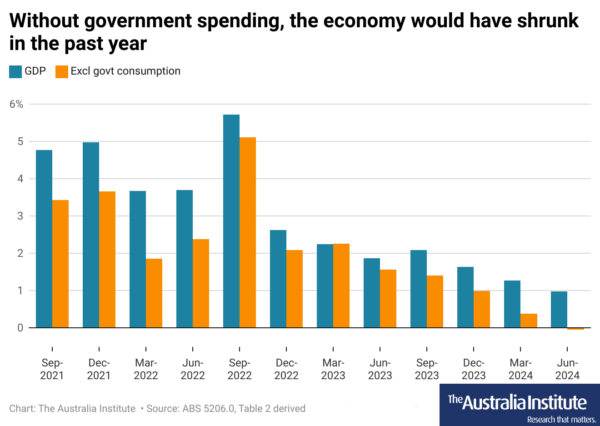
    That is not a sign of a strong economy, nor a sign of one, according to the assistant governor of the RBA, Dr Sarah Hunter, that “is running a little bit hotter than we thought previously”.

    Economies that are running a bit hot are ones in which households are spending a lot more than they were the year before because unemployment is falling and wages are rising well ahead of inflation. Instead we currently have a situation where unemployment has risen from 3.5% in June last year to the current level of 4.2%, household spending grew just 0.5% – well below the long-term average of 3% – and real wages in the past year rose just 0.1%.

    When asked about this discrepancy between reality and the RBA’s belief, the Governor of the Reserve Bank, Michele Bullock told reporters last week that

    …it’s the difference between growth rates and levels.

    She noted that “it’s true that the growth rate of GDP has slowed” but that “part of monetary policy’s job has been to try and slow the growth of the economy because the level of demand for goods and services in the economy is higher than the ability of the economy to supply those goods and services. So there’s still a gap there. So even though it’s slowing, we still have this gap.”

    In effect Bullock was telling people to stop worrying about the fact that household consumption was barely growing or that GDP only grew because of government spending or that GDP per capita has fallen for a record 6 consecutive quarters because the amount of consumption and GDP was too high.

    This could make sense – think of it like a car travelling on a 60km/h road. If it was travelling at 80km/h and slowed to 70km/h even though it was slowing it would still be going too fast.

    In essence this is what Bullock is arguing is happening to demand in the economy – it is slowing but overall there’s still too much of it.

    The only problem is that this is completely wrong.

    Consider the suggestion that the demand for goods and services is higher than the ability of the economy to supply those goods and services. One simple way to look at this is to see if the amount of goods and services bought per person is currently at a level consistent with the growth observed in the decade before the pandemic.

    This is actually not a major test – household consumption, along with most of the economy was rather weak in the 7 or 8 years before 2020. The RBA at the time actually was hoping Australians would spend more than they did, so you would expect in an economy with too much demand that the amount of things we are buying is well above the levels of that particularly weak period.

    But it is not.

    As we can see from the below graph, while household spending did quickly recover after the lockdowns in 2020 and 2021, by the time the RBA began raising interest rates our level of demand for goods and services was only back to the level consistent with the pre-pandemic growth.
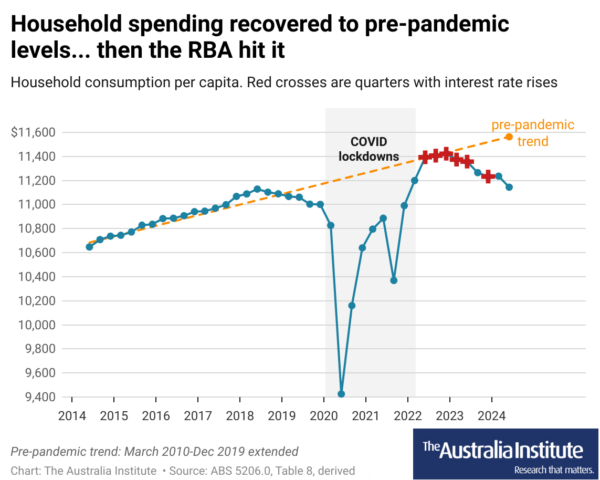
    Now yes you can argue the RBA was right to increase rates at that time – to ensure our spending didn’t keep zooming up in recovery. But by the time of the 10th rate increase in March 2023, household spending per person was already falling and 0.7% below the pre-pandemic trend. When the RBA raised rates for there 12th time in June 2023, the level of demand for goods and services was 1% below the pre-pandemic trend.

    At this point you might think the RBA had done enough. But after pausing for 4 months, the bank inexplicably raised rates for a 13th time in November 2023. At this stage household level of spending was 2.5% below the pre-pandemic trend.

    And because interest rate rises take months to worth through the economy we now find ourselves at a point where the level of household consumption per person is 3.8% lower than would have been expected had households merely kept increasing our consumption in line with the decade before the pandemic.

    In effect Australians are currently consuming almost the same amount of goods and services as they did in June 2018 and yet the head of the RBA would have us believe that is a case of excess demand.

    If we look at the overall economy, the picture is much the same (see the graph at the top of the page). Australia’s level of GDP per capita did recover quickly after the lockdowns and by June 2022 was 1.4% above the pre-pandemic trend level. But the interest rates rises had an immediate impact – reducing GDP per capita in 7 of the next 8 quarters. By June 2023 the level of activity in the economy was already below pre-pandemic expectations, and when the RBA hit Australians with the 13th rate rise in November 2023, the level of GDP per capita was 1.2% below the long-term trend.

    It is now 2.5% below – back at the level it was in June 2021.

    The RBA has got it wrong. They were initially worried that inflation was driven by concerns of strong wage growth rather than supply side issues and corporate profits. They then tried to argue household spending was still growing too strongly. The GDP figures showed that to be woefully mistaken. They then tried to argue that while growth in the economy was slow, there was still too much demand. But again the figures show this to be mistaken.

    The Treasurer Jim Chalmers stated nothing but the facts when he said earlier this month that rate rises were “smashing the economy”. The data supports his assertion, and it is time the RBA admits that their actions have not only slowed the economy but slowed it at a pace that is now harming Australians for no benefit other than the RBA saving face from its previous over-reactions.

    The post Chalmers is right, the RBA has smashed the economy appeared first on The Australia Institute's Centre for Future Work.

  • No Blood – No Job: Privacy laws and workers rights

    Organisations in Australia are using blood analysis as a means of screening future employees for ‘health risks’ that they allege may impact on their performance of work.

    Collecting sensitive information from blood analysis is restricted under Australia’s privacy laws. This is because the mishandling of this information can have a substantial detrimental impact on those who have provided the information. Requiring workers to submit to blood analysis is just one example of how organisations are now routinely collecting sensitive information from workers, sometimes without adhering to the requirements of privacy laws. Other examples include using fingerprint and facial recognition software and sensors that collect physiological and psychological data about workers.

    The protection from arbitrary interference with a person’s privacy is a fundamental human right. Interfering with this right, by collecting sensitive personal information, should occur in limited circumstances and only where necessary. However, this report shows that some organisations in Australia, are not treating the collection of sensitive information from workers as an exception. They are collecting sensitive information as a routine step in their employment processes.

    The findings of this report raise concerns about power, privacy, fairness, and the potential for discrimination in the practices being adopted by some organisations. These findings also show that Australia’s current privacy and workplace relations laws do not adequately address these concerns. Amendments to Australian privacy laws are currently being considered by the Australian Government with reforms likely to be put before the Australian Parliament before the end of 2024.

    This report examines the need for new provisions within either or both privacy or workplace relations laws that set out the rights of workers to protect their sensitive information. It argues that regulation should be geared towards, not only protecting workers’ rights to privacy, but to providing a disincentive to organisations hoarding and misuse of the personal and sensitive information of workers.

    The worker-centric approach called for in this report includes:

    • the development of one system of regulation to protect the privacy concerns of all workers regardless of employment status or work context
    • defining the collection of workers’ personal and sensitive information as high risk requiring both specific and detailed justification for the collection of this information and the genuine informed and affirmative consent of workers
    • the establishment of a tripartite mechanism to assist the regulator to develop and manage processes for dealing with the privacy and related human rights concerns of workers
    • the use of codes and frameworks, developed via a tripartite mechanism, to set out when and how workers’ information can be collected and used
    • the development of an easy to access, and timely, worker centered mechanism to address concerns about the collection and use of workers’ information.

    The post No Blood – No Job appeared first on The Australia Institute's Centre for Future Work.