Author: Jim Stanford

  • The Dimensions of Insecure Work in Australia

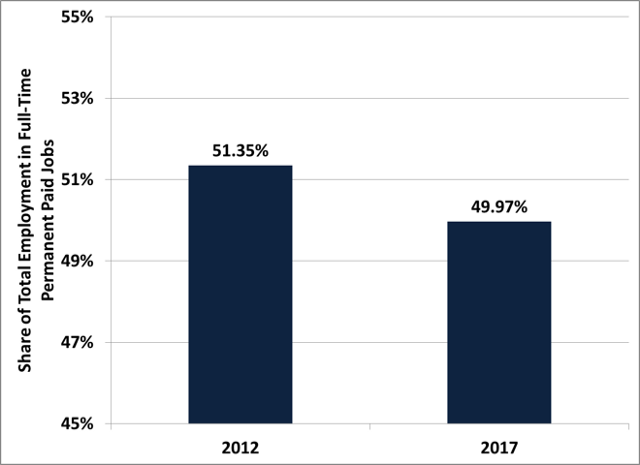
    Share of Workers in Full-Time Paid Employment with Leave Entitlements. Source: Centre for Future Work calculations from ABS Catalogues 6291.0.55.003, EQ04 (2017), and 6333.0 Tables 2.3 and 9.1 (2012).

    The report, The Dimensions of Insecure Work: A Factbook, reviews eleven statistical indicators of the growth in employment insecurity over the last five years: including part-time work, short hours, underemployment, casual jobs, marginal self-employment, and jobs paid minimum wages under modern awards.

    All these indicators of job stability have declined since 2012, thanks to a combination of weak labour market conditions, aggressive profit strategies by employers, and passivity by labour regulators. Together, these trends have produced a situation where over 50 per cent of Australian workers now experience one or more of these dimensions of insecurity in their jobs - and less than half have access to “standard,” more secure employment.

    “Australians are rightly worried about the growing insecurity of work, especially for young people,” said Dr. Jim Stanford, one of the co-authors of the report. “Many young people are giving up hope of finding a permanent full-time job, and if these trends continue, many of them never will.”

    The report also documents the low and falling earnings received by workers in insecure jobs. While real wages for those in permanent full-time positions (the best-paid category) have grown, wages for casual workers have declined. And part-time workers in marginal self-employed positions (including so-called “gig” workers) have fared the worst: with real wages falling 26 percent in the last five years.

    “Given current labour market conditions and lax labour standards, employers are able to hire workers on a ‘just-in-time’ basis,” Dr. Stanford said. “They employ workers only when and where they are most needed, and then toss them aside. This precariousness imposes enormous risks and costs on workers, their families, and the whole economy.”

    Dr. Stanford called on policy-makers to address growing precarity with stronger rules to protect workers in insecure jobs (such as provisions for more stable schedules, and options to transition to permanent from casual work). He also stressed the need for economic policies that target the creation of permanent full-time jobs.

    The post The Dimensions of Insecure Work in Australia appeared first on The Australia Institute's Centre for Future Work.
  • Insecure work: The New Normal

    In this commentary article published originally by Ten Daily, Our Director Dr. Jim Stanford summarises the findings of the Centre’s recent report on “The Dimensions of Insecure Work.”

    If You Have A Stable Full-Time Job You’re An Endangered Species

    Ask any young job-seeker about their prospects of finding a permanent full-time job, and they won’t know whether to laugh or cry. Sure, they might get a few hours of work here, a few hours there: piecing together disparate “gigs” in hopes of paying the rent.

    But landing a permanent full-time job with a regular salary and basic benefits (like paid holidays and superannuation)? Dream on.

    It’s no surprise that young workers experience the insecurity of modern work most brutally: they don’t have experience, seniority, or connections to help them in their hunt. But precarious work now affects Australians of any age, in all sectors of the economy, not just those trying to break in. What was once considered a “standard” job – the kind where you know where and when you will work, and how much you will earn – now feels like the exception, not the rule. And in fact, the hard numbers now confirm it: insecure work has indeed become the new normal.

    With co-author Dr. Tanya Carney, I recently assembled data on eleven different dimensions of job insecurity, based on official statistics from the Australian Bureau of Statistics and other government sources. We considered many aspects of the problem: including the rise of part-time work, casual jobs, people working very short hours, temporary foreign workers, and workers in nominally “self-employed” positions.

    In every case, there has been a marked increase in insecurity in recent years. A turning point was reached in 2012, as the mining investment boom (that underpinned several years of strong job conditions) turned down. That boom, and associated macroeconomic expansion, had masked longer-run structural shifts in the nature of employment – but only for a while. But now, since 2012, the sea-change in employment relationships is starkly visible.

    It was when we put all of these different indicators of insecurity together, that a startling conclusion became clear. The standard “job” has been whittled away on all sides – by part-time work, by casual and temporary jobs, by shifting more tasks to supposedly independent contractors and self-employed gig workers. And in 2017, for the first time since these statistics have been collected, the proportion of employed Australians filling a standard job fell below 50 percent. Less than half of employed Australians now work in a permanent full-time paid position with basic entitlements (like sick pay and paid holidays).

    In other words, most employed Australians experience one or more dimensions of insecurity in their jobs. Insecure work, once on the margins of the labour market, is now the norm. In fact, many workers experience multiple aspects of this insecurity.

    For example, part-time marginally self-employed workers are among the most insecure of all. They have no employees of their own; most aren’t even incorporated. They get a tax number, and then scrabble from gig to gig – accepting outsourced work from large firms who once hired actual employees to perform these tasks. Their incomes, low to start with, have declined a shocking 26 percent in real terms since 2012. They now make, on average, barely one-third as much as a typical paid full-time permanent employee.

    Surprisingly, some defenders of the status quo in Australia’s labour market deny any problem with job security. For example, Craig Laundy, Australia’s Minister for Small Business, claims insecure work is not actually more common, and defends casual work as “a completely appropriate way for many businesses and many employees to conduct their relationship.” Business lobbyists also deny work has become any less secure.

    But this flies in the face of both the official statistics, and the lived experience of millions of Australians struggling to find stable employment. And the increasing precarity of modern work in turn produces a spate of economic, social and political consequences. Households can’t predict their future income; they also can’t make long-run financial commitments (like buying a home, supporting children through higher education, or saving for retirement). Consumer spending and financial stability suffer, as does growth and job-creation.

    Politically, the frustration of millions of Australians about this chronic insecurity will inevitably bubble up at the polling booths. Job insecurity has reached a tipping point, now that less than half of all employed workers fill standard permanent full-time jobs. Sooner or later, a political tipping point will also be reached: as Australians react against the erosion of the ideal of a “fair go.”

    For this reason, hopeful politicians should be ready to present convincing ideas for restoring job stability and shared prosperity, in the lead-up to the next Commonwealth election. Denying that there is even a problem, will not likely do the trick.

    Jim Stanford is Economist and Director of the Centre for Future Work at the Australia Institute. With Tanya Carney he is co-author of The Dimensions of Insecure Work: A Factbook.

    The post Insecure work: The New Normal appeared first on The Australia Institute's Centre for Future Work.
  • The Dimensions of Insecure Work: A Factbook

    Share of Workers in Full-Time Paid Employment with Leave Entitlements. Source: Centre for Future Work calculations from ABS Catalogues 6291.0.55.003, EQ04 (2017), and 6333.0 Tables 2.3 and 9.1 (2012).

    The report, The Dimensions of Insecure Work: A Factbook, reviews eleven statistical indicators of the growth in employment insecurity over the last five years: including part-time work, short hours, underemployment, casual jobs, marginal self-employment, and jobs paid minimum wages under modern awards.

    All these indicators of job stability have declined since 2012, thanks to a combination of weak labour market conditions, aggressive profit strategies by employers, and passivity by labour regulators. Together, these trends have produced a situation where over 50 per cent of Australian workers now experience one or more of these dimensions of insecurity in their jobs - and less than half have access to “standard,” more secure employment.

    “Australians are rightly worried about the growing insecurity of work, especially for young people,” said Dr. Jim Stanford, one of the co-authors of the report. “Many young people are giving up hope of finding a permanent full-time job, and if these trends continue, many of them never will.”

    The report also documents the low and falling earnings received by workers in insecure jobs. While real wages for those in permanent full-time positions (the best-paid category) have grown, wages for casual workers have declined. And part-time workers in marginal self-employed positions (including so-called “gig” workers) have fared the worst: with real wages falling 26 percent in the last five years.

    “Given current labour market conditions and lax labour standards, employers are able to hire workers on a ‘just-in-time’ basis,” Dr. Stanford said. “They employ workers only when and where they are most needed, and then toss them aside. This precariousness imposes enormous risks and costs on workers, their families, and the whole economy.”

    Dr. Stanford called on policy-makers to address growing precarity with stronger rules to protect workers in insecure jobs (such as provisions for more stable schedules, and options to transition to permanent from casual work). He also stressed the need for economic policies that target the creation of permanent full-time jobs.

    The post The Dimensions of Insecure Work in Australia appeared first on The Australia Institute's Centre for Future Work.

  • A Comprehensive and Realistic Strategy for More and Better Jobs

    Dr. Jim Stanford, Director of the Centre for Future Work, reviewed the ACTU’s paper in detail, and prepared an evaluation of its proposals and likely effects. Stanford endorsed the policy’s complementary set of expansionary macroeconomic measures, which would strengthen every major component of aggregate demand in the national economy: including government programs, capital investment, net exports, and consumer spending. He also emphasised the importance of the paper’s vision for a stronger labour market information and planning system, which will be essential to effectively match workers with jobs as the labour market tightens.

    Stanford estimated that the ACTU’s plan, if implemented consistently over a five-year period, would be capable of achieving the following outcomes:

    • Unemployment rate falling to 4 percent or lower.
    • Share of full-time work rebounding toward 75 percent of employment (since employers will be pressured by falling unemployment to create full-time jobs).
    • Underemployment rate falling to fall to 5 percent or lower.
    • Incidence of casual work declining below 20 percent.
    • Labour force participation rising by at least 2 percentage points, especially among young workers.
    • Nominal wage growth accelerating to traditional rates of 4 percent per year.

    Read the complete ACTU paper, Jobs You Can Count On.

    The post A Comprehensive and Realistic Strategy for More and Better Jobs appeared first on The Australia Institute's Centre for Future Work.

  • Wages Crisis Has Obvious Solutions

    This recent commentary, by Centre for Future Work Director Jim Stanford, appears in the March 2018 issue of Australian Options magazine, and is reprinted with permission.

    Wage Crisis Has Obvious Solutions

    By Jim Stanford

    When the head of the central bank declares wages are too low, and urges workers to demand more money, you know you have a problem.

    After all, central bankers are traditionally the “party poopers” of the economy: they are the ones who march in and take away the punch bowl, as soon as the party gets rolling. Yet here was Governor Philip Lowe, Governor of the Reserve Bank of Australia, urging party-goers to turn up the volume. It’s like he was pouring bottles of straight tequila into the punchbowl, instead of taking it away – desperately trying to turn a boring flop into a wild shindig.

    Mr. Lowe made his surprising call at a conference last year on Australia’s economic outlook at Australian National University. He said weak wage growth was holding back national purchasing power and economic growth, and contributing to too-low inflation (which has languished below his bank’s official 2.5 percent target for several years running).

    But while his acknowledgement of the consequences of wage stagnation was refreshing, his diagnosis of the causes was incomplete and unconvincing. In fact, Governor Lowe almost seemed to blame the victims of wage stagnation – namely, Australia’s workers – for the problem. They were unduly worried about losing their jobs to robots or imports, he suggested; they should feel more “confident” in asking for higher wages. He has clearly not experienced the reality of Australia’s dog-eat-dog labour market in recent years, or felt the desperation that drives workers, especially young workers, to accept any job on offer.

    (Incidentally, the RBA’s own enterprise agreement signed last year will raise base wages by just 2 percent per year over the next 3 years … below the bank’s own inflation target!)

    While mainstream economists and policy-makers belatedly recognise the economic and social damage resulting from weak wages (even Treasurer Scott Morrison frets about the negative effect of slow wage growth on his budget balance), they’ve been distinctly reticent to connect the dots about the causes of the problem – and its obvious solutions. Lowe, Morrison, and their colleagues pretend wages will pick up automatically as the economy grows and the labour market tightens. But with official unemployment only a tick above 5 percent (still the RBA /Treasury estimate of “full employment,” according to their discredited but still operational NAIRU model), yet wages still decelerating, this faith in a market solution is increasingly far-fetched.

    Measuring the Slowdown

    The stagnation of Australian wages is visible by many indicators. The most common “headline” source is the ABS’s quarterly Wage Price Index, which reports an index of wages calculated from a representative sample of jobs (the methodology is similar to the Consumer Price Index). The WPI therefore measures changes in average hourly compensation holding constant the bundle of jobs which make up the overall labour market.

    However, one important factor in weak wages has been the changing composition of work. In particular, the growth of part-time, casual, and irregular jobs has undermined the overall level (and stability) of labour incomes. These changes are not captured in the WPI. Similarly, changes in average hours worked per week (due to growing part-time work) are also excluded from the WPI. So the WPI data understates the true extent of the wage slowdown.

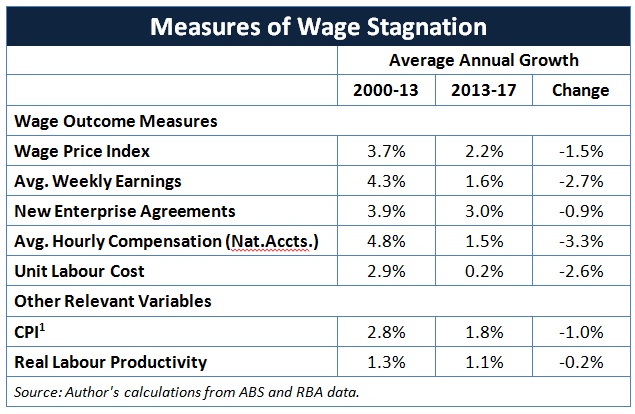
    Other ways of measuring the wage slowdown show an even bigger drop-off in wage growth. These include average weekly earnings, the pay increases specified in enterprise agreements, and estimates of average labour compensation generated through GDP statistics. Trends in all these indicators are summarised in the accompanying table. Whatever measure is chosen, it is clear that there has been a dramatic slowdown in wage growth – especially visible since 2013.

    Annual wage growth fluctuated around 4 to 5 percent during the first decade of the century. Wage growth fell sharply but temporarily during the GFC – but then quickly regained pre-crisis norms from 2011 through 2013. After 2013, however, wage growth has decelerated dramatically: to 2 percent or even lower. In fact, by the broadest measure of labour compensation (wages, salaries, and superannuation contributions paid per hour of work), there has been virtually no nominal wage growth in the past year. Consumer prices, meanwhile, continue to grow at around 2 percent per year (and even faster, if escalating housing prices are taken into account). Real earnings, therefore, are flat or falling.

    What is “Normal” Wage Growth?

    Any shortfall in wage growth below the pace of consumer price increases (corresponding to a decline in the real purchasing power of workers’ incomes) is a clear sign of labour market dysfunction. But even flat real wages (ie. nominal wages that just keep pace with inflation) are problematic. After all, wages are supposed to reflect ongoing growth in real labour productivity (or at least that’s what the economics textbooks tell us). So wages should actually consistently grow faster than consumer price inflation, to fairly reflect the enhanced real output of each hour of labour.

    Therefore, a “normal” benchmark for wage growth might be the sum of long-run consumer price inflation (the RBA’s 2.5 percent target) plus average productivity growth (running around 1.5 percent per year over the past three decades). That suggests a “normal” benchmark for annual nominal wage growth should be 4 percent per year. Australian wage growth in the pre-GFC period generally fit that definition of “normal.” But since 2013 wages shifted to a significantly lower trajectory.

    Joining the Dots

    Contrary to the assumptions of free-market economics, there is no guarantee that wages will automatically grow in line with labour productivity, as a result of automatic market mechanisms. Power is always a key factor in income distribution. And labour markets never “clear,” so that labour supply (the number of workers) equals labour demand (the number of jobs). In fact, inflation-targeting policy deliberately aims to maintain a certain level of unemployment (5 percent is the target in Australia) to suppress wage demands and protect profits.

    The systematic and structural disempowerment of workers and their unions over the neoliberal era is therefore the most relevant factor in the deceleration of wage growth, and the erosion of labour’s share of total GDP. Some obvious indicators of that dramatic shift in economic and political power include:

    • A steady erosion in the real “bite” of minimum wages, which have fallen from 60 percent of median wages in 1990 to around 45 percent today.
    • The collapse of trade union membership in the face of legal restrictions, harassment, and full-protection for “free riders.” Today just 9 percent of private sector workers, and less than 5 percent of young workers, are union members.
    • A corresponding collapse in collective industrial action. Adjusted for the size of the workforce, the frequency of strikes and other industrial disputes has declined by 97 percent from the 1970s to the present decade.
    • The relegation of industry awards to a baseline “safety net,” instead of a system for supporting ongoing progress in wages and working conditions.
    • The generally pro-business shifts in economic policy, including tax cuts, deregulation, privatisation, and globalisation, which have also shifted economic power in favour of employers and hence indirectly suppressed wage growth.

    To begin to rebuild wage growth, restore labour’s share of GDP, and achieve greater equality in labour incomes will require a comprehensive, multidimensional effort to restore the power of all these wage-supporting institutions. The ACTU is tackling this challenge with gusto, with its ambitious “Change the Rules” campaign. The goal is to propose a consistent, holistic vision for repairing the institutions that support workers and their wages – and then building a strong grass roots campaign to push politicians of all stripes to adopt that vision.

    On the other hand, if we follow the advice of Scott Morrison and Philip Lowe, and simply wait for supply and demand forces to rescue wages from their current doldrums, we are going to be waiting a very long time.

    The post Wages Crisis Has Obvious Solutions appeared first on The Australia Institute's Centre for Future Work.

  • The Difference Between Trade and Free Trade

    U.S. President Donald Trump’s recent trade policies (including tariffs on steel and aluminium that could affect Australian exports) have raised fears of a worldwide slide into protectionism and trade conflict. Trump’s approach has been widely and legitimately criticised. But his argument that many U.S. workers have been hurt by the operation of current free trade agreements is legitimate; conventional economic claims that free trade benefits everyone who participates in it, have been discredited by the reality of large trade imbalances, deindustrialization, and displacement.

    Can progressives respond to the real harm being done by current trade rules, without endorsing Trump-like actions – which will almost certainly hurt U.S. workers more than they will help? Centre for Future Work Director Jim Stanford has proposed several key principles to guide a progressive vision of international trade: one that would capture the potential benefits of greater trade in goods and services, while managing the downsides (instead of denying that there are any downsides).

    Dr. Stanford’s commentary was recently published in the Australian Guardian. The column generated follow-up coverage and commentary in Australia and internationally. For example, here is an interview with Phillip Adams on ABC Radio National’s Late Night Live.

    Here is an edited version of Dr. Stanford’s commentary:

    Progressives Alternatives to So-Called Free Trade Deals

    U.S. President Donald Trump’s bellicose policies, including new tariffs on steel and aluminium, have raised fears of a worldwide slide into protectionism and trade conflict. Trump’s unilateral and xenophobic approach to trade policy is reprehensible and dangerous from any perspective. But many progressives feel conflicted about Trump’s actions. After all, he is challenging business-friendly trade deals (including the TPP and NAFTA) which labour, social and environmental advocates opposed for years. And while his policies will clearly make life worse for working and poor people in the U.S., he is nevertheless speaking to their actual experience: unlike free trade defenders, who continue to pretend that the tide of globalisation has lifted all boats.

    But many progressives feel conflicted about Trump’s actions. After all, he is challenging business-friendly trade deals (including the TPP and NAFTA) which labour, social and environmental advocates opposed for years. And while his policies will clearly make life worse for working and poor people in the U.S., he is nevertheless speaking to their actual experience: unlike free trade defenders, who continue to pretend that the tide of globalisation has lifted all boats.

    Given Trump’s domination of the debate, progressives need to work quickly to distinguish our critique of globalisation from his. In particular, we must flesh out a vision of trade policy reforms that would genuinely help those harmed by globalisation, while rejecting the nationalism and racism that underlies Trump’s appeal.

    Established policy elites still ridicule Trump’s belief that trade deals have contributed to the misery and inequality afflicting working class communities in America (and, for that matter, Australia). For them, globalisation must produce winners but no losers. And they trot out theoretical economic models (premised on assumptions of full employment and costless adjustment) to buttress their case. They concede the gains from trade may not have been evenly shared. But they deny that globalisation has anything to do with the erosion of living standards experienced in so many once-prosperous working communities.

    This patronising denial is precisely what got Trump elected in the first place. It’s not that depressed industrial towns in Pennsylvania, Ohio, and Wisconsin (the states that put Trump over the top) didn’t “share in the benefits” of free trade. It’s that their economic viability was destroyed by it.

    Acknowledging that globalisation produces losers as well as winners, allows us to imagine policies to moderate the downsides of trade – and purposefully share the upsides. The next step is to make a crucial distinction between trade and ‘free trade.’ The former is the pragmatic day-to-day flow of goods and services between countries. The latter is the set of specific, lopsided rules embodied in the plethora of trade and investment agreements enacted over the last generation.

    These ‘free trade’ rules often have very little to do with actual trade: describing tariff elimination, for example, usually takes up just a tiny part of the text of each trade deal. The rest is devoted to a raft of provisions securing and protecting the rights of private companies to do business anywhere they want, on predictable and favourable terms.

    Proof of the dissonance between trade and ‘free trade’ is provided by Australia’s lacklustre trade performance over the last two decades. Exports of actual goods and services constitute a smaller share of total GDP today, than at the turn of the century. Sure, the volume of resource exports has surged – not surprisingly, since that’s what our trading partners wanted. But resource prices have been shaky, and meanwhile our other value-added exports flagged badly. If the goal of all the free trade agreements signed since then (a dozen) was to boost Australia’s exports, they failed miserably. But of course, that wasn’t the goal: the deals were actually intended to cement a business-friendly policy environment, even in sectors that have nothing to do with international trade.

    Progressives can endorse mutually beneficial international trade, and even international flows of direct investment, without accepting the lopsided, business-dominated vision of ‘free trade’ agreements. In fact, a progressive approach to managing globalisation would actually boost real trade more effectively: by supporting purchasing power on all sides, and avoiding the contractionary race-to-the-bottom unleashed by current free trade rules.

    Here are several key principles central to a more hopeful and inclusive vision of globalisation:

    Preserve the power to regulate: Free trade deals assume government intervention in markets (regulating prices, service standards, investment, and more) is inherently illegitimate and wasteful; they establish “ratchet” rules to limit regulation and public ownership, and lock-in deregulation over time. The failure of market competition in so many areas – in Australia’s case, including electricity, vocational education, and employment services – reaffirms that trade deals must not inhibit governments from regulating businesses, no matter where they are owned.

    Eliminate investment preferences: ‘Free trade’ deals proffer all kinds of preferences and rights for businesses and investors that have no necessary connection at all to actual trade. Chief among these are the unique quasi-judicial rights and powers granted to corporations (such as investor-state dispute settlement panels); these are an affront to democracy. Progressive trade policy would abolish these preferences, and subject corporations and their owners to the same laws and processes the rest of us face. Similarly, progressive trade deals would aim to relax monopoly patent rights (for drug companies and others), rather than strengthening them.

    Manage capital and currencies: Foreign direct investments in real businesses that produce actual goods and services can certainly benefit host communities, but only so long as those operations are subject to normal public interest and regulatory oversight. Retaining the capacity to regulate foreign investment is essential to capturing maximum benefits from foreign investment. On the other hand, volatile, speculative flows of financial capital and foreign exchange have less upside, and more downside. In particular, rules should prevent the common practice of suppressing exchange rates to gain artificial advantage in international competition.

    Social clauses that mean something: Most ‘free trade’ deals, the TPP included, feature token language about protecting labour and environmental standards. These provisions are window-dressing: responding to fears that global competition will spark a downward spiral in social standards. Typically these clauses simply commit signatories to follow their own laws – with no requirement that those laws are decent to start with. Progressive trade deals would have safeguards that are enforceable, including requiring participating jurisdictions to respect universal standards or lose preferential trade rights. Where trade partners have different standards (such as, for example, levying varying degrees of carbon pricing), border adjustments must be permitted so that trade competition does not undermine environmental and social progress.

    Balanced adjustment: Trade and investment flows never automatically settle at a balanced position – even if a “level playing field” in labour and environmental standards was actually achieved. That’s because competition always has uneven effects, producing both winners and losers. Countries that experience loss of employment and production through global competition (a possibility denied by free trade theory, but commonplace in practice) must be supported with measures to safeguard domestic employment, facilitate adjustment, and boost exports. Chronic surplus countries (like China and Germany) must recycle excess earnings into expanding their own imports, thus bearing a fair share of adjustment – rather than forcing deficit countries to do all the heavy lifting.

    Active, inclusive domestic policies: Opposition to trade liberalisation is relatively mild in the highly trade-exposed social-democratic countries of Europe: like the Nordic countries, Germany, and Netherlands. Their extensive networks of social protections provide average workers with reasonable confidence they won’t be economically tossed aside for any reason: whether trade competition, or some other disruption. That’s why a key component of progressive trade policy must be a general commitment to social protection, inclusion, and job-creation. A general context of security and equity better facilitates adjustments of any kind, in response to any source of change. Indeed, collecting healthy taxes from successful industries, and reinvesting them in priorities like infrastructure, training, and communities, is precisely how to harvest the much-trumpeted gains from trade – and pro-actively share them throughout society. That’s much more feasible than hoping those benefits will somehow trickle down of their own accord.

    Claims by policy elites that international trade is the engine of all progress are vastly overblown. Our well-being mostly depends on what we do with our skills, energies and innovation right here at home. But real international trade and investment, properly managed, can certainly make a contribution to prosperity. And progressives can advance a vision of a more balanced, inclusive globalisation that has nothing in common with Donald Trump.

    The post The Difference Between Trade and ‘Free Trade’ appeared first on The Australia Institute's Centre for Future Work.

  • Subsidising Billionaires: Net Incomes of UberX Drivers in Australia

    The report considers gross revenues generated by a typical urban fare (traveling 10 km, and taking 22 minutes to complete), according to UberX’s published rate schedule. After deducting Uber’s various fees, net taxes, and the costs of providing and maintaining the vehicle, the driver is left with an average of just $8.29 from that fare (barely one-third of the gross revenue they collect). Accounting for unpaid time spent waiting for the next fare and collecting the passenger from their pick-up point, this translates into a net hourly wage (before personal income tax) of $14.62 per hour. This is well below the national statutory minimum wage, and less than half the level of the weighted-average minimum wage (including casual loading and penalty rates for evening and weekend work) that would apply to waged employees under Australia’s Passenger Vehicle Transportation Award. The underpayment of UberX drivers in Australia constitutes a subsidy paid by them to the company amounting to hundreds of millions of dollars per year; and this underpayment of drivers (in Australia and elsewhere) has been essential to the dramatic expansion of Uber’s market value (most recently estimated at almost $50 billion U.S.).

    These findings confirm that the use of digital platforms to organise and compensate irregular work, and the ability of businesses (including large global firms like Uber) to classify their workers as independent businesses in their own right, are undermining the effectiveness of traditional labour market protections (such as the minimum wage, superannuation entitlements, paid leave, and others). The report calls on Australian lawmakers and regulators to urgently address the gaps in existing labour laws, to ensure that traditional labour protections are available to workers in the “gig economy.”

    The post Subsidising Billionaires: Simulating the Net Incomes of UberX Drivers in Australia appeared first on The Australia Institute's Centre for Future Work.

  • Excessive Hours, Unpaid Overtime and the Future of Work (GHOTD 2017)

    2017 marks the ninth annual Go Home On Time Day (GHOTD), an initiative of the Centre for Future Work at the Australia Institute aimed at highlighting the incidence of overwork among Australians, including excessive overtime (often unpaid). To investigate the prevalence of overwork and unpaid overtime, we commissioned a survey of over 1400 Australians on the incidence of overwork and Australian attitudes toward it. The results are surprising.

    Our full report, Excessive Hours, Unpaid Overtime and the Future of Work, by Troy Henderson and Tom Swann, summarises the polling, and considers the implications for labour market policies. Highlights include:

    • There is growing evidence of polarisation in Australian employment patterns, between those with full-time, relatively secure jobs, and a growing portion working part-time, casual, temporary, or insecure positions. Barely half of working Australians are now employed in standard full-time jobs, with the rest in part-time, casual or self-employed positions.
    • Many full-time workers want to work fewer hours, but most of those in part-time or casual positions want more hours. The coexistence of overwork and underemployment is evidence that labour market polarisation and insecurity is hurting the work lives of millions of Australians.
    • Across all forms of employment, Australians work an average of 5.1 hours of unpaid labour per week (up from 4.6 hours in 2016). This unpaid labour represents between 14 percent and 20 percent of the total time spent working by Australian employees.
    • The aggregate value of this “time theft” is large and growing. We estimate the total value of unpaid overtime in the national economy at over $130 billion in 2016-2017, up from $116 billion last year.
    • There would be significant economic, social, and health benefits from providing workers with stronger protections against unpaid overtime, and finding ways to better share available work.

    Our report also investigates Australians’ attitudes toward new technology in the workplace, including computerisation, automation, and digital platforms (or “gigs”):

    • Australians agree that there are significant potential benefits from new technology, and that those benefits could be experienced by businesses, consumers, and workers. Benefits for workers could include higher incomes, shorter working hours, or a combination of the two.
    • When asked which benefits they would prefer, Australians generally want to see both higher incomes and shorter working hours. 60 percent want to see higher incomes (either on their own, or in conjunction with shorter working hours), while 57 percent want to see shorter working hours (either on their own, or in conjunction with higher incomes). Australians want to see a balance between a higher material standard of living, and more time off to enjoy that standard of living.
    • However, when thinking about their own workplaces, Australians fear employers will use new technology primarily to reduce employment levels (rather than increasing incomes or reducing average working hours). 57 percent of workers think their employer will respond to new technology by reducing employment. Only 18 percent expect shorter working hours to be the outcome of technological change, and only 14 percent expect higher incomes.
    • This suggests that while Australians see the potential of new technology to improve their lives, they worry that the implementation of new technology may not translate into gains for workers.

    The jarring coexistence of overwork and underemployment, and the contradiction between Australians’ optimism regarding the potential benefits of technology and their fears about what will happen in their specific workplaces, both suggest a need for more pro-active labour market strategies to share work across all groups of workers, and to enhance the security and stability of jobs. To translate the promise of new technology into concrete benefits for workers (both higher incomes and more leisure time) will require effective measures to limit overtime (including unpaid overtime), enhance the stability of work (especially for workers in the growing number of non-standard jobs), and give workers more say in how new technology is managed.

    The post Excessive Hours, Unpaid Overtime and the Future of Work appeared first on The Australia Institute's Centre for Future Work.

  • Economic Impacts of Reductions In Penalty Rates 2017

    The workforce employed in these predominantly low-wage service sectors already experiences several dimensions of precarious and insecure work arrangements, including a heavy incidence of part-time work, casual work, and irregular hours. The income derived from penalty rates makes an important contribution to the incomes of these workers – who already struggle with balancing their personal and household budgets given these generally irregular work arrangements. Reductions in weekend income will make matters worse for a group which is already struggling. This workforce includes a disproportionate share of relatively disadvantaged populations, including women, young workers, and immigrant workers.

    The post Economic Impacts of Reductions In Penalty Rates for Sunday & Holiday Work appeared first on The Australia Institute's Centre for Future Work.

  • The Future of Work is What We Make It

    To receive a copy of the full Fabians Society booklet, please visit their website.

    The Future of Work is What We Make It

    There has been an outbreak of public concern recently about the impacts of technological change on employment. Some research suggests that 40 percent or more of all jobs are highly vulnerable to automation and computerisation in coming decades (Frey and Osborne, 2013). Some observers even suggest that work can no longer be the primary means for people to support themselves – leading to all sorts of radical policy responses ranging from taxing robots (Delaney, 2017) to the provision of universal basic income to all people, working or not (Arthur, 2016).

    Of course, this general fear of technological unemployment isn’t new. Since the industrial revolution, workers have quite understandably worried about what will happen to their jobs when machines can do their work faster, cheaper, or better. Previous periods of accelerating technological change were also associated with other waves of concern; even relatively recently, futurists were predicting that technology would make work largely obsolete (for example, Rifkin, 1995).

    Conventional market-oriented economists downplay these concerns: the magical workings of supply and demand forces should ensure that any labour displaced by technology is automatically redeployed in other, more appropriate endeavours, and people will be better off in the long run. The focus of policy should be to facilitate that transition through retraining and mobility assistance, allowing displaced workers to move more easily into better, alternative occupations.

    There are many reasons to question this optimistic theoretical perspective. But actual historical experience gives more cause to doubt ultra-pessimistic forecasts of technological unemployment. In practice, previous waves of technological change have not been associated with mass unemployment, for a range of reasons. The labour-displacing effects of new technology can be offset, in whole or in part, by other factors: including new work associated with the development, production, and operation of the new technology itself; new tasks that become conceivable only as a result of the new technology; historic reductions in average working hours (a trend which has unfortunately stalled under neoliberalism); and the capacity of active macroeconomic policy to boost aggregate labour demand when needed.

    So even from a critical economic perspective, there is little reason to conclude that “work will disappear”. This does not mean we should be complacent about the problems and risks posed to workers by accelerating technological change. But it does mean our response to those challenges should be grounded in a more balanced and complete assessment of what technology actually does to work – and where technology comes from in the first place.

    Remember, technology is not some exogenous, uncontrollable force. What we call “technology” is actually the composite of human knowledge about how to produce a broader range of goods and services, using better tools and techniques. Humans put their minds to solving certain problems (so-called “mission-based innovation”, as termed by Mazzucato, 2011), based on their particular concerns and interests. And therefore, technology is never neutral: the problems we turn our creative attention to, reflect the interests and influence of the constituencies which get to decide and fund innovation activity.

    For example, one nefarious use of modern technology in workplaces is the ubiquitous and largely uncontrolled application of surveillance and performance-tracking technology by employers, to more immediately and completely monitor the work effort of their employees. Increasingly intrusive systems now give bosses minute-by-minute data on the whereabouts, productivity, and even attitudes of their workers. This has wide-ranging impacts not only on privacy and the quality of work. It even affects compensation: when it is so easy and cheap to monitor employees (and sack them if their performance is unsatisfactory), employers have less reason to offer workers positive incentives (or “carrots”) for performance and retention – and are more likely to use a disciplinary “stick” instead. It is no accident that surveillance and monitoring technology has advanced in leaps and bounds: employers have a strong vested interest in using these techniques to intensify work and enhance profit margins. Yet at the same time, easily-solvable monitoring problems – like ensuring that franchise businesses actually pay their employees minimum wages, for example, or are making their legally mandated superannuation contributions – are not addressed with technological solutions. Why not?

    This non-neutrality of technology reflects the increasingly lopsided power imbalances in the modern labour market: those with power can influence the direction of technology in ways that reinforce their power. Another example is the one-sided application of digital platforms for assigning work and collecting payment used by “gig”-economy businesses like Uber and Deliveroo. Their technology has not (so far) actually changed the core nature of the work involved in these businesses: passengers are still driven about in a car, and take-away food is still delivered on a bicycle. What technology has facilitated, rather, are big changes in how work is hired, supervised, and compensated. By using digital applications (which they developed and own), platform businesses try to distance themselves from traditional employer functions and responsibilities (like paying minimum wages, or offering any stability or continuity of work). Technology thus allows businesses to shift risk to those performing the work, and minimise their labour costs. These changes in the social relations of work are by no means inevitable – as is being proven as workers around the world fight back against the most exploitive practices of these businesses. (Singapore’s approach was fairly effective in this regard: simply banning Uber from operating altogether). Resisting the mis-use of technology to cheapen and degrade work, is very different from a Luddite-like effort to try to stop technology itself.

    Some jobs will certainly disappear as technology replaces some tasks (and employers use it to enhance their ability to control and parcel out work most profitably). Some new jobs will be created: including good ones (like the creative, knowledge-intensive ones developing and managing new technologies), and some less good ones (like the menial digital work associated with many technologies). Many jobs, perhaps counterintuitively, will hardly be affected at all: including a range of caring services, cleaning, hospitality, and other functions which seem to inherently require hands-on human labour.

    To be sure, the quantity of work available is always a concern, all the more so given the stagnation (globally and in Australia) which continues to dominate the global economy since the GFC. Governments should put top priority on stimulating job-creation, wielding the whole array of policy tools (fiscal, monetary, industry, trade, skills, and more) at their disposal. Spurring stronger demand for labour will automatically ease adjustment to new technologies and their labour-displacing effects.

    But the quality of jobs is an equal concern, and it is in this realm that the impacts of new technology may be most severe. The quality of new jobs created as technology advances, and the quality of existing jobs that are largely untouched by technology, must be targeted for forceful, ambitious policy attention, to arrest and reverse the widespread degradation of work which is being permitted by weak labour market conditions, technology, and the enhanced and largely unchallenged power of employers.

    After all, a sustained structural shift in bargaining power in the labour market, in favour of employers, has been a central goal of neoliberal economic and social policy. There has been an expansion of non-standard employment in all its forms: irregular hours, casual work, labour hire positions, precarious forms of contracting and self-employment, and more. This precarity has been facilitated by a combination of persistently weak labour market conditions (compelling desperate workers to take any job no matter how insecure); technologies which make it easier for firms to orient staffing around precarious and on-call work; and regulatory inattention and complacency. On this last point, regulatory levers for protecting workers have not kept up with employers’ efforts to sidestep traditional minimum standards. Even the simplest of standards (like the minimum wage) are widely unenforced.

    In short, to address the impacts of technology – and, more importantly, the one-sided application of technology within workplaces – we must modernise and revitalise the concept of a social contract. We need a social contract for the digital age, that re-establishes mutual responsibilities and expectations, that commits to improving both the quantity and quality of work as a central goal of policy, and that actively supports the countervailing forces (like unions, employment standards, and cultural expectations of fairness) that are essential to achieving more security and fairness in the world of work.

    The values of NSW Labor provide a solid foundation from which to embark on such a revitalisation. The party’s vision emphasises that ‘prosperity starts with good jobs’ and commits that the ‘benefits of rising prosperity are shared fairly’; working towards such collective prosperity is a stated goal (NSW Labor, 2017). Key to this prosperity from a Labor viewpoint is support for more equal opportunities in the labour market and an effective system for regulating work. These values are constant and are not altered by technology or innovation: they apply whether citizens are engaged to work in full-time, “old economy” jobs or precarious “gigging” in the digital economy. A challenge is posed, though, by the rhetoric of innovation that leads the launch of a shiny new app to distract from the business models that underpin it – often based on underpaid, insecure, or invisible labour. What is needed then is clarity and purpose to create a system for regulating work that is modern, but fair.

    Australian governments at all levels have been creative regulators of the labour market since Federation: think of the tax provisions implemented in the early years following federation. The Commonwealth government was constrained by the Labour power [Section 51 (xxxv)] of the Constitution, meaning that it could not intervene directly to set wages and conditions of work. However, it could impose taxes. The Excise Tariff Act 1906 passed by the Deakin government included a provision for manufacturers of agricultural machinery to be exempt from the excise if the workers in that company were paid a ‘fair and reasonable’ wage (Hamilton, 2011). The Harvester judgement that ensued is embedded in industrial relations folklore and has become synonymous with the establishment of minimum wages in Australia. However, what is often overlooked is that the mechanism used to establish this landmark was not a mechanism of traditional labour law – it was, after all, triggered by tax law.

    Labor Governments have not been alone in this regulatory innovation to address labour policy concerns. The Howard Government was just as inventive and driven in its determination to use the Corporations power [Section 51 (xx)] of the Constitution to create a national regulatory framework that downgraded collective bargaining and instituted statutory individual contracts. A further legacy of that re-orientation was the whittling away of State industrial relations jurisdictions. This might lead to the conclusion that a State Labor government has little capacity to influence the wages and conditions of workers beyond the public sector. However, this conclusion is too narrow, and underestimates the extent to which creative, ambitious interventions at the state level could contribute to the restoration of a progressive social contract.

    Consider, for example, the current Victorian government’s attempts to eradicate the exploitation of workers in industries like horticulture, through the introduction of a legislated licensing scheme for labour hire companies. This is illustrative of the potential for action by a State government to curb the exploitation of vulnerable workers. But legislation is not the only choice; there is a vast array of options on the regulatory spectrum.

    Another means of regulating for better outcomes outside the confines of labour law is to support industry-specific multi-stakeholder collaboration. A developing example of this is the Cleaning Accountability Framework. CAF is an independent, multi-stakeholder initiative comprising representatives from across the cleaning supply chain – including institutional property investors, building owners, facility managers, cleaning companies, cleaners (through United Voice) and industry associations. CAF seeks to improve labour standards by encouraging transparency throughout the cleaning supply chain. CAF will recognise stakeholders who adopt better practice in the cleaning industry through a building certification scheme. In doing so, CAF will work to improve the employment conditions of cleaners, support sustainable business models and responsible contracting practices, help building owners and investors manage risk, and assist tenants in ensuring that they are benefiting from quality cleaning services. Multi-stakeholder initiatives have been criticised for lacking enforceability, but CAF overcomes this by using the structure of the supply chain, specifically the power of building owners and managers to drive compliance.

    None of these examples are centred in the “gig economy,” nor do they address sectors immediately threatened by automation. But they nevertheless provide an insight into “‘outside the box” efforts to improve the quality and fairness of jobs. Similar ambition and creativity could provide a better regulatory environment for the conduct of all types of work – not least in the digitally enabled economy. This could begin with a comprehensive mapping of State-based regulation to identify potential opportunities to leverage existing laws, regulations, procurement policies and industry codes.

    This would be an ambitious project, but given the extent of State influence in major areas of the economy (health, education, transport), it would provide a plethora of policy options.

    Alternatively, if changes to work (whether wrought by technology or ‘innovation’ in business models) are left unquestioned, and if we assign the determination of working conditions to algorithms, then the aspirations encapsulated in “Labor values” will remain unrealised and, a chance to re-imagine a social contract based on decent work will be squandered.

    References

    Arthur, Don 2016, “Basic Income: A Radical Idea Enters the Mainstream,” Parliament of Australia, Research Paper Series 2016-17, November 18.

    Delaney, Kevin J 2017, “The robot that takes your job should pay taxes, says Bill Gates,” Quartz, February 17.

    Frey, Carl Benedikt, and Michael A. Osborne 2013, The Future of Employment: How Susceptible are Jobs to Computerisation? (Oxford: Oxford Martin School).

    Hamilton, R. S. 2011, Waltzing Matilda and the Sunshine Harvester Factory: The early history of the Arbitration Court, the Australian minimum wage, working hours and paid leave (Melbourne: Fair Work Australia).

    Mazzucato, Mariana 2011, The Entrepreneurial State: Debunking Public vs. Private Sector Myths (London: Anthem).

    NSW Labor 2017, “Our Values,”.

    Rifkin, Jeremy 1995, The End of Work: The Decline of the Global Labor Force and the Dawn of the Post-Market Era (New York: Putnam & Sons).

    Sarah Kaine is an Associate Professor at the UTS Business School, and a member of the Advisory Committee of the Centre for Future Work. Jim Stanford is Economist and Director of the Centre for Future Work, part of the Australia Institute.

    The post The Future of Work is What We Make It appeared first on The Australia Institute's Centre for Future Work.