Author: Jim Stanford

  • On the Brink: Erosion of Enterprise Agreement Coverage

    The report shows that the number of current enterprise agreements in private Australian businesses has collapsed by 46% since the end of 2013. The number of private sector workers covered by enterprise agreements has plunged 34% in the same time. In 2017, just 12% of employed private sector workers were covered by an enterprise agreement – down from 19% in 2013.

    If current trends in renewals, new agreements, and terminations continue, less than 1800 agreements would survive to 2030, at which point just 2% of private sector workers would be covered by a collective agreement.

    The dramatic downturn in collective bargaining in Australian businesses reflects a number of simultaneous trends, creating a ‘perfect storm’ that jeopardises the future of private sector bargaining. These trends include a drop-off of renewals of expired enterprise agreements; the dramatic decline in the number of newly negotiated agreements; and a surge in terminations of agreements.

    “It is no exaggeration to conclude that collective bargaining in private businesses will go extinct in coming years if these devastating trends are not reversed,” said Alison Pennington, Economist with the Centre for Future Work and author of the report.

    The report provides a forward simulation of enterprise agreement-making if current trends in renewals, new agreements, and terminations continue. The simulation indicates that the total number of private sector enterprise agreements would fall by half (to below 6000) by 2023, and the proportion of private sector workers covered by agreements would fall below 6%. Things get worse in subsequent years, with less than 1800 agreements surviving by 2030, when only 2% of private sector workers would be covered by a collective agreement – unless urgent action is taken the change existing policies and restore effective access to collective bargaining.

    “The accelerated collapse of enterprise bargaining in the private sector has been a key cause of the unprecedented weakness in wage growth experienced in Australia since 2013,” Pennington said. “When workers have no collective voice or collective bargaining power, they have no chance of successfully negotiating better wage increases from their employers.”

    The report also shows that the rapid decline in enterprise agreement coverage for private sector workers has been mirrored by a rapid increase in the proportion of workers paid according to the minimum terms of Modern Awards.

    “The evidence is overwhelming that Australia’s current system of collective bargaining is completely inadequate for representing workers in our evolving economy, with an increasingly fragmented labour market,” Pennington concluded. “A viable collective bargaining system is essential to shared prosperity, but it will require far-reaching changes to the current rules to keep collective bargaining alive.” The report proposes several broad directions for reforming current laws and practices, to stop and reverse the dramatic decline in collective agreement coverage.

    PLEASE NOTE: This posted version of the paper corrects a previous error arising from a data coding problem which resulted in an inaccurate allocation of newly approved enterprise agreements between new and renewal agreements.

    The post On the Brink appeared first on The Australia Institute's Centre for Future Work.

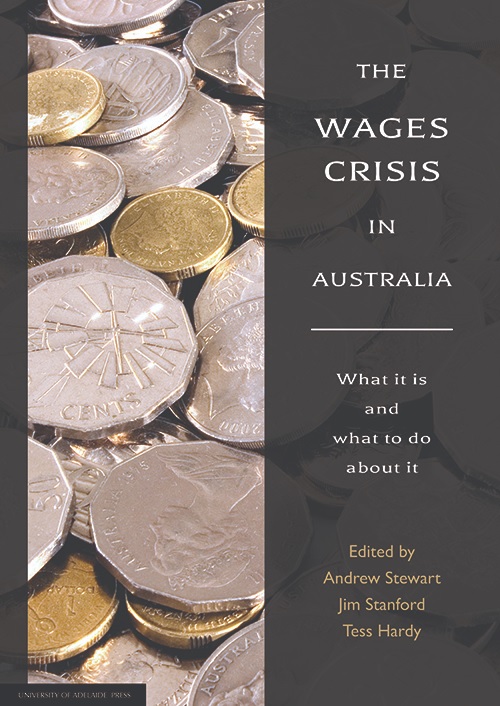
  • New Book: The Wages Crisis in Australia

    Cover

    The wage slowdown has elicited concern from economists and political leaders across the spectrum. Even Dr. Philip Lowe, Governor of the Reserve Bank of Australia, has called it a “crisis,” and suggested that faster wage growth would be beneficial for the economy.

    This new collection of 20 essays by leading labour market experts and commentators in Australia explores the causes, consequences, and potential solutions to this problem. The book is published by University of Adelaide Press. The book was launched in Melbourne on 29 November, with remarks from Natalie James, former Commonwealth Fair Work Ombudsman and Chair of the Victorian Inquiry Into the On-Demand Workforce.

    Through the links below you may access excerpts from the book, links to participating authors, and supplementary material (including commentary, other readings, and videos). Our hope is that this collection will spark a needed debate in Australia about how to get wages back on track.

    About the Editors:

    Andrew Stewart is the John Bray Professor of Law at the University of Adelaide and a Legal Consultant to the law firm Piper Alderman.

    Tess Hardy is a Senior Lecturer at Melbourne Law School, and Co-Director of the Centre for Employment and Labour Relations Law.

    Jim Stanford is Economist and Director of the Centre for Future Work at the Australia Institute.


    A digital edition of the book is available for free download from University of Adelaide Press. Paperback copies can be ordered for $60 from Federation Press; please submit inquiries to info@federationpress.com.au.

    The post New Book: The Wages Crisis in Australia appeared first on The Australia Institute's Centre for Future Work.

  • Excessive Hours and Unpaid Overtime: 2018 Update (GHOTD 10th anniversary)

    2018 marks the tenth annual Go Home on Time Day (GHOTD), an initiative of the Centre for Future Work at the Australia Institute that shines a spotlight on overwork among Australians, including excessive overtime that is often unpaid.

    Over many years, the Centre for Future Work and the Australia Institute have commissioned regular annual opinion polls to investigate overwork, unpaid overtime, and other instances of “time theft” in Australia. This year’s poll of 1459 Australians was conducted between September 17-26, with a sample that was nationally representative according to gender, age and state or territory.

    Of the 1459 respondents, 880 (or 60 percent) were currently in paid work. That subsample was then asked several questions regarding their hours of work, whether they wanted more work or less, and whether they worked unpaid overtime in their jobs.

    This report summarises the results of that polling, and places it in the context of national labour force trends:

    • There is growing evidence of a sharp polarisation in Australian employment patterns, between those with full-time, relatively secure jobs, and a growing portion working part-time, casual, temporary, or insecure positions.
    • In the survey, 54 percent were employed in permanent full-time jobs, while 46 percent were employed as part-time, casual or self-employed workers. In other words, almost half of the sample experienced one or more degrees of nonstandard or insecure work – broadly in line with the experience in the overall labour market.
    • Compared with last year, there was a significant increase in those wanting more paid hours (from 34 percent to 40 percent) and a decrease in those wanting fewer paid hours (from 19 percent to 15 percent). We believe this shift reflects the high levels of underemployment in Australia’s labour force, and the ongoing struggle of those in non-standard jobs to attain enough hours of work.
    • In the survey, 20 percent of full-time workers said they would prefer to work fewer hours, and 30 percent said they wanted more. 50 percent said their hours were about right.
    • By contrast, those in part-time or casual positions work far fewer and more uncertain hours, and most would prefer to work more – 54 percent of parttime workers and 63 percent of casual workers. This highlights the problems of underemployment and inadequate incomes experienced by the growing proportion of Australian workers in insecure jobs. Only 7 percent of part-time employees and 2 percent of casuals wanted fewer paid hours.
    • At the same time as many Australian workers report they would prefer more hours of paid work, the incidence of unpaid overtime is also growing: including coming in early, leaving late, working at home or on weekends, working through regular breaks and lunch hours, responding to calls or emails out of working hours, and more. Across all forms of employment, our respondents reported working an average of 6.0 hours of unpaid labour per week (up from an average of 5.1 hours in 2017 and 4.6 hours in 2016).
    • This translates into an annual average of 312 hours of unpaid overtime per worker per year across all forms of employment. Based on a standard 38-hour workweek, this is equivalent to more than 8 weeks (or 2 months) of unpaid work per worker per year.
    • Full-time workers reported the greatest incidence of unpaid overtime: on average 7.1 hours per week. This was a substantial increase from a reported 6 hours per week in last year’s survey.
    • Part-time workers worked on average 4.2 hours per week unpaid, while even casual workers worked on average 2.8 hours unpaid.
    • The aggregate value of this “time theft” is substantial. Across the workforce, we estimate the total value of unpaid overtime at $106 billion in 2018. This widespread non-payment for so much of Australians’ working time reduces family incomes, weakens consumer spending, and exacerbates the challenge of work-life balance.
    • In an era of wage stagnation, underemployment, insecure work and significant cost of living pressures, Australian workers cannot afford to give their time away to employers for free.

    The post Excessive Hours and Unpaid Overtime: 2018 Update appeared first on The Australia Institute's Centre for Future Work.

  • Under the Employer’s Eye: Electronic Monitoring & Surveillance

    This year, our survey also included a special section focusing on the forms, prevalence, impacts and implications of electronic and digital monitoring and surveillance in Australian workplaces. Our goal was to investigate a secondary dimension of the time pressure facing Australian workers. It is not just that work is being extended into greater portions of our days (through unpaid overtime, the use of mobile phones and computers to reach workers at any time, pressure to not fully utilise annual leave, and similar trends). In addition, even within the work day, time pressure is intensified with the expectation that every moment of work time must be used for productive purposes – an expectation that is increasingly reinforced through omnipresent systems of monitoring, performance measurement, and surveillance. The result of these twin forces is an overall inability for people to escape from the demands of work: neither at the workplace (even for short periods), nor away from it.

    Part I of this report begins by describing the main forms of modern electronic monitoring and surveillance (EMS) that have placed more Australian workers “under their employer’s eye.” These methods include the use of location tracking technologies, monitoring of emails and social media content, the “gamification” of work, digital methods of performance monitoring, and even electronic systems for employee discipline and dismissal. Following sections examine the various purposes of modern EMS systems, and the extent of their application. This is followed by a brief description of the legal and regulatory system governing EMS in Australia; current regulations limiting employers’ use of these systems are sparse and inconsistent. The last section of Part I discusses the direct and indirect consequences of these new forms of monitoring and surveillance for workers. It argues that the impact of omnipresent surveillance in workplaces may be contributing to the slower wage growth which has so concerned Australian economists and policy experts in recent years; because it is now easier and cheaper to monitor and “motivate” employees through surveillance and potential discipline, employers feel less pressure to provide positive economic incentives (such as job security, promotion, and higher wages) to elicit loyalty and effort from their workforces.

    Part II of the report then reports the findings of our original survey data regarding the forms, extent and impacts of EMS systems in Australian workplaces, and the attitudes of Australian workers towards these technologies and trends. We surveyed 1,459 people between 26 October and 6 November 2018, using an online survey methodology, conducted by Research Now. The sample was nationally representative with respect to gender, age and state and territory.

    The post Under the Employer’s Eye: Electronic Monitoring & Surveillance in Australian Workplaces appeared first on The Australia Institute's Centre for Future Work.

  • Permanent Casuals, and Other Oxymorons

    Here is a commentary from Jim Stanford, Director of the Centre for Future Work, discussing the implications of these decisions for the mis-use of casual work. The commentary was originally published on the Ten Daily website.

    Time to rethink reliance on casual work

    Casual work has become a pervasive feature of Australia’s labour market. Until the 1990s, almost all workers, even part-timers, had permanent jobs with reasonably predictable schedules and access to normal work-related entitlements (like paid holidays and sick time). But then employers became obsessed with achieving “flexibility” in hiring. Flexibility sounds like a good thing, but in practice it meant granting employers more freedom to disemploy their workers, with no notice and no severance costs. The downside for workers is lack of certainty in rostering, poor job security, and no access to paid leave. That makes it impossible to make major purchases, plan child care, or take family holidays.

    At last count, around 25 percent of paid employees in Australia (or over 2.5 million workers) were employed on a casual basis. The incidence of casual work has grown noticeably since 2012, when the mining investment boom ended and the overall labour market weakened. Casual work has grown fastest in full-time positions, and among male workers. For young workers (under 25), casual work is especially ubiquitous: 55 percent work casual. OECD data indicates that Australia now has the highest incidence of temporary work of any industrial country.

    Because it is so common, casual work has become “normalised” in the eyes of employers and policy-makers. For example, Craig Laundy, former Commonwealth Minister for the Workplace, endorsed casual work enthusiastically this year, saying it is “a completely appropriate way for many businesses and many employees to conduct their relationship.” Even business lobbyists admit that most casual staff actually work regular and predictable schedules.

    With this normalisation, many industries in Australia now rely on casual work as a permanent, core feature. Instead of using casual workers to meet temporary or seasonal fluctuations in demand, thousands of employers tap a permanent pool of casual workers to meet ongoing staffing requirements. Workers can be stuck on casual status even if they work regular shifts, for years at a time.

    In theory, employers pay a price for this super-flexibility: Australia’s casual loading rules require a 25 percent wage penalty to be paid to casual workers: compensation for lack of access to paid sick leave and holidays, and for the insecurity and instability attached to casual work. In practice, many employers do not pay this wage premium – effectively “hiding it” in lower base wages, or else evading it entirely (especially for young and foreign workers who do not understand the rules). But even if they do pay casual loading, employers should be prevented from abusing casual work as is now commonplace. After all, the inherent insecurity of casual work imposes a cost on workers and their families – a cost that grows if that insecurity is permanent.

    A series of recent legal decisions, however, is now challenging the assumption that casual work can be normal, legitimate and universal. Three particularly important cases could force employers to rethink their reliance on casual staffing:

    • A Federal Court judgment has ordered a labour hire company to pay retroactive annual leave to a mine driver who worked casual for several years, even though he was assigned to regular shifts. Employers complain this ruling somehow amounts to “double-dipping:” they claim that paying the 25 percent casual loading somehow entitles employers to deny paid holidays and other normal rights, even to long-term staff. That assumption has now been refuted.
    • The Fair Work Commission has decided to harmonise evening and Saturday penalty rates between casual and permanent workers in the retail sector. Until now, casuals were denied penalties of up to 25 percent of base wages for those shifts, compared to permanent workers. Now the penalties for casual workers will be raised to the same level as for permanent staff (although, perversely, the Commission is also in the process of cutting penalty rates for all workers on Sundays and holidays).
    • Another Fair Work Commission ruling affecting 85 different modern awards affirmed the right of casual staff to request conversion to permanent status after working regular shifts for a year. Employers can turn down those requests, but only if they would result in major changes in the applicant’s hours of work, or are otherwise “unreasonable.”

    Employers are pushing back hard against these precedents – and they seem to have the ear of the federal government. Business lobbyists predict billions in back payments arising from the annual leave decision, and are demanding legislative changes to avoid those costs. Kelly O’Dwyer, Minister for Jobs and Industrial Relations, has promised to investigate the idea. Some business groups are even proposing a brand new category of “perma-flexi” workers, who would receive a (smaller) wage loading for accepting casual status for years at a time. Anxious to preserve this highly profitable staffing practice, business leaders seem oblivious to the oxymoron inherent in their proposal for permanent casual work.

    Business complaints about the costs of treating casual workers fairly ring hollow. The 25 percent casual loading system was never intended as a carte blanche: that is, a kind of “permit” that granted employers permission to keep workers in perpetual insecurity, denied access to basic security and regular entitlements. Employers who used casual workers only where originally intended – that is, in temporary or irregular shifts – can continue to do so without significant extra costs.

    However, while promising, these recent decisions do not fully address the misuse of casual work. Casual workers should have broader options to convert to permanent status after shorter periods (say, six months) in a regular position. And the application of casual employment rules (which deny termination pay and notice of dismissal to workers, as well as access to paid leave) should be restricted to carefully-defined and genuine situations of temporary or volatile demand.

    Nevertheless, these recent decisions are an important recognition that employers have been abusing this form of employment. And they are a wake-up call to employers, who should now think hard about reducing their reliance on casual staffing – and get back to creating steady jobs that workers (and their families) can count on.

    The post “Permanent Casuals,” and Other Oxymorons appeared first on The Australia Institute's Centre for Future Work.
  • Infographic: The Shrinking Labour Share of GDP and Average Wages

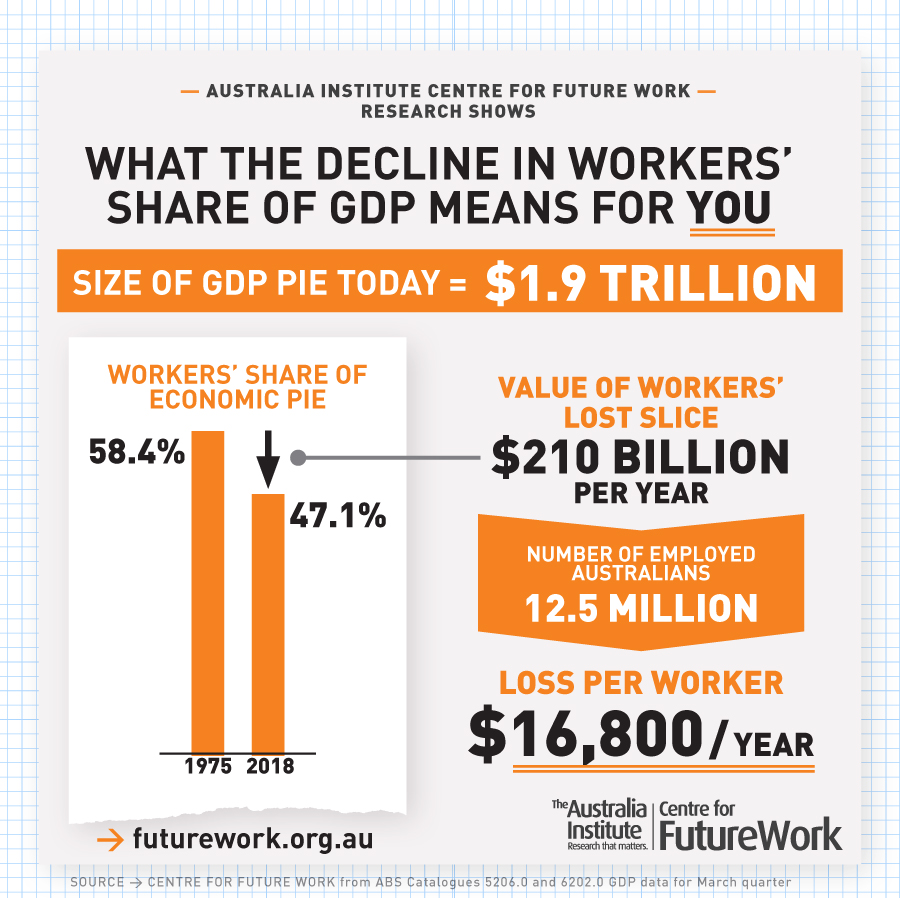
    This infographic summarises the bottom-line impact on average wage incomes for Australian workers.

    Labour Share Infographic

    In the March quarter of 2018, labour income (in wages, salaries, and superannuation contributions) accounted for 47.1% of total GDP. That is down over 11 percentage points from the peak labour share (over 58%) recorded in the same quarter of 1975. The loss of that share of GDP, given total output today, is equivalent to a redirection of some $210 billion in annual income – and the research symposium showed that almost all of that income was captured in the form of higher company profits (especially in the financial sector). If it were divided equally amongst all employed Australians, that lost income share translates into foregone income of close to $17,000 per worker.

    Many thanks to Anna Chang for her creative work on the infographic!

    The research symposium highlighted several factors that have caused the long-run shift in income distribution from workers to the business sector, and resulting growth in personal income inequality in Australia. Key factors included the erosion of union representation and collective bargaining, inadequate minimum wages, and the growing power of the financial sector.  For more details, see the articles by Jim Stanford, David Peetz, Margaret Mackenzie, Shaun Wilson, and Frances Flanagan.

    The post Infographic: The Shrinking Labour Share of GDP and Average Wages appeared first on The Australia Institute's Centre for Future Work.

  • Four Views on Basic Income, Job Guarantees, and the Future of Work

    The unprecedented insecurity of work in Australia’s economy – with the labour market buffeted by technology, globalisation, and new digital business models – has sparked big thinking about policies for addressing this insecurity and enhancing the incomes and well-being of working people. Two ideas which have generated much discussion and debate are proposals for a basic income (through which all adults would receive an unconditional minimum level of income whether they were employed or not) and a job guarantee (whereby government would ensure that every willing worker could be employed in some job, such as public works or public services, thus eliminating involuntary unemployment).

    Progressives have campaigned for generations for stronger income security programs and for a commitment to full employment by government. So these ideas have a long pedigree. However, there is great discussion over both the implementation and cost of these proposals, and their broader (and perhaps unintended) economic and political consequences.

    To shed some additional, constructive perspective on these proposals, we are pleased to present four short commentaries on basic income, job guarantees, and the future of work by four leading Australian experts on the economics and politics of work.

    The four commentaries are posted below in alphabetical order of their authors:

    • Dr. Frances Flanagan, Research Director, United Voice: The Policy and Politics of Basic Income: A Few Concerns
    • Troy Henderson, Economist, Centre for Future Work: Situating Basic Income and a Job Guarantee in a Hierarchy of Pragmatic-Utopian Reform
    • Dr. Ben Spies-Butcher, Dept. of Sociology, Macquarie University: Basic Income as a Progressive Priority
    • Dr. Jim Stanford, Economist and Director, Centre for Future Work: Work, Technology, and Basic Income: Issues to Consider

    Three of the commentaries (by Flanagan, Henderson, and Spies-Butcher) were initially presented to the recent “Reboot the Future” conference in Sydney, hosted by Greens NSW Political Education Trust. The authors expanded and edited their remarks for the purposes of this symposium. We thank the organisers for their cooperation. The fourth commentary (by Stanford) arose from recent discussions within the Centre for Future Work’s voluntary Advisory Committee. Together, we think these nuanced commentaries add valuable perspective to these important but complex policy debates.

    Our publication of these commentaries coincides with this week’s annual General Assembly of the Basic Income Earth Network (BIEN), being held this year at the University of Tampere in Finland. In a personal capacity, Centre for Future Work economist Troy Henderson is presenting at the Assembly on his Ph.D. research regarding the fiscal and labour market impacts of basic income.

    We will continue to consider the advantages and disadvantages of both these important policy proposals in future research and commentary. We thank the authors for their contributions to this discussion, and welcome further feedback!

    The post Four Views on Basic Income, Job Guarantees, and the Future of Work appeared first on The Australia Institute's Centre for Future Work.

  • Possibly Surprising Insights on the Future of Work

    His presentation was “5 Possibly Surprising Insights on the Future of Work”.

    More detail on the issues raised in his presentation is provided in the Centre’s recent submission to the Senate Inquiry on the Future of Work and the Future of Workers.

    The post Possibly Surprising Insights on the Future of Work appeared first on The Australia Institute's Centre for Future Work.

  • Centre for Future Work at ACTUCongress18

    Come and check out our information booth in the exhibitors’ area: meet our staff, learn more about our work, and sign up for updates.

    Our Director Jim Stanford will be presenting as part of a session on The Future of Work (good title!), Tuesday July 17 at 2:15 pm in conference room P1.

    And we will be distributing copies of a brochure with links to some of our most recent research (attached below).

    We are glad that our research can support the campaign to #ChangeTheRules!

    The post Centre for Future Work at #ACTUCongress18 appeared first on The Australia Institute's Centre for Future Work.

  • Advanced Skills for Advanced Manufacturing

    Australia’s manufacturing industry is at a crossroads. After years of decline, the sector has finally found a more stable economic footing, and many indicators point to an expansion in domestic manufacturing in the coming years. Manufacturing added almost 50,000 new jobs in the last year – making it one of the most important sources of new work in the whole economy.

    However, one key factor that could hold back that continuing recovery is the inability of Australia’s present vocational education and training system, damaged by years of underfunding and failed policy experimentation, to meet the needs of manufacturing for highly-skilled workers. The skills challenge facing manufacturing is all the more acute because of the transformation of the sector toward more specialised and disaggregated advanced manufacturing processes. This naturally implies greater demand for highly-trained workers, in all its occupations: production workers, licensed trades, technology specialists, and managers.

    To sustain the emerging turnaround in manufacturing, the sector has an urgent need for a concerted and cooperative effort to strengthen vocational education and training. This report contributes to that process: by cataloguing the emerging skills challenges facing manufacturing, reviewing the failures of the existing approach to vocational education in this sector (and across Australia’s economy as a whole), and proposing twelve key principles for reform.

    This report, by Dr. Tanya Carney and Dr. Jim Stanford, was prepared by the Centre for Future Work for the Second Annual National Manufacturing Summit. The Summit, held at Parliament House on 26 June 2018, will gather leading representatives from all major stakeholders in Australia’s manufacturing sector: business, unions, universities, the financial sector, suppliers and government. They will consider the industry’s prospects and identify promising, pragmatic policy measures to support a sustained industrial turnaround. It is a highly appropriate forum at which to begin a discussion about multi-partite efforts to rebuild vocational education and address the looming skills challenges facing manufacturing.

    The post Advanced Skills for Advanced Manufacturing appeared first on The Australia Institute's Centre for Future Work.